Introduction
Compulsive hoarding is characterized by (a) acquisition and failure to discard a large number of possessions; (b) clutter that precludes activities for which living spaces were designed; and (c) significant distress or impairment in functioning caused by the hoarding (Frost & Hartl, Reference Frost and Hartl1996). Hoarding has been associated with impairment in activities of daily living (Frost et al. Reference Frost, Steketee, Williams and Warren2000), substantial health risks (Steketee et al. Reference Steketee, Frost and Kim2001), and marked occupational and role impairment (Tolin et al. Reference Tolin, Frost, Steketee, Gray and Fitch2007).
Although commonly considered a subtype or dimension of obsessive–compulsive disorder (OCD), a large percentage of individuals who hoard display no other OCD symptoms (Frost et al. Reference Frost, Steketee, Tolin and Brown2006), and hoarding may be as prevalent in patients with other anxiety disorders as it is in patients with OCD (Meunier et al. Reference Meunier, Tolin, Frost, Steketee and Brady2006). Factor and cluster analyses indicate that hoarding consistently emerges as a distinct symptom type (see Calamari et al. Reference Calamari, Wiegartz, Riemann, Cohen, Greer, Jacobi, Jahn and Carmin2004, for a review). Although various OCD symptoms seem to be closely related to one another, hoarding does not seem to be particularly closely associated with OCD and is just as closely related to depression as to OCD (Wu & Watson, Reference Wu and Watson2005). In addition, studies of treatment outcome by symptom subtype have largely shown hoarding symptoms to predict poor outcome for standard OCD treatments using medication and exposure with response prevention (Mataix-Cols et al. Reference Mataix-Cols, Marks, Greist, Kobak and Baer2002; Abramowitz et al. Reference Abramowitz, Franklin, Schwartz and Furr2003; Steketee & Frost, Reference Steketee and Frost2003), suggesting that compulsive hoarding and OCD may involve different biological, cognitive or behavioral mechanisms.
Hoarding behavior is thought to result in part from problems in decision making (Frost & Hartl, Reference Frost and Hartl1996; Steketee & Frost, Reference Steketee and Frost2003; Frost & Tolin, Reference Frost, Tolin, Taylor, Abramowitz and and McKay2008). Research using the Iowa Gambling Task (Bechara et al. Reference Bechara, Damasio, Tranel and Damasio1997), which requires participants to sacrifice immediate rewards to maximize long-term gain, shows that OCD patients with hoarding symptoms perform more poorly than do OCD patients without hoarding symptoms (Lawrence et al. Reference Lawrence, Wooderson, Mataix-Cols, David, Speckens and Phillips2006). This result was not replicated in a separate study (Grisham et al. Reference Grisham, Brown, Savage, Steketee and Barlow2007), although hoarding participants were noted to exhibit problems of impulsivity and inattention on standard neuropsychological tests. One possible explanation for the discrepancy between these two studies is the fact that Lawrence et al. (Reference Lawrence, Wooderson, Mataix-Cols, David, Speckens and Phillips2006) included only OCD patients (with and without hoarding symptoms) whereas Grisham et al. (Reference Grisham, Brown, Savage, Steketee and Barlow2007) sampled primary hoarding patients, 43% of who reported no other symptoms of OCD.
When asked to sort their possessions into categories, individuals with hoarding problems took more time, reported more anxiety and created a greater number of categories than did OCD patients and healthy controls (Wincze et al. Reference Wincze, Steketee and Frost2007). Similar results were obtained using non-clinical volunteers who identified themselves as ‘packrats’ (Luchian et al. Reference Luchian, McNally and Hooley2007). Importantly, however, hoarding participants in the Wincze et al. study showed no difficulty sorting objects that did not belong to them. Problems of executive functioning have also been noted among individuals with kleptomania (Grant et al. Reference Grant, Odlaug and Wozniak2007), a condition that may overlap with hoarding in some respects.
Further complicating the decision-making process is the fact that individuals who hoard display maladaptive beliefs about their possessions, such as an exaggerated sense of emotional attachment to objects, memory-related concerns, responsibility for possessions, and desire for control over possessions (Steketee et al. Reference Steketee, Frost and Kyrios2003), as well as perfectionism and intolerance of uncertainty (Tolin et al. Reference Tolin, Brady and Hannan2008). These factors are thought to render the decision-making process aversive and cumbersome, resulting in behavioral and cognitive avoidance (Frost et al. Reference Frost, Kim, Morris, Bloss, Murray-Close and Steketee1998, Reference Frost, Steketee, Williams and Warren2000).
The phenomenological and behavioral data described above suggest possible abnormalities in frontal cortical regions and anterior cingulate cortex (ACC). Impaired functioning of prefrontal cortex (PFC) and orbitofrontal cortex (OFC), for example, could be associated with diminished capacity to plan, organize, inhibit impulses, and anticipate behavioral consequences (Bechara et al. Reference Bechara, Damasio, Damasio and Anderson1994; Rolls, Reference Rolls2004), as well as the diminished insight and self-awareness noted among individuals who hoard (Fitch et al. Reference Tolin, Frost, Steketee, Gray and Fitch2007). ACC abnormalities might account for the observed problems in motivation, executive control, focused attention and misdirected emotional attachment seen in hoarding patients (Devinsky et al. Reference Devinsky, Morrell and Vogt1995), as well as perfectionism, to the extent that this can be conceptualized as an erroneous sense of decisions being ‘wrong’ (Carter et al. Reference Carter, Braver, Barch, Botvinick, Noll and Cohen1998; Kiehl et al. Reference Kiehl, Liddle and Hopfinger2000; Maltby et al. Reference Maltby, Tolin, Worhunsky, O'Keefe and Kiehl2005).
Neuroimaging studies to date have broadly been consistent with the hypothesis that compulsive hoarding is associated with frontal cortical and ACC abnormality. Animal models of hoarding have implicated ACC (de Brabander et al. Reference de Brabander, de Bruin and van Eden1991). Three studies point to the neural underpinnings of compulsive hoarding in humans. In the first of these, resting positron emission tomography (PET) showed lower glucose metabolism in posterior cingulate and cuneus among hoarding patients (n=12) compared to healthy controls (n=17), and lower glucose metabolism in dorsal ACC compared to OCD patients (n=33) (Saxena et al. Reference Saxena, Brody, Maidment, Smith, Zohrabi, Katz, Baker and Baxter2004). In the second study, functional magnetic resonance imaging (fMRI) was used with OCD patients (n=16) and healthy controls (n=17) during washing-, checking- and hoarding-related imaginal symptom provocation. For the hoarding provocation, participants were shown pictures of items, and were asked to imagine that they owned the items and would have to throw them away. During this task, OCD patients showed greater hemodynamic activity in left precentral gyrus and right medial OFC than did controls (Mataix-Cols et al. Reference Mataix-Cols, Wooderson, Lawrence, Brammer, Speckens and Phillips2004). It is unclear, however, how these results would extend to compulsive hoarding populations because the study assessed the effects of viewing hoarding-related stimuli in patients with OCD, most of whom did not report high levels of compulsive hoarding symptoms. Finally, MRI was used with 63 adult patients with focal brain lesions. Nine of these patients reported the onset of excessive and impairing collecting and saving behavior (that topographically seems to resemble compulsive hoarding) following the onset of the neurological condition. Lesion locations among these nine patients differed from those of the 54 lesion patients who did not show such behaviors mainly in right mesial PFC, extending to ACC (Anderson et al. Reference Anderson, Damasio and Damasio2005).
The aim of the present pilot study was to explore whether the neural regions of interest derived from previous research (Mataix-Cols et al. Reference Mataix-Cols, Wooderson, Lawrence, Brammer, Speckens and Phillips2004; Saxena et al. Reference Saxena, Brody, Maidment, Smith, Zohrabi, Katz, Baker and Baxter2004) differentiate hoarding and non-hoarding participants during a decision-making task in which participants make actual, real-time decisions about whether to keep or discard their possessions. It was predicted that when making decisions about their own possessions, hoarding participants would show increased hemodynamic activity in OFC, PFC and ACC compared to control participants. No such differences were predicted when making decisions about control items that participants did not own, given the apparent absence of decision-making impairments for non-owned items (Wincze et al. Reference Wincze, Steketee and Frost2007). Because of the exploratory nature of this study, whole-brain analyses were also conducted to generate hypotheses for future research.
Method
Participants
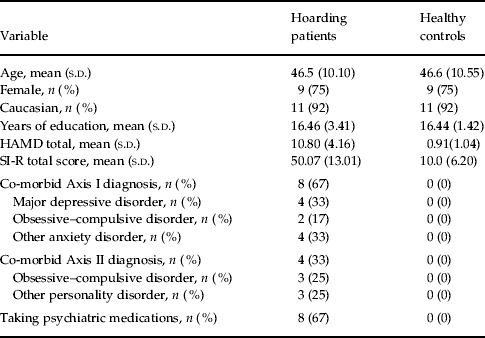
Twelve adult patients with compulsive hoarding and 12 matched healthy controls participated in the study and provided written informed consent. Table 1 presents demographic and clinical characteristics of the sample. All assessments were conducted by a doctoral-level psychologist with experience in the evaluation of compulsive hoarding, OCD and anxiety disorders. Consistent with previous research (Saxena et al. Reference Saxena, Brody, Maidment, Smith, Zohrabi, Katz, Baker and Baxter2004), participants were classified as having compulsive hoarding if they met the clinical criteria for compulsive hoarding outlined by Frost & Hartl (Reference Frost and Hartl1996), hoarding was their primary diagnosis as assessed by the evaluator, and the clinician's global impairment rating was ‘moderately ill’ or above. Where there were questions about the severity of compulsive hoarding, symptom severity was confirmed by a home visit or analysis of current photographs of living space. Compulsive hoarding participants were excluded if they had a history of psychotic disorder, neurologic disorder, substance abuse, or serious suicidal ideation, or if compulsive hoarding was not their primary diagnosis. Concurrent major depressive disorder was allowed as long as it was not the primary diagnosis, given the high level of co-morbidity between hoarding and depression (Frost et al. Reference Frost, Steketee, Tolin and Brown2006). Four of the compulsive hoarding participants were diagnosed with major depressive disorder, two with OCD, and four with other anxiety disorders; four also met criteria for a personality disorder. Most of the sample (67%) were taking psychiatric medications [selective serotonin (SSRIs) or serotonin norepinephrine (SNRIs) reuptake inhibitors]. None of the participants were taking high-potency benzodiazepines. Healthy controls were excluded if they met criteria for a current or past Axis I or Axis II disorder, had a history of neurological disorders, or were taking psychiatric medications.
Demographic and symptom information

HAMD, Hamilton Rating Scale for Depression; SI-R, Saving Inventory – Revised; s.d., standard deviation.
Percentages of co-morbid conditions sum to greater than 100% because some participants were diagnosed with multiple conditions.
Measures
Diagnostic status was determined using the Structured Clinical Interview for DSM-IV Axis I Disorders (SCID-I; First et al. Reference First, Spitzer, Gibbon and Williams1995) and the Structured Clinical Interview for DSM-IV Personality Disorders (SCID-II; First et al. Reference First, Spitzer, Gibbon and Williams1997). Severity of compulsive hoarding symptoms was established using the Saving Inventory – Revised (SI-R; Frost et al. Reference Frost, Steketee and Grisham2004). Symptom criteria for compulsive hoarding were established using the symptom checklist of the Yale–Brown Obsessive–Compulsive Scale (YBOCS; Goodman et al. Reference Goodman, Price, Rasmussen, Mazure, Fleischmann, Hill, Heninger and Charney1989) as well as the Hoarding Rating Scale – Interview (HRS-I; Tolin et al., unpublished observations), which contains interviewer ratings of clutter, difficulty discarding, and acquisition from 0 (none) to 8 (extreme). Severity of depression was assessed using the Hamilton Rating Scale for Depression (HAMD; Hamilton, Reference Hamilton1960). Global impressions of illness severity were recorded using the Clinician's Global Impression (CGI; Guy, Reference Guy1976) scale. Subjective anxiety during the fMRI task was rated by participants on a scale from 0 (none) to 3 (extreme) by button-press.
Materials
The discarding task was designed to assess hemodynamic activity associated with successful and unsuccessful decisions to discard personal possessions and control items. For this task, we selected three different sets of stimuli to be discarded and destroyed:
(1) Paper items (e.g. junk mail, newspapers) that belonged to the participants. Because compulsive hoarding participants have difficulty discarding ordinary possessions, we matched these items by type (e.g. junk mail, newspapers) rather than by emotional valence. Thus, compulsive hoarding participants were instructed to bring to the scanner session paper items meeting these criteria that they would normally have difficulty discarding. Healthy controls were instructed to bring to the scanner session the same types of paper items but without the restriction that they have difficulty discarding the items. We refer to these items as Participant's Possessions (PP). These items were placed in a clear plastic bin on the right or left (counterbalanced) visual field. The bin was labeled with the participant's first name.
(2) Comparable paper items that did not belong to the participant. The research team saved their junk mail and old newspapers for a period of approximately 6 months. For each participant, we selected items that were roughly the same amount, size and type as the participant's items. We refer to these items as Experimenter's Possessions (EP). These items were placed in a separate clear plastic bin on the opposite side of the visual field from the PP. This bin was labeled with the experimenter's first name.
(3) Because of the possibility that participants would decline to discard a PP or an EP, we wanted to insure that any observed differences in hemodynamic response were not simply due to the visual stimulus of seeing an item being destroyed. Therefore, next to the PP and EP bins, we placed two clear plastic bins containing red pieces of blank paper that would be discarded and destroyed if the participant declined to discard a PP or an EP item. We refer to these items as Neutral Stimuli (NS).
The four clear plastic bins (PP, NS, EP, NS) were arranged on a table in front of a plain background, with the left/right location of the PP and EP bins counterbalanced. In the middle of a table was placed a document shredder that had been modified by removing the front cover so that items placed in the shredder could be seen clearly as they were being destroyed. A video camera was placed in front of the materials. Once in the scanner, participants viewed a live video feed of the apparatus that was rear-projected to an opaque screen mounted at the top of the bore of the magnet. Fig. 1 presents the layout of the materials as seen from the participant's perspective while in the scanner.
Apparatus as seen from the participant's perspective while in the scanner. In this picture, the experimenter is holding up a Participant's Possession (PP, right hand) and a Neutral Stimulus (NS, left hand). Experimenter's Possessions (EP) and their accompanying NS are on the experimenter's left. The shredder is in the center of the picture.

Apparatus
Imaging was implemented on a Siemens 3T Allegra scanner. The Allegra is a high-performance head-dedicated system optimized for functional brain imaging. Head motion was restricted using a custom-built apparatus that interfaced with the head coil. Functional image volumes were collected with an echo planar imaging (EPI) gradient-echo pulse sequence [TR/TE 1500/28 ms, flip angle 65°, field of view (FOV) 24×24 cm, 64×64 matrix, 3.4×3.4 mm in plane resolution, 5 mm slice thickness, 29 slices] that effectively covers the entire brain (145 mm) in 1.5 s. The thin slices and short TE make the Allegra optimal for examining orbitofrontal activity.
Procedure
All study procedures were approved by the Institutional Review Board at Hartford Hospital. Participants gave written informed consent prior to the study. After being placed in the scanner and being given sufficient time to habituate to the environment, participants were alternately presented with PP/NS or EP/NS pairs through a live video feed and asked to make the decision of whether to discard the PP and EP items. The experimenter's presentation of each PP/NS or EP/NS pair served as the participant's cue to make the decision to shred that item. Participants were given 8 s to make this decision and to indicate their decision (keep versus shred) by button-press. The experimenter was cued by computer to either place the PP/EP item in the shredder (upon button-press) or to place the PP/EP item to the side and instead place the paired NS in the shredder (at 8 s, if the participant did not press the discard button). Once placed in the shredder, the items were visibly destroyed. Participants completed six blocks for each PP/NS or EP/NS pair. Each block lasted 24 s and consisted of three repetitions of each PP/NS or EP/NS pair.
Image processing
Functional images were reconstructed offline and reoriented to approximately the anterior commissure/posterior commissure (AC/PC) plane. The two functional image runs were realigned using INRIAlign, a motion correction algorithm unbiased by local signal changes (Freire & Mangin, Reference Freire and Mangin2001; Freire et al. Reference Freire, Roche and Mangin2002), spatially normalized using custom linear and non-linear algorithms (Friston et al. Reference Friston, Ashburner, Frith, Poline, Heather and Frackowiak1995), smoothed, and analyzed in standard MNI space using Statistical Parametric Mapping (SPM2). Event-related responses were modeled using a synthetic hemodynamic response function composed of a single gamma function that modeled the hemodynamic response using a peak latency of 6 s. The modeled hemodynamic response for each run was derived by constructing a sequence of appropriately located synthetic responses for stimulus of interest. A 256-Hz high-pass filter was incorporated into the model to remove noise associated with low-frequency confounds (e.g. respiratory artifact). All images were normalized to a mean of 100 (arbitrary units) for each run to compensate for any intensity variations across runs.
For both groups, contrasts were specified on an individual subject basis that evaluated the effects of deciding to discard PP items relative to the baseline of discarding EP items, using images acquired during the 8-s decision-making period. Second-order movement parameters, the square of those generated from INRIAlign, were regressed out for each individual subject contrast. The images containing these amplitudes were then entered into the second-level analyses (i.e. random effects analyses). Between-group comparisons were also entered into analyses of covariance (ANCOVAs) for compulsive hoarding participants having greater activation than healthy controls and for controls having greater activation than hoarding participants, both with HAMD scores as a covariate. Because of the exploratory nature of the present study, for all analyses a statistical threshold of p<0.01 with eight contiguous voxels was used, and small volume correction (SVC) for the regions of interest found in previous research (Mataix-Cols et al. Reference Mataix-Cols, Wooderson, Lawrence, Brammer, Speckens and Phillips2004; Saxena et al. Reference Saxena, Brody, Maidment, Smith, Zohrabi, Katz, Baker and Baxter2004) was not conducted.
Results
Behavioral data
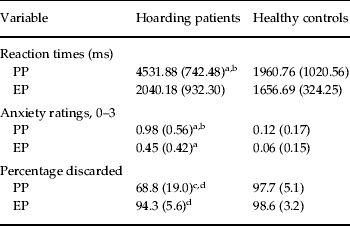
Table 2 presents reaction times during successful decisions to discard PP and EP items, subjective anxiety during the discarding task, and the percentage of refusals to discard PP and EP items for each group. As can be seen, compulsive hoarding participants responded differentially to PP versus EP items, whereas healthy controls did not. A 2 (group: hoarder, healthy)×2 (possession type: PP, EP) mixed-factor analysis of variance (ANOVA) yielded a significant main effect of group [F(1, 19)=41.81, p<0.001], a significant main effect of possession type [F(1, 19)=28.06, p<0.001], and a significant interaction [F(1, 19)=17.18, p=0.001]. Follow-up within-group analyses indicated that compulsive hoarding participants took significantly longer to decide to discard PP items than EP items (t 9=5.87, p<0.001); there was no such difference for healthy controls (t 10=0.94, p=0.369). Comparing the two groups, compulsive hoarding participants took significantly longer than did healthy controls in deciding whether to discard PP items (t 19=6.54, p<0.001) but did not differ in the time it took them to decide whether to discard EP items (t 19=1.28, p=0.214).
Reaction times, subjective anxiety ratings, and percentage discarded when deciding whether to discard Participant's Possessions (PP) and Experimenter's Possessions (EP)

a Hoarding patients>healthy controls, p<0.05.
b PP>EP, p<0.05.
c EP>PP, p<0.05.
d Hoarding patients<healthy controls, p<0.05.
Next, a 2 (group: hoarder, healthy)×2 (possession type: PP, EP) mixed-factor ANOVA of mean anxiety ratings (0–3) during the decision-making task yielded a significant main effect of group [F(1, 19)=22.30, p<0.001], a significant main effect of possession type [F(1, 19)=12.82, p=0.002], and a significant interaction [F(1, 19)=8.05, p=0.011]. Follow-up between-group analyses indicated that compulsive hoarding participants reported significantly greater anxiety than did healthy controls when deciding to discard both PP items (t 19=4.90, p<0.001) and EP items (t 19=2.92, p=0.009). Hoarding participants reported greater subjective anxiety when making decisions about whether to discard PP items than EP items (t 9=3.20, p=0.011). No difference in anxiety ratings between PP and EP items was observed for healthy controls (t 10=1.29, p=0.226). Pearson correlations of behavioral data with the HRS-I in hoarding participants indicated that subjective anxiety about discarding EP items was more strongly associated with acquisition (r=0.30) than with clutter (r=0.15) or difficulty discarding (r=0.25), although this correlation was not significant.
Finally, a 2 (group: hoarder, healthy)×2 (possession type: PP, EP) mixed-factor ANOVA of rates of discarding versus keeping items yielded a significant main effect of group [F(1, 19)=25.59, p<0.001], a significant main effect of possession type [F(1, 19)=16.63, p=0.001], and a significant interaction [F(1, 19)=14.63, p=0.001]. Follow-up within-group analyses indicated that compulsive hoarding participants discarded significantly fewer PP items than EP items (t 9=3.98, p=0.003); there was no such difference for healthy controls (t 10=0.41, p=0.692). Comparing the two groups, compulsive hoarding participants discarded significantly fewer PP items than did healthy controls (t 19=4.86, p<0.001); they also discarded significantly fewer EP items than did healthy controls (t 19=2.15, p=0.045). Pearson correlations indicated that the percentage of PP items discarded was more strongly associated with HRS-I difficulty discarding (r=−0.54) than with clutter (r=0.06) or acquisition (r=−0.01) in the hoarding participants. Thus, the behavioral data suggest that the discarding task was a successful analogue of hoarding behaviors in that compulsive hoarding participants had selective difficulty discarding their own possessions whereas healthy controls did not.
fMRI results
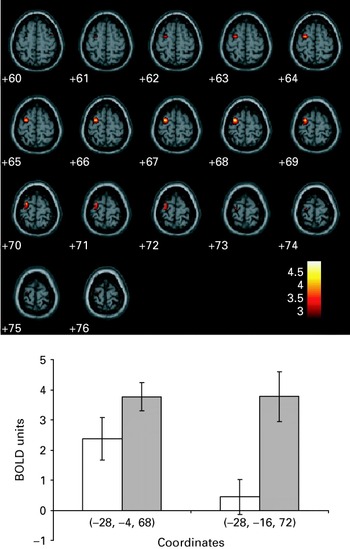
Because compulsive hoarding is associated with depression (Frost et al. Reference Frost, Steketee, Williams and Warren2000), we used an ANCOVA, with HAMD scores as the covariate, for between-group analyses of the hemodynamic response. Examining activation during PP decisions versus baseline (see Fig. 2), hoarding participants did not show greater activity than did healthy controls in any regions. However, healthy controls showed greater hemodynamic activity than did hoarding participants in the left superior frontal gyrus (−28, −4, 68) and the left precentral gyrus (the latter region possibly reflecting the decreased button-pressing in this condition as described in Behavioral data above) [−28, −16, 72 (Brodmann 6)].
Areas of significantly decreased hemodynamic activity for compulsive hoarding participants (□) versus healthy controls ( ) while deciding whether to discard Participant's Possessions (PP) versus baseline. Image is thresholded at p<0.01.

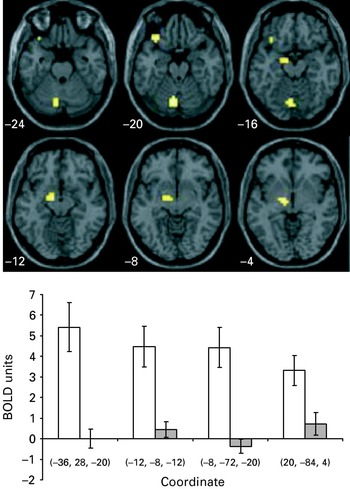
Next, we examined activation during PP decisions versus EP decisions (see Fig. 3). Group differences in the hemodynamic response were confined to the left hemisphere. Compulsive hoarding participants exhibited excessive activation in left lateral OFC [MNI coordinates −36, 28, −20 (Brodmann 47)], left amygdala and parahippocampal gyrus extending into thalamus (−12, −8, −12), and left cerebellum (−8, −72, −20) (p<0.01) when compared to healthy controls. Healthy controls exhibited greater hemodynamic response than did compulsive hoarding participants only in the right lingual gyrus (20, −84, 4) (p<0.01).
Areas of significantly increased hemodynamic activity for compulsive hoarding participants (□) versus healthy controls ( ) while deciding whether to discard Participant's Possessions (PP) versus Experimenter's Possessions (EP). Image is thresholded at p<0.01.

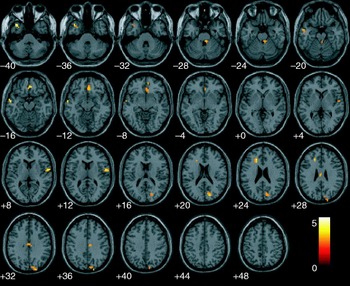
We also analyzed events where compulsive hoarding participants refused to discard PP items. This analysis was limited to compulsive hoarding participants because healthy controls did not refuse to discard their own possessions at rates that could be analyzed. For this contrast, we examined the hemodynamic response during events where compulsive hoarding participants refused to discard PP items when compared to successful decisions to discard PP items, again controlling for HAMD scores. Refusal to discard PP items (see Fig. 4) was associated with greater hemodynamic activity in superior temporal gyrus [−40, 16, −40 (Brodmann 38)], middle temporal gyrus (−56, −4, −16), medial frontal gyrus [4, 40, −16 (Brodmann 11)], anterior cingulate extending to OFC (−20, 32, 24), precentral gyrus [60, 0, 8 (Brodmann 6)], and cerebellum (8, −36, −28; 16, −80, 20) (p<0.01); the latter finding was largely inside the ventricle and therefore probably an artifact. Non-significant activation was also seen in the cuneus.
Areas of significant activation for compulsive hoarding participants when refusing to discard Participant's Possessions (PP) versus successful decisions to discard PP. Image is thresholded at p<0.01.

Correlations with measures of symptom severity for compulsive hoarding participants
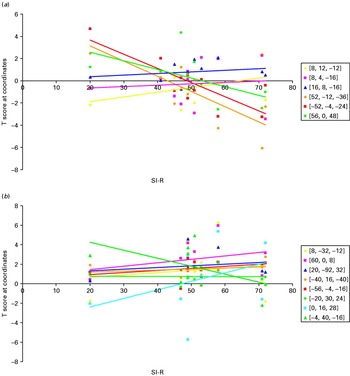
Pearson product moment correlations were calculated between compulsive hoarding symptom severity, as measured by the SI-R, and the hemodynamic response during decisions to discard PP items and refusals to discard PP items, controlling for depression as measured by the HAMD. During successful decisions to discard PP items, compulsive hoarding symptom severity was positively associated with hemodynamic response in subcallosal gyrus (8, 12, −12) [8, 4, −16 (Brodmann 34)], (16, 8, −16) and negatively associated with hemodynamic response in right inferior temporal gyrus [52, −12, −36 (Brodmann 20)], left middle temporal gyrus [−52, −4, −24 (Brodmann 21)], and right precentral gyrus (56, 0, 48). We examined whether these regions (and the 10 mm regions surrounding them) differentiated hoarding from healthy participants; only inferior temporal gyrus was less active in hoarding participants than in healthy controls.
During refusals to discard PP items, compulsive hoarding symptom severity was positively associated with hemodynamic response in globus pallidus (−16, 0, −8), lingual gyrus (16, −64, −12), and left cerebellum (−36, −64, −16). There were no areas of negative association for this contrast. We examined whether these regions (and the 10 mm regions surrounding them) differentiated hoarding from healthy participants; globus pallidus and lingual gyrus (but not cerebellum) showed greater activity in hoarding versus healthy participants. Scatterplots for these relationships are shown in Fig. 5.
Scatterplots of correlations between hoarding severity (Saving Inventory – Revised, SI-R) and neural regions of interest during (a) successful decisions to discard Participant's Possessions (PP) and (b) refusals to discard PP.

Discussion
We found excessive hemodynamic activity in lateral OFC, a region that is associated with processing relative reward value, particularly values that are experienced as punishing (Kringelbach & Rolls, Reference Kringelbach and Rolls2004; Kringelbach, Reference Kringelbach2005). Increased OFC activity may also be associated with greater emotional engagement in affective decision making (Northoff et al. Reference Northoff, Grimm, Boeker, Schmidt, Bermpohl, Heinzel, Hell and Boesiger2006). This finding is broadly consistent with the theory that hoarding behavior stems, in part, from abnormalities in the decision-making process (Frost & Hartl, Reference Frost and Hartl1996; Steketee & Frost, Reference Steketee and Frost2003; Frost & Tolin, Reference Frost, Tolin, Taylor, Abramowitz and and McKay2008); the finding of increased hemodynamic response in lateral OFC may reflect hoarding patients' greater sense that discarding low absolute worth personal possessions is punishing. It remains unclear whether hoarding patients show a general deficit in decision-making capacity, or whether decision-making impairment is limited to personally relevant possessions. As described previously, research on this topic has yielded mixed results (Lawrence et al. Reference Lawrence, Wooderson, Mataix-Cols, David, Speckens and Phillips2006; Grisham et al. Reference Grisham, Brown, Savage, Steketee and Barlow2007), and more research is needed.
Patterns of hemodynamic activity observed in healthy controls are also generally consistent with those from a healthy volunteer study in which participants imagined discarding possessions and exhibited hemodynamic activity in prefrontal regions that did not differ from activity associated with normally aversive tasks (Mataix-Cols et al. Reference Mataix-Cols, Cullen, Lange, Zelaya, Andrew, Amaro, Brammer, Williams, Speckens and Phillips2003).
One potential limitation of the present study is the fact that decisions about whether to keep versus discard items were interspersed with the shredding of items, raising the possibility that the neural mechanisms of decision making were confounded by an aversive response to seeing items discarded and shredded. Although images were acquired during the 8-s decision-making process, because of the sequence of events (decide, discard, decide, discard, etc.) it is possible that neural activity during decision making could include some carryover effects of the discarding and shredding procedure. Future studies should increase the temporal separation of these two events to clarify whether the obtained results are specific to the decision-making process. It would also be helpful for future research to compare neural decision-making processes with neuropsychological indices of impaired decision making.
Also consistent with the notion of difficulty in the decision-making process is the finding of greater activity in left parahippocampal gyrus in hoarding versus control participants. Activity in this region is also associated with effortful memory search and retrieval (Gur et al. Reference Gur, Ragland, Mozley, Mozley, Smith, Alavi, Bilker and Gur1997; Maguire & Mummery, Reference Maguire and Mummery1999), including memory for the associative properties of objects (Yonelinas et al. Reference Yonelinas, Hopfinger, Buonocore, Kroll and Baynes2001). The left parahippocampal gyrus has also been associated with the processing of unpleasant emotions (Lane et al. Reference Lane, Reiman, Bradley, Lang, Ahern, Davidson and Schwartz1997); the difference between groups does not seem to be solely attributable to depression, which was covaried in the present analyses. Relatedly (although not expected), when examining activation during PP decisions versus baseline (rather than EP decisions), hoarding participants showed reduced activity in left superior frontal gyrus compared to healthy controls. The left superior frontal gyrus has been associated with working memory, particularly with more challenging tasks (du Boisgueheneuc et al. Reference du Boisgueheneuc, Levy, Volle, Seassau, Duffau, Kinkingnehun, Samson, Zhang and Dubois2006); suppression of activity in superior frontal gyrus may reflect impaired capacity for self-reflection due to cognitive demand (Goldberg et al. Reference Goldberg, Harel and Malach2006).
Refusals to discard possessions might provide the closest approximation to actual hoarding behaviors. The strength of conclusions that can be drawn from this analysis is limited by the fact that healthy controls refused to discard only a very small number of items, precluding between-group comparisons. For compulsive hoarding participants, refusal to discard personal possessions was associated with increased hemodynamic response, compared to control items, in middle frontal gyrus extending into rostral ACC, a region associated with effortful learning and problem solving, error detection, motivation, and modulation of emotional responses (Devinsky et al. Reference Devinsky, Morrell and Vogt1995; Carter et al. Reference Carter, Braver, Barch, Botvinick, Noll and Cohen1998; Bush et al. Reference Bush, Luu and Posner2000; Kiehl et al. Reference Kiehl, Liddle and Hopfinger2000; Allman et al. Reference Allman, Hakeem, Erwin, Nimchinsky and Hof2001; Polli et al. Reference Polli, Barton, Cain, Thakkar, Rauch and Manoach2005). Thus, ACC abnormalities might reflect the excessive emotional attachment and exaggerated concerns about making the wrong decision reported by individuals with compulsive hoarding. It is noted that hoarding participants refused to discard only 31% of their personal possessions, raising questions of generalizability to actual hoarding situations. One possibility is that participants pre-sorted their possessions prior to the experiment, and did not bring in the most challenging items. Another possibility is that demand characteristics of the experiment increased participants' willingness to discard.
The present results differ from those obtained by Saxena et al. (Reference Saxena, Brody, Maidment, Smith, Zohrabi, Katz, Baker and Baxter2004), who observed lower glucose metabolism in posterior cingulate and cuneus when compared to healthy controls, and in dorsal ACC when compared to non-hoarding OCD patients. That study examined neural activity at rest, rather than during a decision-making challenge. One possible explanation for the discrepancy is a biphasic pattern of neural activity in compulsive hoarding, with decreased activity at rest but increased activity during decision making. Additional research is needed to clarify the time course of neural activity in compulsive hoarding. Mataix-Cols et al. (Reference Mataix-Cols, Wooderson, Lawrence, Brammer, Speckens and Phillips2004) found greater hemodynamic activity in left precentral gyrus and right medial OFC when participants with OCD (most of whom did not appear to suffer from significant hoarding symptoms) were asked to imagine discarding objects. The present finding of increased OFC and precentral activity during actual decision making might be consistent with those results, although the location of activity differed. Our results are also broadly consistent with animal models of hoarding suggesting the role of ACC (de Brabander et al. Reference de Brabander, de Bruin and van Eden1991) as well as hippocampus (Kolb, Reference Kolb1977) and globus pallidus (Mogenson & Wu, Reference Mogenson and Wu1988) in food-hoarding behavior.
Much of the significant hemodynamic activity in the present study was found in association cortex (e.g. parahippocampal regions, lingual gyrus), particularly temporal lobe (superior and middle temporal gyrus), and motor regions (e.g. cerebellum, precentral gyrus). These were unexpected findings and await clarification in a larger sample, although the motor findings might have been a methodological artifact; because participants pressed a button to signal an intent to discard an item, and refrained from pressing a button to signal an intent to keep an item, different responses might well have differentially recruited motor regions of the brain. Future work should use button-press for intent to keep, as well as discard, an item in order to rule out this potential confound.
The present findings may aid understanding of the refractory nature of compulsive hoarding. Individuals with this condition may find the act of deciding to discard personal possessions cognitively burdensome, punishing and aversive, and hence are likely to avoid such decisions in the future. Avoidance of decision making, in turn, leads to the continued accumulation of clutter, ultimately resulting in substantial functional impairment. Because the present results cannot distinguish the effects of compulsive hoarding from those of psychopathology more broadly (and it is noted again that the majority of the sample met criteria for at least one co-morbid psychiatric condition), future studies should use clinical control groups to differentiate the hemodynamic responses of hoarding patients from those of patients with other clinical conditions such as OCD. As only a minority of the present participants met criteria for non-hoarding OCD, it remains unclear whether individuals suffering from co-morbid OCD and hoarding would show similar patterns of neural activity.
Acknowledgments
This work was supported by Hartford Hospital grant 126083 (to N.M.) and NIMH grant R01 MH074934 (to D.F.T.).
Declaration of Interest
None.