Introduction
Until 2005,Reference Gentile 1 clinicians and researchers had focused their attention on a single aspect of the reproductive safety of psychotropic medications and, specifically, on the risk of structural teratogenicity. Nevertheless, progress in the field of perinatal psychiatry has suggested that in utero exposure to different classes of psychotropics may have long-term effects on infant development.Reference Gentile 2
However, currently, little is known about the potential neurobehavioral teratogenicity of antipsychotics. Despite the lack of specific safety data, during the last decades the use of second-generation antipsychotics (SGAs) has progressively increased in pregnant women diagnosed with different psychiatric disorders, including bipolar disorder, schizophrenia, unipolar depressive disorder, and other psychiatric disorders. Indeed, in the US there has been a 2.5-fold increase in the use of SGAs in pregnant women.Reference Toh, Li and Cheetham 3 In contrast, in this specific population of patients, the use of first-generation antipsychotics (FGAs) is progressively decreasing.Reference Toh, Li and Cheetham 3 However, nearly 0.5% of pregnancies are still exposed to FGAs.Reference Hanley and Mintzes 4 It is interesting to note that the proportion of pregnancies exposed to SGAs does not vary between countries, being about 2% of all pregnancies both in the USReference Toh, Li and Cheetham 3 – Reference Epstein, Bobo and Shelton 5 and in some Europen countries, such as Italy.Reference Barbui, Conti and Purgato 6
However, the neurobehavioral teratogenicity of both FGAs and SGAs is far from being established.Reference Gentile 7 Thus, assessing systematically all published information focused on investigating the neurobehavioral effects of antipsychotics in infants in utero exposed to such medications is the aim of this review.
Methods
Sources
PubMed, Scopus, and Google Scholar were searched for eligible articles.
Search strategy
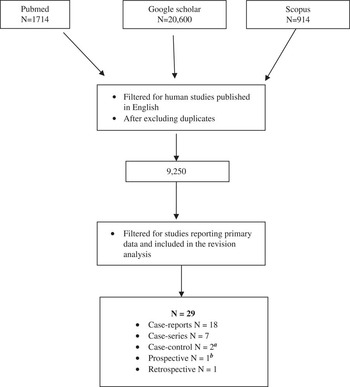
PubMed (1954 to April 2016) was searched using medical subject headings (MeSH): (“antipsychotic agents” [Pharmacological Action] OR “antipsychotic agents” [MeSH Terms] OR “neuroleptics” [All Fields]) (“antipsychotic” [All Fields] AND “agents” [All Fields]) OR “antipsychotic agents” [All Fields] OR “antipsychotics” [All Fields]) AND (“pregnancy” [MeSH Terms] OR “pregnancy” [All Fields]). The PubMed search results were also limited using the search filter for human studies published in English. Scopus and Google Scholar searches were filtered for article title (antipsychotics/neuroleptics, pregnancy). After excluding duplicates, 9,250 articles were identified.
Selection
Only articles that provided original/primary data on neurodevelopmental outcome in human offspring older than 4 months of age, independent of the study design, were selected for being reviewed. This age was selected as some relevant neurodevelopmental milestones are achieved at this time 8 (see Table 1).
Main neurodevelopmental milestones at 4 months of age 8

For those articles that did not specify to which antipsychotic the infants were exposed, we contacted the authors to obtain this information. Length of study and neurodevelopmental assessment methodology did not influence the of study selection process.
Twenty-nine articles met the inclusion criteria. Both authors searched, selected, and rated the studies independently. The retrieved articles were rated in accordance with the GRADE literature rating system (GRADE working group, update 2016). 9 Figure 1 shows a flow-chart detailing the study selection process.
Flow chart detailing the study selection process. a In one case-controlled, prospective study,Reference Peng, Gao and Ding 35 analyses designed to compare groups were performed for all enrolled infants (intent-to-treat analyses using the last observation carried forward method for missing data). The difference was considered statistically significant if a two-tailed P value was less than 0.05. b In a prospective study,Reference Johnson, LaPrairie, Brennan, Stowe and Newport 36 Pearson correlations, independent t-tests, 1-way analyses of variance, and χ 2 analyses tested associations between the dependent variables (Infant Neurological International Battery composite and habituation measures) and potential covariates. Analyses of covariance were performed to test study hypotheses. Multiple regression/partial correlation analyses were conducted to examine treatment duration effects within each exposure group, and post-hoc χ 2 analyses and logistic regression were conducted to further clarify group differences with respect to published clinical cutoffs. All results reflect 2-tailed tests.

Results
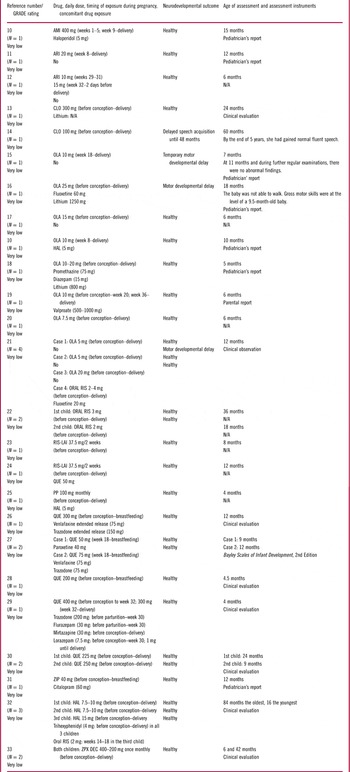
Case reports and case-series studies (see Table 2 )
Neurodevelopmental outcome following antenatal exposure to antipsychotics: case reports and case-series studies

AMI: amisulpride, ARI: aripiprazole, CLO: clozapine, OLA: olanzapine, RIS: risperidone, LAI: long-acting injections, PP: paliperidone palmitate, QUE: quetiapine, ZIP: ziprasidone, HAL: haloperidol, ZPX DEC: zuclopenthixol decanoate, N/A: data not available.
Amisulpride
Only one case is available on amisulpride.Reference Uguz 10 A 35-year-old woman diagnosed with schizophrenia had a history of 2 hospitalizations for acute exacerbation of psychotic symptoms. There were no current psychotic symptoms except residual transient reference thoughts for the last 5 years while she was taking combined therapy with amisulpride (400 mg/day) and aripiprazole (15 mg/day). The patient stopped the medication at the fifth gestational week. However, 1 month later, reference delusion relapsed. Thus, amisulpride, together with FGAs, were re-administered throughout pregnancy. The mother wished to breastfeed her baby, despite the fact that she continued the combined pharmacological treatment postpartum. No signs of neurodevelopmental delay were detected in the baby.
Aripiprazole
Two cases of neurodevelopmental outcome following aripiprazole exposure during pregnancy are available. The first case involved a woman diagnosed with schizoaffective disorder,Reference Mervak, Collins and Valenstein 11 and the second one involved a woman suffering from paranoid schizophrenia.Reference Mendhekar, Sharma and Srilakshmi 12 In both cases, the babies showed no neurodevelopmental problems.
Clozapine
Conflicting results are available on clozapine. Anecdotal reports describe healthy neurodevelopmental outcomes in infants born to schizophrenic mothers antenatally exposed to clozapine in combination with other psychotropic medicationsReference Stoner, Sommi, Marken, Anya and Vaughn 13 ; however, other clinical vignettes report selective neurodevelopmental delay, even in the case of very low dose exposure.Reference Mendhekar 14
Olanzapine
A relatively large amount of information is available on olanzapine. In one case, the exposed baby showed temporary neurodevelopmental problems.Reference Kirchheiner, Berghöfer and Bolk-Weischedel 15 In another case, the authors reported motor retardation in infants born to a mother with bipolar disorder who required polypharmacotherapy during pregnancy to maintain euthymic conditions. Of note, some pregnancy complications occurred, such as preterm birth and gestational diabetes.Reference Burt, Bernstein, Rosenstein and Altshuler 16 However, several cases of healthy outcome are available. The first one involved a 41-year-old woman diagnosed with paranoid schizophrenia at the age of 27 years.Reference Stiegler, Schaletzky and Walter 17 She was on olanzapine treatment for about 3 years when she became pregnant. The pregnancy proceeded without complications except for significant weight gain (64 to 88 kg at delivery). She continued to take the drug during breastfeeding, but the infant showed no signs of neurodevelopmental delay. A second case involved a 35-year-old patient with bipolar disorder. 9 The patient ceased any psychotropic medication when she became aware of her pregnancy. However, at week 8 she was hospitalized because of the occurrence of a manic episode; she was therefore successfully treated with olanzapine and FGAs. The mother wished to breastfeed her baby, despite the fact that she continued pharmacological treatment postpartum. No signs of neurodevelopmental delay were detected in the baby. Other cases with healthy developmental outcomes were described in a baby born to a woman diagnosed with bipolar I disorder, despite the fact that the neonate had suffered from severe hypoglycemia after birth;Reference Rowe, Gowda, Taylor, Hannam and Howard 18 in a baby antenatally exposed to olanzapine and “classic” mood stabilizing agentsReference Ifteni, Moga, Burtea and Correll 19 ; and in a baby born to a mother with schizoaffective disorder exposed in utero to olanzapine monotherapy.Reference Malek-Ahmadi 20 In a case-series study of 10 babies born to women with a history of serious mental illness and who were exposed to antipsychotics,Reference McCauley-Elsom, Cross and Kulkarni 21 data on neurobehavioral outcomes were available for 4 infants, 3 of them exposed to olanzapine. One infant exposed to olanzapine showed motor delay (McCauley-Elsom, personal communication).
Oral risperidone, risperidone LAI, and paliperidone palmitate
A few of reports are available on oral risperidone, risperidone long-acting injection (LAI), and paliperidone palmitate. One reportReference Mendhekar and Lohia 22 describes a case of a 23-year-old woman who presented a 2-year history of undifferentiated schizophrenia with predominant symptoms of incongruent affect, bizarre delusions, and auditory hallucinations wherein oral risperidone was used successfully in 2 consecutive pregnancies. Two reports are available on neurodevelopmental outcome following in utero exposure to risperidone LAI. The firstReference Kim, Kim and Kim 23 describes a 35-year-old woman with schizophrenia treated with the drug before and throughout her pregnancy. She gave birth to a female infant weighing 2230 g at 36 weeks and 6 days of pregnancy, following premature rupture of the membranes. The baby was healthy several months postnatally. The second caseReference Yeong, Worsley, Gilbert and Kulkarni 24 involved a 29-year-old woman with schizophrenia and comorbid obesity. Her son was born at week 36 of gestation by elective caesarean section. He was admitted to the neonatal intensive care unit due to abstinence syndrome and neonatal hypoglycemia. Despite such problems, his neurodevelopment was healthy. One case is also available following antenatal exposure to paliperidone palmitate.Reference Özdemir, Pak, Canan, Geçici, Kuloğlu and Gücer 25 A 37-year-old schizophrenic patient developed persecutory delusions and disorganized behavior at week 29 of pregnancy. She had been using the drug for a year. The last dose was given at the 28th week of pregnancy. The patient had been in remission for 1 year but developed psychotic symptoms for the last 2 weeks despite regular injections. Therefore, a FGA was added to the existing treatment. No neurodevelopmental problems were detected in her baby.
Quetiapine
A 17-year-old pregnant adolescent suffered from pseudotumor cerebri. The neurological illness was treated with acetazolamide and lumbar puncture. She also had a bipolar II disorder (which had been successfully treated with quetiapine and antidepressants) and a history of alcohol abuse. When the patient became aware of her pregnant status, she decided to carry out the pregnancy despite the risk deriving from her neurological condition and the potential iatrogenic risks for the fetus. No signs of developmental impairment were detected in her baby.Reference Klier, Mossaheb, Saria, Schloegelhofer and Zernig 26 In the 2 cases described by Misri et al,Reference Misri, Corral, Wardrop and Kendrick 27 the drug was used as add-on treatment in patients with treatment-resistant major depression. The infant neurodevelopment, assessed by specific instruments such as the Bayley Scales of Infant Development, 2nd Edition, was normal. Other cases of healthy neurodevelopmental outcomes are also available,Reference Lee, Giesbrecht, Dunn and Ito 28 , Reference Gentile 29 and even in successive pregnancies.Reference Grover and Madan 30
Ziprasidone
One case is available on ziprasidone. A 26-year-old African American woman with psychotic depression and post-traumatic stress disorder started, 11 months prior to parturition, treatment with ziprasidone and selective serotonin re-uptake inhibitors (SSRIs) to treat mood symptoms, suicidal thoughts, and olfactory hallucinations. The patient responded well. During the course of therapy, she became pregnant. The risks and benefits of continuing ziprasidone and SSRI were discussed with her. As a result of significant relapse risk, she chose to continue both medications. At 34 and 35 weeks of gestation, the woman was hospitalized with exacerbation of depressive and psychotic symptoms as a result of medication nonadherence. During her hospitalization, SSRIs and ziprasidone were successfully reinstated. Upon discharge, breastfeeding was initiated after birth and maintained postnatally through 6 months, when the baby had reached normal neurodevelopmental milestones.Reference Werremeyer 31
Haloperidol
Data on haloperidol are limited. Uneventful use of haloperidol has been described in 3 consecutive pregnancies.Reference Mendhekar and Andrade 32
Zuclopenthixol decanoate
The only available cases of antenatal exposure to zuclopenthixol decanoate, a long-acting FGA, involve 2 successive pregnancies in the same woman. No problems were detected in either infant.Reference Janjić, Milovanović and Zecević 33
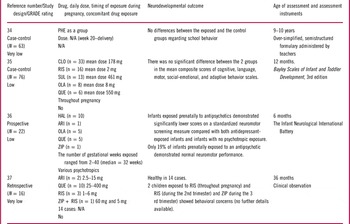
Case-control, prospective, and retrospective studies (see Table 3 )
Neurodevelopmental outcome following antenatal exposure to antipsychotics: case-control, prospective, and retrospective studies

PHE: phenothiazines, SUL: sulpiride, CLO: clozapine, OLA: olanzapine, RIS: risperidone, QUE: quetiapine, ZIP: ziprasidone, HAL: haloperidol, ARI: aripiprazole, ZIP: ziprasidone.
The long-term behavioral outcome of school-age children exposed in utero to phenothiazines after week 20 of pregnancy was investigated in a single case-control study.Reference Štika, Elisová and Honzáková 34 These children showed no behavioral anomalies. However, no specific instruments of evaluation nor qualified intervention by specialized staff were provided.
The study by Peng et al Reference Peng, Gao and Ding 35 aimed to investigate the developmental effects of SGAs in infants born to mothers taking such drugs throughout pregnancy. The developmental progress of 7 infants who experienced fetal exposure to SGAs was compared to that of matched control infants who had no fetal exposure to any antipsychotics. Assessments included cognitive, language, motor, social-emotional, and adaptive behavior composite scores measured by a widely used instrument investigating infant developmental delays. Each child’s progress was charted, and parents were taught about their child’s development by specific scales. There were no statistically significant differences between the 2 groups in cognitive, language, motor, social-emotional, or adaptive development. A prospective controlled study,Reference Johnson, LaPrairie, Brennan, Stowe and Newport 36 conducted December 1999–June 2008 at the Infant Development Laboratory of the Emory Psychological Center (Atlanta, GA, USA), examined a relatively large number of maternal–infant dyads at 6 months postpartum. Women were subdivided into 3 groups: the first exposed to antipsychotics, the second to antidepressants, and the third not exposed to any psychotropic agents. Among 6-month-old infants, a history of intrauterine antipsychotic exposure, compared with antidepressant or no psychotropic exposure, was associated with significantly lower scores on a standard test of neuromotor performance.
WichmanReference Wichman 37 conducted a retrospective chart review of all pregnant women presenting at her medical center from 1993 to 2007. During that time period, there were 30,092 total deliveries.Reference Wichman 37 Of the total number of deliveries, 15 mothers were prescribed atypical antipsychotics at some point during their pregnancy. Two infants, one exposed to risperidone and one exposed to risperidone and ziprasidone, had behavioral problems (Wichman, personal communication).
Discussion
Despite the increasing use of SGAs in pregnancy, data on their neurodevelopmental teratogenicity mainly derive from case reports and small case-series studies. Even findings emerging from case-control and prospective or retrospective studies are of limited clinical relevance due to the small sample sizes of such studies. Likewise, limited data are available on FGAs, despite the fact that such medications were introduced onto the market in the early 1950s and have been in use since then.
However, this situation is not surprising. Difficulties of standardizing amount, timing, pattern of use, puzzling effect of the risk factors, and uncontrolled confounding variables complicate the interpretation of the results of neurodevelopmental outcome studies.Reference Walker, Rosemberg and Balaban-Gil 38 Other various factors unite to complicate the problems in conducting neurobehavioral teratology studies. First, useful information on the late teratogenic effects is unlikely to be forthcoming until children are closer to school age. Second, this kind of long-term follow-up is difficult to carry out because many families move or miss follow-up clinical evaluations.Reference Lobstein and Koren 39
Nevertheless, case reports remain a valued part of the medical literature, despite dramatic changes in the way we receive medical information.Reference Scott 40 Over the past century, case reports have evolved from the arcane purpose of reporting rare or unusual conditions to the more pragmatic role of helping clinicians accurately diagnose and appropriately treat less common clinical conditions.Reference Hurd 41 As reported elegantly by Hurd,Reference Hurd 41 “Reading case reports of less common clinical situations serves a purpose similar to pilots’ flight simulators. If such a situation occurs in real life, the pilot is more likely to respond effectively, even if it is the first time he or she has experienced it. Good case reports can prepare clinicians for the unexpected (p. 410).” However, it is important to stress that there was no common or standardized measurement of neurodevelopmental outcome. Each case was actually assessed differently.
Moreover, 2 case-control studies and one prospective study failed to demonstrate any association between antenatal antipsychotic exposure and long-term impacts on infant and child development. However, the study by Johnson et al Reference Johnson, LaPrairie, Brennan, Stowe and Newport 36 concluded that infants exposed prenatally to antipsychotics demonstrated significantly lower scores on a standardized neuromotor screening measure. However, the small sample, the inclusion of infants exposed to either SGAs or FGAs, the lack of analysis of the effects of single medications, and the concomitant exposure to other psychotropics impair the clinical relevance of such results.
Given this background, we have to conclude that the long-term neurodevelopmental outcomes for children exposed in utero to antipsychotics remain unclear. Indeed, low to very low quality evidence of retrieved data makes it impossible to confirm or exclude whether antenatal exposure to either SGAs or FGAs is associate with potential long-lasting untoward effects on infant neurocognitive development.
However, when considering the risk of these medications in pregnancy, the risk of untreated maternal illness on both maternal and child health outcomes is relevant.Reference Galbally, Snellen and Power 42 Indeed, when the effects of intellectual disability and other neuropsychiatric outcomes was examined on children of mothers with severe psychiatric disorders, including schizophrenia and bipolar disorder, children were found to be at significantly increased risk of intellectual disability.Reference Morgan, Croft and Valuri 43 The study also investigated the distribution of rare syndromes (including Hurler, Klinefelter, Moebius, Noonan, Prader–Willi, Rett, Rubinstein-Taybi, VATER association, and Turner syndromes). Such syndromes showed unusually high rates of prevalence in the case children.Reference Morgan, Croft and Valuri 43
Independent of any safety considerations, it should be stressed that most pregnant women with severe psychiatric disorders require admission to psychiatric emergency services for pharmacological management of psychotic breakdown episodes. In such conditions, in order to obtain a prompt recovery from the psychotic crisis, antipsychotics are the more frequently administered drugsReference Ladavac, Dubin, Ning and Stuckeman 44 ; the safety profiles of the medications regarding the mother–fetus dyad is likely to be neglected.Reference Gentile 7
Since the question of whether in utero exposure to antipsychotics negatively affects brain development remains unresolved, future research needs to focus on prospective, longitudinal studies with adequate measures of key confounding variables, including maternal mental illness, other exposures (such as smoking, alcohol, and illicit drug use), and adequate length of follow-up where accurate child developmental measures are obtained.
Disclosures
The authors do not have anything to disclose.