INTRODUCTION
Pathological Gambling is classified among the impulse control disorders in the DSM-IV (APA, 1994). There has been a growing body of evidence about the relationship between pathological gamblers (PG) and impulsivity (Castellani & Rugle, 1995; Petry, 2001). Vulnerability to gambling and addictive behaviors have been related to neurodevelopment models involving attention, motivation, and functions associated with the frontal lobes and impulse control (Chambers et al., 2003; Navas Collado & Munoz Garcia, 2004). Impulsivity has been investigated by subjective and objective approaches. Self-report scales have developed for assessing impulsivity and had their validity demonstrated in clinical and non-clinical settings (Patton et al., 1995). On the other hand, neuropsychology studies have amassed a body of evidences showing cognitive deficits, mostly on executive functions among psychiatric syndromes in which impulsivity is an important feature, such as substance dependence (Rogers & Robbins, 2001), attention deficit hyperactivity disorder (Seidman et al., 1998), and damage to the frontal lobes (Gualtieri, 1995). These characteristics have also been observed in non-clinical samples with history of aggressive behavior (Barratt et al., 1997; Cherek et al., 1997). Likewise, neuropsychological assessment of PG also has showed attention deficits, specifically on the executive aspects (planning, flexibility, capacity to shift and inhibitory control), whereas the basic functions of attention, involving alertness and focus, were preserved (Cavedini et al., 2002; Petry, 2001; Rugle & Melamed, 1993). However, previous studies have not shown any significant correlation between self-reported impulsivity and neuropsychological measures on PG (Petry, 2001; Rugle & Melamed, 1993). Other experimental measures of impulsivity, such as the Gambling Task, have significantly discriminated PG from non-gamblers, but the correlation with self-reported impulsivity has not demonstrated (Petry, 2001). It is intriguing that inter-related phenomenon, executive dysfunction and self-reported impulsivity in PG, sharing neurological background, have measures that do not correlate. Possible non-excluding explanations are: (1) impulsivity is a complex phenomenon, groups of impulsive subjects are heterogeneous and self-report, and objective measures are addressing independent and complementary traits; (2) previous studies have adopted experimental measures that encompass features related to and beyond impulsivity.
On a pilot study, we have not found differences between PG and matched healthy volunteers on the performance at traditional neuropsychological tests of executive functions, such as Wisconsin Card Sorting Test, Stroop Color Test, and Trail Making Test. It is possible that given the complexity of these traditional tests, one with a focal executive deficit may guarantee a good performance resorting to other cognitive functions (Zaparniuk & Taylor, 1997). Thus, an objective assessment of impulsivity for PG should include tests that are punctual as well as related to the executive functions, preventing subjects from compensating with other cognitive skills vicariously developed. These tests should discriminate PG from non-impulsive individuals and relate to other measures of impulsivity. The Go/No-go paradigm seems to fulfill these requirements. Subjects are instructed to respond to a stimulus on a given condition such as pressing a button when hearing a high tone bell. Then, several stimuli are presented, some meeting the response criteria, others not (e.g., lone tone bells). The subject must discriminate the target stimulus and provide adequate response, while refraining from responding to non-target stimuli. In such paradigm it is expected that: (a) the time required to respond to a stimulus should be shorter for impulsive subjects than non-impulsive controls; (b) errors on a Go/No-go task (producing a response to a non-target stimulus) should be more frequent among impulsive subjects, such errors can be interpreted as either the impulsive subjects do not take enough time to respond accurately, or they fail to properly integrate information; and (c) time and errors would hold a significant relationship to self-reported impulsivity. The objectives of this study are: (1) to evaluate if performance at Go/No-go tasks can discriminate PG from healthy control volunteers and (2) if performance at Go/No-go tasks is either related, or complementary to self-reported impulsivity.
METHODS
Participants
Two hundred and nineteen subjects consecutively admitted to the Gambling Outpatient Program at the Institute of Psychiatry of the University of São Paulo, were invited to participate in this study. One refused and three did not meet the inclusion criteria. Final sample consisted of 214 (112 women) subjects, meeting pathological gambling diagnostic criteria according to the DSM-IV (APA, 1994) and having scores on the South Oaks Gambling Screen—SOGS (Lesieur & Blume, 1987) higher than five. They were screened through the Schedules for Clinical Assessment in Neuropsychiatry-SCAN (Wing et al., 1990) to identify any other current psychiatric disorder. The PG group was been divided into 2 subgroups: PG with comorbidity (CPG) and PG with no comorbidity (NCPG). Demographic data are reported in Table 1. Previous neurological examinations were performed to rule out clinical impairment of sensory, motor, and high cortical functions (gross auditory impairment, dyskinesia, aphasia, and apraxia). All the participants were not taking psychiatric medications.
Demographic variables and performance at Go/No-go tasks and self-reported impulsivity for pathological gamblers with comorbidity-CPG (n = 162), pathological gamblers with no comorbidity-NCPG (n = 52), and healthy volunteers (n = 82)

Eighty-two healthy volunteers (37 women; Table 1) were recruited among employees and their relatives from a recreational club located in the same neighborhood of the Institute of Psychiatry. They were screened through a self-report questionnaire and the SCAN (Wing et al., 1990). Subjects were included in the control group when they did not meet criteria for any current psychiatric disorder and no lifetime diagnosis for a recurrent psychiatric syndrome (psychotic disorders, bipolar disorders, obsessive-compulsive disorder, and substance related disorders).
Instruments
Self-report measure of impulsivity
The Barratt Impulsiveness Scale Version 11 (BIS, Patton et al., 1995), a 30 item self-report questionnaire, has three sub factors: Attentional Impulsiveness, which refers to the characteristic of hectic thinking and hasty decisions; Motor Impulsiveness, which refers to fast reactions and restlessness; and Non-Planning Impulsiveness, which refers to a drive for immediate outcomes and failure to assess long term consequences.
Neuropsychological tests
The Simple Choice Auditory Reaction (SCA) and Simple Choice Visual reaction (SCV) tests were used (PSS Cognitive Rehabilitation computer software package) (Bracy, 1995). The SCA consists of a Go/No-Go reaction test in which subjects are presented with 15 high-tone and 15 low-tone bell trials (1000 Hz, approx. 65 dB) 1 to 4 seconds apart randomly. Facing the computer screen, subjects are instructed to hit the mouse as quickly as possible each time the high-tone bell rings, and not to press it when the low-tone bell rings. A happy or sad face appears in the screen when the subject correctly or wrongly presses the mouse, respectively. Outcome variables were reaction time measured in milliseconds (SCA-time) and the number of errors (e.g., pressing after the low-tone bell stimuli–SCA-errors). The SCV consist of a Go/No-Go reaction test in which subjects are randomly presented with 15 yellow squares and 15 blue squares, measuring four centimeters square. Facing the computer screen, subjects are instructed to hit the mouse as quickly as possible each time the yellow square appears, and not to press it when the blue square appears. A “tah dah!” sound is presented when the subject correctly presses the mouse, and a “puh” sound is presented when the subject wrongly presses the mouse. Outcome variables were reaction time measured in milliseconds (SCV-time) and the number of errors (SCV-errors).
Procedures
A trained neuropsychologist (D.F.) administered the tests in a quiet laboratory and in a standard sequence: beginning with neuropsychological tests and finishing with the BIS. The study protocol was approved by the local ethics review committee. All participants have signed informed consent forms before participating in this study.
Statistical analysis
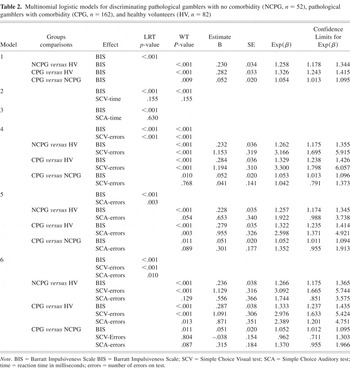
Statistical data are expressed as mean standard error. Probability values reported are two-tailed, with significance set at p < .05. In order to control individual differences among subjects' profiles, which may influence the results, a set of control variables defined by sex, age, years of formal education, and IQ was introduced in all statistical models. The groups' means for BIS, SCA-time, SCA-errors, SCV-time, and SCV-errors were compared by analysis of covariance models (Neter et al., 1996), with the control variables as covariates. This method allows comparison of groups' means for subjects with the same covariates values. Where the residual analysis suggested that the homogeneity of variance assumption failed, a transformation of the dependent variable was applied. Multinomial logistic models (Hosmer & Lemeshow, 2000) were used to perform a discriminant analysis among healthy volunteers, CPG and NCPG groups. This model is an extension of the logistic model when the dependent variable has more than two categories. The aim of this analysis is to confirm the importance of BIS and neuropsychological tests in the discrimination of the groups (all models included the set of control variables previously described). Likelihood ratio tests (LRT) were performed to verify the significance of the inclusion of a particular independent variable when the other variables were already included in the model. The main goal of LRT is to verify the significance of the inclusion of neuropsychological variables when BIS is present in the model, and the significance of BIS inclusion if neuropsychological variables are already in the model. Models with the following regressors were adjusted:

When LRT indicated that at least one of the regressors was significant in the presence of the others, chi-square Wald tests were applied to verify the significance of these variables in the discrimination of each pair of groups. The SPSS software package was used for statistical analysis.
RESULTS
The PG sample presented a high level of comorbities: 162 PG (75.7%) presented one or more comorbidities, whereas only 52 PG had no comorbidity. We have identified nicotine dependence in 147 subjects (68.7%); depressive disorder in 133 subjects (62.1%); anxiety disorder in 77 subjects (36%); phobia in 71 subjects (33.2%); substance abuse disorder, other than nicotine dependence in 45 subjects (21%); obsessive-compulsive disorder in 14 subjects (6.5%); panic disorder in 11 subjects (5.1%); bipolar disorder in 10 subjects (4,7%); and eating disorders in 2 subjects (0.9%). There was no significant difference between all the groups according to the demographic variables, estimated Intelligence Quotient, BIS and performance on the SCA and SCV tests (Table 1).
Analysis of Covariance Models
There were no significant differences among groups' means for SCV-time (p = .798) and SCA-time (p = .758). The effect of group was significant for BIS (p < .001), SCV-error (p < .001) and SCA-error (p < .001). For BIS, the three groups were differed from each other (p < .05). The healthy volunteers' group mean was significantly inferior to that of CPG and NCPG group means; whereas for SCA-error and SCV-error; there was no significant difference among CPG and NCPG means for these variables.
Multinomial Logistic Models
The multinomial logistic models revealed that the inclusion of SCV-time (P = .155) or SCA-time (P = .630) yielded no significant improvement in discriminating the three groups if BIS is already included in the model (Models 2 and 3 of Table 2). The MLM models lead to a different conclusion when we tested for the inclusion of SCV-error (P < .001) and SCA-error (P = .003) in a model with BIS. In these models the inclusion of the neuropsychological variables were significant (Models 4 and 5 of Table 2); additionally, it was possible to conclude that, in a model with BIS, SCV-error was important to discriminate controls from NCPG (P < .001) and CPG (P < .001) groups. A similar result was achieved by SCA-error when we discriminated controls from NCPG (P = .054) and from CPG (P = .003). In Model 6 (Table 2), SCA-error added no significant effect (P = .129) in a model with BIS and SCV-error. In all models, BIS was statistically relevant in discriminating between the three groups.
Multinomial logistic models for discriminating pathological gamblers with no comorbidity (NCPG, n = 52), pathological gamblers with comorbidity (CPG, n = 162), and healthy volunteers (HV, n = 82)

DISCUSSION
The identification of a neuropsychological test that could render a reliable objective measure of impulsivity is important to a more comprehensive investigation of the pathological conditions associated to impulsivity. Such test should fulfill the following requirements: (I) it has to be compatible with a theoretical rationale that explains why this measure is an indicator of impulsivity; (II) it has to be able to discriminate clinically diagnosed impulsive subjects from non-impulsive ones; and (III) it has to compose with other impulsivity measures, an useful discriminating model between impulsive and non-impulsive subjects. The Go/No-go tasks used in this study fulfilled all these requirements. Indeed, CPG and NCPG presented more errors at the SCA and SCV tests than the healthy volunteers. This is in keeping with previous studies (Cavedini et al., 2002; Petry 2001; Rugle & Melamed, 1993), which report poorer performance of pathological gamblers than non-gamblers on tasks involving executive functions. The SCA-errors and SCV-errors independently discriminated PG from healthy volunteers and composed with the BIS a significant prediction model. Conversely, reaction time was not different for CPG, NCPG, and healthy volunteers, suggesting that errors were not caused by inadequate use of time but an incomplete integration and processing of information.
The observation that the inclusion of neuropsychological variables in a model with self-reported impulsivity by the BIS brought significant improvement to discriminate impulsive from non-impulsive subjects underscores their complementary nature, reinforcing the perception of impulsivity as a multi-dimensional phenomenon. Each assessment methodology (experimental or self-report) must account for different aspects and one cannot exclude the other. CPG and NCPG groups differentiated from healthy volunteers on experimental and self-reported measures, suggesting that different mechanisms may account for impulsive behavior in this heterogeneous population. Thus, impulsivity assessment is best performed by a combination of methodologically distinct tests, as shown by the Model 6 (Table 2) comprising a neuropsychological test and a self-report scale of impulsivity. These results reinforce the complementary nature of different approaches to impulsivity. Such combinations hold potential for future studies in non-clinical samples in which self-report scales select impulsive individuals, whereas a set of simple and direct experimental measures help to identifying those at risk for impulse control disorders. Moreover, another important finding of this study refers to the influence of the presence of psychiatry comorbidity among PG in their expression of impulsivity.
This is the first study to compare performance on neuropsychological tests and self-reported impulsivity between PG with comorbidity and PG without comorbidities. The results showed that PG without comorbidity presented high scores on the impulsivity scale and cognitive deficits, however, in the presence of comorbidities, which is very common in the population demonstrated in this work, PG presents an increase in impulsivity expressed by both approaches.
The clinical and cross-sectional nature of this study hinders generalization of non-treatment-seeking gamblers. Another limitation in this study refers to the absence of a specific assessment for attention deficit hyperactivity disorder (ADHD) that could be present among PG as reported by previous studies. Nonetheless, this is the first study to find a composite model for assessing impulsivity among clinically diagnosed subjects that discriminate PG from healthy volunteers. Further studies should investigate if the same model applies for other psychiatric disorders in which impulsivity is also involved, controlling for the presence of ADHD, and if such impulsive features remain after disorder remission. Such work might focus on other impulsivity expressions, for instance, impulsivity craving, novelty seeking, sensation seeking, and different neuropsychological variables involving executive functions, such as decision making and planning, which can improve impulsivity models composed of neuropsychological and personality constructs.
ACKNOWLEDGMENTS
This work was supported by FAPESP (grant # 02/02604-6-DF) and CNPq (CG). The authors thank Drs. Loreen Rugle, Monica L. Zilberman, Nady el-Guebaly, Candida H.P. Camargo, Danielle Rossini, Maria H. B. Mazzoleni, Li Wen Hu, and all the staff from the Gambling Outpatient Unit at the Psychiatry Clinic, University of Sao Paulo. The authors acknowledge that the information in this manuscript and the manuscript itself is new and original and that it is not currently under review by any other publication, and that it has never been published either electronically or in print.