Introduction
Previous studies of mental illness in old age have focused heavily on depression and dementia. Yet, interest in anxiety disorders has increased in recent years, but the range of prevalence estimates of anxiety disorders in old age varied markedly. The prevalence of any anxiety disorders ranges from 3.2% to 15.3% in community-based studies (Forsell and Winblad, Reference Forsell and Winblad1997; Kessler et al., Reference Kessler, Berglund, Demler, Jin, Merikangas and Walters2005). Most of the studies of the prevalence of anxiety disorders were based on the DSM-IV diagnostic criteria (DSM-IV Ed.). Anxiety disorders include different types of specific anxiety disorder sharing characteristics of excessive fear and worry along with somatic symptoms. However, this well-delineated description can only cover the excessive emotional and apparent physical disturbances. There are still about 15–52.3% of older adults experiencing subclinical level of anxiety symptoms that are also disturbing to everyday life (Bryant et al., Reference Bryant, Jackson and Ames2008). This variability could be due to methodological differences, such as the sampling frame recruited and diagnostic criteria in use (Bryant et al., Reference Bryant, Jackson and Ames2008).
Anxiety disorders appear to decline in prevalence with advancing age, and anxiety symptoms are more common than depressive symptoms (Schaub and Linden, Reference Schaub and Linden2000). Studies from western countries estimated that the 12-months prevalence rate of late-life depression in community dwelling older people ranges between 3% and 4.5% (Aziz and Steffens, Reference Aziz and Steffens2013), whereas late-life anxiety disorders range between 6% and 10% (DSM-IV Ed.). Furthermore, the LASA study indicated a six-month prevalence of depression to be 2% compared to a prevalence of 7.3% for anxiety disorder in the same cohort (Beekman et al., Reference Beekman1998). This evidence seems to suggest that anxiety disorders are more common than depression in the community older population.
It is also important to highlight that anxiety disorders are an under-recognized condition in the older population. Although treatments of anxiety disorders are available, only 17–22% of older people with a high level of anxiety symptoms identified in an epidemiological survey sought help from mental health professionals (Himmelfarb and Murrell, Reference Himmelfarb and Murrell1984). Furthermore, anxiety disorders are also associated with disability and suffering that is not limited to the elderly people who affected by the condition alone, but also includes burdens for family members and the society (Senaratne et al., Reference Senaratne, Van Ameringen, Mancini and Patterson2010).
Recently, research has focused on the relationship between anxiety disorders and cognitive functions, but the results are still inconclusive. Wetherell et al. (Reference Wetherell, Reynolds, Gatz and Pedersen2002) found no evidence for cognitive decline in anxious older adults. However, evidence from another two longitudinal studies indicated that anxiety disorders in old age predicted future cognitive decline. Sinoff and Werner (Reference Sinoff and Werner2003) conducted a study on a sample of 137 older adults referred to a geriatric assessment clinic for memory complaints. They found that elevated anxiety symptoms at baseline predicted greater cognitive decline on the Mini Mental State Examination 1–5 years later. Another study involved a sample of 79 depressed older adults with comorbid anxiety (GAD or panic disorders). They found that late onset of anxiety disorders after the age of 55 years was associated with poor cognition at baseline and similar rate of memory in early onset anxiety at four-year follow-up. They also found that the anxious group experienced accelerated decline on a composite measure of dementia screening than depressed as well as non-anxious groups over time (DeLuca et al., Reference DeLuca2005).
Therefore, this study hopes to extend available knowledge on the prevalence and correlates of anxiety disorders in the older population.
In Hong Kong, the prevalence of anxiety disorders in late life has never been systematically investigated. Although figures from other developed countries are available, we could not directly generalize the findings to reflect the situation in Hong Kong, due to cultural differences and different demographic makeup. Besides, most of the systematic epidemiological surveys on the prevalence of late life anxiety disorders were conducted a decade ago (Regier et al., Reference Regier1988; Kessler et al., Reference Kessler, Berglund, Demler, Jin, Merikangas and Walters2005). Therefore, a local study on current prevalence estimates of anxiety disorders in this target population is both timely and relevant. The aim of the study is to examine the point prevalence of anxiety disorders in a cohort of older Chinese population aged 60–75 years in Hong Kong. Based on past researches, we hypothesized that: (i) older adults with anxiety disorders have more chronic illness burden; and (ii) older adults with anxiety disorders have more impairment in cognition.
Methods
Study design and participants
The sample was drawn from the dataset of Hong Kong Mental Morbidity Survey (HKMMS) conducted between November 2010 and May 2013. The HKMMS sample was recruited through a multi-layered random sampling of community dwelling adults in Hong Kong. A detailed description of the population survey has been provided elsewhere (Lam et al., Reference Lam2015). Face to face interviews were completed with a sample of 5,719 community dwelling Chinese adults aged 16–75 years in Hong Kong, with a participation rate of 68%.
Random address localities were generated from the Census and Statistics Department of the Government of Hong Kong SAR. The addresses were stratified by geographical locations and nature of premises (private versus public housing). Samples of geographical areas representative of the residential distribution in Hong Kong were selected, and followed by subsequent stages of geographical sampling (e.g. estates within districts, blocks within estates, and households with blocks).
For each address identified, an advance letter was sent to introduce the survey and stated that an interviewer would be calling to seek permission for interview. At least three advance letters and/or one home visit were conducted within three months of first posting to ascertain the availability of eligible participants. For households with either no eligible participant, failure to gain access, non-response or unknown eligibility, a replacement address with similar geographical and housing characteristics was generated. No substitution was carried out if the original household resident refused to participate. For each eligible household, a trained lay interviewer conducted the assessment. A household member with closest birthday to the day of interview was selected for assessment in order to avoid response bias.
The inclusion criteria of the HKMMS are: (i) aged between 16 and 75 years; (ii) ethnically Chinese; (iii) birthday closest to the date of first scheduled interview; and (iv) consent for participation. Proxy information from first degree relatives was obtained if the subjects were unavailable or unable to provide full information (e.g. intellectual disability or sensory impairments).
For the present analyses, participants aged 60 years or older were considered (N=1,228) from the HKMMS dataset. Individuals with a Cantonese Version of Mini Mental State Examination (CMMSE) score of 18 or below were excluded from the analysis.
Measurements
Diagnosis of anxiety disorders
Ascertainment of diagnosis of common mental disorders was based on the use of the Revised Clinical Interview Schedule (CIS-R) (Lewis et al., Reference Lewis, Pelosi, Araya and Dunn1992). Before commencement of data collection of HKMMS, validation and reliability studies were carried out to validate the CIS-R in the local population. Through translation, back translation, focus group discussion, and pilot studies, the Chinese version of the instruments was prepared, and their psychometric properties were determined (Lam et al., Reference Lam2014). CIS-R consists of 14 sections of psychological symptoms: somatic symptoms, fatigue, concentration and forgetfulness, sleep problems, irritability, worry about physical health, depression, depressive ideas, worry, anxiety, phobia, panic, compulsions, and obsessions. Each section starts with two screening questions to establish if a particular symptom is present in the past month. Following positive responses, follow up questions on the symptoms in past week are asked. Scores for each section range from 0 to 4, except for depressive ideas with a maximum score of 5, with higher score indicating a higher level of symptom severity. Symptom scores are calculated for each section. A total score is generated by summation of the section scores. This indicates the overall severity of the psychological symptoms. The general cut-off point of threshold for adults indicating significant psychological symptoms is 11/12, which could yield a sensitivity of 69.3% and a good specificity of 92.7%. The cut-off point of threshold indicating the need for clinical attention is 17/18, which could yield a sensitivity of 70.2% and a specificity of 95.2% (Lam et al., Reference Lam2015). The CIS-R generated diagnosis of common mental disorders, including depressive disorder (DEP), generalized anxiety disorders (GAD), mixed anxiety and depressive disorder (MADD), other anxiety disorders (OAD), and comorbid mood disorders, according to the Tenth Revision of the International Classification of Diseases of the World Health Organization (ICD-10) (Lewis et al., Reference Lewis, Pelosi, Araya and Dunn1992). The one-week ICD-10 diagnoses of common mental disorders were generated from CIS-R data.
Basic demographic, psychosocial functioning, chronic medical conditions, and global cognitive functioning were also collected. Physical health burden was measured with the Cumulative Illness Rating Scale (CIRS) (Parmelee et al., Reference Parmelee, Thuras, Katz and Lawton1995). Impairment of each medical condition was rated on a 0–4 grading scale. The total score is the sum of all physical system scores. The Short-Form 12 (SF-12) health survey was used to assess the quality of life related functioning of participants (Lam et al., Reference Lam, Tse and Gandek2005). It generates two summary scores on physical and mental component functioning. The scores are on a scale from 0 to 100, with 100 representing the highest level of functioning. Global cognitive functioning was evaluated by the use of CMMSE (Chiu et al., Reference Chiu, Lee, Chung and Kwong1994). It is a 30-points scale that examines different cognitive domains, including orientation to time, orientation to place, registration, attention and calculation, delayed recall, language, ability to follow commands, and visuospatial perception. Basic socio-demographic data on age, gender, years of completed education, marital status and occupational status were also obtained.
Data analysis
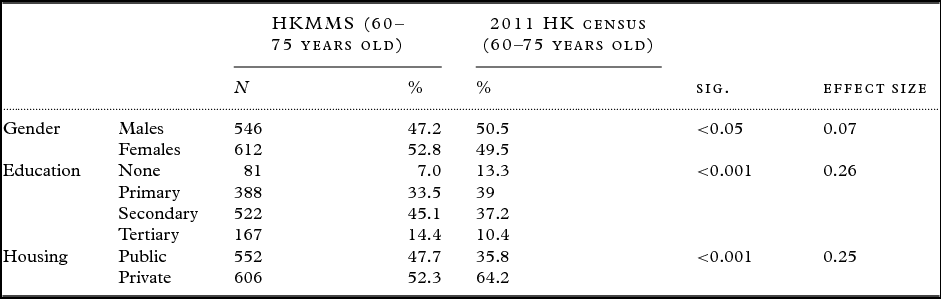
This is a post hoc analysis of HKMMS that evaluate the prevalence of common mental disorders in a representative sample aged 16–75 years in Hong Kong. We extracted respondents aged 60–75 years from the HKMMS to describe the prevalence of anxiety disorders in the Chinese older population in Hong Kong. Before we estimated the prevalence of late life anxiety disorders in the community dwelling older adults in Hong Kong, we first compared the HKMMS data to the Hong Kong Census data 2011 to check for the similarity on the distribution of basic demographic characteristics. The post stratification weights constructed were then entered into the SPSS and applied when calculating weight prevalence of anxiety disorders. Weights were applied to adjust for differences in education and type of housing between the general population and the HKMMS sample, because their effect size is larger than 0.2.
Prevalence of all categories on common mental disorder was calculated following the CIS-R algorithms. The CIS-R algorithms allow categorization according to ICD-10 diagnostic criteria for depression, anxiety disorders (phobias, generalized anxiety disorder (GAD), panic disorder, and obsessive–compulsive disorder), and mixed anxiety and depressive disorder (MADD). For the present study, we have grouped all anxiety disorders and MADD into one category as any anxiety disorders without depression. Anxiety disorders co-occurred with depressive episode is defined as comorbid mood disorders.
Logistic regression was then used to explore any association between anxiety disorders and potential correlates by comparing respondents with anxiety disorders to a mentally healthy group. “Mentally healthy group” was defined as those with a CISR-score less than 6 and without any mental disorder diagnosis. Data were analyzed through binary logistic regression models, using the one-week prevalence of anxiety disorders as the dependent variable and the potential correlates as the independent variables. The potential correlates included socio-demographic variables, health related and cognitive factors. Data analysis was performed using PASW 20.0 for Windows. Statistical significance was set as p < 0.05.
Results
Sample characteristics
One thousand one hundred and fifty eight participants aged 60–75 years were assessed. The demographics of the participants were compared with the Hong Kong population in 2011 for the same age range (Hong Kong Census and Statistic Department, 2012). As shown in Table 1, the sample was comparable to the 2011 census data for Hong Kong on gender. The goodness-of-fit test indicated a small effect size for gender (Table 1). The mean age of the HKMMS participants was 65.9 (SD=4.4) years, and 52.8% were female. The mean years of education was 8.9 (SD=5.3) years. The sample had a CIRS scores of 3.8 (SD=2.2). The mean CIS-R score was 4.7 (SD=6.8).
Comparisons on gender, education level, and type of housing of the participants interviewed (N=1,158) and corresponding population (aged 60–75 years) in Hong Kong.

HKMMS = Hong Kong Mental Morbidity Survey.
Prevalence of anxiety disorders
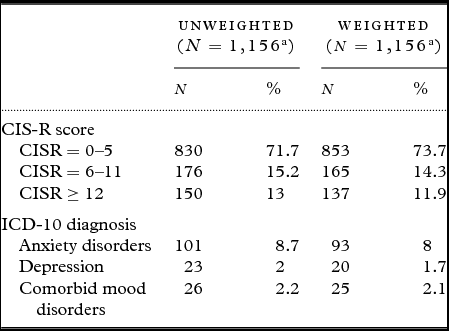
After adjusting for age, gender, and type of housing, 138 participants (11.8%, 95% CI=10–13.7%) had a CIS-R score of 12 or above. According to the ICD-10 diagnosis generated by the CIS-R algorithms, the weighted prevalence of anxiety disorders occurring was 8% (95% CI=6.5–9.6%), followed by 2.1% (95% CI=1.3–3%) with comorbid mood disorders, and 1.7% (95% CI=1–2.5%) with depression. Table 2 depicted the unweighted and weighted prevalence of all categories on common mental disorders.
Unweighted and weighted prevalence of late life common mental disorders by CIS-R score and by ICD-10 diagnosis in Study I

aTwo cases with missing data were excluded from analysis.
Symptoms cluster of anxiety disorders
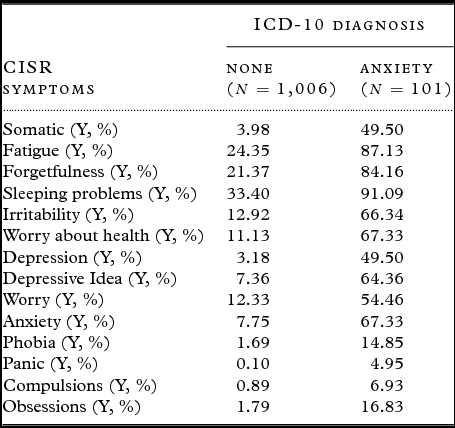
Symptom presentation of anxiety group was predominant of physical symptoms, including fatigue, forgetfulness, and sleeping problems, followed by psychological symptoms, such as irritability, worry about health, feeling anxious, and having depressive ideas. Table 3 displayed the proportion of symptoms endorsed by participants with and without anxiety disorders.
Symptom endorsement of participants with and without anxiety disorders

Correlates of anxiety disorders
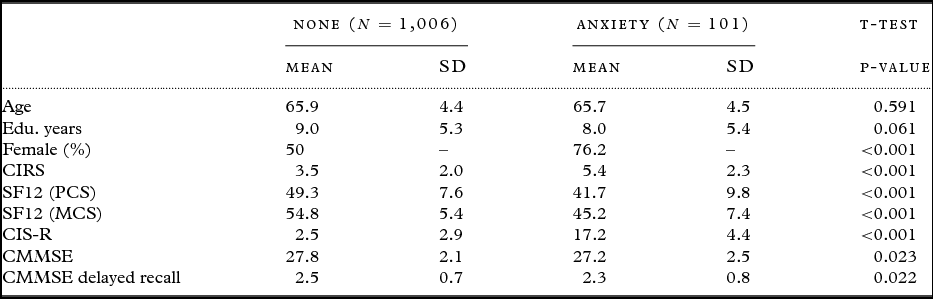
Of the 101 participants with anxiety disorders, the mean age was 65.7 (SD=4.5) years, and 76.2% of the sample were female. The mean years of education was 8.0 (SD=5.4) years. The sample had a mean chronic illness burden score of 5.4 (SD=2.3). The mean CIS-R score was 17.2 (SD=4.4). Compared with those without mental disorders (N = 1006), individuals with anxiety disorders were more likely to be women (χ 2 = 25.3, p < 0.001), had more chronic illness burden (t = −9.3, p < 0.001), had lower scores in SF12 physical component summary (t = 9.2, p < 0.001), CMMSE delayed recall (t = 2.3, p = 0.022), and CMMSE total score (t = 2.3, p = 0.023). Age and years of completed education were not different from the group without depression or anxiety. Table 4 showed the socio-demographic information of participants with and without anxiety disorders.
Sociodemographic information of participants with and without anxiety disorders

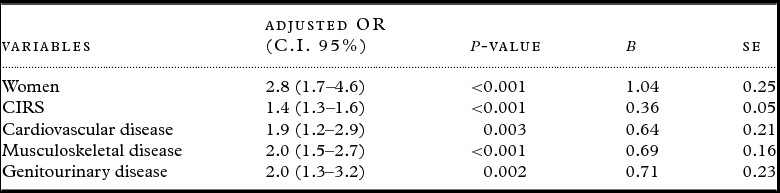
Variables that differed significantly between groups were subjected to a logistic regression analysis to determine which factors were associated with anxiety in the elderly people. These variables included gender, CIRS score, and CMMSE score, but SF12 physical component summary (PCS) score. PCS was excluded from logistic regression analysis, because it was strongly influenced by the existing clinical conditions and was highly correlated with the CIRS score. As a result, it was more worthwhile to examine potential association between the presence of medical comorbidity and anxiety disorders in older adults.
Two significant factors for anxiety disorders were identified by binary logistic regression, including being women (OR 2.8, 95% C.I. 1.7–4.6, p < 0.001) and high CIRS score (OR 1.4, 95% C.I. 1.3–1.6, p < 0.001). We also assessed the association of different physical illnesses against the presence of anxiety disorders. Anxiety disorders was found to be associated with cardiovascular disease (CVD) (OR 1.9, 95% C.I. 1.2–2.9, p = 0.003), musculoskeletal diseases (OR 2.0, 95% C.I. 1.5–2.7, p < 0.001), and genitourinary diseases (OR 2.0, 95% C.I. 1.3–3.2, p = 0.002). Table 5 shows the factors associated with anxiety disorders in adjusted odd ratios.
Associated factors (in OR) of anxiety disorders in older adults

Discussion
The objective of the present study was to comprehensively evaluate the prevalence of late life anxiety disorders in the Chinese community population. It was based on a random sample of person aged 60–75 years. Previous studies of anxiety in old age were based on samples of varying age range with some participants as young as 55 years, and some of these also included elderly people with depression, so the symptomatology of anxiety disorders in the older population is not yet fully understood (Wolitzky-Taylor et al., Reference Wolitzky-Taylor, Castriotta, Lenze, Stanley and Craske2010). Therefore, we have chosen an age cut-off at 60 years, and specifically looked only at those with pure anxiety disorder and independent of depression.
Several major findings came out of in this study. First, our results indicated that anxiety disorders are prevalent condition in the Chinese older community. The HKMMS is the first population-based survey on common mental disorders conducted locally. The current findings gave an overview on the pattern of anxiety disorders in the older Hong Kong population. Based on the use of ICD-10 diagnostic criteria generated by CIS-R, anxiety disorders are common in our community sample with a one-week prevalence of 8%. Our finding on prevalence estimates was much higher than that reported in studies investigating current diagnosis ranging from 3.2% in Sweden (Forsell and Winblad, Reference Forsell and Winblad1997), 4.5% in Berlin(Schaub and Linden, Reference Schaub and Linden2000), and 5.5% in the United States (Regier et al., Reference Regier1988).
Second, the study showed that the effect of gender was consistently found as with other studies, with higher risk of anxiety disorders in females than in males. Women are more likely to report anxiety symptoms to their health care professionals than men (Kessler et al., Reference Kessler, Brown and Broman1981). For men, they would not seek help from doctors until the conditions get worse and have serious impact on their daily activities and health. Indeed, findings from a recent study have already found association of increased rate of mortality in older men with anxiety disorders (van Hout et al., Reference van Hout2004). The risk of mortality in anxious older men is as high as 87% over a seven years period. The excess subsequent mortality figure may reflect that a very few older men with anxiety disorders are willing to seek medical advice and led to delaying treatment on their illnesses. It is important to explore how to increase utilization of medical services in older men in the community, particularly those with comorbid affective disorders.
Third, older adults with anxiety disorders were more likely to have poor physical health. Yet, due to our cross-sectional nature, it was not sure whether these chronic conditions are a cause or a consequence of anxiety disorders in the older adults’ population. Still, a possible explanation could be that an increase in chronic diseases in anxious older individuals may exacerbate the deterioration in functioning as well as wellbeing. Actually, the NCS-R study also reported similar results. They found that the presence of anxiety disorders is associated with having three or more chronic illnesses (Gum et al., Reference Gum, King-Kallimanis and Kohn2009). In addition, a Netherland study involving a sample of 659 participants aged 55–85 years found that individuals with either anxiety symptoms or disorders reported more functional limitations, chronic physical diseases, and decreased well-being in terms of loneliness, satisfaction with life and self-perceived health (de Beurs et al., Reference de Beurs, Beekman, van Balkom, Deeg, van Dyck and van Tilburg1999). In particular, we found association between cardiovascular, genitourinary, and musculoskeletal diseases and increased risk of anxiety disorders. The relationship of anxiety disorders with certain cardiovascular conditions, such as hypertension and coronary heart disease, is already well documented (Kubzansky et al., Reference Kubzansky, Kawachi, Spiro, Weiss, Vokonas and Sparrow1997). Anxiety disorders were also found to be a predictor of recurrent cardiac events in those who have suffered from myocardial infarction (Strik et al., Reference Strik, Denollet, Lousberg and Honig2003; Huffman et al., Reference Huffman, Smith, Blais, Januzzi and Fricchione2008).
Fourth, it is of interest the association between early cognitive impairment and anxiety disorders in older people without cognitive impairment. We found that individuals with anxiety disorders were poorer in global cognition and performed worse in CMMSE delayed recall when compared to the group without mood symptoms. In fact, there is some evidence that supports a linear relationship between increased level of anxiety and decreased cognitive performance in older adults. A clinical study compared cognitive performance among patients with GAD, patients with MADD, and normal older individuals. They found that older adults with GAD performed worse on the California Verbal Learning Test (CVLT) than those with no psychiatric illness (Mantella et al., Reference Mantella2007). The results on reduced episodic memory in anxious older adults reflected the possibility of anxious mood affecting retrieval process and hence delayed recall.
To put this forward, the findings seemed to suggest that anxiety symptoms or disorders were associated with early cognitive decline, especially memory decline, in the non-demented community older population. This interpretation has gained concrete supports from a new longitudinal study on the interplay among amyloid plaque, anxiety symptoms, and cognitive decline. The study has found association between anxiety and cognitive decline in older adults with elevated levels of amyloid-beta. Furthermore, individuals with higher level of anxiety have greater rate of decline in global cognition, verbal memory, language, and executive function than those with lower level of anxiety (Pietrzak et al., Reference Pietrzak2015).
Strength and limitations
The symptomatology of late life anxiety disorders has not been clearly defined. We have taken the chance to group individuals with different types of anxiety disorders, including generalized anxiety disorders, phobias, panic disorders, and mixed anxiety and depressive disorders, into one category. This broad definition of anxiety can allow us to consider both clinical and subclinical levels of anxiety disorders. At the same time, the definition can offer promise of obtaining a reliable estimate of anxiety disorders in old age for mental health services planning. Yet, this broad definition of anxiety may also lead to losing much information to the understanding of individual anxiety disorders. Future studies should consider studying individual anxiety disorders separately.
A number of limitations were noted. We measured anxiety symptoms with CIS-R in this study, but it is not originally designed specifically for assessing anxiety symptoms in the older population. It is possible to have missed some older adults individuals who exhibited anxiety in a way different from the diagnostic criteria developed for the younger population. However, CIS-R enabled us to transform self-report symptoms directly into a classification of common mental disorders on the basis of the disease algorithms. Therefore, it has enabled us to estimate the proportion of anxiety symptomatology in a large community sample. Second, this study is cross-sectional in nature, direction of associations with the correlates of anxiety disorders could not be determined. Longitudinal studies in the future are needed to get more inference on causation, especially on the relationship between prolonged anxiety disorders and subsequent development of cognitive impairment. Third, the three items delayed recall in CMMSE used in the survey is only a screening tool for assessing the memory of our sample. In order to better understand how anxiety disorders affect cognition, more comprehensive cognitive assessments should be adopted to investigate the impact of anxiety disorders on different cognitive domains and memory process in future studies.
Conclusion
Clearly, our study has demonstrated that anxiety disorders are prevalent among the community dwelling older adults in Hong Kong. The next important question is how many of those left untreated in the community? As pointed out in previous literatures, anxiety disorders are a chronic mental illness that can last for many years. Elderly people lived with anxiety disorders frequently found to have greater medical comorbidity that may affect their quality of life and independent. Our findings also suggested a potential risk for early sign of memory impairment in clinically non-demented individuals with anxiety disorders. It is imperative to increase older adults’ awareness of early identification of anxiety disorders and its potential consequences for future physical and cognitive impairment.
Conflict of interest
None.
Description of authors’ roles
A. W. T. Fung analyzed the data and wrote the paper. C. S.-M. Wong collected the data and supervised the data collection. All other authors designed the study and supervised the study progress.
Acknowledgments
The Hong Kong Mental Morbidity Survey is a commissioned project supported by Health and Health Services Research Fund (Ref: 09101601), Food and Health Bureau, Hong Kong SAR Government.