In 1893, the World’s Columbian Exposition was held in Chicago to celebrate the 400th anniversary of Christopher Columbus’ arrival in the New World. It was at this fair, during a special American Historical Association meeting, that Frederick Jackson Turner would first present his influential Frontier Thesis in the form of an essay titled ‘The Significance of the Frontier in American History’.Footnote 1 In this essay, Turner not only proclaimed the conclusion of the American westward expansion itself but also emphasized the importance of this frontier experience in the development of American culture and society.Footnote 2 Meanwhile, out west in San Francisco, Japanese Consul Chinda Sutemi received a guest from Brazil. The visitor was a part of the Brazilian delegation to the same World’s Columbian Exposition, and he was stopping on the US Pacific Coast to investigate the condition of the Chinese communities there. The newly established First Republic, on a quest to attract migrants, had just reopened Brazil’s doors to the subjects of Qing China and Meiji Japan. Possibly shocked by the rampart racism against Chinese immigrants in the United States, the Brazilian delegate approached Chinda to explore the possibility of attracting Japanese migrants to Brazil instead.Footnote 3
Since the mid-1880s, the US mainland had been one of the most popular destinations for Japanese migrants. Some of them came as self-dubbed colonizers who saw the American West as a frontier for Japanese expansion, while others simply wanted to pursue a better life as contract labourers.Footnote 4 Yet Chinda was deeply concerned about the rising anti-Chinese sentiment in the United States. As the number of Japanese immigrants on the US West Coast had steadily increased in recent years, Chinda worried that they would eventually meet the same fate as the Chinese, who were excluded by law. Trying to find an alternative destination for his countrymen, he cast his eyes to Latin America.Footnote 5
The shared interests of both sides made for a productive meeting. Later that year, Charles Alexander Carlyle, a representative of São Paulo coffee planters, also paid a visit to Chinda’s office in California while on his way to Qing China for migrant recruitment. With Chinda’s help, Carlyle visited Japan during the same trip and secured a contract between Prado Jordão & Company of Brazil and Yoshisa Emigration Company (Yoshisa Imin Kaisha) of Japan in 1894, aiming to bring the first group of Japanese migrants to Brazil.Footnote 6 Though this plan eventually failed due to new emigration regulations issued by the Japanese government later that year, it is proof that the history of Japanese migration to Brazil began long before the sail of Kasato Maru in 1908, the commonly accepted official starting point of the migration.
It was no coincidence that the first encounter between Japanese and Brazilian officials regarding the topic of migration took place in the United States. Both Meiji Japan and post-independence Brazil emerged as expanding nations around the time when the United States was accomplishing its own trans-continental expansion. Intellectuals and politicians in both countries referred to the American westward expansion as an example. The rise of Brazil and Japan as civilized powers in the world, as their respective elites concluded, would require migration and colonial expansion at the same time—much like what happened in the United States.
What they took from the success of the US westward expansion, which involved both epic-scaled campaigns of emigration from the East Coast to the West Coast and the massive waves of immigration from Europe to the United States, were two indelibly entwined examples of empire-building centred around migration: the emigration-driven model and the immigration-driven model. The leaders of Meiji Japan were convinced that emigration would be a central means of colonial expansion through which the Japanese, people of a superior race, would claim their rightful share of power, wealth and land in the world as a modern empire. Educated Brazilians, on the other hand, believed that an influx of the superior races through immigration was crucial not only for improving Brazil’s racial composition but also for claiming and utilizing the vast land in the country’s interior region.
Unsurprisingly, imperial visionaries of both Japan and Brazil also saw the Columbian World Fair held in the United States, which highlighted the achievement of settler colonialism in North America, as a perfect opportunity to present their own colonial accomplishments.Footnote 7 In a booklet to promote Japan’s exhibition at the fair, prominent Japanese scholar and educator Nitobe Inazō praised the Meiji colonization of Hokkaido in recent decades as Mission Civilisatrice. Though endowed with ‘magnificent natural resources’, he claimed the land of Hokkaido remained wasted in the hands of ‘a barbarian folk known as Ainu’ and ‘untouched’ by human, until the Meiji government endowed this Japanese frontier with civilization.Footnote 8 The Brazilian exhibition, on the other hand, demonstrated the progress in technological development that the new republic made and also contrasted it with exotic dance performed by ‘live Indians’ from its interior region.Footnote 9
This article argues that Meiji Japan and post-independence Brazil’s imitation of—and interaction with—the process of the American westward expansion eventually led to the start of Japanese migration to Brazil. To this end, it analyses the intriguing parallels between the histories of Japan and Brazil in the nineteenth century, when the ideas and practices of migration and settler colonialism became tightly entwined.Footnote 10 These parallels point to an overall convergence between migration and colonial expansion in the modern world under the global influence of the American westward expansion.
This study examines the pre-history of Japanese migration to Brazil by moving beyond nation-based historical narratives. By doing so, it aims not only to contribute to the separate historiographies of modern Japan, Brazil and the United States, respectively, but also to bring them into conversation. It joins recent transnational scholarship on the histories of Japan and Brazil that has been revising our understanding of the experience of Japanese migration to Brazil in different ways. Historians of modern Japan have begun to re-think the history of Japanese migration to Brazil through the lens of Japanese colonialism. Toake Endoh’s incisive research has demonstrated how, from the late nineteenth century to the second half of the twentieth century, the Japanese government planned and promoted Japanese migration to different Latin American countries in order to achieve economic and political expansion.Footnote 11 Seth Jacobowitz shows how Japanese immigrant literature in Brazil in the early twentieth century was closely tied to Japanese colonialism in Asia.Footnote 12 Two insightful articles from Miriam Kingsberg Kadia further reveal the Japanese intellectuals’ colonial imaginations of Latin America, particularly Brazil, through the aspects of race and culture both before and after the Second World War.Footnote 13 In the field of Brazilian history, Jeffrey Lesser has put Asian immigration to Brazil, as well as the debates about race and ethnicity associated with it, into the larger context of mass immigration to Brazil since the late nineteenth century. Ana Paulina Lee has highlighted the connections between Asian exclusion in Brazil and local racism against Blacks and the indigenous groups.Footnote 14 By analysing and comparing the historical paths of nation-building and settler colonialism of Japan and Brazil in the nineteenth century, I seek to shed new light on the striking similarities these two countries shared during their respective process of expansion.
More broadly speaking, the convergence of Japan and Brazil in the pursuit of settler colonialism demonstrates the global impact of the American westward expansion, which both the Japanese and Brazilian elites saw as a central reference to their own colonial plans. In recent years, historians of the United States and the British Empire have successfully problematized the Turnerian assumption that the western frontier made the United States ‘exceptional’. David M. Wrobel’s analysis of travel writings in the nineteenth century demonstrates the comparability between the US westward expansion and contemporary European colonialism around the world.Footnote 15 James Belich has described the US westward expansion and the British Empire’s overseas expansion as two paralleling and closely connected processes of settler colonialism that led to the global ascendancy of the Anglosphere at the beginning of the twentieth century.Footnote 16 This article, on the other hand, illustrates the global impact of the US westward expansion that reaches beyond the history of the Anglosphere by detailing how nineteenth-century Japanese and Brazilian elites imitated and reproduced the ideas and practices of US frontier experience on the opposite sides of the globe.
On a conceptual level, the study also explores the shared experiences of East Asia and Latin America, two distinct geopolitical regions, in the nineteenth century. Joining the rivalry of modern empires under the shadow of Anglo-American expansion around the world, leaders of emerging powers in both regions referred to the recent history of the US settler colonialism as a guidebook for their own dual processes of nation-making and empire-building. In East Asia, Meiji expansionists were joined by their counterparts in Qing China, who also saw the exportation of domestic population as a critical means of national expansion.Footnote 17 The Brazilian elites’ obsession with internal settler colonialism through immigration was echoed by leaders of other Latin American nations like Argentina, Uruguay and Chile.Footnote 18 These two different practices of settler colonialism, namely the emigration-driven expansion and the immigration-driven expansion, became deeply entwined in Latin America during the nineteenth and twentieth centuries, a period that saw the waves of European and Asian immigration into Latin America on the one hand and accelerated appropriation of indigenous land on the other.
The US frontier and Japanese settler colonialism
Thrust into the world of modern empires in the middle of the nineteenth century, Japan’s rapid transformation into a modern empire took place around the same time when the US westward expansion shifted into high gear. Commodore Mathew Perry arrived in the Edo Bay in 1853, only 5 years after the conclusion of the Mexican–American War in which Perry himself fought as a navy commander. In the 1860s, as the Homestead Act stimulated an epic wave of mass migration from the eastern side of the Mississippi to the American West, the Tokugawa society also underwent a series of political and cultural upheavals that culminated in the formation of the Meiji empire.
The nascent empire was quick to secure its ground. Within a decade after its inception, Meiji Japan had already conducted a series of territorial expansion, including the annexation of Hokkaido and Okinawa and a military expedition to Taiwan, all of which were justified as measures of self-defence.Footnote 19 At the same time, Japan also emerged as a souce of cheap labour in the supply chain of global capitalism. As the process of territorial expansion and that of outgoing emigration had developed hand in hand, Japan’s empire-builders, like their counterparts in the United States, saw migration as a primary means of colonial expansion.Footnote 20
In the Meiji empire’s reproduction of the US frontier model, emigration and settler colonialism converged based on three interlocked logics—the demographic, the racial and the capitalist. First of all, emigration-centred settler colonialism was initially put into practice during Japan’s expansion in Hokkaido at the beginning of the Meiji era, when the modern discourse of overpopulation emerged in the Japanese archipelago to rationalize Japan’s colonial migration to Hokkaido. Mirroring the demographic logic behind the American westward migration,Footnote 21 a governmental document in 1869 contrasted an overpopulated Japan proper with an empty Hokkaido and concluded that the unbalanced distribution of Japanese population had led to regional poverty. The solution, accordingly, was to relocate the surplus people from the overcrowded Japan proper to the under-populated Hokkaido.Footnote 22 By exporting the claimed surplus people as trailblazers of an expanding empire, Meiji Japan would not only alleviate its domestic population pressure but also expand its power and acquire additional wealth. In the same year, the imperial government established Hokkaido Development Agency (Kaitakushi) to oversee the colonization of Hokkaido. The agency quickly launched a series of migration campaigns that showed a clear imprint of Anglo-American expansion in recent past. The Hokkaido Development Journal (Hokkaido Kaitaku Zasshi), the mouthpiece of the agency, compared the Japanese migrants in Hokkaido to the Mayflower Pilgrims. It urged the first Japanese migrants to overcome all obstacles to clear a path for future empire-builders in the northern frontier, just as the Americans’ ancestors had done in the New World.Footnote 23
Second, like its Western counterparts, the Japanese discourse of overpopulation emerged together with a celebration of the overall growth of the Japanese population that served as evidence for Japanese racial superiority. Sugi Kōji, commonly known as the founder of modern Japanese demography, used modern statistical methods to illustrate the comparability of the rate of Japan’s population growth rate with those of the European powers.Footnote 24 For the educated Japanese, Japan’s world-class rate of population growth was a clear sign of its racial superiority and the government’s political success. While they imagined the Japanese migrants in Hokkaido as Japan’s own Mayflower settlers, the Ainu, native residents on the island, were cast in the role of the Native Americans. Horace Capron, the American chief advisor of the Development Agency, came with a resume in colonial expansion: During Millard Fillmore’s presidency, Capron had overseen the removal and resettlement of several Native Americans tribes after the Mexican–American War.Footnote 25 While investigating the land of Hokkaido, Capron perceived clear parallels between the primitive Ainu and the unenlightened Native Americans.Footnote 26 The description of the Ainu by Meiji leaders and Capron as an uncivilized people served as a justification for the Meiji government’s appropriation of their ancestral land. Tsuda Sen, the editor of the Hokkaido Development Journal, argued that the Ainu lacked both the drive and the ability to develop their land. Rather than letting the land sitting wasted, it was only natural for the civilized Japanese to take the land over and use it for better purposes.Footnote 27
This racial hierarchy was codified in laws and regulations that empowered the Japanese government to deprive the Ainu of their land. The Land Tax Reform (chiso kaisei) of 1873 defined the Hokkaido land that sustained the Ainu’s livelihood as wasteland and allowed the government to grant land ownership to the Japanese settlers. In 1876, the Meiji government also outlawed the Ainu way of fishing and hunting.Footnote 28 In the name of spreading civilization, this series of policies deprived the Ainu of their land, materials and cultures, leading to a sharp decline of Ainu population. The educated Japanese, once again, looked to American history for an explanation. They described the Ainu as a vanishing race (horobiyuku minzoku), like the Native Americans in North America. They believed that the demographic decline of the Ainu, though unfortunate, was both natural and unavoidable: in a Social Darwinist world, the backward Ainu could not hope to successfully compete with the superior races.Footnote 29
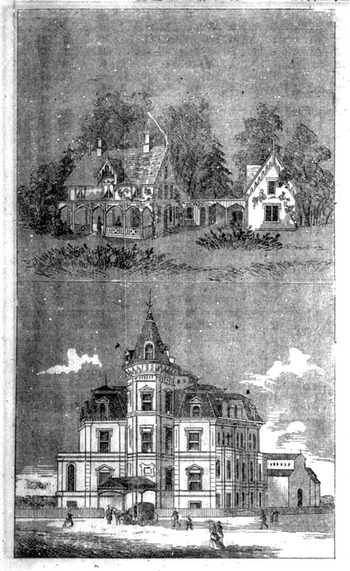
Last but not least, Meiji leaders also legitimized settler migration and land acquisition in Hokkaido by the logic of modern capitalism. In the mind of Tsuda Sen, once in the hand of the Japanese, the land of Hokkaido could be transformed from a wasteland to one of formidable wealth where the Japanese settlers could farm, hunt and engage in commerce.Footnote 30 It would become a precious source of ever-growing wealth, because its earth, river, mineral deposits, flora and fauna were all potential resources for Japan’s nascent capitalist economy. In this respect, too, the American westward migration served as a guidebook. Even though Japan could not yet compete with the United States in terms of wealth, power and progress in democracy and education, Tsuda argued the soil of Hokkaido was as rich as that of North America and its climate was equally suitable for farming. He declared that an ‘America’ would soon emerge from the Japanese archipelago because as Japan’s colonial project continued to develop, material production in Hokkaido would match that in the United States. In particular, he referred the position of Hokkaido in Japan to that of California in the United States. In his mind, California had been no more than an empty land until it became a US territory, yet within two decades of American settlement, blessed with the discovery of gold and tremendous improvement in agricultural technology, California’s population and material products had grown exponentially. Tsuda placed his hope in Hokkaido because he found it comparable to California in terms of both latitude and natural resources; and he envisioned that as Japanese settlers continued to make progress in land exploration, the Ezo of yesterday would become the California of tomorrow. A transformed Hokkaido would become Japan’s own cornucopia; its output would both sustain Japan’s economic growth at home and bring in wealth from abroad through exportation (See Figure 1).Footnote 31
An image in Hokkaido Kaitaku Zasshi paralleling the houses of average farmers and rich farmers in the United States. It idealized the United States as a wealthy nation made by settler colonialism. It aimed to convince the Japanese settlers in Hokkaido that they could become as rich as the Americans if they followed the example of the independent and hard-working American frontiersmen. Source: Hokkaido Kaitaku Zasshi, no. 3 (1888), 49–51.

The American west and colonialism in the Empire of Brazil
Whereas Meiji leaders viewed the US westward expansion as a textbook of emigration-driven settler colonialism in Hokkaido, the Brazilian elites also studied the US experience closely as they designed their own blueprints for expansion in the Southern Cone. Brazil’s history as a colonial territory of the Portuguese Empire could be traced back to the sixteenth century. It did not emerge as an independent geopolitical power until the early nineteenth century. Due to immigration restriction during the centuries-long colonial period, the settler population in Brazil remained relatively small, mainly residing on the East Coast.Footnote 32 The settlers’ efforts to expand into the hinterland had existed since the very beginning of the colonial era. The most noteworthy campaign of their inland exploration was the Bandeirante Movement in the seventeenth and eighteenth centuries that began with slave-hunting and ended with mining.Footnote 33 In general, these activities did not seek to occupy the land itself. However, the Brazilian elites’ ambition for land colonization in the interior region grew rapidly after Brazil declared its independence, especially after Pedro II came to power in 1840.Footnote 34 They began to see colonization of the hinterland as a critical step in the dual process of nation-making and empire-building for the newly independent Brazil.Footnote 35 The ongoing US westward expansion served as a successful example that they could borrow a page from.Footnote 36 Like their Japanese counterparts, the Brazilian elites strove to reproduce the US frontier experience by following the logics of demography, race and capitalism.
First, the Brazilian elites saw population growth as a cornerstone for Brazil’s rise as a modern nation. Similar to the United States of recent past, Brazil had a large territory and a small settler population. Impressed by the role of immigrants played in land exploration in the American West, Rio had an urgent demand for immigrants as the engine of colonization. Given the small size of the existing settler population, Brazilian leaders expected immigrants to assist the government as the state moved to claim its sovereignty over the vast indigenous land it had inherited from the Portuguese crown. As a result, migration, colonization and peopling were often conflated with one another in the minds of Brazilian elites at the time.Footnote 37
In Brazilian elites’ blueprints of empire, race also played a central role. They were convinced by the history of immigration in the United States that only White people could create progress. Henrique J. Rebbello’s 1836 book The Treatise of the Population in Brazil, for example, stressed the urgency to increase Brazil’s population through immigration but also made it clear that only migrants from the ‘civilized’ Europe were welcome.Footnote 38 As subscribers of modern racism, educated Brazilians concluded that the nation’s current backwardness was due to the inferiority of its racial stock, a product of miscegenation between the Portuguese, the indigenous people and African slaves.Footnote 39 They believed that the only way for Brazil to catch up with the United States was to ‘whiten’ the Brazilians through immigration.Footnote 40
Meanwhile, Brazilian leaders also believed that immigration-centred colonization was crucial for Brazil’s economic development and cultural progress. For those who endorsed slavery abolition, immigration was essential for agricultural development. They wanted to model Brazil’s agricultural structure after the United States, preferring small farms to big plantations. As abolition appeared increasingly inevitable, the planters themselves were also warming up to the idea of lenient immigration policies. Though having little interest in turning immigrants into settlers, they believed that immigration could fill the eventual labour vacuum in plantations.Footnote 41
The Brazilian elites’ desire for non-Portuguese White immigrants was evident in the Imperial Constitution promulgated in 1824. One article of the constitution permitted people of all religions to worship privately in this formally Roman Catholic nation. Another article offered Brazilian citizenship to all born in its territory and to women who married Brazilian men.Footnote 42 While this new constitution opened Brazil’s doors to immigrants, the year 1850 marked a decisive moment in the convergence between immigration and settler colonialism. The Queiroz Law, enacted in that year, cut off the major source of slave labour by ending Brazil’s participation in the international slave trade. As labour demand in plantations continued to grow along with the increase in Brazil’s coffee exportation, the ban on the international slave trade made the inflow of free immigrants an economic necessity.
Passed in the same year, the Land Law (Lei de Terras) would allow the government to legally deprive the indigenous peoples of their land by defining it as publicly owned. The Land Law also banned the private acquisitions of such land except through purchase, enabling the government to monopolize the ownership of the land and its distribution. Due to the overall weakness of state power at the time, large planters often ignored this law by claiming new land near their plantations through de facto occupation. Nevertheless, the law did establish a legal basis for the Brazilian government to appropriate indigenous land. Together with the law, the central government created a bureaucratic service, the Repartição-Geral das Terras Púlicas, in charge of managing public land and promoting colonization.Footnote 43 Immigrants were among the main beneficiaries of public land. They were invited into the country and then transported into the inland region, occupying and farming the land there in the decades to come. In essence, they functioned as colonial settlers.Footnote 44
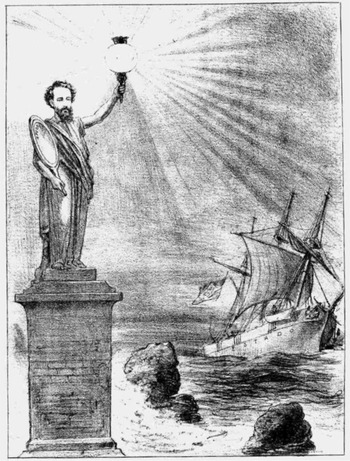
These two important laws represented a turning point in Brazilian history during the mid-nineteenth century, a time when Rio de Janeiro was adopting an increasingly favourable view of immigration. The reasons behind this attitude shift included the modernization of Brazil’s transportation system and the rise of a generation of liberal-leaning intellectuals and politicians who were amazed by the American achievements in modernization and territorial expansion (See Figure 2). They believed that immigrants, like their counterparts in the United States, could serve as agents of progress and civilization for Brazil. In order to make the country more attractive for immigration, they called for a more liberal, open and democratic Brazil by emphasizing local and provincial power, slavery abolition and free trade.
This image is the back cover of an 1877 issue of Revista Ilustrada. It shows how Quintino Bocaiúva, a leading anti-monarchy journalist and politician in Imperial Brazil, envisioned the United States as a model for Brazil’s future nation. Bocaiúva later served as the Brazil’s Foreign Minister after the republican revolution. Source: Revista Ilustrada no. 63 (April, 1877).

In 1866, a group of politicians, journalists and intellectuals formed Sociedade Internacional de Imigração (SII: International Immigration Society), a symbol of the Brazilian liberals’ collective effort towards promoting immigration. The founders of this society believed that immigration was a crucial tool to bring about structural changes in Brazil. They argued that immigrants were both an essential source for non-slave labour and agents of civilization and progress.Footnote 45 However, Brazil’s conservative institutions made the country an undesirable destination of migrants. The society’s mission, as its members envisioned, was to facilitate immigration in through political liberalization in the form of slavery abolition, greater religious freedom and revising existing laws on land and taxation. In addition to calling for these institutional reforms, society members also tried to attract more immigrants through a variety of avenues. Some tried to promote the image of Brazil as a wonderful migration destination, others urged the government to improve transportation logistics for newly arrived immigrants and still others outright became migrant recruiters.Footnote 46 Though the society itself only last for a year due to a lack of governmental support and resources, the words and deeds of its founding members deserve close examination because they represented the aspirations of the liberal-leaning elites, the same group that successfully turned Brazil into a republic by deposing Dom Pedro II. Once in power, the republican government immediately carried out the liberals’ agenda and ushered in the era of mass immigration.
A particularly noteworthy figure was Aureliano Cândido Tavares Bastos, an influential politician and journalist. He was one of the core leaders of SII who had drafted its manifesto. An admirer of the United States, Tavares Bastos believed that the US immigration-driven model of nation-building was the one that Brazil should imitate. A set of far-reaching liberal reforms, including the establishment of a federal system, free trade, the opening of the Amazon and the gradual abolition of slavery, was necessary to attract immigrants.Footnote 47 However, not all foreigners were suitable for Brazil’s grand task. Tavares Bastos’ admiration of the United States made him particularly interested in recruiting US citizens.Footnote 48 The fact that the SII was founded in 1866, only 1 year after the end of the US Civil War, reflected the Brazilian elites’ intention to recruit the Confederate supporters.Footnote 49
The American westward expansion also profoundly shaped the migration recruiting activities of William Scully, another core member of the society, whose primary targets were Europeans. An admirer of the success of Anglo-American settler colonialism in general, Scully believed that the English and the Irish, two major immigrant groups in the United States, were the most desirable for Brazil.Footnote 50 To attract Anglophone immigrants, he named the newspaper that he founded for migration recruitment purpose Anglo-Brazilian Times. The newspaper was published in English and circulated in both Brazil and Europe. Its central message was straightforward: like the United States, Brazil was a land of promise for agricultural settlers. It was similarly endowed with vast terrain, fertile soil and a pleasant climate; there ordinary men could easily acquire land and farming tools and prosper through honest labour.Footnote 51
In addition to attracting the British, the Portuguese, and former US confederates, Brazilian leaders also explored other migration sources. Between 1820 and 1875, they conducted several campaigns to attract immigrants from central and northern Europe as well as Qing China. While none of these campaigns succeeded as planned, the government did manage to bring in 330,000 immigrants overall.Footnote 52 With free land granted by the government, some immigrants indeed became frontier settlers. However, this number was dwarfed by the 9,000,000 immigrants who entered the United States during roughly the same time period. Moreover, over half of the immigrants arrived in Brazil during this period were Portuguese, the majority of whom resided in coastal cities instead of the interior.Footnote 53 Although the last 15 years of the empire saw the arrival of some additional 330,000 immigrants,Footnote 54 compared with the massive influx of immigrants during the time of the First Republic, the immigration policies of this period were far from effective. Nevertheless, neither the idea nor the practice of taking indigenous land through immigration was new in the era of the First Republic. Settler colonialism, as both a political structure and an ideology, had already been firmly established during the imperial era.
Escalated settler colonialism in Brazil and Japan in the 1880s
The decade of the 1880s saw both Brazil and Japan making a substantial leap forward in their practice of settler colonialism, a development that was driven by political and economic changes at both global and local levels. In the Southern Cone, State of São Paulo’s coffee economy continued to expand. This led to not only further encroachment of indigenous land but also a series of institutional changes that resulted in a mass influx of immigrants. Meanwhile, in East Asia, the Meiji government made policy changes that opened the gate for Japan’s emigration-driven expansion overseas. These developments eventually brought the diplomats of the two settler colonial regimes to the same table to discuss Japanese migration to Brazil.
Commercial coffee cultivation in Rio de Janeiro first started in the late eighteenth century, and the beans quickly became a major source of wealth in Brazil’s export-centred economy. By the 1850s, half of the country’s export revenue came from coffee. In the 1860s, thanks to the sale of coffee, the Brazilian empire finally achieved a positive trade balance.Footnote 55 The expansion of coffee cultivation also brought about monumental economic and political changes. During the first half of the nineteenth century, Rio de Janeiro remained the central state for coffee cultivation and the City of Rio continued to be the central port for coffee exportation. By the middle of the century, however, coffee cultivation had expanded southward to São Paulo and Minas Gerais. By the century’s end, the State of São Paulo had overtaken Rio de Janeiro to become the new coffee centre. The rise of São Paulo in the coffee economy was accompanied by the emergence of a new mode of coffee production. Traditional coffee fazendas, represented by those in Rio, were supported almost exclusively by slave labour. However, because the abolitionist movement increasingly gained momentum, the new coffee planters in São Paulo turned to immigrants as an alternative source of labour. As coffee cultivation in the State of São Paulo expanded westward into the inland region, the reliance on immigration labour only increased.
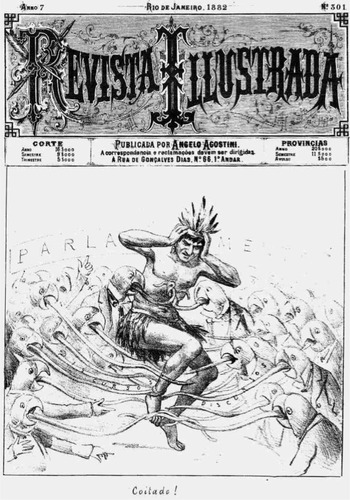
The westward expansion of coffee cultivation was made possible by the construction of railway in the state. Since the formation of the São Paulo Railway Company at the turn of the 1860s, several railway lines began to link the state’s interior region with the City of São Paulo and then to the Port of Santos.Footnote 56 New railway lines kept pushing the frontier of the coffee economy westward and northward, making the transportation of coffee and goods between the eastern coast and inland possible. In the name of law, more and more indigenous land was taken by coffee growers (See Figure 3). The rapid appropriation of indigenous land could be measured by the increase of coffee trees in the state: in 1870, there were 70 million coffee trees; in 1880, 106 million; in 1890, 200 million; and in 1900, the number hit 600 million.Footnote 57
This is the front cover of an 1882 issue of Revista Illustrada. An independent cartoon magazine based in the capital Rio de Janeiro, Revista Illustrada was one of the most influential humour periodicals focusing on contemporary politics in Brazil at the end of the nineteenth century. The image shows that the speeches and debates in the imperial parliament of the day only led to further deterioration of the indigenous people’s condition. The caption reads: ‘Poor thing!’ Source: Revista Illustrada, no. 301 (1882).

The coffee boom in São Paulo also hastened the political rise of the liberal-leaning Brazilian elites. Seeing the United States as a role model of nation-building, they were advocates for both slavery abolition and mass immigration. Two organizations for immigration promotion emerged in the 1880s as a result of their efforts. Of the two, Sociedade Central de Imigração (SCI, the Central Immigration Society) called for an increase of governmental subsidies to attract immigrants, hoping that increased immigration would foster the growth of the small farm economy.Footnote 58 The large coffee plantation owners and their supporters, on the other hand, formed Sociedade Promotora de Imigração (SPI, the Immigration Promotion Society). Its members opposed governmental subsidies on immigration and believed that only private funds should be used for this purpose. While these two societies represented the divergent interests of two very different social groups, they both functioned as key immigration recruiting and promoting organizations that enjoyed governmental support. In addition to seeing immigration as the primary labour source for the booming coffee economy, members of both societies believed that immigration was essential to claim and occupy the vast land in the interior and to whiten the Brazilian racial stock.Footnote 59
With military support, the liberal-leaning faction eventually brought the empire, already exhausted by the Paraguayan War, to an end in 1889. Brazil’s transition into a republic, along with the abolition of slavery, marked the political ascendency of its southern coffee elites, especially those from the State of São Paulo. The establishment of the First Republic further stimulated immigration, a process that was already under its way in the final years of the empire. As SPI and SCI continued to function towards the end of the century,Footnote 60 funds to subsidize immigration, drawn from both public and private sectors, grew steadily. As a result, the republic would receive 2.6 million immigrants within the next three decades. Nevertheless, the Japanese were initially deemed as undesirable. Merely a year after its formation, the new regime banned the immigration of Africans and Asians,Footnote 61 as its leaders considered these two groups racially inferior and believed they would only degrade Brazil’s racial stock. Yet the republic soon reopened its doors to Asian immigrants in 1893 due to a pressing demand for coffee labour. In response to the Meiji empire’s overall successful westernization and expansion in East Asia, Rio turned to the Japanese as a more palatable alternative to the heavily maligned Chinese.Footnote 62
Meanwhile, on the other side of the globe, Japanese expansionists had begun to look beyond Hokkaido to search for migration destinations overseas. Brazil, likewise, was not their first choice. The Meiji government had first sponsored Japanese labour migration to the Kingdom of Hawai‘i in 1885. The American westward expansion had inspired Japanese expansionists to also view the American West itself as an ideal target of Japanese expansion. In the mind of Fukuzawa Yukichi, one of the most influential intellectuals in Meiji Japan, what made the United States especially attractive was not its material wealth but its recent experience of westward expansion. Fukuzawa described the United States as an expanding nation that kept on opening up new land through frontier conquest and migration. He believed that the Japanese should follow the example of the Europeans by migrating to this land of promise and participate in US frontier expansion as colonial settlers. One day, he envisioned the offspring of Japanese immigrants would gain political rights in the United States and sway American politics. Starting from the United States, Japan’s overseas migrants—and their descendants—would establish ten or even twenty settler nations, which he called ‘new Japans’, around the world.Footnote 63
Fukuzawa put his ideas into action. He did not achieve much success with his campaigns to relocate Japanese subjects to the US West Coast, but a number of students from his Keiō School did manage to land in San Francisco. In 1888, they formed the San Francisco chapter of the Keiō Alumni Association with thirty-five initial members.Footnote 64 During the 1880s and 1890s, many educated youth, like these Keio students, had reached the US West Coast alongside Meiji Japan’s political dissents. Together, they constituted the bulk of the elite circle of Japanese American communities of the day.Footnote 65 Although holding divergent political views, they all saw the United States as both a land of promise for individual success and a frontier for Japanese expansion.
The Japanese settlers’ experience at the frontier of the American westward expansion confirmed the intrinsic ties between migration and colonial expansion in their minds. However, those who hoped to pursue a colonial dream in the American West were soon disillusioned by rampart local racism against Asian immigrants. Some took the institutionalized Chinese exclusion and the rise of anti-Japanese sentiment in the United States at the end of the nineteenth century as an announcement that the White settlers had monopolized North American land. As a result, the United States was no longer an ideal target of expansion. Instead, the Japanese should make haste to occupy the supposedly unmarked and unowned territories in the South Seas and Latin America; once they staked their claims of ownership, they could exclude other races just like the White Americans were now doing.Footnote 66 Of course, in the minds of Meiji expansionists, only the ‘civilized’ races were qualified to compete for land ownership. Aboriginal peoples such as Native Americans and the Pacific Islanders were, like the Ainu in Hokkaido, uncivilized races who had no right to the land they were wasting. It was at this time that Brazil caught the interest of Meiji expansionists.
From Mexico to Brazil
The central figure behind the ideas and practices of Japanese expansion to Latin America was Enomoto Takeaki. After serving as a high-rank official during the colonization of Hokkaido in the 1870s, Enomoto rose to a series of key cabinet positions in the Meiji government by heading the Ministries of Communications (1885–89), Education (1889–90), Foreign Affairs (1891–92), and finally Agriculture and Commerce (1894–97).Footnote 67 Believing that national strength could only be achieved through frontier conquest and colonial expansion, Enomoto made a few unsuccessful attempts to purchase the Mariana Islands, the Palau Islands and Borneo as early as the mid-1870s.Footnote 68 To promote studies on the Pacific Rim with colonial ambitions in mind, he helped to establish the Tokyo Geographical Society (Tokyo Chigaku Kyōkai) in 1879, modelled after the Royal Geographical Society in London.Footnote 69
A decisive step that Enomoto made in his promotion of Japanese expansion in Latin America was the formation of the Colonial Society (Shokumin Kyōkai) in 1893, the same year when the First Brazilian Republic reopened its doors to Asian immigration. As Japan’s first nationwide organization to facilitate overseas expansion, members and donors of the Colonial Society came from a variety of social backgrounds and political causes. Their ranks included politicians and bureaucrats, owners and employees of migration companies, journalists and business elites. However, they were unified in their acceptance of the convergence between emigration and settler colonialism, and they shared a belief in the urgent need for Japan to participate in the scramble of land and resources through overseas migration.Footnote 70 The society diligently disseminated information and ideas for overseas expansion by hosting public lectures and publishing the official journal, Reports of the Colonial Society (Shokumin Kyōkai Hōkoku). It also sponsored investigative trips and expeditions around the Pacific Rim. Facilitating Japanese migration to Mexico was among the first missions of the society.
In 1891, 2 years before the formation of the Colonial Society itself, Enomoto had already begun exploring the possibilities of Japanese expansion in Mexico by taking advantage of the Mexican government’s policies to attract immigrants and international investment.Footnote 71 In the same year, under his leadership, the Ministry of Foreign Affairs established the Japanese consulate in Mexico City, which collected local information in order to facilitate migration planning. Fujita Toshirō, the Japanese consul in Mexico, investigated Sonora, Sinaloa and Chiapas in order to evaluate their suitability for Japanese migration.Footnote 72 Fujita hired D.W. Jones, an American expert, as a translator and advisor for this project. Jones convinced Fujita that Mexico was endowed with fertile land and limitless natural resources. He reasoned that because the majority of existing residents were Native Americans who were backward and inferior, Mexican land could be considered empty and open. Jones suggested that Japanese settlers should purchase land along the Mexican West Coast, where they would settle and prosper.Footnote 73 In his report to Tokyo, Fujita also pointed out the importance of coffee cultivation as a promising business for potential Japanese colonies in Mexico.Footnote 74
In 1893, the Colonial Society dispatched its secretary Nemoto Tadashi to southern Mexico to conduct another survey, and Nemoto pointed to Chiapas as the best region to establish Japan’s first colony in Mexico. After a few more inspections and years of negotiation, Enomoto and the Colonial Society eventually garnered sufficient financial and political support to complete a land purchase with a 15-year loan from the Mexican government. They established the first Japanese settler community in southern Chiapas in 1897 known as Enomoto Colony. This colonial project intended to relocate Japanese subjects to Mexico as agricultural settlers who would make a living by cultivating coffee and other tropic crops.
Though Enomoto Colony quickly ran into trouble and collapsed due to a lack of financial backup and labour shortage,Footnote 75 the efforts of Enomoto and his followers marked the starting point of Japanese expansion in Latin America. During his trip to Mexico in 1893, Nemoto also investigated Peru as another potential destination of Japanese migration.Footnote 76 The next year, following the first meeting between Japanese and Brazilian diplomats in San Francisco, Tokyo dispatched Nemoto to investigate Brazil. Nemoto reached Rio de Janeiro in September 1894 and, in the next few weeks, toured Brazilian coastal states such as Pernambuco, Bahía, Minas Gerais and São Paulo. Unsurprisingly, he was most impressed with São Paulo. There he was not only warmly welcomed by the governor but also amazed by the developed transportation system and the facilities in the Port of Santos to accommodate immigrants.
In his report to Tokyo, Nemoto concluded that the Brazilian East was a perfect alternative to the American West as a destination of Japanese migration. Just like the United States, he reasoned, Brazil was endowed with vast and rich land. Among its most prosperous states along the East Coast, São Paulo was particularly promising. Its climate was as pleasant as San Francisco and its vast land had boundless potential to accommodate the Japanese migrants, who could easily settle down and expand their communities.Footnote 77 Encouraged by Nemoto’s report, the Meiji government and migration companies began to earnestly explore the possibility of migration to Brazil. Their Brazilian counterparts, including government officials, planters and migration recruiters, were likewise awash with enthusiasm. Thus began the negotiations. After a few failed attempts, the first official group of Japanese migrants eventually reached the shore of São Paulo in 1908 via the ship Kasato Maru, 1 year after the United States shut its doors to Japanese labour migrants through the Gentlemen’s Agreement.
The colonial nature of Japanese migration could be further testified by the sail of Kasato Maru itself. On the surface, this first group of immigrants appeared no more than contract labourers who simply filled the labour vacuum in Brazil’s coffee plantations created by slavery abolition. Among the 793 migrants on board, all but twelve had signed labour contracts with São Paulo’s coffee planters.Footnote 78 However, the initial agreement on the migration actually required the government of São Paulo to establish colonies for these Japanese migrants along the state’s central railway line so that they could purchase land at a low price. This was because the Japanese government, which had actively supported the Kasato Maru migration campaign, expected these migrants to eventually settle down in Brazil as landowning farmers once their labour contracts ended.Footnote 79
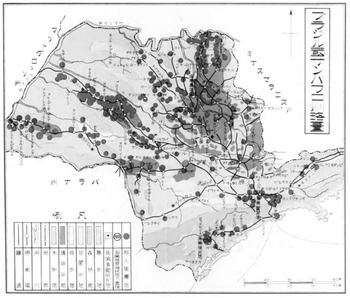
The historical trajectory of Japanese migration and settlement in Brazil in the first half of the twentieth century, too, reveals the colonial aspect of the migration in two ways. On the one hand, the growth of Japanese settler communities in the State of São Paulo took place in tandem with the rapid expansion of coffee zones from the state’s southeastern region to its northern and western borders (See Figure 4). During this process, indigenous forests and lands were claimed by the state government and sold to coffee growers and farmers in an unprecedented speed. Japanese immigrants, who arrived in the state either as contract labourers or farmers, served as an engine of this escalated wave of indigenous dispossession and were among its main beneficiaries. Sponsored by Tokyo, a number of Japanese business tycoons and migration companies also played a role in the land colonization in the Amazon River Basin.Footnote 80 On the other hand, Japanese empire-builders celebrated the experience of Japanese migration and settlement in Brazil as a success story of settler colonialism and used it to promote Japanese migration to Manchuria in the 1930s.Footnote 81 Some Japanese community leaders in Brazil also moved back to Asia and became brains and arms of the empire’s emigration-driven expansion in China and Southeast Asia.Footnote 82
A map that illustrated the information of Japanese settler communities in the State of São Paulo in the early 1930s. Kaigai Kōgyō Kabushiki Gaisha, Kaigai Kōgyō Kabushiki Gaisha Gensei Yōran (Tokyo: Kaigai Kōgyō Kabushiki Gaisha, 1932).

Conclusion
This article has explained how the American westward expansion inspired settler colonialism in both Meiji Japan and post-independence Brazil. These two countries’ respective paths of settler colonialism eventually crossed when their diplomats made contact in 1893 regarding Japanese migration to Brazil. The convergence of Meiji Japan and post-independence Brazil in their nineteenth-century expansion deepens our understanding of the history of Japanese migration to Brazil in two ways. First, it demonstrates that both the intellectual and political origins of the migration should be traced back to the nineteenth century, decades before the sail of the Kasato Maru, hitherto the commonly accepted starting point of the migration. Second, the migration itself, from its very inception, should be understood within the contexts of settler colonial expansion of both Japan and Brazil.
Meiji leaders believed that the Japanese, people of a civilized race like the Anglo-Saxons, had its own manifest destiny to fulfill. The empire’s expansion started with the colonization of Hokkaido through the migration of Japanese settlers to its northern frontier. During the 1880s, it turned to the American West and later Latin America as destinations of Japanese emigration. In the Southern Cone, Brazilian elites saw immigration-driven colonization as a primary means for Brazil’s own project of nation-building. For the liberals who established the First Republic in 1889, immigration meant much more than simply meeting the growing labour demand in coffee plantations. An influx of racially superior people, they believed, would not only improve the existing Brazilian racial stock but also turn Brazil’s hinterland into sources of wealth and power for the expanding nation.
From both the sending side and the receiving side, respectively, leaders of Meiji Japan and post-independence Brazil alike saw migrants as agents of colonialism. Both regimes had embarked the processes to institutionally dispossess indigenous peoples of their ancestral land through migration. These processes were marked by the promulgation of the Land Law of 1850 in Brazil and the Land Regulation Ordinance of 1872 in Japan. Both laws defined the land owned by indigenous peoples as public and allowed the government to legally appropriate and re-distribute it to migrants.
A comparison between the migration organizations established in the Empire of Brazil and Meiji Japan reveals yet another surprising parallel between these two colonial powers on the opposite sides of the globe. Established by Brazilian elites in different times of the nineteenth century, organizations that promoted immigration, such as SII, SCI and SPI, all aimed to attract White immigrants to Brazil as agents of civilization and land colonization. The Colonial Society, established in Tokyo in 1893, on the other hand, took upon the mission of facilitating Japan’s emigration-driven expansion overseas. In both Japan and Brazil, the composition of these migration societies’ membership revealed an indelible link between migration and colonial expansion in the minds of their sociopolitical elites.
This study focuses on the historical convergence between Japan and Brazil in the nineteenth century under the influence of the US westward expansion. Nevertheless, it goes without saying that fundamental differences existed between the historical paths of these three countries. Recognizing their differences in culture, society and ecosystem is to recognize the obvious. Therefore, it is only natural that even in their reproduction of the American frontier model, Japan and Brazil adopted distinct approaches, namely the emigration-driven and the immigration-driven approaches, respectively. Yet, by illustrating the comparability and connections between Japan and Brazil, this article reveals not only the global impact of the American westward expansion but also the historical convergence between East Asia and Latin America in the rivalry of modern empires. It challenges the nation-based historical understanding of Meiji Japan and post-independent Brazil. It also further highlights the contexts of settler colonialism in both East Asia and Latin America that set up the stage for Japanese migration to Brazil at the beginning of the twentieth century.