Introduction
Nutrition has been implicated as an underlying factor in ‘programming’ body composition through foetal and postnatal growth.Reference Sayer, Syddall and Dennison1, Reference Dennison, Syddall, Sayer, Gilbody and Cooper2 Under-nutrition in early life may trigger cellular, endocrine and genetic adaptations that are capable of permanent modifications on morphology and physiology to fit the forecasted environment, and may have adverse effects on body composition if there is an environmental mismatch in later life.Reference Bateson, Barker and Clutton-Brock3 Body composition, in turn, is linked to the development of chronic and metabolic non-communicable diseases (NCDs) such as type 2 diabetes mellitus, cardiovascular disease, metabolic syndrome, sarcopenia and osteoporosis.Reference Wells and Fewtrell4
Recent epidemiological studies confirm that South Africa is going through a rapid nutrition transition evidenced by the coexistence of under- and over-nutrition, both of which are accompanied by physical changes in body composition.Reference Zingoni, Norris, Griffiths and Cameron5 South Africans therefore face a multifaceted burden of disease from infectious diseases, like human immunodeficiency virus/acquired immunodeficiency syndrome, and nutrition-related non-communicable diseases (NR-NCDs). In addition, the prevalence of under-nutrition in children is still high in low- and middle-income communities (LMICs), like South Africa.Reference Jinabhai, Taylor and Sullivan6, Reference Kruger, Puoane, Senekal and van der Merwe7 Malnutrition and growth faltering during the prenatal and infant periods have been reported to be associated with subsequent high fat mass and low lean mass in high-income countries (HICs).Reference Gale, Martyn, Kellingray, Eastell and Cooper8 Despite the importance of assessing early life predictors of subsequent body composition in LMICs, such studies have been limited by the lack of longitudinal birth cohorts. Therefore, this study aims to investigate whether infant nutrition, anthropometry and infant growth are associated with pre-pubertal body composition in urban black South African children enrolled in a longitudinal birth cohort.
Subjects and methods
Subjects
Subjects were recruited from the Birth-to-Twenty cohort, a longitudinal study of health and development of children born within a 7-week period (April 23–June 8, 1990) in the greater Johannesburg metropolitan area in South Africa.Reference Richter, Yach, Cameron, Griesel and De9 At ages 9/10 years, a sub-sample from the cohort (n = 429) was enrolled into a longitudinal study assessing factors influencing bone mass acquisition and health (Bone Health Study).
For the purposes of this study, only the black children enrolled into the Bone Health cohort where considered for the study sample because we measured dual-energy X-ray absorptiometry (DXA)-derived body composition only on this sub-cohort. Consequently, the analytical sample comprised of participants, who had infant feeding and nutrition measures at ages 1 and 2 years, body composition assessment using DXA at age 9/10 years, and who were pre-pubertal according to Tanner staging,Reference Tanner and Whitehouse10 constituted the study (n = 140, 54% male). Those who had missing data were excluded from the study sample.
Infant feeding data
Infant feeding data were collected at 1 year of age and classified according to duration (months) of predominantly breastfeeding or bottlefeeding, and the month of age when solids were introduced.
Dietary patterns
The nutritional adequacy of the weaning diet was assessed using the dietary diversity score (DDS) and the food variety score (FVS) calculated from a retrospective non-quantified food frequency questionnaire (FFQ) completed by the caregivers of the infants at age 1 year. DDS was defined as the number of food groups consumed by the infant in a 24-hour recall period.Reference Steyn, Nel, Nantel, Kennedy and Labadarios11 FVS was defined as the number of different food items consumed over a 24-h recall period.Reference Hatloy, Torheim and Oshaug12
Anthropometry
Birth weight data were collected from birth notification records of all births registered in the municipal area. Length at 1 and 2 years of age was measured with a Harpenden tape to the nearest millimetres and weight at the same time points was measured using a digital scale to the nearest 0.1 kg. z-Scores were calculated using the World Health Organization (WHO) growth standards and z-scores <−2 for height-for-age (HAZ), weight-for-age (WAZ) and weight-for-height were classified as stunted, underweight or wasted, respectively.13 Furthermore, change in WAZ z-score (WAZ change) in infancy was computed in STATA as WAZ (at age 1 or 2 years) minus birth weight z-scores. Height change in infancy was defined as HAZ at age 2 years minus HAZ at age 1 year. Pre-pubertal height was measured using a stadiometer (Holtain, Crosswell, UK) and recorded to the nearest millimetre. Pre-pubertal weight was measured using a digital scale (Dismed, USA) to the nearest 0.1 kg. Body mass index (BMI) z-scores were also generated using the WHO growth standards.
Body composition
Whole body DXA; Hologic QDR4500A, Waltham, MA, USA (software version 11.2) was used to measure whole body fat, lean (fat free soft tissue) and bone mass, excluding the head.Reference Gordon, Bachrach and Carpenter14
Socio-demographic factors
Socio-economic status (SES) measures that were collected from the primary caregiver at 1 year of age included marital status, maternal education and household environment (water usage, water type, house ownership, type of house and availability of electricity).
Statistical analysis
STATA version 10 was used for all statistical analyses. The continuous variables were summarized by gender in tables as number of observations, mean, standard deviation and P-values at a 5% level of significance using a t-test. Some of the variables were categorized, recoded, labelled and cross-tabulated to give proportions for each gender in percentages and frequencies plus the P-values using a Pearson's χ 2-test. This test also was used to check selection bias of the study sample with respect to the analytical study sample and the Birth-to-Twenty cohort excluded from the analyses. Scatterplots and histograms were used at initial exploratory stage to familiarize with the data. We explored multiple bivariate associations between each of the early life factors and pre-pubertal BMI and fat, lean and bone mass, using linear regressions to determine possible exposures to include in the multiple linear regression models. DXA-derived body composition data were not normally distributed, and thus were log-transformed. Linearity was tested by comparing fitted and predicted residuals for the independent variables. Consequently, the multiple linear regression models assumptions were fulfilled. Multiple linear regressions were completed at 1% level of significance to allow for multiple testing. For the multiple linear regressions, we adjusted the significant bivariate analyses for confounders, namely sex, SES and current height (except for BMI z-score models) to determine the independent contribution of each exposure variable to respective outcome variables and the regression coefficient, confidence interval plus standard errors and effect sizes were tabulated. The log-transformed variables were then back-transformed for the sake of interpreting the models in actual measurement units in the text.
Ethical considerations
Ethics approval was obtained from the University of the Witwatersrand Human Research Ethics Committee (Certificate no: M090420). Informed consent was obtained from caregivers or parents at all points of data collection.
Results
Characteristics of study sample
We examined for potential analytical sample bias and found that there were no significant differences with respect to key demographic and childhood characteristics at birth between the study sample and black participants from the Birth-to-Twenty cohort who were not included (Appendix 1) except that the mothers in the study sample were younger than those from the entire Birth-to-Twenty black sample, which implied that they had fewer pregnancies and fewer numbers of children than in those in the study sample.
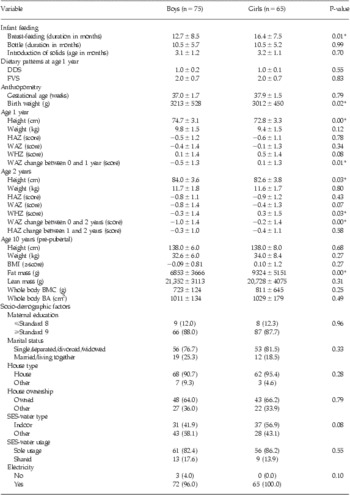
Subject characteristics are presented in Table 1. There was a significant difference in breastfeeding duration with boys being breastfed for a significantly shorter period (12.7 months) than girls (16.4 months). None of the other infant feeding data or dietary patterns was different between the sexes.
Study sample characteristics

DDS, dietary diversity score; FVS, food variety score; HAZ, height-for-age; WAZ, weight-for-age; WHZ, weight-for-height; BMI, body mass index; BMC, bone mineral content; BA, bone area; SES, socio-economic status.
Values are presented as mean ± s.d. for continuous variables and number (%) for categorical variables. Variable categories were rounded off to the nearest one decimal place therefore may not sum to 100%.
Birth weight was significantly higher in the boys and they were also taller at 1 and 2 years of age than the girls. Boys were also significantly lighter for their height than girls at 2 years (P ⩽ 0.05). Girls grew closer to their expected trajectories than boys. Boys tended to fall off their weight trajectories. On the contrary, there was no significant sex difference in change in HAZ score between ages 1 and 2 years (P ⩽ 0.05).
At 10 years of age, girls had significantly greater fat mass than boys, but there were no significant differences in height, weight or lean mass between the sexes. There was also no difference in whole body bone mineral content and bone area between the boys and girls at 10 years of age. Stunting, wasting and underweight at 1 year were 8.6% (n = 12), 3.6% (n = 5) and 8.6% (n = 12), respectively. This increased nearly two-fold at age 2 years: 15.7% (n = 22) stunting, 8.6% (n = 12) wasting and 16.4% (n = 23) underweight in this study sample. There were no sex differences in the socio-economic variables at age 1 year in this study sample.
Association between infant nutrition and body composition
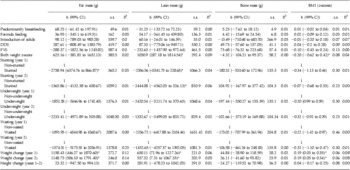
The results of the bivariate and multiple linear regression analyses are presented in Tables 2 and 3, respectively. None of the infant feeding variables or dietary scores were significantly associated with body composition at 10 years of age (Table 2).
Bivariate correlations exploring the association between early life variables and pre-pubertal body composition in black South African children from the Bone Health sub-study (n = 140)

BMI, body mass index; s.e.,standard error; CI, confidence intervals; DDS, dietary diversity score; FVS, food variety score.
The values are from bivariate linear regressions for continuous variables are presented as regression coefficients, 99% CI and the s.e. and R 2 and for categorical exposure variable, one represent the reference group at *P ⩽ 0.01 level of significance.
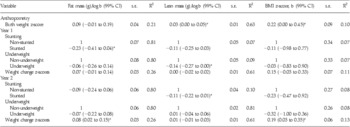
Independent multiple linear regression exploring the association between exposures and pre-pubertal body composition in black South African children from the Bone Health sub-study (n = 140), adjusted for sex, current height (except for BMI z-score) and SES at age 1 year

BMI, body mass index; SES, socio-economic status; CI, confidence intervals; s.e., standard error.
The values are from multiple linear regressions for continuous variables and are presented as regression coefficients, 99% CI, s.e., R 2 and the P-value (*significant at P ⩽ 0.01).
For categorical exposure variables, one represents the reference group.
Association between infant anthropometry and body composition
Birth weight was significantly associated with lean mass and BMI z-score at 10 years, even after adjusting for confounders (Table 3). A one-birth weight z-score increase was associated with a 1051 g increase in lean mass and a 0.22 increase in BMI z-score at the age of 10 years. The models accounted for almost 63% (r 2 = 0.63) and 10% (r 2 = 0.10) of the variance in the lean mass and BMI z-scores, respectively.
Those who were stunted at age 1 year had 1259 g lower fat mass at 10 years of age compared with their non-stunted counterparts (P < 0.01).
Stunting at 2 years of age was only significantly associated with lean mass at 10 years in the multiple linear regression model with those stunted having 1116 g lower lean mass compared with the non-stunted children. Underweight at age 1 year was associated with lower pre-pubertal lean mass after adjusting for confounders, whereas the associations between being underweight at age 2 years and the body composition measures were statistically insignificant.
Wasting at 1 and 2 years of age did not significantly predict any of the pre-pubertal body composition outcomes. A one z-score increase in WAZ change at age 2 years was significantly and positively associated with fat mass and BMI z-scores but not lean and bone mass at 10 years of age (P < 0.01). An increase in the WAZ z-score by one between birth and 2 years of age was associated with a 1083 g and 0.19 increase in fat mass and BMI z-scores, respectively, in the multiple linear regression models. HAZ z-score change from age 1 year to 2 years was not a predictor of any of the body composition measures in both models.
Discussion
In the present study, we have shown in a longitudinal cohort of children living in an LMIC that birth weight was positively associated with lean mass and BMI at 10 years of age. We also found that those children who were stunted in the 1st year of life had markedly lower fat mass at pre-puberty compared with their non-stunted counterparts, whereas stunting at 2 years of age only influenced lean mass at 10 years. Our study also showed that being underweight at age 1 year significantly predicted lower lean mass at 10 years. In the current study, larger WAZ change values, but not HAZ change values, were significantly associated with higher fat mass and BMI z-scores at 10 years of age. This study did not find any associations between infant dietary patterns or wasting and pre-pubertal body composition, likely because of the generally poor quality of the diet as assessed by the DDS and FVS scores.
We have shown an association between birth weight and lean mass at 10 years of age, a finding similar to those of other studies,Reference Cooper, Cawley and Bhalla15–Reference Gigante, Horta, Lima, Barros and Victora18 suggesting that the trajectory of muscle growth is set in prenatal life. The R 2 from the models showing the association between birth weight and lean mass changed from 0.09 to 0.63 after adjusting for confounders implying that gender, current height and SES markedly alter the association. This finding conflicts previous reports that suggest that foetal influences reflected in birth weight could program different body components independent of the postnatal environment.Reference Gale, Martyn, Kellingray, Eastell and Cooper8 In the present study, we also found a significantly positive association between birth weight and pre-pubertal BMI. Some reports that suggest that a higher birth weight is associated with an increased risk of obesity have used BMI as a surrogate measure of adiposity.Reference Okosun, Liao, Rotimi, Dever and Cooper19, Reference Parsons, Power and Manor20 In this study, we included BMI z-scores to gain insight into its association with infant nutrition and growth since it has recently gained public health attention as it has been reported to be correlated to cardiovascular disease risk and other chronic diseases. However, BMI is a measure of weight in proportion to height and it does not distinguish between muscle, bone and fat mass. Therefore, we made use of DXA-derived body composition, which provides a better estimation of each body component to assess the associations. In this longitudinal study, birth weight was significantly and positively associated with lean mass rather than fat mass or bone mass, and therefore we suggest that the positive association between birth weight and BMI could have been mediated by programming of greater lean mass rather than fat mass.
Our study suggests that stunting in the 1st year of life has a greater influence on pre-pubertal fat mass than stunting at 2 years of age. On the other hand, stunting at age 2 years has a significant impact on lean mass compared with the 1st year of infancy. Infancy is a period marked by rapid growth, which puts high demands on nutrition, thus any nutritional insult during this period could lead to metabolic programming that allocates cells to different body components (fat, lean or bone) for survival resulting in stunted growth.Reference Gale, Martyn, Kellingray, Eastell and Cooper8 Permanent adaptations of these components might be detrimental to health in later life. In our study, stunting, a measure of linear growth retardation and an established indicator of chronic under-nutrition, predicted lower fat and lean mass pre-pubertally. Contrary to other studies from HICs,Reference Martins, Hoffman and Fernandes21, Reference Sawaya and Roberts22 which have shown that those who were stunted as infants gain less lean mass and more fat mass compared with the non-stunted counterparts, our data did not show any evidence that those children who were stunted in infancy were more likely to have higher fat mass. Our findings are consistent with those from a low-income study cohort in Kingston, Jamaica.Reference Walker, Gaskin, Powell and Bennett23 In the Kingston study, researchers found that children aged between 7 and 11 years who were stunted between 9 and 24 months of age, had lower fat mass than those who were not stunted. Previously, our colleagues using data from the Birth-to-Twenty study reported significant associations between stunting at 2 years of age and total fat and total tissue, but not lean mass, at 7–9 years of age, with those who were stunted having lower fat mass.Reference Cameron, Wright, Griffiths, Norris and Pettifor24 The discrepancy between the findings from these studies and those in HICs could possibly be explained by the fact that the black South African children, who made up the majority of our study cohort, like the Jamaican sample,Reference Walker, Gaskin, Powell and Bennett23 were from a low-income area with a low household food security, or that they had not yet reached puberty, an important time for fat mass accrual.
In the current study, we have shown that those who were stunted and underweight in infancy had lower lean mass at age 10 years compared with their non-stunted counterparts. Low muscle mass impairs physical work capacity and could have profound implications for productivity in physically demanding careers, which could have economic development implications in LMICs like South Africa.Reference Haas, Murdoch, Rivera and Martorell25 We also found that wasting in infancy, though showing a tendency towards lower fat, lean and bone mass had no significant effect on any of the body composition measures in this longitudinal study. Wasting in children implies failure to gain weight and is often associated with poor physical and physiological development.Reference Copeland26 To disentangle the combined effect of weight and height on body composition, we further investigated the association between WAZ and HAZ changes in infancy and later body composition. The study showed that WAZ change but not HAZ change during the first 2 years of life was positively associated with all the body composition measures. However, the associations only remained for fat mass and BMI after adjusting for confounders. Underweight for age at 1 year was associated with reduced lean mass at 9/10 years. Yet, a gain in WAZ change was associated with an increase in fat mass. These findings are consistent with another study that found a positive association between weight gain in infancy and BMI and fat mass in 19-year-old Dutch children.Reference Euser, Finken and Keijzer-Veen27 Although we did not show an association between height change between 1 and 2 years of age and body composition at 10 years, a study from Guatemala found a positive association between HAZ z-score change from birth to 2 years of age and lean mass but not fat mass in adults.Reference Corvalan, Gregory, Ramirez-Zea, Martorell and Stein28 These findings might imply that an increase in WAZ change in infancy predicts body fatness, whereas HAZ change in infancy may programme lean mass.
We did not show any association between infant feeding or dietary patterns, and pre-pubertal composition. This may be as result of how infant feeding and dietary data were captured; the FFQ data were collected retrospectively and hence we cannot rule out measurement error and recall bias as has previously been reported.Reference Crozier, Inskip, Godfrey and Robinson29, Reference Bingham, Day and Luben30 Several studies have failed to find consistent results in the association of infant feeding with growth and later body composition due to confounding.Reference Butte, Wong, Hopkinson, Smith and Ellis31, Reference Davis, Weigensberg and Shaibi32 However, considering the importance of nutrition in early life growth, there is a need to improve on data collection accuracy and reporting to unpack the possible long-term health benefits of infant feeding practices. The most important strength of this study was the use of longitudinal data from the Birth-to-Twenty study cohort. It allowed us to check associations of early life growth, nutrition and socio-demographic variables with subsequent growth patterns and body composition at 10 years of age in pre-pubertal children in a developing country undergoing a dramatic socio-economic and nutrition transition.
We acknowledge one of the major limitations of this study is incomplete anthropometric data at delivery. Therefore, we could not compute height change from birth but could only assess height change between 1 and 2 years of age. We also lost a number of participants from the Bone Health sub-study data because of missing early life data; hence, the precision of our findings was compromised. Quantifying the FFQ to estimate energy and nutrition intake could have given more insight into infant nutrition rather than use of dietary scores. Examining numerous exposure variable associations between early life factors and pre-pubertal body composition increases type 2 errors. However, we lowered the significance level to P < 0.01 to compensate for multiple testing so as to minimize type 2 errors. The DXA-derived data were skewed; hence, log-transforming complicated the interpretation of regression outputs, and thus the data had to be back-transformed.
Of importance is the implication of these findings for LMICs undergoing socio-economic and nutrition transition. Our data showed that growth faltering in infancy resulted in lower fat and lean mass at pre-puberty. As the nutrition transition wave intensifies in South Africa, we speculate that the same group could be at a higher obesity risk if they are exposed to over-nutrition during adolescence. In addition, weight changes in infancy are positively related to measures of body fatness at pre-puberty, independent of SES or sex, implying that this study population might have already been programmed towards obesity risk, and this speculation needs confirmation with further longitudinal data into adulthood.
Maternal nutrition should also be a public health priority involving intervention programmes that target women of reproductive age and nutrition counselling prior to conception and during pregnancy for optimal birth outcomes such as birth weight. We recommend optimal weight gain in infancy to reduce later obesity risk. However, because of inconsistency in our findings with other studies around the programming of body composition by early nutrition, it might be premature to make policy recommendations at this stage regarding infant feeding. In conclusion, our study has highlighted some evidence of programming of body composition at 10 years of age with the key findings that birth weight consistently predicted higher lean mass and BMI only, and stunting and being underweight in infancy did not show any tendency towards higher fat mass but rather reduced fat mass at pre-puberty. Change in WAZ z-score in infancy programmed body fatness but not bone or muscle mass.
Acknowledgements
This work was funded by the Wellcome trust, Medical Research Council of South Africa and University of Witwatersrand. The authors thank the Birth-to-Twenty team and the study participants for their contribution in Birth-to-Twenty data collection. They also want to acknowledge the statistical input by the faculty biostatistician, Dr Tobias Chirwa in the revision of the manuscript.
Appendix 1: Comparison between Birth-to-Twenty Black participants and those in the study sample