Introduction
A recent study of the psychological approaches to risk reduction and offending behaviour in a medium secure setting for men noted that while group based interventions were based on a cognitive behavioural approach there was little published data on treatment effectiveness (Davies & Oldfield, Reference Davies and Oldfield2009). This issue is also a factor in secure services for women whose patients, whilst not a homogenous group, present with higher levels of personality disorder (particularly borderline), histories of self harm, alcohol or drug problems and a past history of abuse (Thomas et al. Reference Thomas, Dolan, Shaw, Thomas, Thornicroft and Leese2005). The ‘special needs’ of women in secure settings (Bartlett & Hassall, Reference Bartlett and Hassell2001) have to be met by a gender sensitive treatment programme derived from in depth analysis of presenting problems (Thomas et al. Reference Thomas, Dolan, Shaw, Thomas, Thornicroft and Leese2005).
Failure to interact with others in a competent and successful way is of particular significance for women with a diagnosis of personality disorder (Linehan, Reference Linehan1993) or schizophrenia (Spence, Reference Spence1994) and may have far reaching consequences. Social competence is related to the frequency of psychiatric hospitalization and is the greatest predictor of post hospital adjustment among psychiatric patients (Spence, Reference Spence1994). Perhaps not surprisingly, patients view an effective therapeutic milieu as resulting from the experience of positive personal relationships (Gilburt et al. Reference Gilburt, Rose and Slade2008).
Programmes for women in secure settings cover a range of interventions with some that are viewed as ‘core’ (advisable for all) (Long et al. Reference Long, Collins, Mason, Sugarman and Hollin2011a). Developing interpersonal skills is central given the interpersonal dysregulation that characterizes borderline personality disorder (Robins et al. Reference Robins, Ivanoff and Linehan2001); and the role of interpersonal skills in reducing the risk of recidivism (Clarke & Ndegwa, Reference Clarke and Ndegwa2006; Maguire, Reference Maguire2006) and in contributing to ‘relational security’. While there is an emerging evidence base for Dialectical Behaviour Therapy whose skill training includes interpersonal effectiveness, the treatment of female inpatients with dual diagnosis has been less well researched (Duggan et al. Reference Duggan, Huband, Smailagic, Ferriter and Adams2007).
The current study reports on the results of a manualized group cognitive behavioural treatment (CBT) for interpersonal effectiveness developed to meet the needs of women admitted to medium secure services. It details outcomes in terms of attendance and change in group specific and measures of general functioning.
Method
Participants and setting
Women admitted to two medium secure wards within the women's service of an independent, registered charitable trust hospital (St Andrew's Healthcare, Northampton, UK) took part.
Measures
Pre- and post-group measures were:
1. Inventory of Interpersonal Problems (IIP-32; Barkham et al. Reference Barkham, Hardy and Startup1996). The IIP-32 was developed to assess seven difficulties people experienced in their interpersonal relationships. It is a short version of the IIP that has been increasingly adopted by psychotherapy researchers as a measure of outcome (Murran et al. Reference Murran, Segal, Wallner Samsteig and Crawford1994). Items are scored on a five point scale from zero (‘not at all’) to four (‘extremely’). In addition to a total score, eight subscales are derived: domineering/controlling; (PA); vindictive/self centred (BC); cold/distant (DE); socially inhibited (FG); non assertive (HI); overly accommodating (JK); self sacrificing (LM) and intrusive/needy (NO). The IIP-32 is reliable, correlates highly with the long (127 item) IIP and is sensitive to change (Barkham et al. Reference Barkham, Hardy and Startup1996).
2. Generalised Self Efficacy Scale (GSES; Jerusalem & Schwarzer, Reference Jerusalem and Schwarzer1992). The GSES is a ten item self report scale that assesses the strengths of an individual's belief in their ability to respond to difficult situations and deal with obstacles.
3. Camberwell Assessment of Need Forensic Version (CANFOR; Thomas et al. Reference Thomas, Harty, Parrott, McCrane, Slade and Thorneycroft2003); item 14 (company). The CANFOR assesses 25 areas of need; the validity and reliability of the measure have been investigated in medium and high secure psychiatric settings (Thomas et al. Reference Thomas, Harty, Parrott, McCrane, Slade and Thorneycroft2003).
4. Health of the Nation Outcome Scale-Secure (HoNOS-Secure; Sugarman & Walker, Reference Sugarman and Walker2007); item 9 (problems with relationships). A score of two or more on items 1–12 indicates that a care or treatment intervention is needed. HoNOS-Secure is a reliable outcome measure (Long et al. Reference Long, Dickens, Sugarman, Craig, Mochty and Hollin2010a) that is sensitive to change in women treated in secure psychiatric settings (Long et al. Reference Long, Dickens, Sugarman, Craig, Mochty and Hollin2010a).
5. Risk behaviours routinely recorded were grouped according to the categories of the Overt Aggression Scale (OAS; Yudofsky et al. Reference Yudofsky, Silver, Jackson, Endicott and Williams1986) in the three months before the commencement of the group and the three months after.
Group treatment
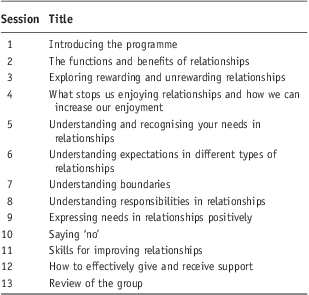
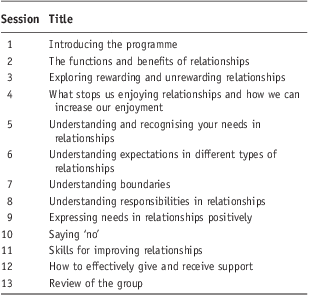
The interpersonal effectiveness group uses a closed group format and consists of 13 75-minute sessions. It is preceded by an individual orientation session and followed by a post-group individual session. The individual orientation introduces the group programme, its purpose and aims, and covers practical considerations related to times, dates and names of group facilitators. The content of the group and the potential benefits of attendance are described in detail and pre-group assessments are completed. The group programme represents an adaptation of, and a development from, the dialectical behaviour therapy (DBT) skills training in interpersonal effectiveness (Linehan, Reference Linehan1993). The group programme is divided into three parts which focus on: (1) understanding relationships (sessions 1–4); (2) understanding the principles of self management in relationships (sessions 5–8); and (3) skills for self management in relationships (sessions 9–12). See Table 1 for details of individual sessions.
Individual sessions in the group programme
The individual post-group session aims to capture the learning and behaviour changes that have occurred over the duration of the group and to identify benefits from the learning. A maintenance and generalization plan is compiled.
In addition to attending key manualized cognitive behaviour therapy (CBT) groups (Long et al. Reference Long, Fulton and Hollin2008) patients attend a variety of treatment sessions led by psychology, occupation therapy and nursing staff. These needs-led sessions cover skills of daily living and self care, education, physical health and exercise and recreational skills.
Statistical analysis
Data were analysed using SPSS software (version 18.0). Where Kolmogorov-Smirnoff tests showed data to be significantly non-normally distributed, non-parametric tests were used. A Bonferonni correction was applied in order to avoid Type I error.
Results
A total of 34 women, diagnosed as dual diagnosis with stable psychiatric symptoms agreed to participate in group treatment: their mean age was 27.6 years, (SD = 5.3 years). The primary diagnosis was personality disorder (emotionally unstable or with mixed features; n = 28; 82.4%); schizophrenia and schizoaffective disorder (n = 4; 11.8%) or bipolar and depressive disorder (n = 2; 5.9%). All of the women were detained under Section 3 of the Mental Health Act 1983 and had a history of disturbed behaviour, particularly self harm and emotional dysregulation. The majority of participants had been admitted from other medium secure units (n = 19; 55.9%) or from prison (n = 15; 44.1%); index offences ranged from major violence (n = 8; 23.5%) to arson (n = 11; 32.4%) and assault, minor violence and ABH (n = 13; 38.2%). Two patients had no index offence.
Completers vs non completers
Patients who attended more than 70% of sessions (i.e. ten or more group sessions) were classified as treatment completers: 22 (64.7%) women were completers. Twelve (35.3%) were non completers. Completers were younger (mean age 23.1 years (SD = 2.3) compared to 29.4 years (SD = 1.6; t (32) = 4.13, p < 0.05)) than non completers and were more likely to have experienced psychotherapy in the past (n = 15 (68%) versus n = 3 (25%); McNemar's test applied, χ2 = 13.85, df = 1). Eleven (50%) completers had engaged in group therapy and one had experienced both individual and group therapy (0.045%). Three non-completers had previously engaged in group therapy.
Completers were in treatment in medium security for a longer period of time compared to non completers (n = 6.8 months, SD = 2.3 months versus n = 3.2, SD = 1.4 months). Of non completers (n = 12): six completed the group at a second attempt in medium security; three completed in a low secure setting; and three did not complete at all. There were no differences between the two groups in terms of diagnosis, source of admission, or risk behaviours in the three months prior to group attendance. Pre-group psychometric measures showed no difference between completers and non completers on the psychometric measures of IIP-32, GSES, HoNOS-Secure item 9 (problems with relationships) or CANFOR item 14 (company).
Risk behaviour outcomes
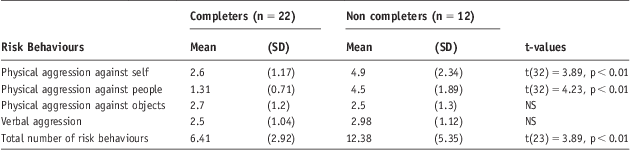
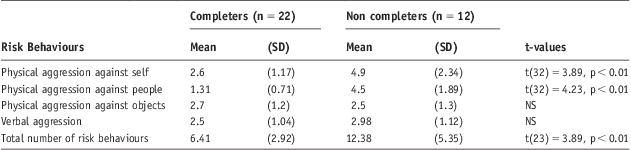
Table 2 shows changes in risk behaviours, grouped to the Overt Aggression Scale categories, in the three month period following treatment. There was a significant reduction in risk behaviour following treatment for completers (pre-treatment mean = 2.45 (SD = 1.23) against post-treatment mean = 4.45 (SD = 2.17; t(23) = 3.89, p < 0.01)) but not for non completers. It shows that treatment completers showed significantly less risk behaviour than non completers, particularly with regard to physical aggression against self and others.
Risk behaviours for completers and non completers in the three months post treatment
Pre-post change on psychometric measures
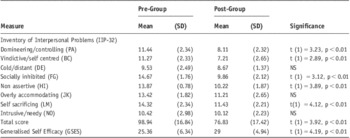
Treatment completers showed significant positive pre-post change in terms of total score on the IIP-32 and in Generalised Self Efficacy (see Table 3).
Pre- and post-group psychometric assessment for treatment completers (n = 22)

On the IIP-32 significant pre-post changes were evident on five subscales labelled: domineering/controlling (PA), vindictive/self centred (BC), socially inhibited (FG), non assertive (HI) and self sacrificing (LM). There were no pre-post changes on the cold/distant (DE), overly accommodating (JK) or intrusive/needy (NO) subscales. Significant pre-post changes were also evident for completers on GSES (t(1) = 4.19, p < 0.01) and on HoNOS-Secure (relationships) (pre-group mean = 3.8 (SD = 0.3) vs post-group mean = 2.1 (SD = 1); t = 2.78, df = 1, p < 0.05) but not on the number of individuals with CANFOR item 14 as a met need (pre-group n = 11 (50%) vs post-group n = 17 (77.3%)). However, significantly more treatment completers had CANFOR item 14 as a met need post-treatment than non completers (completers, post-group n = 17 (77.3%) vs non completers, post-group n = 9 (40.9%), McNemar test χ2 = 13.57, df = 1, p < 0.01).
Discussion
Interpersonal effectiveness is an expression of emotional intelligence (Kunnanatt, Reference Kunnanatt2004) and represents essential skills for the effective transition from hospital to community life. Interpersonal deficits are a defining feature of borderline personality disorder and of the patients treated in the current study. These issues make engagement in group CBT particularly problematic (Freeman & Stewart, Reference Freeman and Stewart2006; Lowings et al. Reference Lowings, Allan and Reader2011). Despite this however, two thirds of patients in the current study did complete group therapy for problems central to recovery and community reintegration.
In the Three Level Hierarchical Model (Cavell, Reference Cavell1990), social competence has social skills (level 3) social performance (level 2) and social adjustment (level 1) components. The current group intervention which calls on assertiveness and interpersonal problem solving skills operates at levels 2 and 3 of this model in emphasizing that ‘effectiveness’ means obtaining desired social changes, keeping both the relationship and one's self respect (Linehan, Reference Linehan1993). In this regard changes in the ‘non assertive’, ‘socially inhibited’ vindictive/self centred, and domineering/controlling subscales of the IIP-32 are encouraging. These IIP-32 changes were also evident for completers on more global measures of self-efficacy (CANFOR), relationships (HoNOS- Secure) and company (GSES).
The improvements evident post-group provide some confirmatory evidence for the value of social skills and communication skills training for individuals with a primary diagnosis of personality disorder (Bedell & Lennox, Reference Bedell and Lennox1997) and schizophrenia (Benton & Schroeder, Reference Benton and Schroeder1990).
As in previous evaluations of manualized group CBT treatment for women (Long et al. Reference Long, Fitzgerald, Fulton and Hollin2010b, Reference Long, Fulton, Dolley and Hollin2011b, Reference Long, Fulton, Dolley and Hollinc) the fact that approximately one third of patients do not complete treatment raises questions about timing, applicability and readiness for treatment. That completers were more likely to have previously experienced previous psychotherapy and to have spent more time in secure care may indicates that motivation to engage in and sustain engagement is a function of time and opportunity in a secure mental health facility. It also highlights the importance of appropriate training in CBT group therapy skills (Freeman & Stewart, Reference Freeman and Stewart2006) to maximise the effectiveness of engagement and integrity. Further work to both develop and evaluate interventions is therefore needed.
Ethical Approval
This study formed part of a wider service evaluation of St Andrew's Healthcare Women's service with approval from a National Health Service Research Ethics Committee (LNRI 06/02501/91).