Hurricane Sandy, the largest Atlantic hurricane in US history, struck the New York City metropolitan region on October 29, 2012. In Hurricane Sandy’s acute phase, the Manhattan campus of the Veterans Administration New York Harbor Healthcare System (VAMC), NYU Langone Medical Center Tisch Hospital (NYULMCTH), and Bellevue Hospital Center (Bellevue) experienced planned, precipitous, and staged evacuations. The loss of 3 major medical facilities deprived lower Manhattan of wide-ranging, quaternary health care services, including emergency care and 911-receiving facilities; inpatient hospital beds; intensive care unit beds; a regional trauma center; a comprehensive psychiatric emergency program (CPEP) and psychiatric services; stroke, cardiac catheterization labs for acute ST-segment elevated myocardial infarction (STEMI), and dialysis centers; and veterans and indigent care services. We previously identified the necessity of establishing a novel freestanding, 911-receiving emergency department (ED) at Bellevue Hospital Center (BHC), to address overwhelming acute ED patient care loads in surrounding facilities and improving access to care.Reference Lee, Smith and McStay 1
Bellevue achieved progressive recovery in care capacity, transitioning from urgent care (November 19, 2012), to freestanding emergency capability (December 10, 2012), to 911-systems receiving designation (December 24, 2012), and ultimately to full hospital reopening (February 7, 2013). Close coordination established with the Fire Department City of New York Emergency Medical Services (FDNY EMS) ensured that certain critical ambulance patients would not be intentionally transported to the freestanding ED (eg, major trauma, active labor, STEMI). However, empiric observations in disasters have demonstrated that nonambulance transport (eg, private conveyance, public transportation, ambulation) of potentially critically ill patients to emergency departments is common.Reference Auf der Heide 2 Furthermore, potentially critical patients, even those presenting by ambulance, could either present acutely or deteriorate during treatment while awaiting limited inpatients beds or transfer to a hospital outside of Lower Manhattan. One safeguard to address this potential safety threat was the utilization of an Emergency Intensive Care Unit (EICU) adjacent to the main Bellevue ED as an effective location for the delivery of dedicated emergency critical care, efficient resuscitation, and facilitation of interhospital critical care transport.
The operational basis for this critical care safety net was an extension of the realities of current emergency practice. By default, many ED physicians must care for critical care patients due to the inability of hospitals and health care systems to address overcrowding, a shortage of intensive care unit beds, and ED boarding.Reference Intas, Stergiannis and Chalari 3 , 4 This pragmatic practice continues to be reinforced, with an estimated 15% of a patient’s total critical care efforts provided by emergency departments, in often less than ideal circumstances. 4 – Reference Goldstein 9 The purpose of this study was to assess the impact of a contingency emergency intensive care space established as part of a freestanding emergency department during the aftermath of Hurricane Sandy.
METHODS
Study Setting and Population
Bellevue is an acute care hospital within the New York City Health and Hospitals Corporation network. This was a retrospective review of all patients cared for in the Bellevue EICU from December 10, 2012, when a freestanding ED was established, to full hospital reopening on February 7, 2013. The opening of the EICU preceded designation of 911-participating ambulance receiving status on December 24, 2012. In association with the Bellevue freestanding ED, the Bellevue EICU was a physically separate, 10-bed unit capable of delivering comprehensive emergency critical care and 24 hours per day emergency intensivist staffing per American College of Critical Care Medicine (ACCM) requirements for Level II critical care centers.Reference Haupt, Bekes and Brilli 10 To optimize care, potentially critically ill patients identified in the ED were immediately transported to the EICU for rapid treatment, stabilization, and preparation for transfer to available NYC emergency or inpatient critical care facilities. Conditions that required immediate therapeutic intervention not available at Bellevue included acute stroke or STEMI. Other critically ill patients who required immediate resuscitation and initial therapeutic intervention available at Bellevue but who were anticipated to require intensive care unit admissions included patients with sepsis or intubated for respiratory failure. These patients were immediately transported to the EICU, where appropriate therapy was initiated, diagnostic procedures completed, and transfer to inpatient facilities arranged. Additionally, the EICU was utilized in conjunction with the 2 existing trauma bays for patients who were inadvertently brought to Bellevue with significant trauma (although there was no onsite trauma surgery service). Adapting to the continuing needs of the freestanding ED, the EICU was also utilized for continued evaluation and treatment of patients unable to be transferred, as well as patients requiring respiratory (airborne) isolation.
EICU staffing adhered to guidelines suggested by the ACCM for critical care centers providing 24 hours/day comprehensive intensive care.Reference Haupt, Bekes and Brilli 10 ,11 Emergency critical care–trained physicians supervised care in the EICU 24 hours per day, 7 days per week. Three critical care fellowship-trained Emergency Medicine physicians alternated care with Emergency Medicine board-certified physicians, and when not physically present were available 24 hours/day for consultation and rapid back-up. In addition, a rotation of 1 post-graduate year (PGY) fourth-year emergency medicine resident, and 2 PGY first-year emergency medicine residents staffed the EICU 24 hours/day. A nurse manager with extensive emergency critical care experience provided precise lines of authority, responsibility, and accountability for the delivery of high-quality patient care. The nurse manager ensured that the critical care nursing practice met appropriate standards. Respiratory care therapists with expertise in the use of mechanical ventilators and proficiency in care of and transport of critically ill patients were available 24 hours a day, 7 days a week. Critical care pharmacy and pharmacist services were available 24 hours a day, 7 days a week, providing essential medications immediately and admixtures in a timely fashion. Registered pharmacists were available to evaluate all drug therapy orders, review and maintain medication profiles, monitor drug dosing and administration regimens, and evaluate adverse reactions, drug/drug interactions, and give drug and poison information.
Laboratory testing was available in a timely fashion, with point-of-care technology also available for rapid results. Radiology services included portable and fixed radiography, computed tomography (CT) and CT angiography (CTA), and duplex ultrasound. Patients in urgent need of radiologic services not available onsite were transferred to an appropriate facility.
For interhospital critical care transport, critically ill patients were accompanied by advanced care life support (ACLS) transport paramedics in addition to a senior emergency medicine resident and critical care nurse. Continuous monitoring, medications, portable mechanical ventilator, emergency vascular access equipment, airway management, and emergency surgical procedures were available during transport. All policies—including those for interfacility transport. restraint, and sedation—were clearly delineated and available to all staff at all times. A continuous quality improvement program was implemented that addressed safety, effectiveness, timeliness, efficiency, and equity.
Data Source and Data Elements
As part of the continuous quality improvement program, all patients placed in the EICU during its operation were compiled. This record was verified through re-examination of the institutional EMTALA log. The Bellevue electronic health record (EHR) (QuadraMed QCR, QuadraMed Corporation, Reston, VA) was the source for patient data, including physician notes, results of laboratory testing, radiology reports, and temporal markers. The authors, who were not blinded to the study outcomes, manually reviewed the EHR and extracted predetermined, relevant data into Microsoft Excel 2010 version 14.0.7153.5000 (Microsoft Corp., Redmond, WA) spreadsheet format. These included hospital arrival/triage time, EICU arrival and disposition time, mechanism of hospital arrival, diagnosis/clinical impression, destination/disposition (expiration; interhospital transfer to an ICU, step-down unit [SDU], telemetry, ward or floor bed, ED, discharge to home, or departure against medical advice [AMA]). A SDU was an intermediate level of care unit below an ICU level of care unit, but more extensive than a simple telemetry ward. ED disposition included patients whose definitive, ultimate disposition was uncertain and whose care/management required additional clinical and consultative services that would otherwise not be available in a free-standing ED (eg, STEMI patient transferred to another institution for coronary intervention). For particular diagnoses of interest, additional factors were evaluated, including ventilation strategies for patients with respiratory failure, fluid resuscitation requirements for those patients with sepsis, blood product use for those patients with gastrointestinal hemorrhage, benzodiazepine use for those patients with alcohol withdrawal, and special situations such as those patients requiring isolation.
Data Analysis
Simple descriptive statistics were analyzed in Microsoft Excel 2010 version 14.0.7153.5000 (Microsoft). SAS software version 9.3 (SAS Institute, Cary, NC) was used for additional analysis. Three emergency medicine attending physicians had additional training and active clinical practice in critical care medicine, medical toxicology, and quality and safety; they jointly reviewed each case to determine each patient’s disposition upon placement into the EICU and actual disposition upon departure from the EICU. An APACHE II score was calculated from available EHR data in critical (ICU/SDU) patients.Reference Capuzzo, Valpondi and Sgarbi 12 The Wilcoxon signed rank test was used to evaluate the differences in each individual patient’s initial disposition and final disposition. As the lengths of stay between patients with and without respiratory isolation were not normally distributed, these two groups were evaluated with the Wilcoxon rank sum test.
Given the potential criticisms that the EICU might have cared for patients simply because it existed and that downgrading might occur in a cross section of similar critical care patients in the course of normal ED operations in patients who remained in ED awaiting critical care beds, we undertook a post hoc analysis to evaluate critical care utilization in the 2-month period following hospital reopening (February 7 to April 7, 2012). The EMTALA EHR database was queried for admitted patients and those patients admitted to critical care spaces, with the resulting administrative database analyzed for rates of downgrading. Charts were manually reviewed to determine if the initial admission/disposition/transfer (ADT) order was changed during ED stay (now without the benefit of the EICU) to a lower level of care (reflecting clinical improvement, presumably from ongoing ED therapy).
Ethics
The conduct of this study was approved by the Institutional Review Boards of the NYU School of Medicine, Office of Science and Research, and the New York City Health and Hospitals Corporation.
RESULTS
During the period between December 10, 2012 through February 6, 2013, 227 patients were treated in the EICU. All records were available for review. For operational reasons, 2 patients received care that normally would have been rendered in the ED space; these were excluded from further analysis. The remaining 225 EICU patients represented approximately 1.8% of patients seen in the freestanding ED during this time period.
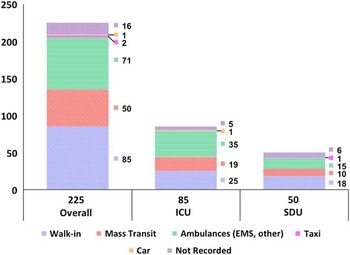
The method of presentation to Bellevue for EICU patients is shown in Figure 1. Highlighting access to care issues, arrival via ambulance occurred in only 31.6% patients overall. In critical patients ultimately requiring ICU and SDU levels of care, only 41.2% and 30.0%, respectively, presented by ambulance.
Mode of Hospital Presentation. Mode of hospital presentation for patients presenting to Bellevue Hospital Center freestanding emergency department emergency intensive care unit (EICU) and for patients initially requiring intensive care unit or step-down unit level of care.

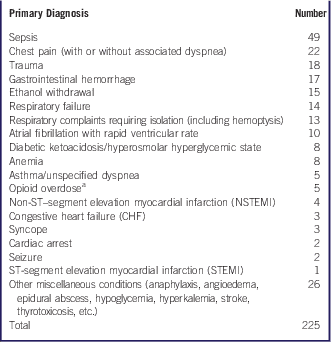
The indication for EICU placement is shown in Table 1. Of note, there were 2 cardiac arrests, 18 trauma patients, and 13 patients who required airborne isolation. The median APACHE II score was 10 (interquartile range, IQR: 7, 15) in patients determined to initially require ICU level disposition. Not fully reflected in the score were several patients with significant acute illnesses—such as STEMI, subarachnoid hemorrhage, angioedema, sedative hypnotic withdrawal, and opioid overdose—requiring naloxone infusion. In patients placed for SDU-level disposition, the median APACHE II score was 9.5 (IQR: 7, 13). For specific disease conditions, in the 14 patients with primary respiratory failure (eg, from COPD) noninvasive ventilation was utilized continuously in 12, of whom 1 progressed to tracheal intubation, whereas the other 2 required immediate intubation. The 49 patients with sepsis required an average of 4.2 liters of crystalloid, in addition to broad-spectrum antibiotics and standard care. The 18 traumatic conditions included 7 patients from a mass-casualty incident (January 2013 Staten Island Ferry crash), 5 significant falls, 2 stabbing cases (to zone 2 of the neck and to the right upper quadrant), 1 bicyclist struck by a motor vehicle, 1 midface laceration by a factory grinder, 1 assault through blunt mechanism, and 1 unspecified trauma. In the 17 patients with gastrointestinal hemorrhage, 9 required erythrocyte transfusions. There were 8 patients with severe diabetic ketoacidosis or a hyperosmolar, hyperglycemic state who required an average volume resuscitation of 5.4 liters of crystalloid, in addition to intensive insulin therapy. The 15 patients in ethanol withdrawal required an average of 40 mg intravenous diazepam plus 125 mg of oral chlordiazepoxide for symptom control.
Indication for EICU Placement

a 4 patients had associated hypothermia.
The median EICU length of stay was 11.55 hours (IQR: 7.30, 16.90). The 13 patients requiring airborne isolation had a significantly longer LOS than those not requiring isolation [25.60 hours (IQR: 17.42, 38.88) versus 11.37 hours (IQR: 6.68, 16.38), P<0.0001].
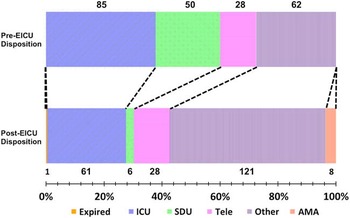
After stabilization and treatment in Bellevue’s EICU, 39% of patients experienced an improvement in their disposition status (P<0.0001) (Figure 2). Importantly, at a time when critical care resources in Lower Manhattan were severely constrained, the number of patients upon interhospital transfer still requiring ICU resources decreased from 85 to 61, and the number requiring SDU resources decreased from 50 to 6. Proportionally, patients requiring ICU and SDU resources decreased from 37.8% to 27.1%, and from 22.2% to 2.7%, respectively. Of note, 52 patients were discharged directly home. There was 1 patient death: A 64-year-old male presented on arrival by ambulance with hypoxemic respiratory failure, septic shock, and multiple organ dysfunction syndrome (including cardiac failure, hypothermia, pancytopenia, and severe acidemia with a lactate of 20 mmol/L) secondary to multidrug resistant Klebsiella bacteremia. His condition progressed to severe ARDS and refractory hypoxemia. The patient was treated with intubation, central venous vascular access, invasive arterial monitoring, broad-spectrum antibiotics, inotropes, vasopressors, and nitric oxide, and sustained for than 31 hours before being made do not resuscitate (DNR) by his family and succumbing to his illness. Highlighting citywide critical care deficits, patients initially requiring ICU- and SDU-levels of care were ultimately dispositioned to 14 and 12 different area hospitals, respectively (18 unique hospitals in total).
EICU Presentation and Disposition Status. Patient status on admission to emergency intensive care unit (EICU) and upon actual departure for continuing care. The “other” category includes patients who on EICU arrival required advanced services below ICU, SDU or telemetry—for example, admission to a ward bed; upon disposition this group included patients transferred to a ward bed (62), transferred to another ED (7), and discharged home (52). AMA, against medical advice; ICU, intensive care unit; SDU, step down unit; Tele, telemetry.

We examined the subsequent course of the 52 patients who were discharged home, and the 8 patients who signed-out AMA. Of those who were discharged, 13 (25%) returned within 30 days of their initial visit. Seven (13% overall) of these visits were for unrelated complaints. Six patients (12% overall) returned for a complaint related to the index visit; 2 of these were anticipated (a scheduled follow-up for staple removal and evaluation of upper genitourinary tract infection), and 4 were unanticipated (2 persistent postconcussive headaches without subsequent interventions, 1 medication refill, and 1 for assistance with clinic appointment scheduling). None required hospitalization. Of the 8 patients who left AMA, 6 did not return to Bellevue, 1 returned for a related reason (the COPD exacerbation for which he was being treated), and 1 returned for an unrelated complaint.
In the post hoc analysis of the immediate 2-month period following hospital reopening (eg, February 7 to April 7, 2012) of 20 071 registered patients, 2397 patients were admitted as inpatients from the ED. Of those admitted, 332 (14%) were correctly coded in the administrative database as critical care bed requests. During this time, the EICU space was not available for ED-based care. Upon manual review of these 332 critical care admissions, there were 5 downgrades from the requested critical care space (1.5%), even in those who remained in the ED for some time. Thus, there was no significant decrease in ICU/SDU resource utilization in patients who remained in the ED awaiting critical care beds without the benefit of the EICU construct.
DISCUSSION
An EICU for critical patients and those with the potential to decompensate was a significant component of the freestanding ED concept established in the aftermath of the Hurricane Sandy disaster. The concept of echelons of medical care in a given theater of operations (TO) is a standard operating principle of military medicine and an important element of prehospital medicine. 13 , Reference Grathwohl and Venticinque 14 Emphasis is placed on those measures necessary to return the patient to a functional status or to achieve stabilization for medical evacuation to the next echelon. Each echelon adds incremental treatment capability, distinguishing it from the previous echelon. Patients not requiring a higher level of care are returned to a functional status, decreasing the health care systemic burden. The added component of forward, flexible mobile medical units (eg, Marine Shock Trauma Platoons) have demonstrated great success in bringing resources to demand.Reference Chambers, Green and Gillingham 15 , Reference Sallee, Love and Welling 16 “Austere” critical care has demonstrated benefits in survival, length of stay, and resource utilization without excessive logistic support or the addition of highly technological equipment in problematic environments.Reference Grathwohl and Venticinque 14 These approaches have resulted in remarkable decreases in mortality in military TO.Reference Eastridge, Costanzo and Jenkins 17
The application of the military’s echelons of care concept to a civilian medical TO dates back at least to 1962, when “advanced treatment centers” were envisioned as part of a civilian echelon structure necessary to treat “many thousands” of civilians in homeland disasters.Reference Hacon 18 More recent application of the military model in a domestic disaster occurred during Tropical Storm Allison’s flooding of Houston in 2001. With 9 hospitals closed, all area hospitals full to capacity, and no available intensive care unit beds, the Air Force deployed a 25-bed expeditionary medical support field hospital to treat 1036 patients, of whom 33 required intensive care (3.2%).Reference D’Amore and Hardin 19 This intensive care requirement is similar to our findings (1.9%), in light of the FDNY 911 restrictions placed on Bellevue’s freestanding ED.
The Bellevue fully capable, free-standing ED was an innovative application of this military echelon care to the Hurricane Sandy civilian disaster, which created a population zone in Lower Manhattan deficient in over 1900 inpatient beds and the proportionate loss of intensive care resources.Reference Lee, Smith and McStay 1 Citywide, post-Sandy, hospital bed capacity was reduced by 8%. 20 This was coupled with at least 3 additional stressors on care capacity: a concurrent influx of evacuees from closed hospitals, an inability to discharge patients due to the loss of 4600 nursing home and acute care facility beds, and significantly increased ED utilization at specific, remaining hospitals. 20 , Reference Smith, Braun and Portelli 21 Both the lay pressReference Pettypiece and Deprez 22 and after-action reports 23 documented high demand and shortages of critical care beds during the aftermath of Sandy. Bellevue’s experience of having to source 18 different hospitals in total for EICU patients who initially required ICU- or SDU-level of care underscored the critical care shortfalls. Critical care resources are still at risk, and uniform bed definitions for ICU beds, step-down beds, and telemetry are still needed to aid future disaster contingency planning. 24
The EICU was a critical component of the Bellevue freestanding ED, permitting immediate lifesaving interventions, adequate stabilization, and decreased critical resource utilization prior to patient transfer for inpatient-based care. While the freestanding ED might have handled caring for and transporting these patients, it was busy assessing, treating, and dispositioning over 12 000 less critical patients. The lack of any significant decrease in ICU/SDU resource utilization in patients who remained in the ED awaiting critical care beds in the posthospital opening period when no dedicated EICU was available further supports a specific benefit from dedicated EICU care during the disaster, as opposed to routine ED care. This early, directed medical resuscitation is analogous to the early “damage control” approach utilized in traumatic injuries prior to transport.Reference Grathwohl and Venticinque 14 Early key interventions are performed anticipating later, definitive therapy.Reference Roberts, Bobrovitz and Zygun 25 The provision of freestanding ongoing ICU care by emergency physicians with critical care training or oversight resulted in improved dispositions and decreased interhospital transfers to critical care and intermediate care beds, and the burden of critical care needs. They ensured that best practice strategies for critically ill patients were incorporated into ongoing care, such as lung protective ventilation, early nutrition, and ventilator associated pneumonia reduction strategies. The expertise of the dual-trained faculty facilitated the progression of care in other areas, including but not limited to the extubation of one patient and subsequent discharge home, the transition of continuous insulin infusion to subcutaneous insulin in multiple patients, and the ability to assess when patients no longer required a critical care bed. This organization of emergency department staff, despite the limited available hospital professionals, provided the opportunity to initiate early goal-directed therapiesReference Goldstein 9 , Reference Dettmer, Holthaus and Fuller 26 and to sustain critical care out of necessityReference Intas, Stergiannis and Chalari 3 , 4 , Reference McCoy, Gale and Sunderram 27 during a period of critical care constraint, when ICU space and staff were at a premium during the Hurricane Sandy disaster.
Our experience during the prolonged post Hurricane Sandy hospital closures mirrors previous findings in acute disasters; potentially critically ill patients may arrive by a variety of transport modalities (Figure 1).Reference Auf der Heide 2 , Reference Hogan, Waeckerle and Dire 28 The significant restrictions on the types of patients brought by 911-system participating ambulances (patients with trauma, cardiac arrest, third-trimester pregnancy, ST-segment elevation myocardial infarction, stroke, obvious surgical disease, emotional disturbance, and those in police custody) did not preclude patient self-triage and even ambulance triage of critical patients to the freestanding ED. Indeed, there were a number of cases of cardiac arrest, severe sepsis, respiratory failure, etc. Teams responding to medical disasters should continue to anticipate the unexpected, and plan in advance for coordinated transfer of patients that may exceed capabilities.
The EICU experience highlighted another deficit in the post-Hurricane Sandy disaster: respiratory isolation beds. This deficit anticipated the subsequent Ebola epidemic, which made patently clear the need for surge isolation capacity. EICU trauma capacity, which was not anticipated to be utilized, additionally allowed Bellevue to receive patients in a mass-casualty incident.
Limitations
The primary limitation is that this was a descriptive study of a dynamic EICU attached to a single-site freestanding ED established in the midst of an ongoing disaster. As in most disasters, a control group was not available. The Bellevue EICU staff (physicians, nurses, respiratory therapists, and pharmacists) were already familiar with the care of diverse medical and traumatic complaints as part of their roles prior to Hurricane Sandy’s landfall. Their success emphasizes the importance of broadly cross-trained personnel. However, we believe that the concept is sufficiently generalizable based on prior success in other primarily noncivilian venues. APACHE II scores were computed based on retrospective chart review, and specific parameters were not always fully evident (eg, Glasgow coma scale). This would actually tend to underestimate the APACHE II score. Nevertheless, the severity of the patients upon placement into the EICU and actual disposition upon departure from the EICU were rigorously assessed by attendings with additional training and active practice in critical care medicine. The post hoc analysis is subject to the obvious limitations of a different hospital state. Nevertheless, the patients essentially all remained in their ICU/SDU status despite ongoing ED care.
The follow-up of patients after discharge or departure against medical advice was limited by the nature of multiple, independent health care systems in New York City, which precluded us from evaluating visits to other EDs. There were 16 patients in whom the mode of presentation to the hospital was not explicitly documented. However, as these were not specifically documented as ambulance arrivals and ambulance run-sheets were not identified, these were most likely ambulatory patient presentations as well. Fluid resuscitation determinations are likely underestimations, based on direct observation of the tendencies of nursing, residents, and attending staff to “hang fluids” without ensuring a specific electronic order; in each instance, an IV bag was changed, prior to subsequent quality improvement interventions to improve documentation.
CONCLUSIONS
A reduction in resource-intensive medical care requirements was achieved via the EICU-capable ward attached to Bellevue’s freestanding ED that was established in the aftermath of Hurricane Sandy. This represented an innovative, modular application of the military’s “echelons of care” concept to a civilian disaster theater of operations. Similar flexible, adaptable care systems should be explored for implementation in disaster response.
Acknowledgments
This work was funded by the US Department of Health and Human Services, Office of the Assistant Secretary for Preparedness and Response (ASPR), award number HITEP130006-01-00 to the NYU School of Medicine. Additional funding has been received for follow-on studies from ASPR, award number HITEP150030-01-00 to the NYU School of Medicine. S.W.S. derives additional salary support from the Fridolin Charitable Trust to the Ronald O. Perelman Department of Emergency Medicine Safety Program and has received an intramural departmental 2015 scholarly innovation grant for work unrelated to the current study. D.J.P. receives additional support from FDNY for work unrelated to the current study. M.H. is supported by an intramural NYU School of Medicine research grant and grants NIH/NCI 5 P30 CA16087-32 and NIH U54DK107977-01 to the NYU School of Medicine for work unrelated to the current study.
Additional acknowledgments are in order for the leadership of Bellevue Hospital Center for their courage and vision to establish the EICU and to the RNs, MDs, and patient care technicians who participated with great enthusiasm to accomplish this effort in stabilizing care for those in need of ICU admissions.
Disclaimers
The funding agency (ASPR) played no role in the design or conduct of the study; collection, management, analysis, or interpretation of the data; preparation of the manuscript; or decision to publish. The content of this article is the responsibility of the authors and does not necessarily represent the official views of the US Department of Health and Human Services (DHHS), the Office of the Assistant Secretary for Preparedness and Response (ASPR), the NYU School of Medicine (NYU SOM), the NYC Health and Hospital Corporation (HHC), Bellevue Hospital Center (BHC), The Fire Department of the City of New York (FDNY), Icahn School of Medicine at Mount Sinai, or any employers, affiliations, named entities, or other funding agencies or sources.
Previous Publication
A portion of this work was presented in abstract form at the National Association of County and City Health Officials (NACCHO) Preparedness Summit, Atlanta, GA, April 2015, and at the 2015 Hurricane Sandy Conference: Translating Research into Practice, New York, NY, August 2015.
Authors’ Contributions
Study conception and design: S.W.S., C.T.J., I.P., G.A., D.J.P., L.R.G., C.M.M.; acquisition of data: S.W.S., C.M.M., C.T.J., S.M., L.A., K.M.T.; analysis and interpretation of data: S.W.S., C.T.J., S.M., L.A., K.M.T., B.W., M.H., C.M.M.; drafting of the manuscript: S.W.S., C.M.M.; critical revision of the manuscript for important intellectual content: C.T.J., S.M., L.A., K.M.T., I.P., G.A., D.J.P., B.W., M.H., L.R.G.; obtaining funding: S.W.S., I.P., L.R.G.; administrative, technical, or material support: S.W.S., S.M., I.P., B.W., M.H.; supervision: S.W.S., C.T.J., G.A., D.J.P., L.R.G., C.M.M. S.W.S., C.T.J., S.M., L.A., K.M.T., L.R.G., and C.M.M. had full access to all of the data in the study and take responsibility for the integrity of the data and the accuracy of the data analysis.