INTRODUCTION
Epilepsy is a prevalent neurological disorder associated with numerous comorbidities that threaten quality of life, education, employment, and social adjustment (Beghi, Camfield, & Camfield, Reference Beghi, Camfield and Camfield2014; Institute of Medicine, 2012; Lin, Mula, & Hermann, Reference Lin, Mula and Hermann2012; Sillanpää & Schmidt, Reference Sillanpää and Schmidt2010). Cognitive impairment is an important pathway through which these less advantageous outcomes may emerge. Impairment in cognitive abilities such as memory, executive function, processing speed, and linguistic abilities exert an overarching adverse effect on the adaptability of an individual (Rudzinski & Meador, Reference Rudzinski and Meador2013).
Epilepsy syndromes are heterogeneous in etiology, natural course and underlying pathogenic mechanisms. All these factors are likely to contribute to the substantial variation in the cognitive sequelae of epilepsy, reflected both in the severity of impairment and number of domains affected (Elger, Helmstaedter, & Kurthen, Reference Elger, Helmstaedter and Kurthen2004; Farwell, Dodrill, & Batzel, Reference Farwell, Dodrill and Batzel1985; Hamiwka & Wirrell, Reference Hamiwka and Wirrell2009; Hommet, Sauerwein, De Toffol, & Lassonde, Reference Hommet, Sauerwein, De Toffol and Lassonde2006; Lin et al., Reference Lin, Mula and Hermann2012; MacAllister & Schaffer, Reference MacAllister and Schaffer2007; Speechley et al., Reference Speechley, Ferro, Camfield, Huang, Levin, Smith and Zou2012).
In children and adolescents, epilepsy and its treatment may interfere with normal cognitive development and early age at onset is a robust predictor of global cognitive impairment, deficits in language function, and lower IQ (Berg, Zelko, Levy, & Testa, Reference Berg, Zelko, Levy and Testa2012; Elger et al., Reference Elger, Helmstaedter and Kurthen2004; Schoenfeld et al., Reference Schoenfeld, Seidenberg, Woodard, Hecox, Inglese, Mack and Hermann1999). Similarly, among adults with chronic localization related epilepsies, childhood as opposed to adult onset of recurrent seizures has been shown to be associated with greater adverse impact not only on cognition but brain morphology as well (Hermann et al., Reference Hermann, Seidenberg, Bell, Rutecki, Sheth, Ruggles and Magnotta2002; Hermann, Lin, Jones, & Seidenberg, Reference Hermann, Lin, Jones and Seidenberg2009; Kaaden & Helmstaedter, Reference Kaaden and Helmstaedter2009; Oyegbile et al., Reference Oyegbile, Dow, Jones, Bell, Rutecki, Sheth and Hermann2004).
Middle-aged and older individuals with chronic childhood-onset epilepsy are subsequently exposed to the cumulative effect of several factors that could conceivably lead to an increased risk for accelerated cognitive decline and brain aging. These factors include, but are not limited to, increasing number and severity of epileptic seizures, increased exposure to adverse antiepileptic medication effects, and chronic epileptiform discharges (Baxendale, Thompson, & Duncan, Reference Baxendale, Thompson and Duncan2012; Dodrill, Reference Dodrill2004; Helmstaedter & Elger, Reference Helmstaedter and Elger2009; Hermann, Meador, Gaillard, & Cramer, Reference Hermann, Meador, Gaillard and Cramer2010; Hermann et al., Reference Hermann, Lin, Jones and Seidenberg2009; Lin et al., Reference Lin, Mula and Hermann2012). There are no long-term population-based studies with control groups spanning decades and thus very little is known about the mid/later life cognitive outcome of childhood-onset epilepsy.
The aim of this unique prospective cohort study was to examine cognitive outcome 50 years later in aging participants with childhood-onset epilepsy and matched healthy controls. The present study is based on the Turku Aging in Childhood-Onset Epilepsy (TACOE) project (Sillanpää et al., Reference Sillanpää, Anttinen, Rinne, Joutsa, Sonninen, Erkinjuntti and Shinnar2015; Sillanpää, Jalava, Kaleva, & Shinnar, Reference Sillanpää, Jalava, Kaleva and Shinnar1998; Sillanpää & Schmidt, Reference Sillanpää and Schmidt2010). The present study is the first time that long-term cognitive outcome determined by formal neuropsychological assessment has been studied in a prospective population-based cohort of childhood-onset epilepsy.
METHODS
The baseline study of this prospective population-based cohort in 1964 included all children aged less than 16 years (mean age 8.0 years; SD 4.8) who were living in the catchment area of Turku University Hospital, Turku, Finland (source population n=108, 199) and met the criteria for epilepsy (two or more unprovoked seizures) (Commission on Revised Classification of Seizures, 1981; Guidelines for Epidemiologic Studies on Epilepsy, 1993). Subjects were identified on the basis of hospital and primary health care records complemented by a review of the National Health Service records, a registry of all patients in Finland. The recruitment and data collection processes have previously been described in detail (Sillanpää et al., Reference Sillanpää, Jalava, Kaleva and Shinnar1998; Sillanpää, Reference Sillanpää1973).
The cohort has been prospectively followed since 1964 including ongoing review of the medical records and a regular, comprehensive evaluation over 5-year intervals. In 1992, the cohort of 176 surviving subjects with epilepsy and sufficient data for evaluation were divided into two groups: those who had any major neurological impairment at epilepsy onset, and those who had no neurological impairment at onset, that is, they were regarded as subjects with uncomplicated epilepsy. The present study originated from the 1992-year data and the source population of the present study comprised the latter group of 99 subjects with uncomplicated epilepsy who were surviving in 1992 and to whom a matched control pair was selected from the nationwide population registry (Sillanpää et al., Reference Sillanpää, Jalava, Kaleva and Shinnar1998). These subjects and their controls were invited to participate in 2012.
Of the original 99 participants with uncomplicated epilepsy, 26 were not available (9 died, 2 had non-Finnish mother tongue, and 15 emigrated or were otherwise untraceable), 51 of the remaining 73 (70%) participated. Of the original 99 controls, 21 were not available (1 died, 1 had non-Finnish native language, and 19 were not traceable). Of the remaining 78 controls, 52 (67%) participated. While the subject-control pairs were no longer complete, the controls effectively continued to serve as a control group. The overall study design, seizure outcome, and comorbidity are described in detail in another report (Sillanpää et al., Reference Sillanpää, Anttinen, Rinne, Joutsa, Sonninen, Erkinjuntti and Shinnar2015).
Comparison between the participating and non-participating individuals with epilepsy showed no differences in seizure variables including age of onset, remission status, or medication status. No differences in demographic variables (sex, marital status, education, working status) were observed between participants and non-participants either within healthy controls or participants with epilepsy.
Seven further participants (four controls and three participants with epilepsy) were excluded from data analyses due to two or more extreme outlier cognitive scores due to disease (e.g., stroke, schizophrenia) or test taking factors (suboptimal effort). The exclusion criteria were identical for participants with epilepsy and controls. The remaining 48 participants with childhood-onset epilepsy (PWE) and 48 healthy controls (HC) were included in the analyses.
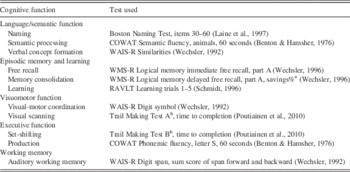
Finnish versions of well-established and validated neuropsychological tests were used (Table 1) (Lezak, Howieson, Bigler, & Tranel, Reference Lezak, Howieson, Bigler and Tranel2012). The tests cover several cognitive domains, including language and semantic function, learning and memory, visuomotor function, executive function, and working memory. The tests have Finnish norms, but they stem from different normative samples and standardized scores are not available for all tests. Raw scores were thus deemed more valid to be used in the present study. The neuropsychological assessments were conducted at the Turku PET-center by a licensed psychologist (P.T.) and a research assistant with a BA in psychology (J.P.) under the supervision of a clinical neuropsychologist (M.K.). The tests were administered in the same order for all participants. All assessments were conducted during a single visit ranging between 1.5 and 2.5 hr.
Cognitive functions and tests administered

a Savings%=delayed free recall/immediate free recall x 100.
b in both Trail Making Test A and B errors were corrected by the test administrator.
The epilepsy group was further divided into participants with continuing seizure activity (PWE-A, seizure activity within the past 5 years and/or AED use) and participants with epilepsy in remission (PWE-R, no seizure activity within the last 5 years and no AED use).
The authors assert that all procedures contributing to this work comply with the ethical standards of the relevant national and institutional committees on human experimentation and with the Helsinki Declaration of 1975, as revised in 2008. The Institutional Review Board of the Hospital District of Southwest Finland approved the study design (Diary No. 120/2008/26.1.2009 §454). Written informed consent was obtained from all subjects about participation and access to their medical records.
Data were analyzed using one-way analyses of variance (ANOVAs), t tests, Mann-Whitney U tests, and χ 2 (Fisher’s exact test, two-tailed) for the demographic, clinical, and background variables, as appropriate. Spearman correlation was used to analyze correlations between age, education, and cognitive test scores. Group effects (PWE vs. HC) on neuropsychological data from 10 tests measuring different cognitive domains were analyzed using a multivariate analysis of covariance (MANCOVA) and subsequent ANCOVAs. Rey Auditory-Verbal Learning Test (RAVLT) was analyzed separately to allow for studying learning effects with a repeated-measures ANCOVA. A follow-up MANCOVA examined possible effects of active versus remitted epilepsy on cognitive test performances (PWE-A, PWE-R, HC). Subsequent ANCOVAs were performed for pairwise contrasts and Cohen’s d was used to determine effect size for pairwise differences.
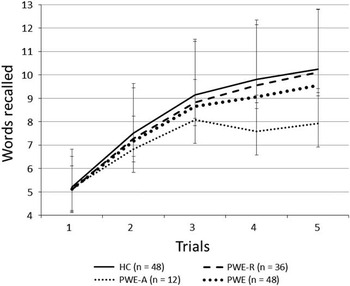
We also conducted a repeated measures ANCOVA to examine possible differences between the groups (PWE-A, PWE-R, HC) in learning over five trials on the verbal learning test (RAVLT) with subsequent pairwise comparisons using Games-Howell post hoc.
The 10 neuropsychological test scores used in the MANCOVA were later z-transformed based on the distribution in the control group (RAVLT was excluded as it contains five different scores). Impairment was defined as a z-score of ≥−1.5 SD. Group- and test-wise calculations on the number and percentage of participants showing impairment were conducted. The sum of impaired tests (0–10) was also calculated and differences between the groups were analyzed using χ2 (Fisher’s exact test).
We also calculated odds ratios (ORs) for having cognitive impairment, defined as a below normal (i.e., z≥−1.5 SD) performance in 3 or more of 10 cognitive tests (≥30%) in the PWE-A and PWE-E groups. We chose to define cognitive impairment this way to minimize the likelihood of false positives. It has been shown that when using −1.5 SD as criterion for impairment on 10 separate tests, the likelihood of obtaining at least two impaired scores by chance alone is approximately 20%, whereas the likelihood of having at least three impaired scores by chance is less than 5% (Ingraham & Aiken, Reference Ingraham and Aiken1996).
Within the PWE-R group, Spearman correlation was used to examine possible associations between age at epilepsy onset, cumulative duration of seizure activity, cumulative duration of seizure free years, number of years on AED medication, and individual neuropsychological test scores. Linear regression was used to examine the effect of the same background and clinical variables on the number of impaired tests within the PWE-R group. PASW Statistics Version 18 (SPSS Inc., 2009) was used to conduct the analyses.
RESULTS
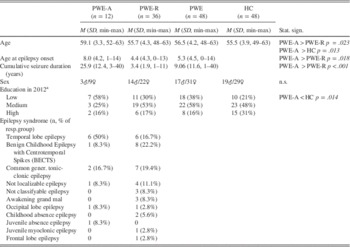
Within the epilepsy group, 12 (25%) continued to have seizures (PWE-A) and 36 (75%) were in remission for 5 or more years (PWA-R). There were no significant differences between the three groups (PWE-A, PWE-R, HC) in sex distribution. PWE-A were older than PWE-R (p=.023) and HC (p=.013). There were no significant differences between the PWE and HC groups in education, but when the two patient groups were analyzed separately, the PWE-A group had lower education than the HC group (Fisher’s exact p=.014). PWA-R had a significantly earlier disease onset age than PWE-A (p=.018). PWE-A had a significantly longer cumulative seizure duration, t=6.257, p<.001, and duration of AED use, t=17.541, p<.001, than PWE-R. There was a clear separation and hardly any overlap in cumulative seizure duration and duration of AED use between the PWE-R and PWE-A groups which allowed a relatively clean comparison between the two. The demographical data are presented in Table 2.
Demographic and clinical data on the participants with continuing seizure activity (PWE-A), participants with epilepsy in remission (PWE-R), all participants with epilepsy (PWE) and healthy controls (HC), α<.05

a Low education=less than or only primary school with or without at least 1 year of professional education, Medium education: middle school/comprehensive school with or without at least 1 year of professional education, High education=high school, college, or university. Educational attainment in the cohort was previously assessed in 1992, many participants had acquired more education since 1992.
Correlational analyses showed that age was associated with performances on 7 out of 10 cognitive test scores (most correlations were at the p<.05-level), education was associated with 8 of 10 test scores (mostly at the p<.01-level). Both age and education were thus entered as covariates into a MANCOVA, which revealed that the covariate education significantly explained variance in overall cognitive test performance, F(2,83) 2.359, p<.001, partial eta2=.221, whereas age did not. The analysis also revealed a significant main effect of group on overall cognitive test results when controlling for the effect of education and age, F(1,83) 2.358, p=.017, partial eta2=.221, as the PWE group performed worse than the HC group.
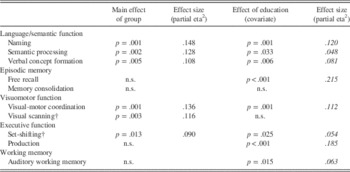
Education was entered as a covariate in subsequent analyses, whereas age was not, as entering weak covariates decrease the statistical power of the analyses. Subsequent ANCOVAs revealed differences between the two groups, controlling for education, on two tests of language and semantic function: naming, F(1,92) 6.733, p=.011, partial eta 2 =.068, and verbal concept formation, F(1,92) 7.373, p=.008, partial eta2=.074; and two tests of visuomotor function: visual scanning, F(1,92) 6.535, p=.012, partial eta2=.066, and visual-motor coordination, F(1,92) 4.636, p=.034, partial eta 2 =.048 (Table 3). No significant group differences were observed in tests of episodic memory, executive function, or working memory.
Effects of group (PWE-R, PWE-A, HC) on cognition (corrected for ageFootnote * and education).

* Not statistically significant.
† Time to completion.
A second MANCOVA, subsequent ANCOVAs and pairwise contrasts were conducted to examine whether the cognitive impairment stemmed more from the active (PWE-A) than the remitted (PWE-R) epilepsy group. As expected, the significant effect of group, F(2,92) 2.130, p=.005, partial eta2=.202, for overall cognitive test performances controlling for education, was replicated. Subsequent ANCOVAs, controlling for education, showed significant effects of group on all three tests of language and semantic function: naming, F(2,92) 7.979, p=.001, partial eta2=.148, semantic processing, F(2,92) 6.776, p=.002, partial eta2=.128, and verbal concept formation, F(2,92) 5.549, p=.005, partial eta2=.108. Also, in line with the corresponding analyses conducted over PWE versus HC, significant group effects were observed for both indices of visuomotor function: visual scanning, F(2,92) 6.032, p=.003, partial eta2=.116, and visual-motor coordination, F(2,92) 7.243, p=.001, partial eta2=.136. Group differences were also observed in one measure of executive function, namely set-shifting, F(2,92) 4.529, p=.013, partial eta2=.090. Again, as in the PWE versus HC comparisons between, no group differences were observed in measures of episodic memory and working memory (Table 3).
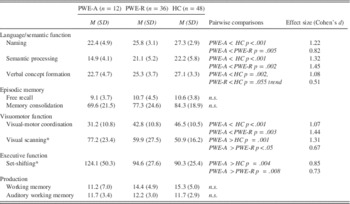
Pairwise comparisons revealed that the group differences mostly stemmed from the fact that the PWE-A group had worse performances than the HC group and in most cases also the PWE-R group (Table 4).
Pairwise comparisons of cognitive test performances (M, SD) in participants with active epilepsy (PWE-A), epilepsy in remission (PWE-R), and healthy controls (HC), controlling for education

* Time to completion, higher value indicates worse performance
When the analysis was conducted over three groups (PWE-A, PWE-R, HC), a significant interaction between group and learning, controlling for education, emerged, F(2,92) 2.282, p=.022, partial eta2=047. Pairwise comparisons did not reveal significant differences between any two groups when controlling for education, thus low education likely explains some of the low performance in the PWE-A group (Figure 1).
Mean performances in the five trials of the Rey Auditory-Verbal Learning Test (RAVLT). Error bars represent SDs. No significant differences were observed between the PWE and HC groups, but when the PWE-A and PWE-R groups were separated in the analysis a significant interaction (p=.003) was found due to the worse performances of the PWE-A group in the fourth and fifth trials as compared to the HC and PWE-R groups.

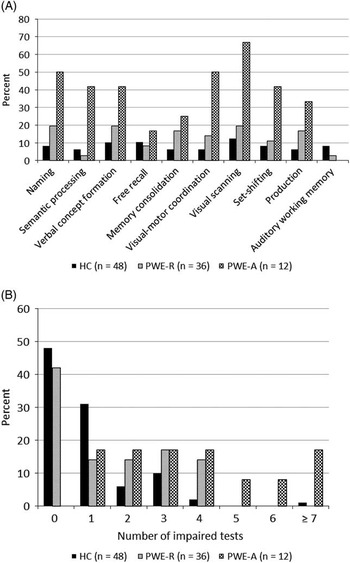
The percent of individuals with impaired z-transformed test scores (<−1.5 SD) was calculated across the three groups (Figure 2A). In the PWE-A group, 40–50% were impaired in the semantic/language, visual-motor and executive tests, whereas impairment in memory tests was observed in 15–18%. In the PWE-R group, the corresponding percentages ranged between 5 and 20%, and in the control group only 5–10% were impaired.
A: Percentage of participants with impairment (≥−1.5 SD) in the tests measuring different cognitive functions. B: Number of impaired tests in the three groups shown as percentages of respective group.

The number of impaired tests was calculated for the three groups (Figure 2B), and the distributions differed significantly, χ 2 17.143, Fisher’s exact p<.01. Pairwise comparisons revealed that there were significant differences between the PWE-A and HC groups, χ 2 13.889, Fisher’s exact p<.01, as well as between the PWE-A and PWE-R groups χ 2 4.907, Fisher’s exact p=.041, and a trend toward significance between the HC and PWE-R groups, χ 2 9.420, Fisher’s exact p=.080. For the PWE-R group, the OR for having cognitive impairment (i.e., impairment in ≥30% of the tests) was non-significant, OR=2.6 (95% CI [0.9, 7.5], p=.0830), but for the PWE-A group it was highly significant, OR=11.7, (95% CI [2.8, 49.6], p=.0008).
Finally, we conducted correlation analyses within the PWE-R group to examine whether age of onset, cumulative duration of seizure activity before remission, cumulative duration of years without seizures, and years of AED use would be related to cognitive functioning. For the individual cognitive tests, the only significant association was between cumulative seizure duration and semantic processing, r=.298, p<.05, all other correlations were non-significant. We also conducted a linear regression analysis within the PWE-R group to examine the possible effect of the same clinical and background variables on the number of impaired tests. The model fit was, however, non-significant (p=.357).
DISCUSSION
This study investigated cognitive outcome in a population-based cohort of participants with childhood-onset epilepsies (PWE), who have been followed prospectively for 50 years. The exceptionally long follow-up period provides an extraordinary opportunity to characterize the very long term impact of epilepsy on eventual cognitive outcomes. The natural history and the social, occupational, and psychiatric outcomes of childhood epilepsy have been the subject of considerable investigation (Camfield & Camfield, Reference Camfield and Camfield2014; Jalava, Sillanpää, Camfield, & Camfield, Reference Jalava, Sillanpää, Camfield and Camfield1997; Sillanpää et al., Reference Sillanpää, Jalava, Kaleva and Shinnar1998; Sillanpää, Haataja & Shinnar, Reference Sillanpää, Haataja and Shinnar2004), but never has cognitive function been studied in detail with contemporary measures of human cognition in such a controlled manner as characterized here.
Two core findings emerge from this investigation. First, the results indicate that, on an overall group-level, persons with childhood-onset epilepsy exhibit several cognitive impairments compared to matched controls in late middle age, affecting mainly language and semantic functions, as well as visuomotor functions. This is in line with the many earlier life neuropsychological investigations of children showing cognitive abnormalities even in epilepsy syndromes previously believed to be benign and uncomplicated (e.g., benign childhood epilepsy with centrotemporal spikes or absence epilepsy) (Hommet et al., Reference Hommet, Sauerwein, De Toffol and Lassonde2006).
Second, from the viewpoint of long-term cognitive prognosis, the continuation or discontinuation of epilepsy is a critical distinction. The group of participants with active epilepsy, that is, continuing seizures and medication over the whole life-span, had completed less formal education and also clearly performed cognitively worse than both healthy controls as well as participants with remitted epilepsy. When cognitive impairment was defined as performing below 1.5 SD on ≥30% of the cognitive tests, the OR for the PWE-A group was very high, OR=11.7, (95% CI [2.8, 49.6], p=.0008). Previous studies with much shorter follow-up periods have indicated that uncontrolled seizures do increase the likelihood of cognitive impairment (Dodrill, Reference Dodrill2004; Seidenberg, Pulsipher, & Hermann, Reference Seidenberg, Pulsipher and Hermann2007), and our long-term outcome data substantiate that. The cognitive domains most impaired in the active epilepsy group included language and semantic function, speeded visuomotor functions, the ability to learn information, and set-shifting. Impairment in these domains has been detected in previous cross-sectional and short follow-up studies (Hermann et al., Reference Hermann, Lin, Jones and Seidenberg2009; Vingerhoets, Reference Vingerhoets2006).
Visuomotor and executive impairment has also been shown in adults with partial and generalized epilepsy even before AED use (Pulliainen, Kuikka, & Jokelainen, Reference Pulliainen, Kuikka and Jokelainen2000), indicating that these functions may be particularly vulnerable to epileptic seizure activity. Impairment in the ability to encode information, learn over trials and consolidate episodic memories has been reported particularly in patients who had temporal lobe epilepsy (TLE) with left (dominant) hemisphere onset (Loring et al., Reference Loring, Strauss, Hermann, Barr, Perrine, Trenerry and Bowden2008). More specifically, impaired learning in an auditory word list learning task has been observed in adult TLE patients (Äikiä, Salmenperä, Partanen, & Kälviäinen, Reference Äikiä, Salmenperä, Partanen and Kälviäinen2001), but in contrast to our findings, the learning curve in the adult patients did not asymptote as it did for the participants with active epilepsy in our sample who were unable to benefit from repetitions.
Similar inability to benefit from repeated exposure has also been shown in preclinical Alzheimer’s disease (Bäckman, Jones, Berger, Laukka, & Small, Reference Bäckman, Jones, Berger, Laukka and Small2005). This inability may thus reflect possible progression of epilepsy-related neuropathology or the addition of other comorbid neurodegenerative processes. Cognitive follow-up and biomarker-analyses will be needed to elucidate the neural underpinnings of cognitive impairment in the participants with active epilepsy, particularly in the case of impaired learning. It is also possible that worse learning in the participants with active epilepsy is mediated by lower educational attainment, in our sample education was a strong predictor of episodic memory and learning performances, and almost all group effects subsided when education was controlled for.
The childhood-onset epilepsy participants in remission exhibited modest differences compared to controls, with 10–20% demonstrating impairment on some cognitive tests. Although not statistically significant (p=.08), they did show an increased likelihood of cognitive impairment (OR=2.6; 95% CI [0.9, 7.5]) and this may represent the persisting mild consequences of early and remitted epilepsy. Previous studies of younger individuals with epilepsy have shown that well-controlled epilepsy predicts normal social functioning and psychological well-being in young adulthood (Koponen et al., Reference Koponen, Seppälä, Eriksson, Nieminen, Uutela, Sillanpää and Kälviäinen2007). Very near normal cognitive functioning has also been shown in children with non-pharmacoresistant epilepsy (mean IQ 95.9) (Berg et al., Reference Berg, Zelko, Levy and Testa2012) and in children with a single (IQ 97) or less than ten seizures (IQ 94) (Sogawa, Masur, O’Dell, Moshe, & Shinnar, Reference Sogawa, Masur, O’Dell, Moshe and Shinnar2010).
Fastenau et al. (Reference Fastenau, Johnson, Perkins, Byars, deGrauw, Austin and Dunn2009) showed that, although up to 40% of children show cognitive impairment at epilepsy onset, the majority, in fact, do not. Our very long-term cognitive outcome data should provide some reassurance, from a population-based perspective, that if seizures remit relatively early on, the cognitive prognosis several decades later will be favorable. Although the cognitive repercussions of seizure activity are present even years after remission, our results indicate that absence of seizures over longer time periods (several years or even decades) may allow for cognitive functions to recover.
A limitation of the study is the lack of serial cognitive data for the participants. Consequently, we cannot establish whether the cognitive deficits observed constitute solely a fixed developmental impairment that has reached a steady plateau, or whether the impairment is progressive in nature. It is likely that some aspects of the impairment particularly in the participants with active epilepsy are developmental in origin, as reflected also by the lower educational attainment. We controlled for education in our analyses, and the results indicate that poor performances on memory tests may be partly mediated by low education (and possibly, by proxy, by cognitive impairments present at epilepsy onset), whereas impairments in other domains seem less so. It is also of interest to note that follow-up of adult patients with chronic TLE showed progressive worsening over a four year period in a subset of patients in many of the same tests/domains that we report in our active epilepsy group (Hermann et al., Reference Hermann, Seidenberg, Dow, Jones, Rutecki, Bhattacharya and Bell2006), that is, speeded cognitive functioning, memory, and naming.
Strengths of the present study include the prospective population-based cohort and very long-term follow-up, extensive formal neuropsychological assessment, and a matched control group. As a population-based cohort, it provides the best estimate of the natural cognitive outcomes of surviving patients with non-complicated childhood-onset epilepsies.
To summarize, our results indicate that for participants with childhood-onset epilepsy in remission, cognitive function is near-normal in late middle age and the risk for cognitive impairment is low. However, individuals who continue to have seizures and/or need continuous AED-medication do show a significantly increased risk of cognitive impairment. Based on the present study, it is not possible to determine whether the observed changes are progressive and on-going in nature, but it is clear that the participants with active childhood-onset epilepsy will be entering their elder years at a distinct cognitive disadvantage, that is, with less cognitive reserve with which to withstand the adverse effects of aging and disease. This is the first time that objective cognitive evidence of this sort has been presented. Further follow-up will elucidate their cognitive trajectory with advancing age.
ACKNOWLEDGMENTS
We thank our coinvestigators: Matti Erkinjuntti, MD, PhD, Turku University Hospital, Division of Clinical Neurosciences, University of Turku, FINLAND, Janina Paju, MA, Department of Psychology, Abo Akademi University, Turku, FINLAND, Maiju Saarinen, MSc, Departments of Public Health and Child Neurology, University of Turku, FINLAND and Pirkko Sonninen, MD, Turku University Hospital, Division of Clinical Neurosciences, University of Turku, FINLAND. Research nurse Leila Kesäläinen+ is acknowledged for her excellent work as a study coordinator and technical assistant that enabled the flexible practical realization of the study. We also thank the participants for their invaluable contribution over the years. The study was financially supported by the national Government Research Grant (EVO) and a CURE Innovation Award (USA).
Potential Conflicts of Interest: Dr. Karrasch serves as Associate Editor for Nordic Psychology. Petri Tiitta: No conflict of interest. Dr. Hermann is funded by NIH grants 3R01NS044351, 1R01AG027161 and 1R01 NS064034. He serves as an Associate Editor for Epilepsy & Behavior. Dr. Joutsa has received a lecturer honorarium from Boehringer-Ingelheim, research grants from Lundbeck and the Orion Research Foundation, and a travel grants from Abbvie. Dr. Shinnar is funded by NIH grants 2R37NS043209, 2U01NS045911, 1U10NS077308 and 1U01NS088034. He has also received grant support from the Rett Syndrome Research Trust. He serves on the Editorial Board of Pediatric Neurology, and serves on two DSMBs for UCB Pharma. He has received personal compensation for serving on Scientific Advisory Boards for Accorda, AstraZenica, and Upsher Smith, for consulting for Accorda, NeurelisUpsher-Smith and Xeris. He has received royalties from Elsevier for co-editing the book, Febrile Seizures. Dr. Rinne serves as a consultant of neurology for TEVA Finland Ltd and CRST Ltd. Anu Anttinen: No conflict of interest. Dr. Sillanpää is funded by the national Governmental Research Grant (EVO) and a CURE Innovators Award (USA). He serves as a Member of the Editorial Board for Acta Neurologica Scandinavica; BMC Neurology; Epilepsia; Journal of Epileptology; Neurologia Dziecieca; Pediatric Neurology; Seizure; and a Member of the Reviewer Body for Journal of Pediatric Neurology.