Throughout American history certain elections have mobilized social groups, shifted voters' partisan affiliations, altered political ideologies, and caused politics to develop in new and unique ways.Footnote 1 William Jennings Bryan's candidacy in the presidential election of 1896 has frequently been seen as such a turning point. Drawing on a long history of conflict over financial issues, Bryan appealed to popular hatred of eastern banks and demanded the free coinage of silver to aid disadvantaged Americans.Footnote 2
Bryan's demands for free silver were not especially radical, nor were they the only contentious economic issue during this period. Prior to the Civil War the status of paper currency, wildcat banks, and the recharter of the Second Bank of the United States consumed elections and dominated public debate.Footnote 3 Yet while issues such as greenback inflation and railroad regulation emerged during the 1870s and 1880s, no single policy debate consumed a presidential election in the way that free silver dominated the election of 1896.
In addition to focusing on monetary policy, the election of 1896 had more general effects on the ideology of the Democratic Party. Prior to the Civil War, the Democrats opposed centralized authority because they feared a powerful federal government could be used to undermine slavery.Footnote 4 While Bryan retained antebellum Democrats' hostility toward banks and concentrated economic power, he used the silver issue to reverse their views of federal regulatory authority. As Michael Kazin has argued, Bryan and the issues associated with the election of 1896 set the Democrats
on a course that led away from their laissez-faire past and toward the liberalism of the new Freedom, the New Deal, and the Great Society. To demand that the government control the money supply … was not quite a blueprint for a regulatory state. But the platform [of 1896] officially declared that Democrats were in favor of beginning to redistribute wealth and power in America. In rhetoric at least, the party has never gone back.Footnote 5
By undermining the Democrats' traditional antistatism with demands for federal action to aid the disadvantaged, Bryan has been described as the “rightful father” of the Progressive ideology of the Democratic Party.Footnote 6 While these demands would be more fully developed during the New Deal, Progressives such as Benjamin Parke De Witt believed the free silver issue “had begun” the Democrats' shift toward their contemporary ideological positions.Footnote 7 And once the Democrats endorsed federal regulation of the money supply, it seemed logical that these powers be extended to other issues as well.Footnote 8
However, this ideological transition had effects that extended beyond debates over the scope of government authority. The Democrats' opposition to federal regulatory authority had to be jettisoned before the American state could assume an active regulatory posture and executive bureaucracies could mobilize popular support for their programs and agendas.Footnote 9 Yet once this change occurred, it influenced American state formation. For once the public was demanding regulation of the economy, the expansion of government authority appears to have been a “near-automatic response” to industrialization, and corporations were increasingly seen to be “fit subjects for regulation.”Footnote 10 In this sense, Bryan and the Democrats' demands for free silver had lasting effects on the American polity and the ideology of the Democratic Party.Footnote 11
If 1896 was a turning point in these transitions, and if free silver was the most important issue of this election, it is critical to understand how free silver became a political issue. Two events in particular require explanation: the demonetization of the silver dollar in the Coinage Act of 1873, and the subsequent development of the free silver movement in the 1870s and 1880s. While free silver is typically associated with Bryan and the election of 1896, Bryan adopted ideas originally popularized by minor third parties such as the American Bimetallic League and the American Bimetallic Party. These parties demanded the free coinage of silver and denounced the Coinage Act of 1873, legislation that eliminated the silver dollar as a legal tender currency, as the “Crime of '73”: a criminal conspiracy by eastern U.S. and European bankers to impoverish American producers and destabilize the economy.
Recognizing his debt to these organizations, Bryan's retrospective of the election of 1896, The First Battle, noted the importance of silver advocates such as A. J. Warner (D-OH), John P. Jones (R-NV), and William Stewart (R-NV). Bryan suggested that Jones's speeches were the most “complete and comprehensive” defense of free silver ever offered, and specifically commended Stewart, noting he had attended
every National conference where the subject was under consideration, and has devoted all his energies to the restoration of the bimetallic standard. I had frequent occasion to visit the United States Senate during the prolonged struggle which ended in the unconditional repeal of the Sherman law, and I shall never forget the earnestness with which he pleaded against the passage of that act. Not only has he availed himself of every opportunity offered by his official position, but he has been constant in his work outside of the Senate, having for more than a year past been connected with the Silver Knight and National Watchman, a paper published at Washington and devoted to the restoration of the money of the Constitution.Footnote 12
As executive director of both the American Bimetallic League and the American Bimetallic Party, Stewart played a critical role in printing and distributing Coin's Financial School, a book that was so widely read that Bryan claimed that nothing else had “produced so great an effect” in exposing the public to the critical economic issues of the day.Footnote 13 Indeed, Bryan claimed the American Bimetallic League's pamphlets were the “first thing” he read regarding the silver issue.Footnote 14
By popularizing the ideas that Bryan would adopt in 1896, these organizations played a critical role in the Democratic Party's transition to embracing a contemporary conception of liberalism.Footnote 15 For when Bryan made free silver the centerpiece of the election of 1896 and redirected the Democratic Party away from their traditional antistatism, he did so by adopting ideas initially espoused by the American Bimetallic League and the American Bimetallic Party.Footnote 16 To understand the ideological transformation the election of 1896 had upon the Democratic Party, it is critical to understand why silver was demonetized, and why certain politicians created the organizations that popularized free silver. For silver's demonetization by the Coinage Act of 1873 provided the basis for subsequent conflict over bimetallism, and the various free silver organizations that campaigned for silver's remonetization popularized the ideas subsequently adopted by Bryan and the Populists.
The legislation that demonetized silver, the Coinage Act of 1873, was believed to be a technical revision of federal coinage statutes, yet its provisions would shape public debate for decades. The Coinage Act's most important provision was its elimination of the silver dollar as a legal tender. In addition to demonetizing silver, the Coinage Act also created a new coin, the Trade Dollar, which was intended to create an international market for American silver bullion that was not a legal tender. Finally, the Coinage Act also reduced the coinage charge placed upon the conversion of silver bullion into coins at U.S. mints.
There are three explanations for the passage of the Coinage Act of 1873. The first, offered by various free silver organizations, Bryan, and the Populists, claimed the Coinage Act of 1873 was drafted by government officials who were bribed by eastern U.S. and European bankers seeking to protect the value of their gold-bearing bonds. According to this account, shadowy financiers manipulated politics for their selfish ends and the resulting currency contraction destabilized the economy and harmed debtors, laborers, and agrarians.Footnote 17
Silver's demonetization was simply one conspiracy the Populists endorsed. Susan Emery's widely read Seven Financial Conspiracies Which Have Enslaved the American People suggested that secret forces influenced regulatory decisions ranging from the creation of the National Banking System to the resumption of the gold standard in 1879.Footnote 18 Emery claimed eastern bankers welcomed the outbreak of the Civil War and used the conflict to take command of the nation's currency and economy, spreading economic ruin and depression among the American people.
While many nineteenth-century Americans endorsed these claims, the organizations that espoused them—and the Populists in particular—have been criticized for holding an inaccurate and conspiratorial view of American history, and their grievances are often seen as the irrational ramblings of Americans seeking scapegoats for problems created by industrialization. Studies by Richard Hofstadter, Irwin Unger, Milton Friedman, and Anna Schwartz suggest that impersonal economic forces, and not scheming creditors, were responsible for silver's demonetization.Footnote 19 Finding no evidence that bankers were involved in silver's demonetization, these studies conclude that the Populists' “conspiracy theory was, of course, groundless.”Footnote 20 By emphasizing free silver advocates' irrational and conspiratorial worldview, these scholars conclude that the paranoid tendencies of American politics appear to have frustrated rational political debate.
Another set of studies offers a third explanation, suggesting there was a conspiracy to demonetize silver, yet still maintaining that the Populists' rendition of events is wildly inaccurate. Instead of attributing the Coinage Act to scheming creditors, Paul O'Leary, Allen Weinstein, and Walter Nugent argue that congressmen and Treasury Department bureaucrats quietly demonetized silver because they realized collapsing silver prices would threaten the gold standard by making silver attractive to monetary inflationists.Footnote 21 Despite admitting that there was a conspiracy to demonetize silver, these studies argue that public officials such as Senator John Sherman (R-OH), Treasury Secretary George Boutwell, and Director of the Mint Henry Linderman, and not eastern U.S. or European bankers, were responsible for the Coinage Act.Footnote 22
Although offering different accounts of the groups responsible for silver's demonetization, there is a widespread consensus that the Populists erred in attributing silver's demonetization to economic elites. With no evidence that bankers influenced silver's demonetization, the Populists' denunciation of the “Crime of '73” is often seen as an embarrassing chapter of American history best forgotten except to foreshadow McCarthyism and other episodes of political hysteria.Footnote 23 Lacking any evidence of bankers' involvement in silver's demonetization, Richard Hofstadter concluded that the Populists embodied the “paranoid style” of American politics, leading many to conclude: “there was no ‘Crime of ’73.'”Footnote 24
While they have been denigrated and dismissed, the Populists' tale of bribery and intrigue is far more accurate than has been realized. Although the Populists have been criticized for their paranoid and conspiratorial tendencies, their central contention, that bankers were secretly involved in bribing the officials who wrote the legislation demonetizing the silver dollar, appears to be true.
Existing studies argue that Henry Linderman, director of the Mint, demonetized the silver dollar when he wrote key sections of the Coinage Act of 1873 with Comptroller of the Currency John Jay Knox. By attributing the Coinage Act to these officials, and Linderman in particular, many have concluded the Coinage Act was drafted independently of financiers. What these studies have overlooked is that Linderman was not acting independently when he drafted the Coinage Act. Linderman was actually working at the behest of William Ralston, president of The Bank of California, who was involved in various schemes to protect the financial empire he had constructed from his control of Nevada's Comstock silver mines.
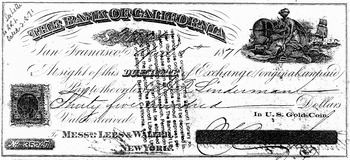
Ralston's method for influencing Linderman was straightforward; Ralston paid Linderman thousands of dollars in exchange for influencing the coinage statutes in ways that were advantageous to The Bank of California. Hardly based on circumstantial evidence, Ralston's bribery of Linderman is bluntly recorded in his correspondence, and one of the actual checks Ralston used to pay Linderman was preserved in Ralston's papers. While the Populists mistakenly blamed eastern U.S. and European financiers for a scheme executed by a California banker, Ralston's involvement in silver's demonetization indicates that the Populists' central claims, while still containing significant inaccuracies, were far closer to the truth than has been realized.
However, Ralston's involvement in the Coinage Act intensifies the mystery surrounding the silver issue. For it is unclear why the Populists mistakenly blamed eastern and European bankers, and not a western financier, for silver's demonetization. This error becomes explicable once we recognize that Linderman was not the only official operating at Ralston's behest. In addition to influencing Treasury Department bureaucrats such as Linderman, Ralston used western representatives such as William Stewart (R-NV), Eugene Casserly (R-CA), and Aaron Sargent (R-CA) to protect the Coinage Act from harmful amendments and to keep him informed of Linderman's actions.
These western representatives' involvement in Ralston's scheme appears to explain why inaccurate claims regarding eastern and European financiers were subsequently popularized. Although the Coinage Act had received little attention or press coverage, in 1876 America slipped into a recession that many newspapers attributed to silver's demonetization. In their attempts to explain the cause of the recession, several newspapers began attributing the recession to silver's demonetization, and claimed the Coinage Act was the result of a conspiracy involving eastern and European financiers.
These editorials caused an explosion of popular outrage in western states with large silver interests such as Nevada and California, and suddenly Ralston's congressional allies found themselves facing constituents outraged by a bill that, unbeknownst to anyone, they had helped pass. Recognizing that their political careers would be ruined if their involvement in the Coinage Act were revealed, Ralston's congressional allies embarked upon a stunning, but entirely comprehensible, course of action. Although they had secretly helped pass the Coinage Act, defended it during congressional debate, and kept Ralston informed of Linderman's actions, some of Ralston's legislative allies began echoing newspapers blaming eastern and European financiers for the “crime” that they had actually committed. By reinforcing popular misconceptions initially created by the inaccurate newspaper editorials, Ralston's congressional allies blamed eastern and European financiers for silver's demonetization, assumed leading roles in the free silver movement, and managed to elude responsibility for what they had done.
One of Ralston's allies, Senator William Stewart (R-NV), would become one of the most prominent leaders of the free silver movement, editing newspapers such as the Silver Knight and the Silver Knight-Watchman, and co-founding both the American Bimetallic League and the American Bimetallic Party, organizations that distributed free silver literature such as Coin's Financial School and helped popularize the ideas subsequently adopted by the Populists and William Jennings Bryan.
Although the silver issue dominated political debate, received extensive press coverage, and captivated the popular imagination, no one realized that some of the politicians leading the free silver movement were deeply implicated in the measure they were denouncing. Voters either accepted the fictitious interpretation Ralston's allies helped popularize, or they adopted the Republicans' inaccurate claims that nothing duplicitous had occurred. Given the inaccuracy of these explanations, the reality of what had transpired was obscured by an avalanche of denunciation, myth, and political maneuvering that remains poorly understood to this day.
By revealing the actual history of silver's demonetization, this paper improves our understanding of monetary policy during this period. However, revealing the forces responsible for silver's demonetization may also alter our understanding of the ideological shift that culminated in Bryan's candidacy. For if the election of 1896 marked the beginning of the Democrats shift toward contemporary liberalism, and if the silver issue was the preeminent issue in this election, the Democrats' ideological transformation may have been more contingent upon political calculations and pressures than has been recognized.
Furthermore, the manipulation and incomprehension surrounding the silver issue raises a range of questions regarding populism and popular control of democratic politics. While Ralston's involvement in silver's demonetization indicates that nineteenth-century voters correctly suspected the coinage statutes were influenced by bribery, Ralston's legislative coalition managed to popularize a narrative that insulated them from electoral retribution. While public opinion and elections are often believed to constrain democratic states, widespread public ignorance and political elites' corresponding ability to manipulate public opinion may grant democratic governments a degree of autonomy from society.Footnote 25
The existence of such instances of ignorance and manipulation raises some of the darker questions that Hofstadter and others asked about populism and misinformation in modern democracies. Yet reinvestigating these questions may also help us view populism not as a paranoid psychological tendency, but as a comprehensible reaction to the inescapable complexity of modern politics and our inevitable reliance upon opinion leaders and other mediators of political information.
THE CRIME OF 1873
Throughout the second party system, monetary policy dominated public debate and popular discussion. However, prior to the Civil War, slavery and secession displaced economic conflicts as the critical issues of U.S. political debate. After the Civil War, monetary policy reentered public debate in 1867 when Ohio Democrat George Pendleton tried to win the presidential nomination of 1868 on an inflationary greenback platform designed to minimize the Democrats' associations with secession and the “bloody shirt.”Footnote 26 Although the Democrats lost the election of 1868, their demands for inflationary fiscal policies became popular among certain agrarian and urban constituencies.Footnote 27 Recognizing that the gold standard had become unpopular, the Republicans quickly passed the Public Credit Act of 1869, legislation requiring that the public debt be paid in either gold or silver, removing financial issues from political debate.Footnote 28
However, in the early 1870s massive silver discoveries in California and Nevada coincided with several European countries' decisions to demonetize their silver currency. As Henry Linderman, director of the Philadelphia Mint, noted, these developments and technological advances in mining and transportation indicated that silver production “will be carried on … to an extent hitherto unknown.”Footnote 29 Linderman recognized that silver prices were about to collapse, a development that threatened to inject monetary policy back into public debate.
In addition to Linderman, both Senator John Sherman and New Yorker Samuel Ruggles had been alerted to Europe's impending demonetization of silver while attending the Paris monetary convention of 1867.Footnote 30 Ruggles reported that the convention's “object, among others, is to agree, if possible, on a common unit of money for the use of the civilized world,” and claimed the conference participants had agreed to “adopting as … [a monetary] unit the … French five franc piece of gold.”Footnote 31
As chairman of the Senate Finance Committee, Sherman was in regular correspondence with public intellectuals such as David Wells, William Graham Sumner, and Charles Francis Adams Jr. Sherman's command of finance policy and economic theory, his role on the Senate Finance Committee, and his subsequent tenure as secretary of the Treasury gave him a close command of financial regulatory decisions. Similarly, Secretary of the Treasury George Boutwell also had extensive knowledge of issues relevant to the Treasury's funding operations and, like Sherman, understood how international bullion trends could influence the public credit.
Although largely unrecognized at the time, if America remained on a bimetallic standard, the injection of large amounts of demonetized European silver into silver markets could have influenced the public credit and the value of domestic silver mines. William Ralston, president of The Bank of California whose vast business empire was based upon his ownership of the Comstock silver mines, was monitoring silver markets and assessing how political decisions could influence his financial operations. In 1869, congressmen, Treasury bureaucrats, and members of the Senate Coinage Committee were invited by California capitalists James G. Flood and William Sharon to tour Nevada's Comstock silver mines and were entertained by Ralston, then cashier of The Bank of California.Footnote 32
Known for his lavish parties and affable manners, Ralston worried that if America remained on a bimetallic standard after Europe demonetized large amounts of silver currency, European silver would be shipped to America to be exchanged for gold. Ralston had constructed a vast network of business enterprises that were dependent upon The Bank of California, which was in turn dependent upon the Comstock silver mines. Ralston's Comstock investments included the Ophir Gold and Silver Mining Company, the Gould & Curry, and Savage mines, and the joint ownership with William Sharon of the Union Mill & Mining Company, which processed most of the Comstock's ore.Footnote 33 Ralston's control over the Union Mill & Mine Company allowed him to control the processing of ore critical for any Comstock mine. By refusing to process certain mines' ore, and by manipulating the prices mines were charged for refining, Ralston acquired many of the Comstock's mines at bargain prices.Footnote 34
Ralston used his control of the Comstock to construct a vast network of business ventures throughout California. Ralston was involved in enterprises such as the Pacific and Mission Woolen Mills of San Francisco, the Pacific Sugar Refinery, the Buena Vista Vinicultural Society, the Virginia & Truckee Railroad, stagecoach companies, and the Spring Valley Water Company, which provided San Francisco with water.Footnote 35 However, Ralston was not solely focused on business interests; he also spent huge sums to develop San Francisco, financing the San Francisco Opera House and constructing the extravagant Palace Hotel and his Belmont estate.
Ralston's business empire depended upon the stability of The Bank of California, which was in turn dependent upon the value of the Comstock silver mines. The stability of Ralston's bank was constantly an issue because Ralston's extensive business investments left him perpetually overextended. Lacking the self-control of many financiers, Ralston was prone to invest in many enterprises that proved unprofitable, and he often masked the nature of his risky investments with bookkeeping gimmicks.
Given The Bank of California's precarious position throughout the early 1870s, Ralston's concerns were hardly misplaced. Anything that threatened the value of Comstock mining stock could trigger a run on The Bank of California. In this context, a flood of European silver into America could have destabilized the value of the Comstock mines. As The Bank of California and the Comstock lode were “almost totally interdependent” during this period, the influx of silver into domestic markets would have undermined the value of the Comstock silver mines, and given the precarious position of The Bank of California, this could have threatened Ralston's entire financial empire.Footnote 36
As Linderman had warned Ralston in 1872, if European countries demonetized their silver currency “the countries maintaining the double standard will be overrun with silver bullion,” a development which would make “a serious decline in price unavoidable.”Footnote 37 These concerns were heightened when Germany's demonetization of silver set off a chain reaction among countries anxious to avoid exchanging their gold for other countries' demonetized silver.Footnote 38 Lacking any international agreement protecting bimetallism, American silver producers would have faced serious losses if America became a dumping ground for Europe's demonetized silver.Footnote 39 Believing the importation of large amounts of European silver would be “harmful both to the United States and to the Bank of California,” Ralston began working to demonetize silver.Footnote 40
While demonetizing silver would insulate America from a flood of European silver, demonetization would limit the domestic outlet for Ralston's bullion and do little to bolster silver prices. The second stage of Ralston's plan was designed to create a new market for the Comstock's silver. Ralston sought to create a commercial coin, the Trade Dollar, which was intended for exportation to Asian currency markets to protect the profitability of the Comstock and the solvency of The Bank of California despite deteriorating silver prices.Footnote 41 The Trade Dollar was designed to replace the Spanish dollar favored for Chinese commercial transactions. As California's proximity to China minimized transportation costs for exporting Trade Dollars, Ralston would enjoy a virtual monopoly over their production. Hardly attempting to bolster silver prices, Ralston hoped that demonetizing silver and creating the Trade Dollar would prevent European silver from flooding the United States while simultaneously creating an international outlet for the Comstock's silver.
Finally, Ralston sought to eliminate the coinage charge the Treasury Department placed upon converting bullion into coin. Aside from minimizing the cost of producing the Trade Dollar, eliminating the coinage charge would also aid Ralston because The Bank of California functioned as an intermediary for refining bullion that the San Francisco Mint converted into coin and that San Francisco businesses used to pay import duties. Ralston hoped demonetizing silver, creating the Trade Dollar, and eliminating the coinage charge would protect The Bank of California from deteriorating silver prices and insulate his business empire from a flood of demonetized European silver coinage.
To ensure the implementation of this plan, Ralston cultivated contacts with Treasury Department bureaucrats and legislators who would control the revision of the coinage statutes. Perhaps most critical was Ralston's relationship with Henry Linderman, director of the Philadelphia Mint and subsequently director of the Mint in the Treasury Department, whose “matchless knowledge” of monetary theory and bullion price trends gave him unparalleled influence over coinage legislation.Footnote 42 Indeed, Linderman would write the key sections of the Coinage Act of 1873 that demonetized silver.
Ralston also maintained contacts with John Jay Knox, deputy comptroller of the Currency in the Treasury Department, who, along with Linderman, would write the initial draft of the Coinage Act of 1873. Knox had offered Ralston financial advice as early as 1869, assuring Ralston that if his advice were followed he would “not only increase your reputation as an able financier but also put money [in] your purse.”Footnote 43 Between Linderman and Knox, Ralston enjoyed access to key Treasury Department bureaucrats.
Additionally, The Bank of California's importance for California and Nevada ensured numerous Western representatives were attentive to Ralston's concerns as well. Perhaps most important was Nevada Senator William M. Stewart, who had been among the “most eminent and affluent of the Comstock lawyers” and had been involved with Ralston ever since the 1860s.Footnote 44 Stewart frequently advised Ralston on legislation influencing The Bank of California and recommended representatives he believed deserved Ralston's support.Footnote 45
There is some evidence that Ralston's relationship with Stewart extended into questionable business practices. For example, upon his election to the Senate in 1869, Stewart sold his Virginia City mansion to Charles DeLong, his law partner and a “one time California miner who knew Billy [Ralston].”Footnote 46 Once in the Senate, Stewart helped secure DeLong an appointment as minister to Japan, and DeLong promptly vacated the residence, selling the house to William Ralston's brother, Andrew, who “paid DeLong $10,000 for the once Stewart property.”Footnote 47 Other western representatives, such as Aaron Sargent, Samuel Axtell, and Eugene Casserly, would assist Ralston with the Coinage Act as well.Footnote 48
The first revision of the coinage statutes was initiated as a consequence of the Public Credit Act in 1869.Footnote 49 Seeking information relevant for the Treasury's funding operations, Secretary of the Treasury George Boutwell dispatched Linderman to western mints to collect information relevant for revising the coinage statutes. After they were introduced it was apparent that Linderman and Ralston “liked each other at once.”Footnote 50 As Linderman “came under the influence of … Ralston … [and] the so-called ‘Bank Crowd’” he began working to secure Treasury policies advantageous to The Bank of California.Footnote 51 In addition to using Ralston to obtain information about bullion markets, Linderman would collect thousands of dollars in bribes in exchange for his services.Footnote 52
Finding Linderman's report “intelligent” and conducted in a “business-like manner,” Boutwell thanked him for furnishing his “views upon other kindred topics which are valuable to the Department.”Footnote 53 Using information from Linderman's report, Knox began to draft legislation to revise the coinage statutes.Footnote 54 However, Ralston's access to Linderman and Knox granted him the ability to manipulate these revisions. Thus, as he drafted the measure, Knox solicited the opinions of “gentlemen as are known to be intelligent upon metallurgical and coinage subjects” and incorporated their suggestions into the bill.Footnote 55 As Knox had written Ralston that his position in the Treasury Department ensured he could “very likely be of service here,” it was little surprise that Linderman and Louis Garnett, manager of Ralston's San Francisco Assaying Works, “were among those … consulted.”Footnote 56
Knox noted that, prior to the revision, the currency statutes could “be so construed as to authorize both a gold dollar unit, and a silver dollar unit, one differing from the other in intrinsic value.”Footnote 57 However, after consulting with Linderman, the bill demonetized silver, ensuring “the present gold dollar piece … is made the dollar unit … and the silver dollar piece is discontinued.”Footnote 58 Given the threat European demonetization posed to his financial interests, Ralston explicitly “opposed the inclusion of a silver dollar in the list of coins” authorized by the Coinage Act.Footnote 59 Although appearing to merely rationalize coinage regulations, Ralston was helping “agents of the Treasury Department draw up … the bill that was necessary for effecting … changes” designed to aid The Bank of California.Footnote 60
Aside from demonetizing silver, Linderman also complained of the coinage charge's inequitable sectional effects, noting that “on comparison, and especially at San Francisco, that the expense of coinage are much greater than abroad, and hence our metallic product commands a higher price in foreign countries than can be realized by its coinage at home.”Footnote 61 Claiming that the coinage charge encouraged the exportation of American bullion, Linderman recommended that the coinage charge “should be abrogated altogether,” and called for a “return to our uniform practice prior to 1853, which was to coin [bullion] without charge, not only as an expedient for encouraging coinage, but as being more consistent with the theory of money as a universal standard of value.”Footnote 62
In addition to removing the coinage charge and demonetizing silver, Knox also recommended creating a 420-grain Trade Dollar that Ralston hoped would replace the Mexican silver dollar widely used in China but which was not a legal tender for domestic transactions.Footnote 63 Using Garnett's suggestions, Knox's draft of the Coinage Act concluded that “if however such a coin is authorized it should be issued only as a commercial dollar, not as a standard unit of account and of the exact value of the Mexican dollar which is the favorite for circulation in China and Japan.”Footnote 64
Although Knox's draft of the Coinage Act included most of Ralston's recommendations, when introduced into Congress the measure met opposition from Senator John Sherman and eastern representatives who opposed reducing the coinage charge. Linderman complained to Ralston that both Sherman and William Kelley (R-PA), chairman of the Coinage Committee, were “disposed to delay,” forcing him to have “a plain talk” with Kelley where Linderman “showed him the … advantages to be [had] by the passage of the Bill.”Footnote 65 As the Coinage Act faced “some apathy in the House and a quiet opposition from [Philadelphia],” Linderman asked Ralston to “write to all your members in the House particularly Sargent and Axtell asking them to give special attention to the Mint Bill in the House” in order to “work up some enthusiasm and interest in the House in order to insure early action by the committee on coinage.”Footnote 66
Western representatives had a number of reasons for assisting Ralston. Many believed the Coinage Act would benefit western states and favored its passage for sectional reasons. For example, Stewart assured Ralston that eliminating the coinage charge would make “San Francisco a city of exchange” for bullion normally shipped East for conversion into coin.Footnote 67 As the bill would aid western bullion producers, Stewart was closely monitoring the Coinage Act's progress. In one instance when Sherman attempted to reinstate the coinage charge, Henry Wilson (R-MA) was “dragged up … at the last moment by Stewart” defeating Sherman's amendment by a single vote.Footnote 68
In addition to protecting the Coinage Act from amendments harmful to Ralston's financial interests, Stewart was also keeping Ralston informed of Linderman's influence over legislative proceedings. Given that thousands of miles separated Linderman from Ralston, it was difficult for Ralston to directly monitor Linderman's actions and it is possible that he was overstating his influence to Ralston. To help monitor Linderman, Ralston was using western representatives to provide information about Linderman's actions.
Stewart's knowledge of Linderman's activities will be critical for understanding his involvement in the free silver movement, for when Stewart assured Ralston that “Linderman is at work on your matters in good earnest and I feel confident of results this session,” he revealed that he understood Ralston was using Linderman to influence the measure.Footnote 69 Given Stewart's exertions on his behalf, Ralston was assured that “Stewart and others of the ‘faithful’” were working “to put the bill [reducing the coinage charge] on as an amendment to some … of the money bills in the Senate, so as to ensure its becoming a law.”Footnote 70 Although Stewart would subsequently denounce the Coinage Act and take a leading role in various free silver organizations, his correspondence with Ralston indicates he was deeply implicated in the measure.
Introduced to the Senate in April of 1870, the bill was referred to the Finance Committee on April 28 and submitted to the House on June 25, 1870.Footnote 71 After Sherman introduced an amendment to reinstate the coinage charge, Ralston's allies complained: “Linderman and his boasted influence with … Sherman were not here.”Footnote 72 Cornelius Cole (R-CA) protested that the amendment was “exceedingly oppressive … to the people of the Pacific coast” that he claimed were “with wonderful unanimity, against this charge.”Footnote 73 However, Sherman complained that western senators were asking that “the people of the United States shall pay the entire cost of the Mint,” and concluded that it was “only the officers of the mint at San Francisco, who desire to enlarge their business at the expense of the people of the United States” that were in favor of removing the charge, and “that is all there is of it.”Footnote 74
Since eliminating the coinage charge was a component of Ralston's plan, Sherman was attacked by nearly every member of Ralston's coalition. Stewart denounced the coinage charge as “a discriminating and unjust tax against the producer of gold,” and Williams denied that the measure would have inequitable sectional effects, claiming: “it is a mistake to suppose that this bill, as it was originally framed, is for the particular benefit of the people of the Pacific coast.”Footnote 75 Hardly benefiting the West, Williams claimed the measure “was framed by persons who do not reside upon that coast and are not in any way interested in its affairs.”Footnote 76
Recognizing that “a majority of the Senators … [to] be controlled by the opinions of the two Senators [Sherman and Morrill] … rather than by the merits or the demerits of the question,” Eugene Casserly (R-CA) attempted to counteract Sherman and Morrill's opposition.Footnote 77 Claiming that the legislation involved “questions which we had not been able to examine for ourselves,” Casserly complained that “it is impossible for any of us to examine personally all the subjects, even those of leading interest, that come before us.”Footnote 78 Casserly then presented the “testimony of an extremely well-informed and capable gentleman in San Francisco,” Louis Garnett, manager of Ralston's San Francisco Assaying and Refining Company, and read his recommendation to eliminate the coinage charge into the Congressional Record.Footnote 79
Despite Casserly's efforts, Morrill and Sherman were simply not cooperating. Morrill dismissed the western representatives' arguments, claiming: “the idea that mere speculators go to San Francisco to buy up gold … in consequence of this coinage tax, is utterly preposterous.”Footnote 80 Since the logic justifying repeal of the coinage charge was incoherent, and since “no Senators except those from that section of the country [the West] have appeared in opposition to this so-called tax,” it appeared that “the Senators from the Pacific coast seem to … believe they have some interest in abolishing this seigniorage charge.”Footnote 81 Yet Morrill confessed he was “unable to see how it is going to benefit the Pacific coast or the miners.”Footnote 82
Despite Ralston's efforts, Sherman and Morrill reinstated the coinage charge and Ralston's coalition was again mobilized into action. William Huntington, cashier of H. D. Cooke's First National Bank, reported having seen “Sherman and … [William] Kelly the Chairman of the Committee on Coinage, and a number of other members, and think that the matter is now in good shape.”Footnote 83 Yet Linderman complained of “some difficulty in getting action on the Mint Bill by the coinage committee of the House.”Footnote 84 The measure faced “local pressure, from [Philadelphia],” and it appeared that “Sherman, Morrill, [and] Fenton … undoubtedly wanted the Bill smothered to death.”Footnote 85 While eastern financiers would subsequently be blamed for the Coinage Act's passage, Linderman was complaining to Ralston that “the New York folks, through Mason, of the Assay office, are stirring up the question of cheap refining claiming to be able to do it at rates much below S.F.”Footnote 86
Linderman specifically complained: “Seligman or some such man grossly misrepresented matters about ‘the repeal of the coinage charge for the benefit of the Bank of California, to enable them [the Bank of California] to avoid paying about $90,000 per annum into the U.S. treasury.’”Footnote 87 While denouncing this “misrepresentation,” Linderman would subsequently assure Ralston: “there will be a saving to producers [i.e., the Bank of California] of $90,000 per annum on account of reduction of coinage charges,” indicating that the eastern financiers' suspicions were hardly wide of the mark.Footnote 88
Despite eastern opposition, Linderman confided to Ralston: “we have the matter well in hand.”Footnote 89 Western representatives such as Casserly and Stewart supported their efforts, and Linderman also reported that Allen G. Thurman (D-OH) “is strong with us for a free coinage.”Footnote 90 Linderman claimed that “Mr. Randall of [Pennsylvania] who has much influence in the House was thoroughly posted and assured me of a solid Democratic vote,” and Secretary of the Treasury George Boutwell “strongly favors a free coinage, and is very pleased with the results of the present refining system.”Footnote 91
Yet Sherman's opposition to reducing the coinage charge remained problematic. Casserly told Ralston that he “had quite a talk with John Sherman” after which Sherman “refused decidedly” to endorse Ralston's plan, opposition that persisted after additional lobbying from Huntington.Footnote 92 Even after the measure passed the House, Ralston's allies complained of “the determined opposition by Sherman and the whole finance committee of the Senate.”Footnote 93
Despite such resistance, Linderman believed “money will not be required” to pass the bill.Footnote 94 However, Linderman informed Ralston that he was “not able to give my services without compensation.”Footnote 95 While Linderman's contemporaries claimed to be “shocked at the suggestion that the Director [of the Mint was] … bribed,” and although scholars such as Milton Friedman claim “no allegation of bribery has ever been … documented … against any individual member of Congress or government official in connection with the passage of the Coinage Act of 1873,” Linderman's requests to Ralston indicate otherwise.Footnote 96 As many believe that Linderman “broke no laws” when drafting the Coinage Act, it is worth quoting him at length.Footnote 97
For my services and expense here, including anything that may be required in coming to Washington, off and on, or New York and until 30th of June next, you will please send me thirty five hundred dollars—on receipt hereof. I suppose you will desire to have me attend to these matters and the pushing of the Mint Bill next session say up to Sept 1, 1872—13 months, which will carry us to the expiration of your present refining contract and by which time, I hope and firmly believe you will have all matters pertaining to refining and coinage in good shape. If so, I will make no engagement nor enter into any business which would interfere with the service indicated. I am willing to do so for the sum of Five Thousand dollars payable January 1st 1872.Footnote 98
Recognizing the value of Linderman's services, Ralston assured him: “we concur in all you suggest as to further compensation … and all other matters of this nature, and will depend on you solely to carry out and do the needful … as I said then, we will take care of you,” promptly sending him a check for $3,500.Footnote 99 While there is little evidence that Ralston was bribing elected officials, he was clearly paying the official responsible for the Coinage Act of 1873.
Given the requests Linderman was making of Ralston, it is not entirely surprising that Linderman was “strangely subdued” when discussing his involvement in the measure, nor is it surprising that it was only after 1872 that “he made his participation extremely effective.”Footnote 100 In addition to Linderman and Knox, Ralston's congressional allies had offered critical support. Linderman assured Ralston that “all the Pacific Coast men have done their duty,” and noted that he had “no doubt whatever of full success the next session.”Footnote 101
It is important to note that Ralston's bribe did not cause the passage of a measure that otherwise would not have passed. Nor was Ralston bribing a majority of representatives. His bribe was focused on influencing the official who was writing the measure and who was explaining the bill to elected officials who had little understanding of what was occurring. While there is a range of influence the bribe could have had, it is likely that it functioned as a form of “insurance” to help increase the probability that Linderman would be attentive to Ralston's interests. While it is unlikely that the bribe made Linderman do something he opposed, it is also unlikely that Ralston would have bribed Linderman had he not received something in return, nor would he have had any need to bribe Linderman if the measure's passage was a foregone conclusion.
There were three aspects of the measure that could have interested Ralston: the repeal of the coinage charge, the creation of the Trade Dollar, and silver's demonetization. The reduction of the coinage charge was not important enough for Ralston to have consumed his time or money, leaving the creation of the Trade Dollar and demonetization as the only aspects of the bill that could have interested him. However, these two enterprises were mutually dependent. Ralston could have chosen to make the Trade Dollar a legal tender, yet he explicitly opposed doing so. Ralston wanted to demonetize the Trade Dollar for the same reason that he endorsed demonetizating the domestic silver dollar, namely that if America retained bimetallism, large amounts of demonetized European silver would flood American silver markets for conversion into gold.
Indeed, we can only explain the Trade Dollar's inclusion in the Coinage Act by recognizing Ralston's opposition to bimetallism. The only reason it was necessary to create the Trade Dollar was to create an international outlet for Ralston's silver that would exist after the elimination of the domestic market for silver coinage. Since Ralston's proximity to China would grant him a monopoly over the production of Trade Dollars, the Coinage Act would simultaneously prevent America from becoming a dumping ground for demonetized European silver coinage while also creating a profitable international market that Ralston would control.
Yet as the Coinage Act moved through Congress, it was apparent that few representatives understood why the Coinage Act was being introduced, or that Ralston was influencing the measure. Congressional debate focused on the repeal of the coinage charge, a relatively minor aspect of the measure that would have far less influence on finance policy than silver's demonetization. Yet even officials such as Sherman, who understood the measure would demonetize silver, and supported it to protect the gold standard, did not realize Ralston was manipulating congressional proceedings through Knox, Linderman, and representatives such as Stewart.
Recognizing that his power over Congress depended upon representatives' ignorance, Linderman told Ralston he “would be astonished at the general want of knowledge on this subject, not half a dozen men in Congress know anything about bullion manipulations.”Footnote 102 By bribing Linderman, Ralston was directly influencing the official who was writing the revisions of the coinage statutes. Given the complexity of the revisions, Ralston did not need to bribe many representatives because legislators were deferring to Linderman's expertise and had little reason to think the Coinage Act had any larger ramifications for finance policy.
Linderman's power over other public officials was derived from his expertise, their corresponding ignorance, and his decision to simply not explain why the bill was being introduced or the interests it was likely to serve. Recognizing that Linderman was steering the bill past representatives who had little understanding of what was occurring, Ralston was assured that “anything that uses the words bullion, assaying, refining, appears to be a perfectly unfathomable mystery to most people, and unless you were to undertake to explain these things yourself you can scarcely credit the blunders and stupidity of people generally.”Footnote 103
Certain congressmen recognized that few understood the measure. Complaining of confused and unfocused legislative deliberations, William Kelley admonished congressmen to “examine the bill and look into the facts of the cases,” complaining that “the gentleman from Ohio [Garfield] has illustrated how little the most industrious and capable members of the House understand about the facts in question.”Footnote 104 Garfield, who was typically informed of financial issues, admitted having “not looked at the general scope of this bill enough to have formed any judgment about it,” and other congressmen similarly confessed they had “not been able to give much attention to this bill, except while it was being read.”Footnote 105
Since most congressmen were unaware of the measures' stipulations, Ralston merely needed to focus his influence on Linderman. Since those who understood the Coinage Act's ramifications simply did not explain the measure, silver's demonetization appeared to be an irrelevant detail in a technical revision of the coinage statutes with little bearing on public policy. In the absence of specialized knowledge regarding bullion trends or an understanding of how these trends could influence the public credit, most representatives simply did not understand the measure they were voting for.Footnote 106
When the Coinage Act was referred back to the House in January of 1872, William Kelley reported that it had “received as careful attention as I have ever known a committee to bestow upon any measure.”Footnote 107 Yet, when House began debate on January 13, 1872, “there was little discussion of the change in monetary standards proposed by the measure.”Footnote 108 The bill was referred to the Senate on May 29, 1872, where it languished for six months. As the bill was delayed in committee, Germany and the Latin Monetary Union demonetized their silver currency. Linderman warned Ralston that in the wake of European demonetization, “the countries maintaining the double standard will be overrun with silver bullion,” a situation that would make “a serious decline in price in unavoidable,” and that Linderman believed “we must prevent, by timely agitation and proper measures.”Footnote 109
Realizing the threat European demonetization posed for American silver producers, Ralston complained that since Germany had “demonetized about $350,000,000 of silver which must take the form of Bullion and pass into the markets of the world” there was “no market now open to us that we are advised of, to which shipments [of silver] can be made without the possibility of a loss.”Footnote 110 European demonetization was causing silver prices to collapse, leaving Ralston complaining “the prospects for silver … are in no way encouraging.”Footnote 111
In addition to these problems, Ralston's plan was generating opposition from eastern financiers. Linderman complained of having “had a fight since January, with the Assay Officer Eugene Kelley and the Chamber of Commerce (of N.Y.) in relation to the Mint Bill and particularly the refining section.”Footnote 112 Yet Linderman assured Ralston “a rod is in soak for these New York fellows … I have kept them whipped all the while and don't mean to let them up until the Bill is finally disposed of.”Footnote 113
Linderman eventually enlisted Eugene Kelly to claim that the coinage charge ensured that “for every two dollars' worth of silver deposited by [New York bankers] … he gets four half dollars and one ten cent piece,” and as a result “under one defect in existing laws he was making at the cost of the Government from seventy-five thousand to one hundred thousand dollars a year.”Footnote 114 Soon the San Francisco Alta was denouncing the New York “Bullion Ring” for enlisting the Journal of Commerce to defraud the government.Footnote 115 However, Linderman's orchestration of media coverage had “involved close attention, hard work and some extra expense,” and while he assured Ralston “it is unnecessary to trouble you with details,” he asked Ralston for a “draft or place to my credit fifteen thousand dollars” which would “cover the matter.”Footnote 116
Although European demonetization threatened domestic silver producers, certain public officials worried collapsing silver prices would soon threaten the public credit. In December 1872, Comptroller of the Currency John Pollock warned that “the very large increase in silver deposits … [which] have largely increased during the past ten or twelve months” were being “caused by the still larger production of silver in the different mining regions of our country.”Footnote 117
By the end of 1872, silver's premium had disappeared, and Linderman warned Boutwell that silver could now be profitably exchanged for gold at the Treasury.Footnote 118 Unless silver was demonetized, further delay would “result in the mints being flooded with depreciated silver bullion,” a development which posed “a grave threat to the public credit and to successful resumption of specie payments.”Footnote 119 Among “knowledgeable advocates” of sound public finance, a bill designed to “drive silver out of circulation became not merely attractive, but absolutely necessary.”Footnote 120
After another trip to the Comstock, Linderman warned Boutwell that “a further increase in [the volume of silver is] quite certain,” a development that rendered “the future value of silver as compared with gold … a matter of national importance.”Footnote 121 Linderman urged Boutwell to recommend immediate passage of the Coinage Act and substitution of the demonetized Trade Dollar for the domestic silver dollar. Linderman's public statements claimed this would protect the public credit, suggesting that if silver remained a legal tender, government bonds would depreciate “proportionally with the decline in the value of silver; and all attempts to fund obligations at lower rates of interest would no doubt … [fail], as it would have been impossible … to have sold at par in gold, public securities legally payable in silver dollars of 412 1/2 grains.”Footnote 122 While publicly justifying these decisions as necessary to protect the public credit, Linderman was privately assuring Ralston that if the Trade Dollar was “favorably received in China it will prove the most important economic event for California that has yet happened.”Footnote 123
While certain officials such as Sherman and Boutwell pursued demonetization to protect the public credit, Linderman assured Ralston that he could generate support for the measure merely by continuing “to urge the matter officially if possible, on the necessities of the service and the importance of cheap refining and a free coinage for the financial and industrial interests of the country,” even though other motives were clearly influencing his actions.Footnote 124 Since most legislators had little understanding of silver bullion price trends or monetary policy, Linderman simply did not explain the true purposes of the bill, instead assuring them that there were public reasons for passing legislation that most representatives had not read.
In this context it became essential for Ralston to have the Trade Dollar replace the domestic silver dollar. Given the “gradual and continued decline in the price of silver bullion,” Linderman believed that “the successful introduction of the trade dollar in the Oriental markets is to us a matter of great importance.”Footnote 125 As Linderman noted, the Trade Dollar would give “some relief to our mining industries from the serious decline and further apparent depreciation in the value of silver.”Footnote 126
Linderman openly admitted he had created the Trade Dollar “after consulting with some of the leading business men of San Francisco” who urged him “to recommend, in lieu of our old dollar, a new coin or disk, which shall be slightly more valuable than the Mexican dollar.”Footnote 127 Ralston's responsibility for the Trade Dollar was corroborated by the Virginia City Territorial Enterprises' claim that “William C. Ralston, Milton S. Latham, Louis A. Garnett and other philosophic financiers of San Francisco … have recommended to influential parties at Washington the addition to our silver money-dollar of a coined ingot or circular disk, to be known as a silver trade-dollar.”Footnote 128 Following Ralston's death, it was noted that “to … Mr. William C. Ralston is due the origin of the present trade-dollar.”Footnote 129
With Linderman warning public officials of silver prices collapsing and “recognizing the dangers of inaction under these circumstances,” some public officials began to take immediate steps to demonetize silver “before their expert and specialized information became public knowledge.”Footnote 130 Sherman invited Boutwell and Linderman to testify before the Senate Finance Committee to discuss how the declining silver premium would influence resumption.Footnote 131 Four days after this meeting, Boutwell gave Sherman a draft of the Coinage Act substituting the domestic dollar with the Trade Dollar, and since the Trade Dollar was not a legal tender, this effectively demonetized silver.Footnote 132
On January 7, 1873, Sherman introduced a draft of the Coinage Act that stripped the 384-grain silver dollar from the bill. Yet instead of explaining this, Sherman claimed the bill included a silver dollar that was “the precise equivalent of the five-franc piece.”Footnote 133 Since the French five-franc piece contained 384 grains of silver, Sherman “left the distinct impression among his Senate colleagues that the revised coinage bill … now contained both the 384 grain and 420 grain silver dollars.”Footnote 134 Sherman did not explain that the 384-grain domestic silver dollar was no longer included in the bill, nor did he explain “the essential reason for [his] actions—the expected market downturn in silver.”Footnote 135 While Sherman's introduction of the Coinage Act would lead many to subsequently blame him for silver's demonetization, Sherman had replaced the domestic silver dollar with the Trade Dollar at Linderman's request.Footnote 136 Sherman noted: “I do not like myself to break in upon this plan, or to change it in the slightest degree, but prefer to leave it to the proper officers of the Mint.”Footnote 137
Linderman's recommendation to substitute the Trade Dollar for the domestic dollar rules out the possibility that Ralston sought to use the Coinage Act to merely secure distributive benefits, such as the reduction in the coinage charge, or that silver was demonetized in opposition to Ralston's demands. If Ralston had sought to retain bimetallism, he could have asked Linderman to simply include both the Trade Dollar and the domestic silver dollar in the Coinage Act. Linderman's recommendation to replace the domestic silver dollar with the Trade Dollar indicates that Ralston sought silver's demonetization and that his bribery of Linderman facilitated this objective.
With most representatives unaware of what was occurring, congressional debate focused on retiring coins whose weight had been eroded and removing the eagle from the back of the coins.Footnote 138 The bill passed the Senate without discussion, and when President Grant signed the bill on February 12, 1873, “the crime was now a fait accompli as far as Linderman, William C. Ralston and others of the bank crowd were concerned.”Footnote 139 In the final recorded vote in the House the Coinage Act passed by an overwhelming majority of 110 to 13, a margin that reflected the impression that the measure was technical, nonpolitical, and nonpartisan.Footnote 140 Had legislators or voters been aware of the interests supporting the measure, or its likely consequences, it would have been much more difficult to pass.
Instead of concluding that the measure harmed Ralston's silver interests, Linderman assured Ralston that the Coinage Act “cannot but prove beneficial to the country and the mining interest especially, and I trust that directly or indirectly you will share in it,” even though he believed “the next two or three years [look] to be somewhat rough for the Atlantic coast, financially speaking.”Footnote 141 Echoing these evaluations, after the Coinage Act's passage and the Treasury's coinage of Trade Dollars, Ralston assured Secretary of the Treasury Benjamin Bristow: “we appreciate what you have had done for this coast most fully.”Footnote 142
With silver prices continuing their “further depreciation,” Linderman believed this trend was “what I have expected for some time past, and will no doubt be accelerated when Germany shall commence exporting silver, as must soon be the case under the operations of their new coinage law.”Footnote 143 As silver prices “exhibited a declining tendency” that would continue so long as “the mines of the United States and Mexico continue to yield so largely,” Linderman concluded “the action of our Secretary of the Treasury was a good shot of policy.”Footnote 144
While it may initially appear that silver producers would have profited from government silver purchases, and hence should have opposed silver's demonetization, prominent silver producers remained opposed to bimetallism throughout the 1880s. Even after the free silver movement materialized and Ralston lost control of the Comstock to the “Bonanza Kings” James Flood, John MacKay, James Fair, and William O'Brian, they exhibited little interest in free silver.Footnote 145 Indeed, the San Francisco financiers who wrestled control of the Comstock from Ralston were “almost unanimously opposed” to bimetallism.Footnote 146 As the Commercial and Financial Chronicle observed, American silver producers worried that reinstituting bimetallism would cause Europe's demonetized silver to flood American bullion markets.Footnote 147
Echoing the concerns that had motivated Linderman and Ralston to demonetize silver, New York financier August Belmont warned Sherman that if silver were remonetized, “every dollar of Gold would be taken from us, and we would be flooded with the silver now locked up in the … Latin Union and Holland.”Footnote 148 Had the Trade Dollar been successfully adopted in China, Ralston's plan would have protected him from the downturn in silver prices, while simultaneously insulating U.S. silver producers from European demonetization.Footnote 149
While western mining interests facilitated silver's demonetization, the Trade Dollar's failure to receive widespread circulation in China eliminated the international market for American silver producers' bullion. Lacking an international market, American silver interests would eventually demand the Treasury Department purchase their bullion and restore bimetallism. Yet this was not simply a reversal in preferences; western silver interests would have been placated had the Trade Dollar been widely adopted in China. However, the failure of the Trade Dollar eliminated the international market for their bullion, leaving them lobbying the Treasury Department to purchase their silver.
This sequence of events, and the failure of the Trade Dollar in particular, indicate that Ralston was hardly an omniscient manipulator always confident of success of his actions. Ralston lacked the ascetic self-control of a Rockefeller or Morgan, and his extensive business ventures left him perpetually overextended. Nor was Ralston always a good judge of business opportunities. He had lost considerable sums in a diamond hoax and he was constantly spending unjustified sums on the construction of the Palace Hotel. The Bank of California's collapse indicates that Ralston's imperfect understanding of economic conditions prevented him from predicting the optimal course of action for his bank.
Yet to conclude that Ralston opposed silver's demonetization one would have to believe that he did not understand that Knox and Linderman had demonetized silver with the initial draft of the Coinage Act, and that after paying Linderman thousands of dollars, Linderman would implement a policy Ralston opposed. Finally, one would expect Ralston to express dismay once the Coinage Act was passed; yet the exact opposite happened. For both Ralston and Linderman believed the Coinage Act aided western silver producers.
After the Coinage Act's passage, Linderman wrote to James Garfield (R-OH) and arranged a meeting with Ralston, who informed Linderman that he would “do what we can to make him [Garfield] happy.”Footnote 150 Shortly after meeting with Ralston and Oscar LaGrange, superintendent of the San Francisco Mint, Garfield purchased several thousand dollars of stock in Comstock silver mines. For some, it seemed that there could “be no question but that the owners and miners of silver bullion were at once apprised of the effect of the act … if the discontinuance of the coinage had not been understood and expected, it would have provoked inquiry and complaint, but it excited no comment.”Footnote 151
Hardly drafted by eastern financiers or public officials solely attempting to protect the gold standard, it was “the Bank of California, and … Billy Ralston [who] could claim the major part of the credit” for the Coinage Act's passage.Footnote 152 By demonetizing the domestic silver dollar, Linderman ensured the Coinage Act “came very close to being what the West wanted.”Footnote 153 By insulating domestic silver producers from a flood of demonetized European silver, Linderman concluded: “it is evident that Congress acted wisely in establishing gold as the sole standard of value.”Footnote 154 While certain public officials, such as Sherman and Boutwell, probably understood that the Coinage Act demonetized silver and believed this course of action was desirable for purely public reasons, these officials relied upon Linderman for information and technical recommendations and it is unlikely that they could have secured the measure's passage in the absence of Linderman's expertise.
Linderman's command of information, and the fact that so few understood how silver would influence monetary policy, facilitated implementation of a measure that would become deeply unpopular. Had the Coinage Act been better understood by representatives or the public, it would have been far more difficult to pass. Legislators' ignorance allowed Linderman to wield his expertise to aid his personal interests and Ralston's bank. While Linderman was a key figure in the measure's passage, he was using information and suggestions provided by Ralston. After the Coinage Act's passage, Linderman wrote to Ralston:
If it had not been for us (yourself Garnett and myself) this measure never would have come to fruition. It had not the least chance. Never in the history of legislation was a measure more carefully and persistently guarded than this coinage bill by me and of course I could not have been there without some friends behind me.Footnote 155
Given the secrecy surrounding his actions, few understood Ralston's influence over the measure. Recognizing the power such secrecy conferred, Linderman assured Ralston: “it will never of course be known to the outside world what labor this measure has taken.”Footnote 156 Although certain experts had “watched [the Coinage Act] … very carefully; most others did not,” and as a result, the measure “was not understood by the Congress which passed it,” a fact which “is established by the concurring testimony of nearly every member of the Senate and House of 1873.”Footnote 157
As most congressmen were ignorant of the measure's ramifications, it was a forgone conclusion that the public was unaware of what had happened. Contemporaries bluntly recognized that “the great mass of the citizens of the United States did not know, as late as March 1, 1876, that silver had been demonetized, and most of them had yet to learn even the meaning of the word demonetization.”Footnote 158 Those seeking to mobilize popular awareness found the public was “without opinions and without any special knowledge of the facts bearing upon the question of the metallic standards.”Footnote 159
The legislation's complexity ensured that “almost nobody appears to have considered what had happened to the nation's currency, although some were aware of the consequences even before [the Coinage Act's] final passage.”Footnote 160 Silver's demonetization had been “an unexpected stab in the dark, unseen until too late to be avoided.”Footnote 161 As the Coinage Act had proceeded through Congress, there was “nearly [a] total absence of public notice of it,” and it was “common knowledge,” about which there could be “no dispute,” that the Coinage Act “was not understood by the people.”Footnote 162
Given the misunderstanding and ignorance surrounding the measure, it is unsurprising that the public would adopt interpretations that were divorced from the reality of what had occurred. Although Ralston and Linderman recognized the measure harmed eastern silver interests, the public would mistakenly blame eastern bankers for its passage. Nor was this attribution a random mistake, this perception was deliberately cultivated to mask Ralston's congressional allies' responsibility for a measure that became deeply unpopular. To understand how this occurred, we must document the sequence of events that drew the public's attention to the silver issue, attention that then forced Ralston's legislative allies to dissimulate regarding their role in the Coinage Act.
ORIGINS OF FREE SILVER
The public was first alerted to silver's demonetization in 1876 when editorialist George Weston published a series of articles attributing the Panic of 1873 to silver's demonetization. By September of 1876, Weston was claiming silver's demonetization occurred “without discussion, and without the knowledge of the country,” and it was “not certain that even now a majority of the people of the country know that it is so.”Footnote 163 Weston recognized something that, in retrospect, is plainly obvious. The measure's length and complexity ensured that a “critical examination of every part of such an immense work could not be made by members of Congress without neglecting all their other duties,” and as a result, it was “impossible to locate the responsibility where so many were employed in various capacities, and where opportunities were so numerous for artful suggestions from persons not employed.”Footnote 164
Despite such complexity, Weston believed “all that we need to know, and that is, what classes and interests, here and in Europe, profited by the falsifications.”Footnote 165 Claiming the measure harmed the West and South, Weston's articles began attracting attention and soon “‘silver’ had seized the public imagination.”Footnote 166 As public outcry spread, representatives from states such as California, Nevada, and Ohio suddenly found themselves facing enraged constituents. Reacting to the public's outrage, representatives such as John P. Jones and Richard P. Bland began echoing Weston's claims that silver had been demonetized “in the interest of a few plutocrats in England and in Germany,” blaming demonetization on eastern creditors who “did not care which metal was demonetized, provided money was made scarce and dear.”Footnote 167
As Nevada was plunged into recession, Jones began claiming that efforts to “remonetize silver offered the promise of eventual relief,” and began to “channel economic discontent among the state's merchants and businessmen as well as among the miners themselves.”Footnote 168 After leading a congressional inquiry into silver's demonetization in 1876, Jones was reelected to the Senate in 1878, becoming one of Nevada's most popular representatives, an “inconceivable achievement” before his adoption of the silver issue.Footnote 169
Soon others, such as Thomas Ewing (D-OH), were claiming silver had been demonetized “at the insistence and for the benefit of European money kings,” and that, after European bankers and the Rothschilds “had stricken down silver in Germany, they sent Mr. Ernest [Seyd] to the United States, and had our Congress demonetize it also.”Footnote 170 Ewing further argued that silver had been demonetized by “the great money power—the worst legacy of the war—[who] intend, by this scheme of forced resumption, to make gold the sole measure and payer of debts.”Footnote 171
However, these claims were simply inaccurate. Seyd had written a book endorsing bimetallism,Footnote 172 and although the Rothschilds were being blamed for the “Crime of '73,” Edmund de Rothschild was urging Secretary Bristow that “it would be a great relief for the commercial world if the United States could extend their silver currency,” as this would “facilitate the absorption of the great amount of silver now on hand” and thereby “place the currency of the United States on a safer basis than the greenbacks.”Footnote 173
Reacting to these inaccuracies, Sherman's associates complained of the “eminent ignorance” of those claiming to “know that the dropping of the old silver dollar from our coinage was actuated by sinister motives; that you [Sherman] were the passive tools in the hands of the great Rothschilds.”Footnote 174 Republicans claimed that, far from obeying the demands of eastern financiers, monetary policy since the Civil War had been “made in opposition to the advice of the banking interest of the country.”Footnote 175 Others complained that there was no “foundation for this absurd story … of the influence exerted by bankers and capitalists to control legislation at Washington … [and even though] it is still being repeated by greenback orators … stories … like this one, will vanish into thin air when examined by the lights of truth.”Footnote 176
However, the popularized depictions of silver's demonetization were not completely fictitious: a banker had been involved in the Coinage Act, public officials had been bribed, and there had been a “Crime of ‘73.” Yet since voters were relying upon newspaper editorials and politicians for information, and since the information revealed by these sources was inaccurate, none of this was apparent, and the public began blaming eastern and European financiers for a scheme executed by a western banker.
Ralston's Bribe.

Although no one realized western representatives had facilitated the measure's passage, this could have been little comfort to Ralston's legislative allies, who suddenly found their constituents exploding in outrage over silver's demonetization. Facing enraged voters, and knowing they bore responsibility for a measure that was being erroneously attributed to eastern financiers, Ralston's congressional allies embarked upon a stunning, yet entirely comprehensible, course of action. Instead of attempting to correct the public's misconceptions, Ralston's legislative allies either denied anything conspiratorial had happened, or began echoing claims that the Coinage Act was a plot by eastern plutocrats to impoverish American producers.
Senator Allen Thurman (D-OH) claimed he supported for the measure, thinking it was “simply a bill to reform the mint, regulate coinage, and fix up one thing and another,” and complained “there is not a single man in the Senate … who had the slightest idea that it was even a squint toward demonetization.”Footnote 177 Thurman's claim may have been technically accurate, but he had not revealed all he knew, for he had been in contact with Linderman as the measure proceeded through Congress.Footnote 178
Similarly, Senator William Kelley (R-PA) professed ignorance of the Coinage Act's demonetization of the silver dollar, claiming: “there is no mystery equal to the demonetization of the standard silver dollar of the United States. I have never found a man who could tell just how it came about or why.”Footnote 179 These claims are incongruent with Linderman's conversations with Kelley, and the fact that Kelley's statements in congressional debate indicate that he understood the measure demonetized the silver dollar. Although Kelley would become a prominent bimetallist, as the Coinage Act was moving through Congress Linderman reported to Ralston that he had “a plain talk” where he had explained to Kelley “the advantages to be [had] by the passage of the Bill.”Footnote 180 Linderman had reported: “the result of the interview was that … [Kelley] agreed to call a meeting of the committee for Wednesday next and with me to be present to explain any points that may be raised.”Footnote 181
Similarly, although Linderman had urged Ralston to “write to all your members in the House particularly Sargent and Axtell” to support the Coinage Act, Sargent was now denying that anything underhanded had occurred.Footnote 182 Although Sargent had assured Ralston that he was “watching for a chance to push the bill, believe I understand it, and will do all that I can,”Footnote 183 once the public was denouncing silver's demonetization Sargent claimed:
I say there has been no fraud committed; I do not know of any fraud; and points are not gained by calling hard names. Fraud does not exist because a suspicion of it may exist in senator's minds. Let those who talk fraud show fraud. I know of no fraud in former legislation, and I admit none so far as myself is concerned, and I do not believe there was any on the part of congress … and it is a shame, an appeal of demagoguism to talk about fraud in any such connection as this.Footnote 184
As his actions on Ralston's behalf were unknown, Sargent soon introduced legislation remonetizing silver to curry favor with public opinion.Footnote 185
Clearly some public officials were obfuscating. Yet while officials such as Thurman and Sargent simply denied any knowledge of the content of the bill, Senator William Stewart (R-NV) took a different approach. Instead of denying knowledge about the bill, Stewart began claiming that silver's demonetization was a criminal act executed by eastern and European financiers. He began campaigning for free silver, editing free silver newspapers such as the Silver Knight and the Silver Knight-Watchman, and helping create both the American Bimetallic League and the American Bimetallic Party. Contemporaries believed “Stewart was the original silver man,” for he was “the man who since ’73 has talked, slept, written, eaten, acted, voted and harangued the monstrous Crime of ‘73.”Footnote 186
As executive director of the American Bimetallic League, Stewart would help publish William H. Harvey's Coin's Financial School, the founding document of the free silver movement that presented “the unassailable logic of free silver and the conspiracy behind the gold standard,” and would do more than any single publication to popularize the cause of free silver.Footnote 187 Denouncing the eastern “bondholding directory … [that had] deemed it necessary to demonetize the standard dollar and destroy its legal tender character,” Stewart transformed free silver into an issue of national political debate.Footnote 188 Stewart's presentation of the silver issue became so effective that his close associates concluded he was a “stalwart champion of silver as a monetary metal.”Footnote 189 As Stewart assumed prominence in the free silver movement, Richard Hofstadter would subsequently label him “the silver Senator from Nevada.”Footnote 190
However, several facts were incongruent with Stewart's position on the silver issue. Stewart had voted for an earlier draft of the Coinage Act that demonetized silver that passed the Senate on January 10, 1871, a vote consistent with the fact that he was “an uncompromising advocate of the gold standard until the close of his second term in the United States senate.”Footnote 191 Nor was this vote lost on certain political observers who complained that Stewart had “voted in favor of the bill [the Coinage Act], and thus became a principal in the ‘crime of 1873.’”Footnote 192 However, Stewart's adoption of the free silver issue was so ardent, and his denunciation of the Coinage Act became so prolific, that one of his biographers noted: “it seems almost ludicrous that this ardent partisan for the free coinage of silver and the promotion of bimetallism should have been charged with negligence, or even collusion, in the passage of the [Coinage Act] of 1873.”Footnote 193
Given his prominence in the free silver movement, charging Stewart with responsibility for the Coinage Act does not just seem ludicrous, it is ludicrous, and yet this is exactly what happened, for Stewart had had “faithfully … listened to the supreme voice in San Francisco” and had “obeyed to the letter all behests” Ralston had made of him.Footnote 194 As Congress debated the Coinage Act, Stewart wrote to Ralston that “this bill in connection with existing laws makes San Francisco a city of exchange” for silver bullion, and assured him: “Linderman is at work on your matters in good earnest and I feel confident of results this session.”Footnote 195
Stewart's communications with Ralston indicate that he understood the measure's sectional ramifications and also understood that Linderman was working at Ralston's behest. This recognition, Stewart's expertise in mining law, and his role as Nevada's representative led his contemporaries to claim that it was “impossible that he did not thoroughly understand every provision of the said coinage act.”Footnote 196 Some believed Stewart was the senator “best equipped” to understand the measure, and “the probability of his being ignorant of any provision of it … is so slight as to render any claim to that effect incredible.”Footnote 197
While Stewart's relationship with Ralston remained unknown, somehow eastern banker Henry Clews recognized what was occurring. Although a number of his assertions were inaccurate, Clews argued that Stewart was
[T]he principal author of the bill which is said to have demonetized silver … Senator Stewart [was] … chiefly instrumental in the passage of that bill, and has tried very hard to fasten the responsibility for it upon the wicked and avaricious gold monometallists … This is the history, in brief, of what is indignantly called the “crime of 1873” by the silverites … for which eminent silverites were themselves mainly responsible, being accessory to the “crime” both before and after the fact.Footnote 198
However, as Stewart “began associating the gold standard with rich and powerful commercial and industrial interests, and silver with the masses,” these assertions simply did not have traction with public opinion.Footnote 199 New York financiers could denounce him, but as Stewart worked to “establish himself as a leader of the silver forces,”Footnote 200 he would justify his return to the Senate in 1887, claiming it was his duty to “rectify the crime which was clandestinely committed without my knowledge, or the knowledge of the American people.”Footnote 201 Deeply involved in a measure that had become widely unpopular, Stewart was popularizing these claims to mask his role in the Coinage Act's passage.
Although deeply duplicitous, it is not clear that Ralston's legislative allies could have pursued any other course of action. They represented states with large silver interests and their constituents were outraged over what they thought had happened. If Ralston's coalition tried to ignore the silver issue they would create an opportunity for other candidates to adopt the issue and create the potential for electoral retribution. Once public opinion had become inflamed they had no choice but to support free silver, and the only way they could do this was by masking their role in the Coinage Act's passage.
As few understood the connections between Ralston, Linderman, and certain western representatives, officials such as Stewart could deny knowledge of the measure, denounce eastern and European bankers, and begin leading the free silver movement. Furthermore, by the time the silver issue became prominent, many of the key actors associated with the Coinage Act were dead. Ralston died shortly after the collapse of The Bank of California in 1875, a year before the silver issue entered popular debate. Similarly, legislative inquiries into Linderman's manipulation of Comstock mining stock and the San Francisco Mint hastened his fatal heart attack in 1879.Footnote 202
With Linderman and Ralston dead, the only individuals who could have revealed Stewart's involvement in the Coinage Act were the other members of Ralston's legislative coalition. Yet they were committed to secrecy, for any admission of involvement in the Coinage Act would have driven them from office. This left Stewart free to claim “there had been a conspiracy in the passage of the act which demonetized silver, and that its leader had been John Sherman,” and assert that he “was compelled in self-defense to investigate and expose the manner of the demonetization of silver and the tricks employed for that purpose.”Footnote 203 Given Stewart's role in the Coinage Act, his claims that “the success of foreign bondholders in demonetizing silver by the Mint act of 1873 … has made the foreign gold kings believe they have a right to rule this country by divine prerogative,” appear largely theatrical.Footnote 204
However, Stewart was not Ralston's only associate who was more deeply involved in the Coinage Act than their public pronouncements indicated. For while John P. Jones chaired the legislative inquiry into silver's demonetization, Jones was probably far more aware of why silver had been demonetized than he ever revealed. Jones had been a superintendent for Ralston's Crown Point mine until 1871, and as the Coinage Act was proceeding through Congress, Jones had assured Ralston: “I fully believe that properly understood my interest in Nevada and those of my friends are of the same and real character with the interests of yourself and your friends and with those of the public at large.”Footnote 205
Aside from his relationship with Ralston, in 1875 Jones purchased a silver mine with William Stewart.Footnote 206 In addition to his relationships with Ralston and Stewart, Jones was also closely acquainted with Linderman. In fact, Secretary of the Treasury Benjamin Bristow was making investments with Jones through Linderman.Footnote 207 At one point, Linderman apologized to Secretary Bristow for not having “control of the [amount] you gave our friend for investment as I could make an operation which would give you a large profit.”Footnote 208 The friend Linderman alluded to was John P. Jones, who wrote Bristow that he had been so “deeply immersed in business of various kinds, so that my attention has been almost entirely diverted from affairs of state,” and complained that “in regard to the matters in which you and I are interested I have to tell you that I lost a small amount but it will come out all right in the end.”Footnote 209 Given Jones's relationship with Linderman, and his joint ownership of silver interests with Stewart, it is likely that he understood what had transpired.
The combination of inaccurate media coverage and politicians' efforts to obscure their involvement in the Coinage Act led voters to blame the wrong individuals for silver's demonetization. As no one recognized Ralston's involvement in the Coinage Act, Stewart and others were free to popularize depictions of demonetization that masked their involvement in the measure and caused the public to adopt a fictitious account of what had occurred.Footnote 210 Yet since free silver was so widely debated in Congress and in the press, no one realized that public debate was based upon inaccurate and misleading assumptions, some of which had been disseminated by the officials responsible for silver's demonetization.
Instead of realizing that popular discussion exhibited severe inaccuracies, the extensive attention the silver issue received created the appearance of a vibrant and open public debate, and political observers mistakenly concluded: “there never was a time in the history of the country when the average voter was so thoroughly informed as to the financial situation.”Footnote 211 However, this impression was misleading. Ralston's coalition was arranging the “facts” in ways that were propelling the country toward the 1896 “battle of the standards,” a presidential election they must have watched unfold with an unsettling combination of bemusement and discomfort because the public was adopting an interpretation of events that was only tangentially related to what had actually occurred.
While Stewart and other members of Ralston's coalition never became Populists or took any official role in the Populist Party, they helped popularize the ideas and policies that the Populists subsequently adopted. This was not the result of some well-planned conspiracy: they simply wanted to secure reelection, and it is not clear that there was any other course of action they could have pursued. When Bryan subsequently made free silver the centerpiece of the election of 1896, Ralston's coalition's ideas inadvertently wound up influencing the election of 1896.
Yet none of this was recognized at the time. Indeed, even Stewart's closest associates remained unaware of his role in silver's demonetization. When A. J. Warner, president of the American Bimetallic Party, claimed that the “if the money standard could be changed … and few people would find it out; even those who were robbed might not know by whom or how it was done in time to save themselves,” he revealed how completely Stewart had deceived him.Footnote 212 Despite his claim that “a small, though strong, money hierarchy … has kept the masses in darkness and in bondage,” it was Stewart, and Ralston's congressional allies, who were obscuring what had occurred.Footnote 213
The complexity of the silver issue was not unrecognized. Some voters complained: “in the great diversity of opinion existing amongst minds, equally educated and equally having means of information, it is difficult to know where the right is.”Footnote 214 Others observed that even after examining “the facts concerning coinage and monies … it seemed impossible to get any clear understanding of the subject.”Footnote 215 Yet even those western senators who allied themselves with Stewart and devoted considerable “care and industry” to inform themselves of the silver issue, such as Henry Moore Teller, remained unaware of Stewart's role in silver's demonetization.Footnote 216
The misunderstanding surrounding who facilitated the Coinage Act's passage paradoxically allowed some of those who facilitated silver's demonetization to elude popular accountability, and in some instances, to become prominent leaders of the free silver movement. Addressing the first National Silver Convention in 1889, Stewart proclaimed that the demonetization of the silver dollar was “the crime of the nineteenth century.”Footnote 217 Yet when Stewart elaborated by noting: “how or when … the silver dollar was omitted from the Statute … must remain a mystery,” he must have known he was hardly far from the truth.Footnote 218 Stewart's manipulation of information, the secrecy surrounding Ralston's influence, and the errors in newspaper coverage left Ralston's allies free to assume prominent positions in a political movement that should have been denouncing them.
This is not to suggest that Stewart was entirely comfortable with his actions. After being labeled “one of the most rabid advocates of free silver,” Stewart wrote an editorial in the Silver Knight-Watchman that, in retrospect, reveals some uneasiness with what he had done.Footnote 219 After years of masking his role in silver's demonetization, after co-founding the American Bimetallic League and the American Bimetallic Party and watching the country convulsed by free silver in 1896, Stewart noted: “we presume the perpetrators of the crime of 1873 can never be brought to punishment, except the sort that rankles in the soul and keeps criminals awake o' nights.”Footnote 220 Although unrecognized by readers of the Silver-Knight Watchman, or anyone unfamiliar with the Ralston manuscripts, it is likely that Stewart was speaking of himself.Footnote 221
Despite all the falsehoods that were influencing public opinion, greenback inflationists were now endorsing free silver. Republican supporters of the gold standard were complaining that “the feeling in the West and South, not long ago for greenbacks and [is] now for silver legal tender.”Footnote 222 While the Greenback Party had initially opposed silver's remonetization, the Treasury Department had resumed the gold standard in 1879 and, by eliminating the gold premium, had neutralized the greenback issue. With greenbacks trading at par for gold, inflationist groups began switching to demanding bimetallism in addition to, or as an alternative to, greenback inflation.
Standard explanations for free silver's popularity suggest debtors recognized inflation would ease their debt burdens. Such explanations assume voters understood the relationship between the money supply, interest rates, and debt. However, free silver's wide appeal may have been derived from the rhetorical associations of the term “free silver.” Most nineteenth-century voters, like many contemporary citizens, were ignorant of basic social and political information, such as who Abraham Lincoln was, in the years following the Civil War.Footnote 223 This may indicate that it is unrealistic to assume widespread popular understanding of economic theories linking public decisions to personal conditions.
Free silver's popularity was probably derived from the simplicity of the phrase “free silver” and the simple logic the term embodied: if there were a shortage of money during a recession the government should provide more of it. If voters had little information about politics, economic theory, or finance policy, it would have been difficult for politicians to explain how they could have opposed “free” silver. Little surprise that Republicans often focused on the “dishonesty” of inflation and largely ignored economic arguments. While both parties' positions on monetary issues had a clear economic dimension, there were distinct incentives for politicians to endorse simple policy proposals that catered to the public's understanding of public policy.
Yet as people struggled to make sense of what had occurred, across the country it seemed that “the people want more silver,” and those opposing these demands were warned that their “position on the silver question will injure you before the people.”Footnote 224 Others similarly concluded: “since the country became fully informed of the effect of the coinage act of February 12, 1873 omitting the silver dollar as a legal tender from the coinage of the United States, there has been an unmistakable determination among the people that it should be restored.”Footnote 225
Faced with these explanations, Americans either endorsed Weston and Stewart's interpretation of the “Crime of '73,” or they adopted the alternative view that nothing conspiratorial had occurred. Yet neither interpretation was accurate. Those who accepted the popularized depiction of conspiracy mistakenly concluded: “it is about time that the American people of this country have put a stop to British rule in our money matters and were independent of any nation in regard to the question.”Footnote 226 While correct in suspecting that economic elites had manipulated the coinage revisions, many voters were blaming the wrong bankers for silver's demonetization.
However, those who believed nothing manipulative had occurred were hardly more accurate. For they erroneously concluded: “in spite of all proof to the contrary, the blatant advocates of silver monometallism continue to reiterate the falsehood that the act of 1873 was passed surreptitiously, [and] was the result of bribery and the greatest crime that ever disgraced a nation.”Footnote 227 As no one outside of Ralston's circle of conspirators knew of Ralston's involvement in the Coinage Act, those who denied that anything underhanded had occurred mistakenly concluded that “the entire baselessness of … the ‘crime of 1873’ … has been demonstrated often enough and in convincing detail” and no longer warranted serious consideration.Footnote 228
CONCLUSION
Denigrated and dismissed, the Populists have been criticized for endorsing an inaccurate and conspiratorial account of American history. Exemplifying this view of the Populists, Richard Hofstadter concluded that they exhibited the “paranoid style” of American politics. While the Populists erred in attributing the Coinage Act to eastern and European bankers, the “Crime of '73” was no delusion, and the Populists' suspicions were not based simply upon paranoia.Footnote 229 Indeed, the Populists erred, not because their paranoia led them to endorse a conspiracy theory, but because they never considered the possibility that leaders of the free silver movement were deeply implicated in silver's demonetization. Although consensus historians believed the Populists were “obsessed with imaginary grievances,” the interpretations they developed were, ironically, more mythic than the Populists'.Footnote 230
However, recognizing that a banker was involved in the Coinage Act should not obscure the fact that the Populists attributed silver's demonetization to the wrong officials and bankers. This oversight was not a random mistake, it was a perception that Ralston's allies deliberately cultivated by popularizing the inaccuracies that were contained in the initial media coverage of the Coinage Act. By capitalizing on widespread public ignorance of regulatory policy, disseminating an explanation that played into popular stereotypes about bankers, and taking leading positions in the free silver movement, Ralston's allies transformed a political issue that should have destroyed their careers into a source of popular adoration and power.
In doing so, Ralston's allies managed to secure their immediate political objectives and deflected public outrage. However, this inadvertently wound up influencing the ideological development of the Democratic Party. Prior to the Civil War, the Democrats had opposed centralizing regulatory authority in the federal government. Influenced by the Jeffersonian ideas manifested in Jackson's opposition to the recharter of the Second Bank of the United States and his veto of the Maysfield Road, many Democrats worried that any aggrandizement of federal authority could be used to threaten slavery. However, the Civil War had removed this justification for limiting federal authority, and the economic policies that Ralston's coalition popularized offered a model for a new kind of politics that had lasting implications for the American polity.
This is not to deny the deep similarities between antebellum monetary conflicts and the free silver issue. In both cases popular outrage focused on the corrupting power of concentrated economic power, and both played upon American's populist sensibilities. However, the free silver movement introduced an innovation that has become so commonplace that its novelty has been largely overlooked. While Bryan retained continuity in the groups he denounced and the interests he sought to protect, the means he adopted to achieve these objectives were novel. Instead of demanding devolution of banking authority to the states, as Jackson had, he demanded federal regulation of banks and the free coinage of silver to aid the disadvantaged. Increasingly, the federal government was seen as the public's ally in opposing special interests and powerful economic groups.
However, these ideas, and the conspiratorial account that made them agreeable to the public, had been popularized to mask Ralston's allies from their role in the Coinage Act's passage. By supplying Bryan with the ideas that would dominate the election of 1896, Ralston's legislative coalition inadvertently influenced the Democrats' ideological transition toward contemporary liberalism. While this ideological transformation was influenced by ideas popularized by the free silver movement, the Coinage Act's elimination of bimetallism provided the underlying condition that made such duplicity necessary in the first place.
Although it is likely that other representatives from Nevada and California would have demanded free silver if had it not been demanded by Ralston's allies, such mobilization would not have been necessary had silver not been demonetized. Without the passage of the Coinage Act, silver currency would have entered circulation as its price declined and the silver dollar became worth more than a dollar in silver bullion. This would have led to a situation similar to that in Spain, which maintained a bimetallic standard after most European countries adopted the gold standard in 1873. In Spain, Gresham's Law, the tendency of bad money to drive out good money, led silver to be exchanged for gold, stripping the Spanish Treasury of its gold reserves.Footnote 231 If this occurred in America, silver would have acted as an inflationary monetary unit, and resumption, had it still been accomplished in 1879, would have been on the basis of a silver standard and not gold.
It is of course possible that had the Coinage Act not been implemented, other legislation would have been introduced to end bimetallism. For example, Republicans seeking to protect the gold standard might have sought silver's demonetization for purely political reasons. However, had this occurred after the silver dollar entered circulation and its inflationary effects been observed, demonetizing silver would have been much more difficult to accomplish.
However, the continuation of bimetallism would have had political effects as well. Specifically, had silver been retained as a legal currency, the underlying condition, the gold standard, that made free silver organizations such as the American Bimetallic League and the American Bimetallic Party necessary, would not have existed. This would have made the free silver movement unnecessary—silver currency would have simply entered circulation as its price declined. Had silver reentered circulation, bimetallism would not have emerged as a political issue, Bryan would never have made his “Cross of Gold” speech, and the election of 1896 may have been fought over other issues, such as the tariff, that did not require proactive state intervention. Depending upon the issues that would have dominated the election, this could have delayed the Democratic Party's transition to contemporary liberalism.
It is important to note that Ralston's bribery was not critical for this process, nor was it particularly unusual. The Gilded Age was, after all, “the great barbeque,” and many lobbyists used various corrupt methods to influence American politics.Footnote 232 There is a tendency to view bribery from contemporary perspectives, where the slightest indiscretion incites popular outrage and attracts critical media attention. However, nineteenth-century politicians were probably more willing to tolerate indiscretions, and the legal norms surrounding public ethics were far less developed.
While politicians may have had a more relaxed attitude toward bribery, they still risked incurring the public's wrath if implicated in corruption. For example, the Whiskey Ring scandal weakened the Grant administration, publication of the “Colton Letters” exposed the Central Pacific's bribery of officials, and James G. Blaine's implication in a railroad corruption scandal fatally undermined his bid for the 1876 Republican presidential nomination. Voters were outraged by scandals such as the Crédit Mobilier, and precursors to the “muckrakers,” such as Charles Francis Adams Jr., earned prominent reputations documenting cases of “stock watering” and public officials' subservience to corporate interests.Footnote 233
While nineteenth-century voters may have expected parties to provide jobs, patronage, and drinks during elections, they did not expect, accept, or tolerate corruption. Indeed, the public's suspicions that powerful economic interests were manipulating politics stimulated the Populists' and progressive critiques of American politics, critiques that would not have been persuasive if corruption were accepted in American politics.
Seen against the backdrop of Gilded Age politics, the bribery associated with this chapter of financial policy was hardly unusual. However, the importance of Ralston's bribe lies not in its demonstration that finance policy was subject to corrupt forces that often influence American politics, but in its demonstration that studies of this period have underestimated the accuracy of the Populists' claims, and that the errors in the subsequent historiography have broader ramifications for our understanding of popular comprehension of democratic politics.
That Ralston's conspirators manufactured a conspiracy theory is merely an irony of history. But in masking their responsibility for demonetizing silver, the conspirators inadvertently tapped into what is more charitably understood as public confusion, not public paranoia. Americans were faced with new economic fluctuations that had no clear, comprehensible, or simple explanation. Newspapers had provided a personalized explanation for these fluctuations, an explanation adopted by the conspirators that targeted sinister special interests. If this was the explanation for the country's problems, the solution was obvious: elect public-spirited men who would not accept bribes or be influenced by economic elites. This political template remains in place to our day. Both political parties blame public problems on “special interests” and claim that if self-interested backroom dealers could be thrown out of government and public officials rendered more responsive to popular demands, all would be well.
According to this conception of American politics, the responsiveness of elected officials to public opinion is critical. The principal challenge is to ensure that officials are not diverted from responding to public opinion by bribes or the inducements of special interests. As with many of the Populists' ideas, there is some truth to this view of American politics. Yet, even if politicians are responsive to public opinion, how can the public know which policies to endorse, given the inevitable complexity of modern societies? And, if government subservience to special interests is a problem, how can we know which politicians are serving special interests, given our imperfect and indirect knowledge of politics?
Voters know little of what goes in Washington and they understand even less of the complex legislation that is the principal subject of contemporary American politics—legislation that even elected representatives often do not read. It is hardly surprising that few members of the public were aware of the Coinage Act's introduction, or that few elected officials understood its ramifications. It is also understandable that when the media produced a simple and personalized explanation for the country's economic problems, an explanation that played on popular preconceptions of bankers, it was adopted despite its inaccuracies.
When Ralston's coalition helped popularize this account, they drew on voters' opposition to bankers and foreigners to generate public outrage that stimulated widespread political engagement. The resulting popular outcry carried through to Bryan's nomination, and helped usher in a new style of politics, one demanding the application of the state to solve the problems of common Americans. This package of ideas drew on a long history of clashes between ill-intentioned special interests and public-spirited politicians, yet its novelty was the idea that the federal government needed to act to aid the disadvantaged. When adopted by Bryan, this ideational synthesis would animate the Progressive movement and the politics of the next hundred years.
While it has become commonplace to assume that the state should respond to public demands, the sources of such ideas are not self-evident. For it is clear in the case of the Coinage Act and the free silver movement that the American public, like most elected officials and public observers at the time, never understood the forces responsible for one of the most divisive political issues of the nineteenth century. Nor is this surprising. People know little and they are entertained by even less. Meanwhile they have created in the modern state a mighty engine that caters to their petty whims as readily as does capitalism in the private sphere. The engine is, of necessity, run by thousands of officials who will forever remain nameless—as nameless as Henry Linderman and William Ralston might be to anyone who has not read these pages.
The anonymity of government officials, voter reliance upon opinion leaders for political information, and the corresponding susceptibility of public opinion to manipulation, indicate that democratic states may enjoy a degree of autonomy from society even when they face elections and the power of public opinion. However, state autonomy in democratic societies may not be derived from institutional variables, such as access to taxation revenue and control of standing armies and expert bureaucracies, traditionally believed to grant governments independence from society. Rather, state autonomy in democratic societies may be a consequence of widespread voter ignorance, elites' abilities to manipulate public opinion, and the corresponding difficulty of becoming informed of modern states' multitudinous regulatory decisions.Footnote 234
Presumably opinion leaders and rival political parties have incentives to inform voters if officials pursue policies the public opposes. Yet even relatively informed political elites may not understand the forces responsible for regulatory decisions if interests and causal relationships are complicated or masked.Footnote 235 Furthermore, even if elites understand such relationships, they may be too complicated to explain to mass publics.Footnote 236 In the case of the silver issue, other elites were deeply misled about the nature of the interests involved and subsequent academic studies were hardly more accurate.
Given such difficulties, we can hardly blame nineteenth-century voters for misunderstanding the forces responsible for silver's demonetization. Nor should we be surprised if contemporary political events are prone to similar levels of misunderstanding and confusion. The vast scope of modern politics, the complexity of the state's regulatory operations, and the secrecy surrounding the calculations of the actors involved indicate that even attentive political observers may face a chaotic set of existential judgments and poorly informed positions that lead them to adopt fictitious ideas that mask complex processes and decisions in unexpected ways.