Introduction
More than two decades of constructivist scholarship have firmly established the notion that states’ foreign policies are not exclusively driven by material interests. Whose ideas matter and in what way, however, has remained subject to debate. This article contributes to the debate by examining the explanatory power of government ideology, on the one hand, and political culture, on the other, in studying foreign policy differences among liberal democracies. Whereas the former highlights differences within states and similarities across them, the latter assumes that differences within states are negligible but those across them are essential to achieve an understanding of international politics. Because of different methodological affinities, these strands of research have seldom engaged in direct dialogue with each other. Instead, students of political culture have by and large focused on the qualitative in-depth study of a few countries, whereas scholarship on government ideology has used existing data sets to run quantitative analyses. A major obstacle against testing government ideology against political culture has been the lack of accepted indicators for political culture that would allow a large-N test.
Our article contributes to overcoming this obstacle by suggesting a new indicator for a key dimension of political culture, namely dealing with norm violations. We demonstrate the value-added of this measure by testing the explanatory power of government ideology and political culture in a large-N study of the policies of liberal democracies towards a state whose norm violations have been considered a challenge to international peace and security: North Korea.
The remainder of this article proceeds as follows. The next section reviews research on the ideational foundations of foreign and security policy, focusing on government ideology and political culture as two main alternative strands. The subsequent section provides a brief portrait of our case: the crisis diplomacy of liberal democracies towards North Korea in four episodes of norm violations. We then present our research design and, in particular, our measures of crisis diplomacy and cultures of dealing with norm violations. Our results, discussed in the fourth section, demonstrate that political culture, not government ideology, drives foreign policy towards North Korea.
The ideational foundations of foreign policy
Constructivist scholarship has examined foreign policy differences in two main ways:Footnote 1 it has either explained state action with the ideas, norms, and values that can be attributed to a particular society as such, or it has pointed to those held by a specific group in power, that is, the government of the day.Footnote 2 The former line of research has used different concepts, including ‘national role conceptions’ (Maull, Reference Matzav1990; Breuning, Reference Breuning1995), ‘national identity’ (Berger, Reference Berger1996, Reference Berger1998), ‘political culture’ (Kier, Reference Kelly1997; Duffield, Reference Duffield1999) and ‘strategic culture’ (Johnston, 1996). Although these concepts draw on different (though related) theoretical foundations, students of ideas and foreign policy often treat them as by and large interchangeable (see, e.g. Jepperson/Wendt/Katzenstein, 1996; Farrel, 2002; Geis et al., Reference Geis, Müller and Schörnig2013). For the purposes of this study, we prefer the notion of ‘political culture’ for two main reasons: while ‘national role conception’ and ‘national identity’ attribute a key role to the perceptions and expectations of significant others, political culture emphasizes the domestic roots of foreign policy. Second, whereas strategic culture points to the shared ideas of a specific segment of society, political culture refers to those ideas that are shared within society more broadly.
Political culture and foreign policy
Political culture has been defined as the ‘subset of beliefs and values of a society that relate to the political system’ and that are ‘transmitted from one generation to the next through mechanisms of socialization’ (Berger, Reference Berger1998: 9). Students of political culture assume that ‘cultures are relatively stable, especially when compared with material conditions’ (Duffield, Reference Duffield1999: 770). Although change occurs, ‘the pace of change is glacial’ (Berger, Reference Berger1996: 318). The relative stability of political culture results from the institutionalization of norms and values, both formal and informal (Berger, Reference Berger1996: 318).
Students of political culture and foreign policy have focused on countries whose policies seem puzzling from a (neo)realist or rationalist perspective. For example, the reluctance of Germany and Japan to participate in military interventions has been attributed to a ‘culture of antimilitarism’ (Berger, Reference Berger1998) that has become institutionalized in both countries since World War II (for similar arguments see Maull, Reference Matzav1990; Duffield, Reference Duffield1999; Geis, Reference Geis2013).
Students of political culture typically prefer the in-depth study of one or two countries (e.g. Kier, Reference Kelly1997; Berger, Reference Berger1998; Duffield, Reference Duffield1999). Larger comparative studies are not unheard of but these are usually collaborative projects that consist of a series of individual country studies (Jachtenfuchs et al., 1998; Risse et al., Reference Ray1999; Geis et al., Reference Geis, Müller and Schörnig2013). To a large extent, the dearth of large-N and the wealth of single case studies result from the kind of data that are commonly considered necessary to establish claims about political culture. According to this widely shared perspective, the study of political culture requires an in-depth understanding of texts that reflect the beliefs and values underlying foreign and security policy. Such texts typically include white papers, parliamentary debates, newspaper editorials, and the like.
An additional challenge is that some foreign policy issues are not in themselves salient enough to have become part of a state’s political culture or identity. However, the fact that they are not being explicitly addressed in parliamentary debates, party programmes, and the like does not mean that they lack ideational foundations in society. In such cases, the ideational foundations can be examined with the help of a domestic analogy: norms and values which are institutionalized in an analogous area of domestic politics also guide foreign policy. This is because decision-makers (as well as society at large) strive for a consistent set of norms and values.
Arguments linking domestic culture to foreign policy have been proposed in relation to various areas of foreign policy: one prominent example has been Maoz and Russett’s (Reference Lumsdaine1993) classic study on the normative causes of the democratic peace. To test the normative against the structural explanation for the absence of war among democracies, they ‘measure democratic norms by the amount of violence within a state’ (Maoz and Russett, Reference Lumsdaine1993: 630). Specifically, they combine measures of political violence (such as the number of deaths from political violence and the number of political executions) and political conflict. This is an elegant measure that is consistent with the theory that ‘states, to the extent possible, externalize the norms of behaviour that are developed within and characterize their domestic political processes and institutions’ (Maoz and Russett, Reference Lumsdaine1993: 625). However, although this works very well in distinguishing democracies from non-democracies, the variation among democracies is unlikely to be high enough to explain policy differences. In international political economy, Katzenstein (Reference Kang1978) argued that consociational democracies are more accommodating in international politics, too, because a culture of compromise is part of the political culture and identity in these systems. Lumsdaine (Reference Liberman1993) suggested that Scandinavian welfare states spend more on foreign aid than do Anglo-Saxon liberal states because their domestic culture emphasizes the responsibility of the state (rather than that of the individual) in alleviating poverty. Finally, Wagner (Reference Wagner2002) demonstrated that states with regional parliaments also support a strengthening of the European Parliament, whereas unitary states are opposed to any form of parliamentarianism above or below the national level.
Government ideology and foreign policy
Students of political culture and foreign policy have been criticized for neglecting agency, that is, downplaying change as a result of entrepreneurial action and political contestation (Barnett, 1999; Wiener, Reference Wiener2007). In contrast, students of government ideology have put contestation at the centre of their analysis and start from the assumption that foreign policy changes occur as the result of a change in government. This resonates well with the notion that international politics has become politicized (Zürn, Reference Zürn2014). From this perspective, politics does not stop at the water’s edge. Instead, foreign policy follows the same logic of contestation that characterizes domestic politics. This, in turn, attributes a prominent role to the left/right cleavage as a main structuring dimension of contestation.
A growing body of literature has demonstrated that a government’s ideological orientation has a significant impact on states’ foreign and security policies. Palmer et al. (Reference O’malley2004) find that right governments are more likely to be involved in militarized disputes than are left governments; Arena and Palmer (Reference Arena and Palmer2009) and Clare (Reference Clare2010) find that right governments are also more likely to initiate disputes. Mello finds that partisanship has ‘strong explanatory power in the case of the Iraq War, where left partisanship led consistently toward abstention’ (Reference Maull2014: 197). Schuster and Maier (Reference Risse, Engelmann-Martin, Knope and Roscher2006) confirm this finding for Western European but not for Central and Eastern European democracies. Koch (Reference Klingemann, Hofferbert and Budge2009) finds that governments of the left engage in shorter disputes. Rathbun argues that rightist parties ‘generally oppose peace enforcement since it is not considered to be a vital national interest’ (Reference Pinker2004: 197).
Cultures of dealing with norm violations: liberal democracies and policies towards North Korea
Whereas many of the studies reviewed in the previous section focus on the actual use of military force, we are interested in the cultural foundations of dealing with norm violations more generally. Akin to the work by Maoz and Russett, we draw on a domestic analogy, that is, we assume that policies towards norm violations at an international level are driven by domestic cultures of dealing with domestic norm violations. To examine the link between political culture and international norm violations, we study the policies of liberal democracies towards North Korea during four crises in the 1990s and 2000s.
We choose North Korea for three reasons. First, it is one of the most prominent cases of deliberate violations of international norms in the post-Cold War period. Whereas other cases of norm violations may, at least in part, be attributed to ‘involuntary defection’, there is little doubt that North Korea’s violations of international norms have been deliberate (Fitzpatrick, Reference Fitzpatrick2011; Lankov, Reference Lake2014). While non-democracies and democracies alike consider the violation of the Nuclear Non-Proliferation Treaty a threat to international peace and security, democracies are also appalled by North Korea’s authoritarianism and human rights record.
Second, the almost complete absence of economic and cultural exchange puts dealing with norm violations at the centre of policies towards North Korea. The absence of economic ties in particular removes a possible constraint on states’ crisis diplomacy as economic dependence may hamper the adoption of confrontational policies.Footnote 3
Third, and demonstrated in more depth in the next section, liberal democracies have nevertheless adopted very different policies towards North Korea, ranging from accommodation to confrontation. With a view to a shared perception and in the absence of economic constraints, this variation poses an interesting puzzle for the study of the ideational driving forces of confrontation and accommodation in response to violations of international norms.
Accommodation or confrontation: the policy dispute over North Korea
Over the last two decades or so, US governments have referred to North Korea as a ‘rogue state’ (Albright, Reference Albright1998), a ‘state of concern’ (Marquis, Reference Maoz and Russett2000), a ‘backlash state’ (Lake, Reference Kroenig1994) and, together with Iran and Iraq, as an ‘axis of evil’ (Bush, Reference Bush2002). The stigmatizing language has been accompanied by diplomatic efforts to increase the pressure on the regime in Pyongyang and by threats of ‘isolation and hardship’ (Lake, Reference Kroenig1994: 46). Although the United States has indicated its preference for a negotiated settlement, it has advocated the imposition of various rounds of sanctions against Pyongyang.
The nine resolutions passed in the United Nations Security Council indicate that American concerns about North Korea’s nuclear weapons programme are shared by the international community.Footnote 4 Beneath the surface of a common policy, however, fundamental policy differences persist, which pit champions of a stigmatizing and confrontational policy against other states that prefer a more moderate stance with an emphasis on negotiation and reassurance. Certainly, policy differences between the USA, on the one hand, and China and Russia, on the other, are no surprise to any observer with a sense of great power competition and of the conflict between the liberal internationalism of the former and the concerns for sovereignty and non-intervention among the latter. Within the political West, that is, among liberal democracies, the policy differences are more puzzling. After all, liberal democracies are united in their perception of North Korea as a threat to international peace and security, whether for its human rights violations or its nuclear weapons programme.
Splits among liberal democracies go back to the 1993 nuclear crisis. These splits were not only transatlantic – European countries, too were divided between those advocating strong sanctions against the regime, and others pleading for a more measured response (Bridges, Reference Bridges2003). Those pleading for accommodation emphasize the importance of fostering mutual trust and cooperation. The perfect epitome of such an accommodationist position is German Chancellor Gerhard Schröder’s comment on South Korea’s ‘sunshine policy’:
I see an interesting parallel between President Kim’s winning the Nobel Peace Prize this year and former German chancellor Willy Brandt’s winning the same prize thirty years ago. Brandt’s initiative led to Germany’s unification twenty years later. […] According to Brandt’s Ostpolitik, we first got the talks started, and they gave way to more bilateral contacts. Then came various exchanges (Korea Times, Reference Koch2000).
A few months later, when Germany opened diplomatic relations with North Korea, the Federal Foreign Office touted the step as a ‘contribution of the Federal Government to the gradual reintegration of North Korea into the international community’ (AFP/DPA, 2001, our translation).
At the opposite end of the spectrum, the US Secretary of State Powell made it clear what a confrontationist policy looks like. In 2002, he argued ‘We cannot suddenly say, “Gee, we’re so scared. Let’s have a negotiation because we want to appease your misbehaviour”. This kind of action cannot be rewarded’ (The Telegraph, 2002). Only a year later, a similar position was reiterated, arguing that ‘[f]irst is the regime change. It need not necessarily be military, but it could lead to that’ (quoted in Kang, Reference Kagan2003: 57). Among the European countries, France has been perceived as being the most severe of all European countries, while reasons for such policy have ‘not [been] entirely clear’ (Dorient, Reference Dorient2002: 177). In reaction to the 2006 nuclear test, the British Prime Minister Blair called this act ‘[an act of] defiance [showing] North Korea’s disregard for the concerns of its neighbors and the wider international community’ and promised a ‘robust’ response (The Guardian, Reference Stein2006). Israel has, throughout the dispute, portrayed North Korea as a rogue state (akin to Iran), most recently during a visit of South Korea’s deputy Prime Minister, when Prime Minister Netanyahu argued that ‘[i]t was said that the inspections would prevent proliferation. It was said then that they would moderate North Korea’s aggressive behavior and integrate it into the family of nations. Unfortunately that didn’t happen’ (Matzav, Reference Marquis2015).
Of course, theories of international bargaining may explain why states make confrontational or accommodating moves in response to North Korea’s actions over time. However, theories that focus on characteristic patterns of interaction have difficulty in accounting for different degrees of confrontation or accommodation across states at the same time. It is these differences among like-minded states, with a shared threat perception, that we are interested in explaining. Rather than analysing the policies and their ideational foundations in a few countries in-depth, we aim to advance the quantitative study of political culture by comparing political culture across a larger number of liberal democracies.
Cultures of dealing with norm violations: domestic punitivity and policies towards North Korea
We argue that the policies of democracies towards ‘norm-breakers’ are influenced, via a domestic analogy, by their domestic discourses and practices of dealing with norm violations. Because North Korea is framed as a persistent violator of international norms, the challenge posed by this ‘renegade regime’ is similar to that posed by criminals in domestic society.
Sociologists and criminologists distinguish between a rehabilitative and an exclusionary culture of dealing with norm violations. A rehabilitative culture is characterized by an understanding that ‘penal measures ought, where possible, to be rehabilitative interventions rather than negative, retributive punishments’ (Garland, Reference Garland2001: 34). This approach premises that through social engineering norm violations can be reduced. Moreover, it underscores the need to understand the individual offender (and his or her motivation) and is aimed towards his or her reintegration.
The exclusionary paradigm was developed as a critique of the rehabilitative one. It draws on retributionist thinking, according to which penalties are just and deserved (this line of argument is particularly strong among conservatives, see Skitka and Tetlock, 1993). This paradigm frequently regards criminals as fundamentally different from the rest of the community. While the rehabilitative line of argument underscores the importance of understanding criminals, for retributionist thinking such arguments appear morally dubious and out of touch with popular moral sentiments.
Furthermore, this argument is fuelled by considerations taken from a ‘risk society’ approach (Beck, Reference Beck1992; O’Malley, Reference Nye2010), highlighting the need to identify and manage unruly groups (Feeley and Simon, Reference Feeley and Simon1992).
Retributionist thinking assigns priority to the deterrence, punishment, and incapacitation of deviant delinquency. The protection of the public and the concern for victims of crime drive scholars and politicians in the exclusionary paradigm. Society is ‘exclusive’ and ‘responds to deviance by separation and exclusion’ (Young, Reference Young1999: 26, see also Bauman, Reference Bauman2000). The underlying problem is similar to that in cases of ‘norm violators’ – how to approach actors who break the core norms of the community?
Based on this outlook, we can hypothesize that:
Hypothesis 1a The more rehabilitative a country’s domestic culture of dealing with norm violations, the more accommodationist its foreign policy.
Hypothesis 1b The more exclusionary a country’s culture of dealing with norm violations, the more confrontational its foreign policy.
Right hawks and left doves: party politics and policies towards North Korea
As we have outlined above, previous research has identified that the right-left differentiation between governments influences the foreign and security policy of liberal democratic states. It has been suggested that this also matters in the case of the United States, where Cha and Kang (Reference Kagan2003) have argued that the policy towards North Korea was a matter of partisanship. The difference between Democrats and Republicans in their understanding of North Korea as a threat has also been seen to matter both by scholars studying elections (Kihl and Kim, Reference Kier2006) and by pollsters (Pew Research Center, Reference Onderco and Wagner2013).
We hypothesize that:
Hypothesis 2a The more right-wing governments are, the more confrontational their foreign policy.
Hypothesis 2b The more left-wing governments are, the less confrontational their foreign policy.
Research design
In this article, we want to go beyond the comparative study of a few cases that is the common currency in research on political culture and foreign policy and test the political culture hypothesis in a large-N study that includes all countries whose democratic character is beyond doubt. Of course, this includes countries whose policies have little if any impact on the course of the conflict. However, our study of the ideational driving forces of crisis diplomacy benefits from any case as long as two conditions are met. First, there must be a discernible policy towards North Korea. Because North Korea’s norm violations have been challenging the international non-proliferation regime, they have triggered policy responses not only from regional actors but from further afield as well. Second, we limit our study to liberal democracies as both domestic cultures of dealing with norm violations and the party political orientation of the government are not comparable in non-democracies.
We draw on the Polity IV database that has become widely employed in international relations and comparative politics research to measure the ‘democraticness’ of a country.Footnote 5 It includes an 11-point democracy scale (0–10) and an 11-point autocracy scale (0–10). A country’s regime type (‘combined Polity score’) is then measured by subtracting its autocracy score from its democracy score yielding a 21-point scale (−10 to +10). Although a score of 7 is often used as a threshold for considering any country a democracy, we apply a more restrictive measure because we want to include only those states whose democratic character is uncontested (i.e. we want to exclude ‘illiberal’ or ‘defect’ democracies). We therefore included only states with a combined Polity score of at least 9 over the entire period under study (1993–2009).Footnote 6
Measuring foreign policy positions
A major challenge to any large-N comparative study of foreign policy is that policy differences are obvious to participants in, and educated observers of, international diplomacy yet observable and measurable indicators are difficult if not impossible to find. Prima facie, there would be three options to measure such relations: events data, observation of the absence or presence of diplomatic relations, and the voting records in the United Nations Security Council. Yet, a closer look reveals severe shortcomings for using any of them.
Events data do a good job in capturing collective policies (such as sanctions by the UN or the EU) or the policies of the most prominent states (such as a relocation of an aircraft carrier). However, they tend to neglect the individual policies of all other states thereby losing most of the variation we are interested in. This general shortcoming is confirmed by a closer look at conflict data sets such as the International Crisis Behavior Dataset (Brecher and Wilkenfeld, Reference Brecher and Wilkenfeld2010). This data set includes the nuclear crises of 1993, 2002/03, and 2006 but only provides data for the United States, South Korea, and North Korea. While such sources are most valuable for the study of negotiations over time, they are much less suitable for the study of policy differences across a larger number of liberal democracies.
Voting records in international organizations have become accepted indicators of states’ positions towards major relevant issues in international politics and have thus been used to map cleavages within the international community (Gartzke, Reference Gartzke2000; Voeten, Reference Voeten2004; Hosli et al., 2011). However, like-minded states also act strategically and are aware that the chances for successful coercion increase with the unity with which demands, offers, and threats are voiced. Therefore, like-minded states prefer to keep their policy differences out of the public eye, which makes pinning down individual countries’ positions difficult. It is telling that, except for the first UN Security Council Resolution related to North Korea’s nuclear programme (UN SC Resolution 825 of 1993),Footnote 7 all remaining eight resolutions have been adopted unanimously. As the former British diplomat Michael Wood argued, ‘most of the negotiating history of a resolution is not on the public record, and indeed may be known in full only to Council members or even to a limited number of them’ (Reference Wood1998).
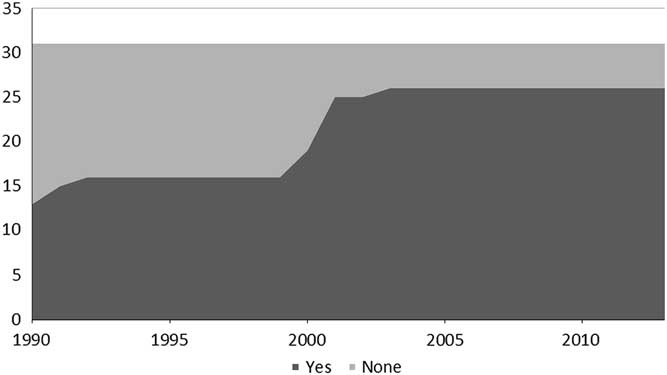
In a similar way, diplomats consider the establishment of diplomatic relations with North Korea as a sign of overcoming confrontation and of ‘warming up’ relations with the country. However, this measure is rather crude as it can only capture the establishment, suspension, and severance of diplomatic relations, and none of these actions is suited to capture policy nuances short of full-scale confrontation or accommodation. Indeed, democracies have established diplomatic relations with North Korea in waves, and none of them has suspended or abandoned diplomatic ties since, even though policy differences have been pronounced. Figure 1 provides a graph of the development of the relations between North Korea and the democratic countries within our sample, from the end of the Cold War to today.
Diplomatic relations of democratic countries with North Korea (The National Committee on North Korea, 2013).

Policy differences among democracies therefore remain hidden behind a façade of consensus and unity. To overcome this limitation, we decided to systematically ask those who have insights into the nuances of accommodationist or confrontational policies. We thus carried out an expert survey to determine the policies of liberal democracies towards North Korea.Footnote 8
In the survey, we asked over 400 expertsFootnote 9 from 47 countries to evaluate the positions of six countries [their own (or that of their research specialty) plus five others] vis-à-vis North Korea from ‘very accommodationist’ to ‘very confrontational’ on a seven-point scale (ranging from 1 to 7). Experts were asked to evaluate the positions at four time-points: 1993, when, for the first time, North Korea announced its decision to withdraw from the Treaty on the Non-Proliferation of Nuclear Weapons (NPT); in 2003, when the country actually withdrew from the NPT; in 2006, when it conducted its first nuclear test; and in 2009, when it conducted its second nuclear test.Footnote 10 We received 173 responses with at least one valid answer, a response rate of 38%.
We excluded from our sample experts who deviated by more than one point from the state-year mean and re-estimated the mean expert scores.Footnote 11 Further, we excluded all time-points with fewer than three observations. If more than two time-points were missing for a particular country, we also excluded the country from the analysis.
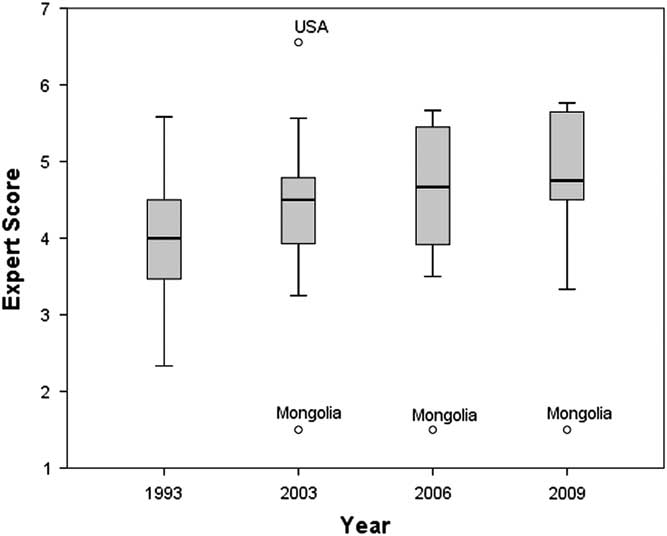
We report the expert scores for all countries and episodes in the supplementary information online. Figure 2 presents the boxplot with the overall trend of development of democracies’ positions towards North Korea. This graph clearly demonstrates two points: first, taken together, the states examined became more confrontational over the course of consecutive crises. This can easily be explained by the interaction between liberal democracies and North Korea. Second, and most important for the purpose of this paper, considerable differences between states advocating confrontation and those preferring accommodation remain throughout the period under study. As indicated by the grey boxes, representing the middle 50% of the data, and the long vertical lines (‘whiskers’), representing the spread of data up to one-and-half-times of the interquartile range (the difference between the first and third quartiles), policy differences among states are large and persistent.
Overall trend of democracies’ positions towards North Korea.

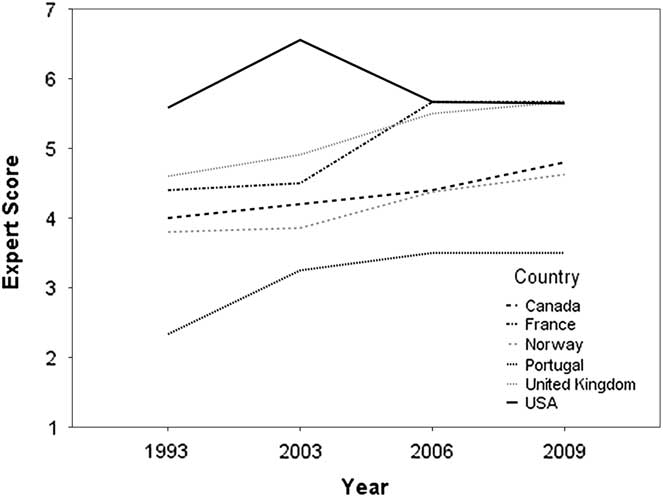
Whereas Figure 2 provides an overview over the entire group of states under study, Figure 3 maps a few selected states to further demonstrate the stability of policy differences. As can be seen in Figure 3, throughout the entire period between 1993 and 2009, Portugal always followed a more accommodationist policy than Canada and Norway but all three states were more accommodationist than the United States, the United Kingdom, and France. It goes without saying that a graph of all countries’ policies would not exhibit 22 lines in perfect parallel. Instead, some states become more confrontational or accommodationist than others over time as well. In any case, states by and large keep country-specific preferences for confrontation or accommodation relative to other states.
Country patterns (selected countries).

Explanatory variables
Differences in crisis diplomacy are often attributed to economic interests and varying degrees of economic vulnerability. In line with commercial liberalism (Nye, 1988), it is argued that states with significant economic ties stand to lose a lot from a potential escalation. Governments will therefore tend to avoid conflict with a country with which they are economically interdependent. This well-established theory, however, is difficult to apply to the case of North Korea as Pyongyang’s juche ideology has minimized economic ties with the outside world. Although North Korea has not achieved economic autarky, the volume of its trade has remained insignificant for its trading partners. Since we are interested in explaining policies towards North Korea, the absence of any significant economic exchange for the states interacting with North Korea led us to exclude commercial liberalism from the research design.Footnote 12
Instead, we focus on the two ideational variables reviewed above, government ideology and political culture. Although our prime interest lies in the study of the ideational foundations of foreign policies, we do not claim that foreign policy is exclusively driven by ideas. Rather, we expect other factors to influence foreign policy as well. That is why we start off by looking at military capabilities, realism’s pet variable, as the default explanation in our research design.
The power-political roots of coercive diplomacy: According to neorealists, policy differences result from differences in the power positions of states. According to Waltz (Reference Waltz1993: 45), ‘the placement of states in the international system accounts for a good deal of their behaviour’. Weak states that lack the military capabilities to carry out military threats will therefore choose diplomatic, non-military means. In contrast, powerful states have the full spectrum of foreign policy instruments at their disposal and frequently make use of them. This notion was popularized by Kagan with a view to the United States and Europe: ‘American military strength has produced a propensity to use that strength. Europe’s military weakness has produced a perfectly understandable aversion to the exercise of military power’ (Reference Johnston2002: 10). Indeed, the militarily preponderant powers tend to be more likely to escalate conflicts in the direction of war (Siverson and Tennefoss, Reference Seki and Williams1984; Huth, Reference Hosli, Mattila and Uriot1989). Therefore, countries possessing ‘a hammer’ might be reasonably expected to see international disputes as nails.
In the particular case of nuclear proliferation, it has been argued that proliferation policies may be best understood by countries’ ability to project power over the likely proliferator (Kroenig, 2009; Kroenig, Reference Kroenig2014). When it comes to the particularities of the North Korean dossier, similar arguments were advanced by analysts. It has been argued that the EU’s almost inexistent clout on the Korean Peninsula is at least partly due to the absence of the EU’s power projection in the region (Kelly, Reference Katzenstein2012). When it comes to the policy of European countries, these were mostly associated with soft power, which is considered as distinguishing Europeans from the United States, for example (Fitzpatrick, Reference Fitzpatrick2012; Worre and Han, Reference Worre and Han2012). Indeed, even North Korea expected that the European countries, focused on ‘soft power’, will be more amenable to it (Ford and Kwon, Reference Ford and Kwon2008).
We capture the military superiority by measuring democracies’ military expenditures as a share of North Korea’s military expenditure (similar to, e.g. Reiter, Reference Rathbun1999). This operationalization captures how many times more any given democracy spends on defence compared with North Korea. The data is taken from the Correlates of War’s (2012) National Material Capabilities database. The military expenditures of democracies range from 0.2% of those of North Korea (in the case of Mauritius) to 110-fold (in the case of the United States). Missing data on military expenditure was imputed by the next most recent version available.
Our realist hypothesis reads:
Hypothesis 3a The more military capabilities a state has at its disposal, the more likely it is to adopt a confrontational foreign policy.
Hypothesis 3b The fewer military capabilities a state has at its disposal, the more likely it is to adopt an accommodationist foreign policy.
Additionally, we also capture the realist non-proliferation policy explanation, which argues that states with nuclear weapons will be particularly opposed to the expansion of the nuclear weapons club because it would decrease both their strategic advantage and military superiority (Sagan and Waltz, Reference Reiter2003; Kroenig, Reference Kroenig2014). We therefore hypothesize:
Hypothesis 4a Countries possessing nuclear weapons adopt a more confrontational foreign policy towards states that violate the Nuclear Non-Proliferation Treaty.
Hypothesis 4b Countries not possessing nuclear weapons adopt a more accommodationist foreign policy towards states that violate the Nuclear Non-Proliferation Treaty.
Measuring cultures of dealing with norm violations: prison populations: We use the prison population of a given country per 1000 inhabitants to measure the domestic culture of dealing with norm violations. This measurement is based on the expectation that the more exclusionary states are domestically towards norm-breakers, the more confrontational the state would be towards North Korea, ceteris paribus.
A state’s culture of dealing with norm violations finds expression in various ways. A state’s criminal law system reflects society’s punitiveness to norm violations. The interplay between penal code, sentencing guidelines, and the actual practice of punishment may be measured by prison populations, that is, the number of prisoners per 1000 inhabitants. High shares of prisoners indicate that a country’s criminal law system emphasizes retribution over re-socialization. A country’s prison population is low if either the penal code refrains from harsh punishments, if sentencing guidelines prioritize rehabilitative over retributive measures or if courts use the discretion they have to avoid retribution (e.g. by using probation and parole).
Capital punishment could also be considered an important indicator for a country’s punitivity. However, it only allows us to distinguish between a very small group of countries who use it and the large majority that do not. It is therefore too crude as an indicator of a domestic culture of dealing with norm violations.
An objection could be raised that prison populations reflect crime rates, not cultures of dealing with norm violations. As criminologists have argued, however, prison population rates ‘are largely unrelated to victimization rates or to trends in reported crime’ (Lappi-Seppälä, Reference Lankov2011: 308), instead, they are ‘a matter of political choice’ (Morgan and Liebling, Reference Mello2007: 1107).
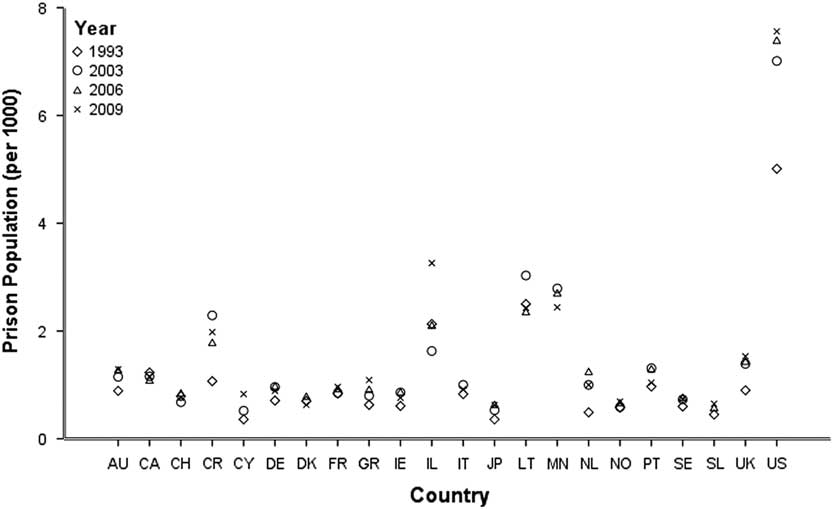
We obtained the data on prison populations from the International Centre for Prison Studies (Reference Huth2010). According to its figures, prison populations range from 0.36/1000 inhabitants in Japan and Cyprus in 1993 to 7.56/1000 inhabitants in the United States in 2009. As expected from the perspective of political culture, prison populations mostly vary across states but over the 16-year period under study, there is also some variation over time, particularly in some states such as the United States and Israel (Figure 4).
Prison populations (per 1000 inhabitants).

Government ideology: A variable on the left-right orientation of government has been included in several data sets that have emerged from the comparative study of governments. Woldendorp et al. (Reference Woldendorp, Keman and Budge2011) include a measure of the ‘ideological complexion of government (CPG)’ for the 40 parliamentary democracies in their data set (updated by Seki and Williams, Reference Sagan and Waltz2014). In a similar way, the Comparative Political Dataset (Armingeon et al., Reference Armingeon, Engler, Potolidis, Gerber and Leimgruber2012) includes variables on the percentage of cabinet posts held by members from right-wing, centre, and left parties, and the Database of Political Institutions (Beck et al., Reference Beck, Clarke, Groff, Keefer and Walsh2001) includes a variable indicating the left/right orientation of the government in economic terms. Both measures result from the coders’ own judgment, based on party documents (and, if deemed necessary, secondary literature), and provide a ready-made measure of parties’ ideologies.
The plurality of literature in the field of foreign policy analysis, however, draws directly on the Comparative Manifesto Project’s (Volkens et al., Reference Volkens, Lehmann, Merz, Regel, Werner, Lacewell and Schultze2013, CMP hereinafter, Klingemann et al., Reference Kihl and Kim1994) left-right scale to establish a political party’s position. The CMP measures a political party’s position on a large number of issues by assigning statements (‘quasi-sentences’) in the manifesto to pre-given categories, such as ‘free enterprise’ or ‘military: positive’ or ‘military: negative’. The more often a category is mentioned, the higher the salience of the issue in the manifesto. In addition to measuring a political party’s position on issues such as the military, internationalism, the European Community, or foreign special relationships, CMP also aggregates the various measures into a left-right measure. The CMP data come with two advantages: first, as their unit of analysis is a party’s election manifesto, they are more sensitive to changes over time than expert surveys that are carried out at a certain point in time. Second, they provide a better measure of cross-national variation as they are less interested in a political party’s ideological position within a country but rather in its position among all other parties, domestic as well as foreign (Mello, Reference Maull2014).
Combined with data on which political party is in government, the CMP data are widely used to measure government ideology, when the weighted average of governmental parties’ left-right values is calculated in order to establish a government’s left-right orientation.
We use both measures of government ideology. First, we follow Mello (Reference Maull2014: 82) and calculate a weighted score where each government coalition partner’s left-right value, as provided by the CMP data set, is set in relation to its share of parliamentary seats and the overall number of seats of the governing coalition. Data on a party’s share of seats in parliament are taken from the ParlGov data set (Döring and Manow, Reference Döring and Manow2012). The second measure is the ‘Ideological CPG’ variable from the Party Government Dataset (PGD) (Woldendorp et al., Reference Woldendorp, Keman and Budge2011; Seki and Williams, Reference Sagan and Waltz2014). This variable, developed by Woldendorp et al. (Reference Woldendorp, Keman and Budge1993) classifies every government on a scale from 1 to 5, based on the proportion of cabinet seats. On this scale, 1 means that >66% of cabinet portfolios are held by right-wing parties, whereas 5 means that >66% of cabinet posts are held by left-wing parties. Parties are coded by experts based on party documents.
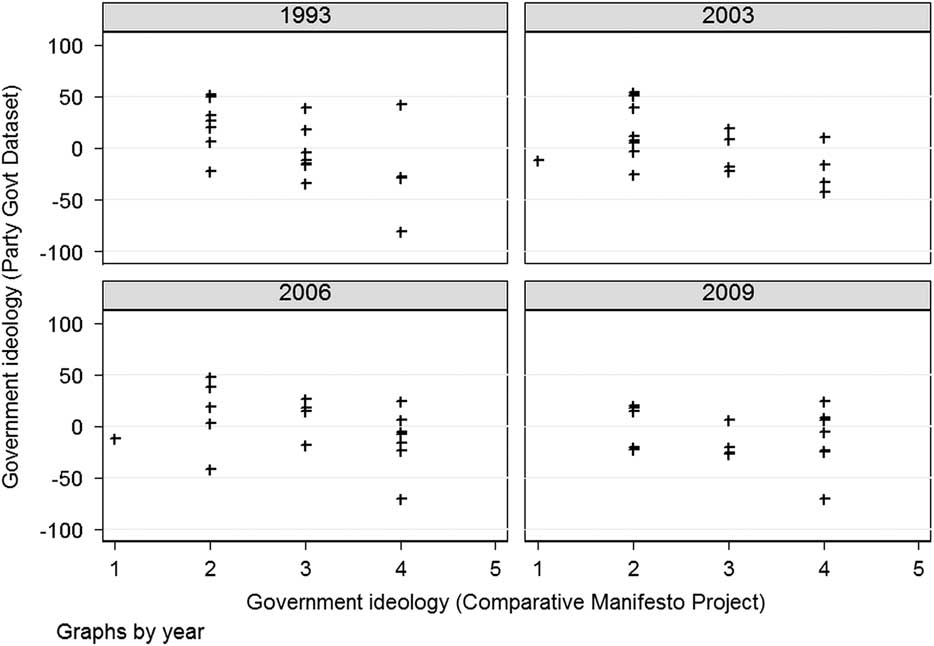
As Figure 5 demonstrates, the two measures differ considerably, and we therefore decided to run independent tests with each of the two measures.
Comparing measures of government ideology.

Results
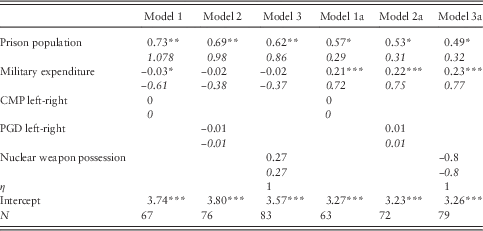
We estimate two sets of models. The second set differs from the first in excluding the United States, which is an outlier on two of the three variables of interests: prison population and military expenditure. Within each set, the first two models differ in their measure of government ideology (see above), the third model estimates the effect of the possession of nuclear weapons. Models 1, 2, 1a, and 2a are estimated using ordinary least squares (OLS) regression with country fixed effects. Models 3 and 3a are estimated using OLS regression with fixed effects vector decomposition, a method that allows us to estimate a time-invariant variable such as the possession of nuclear weapons (Plümper and Troeger, 2007).
Statistical analysis

CMP=Comparative Manifesto Project; PGD = Party Government Dataset.
Italics represent effect of change by 1 standard deviation.
*P<0.1; **P<0.05; ***P<0.01.
At first, we turn to the two ideational variables: the domestic culture of dealing with norm violations and the ideological orientation of the government. We see that the domestic culture of dealing with norm violations is strongly and positively associated with policy towards North Korea. The more exclusionary cultures are in dealing with norm violations domestically, the more confrontationist towards North Korea these countries tend to be, ceteris paribus. This is clear from models 1 and 2. The effect is present in all models.Footnote 13 Thus, institutionalized discourses and practices of punitivity domestically are associated with punitivity towards North Korea, regardless of military expenditure or government partisanship. An increase by 1 std. dev. in prison population is associated with an increase in confrontation of about 1 point on a seven-point scale, that is, more than the increase in the mean of liberal democracies from 1993 to 2009. We consider this strong support for our theoretical argument that coercive diplomacy does indeed have ideational roots and that differing institutionalized practices affect how states behave in interstate crises.
In the robustness check models, where we excluded the United States, the effect of the domestic culture of dealing with norm violations persists, but estimated coefficients, statistical significance as well as substantive effects, change. Ceteris paribus, an increase by 1 std. dev. of the prison population is associated with a move towards a more confrontational policy by approximately one-third of a point. This effect is statistically significant at the 10% level, which, given the small N, we still consider as confirming our hypothesis. This testifies that the effect of domestic culture of dealing with norm violations is persistent among democracies, even if one disregards the United States as an outlier.
A good example of how domestic penal welfarism is reflected in foreign policy is Sweden. Sweden is one of the least punitive countries in Europe. Its policy towards North Korea is marked with a strong accommodationist drive as well. The official website of the Swedish Embassy to Pyongyang states that ‘Sweden has sought to help achieve greater openness in North Korea and a gradual integration of the country into the international community’ (Sweden Abroad, Reference Skitka and Tetlock2015). A recent article summarized, Sweden is also taking part in capacity-building in the country, low-key human rights advocacy, and is best understood as a facilitator between the North Korea and the world (Andersson and Bae, Reference Andersson and Bae2015). These are but simple examples of how the penal welfarist idea of reintegration is manifested in foreign policy.
In contrast to political culture, government ideology is not a significant factor in any of the models. We thus cannot confirm the notion that right governments are more confrontational than left governments. Although previous research found that the ideological orientation of government matters for the actual use of force, our findings suggest that there is no significant difference for policies short of using force. Clearly, differences across liberal democracies are more pronounced than those within them. This finding is also in line with the recent case study literature, which has suggested that parties may be less consistent in their foreign policy orientation, and that national concerns may stand above partisanship (Verbeek and Zaslove, Reference Verbeek and Zaslove2015).
As for the power-politics explanation, we observe that within the full sample, the statistical significance of the effect depends on the conceptualization of the government ideology. However, the situation changes if the United States – by far the biggest outlier on the military expenditure scale – is excluded. Then the effect reverses and becomes much stronger. Military expenditure is then positively and statistically significantly associated with confrontational policy towards North Korea. Substantively, the increase in military expenditure by 1 std. dev. is associated with an increase in confrontation by ~0.7 points on a seven-point scale, ceteris paribus. This confirms the continuing relevance of realist explanations, and the relevance of military power as an enabler of the coercive diplomacy. On the other hand, the possession of nuclear weapons is not statistically significantly related to the coercive position towards North Korea. This may be because, as Sagan argues, the proliferation of weapons of mass destruction is a threat to a global community as such, and therefore possession of nuclear weapons may not be relevant in this case (Sagan and Waltz, Reference Reiter2003).
Conclusion
The finding that foreign policy is partly driven by ideas no longer makes breaking news. What remains to be studied, however, is whose ideas influence the foreign and security policies of liberal democracies and in what ways. This debate had been hampered by the dearth of measures that allow us to study political culture across a larger number of countries (as well as over time) and, as a consequence, to test political culture directly against other ideational variables, such as government ideology.
In this article, we suggest using prison populations as a measure for the ideational foundations of accommodation and confrontation because they elegantly capture different degrees of punitiveness across societies. This measure allowed us to examine the explanatory power of government ideology, on the one hand, and political culture, on the other.
Our findings provide strong evidence for the importance of political culture in influencing liberal democracies’ policies during international crises. The striking policy differences between states advocating confrontation and those pleading for accommodation do not result from the ideological orientation of the political party/parties in government, but from norms entrenched in the political culture, deeper than partisanship. Notwithstanding, evidence from earlier studies about the impact of government ideology on the use of force, our findings suggest that government ideology has not influenced policy in a diplomatic crisis short of using force.
While our study also confirms realist expectations about the importance of military capabilities, its main finding concerns the strong impact of political culture on crisis diplomacy. To be sure, the choice between confrontational and accommodationist policies is in part a strategic decision and thus depends on the actions of an adversary. However, the policy differences among liberal democracies at any particular point in time mainly result from different understandings about the merits and shortcomings of punishment in international relations.
Our finding that domestic cultures of dealing with norm violations is another influential factor that impacts on state policy, suggests a new look at the sources of foreign policy and, by implication, divisions among liberal democracies. Of course, constructivist scholars have long argued that political culture and identity heavily influence state action. However, the cultural roots of coercive diplomacy have hardly been examined thus far in a comparative and quantitative way. Our findings therefore open new ways to consider the impact of institutionalized discourses and practices on coercive diplomacy.
Our study also contributes to a growing body of research that emphasizes the close connections between different forms of violence as well as policies addressing them. In his landmark study, Pinker (Reference Palmer, London and Regan2011) argues that trends in warfare, in murder rates, and even in the physical punishment of children have common root causes. In a similar vein, studies of elites and public opinion have shown that attitudes towards punishment and retribution domestically correlate with support for hawkish policies internationally (Liberman, Reference Lappi-Seppälä2006; Liberman, Reference Liberman2007; Rathbun, Reference Plümper and Troeger2007; Liberman, Reference Liberman2013; Stein Reference Siverson and Tennefoss2015). While most of these studies examine variation within American society, we demonstrate that there are also important variations across liberal democracies. In fact, our study suggests that differences across liberal democracies are even more pronounced than those within them. To fully grasp the political controversies about appropriate policy responses towards violations of international norms that have at times bitterly divided the political West, an understanding of political culture is an essential addition.
Acknowledgements
The research for this article was supported by the Netherlands’ Organization for Scientific Research. An earlier version of this paper was presented at the ISA Annual Convention in Toronto in 2014. The authors thank the attendees of the panel and its discussant, Marijke Breuning, in particular, the three excellent reviewers, the editors of EPSR, as well as Jaap Woldendorp, for comments and suggestions. All mistakes remain the authors own.
Supplementary Material
For supplementary material referred to in this article, please visit http://dx.doi.org/10.1017/S1755773915000387