

INTRODUCTION
How scholars understand corporate social responsibility (CSR) is changing. While theories of CSR have been categorized in many ways (Dawkins, Reference Dawkins2015; Garriga & Mele, Reference Garriga and Melé2004; Okoye, Reference Okoye2009), a particularly interesting recent development has been the depiction of CSR as a political process in which the meaning of corporate action is contested through discursive interaction between corporations and their stakeholders (Scherer & Palazzo, Reference Scherer and Palazzo2007). This perspective asserts that CSR is essentially contested because stakeholders recognize that corporate claims of social responsibility are driven by multiple motives and are open to interpretation from multiple points of view (Friedman & Miles, Reference Friedman and Miles2002; Matten & Moon, Reference Matten and Moon2008; Moon, Crane and Matten, Reference Moon, Crane and Matten2005; Okoye, Reference Okoye2009). The incompatibility of sensemaking systems and power relations among firms and their stakeholders generates fundamental disagreements over priorities and who benefits from CSR activities (Beckman, Colwell, & Cunningham, Reference Beckman, Colwell and Cunningham2009). In this spirit we adopt a definition of CSR proposed by Baumann-Pauly and colleagues (Reference Baumann-Pauly, Wickert, Spence and Scherer2013: 693) that embraces the essential contestedness of CSR: “We understand CSR as an umbrella term for the debate about the relationship and interactions between business and society.”
In framing CSR as essentially contested, we are prompted to ask how firms engage their stakeholders in active discourse, rather than whether they acquiesce in notions of what CSR ‘really’ is in order to improve their reputations (Dawkins, Reference Dawkins2015; Okoye, Reference Okoye2009). In this article we explore the essential contestedness of CSR as a process that managers and stakeholders actively negotiate. Managers working on behalf of their firms are active participants in the process of contesting jurisdiction over CSR with stakeholders. What makes the managerial role particularly interesting is the quasi-obligatory nature of managerial participation in CSR processes. According to Devinney (2004: 44) “…corporations receive a social sanction from society that requires that they, in return, contribute to the growth and development of that society.” This attitude toward CSR has been so widely adopted that to be seen as legitimate, corporations must engage in activities that they claim are socially responsible (Devinney, 2004; Scherer, Palazzo, & Seidel, Reference Scherer, Palazzo and Seidl2013) or be challenged by stakeholders. As we outlined above, when corporations carry out what they regard as socially responsible activities, some stakeholders are likely to challenge them (Lamin & Zaheer, Reference Lamin and Zaheer2012). If CSR activities are thus simultaneously obligatory and contested, then theory development ought to focus on the dynamics of organization-stakeholder relationships, and in particular on the question that guides this research: How do different stakeholders evaluate corporate claims of social responsibility under different conditions?
Recent scholarship on how stakeholders evaluate CSR activities has focused on authenticity as a key criterion (Beckman, Colwell, & Cunningham, Reference Beckman, Colwell and Cunningham2009; Mazutis & Slawinski, Reference Mazutis and Slawinski2015; McShane & Cunningham, Reference McShane and Cunningham2012). Authenticity evaluations have been described in two ways. First, some scholars have argued that stakeholders evaluate CSR activities as authentic when they are consistent with a firm’s observed identity. Second, others have defined authenticity as the evaluation of how well activities conform to the stakeholder’s socially constructed schemas for what constitutes responsible action, which includes the question of whether corporations ‘walk’ the talk and actually match rhetoric with action. Scholars have tried to reconcile these competing approaches by combining identity and schema-based evaluations (Ewing, Allen, & Ewing Reference Ewing, Allen and Ewing2012; Mazutis & Slawinski, Reference Mazutis and Slawinski2015). Combining these evaluations implies that there are a range of evaluations possible, and that evaluations of authenticity speak to stakeholders’ perceptions of the rightness of motives as well as the rightness of activities.
In order to understand the role that authenticity evaluations play in discourse, we need to understand how context shapes their meaning. Authenticity evaluations are a means of understanding stakeholder responses to corporate claims, which are made in the context of the distribution of power and the compatibility of sensemaking systems between a firm and its stakeholders (Bondy, Moon, & Matten, Reference Bondy, Moon and Matten2012; Dawkins, Reference Dawkins2015; Lamin & Zaheer, Reference Lamin and Zaheer2012). We propose that as patterns of power and pluralism change, the discourse of contestedness changes. As firms and stakeholders move from context to context, structurally similar authenticity evaluations take on different meanings. Because the meaning of authenticity evaluations depends on the context in which they are made, our research question can produce new insights into the discourse over CSR. In a specific context, does evaluation lead stakeholders to treat a CSR activity as assertive, provocative, conciliatory, or disruptive? Different kinds of authenticity evaluations give us insight into how stakeholders’ responses to CSR activities change across contexts. To be able understand how these insights fit together in a systematic way, we need to combine ideas about complex authenticity evaluations with a framework for describing the embedding context in which evaluations are produced.
Several authors (Frundt, Reference Frundt2009; Scherer, Palazzo, & Seidl, Reference Scherer, Palazzo and Seidl2013; Wicki & van der Kaaij, Reference Wicki and van der Kaaij2007) discuss a case that helps illustrate the need for a framework that puts stakeholder authenticity evaluations in context. Chiquita Brands, working with the Rainforest Alliance, engaged in a decade-long project to improve its operations by reducing pesticide and fungicide use and improving water quality in its banana plantations. When Chiquita began to make social responsibility claims for these activities in its branding, stakeholders evaluated the claims in a variety of ways. Certification of the sustainability claims by the Rainforest Alliance led stakeholders who shared the firm’s schemas (like other producers) to evaluate the corporation’s actions as authentic maintenance of appropriate standards. Environmental and social activists, guided by their own sensemaking systems, rejected the firm’s claims as provocative and inauthentic because the corporation had only reduced chemical use rather than eliminating it and did not provide economic justice for farmers (Frundt, Reference Frundt2009; Scherer, Palazzo, & Seidl, Reference Scherer, Palazzo and Seidl2013). Some stakeholders viewed the initiative as a gesture toward compliance because it conformed partially to their schemas, while others (particularly workers) voiced suspicions because it was inconsistent with Chiquita’s identity as understood from past actions (Frundt, Reference Frundt2009) or because Chiquita was a donor to the Rainforest Alliance (Wicki & van der Kaaij, Reference Wicki and van der Kaaij2007). Power relations shaped evaluations as well, since environmental activists unconnected to Chiquita were free to be negative (Freeman et al., Reference Freeman, Harrison, Wicks, Parmar and De Colle2010), while stakeholders who depended on the firm may have appeared to agree because they suppressed their negative responses (Dawkins, Reference Dawkins2015).
This article develops a conceptual framework for understanding this variety by treating CSR activities as discursive moves in a contest over what constitutes socially responsible action. By developing theory that situates CSR activities and authenticity evaluations within patterns of pluralism and power, we acknowledge the role that field dynamics and institutional complexity play in shaping the discourse of CSR. Our theorizing yields a framework that positions authenticity evaluations in different states of field-level complexity. While this framework is theory-based, we also regard it as a practical aid to management and stakeholders. If managers and stakeholders understand how power is distributed in their relationships, and how others make sense of the world, they can begin to engage in a more direct discourse. Becoming more aware of how the other side understands CSR activities will help each side engage more directly with the other and may make it easier to arrive at negotiated settlements. If stakeholders have a better grasp of how managers make sense, they will be able to frame their evaluations of CSR activities in ways that make sense to managers, making it more likely that CSR will serve stakeholder needs. We must be clear that we do not propose this theory as a guide to manipulation, helping powerful firms impose a less demanding version of CSR than stakeholders would like or vice versa. Firms may be able to impose versions of CSR that are incompatible with stakeholders’ beliefs (Fligstein & McAdam, Reference Fligstein and McAdam2012; Whelan, Reference Whelan2013), but managers should recognize that ‘domesticating hostility’ (Burchell & Cook, Reference Burchell and Cook2013) merely defers active resistance. Because the application of power does not make sensemaking systems more compatible, CSR will remain an essentially contested concept even when disagreement is suppressed.
UNPACKING ESSENTIAL CONTESTEDNESS IN CSR
Our literature review begins by defining CSR, stakeholders and the fields they constitute. We then discuss and integrate the various approaches to authenticity evaluations in the CSR literature, since these evaluations are central to our contribution. We conclude the section on authenticity by noting that although authenticity theory provides a way to describe complex evaluations, it does not address the questions of power or pluralism that make CSR an essentially contested concept. We therefore provide a brief summary of the literatures on pluralism and essential contestedness before moving on to theory development.
Much of the research on CSR is motivated by the question of what constitutes socially responsible corporate behavior (Okoye, Reference Okoye2009). While there has been little agreement about what CSR is, the widespread diffusion of practices such as formal CSR reporting has been taken as evidence that CSR activities have become an obligatory part of what it means to be a legitimate corporate actor (Marquis, Glynn, & Davis, Reference Marquis, Glynn and Davis2007; Moon, Crane, & Matten, Reference Moon, Crane and Matten2005). CSR activities may create environmental, social, or economic value for stakeholders, but they can also serve profit motives (Stout, Reference Stout2012). The fact that stakeholders are aware of firms’ mixed motives generates negative evaluations and contributes to the essential contestedness of the concept (Beckman, Colwell, & Cunningham, Reference Beckman, Colwell and Cunningham2009). Because we embrace the idea that CSR is an essentially contested concept, we adopt a political model of CSR based on Baumann-Pauly and colleagues’ (Reference Baumann-Pauly, Wickert, Spence and Scherer2013) definition which frames CSR as discourse about the relationship between business and society. Consistent with this definition is the idea that while CSR activity is more or less obligatory, firms are not ‘passive pawns’ in the debate (Bondy, Moon, & Matten, Reference Bondy, Moon and Matten2012).
This article adopts as its focus of analysis the discursive interplay between CSR activities and stakeholder evaluations of them. Although it has been argued that CSR should be integral to corporate behavior (Freeman, et al., Reference Freeman, Harrison, Wicks, Parmar and De Colle2010; Porter & Kramer, Reference Porter and Kramer2006; Reference Porter and Kramer2011), it is often enacted as discrete activities for which the firm makes social responsibility claims (Bondy, Moon, & Matten, Reference Bondy, Moon and Matten2012; Dawkins, Reference Dawkins2015). Our analysis includes activities explicitly intended to demonstrate CSR and normal activities that are implicitly responsible, such as energy saving activities.
The assertion that power and pluralism matter for understanding stakeholder relations (Tashman & Raelin, Reference Tashman and Raelin2013) requires a broad definition of stakeholders. Focusing on stakeholders with a direct interest in a firm yields a limited scope of relations compared to an approach that includes stakeholders who influence a firm even if they lack a direct connection. We therefore adopt a wide definition drawn from Freeman and colleagues (2010) and others (e.g. Marquis, Glynn & Davis, Reference Marquis, Glynn and Davis2007): Stakeholders to a corporation are the organizations, individuals, and constituencies that influence or are influenced by corporate action. Because stakeholders and firms are differentiated by how they make sense of the world, our definition further recognizes that stakeholders and the corporations they interact with constitute a field where the debate over CSR is played out. We understand this field as a strategic action field, which Fligstein and McAdam define as:
…a constructed mesolevel social order in which actors (who can be individual or collective) are attuned to and interact with each other on the basis of shared (which is not to say consensual) understandings about the purposes of the field, relationships to others in the field (including who has power and why) and the rules governing legitimate action in the field (2012: 9).
Compared to other field theories (e.g. Bourdieu, Reference Bourdieu1980; DiMaggio & Powell, Reference DiMaggio and Powell1983), strategic action fields emphasize the contested nature of institutional life and actors’ ability to influence activities, roles and modes of action. This broad framing of stakeholders and corporations interacting in strategic action fields allows us to understand how institutional dynamics may influence the contest over CSR.
Authenticity Evaluations and CSR
“To say that something is authentic is to say that it is what it professes to be, or what it is reputed to be” (Varga & Guignon, Reference Varga, Guignon and Zalta2014: 1). Stakeholder evaluations of the authenticity of CSR activities play an important role in the discursive processes that constitute CSR (Baumann-Pauly et al., Reference Baumann-Pauly, Wickert, Spence and Scherer2013; Beckman, Colwell, & Cunningham, Reference Beckman, Colwell and Cunningham2009; Mazutis & Slawinski, Reference Mazutis and Slawinski2015). We define authenticity evaluations as a class of appraisive judgements (Okoye, Reference Okoye2009) that observers make concerning claims about CSR activities and the motives of the actors making these claims. Authenticity evaluations ask whether the claims firms make about CSR activities are as they should be, given the evaluator’s expectations. Because they are relative to the evaluator’s expectations, authenticity evaluations provide a mechanism to explain how CSR activities can achieve apparently desirable social or environmental impacts, but still be evaluated as inauthentic by some stakeholders, resulting in reputational damage to a company. Because stakeholders possess a wide range of expectations about how companies should act, this article focuses on stakeholders’ evaluations of CSR activities rather than on the problem of how to know the ‘true self’ of an organization (Varga & Guignon, Reference Varga, Guignon and Zalta2014).
Drawing on Peirce (Reference Peirce1955), scholars have identified two types of authenticity evaluations based on icons and indices (Ewing, Allen, & Ewing, Reference Ewing, Allen and Ewing2012; Grayson & Martinec, Reference Grayson and Martinec2004). Iconic authenticity evaluations assess how activities fit with a socially constructed norm about what actions are appropriate. Indexical authenticity is based on how activities fit with a firm’s identity as judged by the evaluator, judging whether activities are ‘in character’ for the firm’s ‘real’ self. Identity, as Pierce (Reference Peirce1955) argues, is known primarily through such signs. Because iconicity and indexicality are labels better suited to philosophy than a theory of essential contestedness, we call iconic authenticity ‘schematic’ to emphasize its relation to social constructed schemas; and indexical authenticity ‘emblematic,” to denote whether a CSR activity is accepted as consistent with a firm’s observed identity. This distinction explicates the interpretive processes that underlie authenticity judgments and invites consideration of how firms’ identities and societal expectations of CSR are socially constructed.
Schematic authenticity. Schematic authenticity involves a judgment in which an object is perceived as corresponding more or less closely to a socially constructed schema for it (Ewing, Allen, & Ewing, Reference Ewing, Allen and Ewing2012). A schema is “…an abstract representation [of a concept that] includes the concept’s attributes and the relations between them” (Fiske & Taylor, Reference Fiske and Taylor2013: 104). An example of schematic authenticity evaluation can be seen in research that asks consumers how well the attributes of a restaurant conform to their schemas for judging the authenticity of a restaurant and its cuisine (Kovács, Carroll, & Lehman, Reference Kovács, Carroll and Lehman2013). Although such evaluations are socially constructed, they are not uniform judgments measured against an objective standard. For example many Western consumers regard the use of child labor to manufacture apparel as socially irresponsible, but other stakeholders might value the improved standard of living children experience because of their labor. Similarly, the McDonald’s Corporation’s support of the Ronald McDonald House charity might be seen as schematically authentic by some because helping the families of sick children conforms to their schema of social responsibility, while for others building brand by exploiting sick children violates their schema (Simon, Reference Simon2013).
Accusations of greenwashing result from schematic authenticity evaluations. Greenwashing occurs when a firm engages in environmentally oriented CSR activities that are evaluated as either self-serving window dressing or where the observer recognizes that firm did not do what it claims to have done (Delmas & Burbano, Reference Delmas and Cuerel Burbano2011; Parguel, Benoît-Moreau, & Larceneux, Reference Parguel, Benoît-Moreau and Larceneux2011; Perez-Batres et al., Reference Perez-Batres, Doh, Miller and Pisani2012). The ideal that firms should ‘walk the talk’ and live up to their claims is an element of a schema for defining socially responsible action. In some sensemaking systems nominal or symbolic action (Clark & Newell, Reference Clark and Newell2013; Reference MacLean and BenhamMaclean & Benham, 2010) may be acceptable within a schema for socially responsible action, but for other stakeholders their schema for CSR requires concrete, measurable outcomes that align with claims. As these examples show, schematic authenticity evaluations of CSR are made by stakeholders who consider whether CSR activities are socially responsible according to their own schemas, which may include different priorities around values and outcomes.
Emblematic authenticity. Grayson and Martinec (2004: 297) describe identity-based authenticity in terms of the perceived relation between an action and the observer’s perception of the actor’s identity: “…a person’s actions or expressions are authentic if they are thought to reflect who the person really is and are not "put on" or imitated merely to meet social conventions or make money.” To outsiders, a person or firm’s identity is a matter of observation. The observer’s biases, and relations between observer and observed, shape how identity is construed (Bitektine & Haack, Reference Bitektine and Haack2015; McShane & Cunningham, Reference McShane and Cunningham2012). In order to emphasize our interest in identity as the observer sees it, we introduce the concept of observed identity. While corporate identity is defined as organizational attributes that are central, enduring and distinct (Albert & Whetten, Reference Albert, Whetten, Cummings and Staw1985), observed identity is the set of attributes that an observer believes are central and enduring about a firm. The concept of observed identity acknowledges that different observers see different attributes as consistent with and thus emblematic of observed identity (Dutton & Dukerich, Reference Dutton and Dukerich1991; King & Whetten, Reference King and Whetten2008). For example, in the field of microfinance some stakeholders identify microfinance firms as social service agencies working on poverty alleviation and evaluate activities that stray from that identity as emblematically inauthentic, while other stakeholders identify such firms as unusual banks, and question activities that deviate from profit-making and risk management (Battilana & Dorado, Reference Battilana and Dorado2010). Similarly, Glynn’s (Reference Glynn2000) study of a symphony orchestra describes how musicians, donors, and management conferred very different observed identities on the organization.
Numerous studies consider how identity-based emblematic authenticity evaluations are used by stakeholders, proposing that stakeholders evaluate authenticity on the basis of whether CSR activities are true to the observed identity of the corporation (Beckman et al., Reference Beckman, Colwell and Cunningham2009; Bitektine & Haack, Reference Bitektine and Haack2015). Studies of employee attitudes toward employer’s CSR activities have found that when activities are evaluated as emblematically authentic, employee organizational commitment increases and employees are less likely to question the motives underlying such activities (McShane & Cunningham, Reference McShane and Cunningham2012; Yim & Fock, Reference Yim and Fock2013). Stakeholders other than employees make similar evaluations. For example, some stakeholders may evaluate the Ronald McDonald house initiative as emblematically authentic because it is linked to attributes of the corporation that observers regard as central and enduring: it is child oriented, family friendly, and linked to a corporate symbol (Simon, Reference Simon2013). This would be less likely if Ronald McDonald House was a drug rehabilitation initiative and thus not as family oriented. Assessments of emblematic authenticity include the underlying motives that are part of an organization’s observed identity. For example, when stakeholders who view a microfinance organization as a social enterprise see it foreclosing on a borrower, observed identity is violated, and stakeholders question the motives that prompted the behavior.
Evaluating a CSR activity as emblematically authentic does not mean that a stakeholder views it as socially responsible, only that the firm is behaving as expected based on observed identity. For example, the actions of a firm perceived as an environmental bad actor can be evaluated as true to itself (emblematically authentic) even if those activities are not perceived as socially responsible (McNeil, Reference McNeil2010; Whelan, Reference Whelan2013). If the same firm complied with stakeholder schemas for CSR, this could yield an evaluation that the action is not emblematically authentic because it does not fit the observed identity. In making this observation, we also note that schematic authenticity evaluations do not generate emblematic authenticity evaluations. In the Chiquita example, some stakeholders regarded the firm’s activities as schematically authentic, but withheld support because emblematic inauthenticity made them question Chiquita’s motives (Frundt, Reference Frundt2009). Given these interaction effects, we next discuss a framework that considers schematic and emblematic authenticity simultaneously.
Mixed Authenticity Evaluations. A CSR activity can be evaluated as emblematically authentic and schematically inauthentic, or schematically authentic but not emblematically authentic, suggesting the need for a framework that captures multiple states. Mazutis and Slawinski (Reference Mazutis and Slawinski2015) proposed a taxonomy that categorizes mixed authenticity evaluations according to the distinctiveness of a firm’s CSR activities relative to its identity, and to the social connectedness of its CSR activities to stakeholders’ goals. They categorize CSR activities as authentic when they are distinctive to the firm and socially connected and as inauthentic when neither is true. CSR activities are labeled as ‘disingenuous’ when they are socially connected but not distinctive and as ‘misguided’ when the activity is distinctive but disconnected from societal norms. These labels suggest that stakeholders’ authenticity evaluations go beyond a binary choice to support or reject CSR activities, as Lamin and Zaheer (Reference Lamin and Zaheer2012) also discovered. Although we regard this as an important insight, a limitation of this model is that it treats authenticity evaluations as though they are made in environments where all stakeholders interpret actions in the same way and where power differentials between firms and stakeholders play no role. Below we describe how power and pluralism influence the sensemaking systems that different stakeholders adopt to make authenticity evaluations of CSR activities.
Pluralism, Power, and Institutional Complexity
Strategic action fields are pluralistic, made up of incumbents and challengers (Fligstein & McAdam, Reference Fligstein and McAdam2012) with different socially constructed sensemaking systems (Weick, Reference Weick1979). The term ‘sensemaking system’ includes all of the logics, frames, mental models, schemas, ideologies, values, norms, and beliefs stakeholders use to make sense of the world. Recent scholarship reminds us that sensemaking systems are created from the bottom-up via shared frames that emerge from dyadic and group interactions (Bitektine & Haack, Reference Bitektine and Haack2015; Gray, Purdy, & Ansari, Reference Gray, Purdy and Ansari2015). Sensemaking systems reduce cognitive costs by equipping actors with taken for granted schemas that prescribe appropriate behavior (Bitektine & Haack, Reference Bitektine and Haack2015). The sensemaking systems used by actors such as firms, regulators, communities, or professions prescribe values and incorporate schemas for how to make sense of the world (Purdy & Gray, Reference Purdy and Gray2009). Even when actors engage in a conscious, practical-evaluative mode of decision-making (Smets & Jarzabkowski, Reference Smets and Jarzabkowski2013), they retain many of the biases of their sensemaking systems.
The idea of pluralism is fundamentally aligned with stakeholder theory (Donaldson & Preston, Reference Donaldson and Preston1995; Mitchell, Agle, & Wood, Reference Mitchell, Agle and Wood1997). While institutional pluralism has seldom been explicitly discussed in the business ethics literature, several studies of CSR embody pluralistic approaches. Scherer and Palazzo (Reference Scherer and Palazzo2007) differentiate between positivist and postpositivist approaches to CSR, which resonates with Driver’s (Reference Driver2006) discussion of the stalemate between economic and ethical views of CSR or Okoye’s (Reference Okoye2009) proposal of a four-way contest between competing views of CSR. Each of these studies identifies a variety of schemas for determining what constitutes socially responsible behavior. Similarly, when Bondy, Moon, and Matten (Reference Bondy, Moon and Matten2012) argue that multinational corporations (MNCs) are shifting from an ethical/collectivist view of CSR to a strategy-centered view, they imply that these firms are adopting a corporation-centered sensemaking system. These studies demonstrate that multiple sensemaking systems co-exist within firms and in their environments, resulting in contests for jurisdiction over what it means to be socially responsible. Pluralism can become institutionalized in fields when the contest between sensemaking systems over shared understanding is deeply entrenched.
An alternate approach to understanding pluralism is found in research on agonistic pluralism (Burchell & Cook, Reference Burchell and Cook2013; Dawkins, Reference Dawkins2015). Dawkins (Reference Dawkins2015: 9) notes that “agonistic pluralism embraces the notion of struggle and contestation among those with differing values.” Burchell and Cook (2013: 749-750) go further when they say that “within an agonistic relationship, groups are not expecting to negotiate an acceptable compromise or to reach consensus. They are simply seeking to gain a position of hegemonic control within accepted parameters.” Theories of agonistic pluralism thus treat alternative sensemaking systems as locked in power struggles in which groups try to prescribe values and behaviors for the field. While we acknowledge that hegemonic control is sometimes a goal in discursive contests over CSR, experience shows that hegemony is often an unstable state. Because agonistic pluralism assumes fundamental incompatibility, it is more about the essential contest than the achievement of hegemony as an end state.
The essential contestedness of the CSR concept arises as much from the fact that power is unevenly distributed as it does from the fact that fields are pluralistic. Greenwood and colleagues (Reference Greenwood, Raynard, Kodieh, Micelotta and Lounsbury2011) call the situation where actors are subject to incompatible prescriptions from actors with different kinds of power and different sensemaking systems ‘institutional complexity.’ Institutional complexity and the contests that follow from it are an inevitable and sometimes desirable characteristic of strategic action fields (Baumann-Pauly, Scherer, & Palazzo, Reference Baumann-Pauly, Scherer and Palazzo2016). Because institutional complexity is not fixed, firms and their stakeholders can use the contests they are involved in to shape their environments. Thompson and Purdy (2016: 161) argue that:
Complexity has a generative capacity (Kraatz & Block, Reference Kraatz, Block, Greenwood, Oliver, Sahlin and Suddaby2008) and actors are able reconstruct complex fields in support of their interests (Zilber, Reference Zilber2011)…organizations may perpetuate conflicts between overlapping institutional logics to create productive tension (Murray, Reference Murray2010), strategically add logics to better situate themselves in a field (Durand, Szostak, Jourdan, & Thornton, Reference Durand, Szostak, Jourdan, Thornton, Lounsbury and Boxenbaum2013), or draw on multiple logics as cultural tools to maintain the existing organizational and institutional orders (McPherson & Sauder, Reference McPherson and Sauder2013).
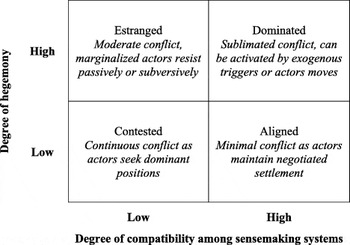
When applied to CSR, this view of complexity implies that contests for jurisdiction can change how corporations and stakeholders are positioned in terms of relative power; alter the level of agreement between sensemaking systems; or increase, decrease, or maintain the intensity of discourse. In order to understand the essential contestedness of CSR we need to understand how sensemaking systems are related and how power is allocated among them. To accomplish this, we borrow a typology created by Besharov and Smith (Reference Besharov and Smith2014) that proposes four ideal types of complexity within organizations: contested, aligned, estranged, and dominant. We apply their typology at the level of strategic action fields. As shown in Table 1, the four types of complexity are defined by the distribution of power among sensemaking systems, the degree of compatibility between them, and the patterns of conflict that characterize them.
Types of Complexity in Organizations and Fields

Hegemony. We describe the distribution of power in a field in terms of hegemony (Burchell & Cook, Reference Burchell and Cook2013). Hegemony is the dominance of one sensemaking system over others in a strategic action field, giving that system jurisdiction over the purposes, relationships and rules of the field. It is reduced when multiple sensemaking systems share jurisdiction, and increased when one system dominates the field. For example, firms in the newspaper publishing industry have experienced increasing hegemony in their field as it has shifted from a blend of editorial and corporate sensemaking systems to a system dominated by the profit-oriented corporate system (Thornton, Ocasio, & Lounsbury, Reference Thornton, Ocasio and Lounsbury2012). As a result, newspapers have changed the decision-making process and values that guide story placement and editorial position, and have aligned themselves with particular audiences to ensure their financial survival. Hegemony is important for understanding evaluations of CSR activities because when it is low, firms and stakeholders are exposed to multiple prescriptions emerging from several powerful sensemaking systems. When hegemony is high, firms and stakeholders are under more pressure to accept the prescriptions of the dominant sensemaking system.
Compatibility. Compatibility among sensemaking systems forms the second axis of Table 1. Compatibility is a state in which different things coexist without conflict. The degree of compatibility is low if sensemaking systems share few values and schemas and thus generate competing prescriptions. The degree of compatibility is high if sensemaking systems share many values and schemas and thus generate similar prescriptions. For example, many sensemaking systems include prescriptions about hierarchy—which roles takes charge and when. As we all know parental roles and managerial roles are easily conflated, but are also different enough to engender conflict when parents try to act as managers or vice versa.
Compatibility may appear to be high if a history of interactions between sensemaking systems has given rise to stable relationships between systems (Bitektine & Haack, Reference Bitektine and Haack2015; Purdy & Gray, Reference Purdy and Gray2009; Smets et al., Reference Smets, Jarzabkowski, Burke and Spee2015). When relationships are stable, disputes over what constitutes responsible action have negotiated settlements such as sequential treatment or acceptance of symbolic action (Clark & Newell, Reference Clark and Newell2013; Reference MacLean and BenhamMaclean & Benham, 2010). Scholars theorize that even when contests for jurisdiction are suppressed by stable relationships between systems, the potential for conflict to re-emerge is always present because differences are sublimated rather than removed. Conflict can be triggered by exogenous change or by action that intentionally or unintentionally challenges the status quo (Besharov & Smith, Reference Besharov and Smith2014; Friedman & Miles, Reference Friedman and Miles2002; Kraatz & Block, Reference Kraatz, Block, Greenwood, Oliver, Sahlin and Suddaby2008).
Institutional Complexity and Authenticity
The degree of compatibility between sensemaking systems has implications for schematic authenticity evaluations via the idea of social connectedness. Social connectedness is a firm’s responsiveness to a range of stakeholder goals as the result of a collectivist orientation (Mazutis & Slawinski, Reference Mazutis and Slawinski2015). Social connectedness to a range of stakeholders requires compatibility between sensemaking systems. If schemas for socially responsible behavior are incompatible, it will be difficult to be widely responsive or socially connected, no matter what the firm’s orientation (Friedman & Miles, Reference Friedman and Miles2002). When compatibility is high (i.e., in Table 1 the state of the field is aligned or dominated), a stakeholder will be more likely to evaluate CSR activities as conforming to its schema for social responsibility (schematic authenticity), making social connectedness more likely (Friedman & Miles, Reference Friedman and Miles2002). The same activities might be evaluated as nonconforming when sensemaking systems are incompatible (contested or estranged pluralism).
We can draw a similar connection between hegemony and distinctiveness. The idea of distinctiveness does not take into account the level of hegemony in a field. When hegemony is low (the field is contested or aligned), stakeholders will be more likely to develop distinctive observed identities for firms. This is because when multiple systems have power, participants in the field seek to understand which parts of the field each actor and system has jurisdiction in (Battilana & Dorado, Reference Battilana and Dorado2010; McPherson & Sauder, Reference McPherson and Sauder2013), changing the kinds of motivations observers attach to departures from observed identity. When a field is hegemonic (the field is estranged or dominated), conformity to the dominant system and solidarity within that system may be more important for observed identity than distinctiveness. Identifying a firm as a typical corporation that upholds the values of a dominant system or a renegade from that system may be more important for emblematic authenticity evaluations than teasing out unique attributes (King & Whetten, Reference King and Whetten2008) and may be cognitively less costly for stakeholders (Smets & Jarzabkowski, Reference Smets and Jarzabkowski2013). In hegemonic fields, observed identity is more likely to be stereotypic, as when workers perceive all employers are the same, or when activists lump all multinationals together, or when a regulator treats all firms in a uniform way. Distinctiveness plays a much less important role in emblematic authenticity evaluations in hegemonic fields.
These links from schematic and emblematic authenticity to compatibility and hegemony suggest that Mazutis and Slawinski’s (Reference Mazutis and Slawinski2015) taxonomy is applicable to authenticity evaluations made in aligned fields, where hegemony is low, making distinctiveness important, and sensemaking systems are compatible, making wide social connectedness possible. Their model does not help us understand how authenticity evaluations would be generated in hegemonic fields or in fields where sensemaking systems are incompatible. Linking authenticity evaluations to the institutional complexity of fields is an opportunity to build more encompassing theory about how stakeholders evaluate CSR activities in different contexts.
When firms and stakeholders have different sensemaking systems, they may evaluate field level complexity differently (Burchell & Cook, Reference Burchell and Cook2013; Dawkins, Reference Dawkins2015). For example, the assertion that CSR is a norm imposed on corporations by society begs the question of whether there is an active contest for jurisdiction or whether a negotiated settlement has been achieved. The increasing importance of formal reporting, third party certification, and other systems for standardizing CSR would tend to suggest a settlement in an aligned field, while disagreement over which CSR activities are authentic suggests that the field is contested by stakeholders with incompatible sensemaking systems who have some degree of power. Some stakeholder groups argue that CSR is a marketing concept imposed by a hegemonic sensemaking system (Dawkins, Reference Dawkins2015; Moon, Crane, & Matten, Reference Moon, Crane and Matten2005). Stakeholders taking this position would tend to see the field as estranged or dominated. When a field is treated as estranged, stakeholders may frame themselves as revolutionaries or resistance fighters, while if the field is seen as dominated, stakeholders may see themselves as victims of or collaborators with a hegemonic system.
This reveals a key problem for theory building: that stakeholders see themselves in different relationships to firms depending on the state of the field. Different types of complexity change the meaning of authenticity evaluations. For example, in a contested field an evaluation of schematic authenticity may signal a concession by the firm, while in an aligned field the same evaluation would be more likely to build solidarity between the firm and stakeholder.
A FRAMEWORK FOR UNDERSTANDING CONTEXTUALIZED STAKEHOLDER AUTHENTICITY EVALUATIONS OF CSR ACTIVITIES
To understand how corporate claims of social responsibility will be evaluated by which stakeholders under different conditions, we develop a framework that organizes the variety of authenticity evaluations for all four ideal types of complexity: aligned, contested, estranged, and dominated. Although the framework is organized using ideal types (Doty & Glick, Reference Doty and Glick1994), we illustrate it with real world examples. We begin by addressing the evaluation of activities as authentic or inauthentic on both criteria. Understanding when these occur can help us focus our attention on kinds of evaluation that are more informative about the contestedness of CSR.
When should we expect stakeholders to evaluate a CSR activity as authentic on both emblematic and schematic grounds? Our literature review suggests that the essential contestedness of CSR activities can be suppressed to a meaningful degree when sensemaking systems are compatible. Although compatibility is the primary determinant of positive authenticity evaluations, hegemony will moderate the effect. In an aligned field, corporations that have a history of good social and environmental performance, such as the active wear company Patagonia or the socially oriented shoe company TOMS, can have a distinctive observed identity based in part on avowal of a sensemaking system compatible with stakeholders’ systems. As long as these corporations walk the talk of environmental, social, and economic justice in their activities, these stakeholders are likely to regard those activities as wholly authentic. In dominated fields under a hegemonic, corporate-centered sensemaking system, we would expect CSR activities to be standardized and thus consistent with stereotyped observed identities: philanthropy, energy saving, community clean-up, and employee engagement are all easily recognized markers of good corporate citizenship. Uniformity of CSR activities carried out by stereotyped corporations that fit into the overlap between stakeholder and firm sensemaking systems should lead activities to be evaluated as schematically and emblematically authentic.
Evaluation of activities as inauthentic on both criteria will be more common when the compatibility of systems is low. Stakeholders whose sensemaking systems are incompatible with a corporate or market-centered system and who have power are likely to evaluate many CSR activities as schematically inauthentic. This will be amplified when the activity is also evaluated as emblematically inauthentic. For example, Google, Apple, Facebook, and other high tech firms have long been seen as ‘cool,’ technologically differentiated, socially progressive, desirable employers by many stakeholder groups in the San Francisco Bay Area (Michels, Reference Michels2014). This identity has recently been undermined by the practice of using private buses to bring the employees of these firms to work. While companies claim that the use of private buses is responsible because it reduces traffic congestion and pollution, the practice enables the employees of these firms to live in the centers of cities like San Francisco and Oakland, driving up housing costs and crowding out working-class residents. Because these buses increase economic segregation and shift the burden of commuting to working class residents, their use has been challenged by community-oriented stakeholder groups as socially irresponsible and as inconsistent with the observed identities of the firms. Several ballot measures to curb these practices have been proposed by community activists (Michels, Reference Michels2014). The result of this struggle appears to be that the observed identities of these firms are shifting toward a stereotype of corporate greed and arrogance, especially as the firms make hegemonic common cause with property owners, real estate developers, and political elites. This example suggests that evaluations of inauthenticity on both criteria are most likely to come from stakeholders whose sensemaking systems are rigid or who are negatively affected by the activity. This example also returns us to the idea that firms may engage in CSR activities in order to be responsible on their own terms, rather simply conforming to external expectations.
Exploring Mixed Authenticity Evaluations
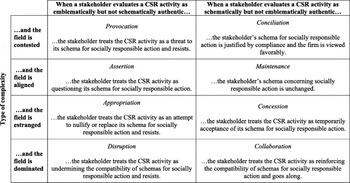
Mixed evaluations occur when stakeholders perceive CSR activities as schematically but not emblematically authentic, or as emblematically but not schematically authentic. Such evaluations thus are predictive of how stakeholders will participate in the discursive contest for jurisdiction. The entries in Table 2 are the outcomes that we propose will emerge when stakeholders produce mixed evaluations of CSR activities, depending on the type of complexity present in the field constituted by their relations with the firm in question. We include Table 2 to demonstrate that structurally similar evaluations do not necessarily carry the same meanings or lead to the same forms of discourse. Different combinations of power and compatibility change relationships and thus alter the meaning of authenticity evaluations and the kinds of responses that follow from them. Our discussion below is organized according to the four states of fields that result from differing levels of hegemony and compatibility among sensemaking systems.
Outcomes of Mixed Authenticity Evaluations in Different States of Field-level Complexity

Contested fields. In contested fields, stakeholder groups and firms try to establish their own jurisdiction, and are committed to their own schemas as well as to the observed identities they assign to each other. Discursive conflict in contested fields can settle into a low intensity state if neither side tries to persuade the other (Besharov & Smith, Reference Besharov and Smith2014). Emblematic authenticity evaluations in contested fields will be driven by distinctiveness—does the stakeholder see the firm being true to a unique self rather than showing solidarity with similar firms? In a contested field, making social responsibility claims for activities that stakeholders evaluate as emblematically authentic but schematically inauthentic is likely to increase debate over what constitutes CSR. Contested fields are an opportunity for firms as well as stakeholders to assert and defend positions. We therefore propose that CSR activities that produce emblematic but not schematic evaluations in contested fields constitute provocation because they can be expected to trigger contentious stakeholder discourse. Royal Dutch Shell engages in CSR activities that are consistent with its observed identity but violate stakeholder schemas in order to stimulate discourse over what it means to be socially responsible (Whelan, Reference Whelan2013).
When a CSR activity is evaluated as consistent with the stakeholder’s schema in a contested field it will, almost by definition, be evaluated as inconsistent with the firm’s observed identity. A firm departing from the expectations created by a distinctive observed identity in order to comply with the prescriptions of a stakeholder’s schema is behaving in a conciliatory manner, making it more likely that the discourse of stakeholder resistance will be reduced. It is possible for firms to do this in a contested field precisely because stakeholders are likely to develop ideas about observed identity that differentiate each firm. When observed identity is used to differentiate firms from each other, a firm breaking ranks with its peers would not be seen as unusual. While engaging in activities that fit a stakeholder’s schema should not be described as surrender (since it does not mean that the struggle for jurisdiction ceases), it does signal that the firm is motivated to develop a less oppositional discourse with at least one stakeholder group. Opposition is reduced by the firm’s gesture of compliance with the stakeholder’s schema. We therefore propose activities that attract schematic but not emblematic evaluations in contested fields are interpreted as conciliation and trigger a positive response.
An example of this occurred when the McDonalds Corporation developed fresh food items that partly aligned its menu with the expectations of state-based and professional stakeholders concerned with better nutrition. For several years the fresh food items received a disproportionate share of promotion efforts but sold poorly (Patton, Reference Patton2013), which suggests that the activity was not consistent with consumers’ expectations. Resistance by franchisees also suggests that the activity was viewed as inconsistent with the corporation’s observed identity by internal stakeholders. Some state and professional stakeholders evaluated this activity as nominally socially responsible, but also as inconsistent with the firm’s observed identity because the rest of the menu had not changed for the better. This is an example of conciliation posing as a strategic response to a social trend.
Aligned fields. In an aligned field, power is distributed and the prescriptions of sensemaking systems are compatible. Observed identities will be distinctive, as in the contested field. When sensemaking systems are compatible, firms will be able to shape CSR activities to conform to multiple stakeholder schemas. Although an aligned field is likely to be less contentious than a contested field, this does not mean jurisdiction will be fully resolved. When managers want to assert the differences between sensemaking systems, they can undertake activities that are consistent with observed identity but not with the schemas held by stakeholders. Stakeholders are likely to respond by questioning the motivation for the activity and increasing the intensity of discourse. We propose that these activities are evaluated as assertion, and that they have the potential to move the field toward a contested state. An example is BP’s claims that its responses to the Deepwater Horizon disaster were a model of corporate responsibility (Bondy, Moon, & Matten, 2011). This assertion was regarded as typical of BP and triggered an extended public discussion of what environmental responsibility actually requires in the face of a disaster. This discussion appears to have reinforced consensus across stakeholder groups who refused to adjust their schemas.
When a firm in an aligned field undertakes an activity that is consistent with stakeholder schemas but out of character for its observed identity, it may do so to maintain the relationships that create compatibility within the field. We propose that CSR activities in aligned fields that attract this kind of authenticity evaluation are interpreted as maintenance moves, designed to reinforce the status quo. Mazutis and Slawinski (Reference Mazutis and Slawinski2015) discuss the example of Wal-Mart’s supply-chain-based sustainability initiatives. By extending and enforcing its version of sustainability deep into its supply network, Wal-Mart is able to maintain the status quo (and avoid significant stakeholder challenges) by engaging in activities that are regarded as socially responsible but out of character for its observed identity. Over the long term a series of maintenance moves may help a firm change its observed identity.
Estranged fields. When a field is estranged, relatively powerless stakeholders who disagree with a hegemonic, corporate-centered sensemaking system will be likely to reject CSR activities as schematically inauthentic, but may see the firms carrying out those activities as being true to a stereotypical observed identity. Jurisdiction over what it means to be a socially responsible business will be contested by marginalized groups but the discourse of resistance may not be intensive or effective. Stakeholders may suppress their negative evaluations or express them in subversive ways. They may rely on third parties to voice their disagreement. Firms will reinforce the dominance of their corporate, market-oriented sensemaking system by engaging in standardized CSR activities that enhance solidarity between firms. The image we have is of managers in an industry closing ranks to dominate communities, governments, labor, or suppliers. Closed ranks suppress differences between firms from the stakeholder’s point of view. When firm’s CSR activities are true to observed identity but inconsistent with stakeholder schemas, stakeholders often respond as if managers are trying to take over jurisdiction over what it means to be socially responsible. We therefore propose that activities that draw this kind of evaluation are interpreted as appropriation, leading stakeholders to resist the nullification or replacement of their schemas for what constitutes socially responsible action.
For example, the Monsanto Company, in partnership with Cargill and the Gates Foundation, was involved in an initiative to combat the brown streak virus that decimated cassava production across East Africa (McNeil, Reference McNeil2010). The partnership’s solution was to introduce a genetically modified cassava strain. This activity, which showed promise of technical success, drew negative evaluations from environmental and social justice activists and from many African economic development organizations. The fact that the activity was based on Monsanto’s expertise in genetic modification led challenger stakeholders to argue that the activity was not schematically authentic because they did not view it as environmentally sound. They also saw the activity as strongly linked to Monsanto’s observed identity as a predatory enforcer of its intellectual property rights in GMO crops. They therefore evaluated the activity as an attempt by stereotypic Western corporations to appropriate jurisdiction over how cassava is produced and what it means to be socially responsible.
We can imagine occasions where firms in an estranged field would engage in activities that conform to stakeholder schemas, and thus violate a firm’s stereotypic observed identity. Because this could lead to a diminution of the dominant group’s power, we would expect such activities to be rare. We propose that activities that receive this kind of evaluation are interpreted as a concession on the part of the firm and that stakeholders view them as indicative of temporary success. Such evaluations keep the struggle between the hegemonic group and its challengers alive but reduce the immediate level of conflict. For example, when Wal-Mart and Ikea broke ranks with other retailers and raised their minimum wage, many stakeholders applauded the move, but few saw it as indicating a fundamental change in labor relations and many saw it as acceptance of an unavoidable trend (Davis, Reference Davis2015). Concessions are unlikely to alter stakeholder positions or discourse.
Dominated fields. When a field is in a dominated state, sensemaking systems will be compatible and observed identity will be shaped by solidarity within groups or the field. Despite the apparent harmony implied by compatibility and hegemony, the contest between a dominant system and stakeholder systems can be re-ignited when firms engage in activities that conflict with stakeholder schemas. Compatibility does not mean that sensemaking systems become identical; even when a strong negotiated settlement engenders solidarity between the hegemonic incumbent and its dependents, differences between sensemaking systems are sublimated rather than removed. The power of incumbents may lead them to violate the status quo. Activities of this type risk pushing the field toward an estranged state. We propose that activities evaluated in this way are interpreted as acts of disruption that undermine the status quo. Porter and Kramer (Reference Porter and Kramer2011) advocate for this kind of move when they discuss the potential for firms to shift from a fair trade orientation in cocoa sourcing to a shared investment approach that many stakeholders reject because it gives buyers more power over growers. Because disruption changes the rules of established relationships, it is likely to trigger subversive discourse on the part of stakeholders.
Firms can also act to sustain dominated fields by engaging in actions that are inconsistent with their observed identities but favorable to stakeholder schemas. Such activities would tend to enhance the stable relationships that contribute to compatibility and would create the impression that differences between sensemaking systems matter less than membership in the field. We propose that activities evaluated in this way are interpreted as collaboration, in the sense of cooperating with an occupying hegemonic power. The involvement of Wall Street investment banks with the Susan G. Komen ‘Paint Wall Street Pink’ event generates this kind of evaluation. Stakeholders to firms like Goldman Sachs have characterized them as hostile to women (Epprecht, Reference Epprecht2013), but welcome corporate participation in breast cancer prevention initiatives. This hides or tries to trivialize incompatibilities and power differentials. Collaboration is how hostility is domesticated (Burchell & Cook, Reference Burchell and Cook2013).
Summary. The outcomes listed in the left column of Table 2 (provocation, assertion, appropriation, and disruption) are difficult to reconcile with the idea that CSR is an obligation defined by societal expectations. When CSR activities are evaluated as emblematically but not schematically authentic, the stakeholder is, in effect, making a judgement that the firm is challenging for jurisdiction over what it means to be socially responsible. Exactly how stakeholders evaluate and respond to such challenges depends on how they see the state of the field and the distribution of power relations within it, creating differences in the vertical dimension of Table 2. Discursive responses to provocation and assertion are more likely to be open and aggressive than the responses triggered by appropriation or disruption when stakeholders are less powerful. As a practical matter, managers and stakeholders will need to understand whether they see the state of the field in the same way. A manager who views a field as aligned may be surprised by the evaluation and response of a stakeholder who views it as contested or estranged, just as stakeholders may be surprised by the activities of corporations who view a field as dominated when stakeholders view it as contested.
The outcomes listed in the right column of Table 2 (conciliation, maintenance, concession, and collaboration) are consistent with the idea that firms comply with society’s expectations. A firm can avoid the costs of contesting jurisdiction over what it means to be responsible by behaving in ways that are at odds with its observed identity but that fit the stakeholder’s schema. Persisting in maintenance or collaboration activities may lead stakeholders to re-evaluate the firm’s observed identity. There are also important differences along the vertical dimension in this column. Persisting in identity altering activities may be more difficult to do when hegemony of a corporate-oriented sensemaking system makes preservation of solidarity between corporations important. The risk of activities that are viewed as concession or conciliation is that firms will be seen as seeking stakeholder support without commitment to underlying principles, leading to accusations of green-washing, window-dressing, or pandering. The same activities in a hegemonic field will be interpreted as moves to maintain the status quo. It is worth noting that actions that appear to ‘go along’ with one or more stakeholder schemas for social responsibility can enhance or maintain the isolation of other, more antagonistic, stakeholder groups. A firm complying with a stakeholder schema but violating its own identity may be acting to isolate opposition by some other stakeholder group. A contest over jurisdiction can be won by dividing, co-opting, or isolating opposition groups through concession or collaboration as well as by asserting a strong position.
DISCUSSION AND CONCLUSION
We offer a framework that can be used to understand how CSR activities are evaluated in a variety of contexts and what this means for stakeholder responses. Our work shows when and how structurally equivalent authenticity evaluations mean different things. A firm violating its observed identity to conform to a stakeholder schema when the stakeholder is powerful is doing something very different from a firm taking the same action when the stakeholder is weak. Authenticity evaluations also lead to different forms of discursive interplay based on whether sensemaking systems are compatible or incompatible. As Table 2 illustrates, the most obvious qualitative differences in meaning are between the columns, which show distinctly different orientations toward power. The meanings in the left column are oriented toward challenge and change, while the meanings on the right are oriented toward appeasement and conformity. The differences between rows within columns are also meaningful, since evaluating a CSR activity as conciliation promotes a different discourse that evaluating the same activity as maintenance or concession. Firms that violate identity to meet expectations can still face stakeholder skepticism and resistance. Knowing how activities are evaluated allows us to predict the kinds of discursive responses stakeholders will enact, and thus points toward a theory of CSR dynamics.
Although we accept the idea that CSR activities have become something corporations have to do to be accepted as legitimate (Lamin & Zaheer, Reference Lamin and Zaheer2012), CSR is more fundamentally an essentially contested concept than a social mandate. Managers face the dilemma of having to undertake activities that may be negatively evaluated even as they appear to create value for stakeholders. Drawing upon research on institutional complexity, we highlight the varied and dynamic nature of stakeholder evaluations and responses, noting that the hegemony and compatibility of plural sensemaking systems determine how vigorously jurisdiction over meaning making in fields and organizations is contested. We link the literature on mixed authenticity evaluations of CSR activities to institutional complexity by showing how emblematic and schematic authenticity evaluations connect to the hegemony and compatibility dimensions of fields. This combination yields insights into the different types of authenticity evaluations that occur based on the complexity of a field, and results in a framework that allows us to compare and contrast different CSR activities and evaluations of them as moves in a discursive contest. Our work offers new and systematic insights into the dynamics of organization-stakeholder discourse that arise as firms and their stakeholders attempt to establish jurisdiction over what CSR activities are appropriate.
The major contribution of this article is to develop theory that provides a systematic explanation of the essential contestedness of CSR. CSR activities are part of a discursive contest for jurisdiction over how business, its purposes, and its everyday operations are understood and evaluated. Stakeholders respond to these activities dynamically by evaluating both their content (through schematic authenticity) and the motivations behind them (emblematic authenticity). Some activities minimize conflict through compliance, but others are designed to change how CSR is understood by stakeholders. Our theory thus helps explain qualitative variation in the essential contestedness of CSR, and in the kinds of settlements that evolve. Understanding how stakeholders’ responses are generated gives us insight into the conformity that results when firms seek to reduce contestedness and into the actions firms or stakeholders take when they want to challenge the status quo. It leads us to see the production and evaluation of CSR activities as a dynamic process that is responsive to intentional action, to accidents, and to changes in power or the mix of sensemaking systems deployed by stakeholders and firms.
In taking a general conceptual approach, we have had the freedom to illustrate our meaning with examples, but we recognize that this is no substitute for the rigor of empirical tests in specific settings. We hope that future empirical research will overcome this limitation. We believe that the best way to measure these constructs would be to apply a categorical coding approach to published stakeholder responses to CSR activities. This approach would not impose the framework on the production of responses and thus would allow scholars to determine whether the categories exist in nature or not. Stakeholder responses to CSR are published in a variety of forms, including blogs, fundraising appeals, legal testimony, and media interviews. Empirical research could collect responses from multiple stakeholders for each activity in order to test our view that stakeholders bring distinctive sensemaking systems to the evaluation process. Coding for the degree of hegemony would depend on statements about the degree to which society in general and the firm-stakeholder relationship in particular are dominated by one sensemaking system. Compatibility, in contrast, could be coded from statements that indicate the congruence of the stakeholder’s beliefs with the goals the firm. The level of emblematic authenticity could be assessed by coding statements that address whether stakeholders evaluate CSR activities as typical or expected given the firm’s history and observed identity, while schematic authenticity would be coded from statements concerning whether the stakeholder interprets the CSR activity as actually socially responsible.
We recognize that authenticity evaluations will seldom conform to the ideal types we discuss here, since ideal types are seldom found in nature (Doty & Glick, Reference Doty and Glick1994). As our illustrative examples show, real-life CSR activities can be evaluated as consistent with some elements of observed identity but not with others (Ewing, Allen, & Ewing, Reference Ewing, Allen and Ewing2012). CSR activities can be partly consistent with a stakeholder’s schema and thus be evaluated as partly responsible. Future research might consider exactly how little or how much deviation from the ideal there has to be for a stakeholder to evaluate an activity as authentic or inauthentic in schematic or emblematic terms. Another important area for future research is investigating whether and how stakeholders move between sensemaking systems, how easily or frequently this occurs, and what effect such movement has on authenticity evaluations. Although for reasons of space we do not fully explore the topic, our framework has the potential to help us understand how the contest over what it means to be socially responsible can shape the fields it occurs in. To realize this promising area for future research scholars should expand on the idea that because sensemaking systems can become more or less compatible and stakeholders or corporations can develop or lose power, our theory can help explain transitions between field states, as the compatibility and hegemony of fields are influenced by discursive contests for control. Given the fascination of some scholars with the idea of hegemonic control (Burchell & Cook, Reference Burchell and Cook2013) it would be interesting to see to what extent firms actually try to achieve it.
This study has practical implications for managers and stakeholders. The most important comes from the emphasis it places on knowing how each side in the contest makes sense and/or sees power relations. If stakeholders believe that managerial and corporate sensemaking systems dominate society, then our theory helps managers who reflect on context understand why activities that they see as desirable or benign are treated as instruments of oppressive hegemony by stakeholders. If stakeholders believe that their own sensemaking systems are compatible with a firm’s, they may be more likely to take CSR activities for granted. If stakeholders believe that power is distributed and that establishing jurisdiction requires give and take, they can engage in discourse over CSR activities in a shared but still essentially contested process. The settlements they reach may not fully reconcile the demands of sensemaking systems based in markets or hierarchies with the demands of systems based in communities, families, the state, religion, or professions, but they may find common ground. The practical value of our framework is that it situates stakeholder and managerial beliefs in a common system of reference and thus makes connections and differences between systems more visible. We hope that this makes it easier for stakeholders and managers to reflect on, understand, and respond to opposing positions in the emblematic and inevitable contest for jurisdiction over what it means to be socially responsible.
ACKNOWLEDGEMENTS
We would like to acknowledge the support and encouragement we received from the participants in the Fourth and Seventh Annual Academic Research Conferences on Corporate Social Responsibility at the Milgard School of Business, University of Washington Tacoma.