INTRODUCTION
Sharks and their relatives, including skates, rays and chimaeras, are a small, evolutionarily conservative group, comprising approximately 1000 species that have functioned successfully in diverse ecosystems for 400 million years (Abdulla, Reference Abdulla2004). Despite their evolutionary success, a number of sharks are now threatened with extinction as a result of human activity. Sharks are recognized as highly vulnerable to overexploitation, leading to population depletion due to their life history strategies (Abdulla, Reference Musick, Fowler, Cavanagh, Camhi, Burgess, Cailliet, Fordham, Simpfendorfer and Musick2004). They are predominantly characterized as long-lived, slow growing and producing few offspring. These characteristics are associated with low productivity, close stock recruitment relationships and long recovery times in response to overfishing. Other threats such as pollution and habitat destruction are also serious issues for sharks (Compagno, Reference Compagno, Fowler, Cavanagh, Camhi, Burgess, Cailliet, Fordham, Simpfendorfer and Musick2005; Musick, Reference Musick, Fowler, Cavanagh, Camhi, Burgess, Cailliet, Fordham, Simpfendorfer and Musick2005).
The shark and ray landings that constitute a part of the demersal fisheries occur throughout the Malaysian waters, from the coasts to the edges of its Exclusive Economic Zone (EEZ) (Department of Fisheries Malaysia, 2006). These landings contribute only a minor portion of less than 2.2% of total marine landings. Sharks are not targeted by fishers but are caught together with other commercially important species (Department of Fisheries Malaysia, 2006).
A few studies and publications dealing with the identification of sharks are now available in Malaysia. Ahmad et al. (Reference Ahmad, Rosidi and Solahuddin1999) reported 48 species of sharks and 41 species of rays inhabiting the Malaysian waters. Ahmad et al. (Reference Ahmad, Abdul Haris Hilmi, Gambang, Ahemad and Solahuddin2004) also reported a total of 63 species of sharks, 68 species of rays and three species of chimaeras in the waters. Yano et al. (Reference Yano, Ahmad, Gambang, Idris, Solahuddin and Aznan2005) reported a total of 56 species of sharks, 52 species of rays and two species of chimaeras in the waters. Although some information on the fishing and taxonomy of sharks from Malaysian waters is available (e.g. Ahmad et al., Reference Ahmad, Rosidi and Solahuddin1999, Reference Ahmad, Abdul Haris Hilmi, Gambang, Ahemad and Solahuddin2004; Yano et al., Reference Yano, Ahmad, Gambang, Idris, Solahuddin and Aznan2005; Department of Fisheries Malaysia, 2006), biological and ecological studies on shark species are at rudimentary levels.
We started a landing port survey in October 2014, with an aim to increase understanding of the biology and ecology of sharks in Malaysian waters. During this research, we found a number of young of the year (YOY) sharks just after they were born. This paper presents a preliminary record of young sharks, for understanding the current status of human impact on sharks in Malaysia, and the results can be used as guidance for the conservation and protection of shark diversity in the region.
MATERIALS AND METHODS
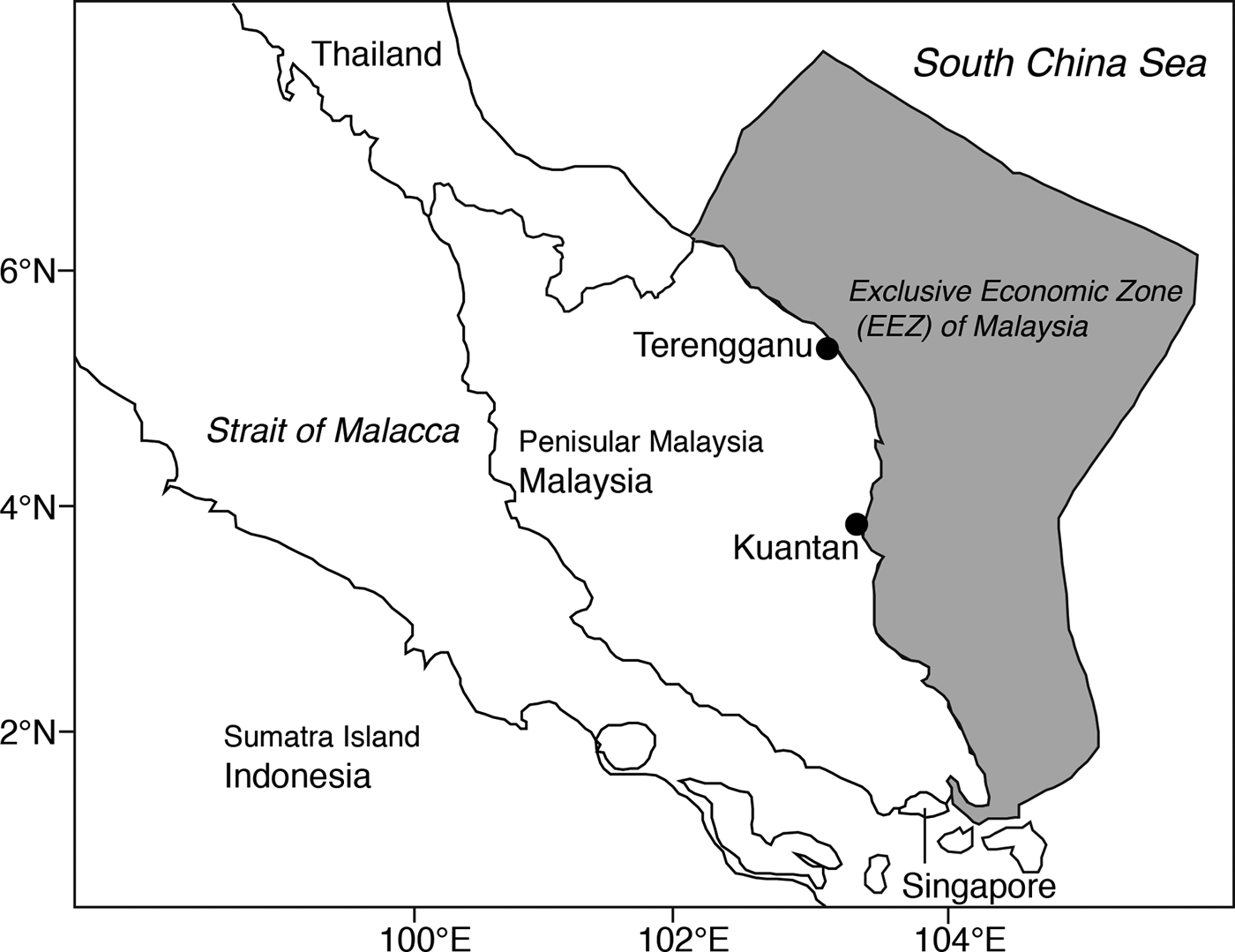
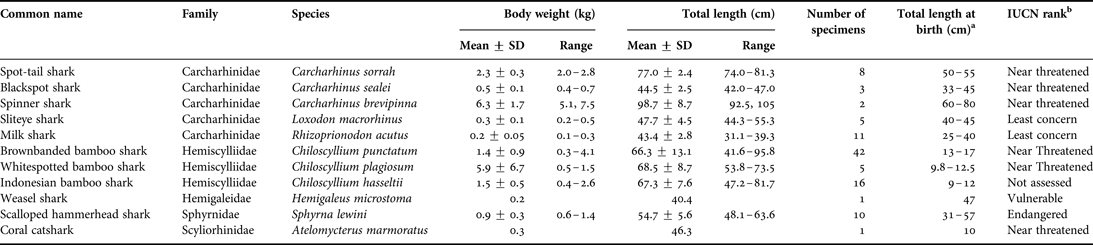
The landing port survey was conducted at two sites (states), Terengganu and Kuantan, on the eastern coast of Peninsular Malaysia, every two weeks between 30 October and 24 December 2014 (Figure 1). All specimens were donated or purchased in the landing ports and were transported to the laboratory for observation. Sharks from the Malaysian South China Sea were captured by commercial trawlers and purse seiners as part of the demersal fishery from the coasts to the edge of Malaysia's EEZ (Figure 1). The external morphometric characteristics were measured, species identification for each shark specimen was conducted according to Ahmad & Lim (Reference Ahmad and Lim2012) and Ahmad et al. (Reference Ahmad and Lim2013), and the data is presented in Table 1.
Map of the locations of the landing ports (the states of Terengganu and Kuantan) where sharks were landed and collected. The EEZ of Malaysia where sharks were captured is also illustrated.

RESULTS AND DISCUSSION
A total of 104 sharks were collected in this study, comprising the four families, Carcharhinidae, Hemiscylliidae, Sphyrnidae and Scyliorhinidae, and of these, 11 different species of shark were examined. The brownbanded bamboo shark Chiloscyllium punctatum was the most dominant species (Table 1). We were able to survey all sharks landed at the landing port in the state of Terengganu, while we randomly selected shark specimens from the range of species landed in the state of Kuantan. Based on the landing data collected from 2003 to 2004, the most dominant species of sharks found in Malaysia belonged to the families Hemiscyllidae and Carcharhinidae (Department of Fisheries Malaysia, 2006). The present record is consistent with that of previous records.
Measurements of size and weight were different and varied among species, ranging from 0.1 to 7.5 kg in body weight and from 31.1 to 105 cm in total length (TL) (Table 1). The TLs at birth were varied among species (IUCN, 2014, Table 1). Five out of the 11 shark species, Carcharhinus sealei, Loxodon macrorhinus, Rhizoprionodon acutus, Hemigaleus microstoma and Sphyrna lewini, were in the range of, or even less than, the lengths of sharks previously measured at birth (Table 1, Figure 2A–C). Although the TLs of the brownbanded bamboo shark Chiloscyllium punctatum (41.6–95.8 cm) were greater than the TLs of the species measured at birth (13–17 cm) (Table 1), various growth stages from juvenile to the matured adults were landed (Figure 2D). No colour pattern was found on specimens of the adult stage, however, transverse bands can be found on juvenile and young stages of Chiloscyllium punctatum (Figure 2D). Males mature at 68–76 cm TL and the maturation of females occurs at about 63 cm TL (Compagno, Reference Compagno2001). These results suggest that a number of sharks were born in the vicinity of the fishing grounds just before they were fished. And, the fishing grounds in the Malaysian South China Sea do overlap the spawning, nursery and feeding grounds of these shark species.
Sharks captured as bycatch and landed in the landing ports in the Malaysian South China Sea. (A) YOY Loxodon macrorhinus; (B) YOY Rhizoprionodon acutus; (C) YOY Sphyrna lewini; (D) Chiloscyllium punctatum in juvenile to adult stages. Scale bars = 10 cm.

Among the five of the 11 YOY sharks, the scalloped hammerhead shark Sphyrna lewini and the weasel shark Hemigaleus microstoma are categorized as Endangered and Vulnerable species, respectively (IUCN, 2014; Table 1). The YOY scalloped hammerhead shark (Figure 1C) is commonly found at landing ports in the Malaysian South China Sea. Thus, the current fishing methods could be detrimental to the critical levels of sharks in these waters, and could even lead to their extinctions in the future. Furthermore, the numbers of YOY shark species that were captured suggest that those sharks might also be threatened in maintaining their populations.
The fisheries in Malaysia play a significant role in supporting the country's economic growth through the provision of employment and by providing a source of much-needed protein to the population (Department of Fisheries Malaysia, 2006). The trend in shark landings has increased from 4140 tonnes in 1990 to a peak of 8695 tonnes in 2003. It is observed that the trend stabilized at around 5000 tonnes from 1982 to 1990 but increased gradually to 8695 tonnes in 2003 (Department of Fisheries Malaysia, 2006). This data suggests that YOY sharks might be captured more frequently in the Malaysian South China Sea area. Sharks are not targeted by fishers but are caught as bycatch with other commercially important species (Department of Fisheries Malaysia, 2006). Sharks are predominantly characterized as long-lived, slow growing and producing few offspring. The International Union for Conservation of Nature and Natural Resources reported that over half of the evaluated pelagic shark species are believed to be under threat from extinction (IUCN, 2014). These characteristics are associated with low productivity, close stock-recruitment relationships and long recovery times in response to overfishing. Thus, an improvement in the species selectiveness of fishing gear is needed to protect and conserve sharks.
ACKNOWLEDGEMENTS
The authors are grateful to Dr Ahmad Ali for his kind guidance for the identification of sharks. We also thank Ms Ling Shi Gan for her kind assistance with the field survey. This work was supported by the Higher Institution Centre of Excellence (HICoE) Research Grant (Grant No. 66928), under the Institute of Oceanography and Environment (INOS).