Significant outcomes
• Routine clinical practice results in the under-detection of neuropsychiatric symptoms in neurology in-patients.
• Ongoing screening improves detection of neuropsychiatric symptoms but effects are not sustained when screening stops.
• Incorporating screening for neuropsychiatric symptoms into routine clinical practice would result in sustained improvement in the rate of detection and treatment of these symptoms.
Limitations
• This is a retrospective study looking into case notes.
• Findings are applicable to specialist neurological settings. It is unclear whether similar screening would be beneficial in neurological patients in primary care settings.
Introduction
Psychiatric comorbidity is common among in-patients in general hospitals. A Danish study of 294 consecutive medical in-patients (Reference Hansen, Fink, Frydenberg, Oxhoj, Sondergaard and Munk-Jorgensen1) detected a prevalence of current mental disorders of 38.7%. The study also noted that the detection of psychiatric illness by medical staff and subsequent referral to psychiatric services was low. In an earlier study, Silverstone (Reference Silverstone2) highlighted that despite this finding being repeatedly confirmed in studies for the past 20 years, recognition of these problems remained poor. This has important implications as it has been shown by Silverstone (Reference Silverstone2) and others that medically ill patients who have unrecognised and untreated comorbid psychiatric illness (e.g. depression) have poorer outcomes in terms of morbidity, length of hospital stay, levels of functioning and mortality.
In patients with neurological disorders, the prevalence of psychiatric illness is higher. Fink et al. (Reference Fink, Hansen, Sondergaard and Frydenberg3), in a study of 198 consecutive patients referred for the first time to a neurologist, found an overall prevalence of current mental disorder of 55.1%. As in general medical patients, this often goes unrecognised. Bridges and Goldberg (Reference Bridges and Goldberg4), in an earlier study of neurology in-patients, estimated the prevalence of psychiatric illness to be 39%, of which 72% went undetected by the neurologist. In this context referrals to psychiatry services are low. Fink et al. (Reference Fink, Hansen, Sondergaard and Frydenberg3) found a referral rate of just 1.5% and de Jonge et al. (Reference de Jonge, Huyse and Herzog5) a similar rate of 1.8%.
The study by Jefferies et al. (Reference Jefferies, Owino, Rickards and Agrawal6) identified the prevalence of psychiatric disorders to be 51.3% among in-patients in a neurology ward at a regional neuroscience centre. In this study consecutive admissions to a dedicated neurology ward were assessed with a battery of screening questionnaires followed by a full psychiatric assessment using diagnostic and statistical manual of mental disorders, fourth edition (DSM-IV). The screening questionnaires were shown to have high sensitivity and specificity (81 and 77%, respectively). It was suggested that they could be an effective and simple way of identifying those patients with psychiatric comorbidity in a neurology in-patient setting.
While Jefferies et al. (Reference Jefferies, Owino, Rickards and Agrawal6) showed a prevalence rate of psychiatric disorders of 51.3% utilising screening questionnaires and a full psychiatric assessment, these are not employed in routine clinical practice. The rate of detection of psychiatric illness in routine clinical practice in this setting is not known. It is also not known if the screening programme had an enduring impact on the detection of psychiatric illness and subsequent referral to neuropsychiatric services in routine clinical practice.
The aims of this study were as follows:
1 Establish the rate of detection of psychiatric illness among neurology in-patients at a regional neuroscience centre in routine clinical practice.
2 Establish the rate of referral and reason for referral to the neuropsychiatric service in this setting.
3 Establish if there was an enduring impact from a dedicated neuropsychiatric screening service on the rate of detection of psychiatric illness in this setting.
Methods
Consecutive admissions to a dedicated neurology ward in the 3-month period before and after a neuropsychiatric screening programme were identified from the units admission register. The results of the 6-month neuropsychiatric screening programme were reported previously (Reference Jefferies, Owino, Rickards and Agrawal6). If a patient had multiple admissions during the period in question, this was only counted once. Case notes were then obtained from the medical records department and data extracted from the notes by two psychiatric higher specialist trainees. Information collected from the case notes included demographic data, neurological diagnosis, evidence of identification of psychiatric symptoms by neurologists, presence of a referral to neuropsychiatric services and reason given for requesting neuropsychiatric opinion, and neuropsychiatric diagnosis following assessment by the neuropsychiatric team.
Neurologists were considered to have identified psychiatric symptoms if they had made a note of the symptoms in the clinical record following clinical history taking and examination. This represents routine clinical practice in this neuroscience centre and does not involve the routine use of screening tools for eliciting psychiatric symptoms.
The neuropsychiatric service database was used to cross reference cases referred for neuropsychiatric opinion. Data were entered into Statistical Package for Social Sciences (SPSS) software for analysis.
Results
Characteristics of the sample
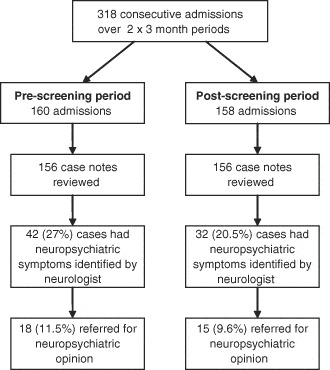
There were 318 consecutive admissions over the two 3-month study periods (Fig. 1). Case notes were located for 312 (98%) patients. Of the total sample 168 (53.8%) were males and 143 (45.8%) were females. The age range was 17–93 years (mean 53.8). The demographic characteristics of the sample were similar to those of Jefferies et al. (Reference Jefferies, Owino, Rickards and Agrawal6).
Flow-chart of case identification and referral.

In the 3-month period before the dedicated neuropsychiatric screening programme, there were 160 consecutive admissions of which 156 (97.5%) case notes were located. Of these, 51.3% were men and 48.7% were women. The age range was 18–93 (mean 53.3). In total, the neurologists recognised neuropsychiatric symptoms in 42 (26.9%) of these cases.
In the 3-month period following the end of the dedicated neuropsychiatric screening programme, there were 158 admissions of which 156 (98.7%) case notes were located. Of these, 56.4% were men and 43% were women. The age range was 17–90 (mean 54.2). In total there were 32 (20.5%) cases where the neurologists detected the presence of neuropsychiatric symptoms.
Rate of detection of psychiatric symptoms
Over the study periods (pre- and post-screening periods) a total of 74 (23.7%) patients were identified as having symptoms of mental illness present during their admission (Fig. 1). Eight patients had more than one neuropsychiatric symptom identified.
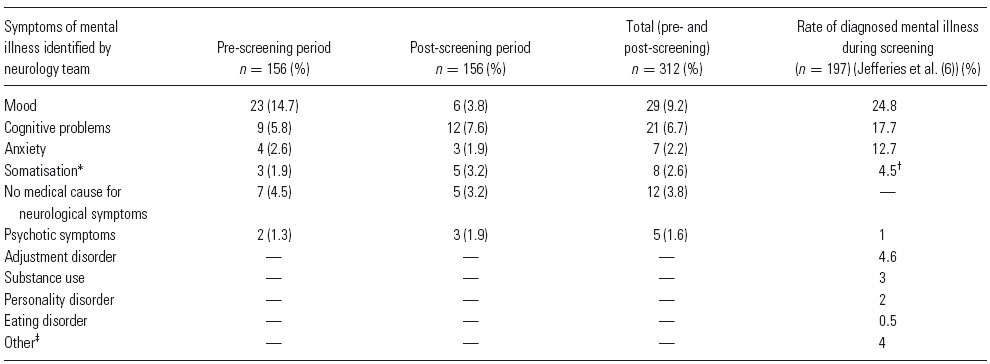
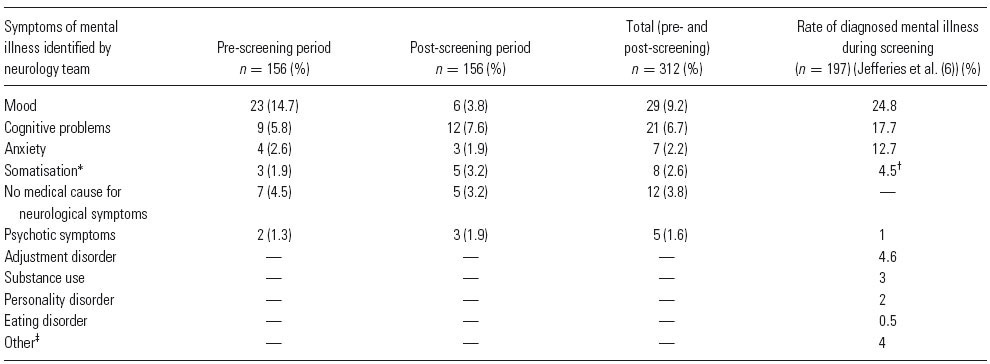
Table 1 illustrates the rate of detection of the symptoms of mental illness by neurologists during the two study periods and offers a comparison with the rate of diagnosed mental illness detected by Jefferies et al. (Reference Jefferies, Owino, Rickards and Agrawal6) during their period of screening.
Rate of detection of symptoms of mental illness
* Non-epileptic attack disorder.
† Somatoform disorder in Jefferies et al. (Reference Jefferies, Owino, Rickards and Agrawal6).
‡ Comprises the following disorders identified by Jefferies et al.: disorders usually diagnosed in childhood; other disorders that may be of clinical importance.
During the pre-screening period, the most common neuropsychiatric symptoms recognised were those related to disturbance of mood (14.7%) and cognitive problems (5.8%). Neurologists were of the opinion that of the 156 patients admitted, 7 (4.5%) had no medical cause for the symptoms with which they presented.
In the period following the dedicated neuropsychiatric screening programme (post-screening period), neurologists identified that 7.6% of patients had cognitive problems and 3.8% had mood symptoms. Of the 156 admissions in the second study period, the neurologists identified 5 (3.2%) as having medically unexplained symptoms.
Rate of referral to neuropsychiatry
In the period before the screening programme (pre-screening period), of the 42 patients identified as having symptoms of mental illness, 18 (43%) were referred to the neuropsychiatry team for assessment (Fig. 1). Of the 32 patients identified as having neuropsychiatric symptoms in the post-screening period, 15 (46.9%) were referred for further neuropsychiatric assessment and opinion. Over the full study period this represents a referral rate of 44.6% in those patients where neuropsychiatric symptoms are identified. The most common reasons for referral to the neuropsychiatry team were for assessment where there was no medical cause for the neurological symptoms (30.3%) and for mood symptoms (30.3%). Of the 12 patients in which there was no identifiable medical cause for their neurological symptoms, 2 (16.6%) were diagnosed with a mood disorder following neuropsychiatric assessment, 3 (25%) with an anxiety disorder and 2 (16.6%) with somatoform disorder. Three either refused to be assessed or did not attend their scheduled appointment with the neuropsychiatry team.
Impact of screening on routine clinical practice
A comparison of the frequency with which neurologists identified symptoms of mental illness before and after the screening programme is evident in Table 1. The most notable change was in the detection of mood symptoms which decreased from 14.7% pre-screening to 3.8% after the screening programme was completed.
Discussion
Jefferies et al. (Reference Jefferies, Owino, Rickards and Agrawal6) identified that the prevalence of DSM-IV diagnosable psychiatric conditions in a neurology in-patient unit was 51.3%. In this study, which looked at routine clinical practice in the same neuroscience centre in a comparable clinical sample, the recognition of neuropsychiatric symptoms by neurologist in patients admitted to the ward was 23.7%. Although we are comparing the prevalence of diagnosable psychiatric disorders with the rate of detection of the symptoms of mental illness, the result is still significant as one would expect the prevalence of the symptoms of mental illness to be higher than that of disorders meeting DSM-IV diagnostic thresholds. Even so, less than half are being recognised in routine clinical practice during a patient's admission.
Symptoms relating to mood and cognitive problems were most commonly recognised by neurologists. Although ‘no medical cause for neurological symptoms' is not strictly speaking a symptom of mental illness, it is used by neurologists to imply that psychological factors are felt to be responsible for the patient's physical presentation. Table 1 also highlights the fact that certain disorders are only picked up with the use of active screening. Adjustment disorders, substance misuse and personality disorders can all have an impact on the manifestation of physical symptoms and, if not recognised and addressed, on the effectiveness of treatment interventions.
Of those patients in which symptoms of comorbid mental illness were recognised, less than half (44.6%) were referred for a neuropsychiatric opinion. Although these findings compare favourably with previous studies, of the total study population only 10.6% of patients were offered a neuropsychiatric intervention. In Jefferies et al. (Reference Jefferies, Owino, Rickards and Agrawal6), however, all those screened and identified (51.3%) were offered a neuropsychiatric intervention. This highlights a significant unmet need in this population.
Although this study did not establish the reasons for the low rate of referral to neuropsychiatry when psychiatric symptoms were identified, the possible reasons why this may not have occurred could be that the neurologists:
1 were uncertain about the presence of psychiatric symptoms;
2 were of the opinion that the symptoms were mild or insignificant at the time;
3 were able to manage the psychiatric symptoms themselves;
4 made a referral elsewhere for an opinion.
Cognitive problems are a case in point as these were often referred to neuropsychology for assessment. Dementia is sometimes seen as the domain of the neurologist and this may explain the low rate of referral to neuropsychiatry. There was no indication from the review of the notes that patients were either treated by neurologists for their mood problems or were being referred elsewhere.
The most noticeable difference between the pre- and post-screening periods was the significant reduction in the identification of mood symptoms by neurologists in the post-screening period. This was not the case for cognitive problems or medically unexplained symptoms (which would include somatisation and non-epileptic attack disorder). This difference could not be explained by a difference in sample characteristics or as a result of changes in junior medical staff. A possible explanation for this could be that neurologists had become accustomed to the neuropsychiatry team actively screening all admissions for psychiatric symptoms during a 6-month dedicated screening programme (Reference Jefferies, Owino, Rickards and Agrawal6). This may have had the effect of reducing their vigilance for detecting symptoms of mood disorders after the screening programme had ended. Mood disorders, unlike dementia or medically unexplained symptoms such as non-epileptic attack disorder, do not traditionally form part of the core business of neurology and this too may explain the apparent negative effect of the cessation of screening programme on the detection of mood symptoms.
Conclusions
Psychiatric comorbidity is common among patients with neurological conditions and significantly impacts their quality of life (7–10). Unfortunately, data continue to highlight that the rate of detection of neuropsychiatric symptoms and the subsequent referral to neuropsychiatry remain low in routine clinical practice. Actively screening for psychiatric symptoms in neurology in-patients is effective but does not appear to have a sustained influence on routine clinical practice once it stops. The impact of cessation of a screening service may be negative, as is evident in this cohort for mood symptoms, as the screening programme decreased the onus on the neurologists for identifying these problems. One way of addressing this issue could be the incorporation of active ongoing screening into routine clinical practice.
Acknowledgements
We thank Graham Brice and Simon Jones from medical records St George's Hospital; Christina Tuckey, Jill Horne and Rebecca Ewens of South West London and St George's Mental Health NHS Trust; and the neurology secretaries at Atkinson Morley Unit St George's Hospital for all their assistance in locating case notes and Anthony Moss of St George's University of London for his assistance with data analysis.