Implications
Understanding evolutionary adaptations of ruminants will have an impact on (i) husbandry of captive wild ruminants, many of which cannot be kept or fed as domestic ruminants and (ii) research for continuous refinement of the production potential of domestic ruminants, by offering a range of species for investigating seasonal aspects of nutrition and reproduction and by outlining an important physiological mechanism: some ruminants (including cattle relatives) have increased fluid throughput through the forestomach during evolution. Continuing this evolutionary trajectory, that is increasing fluid throughput further by selective breeding for this trait, represents a logical option that should be further investigated.
Introduction: ruminant research and comparative herbivore digestive physiology
Vertebrate herbivores cannot digest plant fibre auto-enzymatically but rely on gut microflora for this purpose. As self-evident as this statement might seem today, with a large number of reviews dealing with the contribution of microbial fermentation to digestion in vertebrates (the most prominent probably being Stevens and Hume, Reference Stevens and Hume1998), the origins of comparative herbivore digestive physiology lie in research on domestic ruminants. Initial observation that fermentative activity in the large intestine of horses is similar to that in the rumen (e.g. Elsden et al., Reference Elsden, Hitchcock, Marshall and Phillipson1946; Argenzio and Stevens, Reference Argenzio and Stevens1984) opened the door for a large-scale recognition of fermentative digestion in herbivores. Methodological knowledge and concepts gained in domestic ruminant research were applied to other herbivores to discover the immense variety of digestive adaptations. Moir et al. (Reference Moir, Somers, Sharman and Waring1954) described a ‘ruminant-like’ digestion in a wallaby and thereby initiated a new direction of comparative studies on foregut fermentation strategies. Thus, the history of comparative digestive research followed a two-fold top-down approach: (i) from what is probably the most sophisticated digestive system (ruminant) to fermentative digestion in many other vertebrates (including fish and tadpoles) and (ii) within the ruminants from what is probably the most advanced system (cattle) to the digestive physiology of many other ruminants (including deer, antelope and giraffe). This top-down approach is reflected by the fact that many important reviews on comparative herbivore and ruminant digestive physiology have appeared in the monograph series of the International Symposium on Ruminant Physiology or in proceedings of similar symposia (Moir, Reference Moir1965; Hörnicke and Björnhag, Reference Hörnicke and Björnhag1980; Hume and Warner, Reference Hume and Warner1980; Kay et al., Reference Kay, von Engelhardt and White1980; Stevens et al., Reference Stevens, Argenzio and Clemens1980; Hofmann, Reference Hofmann1988; Hume and Sakaguchi, Reference Hume and Sakaguchi1991; Langer and Snipes, Reference Langer and Snipes1991; Van Soest et al., Reference Van Soest, Dierenfeld and Conklin1995; Cork et al., Reference Cork, Hume and Faichney1999).
Aim of this review
Since these beginnings, comparative herbivore physiology has become a research field in its own right. Comprehensive reviews of this field can be found in several monographs (Van Soest, Reference Van Soest1994; Hume, Reference Hume1999; Karasov and Martínez del Rio, Reference Karasov and Martínez del Rio2007) and edited books (Hudson and White, Reference Hudson and White1985; Chivers and Langer, Reference Chivers and Langer1994) and is not the aim of this contribution. We want to highlight certain research areas, such as adaptations to seasonality, extreme climate and physiological adaptations to nutritional niches. All these research fields have drawn upon knowledge gained by, and methods originally developed for, research on domestic ruminants. Comparative physiology can offer a concept of where ruminants in general, and domestic ruminants in particular, ‘came from’ in adaptive terms, and can offer a perspective on what evolutionary trajectories might be worthwhile pursuing, if those adaptations that led to their carriers’ present success should be even reinforced in the future. Therefore, we will outline our view of the evolutionary position of ruminants.
Foregut and hindgut fermentation: why ruminants are special
Depending on the site of major microbial digestion, herbivores are classified as foregut fermenters (primary fermentation chamber proximal to the small intestine) or hindgut fermenters (primary fermentation chamber distal to the small intestine). Because the small intestine is the major site of nutrient absorption (with the exception of volatile fatty acids that are absorbed mainly in the fermentation chambers), a discussion about differences between foregut and hindgut fermenters is a stimulating didactic exercise. In a foregut, nutrients are metabolised or modified by microbes before absorption, leading to energetic loss when substrates like sugars/starches are fermented rather than being digested more profitably auto-enzymatically (Stevens and Hume, Reference Stevens and Hume1998) and to the higher degree of saturation in the body fats of foregut fermenters (Clauss et al., Reference Clauss, Grum and Hatt2009a). Hume (Reference Hume1985) outlined how some differences between foregut and hindgut fermenters might be less important than usually thought: although detoxification in the foregut could be considered advantageous on certain foods rich in plant secondary metabolites (PSMs), detoxification in the liver is another viable option for simple-stomached animals that actually absorb toxins. Also, although protein and vitamins synthesised by the microbial flora might be lost to the host in hindgut fermenters, this effect may not be relevant under natural conditions in large herbivores (because of their relatively low metabolic rates), and is compensated by coprophagy in small herbivores (Hume, Reference Hume1985). Additionally, differences in protein loss in the faeces have yet to be proven for different digestion types – a preliminary comparative screening of a large variety of zoo herbivores, including coprophageous and non-coprophageous hindgut fermenters as well as ruminant and non-ruminant foregut fermenters, did not detect any relevant differences in metabolic faecal nitrogen between the groups (Schwarm et al., Reference Schwarm, Schweigert, Ortmann, Hummel, Janssens, Streich and Clauss2009c).
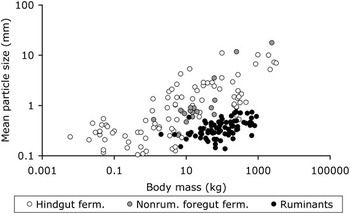
Nevertheless, foregut fermentation is usually considered superior to hindgut fermentation, based on observations on digestive efficiency in domestic herbivores, on species diversity today and in the recent fossil record (Moir, Reference Moir1968), or predictions by gut models (Alexander, Reference Alexander1993). However, this view often equates ‘foregut fermenters’ with ‘ruminant’ – either subconsciously, or consciously as stated by Janis (Reference Janis1976): ‘I will use ‘ruminant’ to designate any animal that ferments cellulose in its forestomach.’ Such an approach ignores two facts: (i) when compared with ruminants, non-ruminant foregut fermenters do not appear as successful in terms of species diversity (Langer, Reference Langer1991, Reference Langer1994). An exception is the macropodid marsupials on the Australian continent (Cardillo et al., Reference Cardillo, Huxtable and Bromhan2003), which is a special case because of its low-primary productivity (Milewski and Diamond, Reference Milewski and Diamond2000), and historical lack of eutherian competitors and (ii) ruminants have evolved the peculiar adaptation of rumination, which sets them apart from other foregut fermenters (Fritz et al., Reference Fritz, Hummel, Kienzle, Arnold, Nunn and Clauss2009; Schwarm et al., Reference Schwarm, Ortmann, Wolf, Streich and Clauss2009a; Figure 1). Equating ruminants and non-ruminant foregut fermenters denies the relevance of this adaptation.
Mean particle size of faeces in mammalian hindgut fermenters, nonruminant foregut fermenters and ruminants of varying body size (Fritz et al., Reference Fritz, Hummel, Kienzle, Arnold, Nunn and Clauss2009); note that ruminants produce finer faecal particles than other herbivores of comparable body size.

To explore the role of the different digestive strategies, we base our approach on the supposition that species evolve to maximise energy intake. Higher energy intake should allow a higher level of metabolism, which has certain competitive advantages (McNab, Reference McNab2006). Higher energy intake can be achieved by increasing food intake, and/or by increasing digestive efficiency. Digestive efficiency is mainly determined by food quality, by ingesta retention time and ingesta particle size (Hume, Reference Hume2005). Ingesta retention and particle size can actually compensate for each other (Clauss et al., Reference Clauss, Nunn, Fritz and Hummel2009b), with longer retention and smaller particles enhancing digestive efficiency. Ingesta retention can be described as a function of gut capacity (Langer and Snipes, Reference Langer and Snipes1991) and of food intake (Clauss et al., Reference Clauss, Schwarm, Ortmann, Streich and Hummel2007b). Increasing food intake may mean less time for selecting high-quality food, less time for mastication (leading to larger particle size) and shorter ingesta retention. However, animals differ in the extent to which food intake levels influence ingesta retention (Clauss et al., Reference Clauss, Streich, Schwarm, Ortmann and Hummel2007c). This trade-off between food intake and digestive efficiency means that animals rarely optimise digestive efficiency, but seek to maximise net energy gain by a compromise between these two factors (Hume, Reference Hume2005).
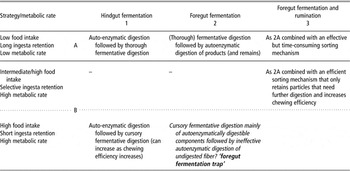
The difference between hindgut and foregut fermentation is often summarised in the literature by a low-intake, high-efficiency strategy in ruminants as opposed to a high-intake, low-efficiency strategy in equids (e.g. Janis, Reference Janis1976). Actually, it appears more plausible to characterise the digestion types in a different way (Table 1; Clauss et al., Reference Clauss, Streich, Nunn, Ortmann, Hohmann, Schwarm and Hummel2008d), based on the prerequisites that (i) fermentative digestion of fibre requires more time than fermentative digestion of easily digestible substrates and (ii) that auto-enzymatic digestion of easily digestible substrates is energetically more efficient than fermentative digestion of these substrates: hindgut fermenters can pursue both strategies, either high-intake/low-efficiency or low-intake/high-efficiency, because auto-enzymatic digestion will always be efficient and subsequent fermentative digestion can be either thorough or cursory. Non-ruminant foregut fermenters, however, cannot adopt the high-intake/low-efficiency strategy, because they lose the easily digestible nutrients to the foregut microflora but would not achieve thorough fibre fermentation, having only the disadvantages of both ways. The only way to avoid this problem would be through a ‘bypass’ of the foregut fermentation system by easily digestible nutrients. Although such bypass has been proposed to occur not only in suckling but also in adult ruminant and non-ruminant foregut fermenters, current experimental evidence does not support this concept (reviewed in Lechner et al., Reference Lechner, Barboza, Collins, Günther, Hattendorf, Hummel and Clauss2009): the excretion of orally ingested fluid markers is not different from particles in foregut fermenting primates, or from fluid markers inserted into the rumen in ruminants.
Concept of differences in metabolic options available to herbivores of different digestive strategies (adapted from Clauss et al., Reference Clauss, Schwarm, Ortmann and Hummel2008b and Reference Clauss, Streich, Nunn, Ortmann, Hohmann, Schwarm and Hummel2008d)

Examples: 1A koala (Phascolarctos cinereus); 1B equids; 2A hippo (Hippopotamus amphibius); 2B none; 3A camelids; 3B true ruminants.
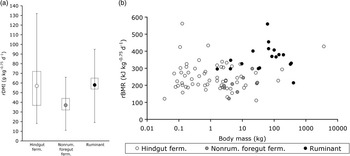
We term this particular predicament – the limitation of a conventional foregut to a low-intake/high-efficiency strategy – the ‘foregut fermentation trap’ and hypothesise that it represents a major constraint for the evolutionary success of non-ruminant foregut fermentation, limiting this strategy to herbivores with relatively low metabolic rates (Clauss et al., Reference Clauss, Schwarm, Ortmann and Hummel2008b). Although this hypothesis remains to be tested, available data suggest that whereas hindgut fermenters display a large range of food intakes and metabolic rates, non-ruminant foregut fermenters are limited to low intakes and low metabolic rates (Figure 2). Consistent with this view, the only geographic region where a large species radiation of non-ruminant foregut fermenters is documented, Australia, is generally marked by low-primary productivity and a mammal population (the marsupials) that is characterised by relatively low metabolic rates (McNab, Reference McNab2008). In non-ruminant foregut fermenters, particle retention in the foregut is indiscriminate (Schwarm et al., Reference Schwarm, Ortmann, Wolf, Streich and Clauss2008, Reference Schwarm, Ortmann, Wolf, Streich and Clauss2009b), meaning that particles are retained irrespective of their size and digestion status. In contrast, the sorting mechanism in the forestomach of ruminants selectively retains those particles that can be further digested but expels those that already are – thus conceptually allowing a higher intake in ruminants than in non-ruminant foregut fermenters (Clauss et al., Reference Clauss, Schwarm, Ortmann, Streich and Hummel2007b; Schwarm et al., Reference Schwarm, Ortmann, Wolf, Streich and Clauss2009a; Figure 2a). Additionally, this sorting mechanism represents the most efficient mechanism by which mammals can increase their chewing efficiency in terms of ingesta particle size (Fritz et al., Reference Fritz, Hummel, Kienzle, Arnold, Nunn and Clauss2009). Distal to the forestomach, ingesta particle size is lower in ruminants than in other mammals of comparable size (Figure 1). It is tempting to speculate that a basic difference in the sorting mechanism between camelids (with the little-understood retention of large particles in the third forestomach compartment, Lechner-Doll and von Engelhardt, Reference Lechner-Doll and von Engelhardt1989) and ruminants prevents the former from achieving the high food intakes, metabolic rates (Van Saun, Reference Van Saun2006; Maloiy et al., Reference Maloiy, Rugangazi and Rowe2009), species diversity and geographic distribution of the ruminants. Until the particle flow in the camelid forestomach is characterised in more detail, this must remain speculative. To conclude, it is most likely not foregut fermentation per se, but its combination with an ingesta sorting and comminution mechanism, that represents the most successful adaptation to herbivory, which is reflected in the high species diversity of ruminants as we know them today.
(a) Differences in relative dry matter intake (rDMI, per unit metabolic body weight; means, ranges and 25% to 75% percentile) between hindgut fermenters (n = 49 species), nonruminant foregut fermenters (n = 19) and ruminants (n = 25) (data from Clauss et al., Reference Clauss, Schwarm, Ortmann, Streich and Hummel2007b). When tested by one-way ANOVA (P = 0.001) and post-hoc tests with Sidak adjustment, differences between nonruminant foregut fermenters and both hindgut fermenters (P = 0.002) and ruminants (P = 0.004) were significant, but not between hindgut fermenters and ruminants (P = 0.997). (b) Variation of relative basal metabolic rate (rBMR, per unit metabolic body weight) in mammalian herbivores (species selected from the collation of Savage et al., Reference Savage, Gillooly, Woodruff, West, Allen, Enquist and Brown2004; see White and Seymour, Reference White and Seymour2005 on the problem of measuring BMR in large herbivores). Note the generally higher range of rBMR measured in ruminants as compared with nonruminant foregut fermenters and the large range of rBMR measured in hindgut fermenters.

However, the presumed selective advantage of the ruminant sorting mechanism comes at a price. The ruminant sorting mechanism depends largely on particle density (Lechner-Doll et al., Reference Lechner-Doll, Kaske and von Engelhardt1991). Because this mechanism depends on the interplay between the position of certain ruminant anatomical features and gravity, ruminants cannot rest lying on their side – as do horses, rhinoceroses, or elephants – but must always keep their forestomach in the vertical plane by standing up or resting in sternal recumbency (Clauss, Reference Clauss2004). Also, when comparing measurements of methane emission in ruminants against the few available measurements in non-ruminating foregut fermenters (Kempton et al., Reference Kempton, Murray and Leng1976; von Engelhardt et al., Reference von Engelhardt, Wolter, Lawrenz and Hemsley1978; Dellow et al., Reference Dellow, Hume, Clarke and Bauchop1988) or equids (Pagan and Hintz, Reference Pagan and Hintz1986; Vermorel et al., Reference Vermorel, Martin-Rosset and Vernet1997), it seems that energetic losses due to methane production represent another cost associated with ruminant digestive physiology – although the causes remain to be explored.
Comparative studies on ruminants
Seasonality
Like other animals, ruminants are subjected to seasonal rhythms of body mass gain or loss, food intake (Barry et al., Reference Barry, Suttie, Milne and Kay1991; Rhind et al., Reference Rhind, Archer and Adam2002), energy expenditure and metabolism (Mauget et al., Reference Mauget, Mauget and Sempéré1997; Arnold et al., Reference Arnold, Ruf, Reimoser, Tataruch, Onderscheka and Schober2004) and reproduction (Asher et al., Reference Asher, Monfort and Wemmer1999; Santiago-Moreno et al., Reference Santiago-Moreno, Gómez-Brunet, Toledano-Díaz, Picazo, Gonzalez-Bulnes and López-Sebastián2006). Two major mechanisms for this seasonality are recognised: the availability of resources (resource-induced seasonality) and hormonal control triggered by photoperiod (endogenous seasonality) (Loudon, Reference Loudon1991). High-latitude habitats have a reliable and predictable seasonal rhythm of resource availability, and it is adaptive to regulate physiology in synchrony with this rhythm. More tropical habitats may also experience fluctuations in resource availability, but the predictability of this fluctuation might not be high enough to make an endogenous synchronization adaptive. Alternatively, the partial or complete absence of photoperiodicity in the tropics might have prevented the evolution of endogenous rhythms.
An easy way to identify the seasonality type of a species is to evaluate breeding records of captive animals (Kirkwood et al., Reference Kirkwood, Gaskin and Markham1987; Piening et al., Reference Piening, Hammer, Clauss and Hammer2009). Cervidae (deer), Caprinae (sheep, goats and relatives) or muskoxen have an endogenous seasonality that persists even when offered food and shelter ad libitum in captivity (under natural photoperiodicity). Other ruminants, such as cattle, antelope, and giraffe, have resource-induced rhythms that do not persist in the presence of ad libitum resources in captivity. The same pattern is observed in domestic ruminants: seasonal physiological or reproductive patterns are much less pronounced in cattle than in sheep and goats. In general, the expression of seasonal patterns is considered less pronounced in domestic than in wild ruminants (Rhind et al., Reference Rhind, Archer and Adam2002).
Interrelationships between photoperiod and nutritional state have long been suspected and have been demonstrated by experiments in which photoperiod and dietary resources were uncoupled (Heydon et al., Reference Heydon, Sibbald, Milne, Brinklow and Loudon1993; Webster et al., Reference Webster, Corson, Littlejohn, Martin and Suttie2001; Soppela et al., Reference Soppela, Saarela, Heiskari and Nieminen2008). In particular, leptin would appear a suitable modulator of food intake and animal metabolism. Leptin normally reflects body fat levels (Suzuki et al., Reference Suzuki, Yokoyama, Onuma, Takahashi, Yamanaka, Okada, Ichimura and Ohtaishi2004; Becker and Katz, Reference Becker and Katz2005; Chilliard et al., Reference Chilliard, Delavaud and Bonnet2005; Ostrowski et al., Reference Ostrowski, Williams, Mésochina and Sauerwein2006), but is modified by photoperiod and sex hormones (Chilliard et al., Reference Chilliard, Delavaud and Bonnet2005; Gaspar-López et al., Reference Gaspar-López, Casabiell, Estevez, Landete-Castillejos, De La Cruz, Gallego and García2009); yet, exact pathways remain to be elucidated. High levels of circulating leptin have been shown to reduce food intake and increase energy expenditure, and low levels to enhance food intake and decrease energy expenditure (Chilliard et al., Reference Chilliard, Delavaud and Bonnet2005). It would, therefore, appear logical that seasonal modulation of leptin (through melatonin) should lead to a suppression of leptin levels during summer, to reduce the putative intake-depressive effect of leptinemia and to allow the animal to increase its body fat stores beyond a maintenance level. For the winter season, reductions in both activity (including foraging) and energy expenditure should be beneficial, but it appears that leptin alone cannot explain these two effects. The facts that long day periods do not lead to a decrease in leptin levels, yet food intake and fat accretion are nevertheless not limited during this period, and that short day periods lead to a marked decrease in leptin levels irrespective of food intake or nutritional status (Chilliard and Bocquier, Reference Chilliard and Bocquier2000; Soppela et al., Reference Soppela, Saarela, Heiskari and Nieminen2008), indicate that other factors must be involved in the regulation of food intake and animal metabolic rate. Comparative (multi-species) studies of the interaction of leptin, photoperiod/melatonin, dietary resources and other mediators, especially between species of different seasonality type, are needed.
Heat and drought
A large body of research has investigated adaptations of ruminants and other animals to heat and drought (Silanikove, Reference Silanikove1994; Cain et al., Reference Cain, Krausman, Rosenstock and Turner2006). Apart from behavioural adaptations to reduce heat load and to increase water uptake, desert-adapted ruminants have particularly long distal colons (Woodall and Skinner, Reference Woodall and Skinner1993) and produce very dry faeces (Clauss et al., Reference Clauss, Lechner-Doll and Streich2004). They also probably have longer loops of Henlé or a thicker renal medulla (e.g. Horst and Langworthy, Reference Horst and Langworthy1971; Dunson, Reference Dunson1974) and produce less and more concentrated urine (Maloiy et al., Reference Maloiy, Macfarlane and Shkolnik1979; Beuchat, Reference Beuchat1990). Desert species generally show a lower field metabolic rate and a lower water turnover (Cain et al., Reference Cain, Krausman, Rosenstock and Turner2006). Larger horns in bovid species from arid areas, with thinner keratin sheaths than in temperate species, facilitate heat loss (Picard et al., Reference Picard, Thomas, Festa-Bianchet, Belleville and Laneville1999).
The rumen has been considered a water reservoir in desert ruminants (Silanikove, Reference Silanikove1994). Water ingestion during rehydration does not lead to an increased rumen fluid outflow, in contrast to the ingestion of isotonic fluid (Shkolnik et al., Reference Shkolnik, Maltz and Chosniak1980). Particularly long fluid retention times in the rumen of desert ruminants may support the water reservoir function (Hummel et al., Reference Hummel, Steuer, Südekum, Hammer, Hammer, Streich and Clauss2008a). Whether ingested drinking water is actively retained in the rumen in rehydration, or whether fluid absorption across the rumen wall and rapid recycling through saliva (Silanikove, Reference Silanikove1994) prevents (non-absorbable) fluid markers from leaving the rumen, remains to be investigated.
Perhaps the most controversial concept of heat adaptation in ruminants is a putative heterothermy that allows an increase in body temperature to minimise evaporative water loss. First proposed for ruminants by Taylor (Reference Taylor1969), this concept has become textbook knowledge (Jessen, Reference Jessen2001), yet has been criticised for deriving from spurious results caused by unnatural husbandry of experimental animals (e.g. Fuller et al., Reference Fuller, Maloney, Mitchell and Mitchell2004). Experimental data from free-ranging animals gained by remote-sensing temperature measurements have yielded conflicting evidence (Ostrowski et al., Reference Ostrowski, Williams and Ismael2003; Fuller et al., Reference Fuller, Maloney, Mitchell and Mitchell2004; Ostrowski and Williams, Reference Ostrowski and Williams2006). Either heterothermy does occur but might do so less frequently than previously thought, or many of the recent studies might have been limited by a lack of extreme environmental conditions.
Nutritional niche
Natural forages: grass, browse and fruits
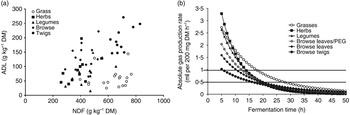
Wild ruminant diets include grasses, browse (forbs/herbs, leaves and twigs of woody plants) and wild fruits. In contrast to a common preconception of browsing animals as ‘concentrate selectors’ (see below), grasses are not generally less digestible than browse (reviewed in Clauss et al., Reference Clauss, Kaiser and Hummel2008a). Grasses are peculiar in that they appear to deviate from the common pattern found in other forages of increasing lignin with increasing cell wall content (Figure 3a); the fibre component of grasses contains particularly high percentages of hemicellulose and cellulose. Browse typically has a higher lignin content but also contains rapidly fermentable fibre such as pectins. As a result, grass has fundamentally different fermentation characteristics than browse (Hummel et al., Reference Hummel, Südekum, Streich and Clauss2006a), with a slower fermentation rate but potentially higher total digestibility, which means that grass can profitably be retained in the fermentation chamber longer than browse (Figure 3b). As a defense against herbivory, browse often contains PSMs that require neutralization/detoxification by the consumer. On the other hand, grasses contain abrasive phytoliths (silica) that require more durable (higher-crowned or hypsodont) teeth. Although the kinetics of digestion-induced density changes of forage particles remain to be investigated systematically between forages, rumen contents of grazing or browsing ruminants are similar in that they separate according to particle size by their functional density (Figure 4) – thus all meeting the prerequisite for the reticulo-rumen (RR) separation mechanism (Sutherland, Reference Sutherland1988; Baumont and Deswysen, Reference Baumont and Deswysen1991; Lechner-Doll et al., Reference Lechner-Doll, Kaske and von Engelhardt1991). Masticatory adaptations in ruminants suggest that grasses are physically more demanding to chew than browse (Archer and Sanson, Reference Archer and Sanson2002; Clauss et al., Reference Clauss, Hofmann, Streich, Fickel and Hummel2008c; Kaiser et al., Reference Kaiser, Fickel, Streich, Hummel and Clauss2010), but systematic comparative investigations on forages are lacking. It is commonly assumed that wild fruits represent particularly high-quality food; however, wild fruits have little in common with produce cultivated for human consumption (Schwitzer et al., Reference Schwitzer, Polowinsky and Solman2009) and contain more fibre than usually thought; their fermentative and physical characteristics remain to be investigated.
(a) Relationship between cell wall (NDF) and lignin (ADL) content in different forages; note the low proportion of lignin in grasses. (b) Comparative decrease of absolute gas production rate (ml gas/(200 mg dry matter (DM)×hour)) in different forage classes (PEG = polyethylene glycol); note the slower decrease in grass (from Hummel et al., Reference Hummel, Südekum, Streich and Clauss2006a).

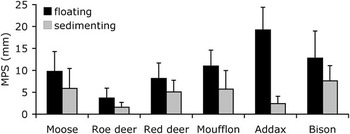
Mean particle size (MPS) of floating and sedimenting fraction of rumen contents in free-ranging or naturally fed wild ruminants. Note that sedimenting particles are always smaller than floating ones (from Clauss et al., Reference Clauss, Fritz, Bayer, Hummel, Streich, Südekum and Hatt2009d, Reference Clauss, Fritz, Bayer, Nygren, Hammer, Hatt, Südekum and Hummel2009e).

Historical note: the browser-grazer concept
Differences in the anatomy of the digestive tract between ruminant species have been known for a long time (e.g. Garrod, Reference Garrod1877; Neuville and Derscheid, Reference Neuville and Derscheid1929). They were investigated systematically by Hofmann (Reference Hofmann1973, Reference Hofmann1988, Reference Hofmann1989) who observed that these differences corresponded to differences in natural diet. Three major feeding types were defined (grazers – animals consuming grass; browsers – animals consuming tree leaves and twigs as well as herbs/forbs; intermediate feeders – animals consuming a mixture of grass and browse on a continuous basis or changing seasonally between the two) that are characterised by morphological differences (see below). Additionally, a series of physiological hypotheses, for example regarding fibre digestibility or ingesta retention, were formulated. Other authors reported similar observations (Kay et al., Reference Kay, von Engelhardt and White1980; Kay, Reference Kay1989), the browser-grazer dichotomy has been used by researchers worldwide (reviewed in Clauss et al., Reference Clauss, Kaiser and Hummel2008a) and incorporated into textbooks (Robbins, Reference Robbins1993; Van Soest, Reference Van Soest1994; Karasov and Martínez del Rio, Reference Karasov and Martínez del Rio2007). However, the concept has been criticised, mainly because the original work included more photographic material than original data, hardly any statistical data evaluation, and because physiological hypotheses remained untested (Gordon and Illius, Reference Gordon and Illius1994; Robbins et al., Reference Robbins, Spalinger and Van Hoven1995; Pérez-Barberìa et al., Reference Pérez-Barberìa, Gordon and Illius2001a). Nonetheless experiences in the husbandry of wild ruminants in zoological collections support the concept that major differences exist in the digestive strategy of browsers and grazers, because browsing ruminants are notoriously difficult to feed in captivity (see below). Also, a large number of Hofmann’s original observations and hypotheses have been corroborated in recent studies, leading to a more refined concept of comparative ruminant digestive physiology (see below).
Precautionary note: nomenclature reflects concepts
The terminology used in the classification of ruminant ‘feeding types’ must be defined. The selection of the natural diet of herbivores can be described in botanical terms (browser/grazer) or in terms of diet quality (selective/unselective). Although the degree of selectivity usually declines with body mass of a species (i.e. larger species often consume food of higher fibre content, Owen-Smith, Reference Owen-Smith1988; Codron et al., Reference Codron, Lee-Thorp, Sponheimer, Codron, de Ruiter and Brink2007), there is no similar body size gradient in terms of the botanical composition of the diet (Clauss et al., Reference Clauss, Kaiser and Hummel2008a).
The initial concept proposed by Hofmann (Reference Hofmann1973 and Reference Hofmann1989) used the term ‘concentrate selector’ as a description of browsing ruminants, thus equating botanical and nutritive characteristics of the natural diet – an equation which is not supported by empirical data (Robbins, Reference Robbins1993; Clauss et al., Reference Clauss, Kaiser and Hummel2008a). One effect of the amalgamation of botanical composition and nutritive quality probably is that nowadays, even the lay community equates a ‘browser’ with a highly selective animal choosing only high-quality material – no one would think of searching the internet with a ‘web-grazer’. Another effect is that, in zoo settings, feeding regimes are often difficult to change because it does not appear logical to reduce the amount of ‘concentrates’ given to a ‘concentrate selector’. Hence the term is best avoided. Concepts that treat both botanical and nutritive aspects in an integrated way have been developed (Demment and Longhurst, Reference Demment and Longhurst1987) and can explain evolutionary adaptations at finer levels than the botanical approach alone (Codron et al., Reference Codron, Brink, Rossouw, Clauss, Codron, Lee-Thorp and Sponheimer2008b). When appropriate, the terms ‘selective/unselective browser/grazer’ should be applied.
Another conceptual difficulty arises from the fact that in some of the original work, it was unclear what the classification of a ruminant species was based on – on its natural diet, or on morphological adaptations (cf. the legend to Figure 3 in Hofmann, Reference Hofmann1985). Only if the natural diet and the morphophysiological adaptations are clearly separated can we test whether the latter actually represent adaptations to the former. In this respect, it appears problematic to describe a certain set of parameters as a typical ‘grazer anatomy’ or ‘grazer physiology’ because these anatomical/physiological features might also occur in animals that can ingest other forage types. Ideally, the terms ‘grazer/browser’ should be reserved to descriptions of the natural diet, whereas morphophysiological types should be denoted by other terms. In this chapter we will use the terms ‘moose-type’ (for a typical ‘browser’) and ‘cattle-type’ (for the most advanced ‘grazer’).
Ruminant forestomach physiology: why ‘cattle-type’ ruminants are special?
Although, it is usually thought that intermediate feeders and grazers evolved from browsing ruminants (Hofmann, Reference Hofmann1989; Pérez-Barberìa et al., Reference Pérez-Barberìa, Gordon and Nores2001b), recent evidence suggests that both strict browsers and strict grazers evolved from intermediate-type ruminants (Codron et al., Reference Codron, Brink, Rossouw and Clauss2008a; DeMiguel et al., Reference DeMiguel, Fortelius, Azanza and Morales2008). In this respect, we consider the ‘moose-type’ and the ‘cattle-type’ both as extremes of a range of extant ruminant digestion types.
Because grass ferments more slowly than browse, grazers probably have longer particle retention times (Hummel et al., Reference Hummel, Südekum, Streich and Clauss2006a; Clauss et al., Reference Clauss, Schwarm, Ortmann, Streich and Hummel2007b), but they also have more voluminous forestomachs, which avoids a constraint on food intake (Clauss et al., Reference Clauss, Lechner-Doll and Streich2003b). In ‘cattle-type’ ruminants, this forestomach capacity increase may have led to a space competition with other organs of the body cavity, such as the lungs or the distal colon, leading to compensatory high respiratory rates (Mortolaa and Lanthier, Reference Mortolaa and Lanthier2005) and moist faeces of a ‘pie’ consistency (Clauss et al., Reference Clauss, Frey, Kiefer, Lechner-Doll, Loehlein, Polster, Rössner and Streich2003c).
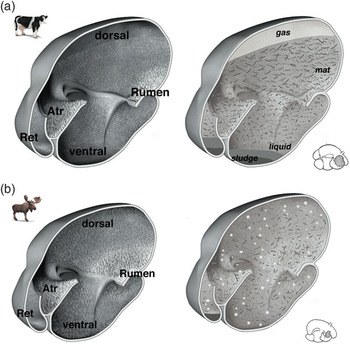
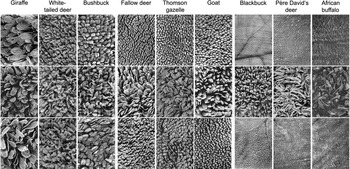
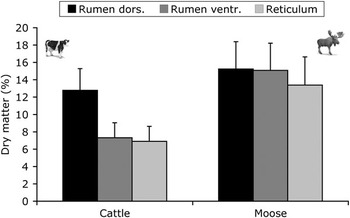
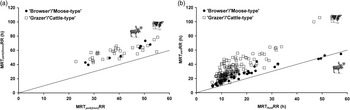
The stratification of rumen contents (Figure 5a) is well-described in domestic (‘cattle-type’) ruminants (cf. Hummel et al., Reference Hummel, Südekum, Bayer, Ortmann, Hatt, Streich and Clauss2009). It is considered responsible for the regional differences in papillation of the ruminal mucosa (Figure 6, right side) and recognised as part of the selective particle retention mechanism (the ‘filter bed-effect’, Faichney, Reference Faichney2006). The stronger rumen pillars of ‘cattle-type’ ruminants (Clauss et al., Reference Clauss, Lechner-Doll and Streich2003b) are considered adaptations for contracting against a distinct fibre mat. In contrast, the rumen contents of more ‘moose-type’ ruminants are much less stratified or not at all (Figure 5b): Such ruminants have an even ruminal papillation (Clauss et al., Reference Clauss, Hofmann, Fickel, Streich and Hummel2009c; Figure 6 left side), no distinct gas dome (Tschuor and Clauss, Reference Tschuor and Clauss2008), weaker rumen pillars, more viscous rumen fluid (Clauss et al., Reference Clauss, Fritz, Bayer, Hummel, Streich, Südekum and Hatt2009d; Clauss et al., Reference Clauss, Fritz, Bayer, Nygren, Hammer, Hatt, Südekum and Hummel2009e), and a less distinct difference between fluid present in the dorsal and the ventral rumen (Figure 7). The higher fluid viscosity, and the ensuing inclusion of gas bubbles in the fluid in ‘moose-type’ ruminants (Figure 5b) lead to a typical ‘frothy’ appearance of the ingesta (Clauss et al., Reference Clauss, Lechner-Doll, Behrend, Lason, Lang and Streich2001), and might also lead to a higher buffering capacity of the ingesta (because of CO2 inclusion), which might require a thicker layer of the acid-producing abomasal mucosa (Hofmann, Reference Hofmann1988). It was previously thought that the lack of stratification resulted in less efficient particle separation, leading to larger faecal particles in browsing than in grazing ruminants kept in zoos (Clauss et al., Reference Clauss, Lechner-Doll and Streich2002). More recent results have shown that such differences do not occur if species are measured on their natural diets (Hummel et al., Reference Hummel, Fritz, Kienzle, Medici, Lang, Zimmermann, Streich and Clauss2008b; Lechner et al., Reference Lechner, Barboza, Collins, Fritz, Günther, Hattendorf, Hummel, Südekum and Clauss2010). Correspondingly, no difference in particle discrimination (mean retention of large vs. small particles in the RR) was evident between ‘moose-type’ and ‘cattle-type’ ruminants (Figure 8a). These results lead to the conclusion that stratification of RR contents is not an obligatory prerequisite for the particle sorting mechanism and raises questions about the adaptive relevance of RR contents stratification.
Schemes of the ruminal mucosa and rumen contents in (a) ‘cattle-type’ and (b) ‘moose-type’ ruminants (modified by Jeanne Peter from Clauss et al., Reference Clauss, Lechner-Doll and Streich2003b; Tschuor and Clauss, Reference Tschuor and Clauss2008; Hummel et al., Reference Hummel, Südekum, Bayer, Ortmann, Hatt, Streich and Clauss2009; inserts on omasum size from Hofmann, Reference Hofmann1973). The dorsal and ventral rumen, the Atrium ruminis (Atr) and the reticulum (Ret) are indicated. Note a distinct gas dome in ‘cattle-type’ in contrast to a frothy inclusion of small gas bubbles in ‘moose-type’, a distinct fibre mat and fluid pool in ‘cattle-type’ and the relatively larger omasum in ‘cattle-type’ ruminants.

Samples of mucosa from the dorsal rumen (top set), the atrium ruminis (middle set) and the ventral rumen (bottom set) of nine ruminant species. Note that while the atrium ruminis is always heavily papillated, papillation of the dorsal and ventral wall appears to decrease from the browsing species (left) to the intermediate feeders (centre) and the grazers (right) (from Clauss et al., Reference Clauss, Hofmann, Fickel, Streich and Hummel2009c).

Dry matter concentration in dorsal and ventral rumen and reticular contents in cattle and moose (data from Clauss et al., Reference Clauss, Fritz, Bayer, Nygren, Hammer, Hatt, Südekum and Hummel2009e; Hummel et al., Reference Hummel, Südekum, Bayer, Ortmann, Hatt, Streich and Clauss2009). Note the gradient between dorsal and ventral rumen and the similarity between ventral rumen and reticulum in cattle and the homogeneity in the rumen contents of moose with a higher fluid content in the reticulum only.

Relationship of mean retention time (MRT) in the reticulorumen (RR) of individual ruminant animals of two different ‘rumen physiology types’ for (a) small particles (2 mm) and large particles (20 mm) as measured by chromium and rare earth-mordanted fibre (data for the ‘browser’ moose and for the ‘grazers’ cattle, muskox, sheep from Lechner et al., Reference Lechner, Barboza, Collins, Fritz, Günther, Hattendorf, Hummel, Südekum and Clauss2010 and from M. Lechner-Doll, personal communication). (b) Fluid and small particles (2 mm) as measured by cobalt-EDTA and chromium-mordanted fibre (data for the ‘browsers’ moose, giraffe, okapi, roe deer and for the ‘grazers’ cattle, banteng, addax, muskox, sheep, mouflon from Clauss et al., Reference Clauss, Hummel and Streich2006a; Hummel et al., Reference Hummel, Steuer, Südekum, Hammer, Hammer, Streich and Clauss2008a; Schwarm et al., Reference Schwarm, Ortmann, Wolf, Streich and Clauss2008; Lechner et al., Reference Lechner, Barboza, Collins, Fritz, Günther, Hattendorf, Hummel, Südekum and Clauss2010). Solid lines denote y = x.

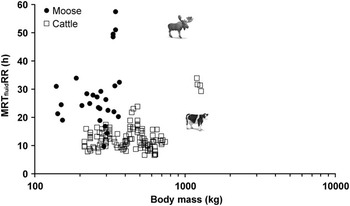
The most obvious physiological difference between the ruminant digestion types is the difference in the ratio of small particle v. fluid retention in the RR (Clauss and Lechner-Doll, Reference Clauss and Lechner-Doll2001; Hummel et al., Reference Hummel, Clauss, Zimmermann, Johanson, Norgaard and Pfeffer2005; Clauss et al., Reference Clauss, Hummel and Streich2006a; Figure 8b). Higher ratios in ‘cattle-type’ ruminants are not only an effect of longer particle retention, but also of a relatively shorter fluid retention (Figure 9). Moister RR contents and higher fluid throughput are possibly compensated by the larger fluid-absorbing omasum of ‘cattle-type’ ruminants (Clauss et al., Reference Clauss, Hofmann, Hummel, Adamczewski, Nygren, Pitra, Streich and Reese2006b; Figure 5) that ensures that ingesta flowing to the abomasum is not unduly diluted. Higher reticular crests in ‘cattle-type’ ruminants possibly allow complete lumen closure of the reticulum during contractions, which can quickly refill with material from the ventral rumen. In ‘moose-type’ ruminants with drier ventral rumen contents, refilling of the reticulum would be more difficult, complete lumen closure of the reticulum might therefore not be advantageous, and hence reticular crests may have been reduced in height (Clauss et al., Reference Clauss, Hofmann, Streich, Fickel and Hummel2010).
Mean retention time (MRT) of fluid in the reticulorumen (RR) of cattle and moose of various body masses (data from Clauss et al., Reference Clauss, Hummel and Streich2006a; Lechner et al., Reference Lechner, Barboza, Collins, Fritz, Günther, Hattendorf, Hummel, Südekum and Clauss2010). Note the generally shorter fluid MRTs in cattle as compared with moose.

Why this difference in fluid content and passage? ‘Moose-type’ ruminants might have evolved a saliva that contains defences against PSMs, is therefore particularly protein-rich and viscous, and requires large salivary glands that still cannot secrete particularly large amounts without compromising the salivary composition (Hofmann et al., Reference Hofmann, Streich, Fickel, Hummel and Clauss2008). ‘Cattle-type’ ruminants might not be constrained by such a requirement, and could evolve to pass large amounts of fluid through their RR. On the one hand, more fluid in the RR would enhance the stratification of rumen contents, with the formation of a fibre mat and the consequent ‘filter-bed effect’ that increases the retention of small particles, thus probably facilitating the higher fibre digestibilities achieved by ‘cattle-type’ ruminants (Pérez-Barberìa et al., Reference Pérez-Barberìa, Elston, Gordon and Illius2004). On the other hand, an increased fluid passage will also potentially lead to increased yields of bacteria from the RR (reviewed e.g. in Harrison and McAllan, Reference Harrison and McAllan1980), increasing the harvest of microbes by flushing them out of the RR, and thus selecting for bacterial strains with high compensatory growth capacity. Although we cannot yet easily quantify the potential profits of these adaptations in ruminants on average forage diets, the evidence for convergent evolution toward such mechanisms suggests that they must be substantial.
Consequences
Dietary niches of wild ruminants and feeding in domestic ruminants
No comprehensive treatment of natural diet selection in all ruminant species exists, but the limited data collections indicate that there is little correlation between botanical diet composition and body mass (Clauss et al., Reference Clauss, Kaiser and Hummel2008a). However, it seems that ‘strict browsers’ – animals with a presumptive ‘moose-type’ physiology – are limited to browse-only diets, whereas a ‘cattle-type’ physiology appears to allow a wider range of dietary niches. In this respect, it has been suggested that ‘browsers’ (i.e. ‘moose-type’ ruminants) can be characterised as ‘non-grazers’, whereas ‘grazers’ (i.e. ‘cattle-type’ ruminants) might add varying proportions of browse to their natural diet of grass (Van Wieren, Reference Van Wieren1996; Clauss et al., Reference Clauss, Lechner-Doll and Streich2003b). Consider, for example, species like muskoxen (Ovibos moschatus), wood bison (Bison bison athabascae), European bison (Bison bonasus), red forest buffalo (Syncerus caffer nanus) and anoa (Bubalus depressicornis), all of which have a ‘cattle-type’ anatomy yet presumably ingest significant amounts of browse in the wild. Similarly, range cattle may also include significant amounts of browse in their diet (Holechek et al., Reference Holechek, Vavra, Skovlin and Krueger1982). This flexibility is used in pasture programs aimed at maintaining botanical species diversity (Rutter, Reference Rutter2006). How the ruminant digestion types are linked to their dietary niches requires more detailed investigation.
It has been shown that the inclusion of tree leaves in the diet of ‘cattle-type’ ruminants increases food intake (and potentially accelerates ingesta passage) (Tomkins et al., Reference Tomkins, McMeniman and Daniel1991; Boyd et al., Reference Boyd, Collins and Urness1996), although quantitative effects, including thresholds, remain to be investigated. In contrast, the inclusion of woody twigs in the diet prolongs retention and reduces food intake (Baker and Hobbs, Reference Baker and Hobbs1987). Although the reasons remain to be elucidated, it can be speculated that this is due to physical and fermentation characteristics of browse. Similar effects are reported in domestic ruminants when legumes or straw are included in their diets (Prigge et al., Reference Prigge, Stuthers and Jacquemet1990; Goodchild and McMeniman, Reference Goodchild and McMeniman1994). Browse (tree leaves and twigs) historically had some relevance in the feeding of domestic ruminants in Central Europe (Nehring and Schütte, Reference Nehring and Schütte1950, Reference Nehring and Schütte1951a, Reference Nehring and Schütte1951b; Nehring, Reference Nehring1965), but the logistic challenges to grow and harvest browse prevent its use in intensive systems. In contrast, the nutritional value of browse in more extensive agricultural systems in the tropics is an area of increasing research (Ben Salem et al., Reference Ben Salem, Priolo and Morand-Fehr2008).
Implications for ruminant welfare
Apart from comparisons of the natural diet of wild ruminants and the artificial diets used in intensive production systems, with their consequences on animal health, animal longevity, and global ecology (Hofmann, Reference Hofmann1989; Knaus, Reference Knaus2009), most welfare-related consequences of the physiological adaptations presented in this review are relevant for zoo animals.
A seasonal nutritional regime, including fattening in summer and body mass loss in winter, has long been recommended in the zoo literature (Lechner-Doll et al., Reference Lechner-Doll, Deutsch and Lang2000). However, such regimes are not in wide use to our knowledge, and their effects on captive wildlife health remain to be investigated.
With respect to temperature physiology, it has been suggested that wild ruminants with obligatory passive heterothermy might be particularly susceptible to cold stress in the temperate zone (Clauss et al., Reference Clauss, Suedmeyer and Flach1999). Yet, so far, physiological and epidemiological evidence for this suspicion is lacking.
Just as ‘moose-type’ ruminants ingest very little grass in the wild, such animals often refuse to ingest grass hay in captivity (Clauss et al., Reference Clauss, Kienzle and Hatt2003a), which might lead to a disproportionately high-intake of concentrates with consequences such as acidosis (Clauss et al., Reference Clauss, Kienzle and Hatt2003a), laminitis (Zenker et al., Reference Zenker, Clauss, Huber and Altenbrunner-Martinek2009), oral stereotypies (Hummel et al., Reference Hummel, Clauss, Baxter, Flach and Johansen2006b) and urolithiasis (Wolfe et al., Reference Wolfe, Sladky and Loomis2000). The physical inadequacy of grass hay for a ‘moose-type’ rumen may lead to bezoars or RR blockage (Hummel and Clauss, Reference Hummel and Clauss2006). Additionally, conventional zoo diets, which contain abrasive silicates either in pelleted feeds or in grass-based forages, result in unnatural tooth wear in browsing ruminants (Clauss et al., Reference Clauss, Franz-Odendaal, Brasch, Castell and Kaiser2007a; Kaiser et al., Reference Kaiser, Brasch, Castell, Schulz and Clauss2008). The problem of providing adequate nutrition for ‘moose-type’ ruminants is finally reflected in their relatively short average life expectancies in captivity (Müller et al., Reference Müller, Bingaman, Streich, Hatt and Clauss2010). Therefore, feeding such ruminants requires strategies to increase fibre content in the compound feeds offered to them (Clauss and Dierenfeld, Reference Clauss and Dierenfeld2008), to replace grain components in such feeds with pectins (Hummel et al., Reference Hummel, Pfeffer, Norgaard, Johanson, Clauss and Nogge2006c), and to ensure continuous provision of browse forage – if necessary by browse plantations (Höllerl et al., Reference Höllerl, Stimm, Hummel and Clauss2006) and browse silage (Hatt and Clauss, Reference Hatt and Clauss2006).
Implications for modern production systems
With respect to the physiology of seasonality, current research activities aim to unveil the underlying mechanisms with the aim of ultimately overcoming the constraints imposed on production systems by the ingrained seasonal rhythms of some domestic ruminants (Chemineau et al., Reference Chemineau, Guillaume, Migaud, Thiéry, Pellicer-Rubio and Malpaux2008).
With respect to adaptations to heat and drought, research focus is on identifying breeds that allow optimal productivity under given conditions (e.g. Alamer and Al-hozab, Reference Alamer and Al-hozab2004).
Because the rumen contents of ‘moose-type’ ruminants (Figure 5b) bear some resemblance to those of cattle suffering from frothy bloat, further inquiries into adaptations of ‘moose-type’ ruminants on RR motility, and how fermentation gases are dealt with, could enhance our understanding of the etiopathology of bloat in cattle.
With respect to the demonstrated evolutionary trajectory of ‘cattle-type’ ruminants for high fluid throughput through the RR, it has long been recognised that increasing RR fluid throughput could enhance the ruminant productivity (Chalupa, Reference Chalupa1977; Croom et al., Reference Croom, Bird, Blacks and McBride1993), mainly because of increased yields of rumen microbes. Different ways of increasing RR fluid throughput have been tested. Infusions of water (or efforts to increase water intake) are ineffective (Harrison and McAllan, Reference Harrison and McAllan1980), because of the homoeostatic mechanism mentioned in the ‘adaptation to heat/drought’ section. However, the infusion of saline solutions or artificial saliva, as well as inclusion of mineral salts in the diet, can be used to increase the RR fluid throughput (Chalupa, Reference Chalupa1977). Offering of saline drinking water leads to an increase in water intake in ruminants (e.g. Kii and Dryden, Reference Kii and Dryden2005; Valtorta et al., Reference Valtorta, Gallardo, Sbodia, Revelli, Arakaki, Leva, Gaggiotti and Tercero2008) that translates into increased RR fluid throughput, but investigations are so far concentrated on the negative effects of saline water rather than on potentially positive effects of isotonic drinking solutions. Pharmacological approaches have been pursued using salivary stimulants and positive effects were demonstrated such as increased bacterial protein outflow from the RR (Wiedmeier et al., Reference Wiedmeier, Arambel and Walters1987; Froetschel et al., Reference Froetschel, Amos, Evans, Croom and Hagler1989; Bird et al., Reference Bird, Croom, Bailey, O’Sullivan, Hagler, Gordon and Martin1993). However, pharmacological solutions appear less attractive than selective breeding for certain traits. Given that frothy bloat in cattle is linked to low-saliva production (Mendel and Boda, Reference Mendel and Boda1961; Gurnsey et al., Reference Guernsey, Jones and Reid1980) and long fluid retention in the RR (Majak et al., Reference Majak, Hall, Rode and Kalnin1986; Okine et al., Reference Okine, Mathison and Hardin1989), and that selective breeding against bloat susceptibility can be successful (Morris et al., Reference Morris, Cullen and Geertsema1997), selective breeding for increased saliva production and hence increased RR fluid throughput should be attempted. Cattle with higher salivary flow rates would also appear desirable in terms of their capacity to buffer high-energy rations used in modern production systems. Consistent selection criteria could be followed under standardised conditions in animals with flow probe implants (Meot et al., Reference Meot, Cirio and Biovin1997). Whether measurable improvements are possible under modern production systems, so that breeding programs that continue the evolutionary trajectory of ‘cattle-type’ ruminants become an attractive strategy, and whether it would have other effects, for example on methane production, remains to be demonstrated.
Acknowledgements
The core of this review is based on studies funded by the Swiss National Fund (3100A0-115958/1), the German Reseach Foundation (CL 182/3-1 and 3-2, OR 86/1-1), the German Wildlife Foundation (Deutsche Wildtierstiftung e.V.), and the contribution of D. Bayer, J. Fritz, I. Lechner, and A. Schwarm to these projects is gratefully acknowledged. M. Clauss dedicates his contribution to M. Lechner-Doll, who introduced him to ruminant digestive physiology, and thanks A. Hug and J. Peter for their support in graphical design and B. Schneider and J. Wick for their support in literature acquisition. The authors would also like to thank the reviewers whose comments helped in improving the manuscript.