


1. Introduction
The Cambrian rocks of the Grand Canyon, known collectively as the Tonto Group (Powell, Reference Powell1876; Walcott, Reference Walcott1895; Figure 1), record dramatic faunal diversification, abrupt extinctions and large-magnitude carbon cycle perturbations, characteristics of the middle and late Cambrian Earth system (Corsetti and Kaufman, Reference Corsetti and Kaufman1994; Knoll and Carroll, Reference Knoll and Carroll1999; Maloof et al. Reference Maloof, Schrag, Crowley and Bowring2005; Babcock et al. Reference Babcock, Peng, Brett, Zhu, Ahlberg, Bevis and Robison2015). These biological and environmental events coincide with the Sauk transgressions, repeated dramatic sea-level fluctuations preserved in clastic sedimentary sequences globally of this age (Sloss, Reference Sloss1963; Palmer, Reference Palmer1981). The Tonto Group has been cited as an archetypal example of a gradual marine transgression (McKee, Reference McKee1945), thought to represent tens of millions of years of continuous sea-level rise (Levy and Christie-Blick, Reference Levy and Christie-Blick1991). However, modern sedimentologic, chemostratigraphic and biostratigraphic syntheses have revealed more diverse depositional environments (Rose, Reference Rose2006; Rowland et al. Reference Rowland, Korolev, Hagadorn and Ghosh2023), dynamic base-level fluctuations (Rose, Reference Rose, Hollingsworth, Sundberg and Foster2011) and significant depositional hiatuses (Dehler et al. Reference Dehler, Sundberg, Karlstrom, Crossey, Schmitz, Rowland and Hagadorn2024; Sundberg et al. Reference Sundberg, Foster, Webster, Miller and Hagadorn2026) within the Tonto Group. Recent high-precision U-Pb detrital zircon geochronology constraining the basal Tapeats Sandstone of the Tonto Group to ≤508 Ma has also compressed its depositional history (Karlstrom et al. 2018, Reference Karlstrom, Mohr, Schmitz, Sundberg, Rowland, Blakely, Foster, Crossey, Dehler and Hagadorn2020). These emerging details raise questions regarding the relevant importance of epeirogenic versus eustatic drivers of transgression of sea level across the cratonic margin (Bond et al. Reference Bond, Kominz, Steckler, Grotzinger, Crevello, Wilson, Sarg and Read1989; Levy and Christie-Blick, Reference Levy and Christie-Blick1991; Landing et al, Reference Landing, Amati and Franzi2009; Tasistro-Hart and Macdonald, Reference Tasistro-Hart and Macdonald2023; Dehler et al. Reference Dehler, Sundberg, Karlstrom, Crossey, Schmitz, Rowland and Hagadorn2024).
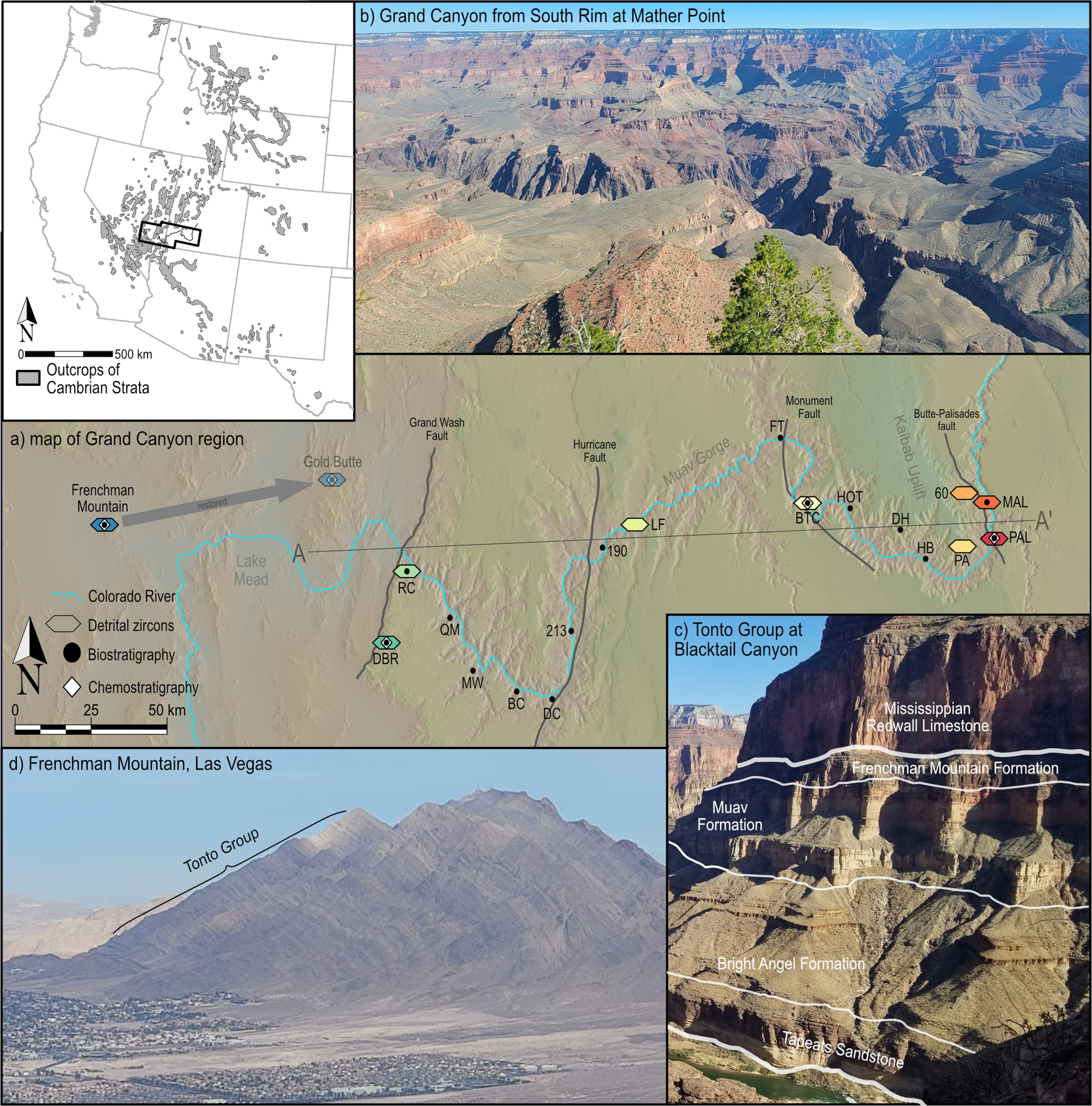
(a) Map of Grand Canyon, AZ, and Frenchman Mountain, NV region, showing the locations of measured sections, chemostratigraphic and detrital zircon sampling. From west to east the measured sections are: DBR – Diamond Bar Ranch, RC – Rampart Cave, QM – Quartermaster Canyon, 213 – river mile 213, 190 – 190-mile Canyon, LF – Lava Falls, TW – Toroweap, CC – Cove Canyon, GC – Gateway Canyon, OLO – Olo Canyon, KC – Kanab Canyon, FT – Fishtail Canyon, FR – Fossil Rapids, BTC – Blacktail Canyon, HOT – Hotauta Amphitheater, TC – Tanner Canyon, PC – Pipe Creek, PA – Piano Alley, PAL – Palisades, MAL – Malgosa Canyon, NKW – Nankoweap, 60 – Sixtymile Canyon, 50 – 50-mile Canyon, 41.5 – 41.5-mile Canyon. The upper left inset shows the regional location of Grand Canyon within western Laurentian Cambrian outcrops. (b) Photograph from Grand Canyon National Park, showing the Tonto Group and Great Unconformity as seen from Mather Point on the South Rim. (c) Tonto Group at Blacktail Canyon, proposed to be the type section in the study of Rose (Reference Rose2006). (d) Frenchman Mountain section seen from the air, just east of Las Vegas, NV.

Figure 1. Long description
The image consists of four elements: one map, two photographs, and one diagram. Panel A is a map of the Grand Canyon region and Frenchman Mountain, showing the locations of measured sections and sampling sites. The map includes labels for various canyons and sites, such as Diamond Bar Ranch, Rampart Cave, and Quartermaster Canyon. The inset in the upper left corner shows the regional location of the Grand Canyon within western Laurentian Cambrian outcrops. Panel B is a photograph from Grand Canyon National Park, showing the Tonto Group and Great Unconformity as seen from Mather Point on the South Rim. Panel C is a photograph of the Tonto Group at Blacktail Canyon, proposed to be the type section in the study of Rose (2006). Panel D is a photograph of Frenchman Mountain seen from the air, just east of Las Vegas, NV. The images are combined to provide a comprehensive view of the geological features and sampling locations in the Grand Canyon region, highlighting the Tonto Group and related formations.
The shifting chronology of the Tonto Group is contemporaneous with broader changes to the global Cambrian timescale (Peng et al. Reference Peng, Babcock, Ahlberg and Gradstein2020), driven by recent geochronology from Laurentia (Sundberg et al. Reference Sundberg, Karlstrom, Geyer, Foster, Schmitz, Hagadorn, Mohr and Crossey2020; Cothren et al. Reference Cothren, Farrell, Sundberg, Dehler and Schmitz2022; Nelson et al. Reference Nelson, Crowley, Smith, Schwartz, Hodgin and Schmitz2023; Farrell et al. Reference Farrell, Cothren, Sundberg, Schmitz, Dehler, Landing, Karlstrom, Crossey and Hagadorn2025), Avalonia (Landing et al. Reference Landing, Schmitz, Westrop and Geyer2023; Farrell et al. Reference Farrell, Cothren, Sundberg, Schmitz, Dehler, Landing, Karlstrom, Crossey and Hagadorn2025) and Baltica (Rooney et al. Reference Rooney, Millikin and Ahlberg2022). This recent chronostratigraphic work has queried the accuracy of compiled numerical calibrations of various stages and ages of the Cambrian timescale, which are vital to the estimation of rates of sea level rise, geochemical cycling and biological evolution and overturn. The aforementioned emerging geochronology, biostratigraphy and chemostratigraphy of the Tonto Group lead us to hypothesize that through careful integrated stratigraphy within a robust statistical age modelling framework we might construct not only an unprecedented age model for the Sauk transgression across southwest Laurentia, but also a new global timescale for the Cambrian Earth system relevant to both Laurentian and global paleobiological, paleogeographic and tectonic syntheses.
To test these hypotheses, we designed and implemented a study integrating trilobite biostratigraphy and carbon isotope stratigraphy with high-precision U-Pb detrital zircon maximum depositional ages (MDAs) to condition a Bayesian age model that translates the Tonto Group stratigraphy from thickness to time. We use dynamic time warping (Lisiecki and Lisiecki, Reference Lisiecki and Lisiecki2002) to quantitatively correlate new carbon isotope chemostratigraphic profiles (Dehler et al. Reference Dehler, Sundberg, Karlstrom, Crossey, Schmitz, Rowland and Hagadorn2024), creating robust chronostratigraphic timelines across facies belts. These timelines integrate and extend the utility of the recently revised trilobite biostratigraphy of the Grand Canyon (Sundberg et al. Reference Sundberg, Foster, Webster, Miller and Hagadorn2026), particularly identifying the physical and temporal extent of unconformable surfaces. Hiatus durations and sediment accumulation rates are then calibrated by Bayesian age modelling informed by a set of new high-precision U-Pb detrital zircon MDAs throughout the Tonto Group. This age model addresses our hypotheses by revealing synoptic and secular changes in margin subsidence, marine transgression and sediment accumulation in a west to east transect along the Grand Canyon, relevant to a discussion of the mechanisms of sea-level transgression. The age model also leads us to evaluate the necessity of a recalibration of the traditional middle Cambrian timescale of western Laurentia and its global timescale counterparts.
2. Tonto Group stratigraphy and geochronology
The Tonto Group ranges in thickness from ≤250 m in eastern Grand Canyon to ≥800 m at its westernmost exposure at Frenchman Mountain, Nevada (Figure 1d). Frenchman Mountain provides an ideal representative section of the Tonto Group. It is notable for its comprehensive bio-, chemo- and lithostratigraphy (Rowland et al. Reference Rowland, Korolev, Hagadorn and Ghosh2023) and preserves stratigraphy from the upper Stage 4 (upper Series 2) to the lower Steptoean Stage (lower Furongian Series), as well as two globally recognized carbon excursions, the Drumian Isotopic Carbon Excursion (DICE) and Steptoean Positive Isotopic Carbon Excursion (SPICE). Frenchman Mountain is also a stratigraphic link between the Grand Canyon stratigraphy to the east and the Great Basin stratigraphy to the northwest, which allows seamless integration of our age model from the craton to deep miogeoclinal portions of the continental margin, as well as to correlative stratigraphic units elsewhere along western Laurentian margin.
2.a CA-ID-TIMS U-Pb geochronology
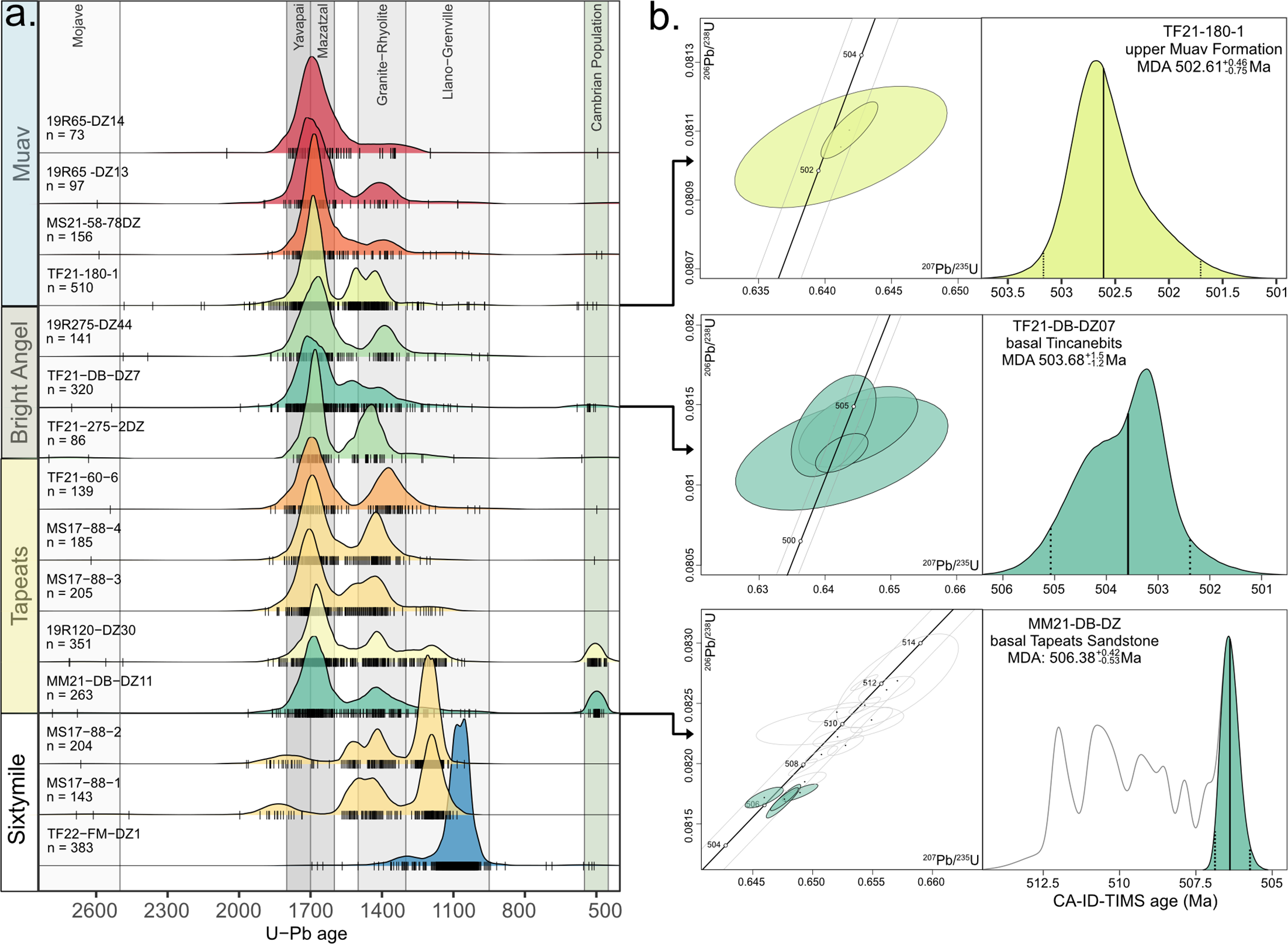
The tandem U-Pb geochronological method (Farrell et al. Reference Farrell, Cothren, Sundberg, Schmitz, Dehler, Landing, Karlstrom, Crossey and Hagadorn2025) was employed to obtain MDAs from clastic facies of the Tonto Group. Detrital zircon samples were collected from key measured sections throughout the Grand Canyon and dated using laser ablation-inductively coupled plasma-mass spectrometry to screen for a potential Cambrian detrital zircon population (Figures 1a and 2a). If Cambrian grains were found, they were re-dated via chemical abrasion-isotope dilution-thermal ionization mass spectrometry (CA-ID-TIMS) to obtain precise and accurate MDAs. Three of the 15 interrogated Tonto Group samples yielded useful MDAs (Figure 2) to be employed in our Bayesian age model. Sample MM21-DB-DZ, which is an amalgamation of three detrital zircon samples (MM21-DB-DZ11, MM21-DB-DZ12 and MM21-DB-DZ13; see supplemental material) from the lower Tapeats Sandstone, ∼2 m above the Great Unconformity at Diamond Bar Ranch, ∼60 km SSE of the restored Frenchman Mountain section at Gold Butte, Nevada. This sample was collected ∼50 m below an occurrence of Bolbolenellus euryparia and yielded an MDA of ≤506.4 ± 0.42 Ma (Figure 2c). This age provides the biostratigraphically oldest MDA from the Tapeats Sandstone in western Grand Canyon. Sample TF21-DB-DZ07 is from Diamond Bar Ranch, and it was collected at the base of the Tincanebits tongue in the upper Bright Angel Formation, which correlates westwards to the Lyndon Limestone at Frenchman Mountain (McKee, Reference McKee1945; Dehler et al. Reference Dehler, Sundberg, Karlstrom, Crossey, Schmitz, Rowland and Hagadorn2024). It is biostratigraphically within the Glossopleura walcotti Biozone, and at this site these strata lie unconformably atop strata of the Mexicella mexicana Biozone (Sundberg et al. Reference Sundberg, Foster, Webster, Miller and Hagadorn2026). This sample yielded an MDA of ≤503.7 ± 0.96 Ma (Figure 2b). Sample TF21-180-1 comes from river left at mile 180, just below Lava Falls where we sampled ∼0.25 m siliclastic event bed that is traceable for hundreds of kilometres and that separates the Peach Springs and Kanab Canyon members of the Muav Formation, within the lower Ehmaniella Subzone (Sundberg et al. Reference Sundberg, Foster, Webster, Miller and Hagadorn2026). This sample yielded an MDA of ≤502.6 ± 0.65 Ma (Figure 2a). A similar detrital zircon population was reported in southern Arizona (e.g., Muhlbauer et al. Reference Muhlbauer, Schmitz, Sundberg, Dehler, Karlstrom and Hagadorn2025).
(a) LA-ICPMS U-Pb detrital zircon spectra from the Tonto Group (colours match locations in Figure 1a). (b) Concordia and probability density plots for CA-ID-TIMS U-Pb detrital zircon MDAs.

2.b Bayesian age model
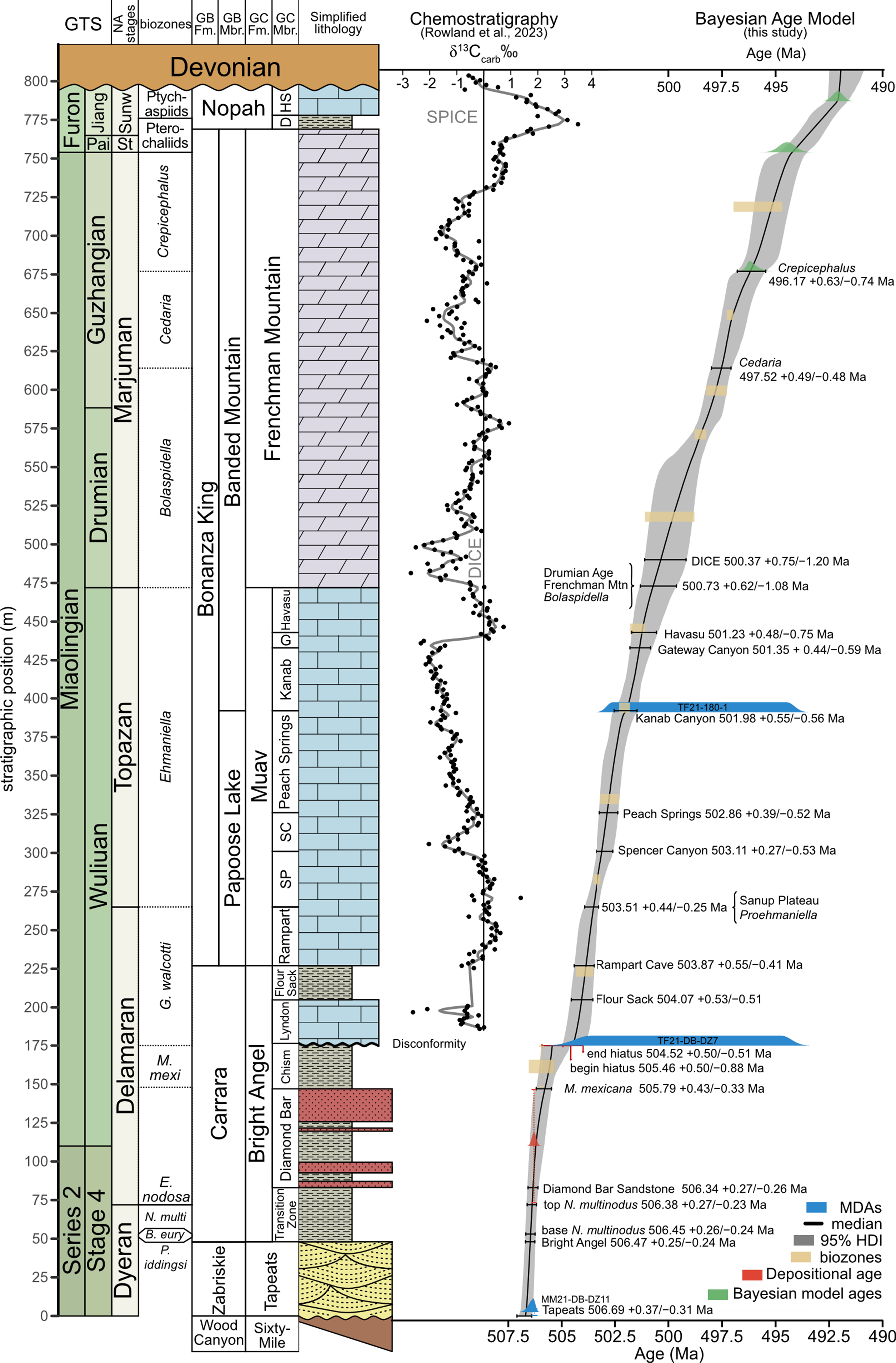
We used the open-source R package modifiedBChron (Trayler et al. Reference Trayler, Schmitz, Cuitiño, Kohn, Bargo, Kay, Strömberg and Vizcaíno2019; R Core Team, 2022), which is an adaptation of BChron (Parnell et al. Reference Parnell, Haslett, Allen, Buck and Huntley2008) but designed for deeper time geologic scales. These algorithms model sediment accumulation by using piecewise linear monotonic random walks that obey the constraint of superposition, parameterized by a compound Poisson-gamma process to model accumulation rates and the number of accumulation events between the conditioning likelihoods. Various likelihood probabilities assigned to discrete horizons or intervals within this prior probability framework condition the posterior probability of age as a function of stratigraphic position. Four data types were used as probability likelihoods to condition the Bayesian age model at Frenchman Mountain: (1) The three aforementioned CA-ID-TIMS U-Pb detrital zircon MDAs. (2) Three Bayesian depositional ages for the base of the Crepicephalus Biozone (496.3 +0.4/−0.9 Ma), the onset (494.5 +0.8/−0.7 Ma) and the termination (492.1 +0.5/−0.4 Ma) of the SPICE obtained from Smithfield Canyon in northern Utah (Farrell et al. Reference Farrell, Cothren, Sundberg, Schmitz, Dehler, Landing, Karlstrom, Crossey and Hagadorn2025) and correlated to Frenchman Mountain. A major advantage of using the Frenchman Mountain is that it is the only chemostratigraphic section of the Tonto Group that extends into the SPICE interval, allowing us to leverage these modelled depositional ages of Farrell et al. (Reference Farrell, Cothren, Sundberg, Schmitz, Dehler, Landing, Karlstrom, Crossey and Hagadorn2025). (3) A published depositional age for the Series 2 – Miaolingian Boundary from eastern Avalonia at 506.3 ± 0.2 Ma (Landing et al. Reference Landing, Schmitz, Westrop and Geyer2023), which can be correlated through trilobite biostratigraphy into the equivalent stratigraphy at Frenchman Mountain. (4) A constrained optimization composite (Sadler et al. Reference Sadler, Cooper and Melchin2009) of 11 Laurentian trilobite biozones from M. mexicana to Crepicephalus biozones (Dehler et al. Reference Dehler, Sundberg, Karlstrom, Crossey, Schmitz, Rowland and Hagadorn2024; Sundberg et al. Reference Sundberg, Foster, Webster, Miller and Hagadorn2026) correlated into the stratigraphy of Frenchman Mountain (Rowland et al. Reference Rowland, Korolev, Hagadorn and Ghosh2023).
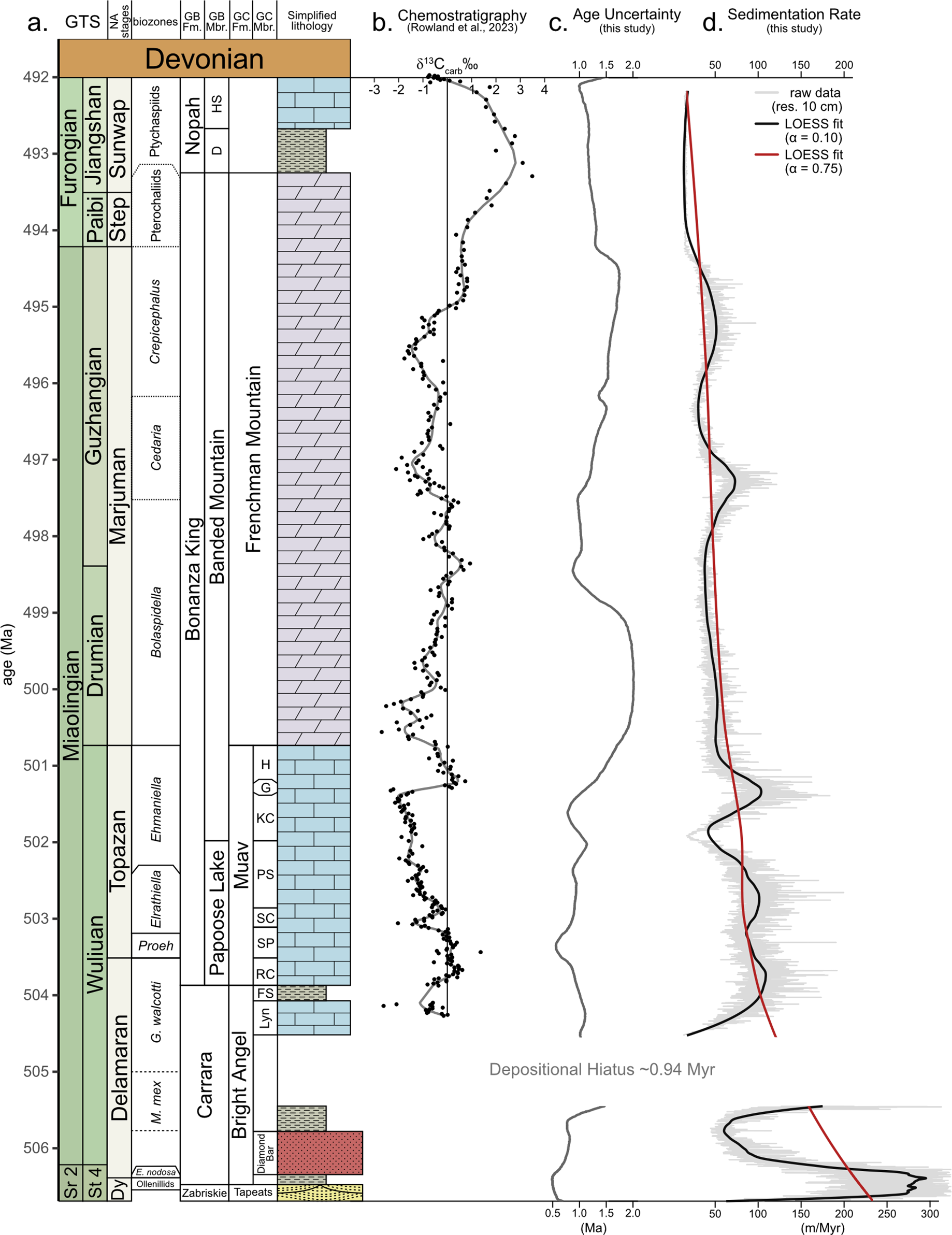
The modifiedBChron algorithm uses a Metropolis-Hastings decision to probabilistically accept random draws from the conditioning likelihoods to construct a Markov chain for each of the parameters of the model. From the accepted well-mixed posterior draws, the random walks through the conditioning likelihoods, with interpolation controlled by the compound Poisson-gamma hyperparameters, are used to assign an age and uncertainty at a resolution of 10 cm though the entire ∼800 m Cambrian succession at Frenchman Mountain (Figures 3 and 4). The most probable depositional age and uncertainty is defined herein as the median and 95% credible interval (c.i.) of all accepted posterior distribution of ages. Within the modifiedBChron framework, the 95% credible interval represents the posterior probability that the true depositional age lies within that range. Each interval’s probability distribution is conditioned by the radioisotopic and biostratigraphic likelihoods occurring throughout the entire stratigraphic section. This continuous radioisotopically calibrated chronology through the Tonto Group at Frenchman Mountain allows us to place an age and uncertainty of globally and regionally important litho-, bio- and chemostratigraphic horizons and depositional hiatuses within the Tonto Group. Additionally, we can calculate the duration and credible interval for any interval of interest, such as global and regional stages, biozones, chemostratigraphic excursions or depositional hiatuses. It should be noted here that we exclude from our model the lowest Tonto Group unit, the ≤527 to ≤509 Ma Sixtymile Formation (Karlstrom et al. 2018; Reference Karlstrom, Mohr, Schmitz, Sundberg, Rowland, Blakely, Foster, Crossey, Dehler and Hagadorn2020), due to its sparse and discontinuous preservation and lack of bio- or chemostratigraphically amenable strata.
Lithostratigraphic column and chemostratigraphy are modified from Rowland et al. (Reference Rowland, Korolev, Hagadorn and Ghosh2023) of Frenchman Mountain. Furon – Furongian; Pai – Paibian; Jiang – Jianshanian; St – Steptoean; Sw – Sunwaptan; Dund – Dunderbergia; Aphel – Aphelaspis; M. mexi – Mexicella mexicana; N. multi – N. multinodus; B. eury – B. euryparia; Rampart – Rampart Cave; SP – Sanup Plateau; SC – Spencer Canyon; Kanab – Kanab Canyon; G – Gateway Canyon; D – Dunderberg Shale; HS – Halfpint and Smoky; SPICE – Steptoean Positive Isotopic Excursion; DICE – Drumian Isotopic Carbon Excursion. All modelling results and uncertainties are reported as the median and 95% credible interval.

Figure 3. Long description
A detailed stratigraphic and chemostratigraphic analysis of the Tonto Group in the Grand Canyon. Panel A: The stratigraphic column displays various geological stages from the Devonian to the Cambrian, including Furongian, Paibian, Jianshanian, Steptoean, Sunwaptan, Dunderbergia, Aphelaspis, and Mexicella mexicana. It also shows simplified lithology with different formations like Nopah, Bonanza King, Frenchman Mountain, and others. Panel B: The chemostratigraphy section shows the δ13Ccarb values plotted against stratigraphic position, highlighting significant isotopic excursions like SPICE and DICE. Panel C: The Bayesian Age Model presents age estimates in million years (Ma) with median and 95% credible intervals, including key biostratigraphic markers and depositional ages. The graph shows a clear trend of age progression from older to younger strata, with notable hiatuses and fluctuations in depositional environments.
(a, b) Chronostratigraphic column and chemostratigraphy modified from Figure 3. Through our age model we have transposed the stratigraphic section in Frenchman Mountain from rock (m) to time (Ma). Pai – Paibian; Jiang – Jiangshanian; St – Steptoean; Sw – Sunwaptan; Dund – Dunderbergia; Aphel – Aphelaspis; M. mex – Mexicella mexicana; N. multi – N. multinodus; B. eury – B. euryparia; RC – Rampart Cave; SP – Sanup Plateau; SC – Spencer Canyon; KC – Kanab Canyon; G – Gateway Canyon; H – Havasu; D – Dunderberg Shale; HS – Halfpint and Smoky; SPICE – Steptoean Positive Isotopic Excursion; DICE – Drumian Isotopic Carbon Excursion. (c) Curve showing the width of the HDI from the Bayesian age model. (d) Curves denoting the Tonto Group sedimentation rate, calculated at a resolution of 10 cm.

2.c Chemostratigraphic correlations
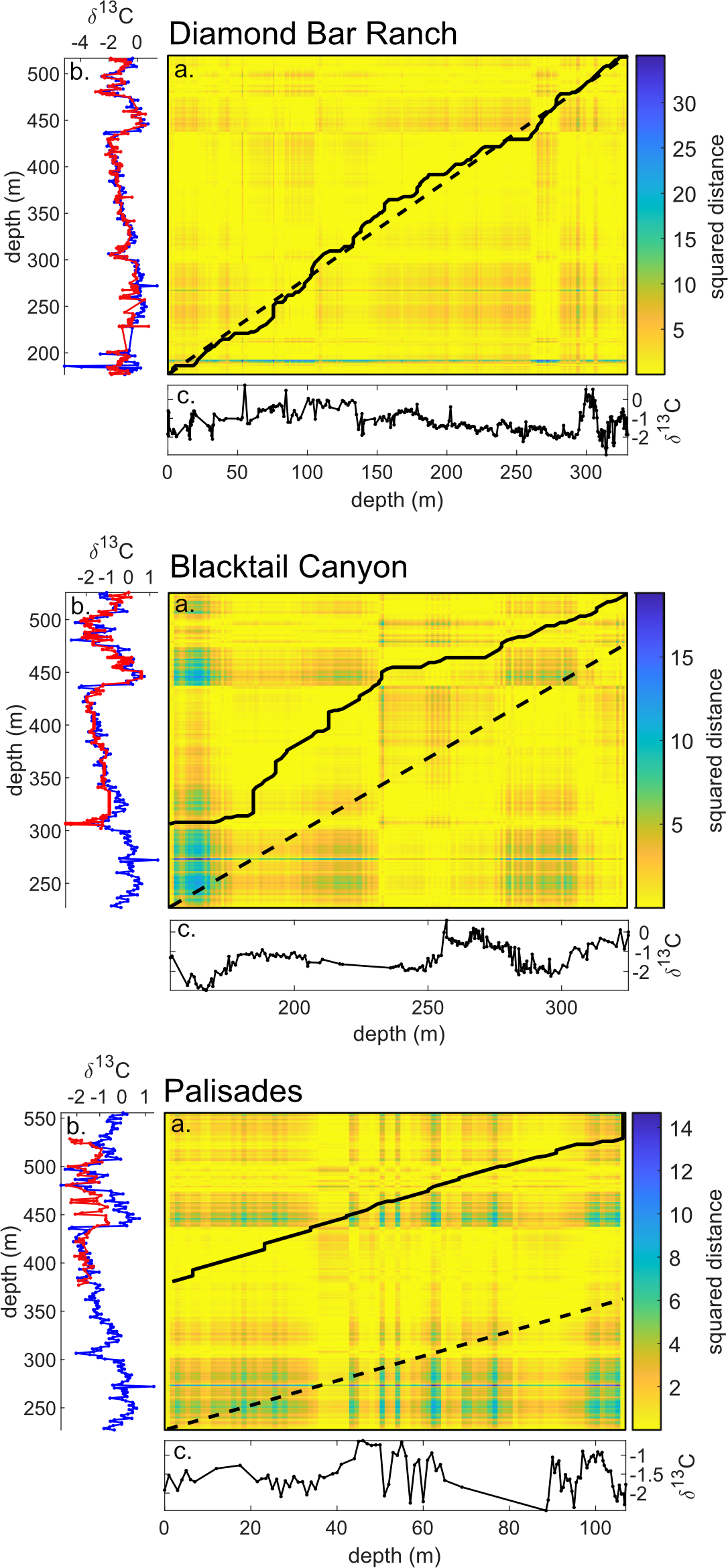
The depositional ages of the carbonate-dominated Muav Formation members were extrapolated eastwards from Frenchman Mountain using δ13C chemostratigraphic profiles from several measured sections within the Grand Canyon (Dehler et al. Reference Dehler, Sundberg, Karlstrom, Crossey, Schmitz, Rowland and Hagadorn2024). These δ13C records have analogous morphologies, which are interpreted to represent secular changes in seawater chemistry, albeit on different stratigraphic scales, due to synoptic differences in rock accumulation rate along the Grand Canyon transect. We used the dynamic time warping algorithm of Lisiecki and Lisiecki (Reference Lisiecki and Lisiecki2002) as formulated by Hay et al. (Reference Hay, Creveling, Hagen, Maloof and Huybers2019) to correct for these differences in accumulation rates and quantitatively aligned these more easterly chemostratigraphic records to the radioisotopically calibrated chemostratigraphic record at Frenchman Mountain, subject to biostratigraphic controls (Figure 5). In dynamic time warping, the alignment of the three candidate δ13C profiles at Diamond Bar Ranch, Blacktail Canyon and Palisades to the target δ13C profile at Frenchman Mountain (Rowland et al. Reference Rowland, Korolev, Hagadorn and Ghosh2023) was accomplished by a combination of expansion, compression or translation of the candidate profiles, depending on two stratigraphically meaningful parameters: (1) the edge parameter that either penalizes or encourages data points in the candidate profile to extend beyond the time span of the target profile and (2) the stretch parameter that either penalizes or allows stretching or compressing of the candidate profiles to best fit the target profile. We modulated the edge (0.2–1.1) and stretch (0.99–1.1) parameters to obtain alignments that adhere to the biostratigraphic constraints from Dehler et al. (Reference Dehler, Sundberg, Karlstrom, Crossey, Schmitz, Rowland and Hagadorn2024) and Sundberg et al. (Reference Sundberg, Foster, Webster, Miller and Hagadorn2026). From the prior constraints of litho- and biostratigraphy, the target profile at Frenchman Mountain was first trimmed at 525 m, as we know that none of the candidate profiles at Diamond Bar Ranch, Blacktail Canyon, or Palisades extend significantly above the lower Bolaspidella Biozone and its basal DICE excursion (Figure 5). The lower extent of the target profile at Frenchman Mountain was similarly trimmed at 227 m (the base of the Rampart Cave Member), as the δ13C profile spans from Glossopleura through Bolaspidella biozones at Diamond Bar Ranch, while the δ13C profiles are exclusively within the Elrathiella Subzone of the Ehmaniella Biozone through to the Bolaspidella Biozone at Blacktail Canyon and Palisades. The dynamic time warping paths (Figure 5) converge on stable reasonable solutions for parameter values similar to those used in Hay et al. (Reference Hay, Creveling, Hagen, Maloof and Huybers2019).
Results of dynamic time warping of Grand Canyon Tonto Group carbon isotope chemostratigraphy at Diamond Bar Ranch, Blacktail Canyon and Palisades. (a) The squared-difference cost matrix and resulting alignment path (solid line), dashed line shows the alignment if both target and candidate δ13C profiles had the same accumulation rate. (b) The target δ13C profile (red) aligned via dynamic time warping to the candidate δ13C profile at Frenchman Mountain (blue). (c) the target δ13C profile (black) before dynamic time warping.

Figure 5. Long description
Three sets of graphs depict the results of dynamic time warping of carbon isotope chemostratigraphy for the Tonto Group at Diamond Bar Ranch, Blacktail Canyon, and Palisades. Each set includes three panels labeled a, b, and c. Panel a shows a heatmap of the squared-difference cost matrix with the alignment path in solid black and the dashed line representing equal accumulation rates. Panel b displays the target delta 13C profile in red aligned to the candidate delta 13C profile at Frenchman Mountain in blue. Panel c presents the target delta 13C profile in black before dynamic time warping. The x-axis represents depth in meters, and the y-axis represents delta 13C values. The heatmap uses a color gradient from blue to yellow to indicate squared distance. The graphs illustrate the alignment and comparison of carbon isotope profiles across different locations in the Tonto Group.
3. Discussion
3.a Lithostratigraphic continuity of the Tonto Group
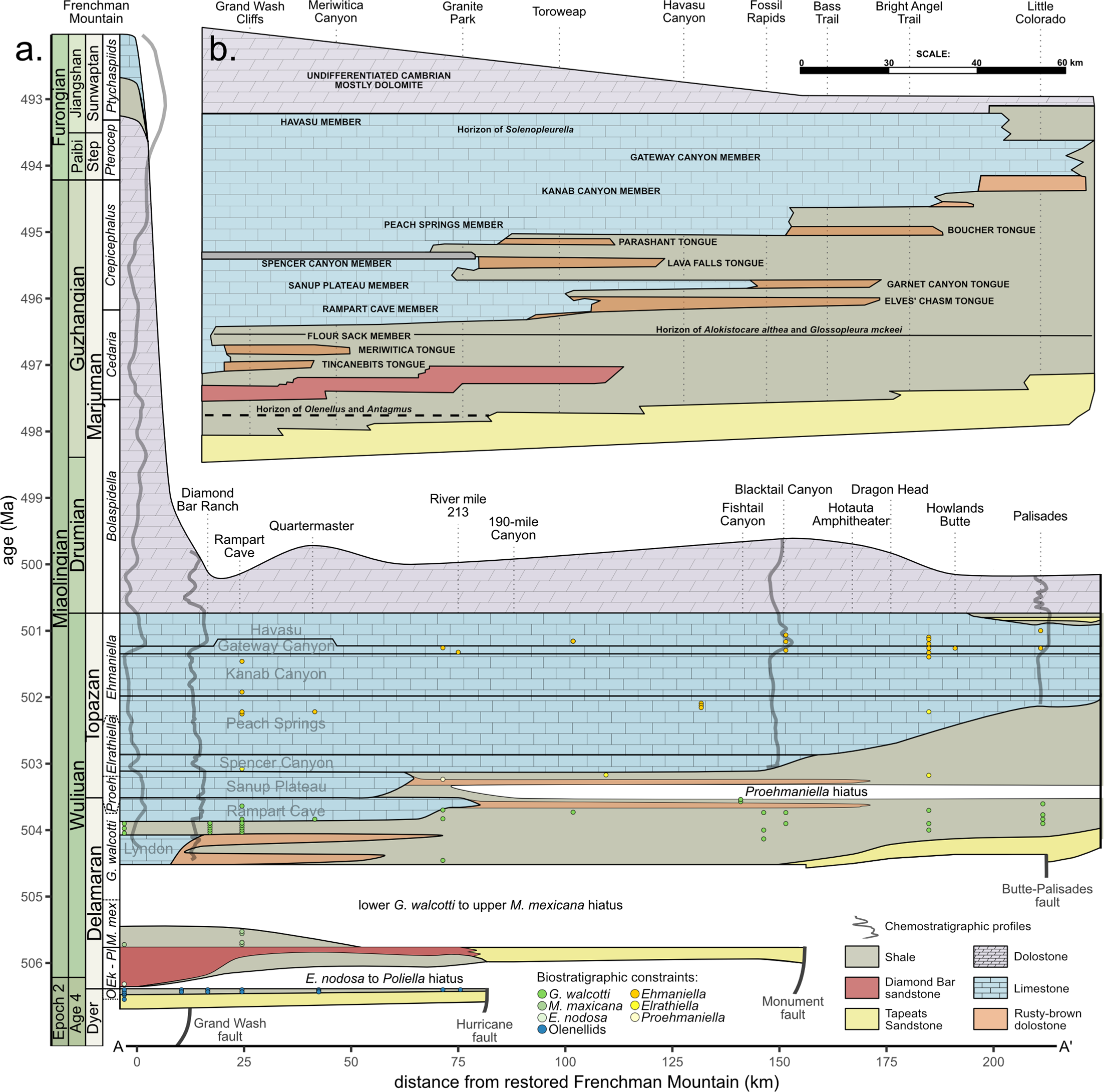
The results of the dynamic time warping confirm the isochronous contacts between the carbonate members of the Muav Formation and the basal Frenchman Mountain Dolostone across the Grand Canyon transect (Figure 6a), as postulated by Dehler et al. (Reference Dehler, Sundberg, Karlstrom, Crossey, Schmitz, Rowland and Hagadorn2024). The base of the Frenchman Mountain Dolostone correlates to the base of the Drumian Stage and represents a near isochronous surface, within the resolution of the model at 500.7 (+0.6/−1.1) Ma, from Frenchman Mountain to the Butte Fault. East of the Butte Fault, the contact between the Muav and Frenchman Mountain Formations becomes bio- and chronostratigraphically younger, as evidenced by the presence of Bolaspidella taxa within the upper Muav Formation (Dehler et al. Reference Dehler, Sundberg, Karlstrom, Crossey, Schmitz, Rowland and Hagadorn2024; Sundberg et al. Reference Sundberg, Foster, Webster, Miller and Hagadorn2026). In contrast, the top of the unit is an erosional surface overlain by Devonian to Mississippian strata (Brathovde, Reference Brathovde1986; Rowland and Korolev Reference Rowland, Korolev, Hollingsworth, Sundberg and Foster2011), and from our model this surface exposes strata ranging in age from c. 500 to 493.2 (+0.6/−0.6) Ma (Figure 6a). From the dynamic time warping analysis, we can see that the upper three limestone members of the Muav Formation are traceable across our entire Grand Canyon transect, including the Peach Springs – Kanab Canyon contact, which forms an isochronous surface at 501.9 (+0.55/−0.51) Ma (within error of the MDA at this horizon; Figures 2b and 3c). The basal carbonate facies of the Peach Springs Member thin and young from west to east, transitioning to a more clastic-dominated facies; however, the unit is still recognizable at the eastern end of our transect. The lower three limestone members of the Muav Formation are also isochronous in western Grand Canyon, but transition eastwards to more clastic facies (the Lava Falls, Garnet Canyon, and Elves Chasm tongues of Mckee [Reference McKee1945]; Figure 6a) of the Bright Angel Formation.
(a) Time transgressive Wheeler diagram of the Cambrian Tonto Group updated from Dehler et al. (Reference Dehler, Sundberg, Karlstrom, Crossey, Schmitz, Rowland and Hagadorn2024). Coloured biostratigraphy constraints come from Sundberg et al. (Reference Sundberg, Foster, Webster, Miller and Hagadorn2026). (b) The classic depiction of the unit’s depositional history (modified from McKee, Reference McKee1945).

3.b Depositional hiatuses in the Tonto Group
The depositional models for the Tonto Group outlined in the work of Rose (Reference Rose2006) and Dehler et al. (Reference Dehler, Sundberg, Karlstrom, Crossey, Schmitz, Rowland and Hagadorn2024) suggest sediment accumulation in shallow marine to terrestrial environments along a low-relief stable cratonic margin sensitive to episodic fluctuations in eustatic sea-level. These newer models suggest a higher susceptibility to depositional hiatuses and erosion than considered in earlier stratigraphic models (McKee, Reference McKee1945; Figure 6b). Dehler et al. (Reference Dehler, Sundberg, Karlstrom, Crossey, Schmitz, Rowland and Hagadorn2024) summarize litho- and biostratigraphic evidence for three disconformities large enough to be accounted for in the Tonto Group age model. These depositional hiatuses occur at the base, middle and top of the North American Delamaran Stage (lower global Wuliuan Stage; Figure 6a) and are thought to become more pronounced eastwards, due to reduced subsidence rates and stronger terrestrial influence. Other hiatuses may exist in the upper Muav Formation and Frenchman Mountain Dolostone (Schenk and Wheeler, Reference Schenk and Wheeler1942; Rowland et al. Reference Rowland, Korolev, Hagadorn and Ghosh2023), but the current biostratigraphy lacks sufficient resolution to assess them (Sundberg et al. Reference Sundberg, Foster, Webster, Miller and Hagadorn2026).
In central and eastern Grand Canyon multiple occurrences of Elrathiella Subzone directly above G. walcotti Biozone indicate a depositional hiatus during the Proehmaniella Subzone, at the Delamaran-Topazan boundary. However, the presence of Proehmaniella species in western Grand Canyon (McKee, Reference McKee1945; Dehler et al. Reference Dehler, Sundberg, Karlstrom, Crossey, Schmitz, Rowland and Hagadorn2024; Sundberg et al. Reference Sundberg, Foster, Webster, Miller and Hagadorn2026) indicates that this hiatus must diminish or pinch out completely to the west. Although this hiatus is not present at Frenchman Mountain, our modelling suggests it lasted a maximum of 0.3 (+0.5/−0.2) Myr in central and eastern Grand Canyon. A middle Delamaran Stage hiatus is widely expressed across our Grand Canyon transect and throughout the Great Basin (Lin et al. Reference Lin, Sundberg, Jiang, Montañez and Wotte2019; Dehler et al. Reference Dehler, Sundberg, Karlstrom, Crossey, Schmitz, Rowland and Hagadorn2024). Stratigraphically it occurs at the base of the Lyndon Limestone (which correlates eastwards to the Tincanebits tongue) during the upper M. mexicana to lower G. walcotti biozones (Dehler et al. Reference Dehler, Sundberg, Karlstrom, Crossey, Schmitz, Rowland and Hagadorn2024; Sundberg et al. Reference Sundberg, Foster, Webster, Miller and Hagadorn2026). To incorporate this depositional hiatus, our model was segmented above and below this disconformity (Figures 3 and 4). Our modelling constrains the duration of this depositional hiatus to 0.9 ± 0.7 Myr. The Dyeran-Delamaran hiatus is expressed as the absence of the lower Eokochapsis nodosa Biozone. This hiatus is thought to expand eastwards (Dehler et al. Reference Dehler, Sundberg, Karlstrom, Crossey, Schmitz, Rowland and Hagadorn2024; Sundberg et al. Reference Sundberg, Foster, Webster, Miller and Hagadorn2026); however, its full extent is unknown due to the paucity of age-diagnostic fauna. Our modelling places a maximum duration of ≤0.6 ± 0.4 Myr on this hiatus.
3.c Age constraints on the clastic sedimentation in the Tonto Group
Despite changing lithologies and sparse biostratigraphic constraints, we can now model the age of the clastic Bright Angel Formation and Tapeats Sandstone east of the Grand Wash fault by extrapolating clastic rock accumulation rates derived from our Frenchman Mountain-based Tonto Group age model to central and eastern measured sections, with the assumption that accumulation rates are age equivalent along the Grand Canyon transect. The accumulation rate of the Tapeats and transition beds of the lower Bright Angel Formation at Frenchman Mountain are constrained by our Bayesian age model to 236.5 (+103.6/−64.4) m/Myr (Figure 4d), significantly faster than sedimentation rates reported in Anttila et al. (Reference Anttila, Macdonald, Zinto and Britt2024) for the Sauk Transgressions. Dividing the measured section thicknesses (m) by the modelled rock accumulation rate (m/Myr) provides rock accumulation duration (Myr). When these durations are applied to extrapolated time below isochronous horizons within the Muav Formation, they yield depositional ages for the base and top of the Bright Angel and Tapeats formations, assuming constant clastic sedimentation rates across the Grand Canyon transect. To test the sensitivity of our model to the uncertainty in our molded rock accumulation rate we calculated the basal ages of the Tapeats Sandstone and Bright Angel Formation at the extreme ends of the 95% c.i. (i.e., the 2.5% and 97.5% quantiles). This resulted in an age difference of 0.21 Myr. We applied this approach to eight measured sections (Rose, Reference Rose2003; Dehler et al. Reference Dehler, Sundberg, Karlstrom, Crossey, Schmitz, Rowland and Hagadorn2024) with identifiable litho-, bio- or chemostratigraphic constraints projected into the cratonward transect shown in Figure 6. As a result, the lower carbonate members of the Muav Formation in western Grand Canyon can be traced into their clastic Bright Angel Formation time-equivalents, from the G. walcotti Biozone (504.5 ± 0.5 Ma) at Frenchman Mountain to lower Ehmaniella Subzone (502.2 [+0.5/−0.5] Ma) at Palisades. The Bright Angel Formation is interrupted by the three major depositional hiatuses noted above and spans from the Peachella iddingsi Biozone in the west to Elrathiella Biozone in the east. Our age model demonstrates that siliclastic deposition was partitioned across the platform, and that at any given position on the transect deposition was only active for a timescale of ∼1 Myr between hiatuses. This age model developed from clastic rock thickness, and accumulation rate is fully consistent with the available biostratigraphic constraints within the Bright Angel Formation.
The depositional age of the basal sheet sands of the Sauk II transgression (Tapeats Sandstone) was similarly constrained along the transect using a combination of biostratigraphy and modelled rock accumulation rates. Like the Bright Angel Formation, the Tapeats Sandstone displays clear and discrete diachrony. West of the Hurricane fault, it lies below or within the olenellid biozones and above the MDA of 506.4 ± 0.4 Ma, constraining its depositional age between 506.7 (+0.4/−0.3) and 506.3 (+0.3/−0.2) Ma. It becomes unfossiliferous east of the Hurricane Fault and is not exposed for ∼50 river miles through the Muav Gorge (Figure 1a); nevertheless, occurrences of G. walcotti Biozone in the lower Bright Angel Formation throughout the transect (Foster, Reference Foster2011) provide minimum age constraints of 503.5 (+0.5/−0.2) Ma.
Between the Hurricane and Monument faults, we applied our accumulation rate model to three measured sections (190-mile Canyon, Fishtail Canyon and Blacktail Canyon), the apparent age of the basal Tapeats Sandstone from our measured sections ranged from c. 505.5 Ma at 190-Mile Canyon, just east of the Hurricane fault, to c. 504.9 Ma at Blacktail canyons, just west of the Monument Fault. These ages lie within the middle Delamaran hiatus (505.5 (+1.0/−0.5) – 504.5 (+0.5/0.5) Ma), which is expressed across the entire Grand Canyon transect (Dehler et al. Reference Dehler, Sundberg, Karlstrom, Crossey, Schmitz, Rowland and Hagadorn2024). To account for this hiatus, the Tapeats Sandstone in this central transect was placed below the middle Delamaran hiatus, as a facies equivalent to the Diamond Bar Sandstone of western Grand Canyon (Figure 4a). Basal Tapeats Sandstone ages from measured sections east of the Monument Fault are identical within the model uncertainty from 504.5 (+0.5/−0.7) to 504.3 (+0.6/−0.5) Ma, both of which are notably above the middle Delamaran hiatus. Our modelling has thus refined the Tapeats Sandstone into a compound unit composed of three distinct age belts propagating towards the craton.
3.d Mechanisms of Sauk II transgression
We have affirmed the time-transgressive nature of the Tonto Group proposed by McKee (Reference McKee1945). However, with significantly improved age resolution, our model quantifies the depositional history and potential mechanisms driving the Sauk transgressions in western Laurentia. Our work shows that basal sands and muds of the Sauk II transgression traversed ∼300 km of the continental margin in just 2.4 (+0.7/−0.6) Myr, far more rapidly than the previous estimates of 40–60 Myr (Figure 6a; Kominz, Reference Kominz1995; Levy and Christie-Blick, Reference Levy and Christie-Blick1991). This timeframe includes the 0.94 ± 0.7 Myr hiatus separating the western and central Tapeats Sandstone from the eastern Tapeats Sandstone. This rapid cratonic flooding, occurring between 506.7 (+0.4/−0.3) and 503.9 (+0.4/−0.4) Ma, required substantial and swift base-level fluctuations, followed by stable shallow carbonate sedimentation, which lasted ∼9 Myr, from 502.2 (+0.5/0.4) to 493.2 (+0.6/0.6) Ma.
Our model is internally consistent with discrete accommodation space for the basal Sauk II propagating cratonward over ∼2.4 Myr. The thickest and the most carbonate-dominated Tonto Group deposits reside to the west of the Grand Wash Fault, consistent with continuing growth fault motion throughout the Miaolingian. The restriction of olenellid trilobite occurrences west of the ancestral Hurricane Fault suggests that subsidence along this fault may have controlled accommodation until c. 506.4 Ma. Our model-based sedimentation rates indicate a stepwise eastward younging of the Tapeats Sandstone, which we interpret as resulting from a rapid regression and transgression during the middle Delamaran hiatus combined with subsidence along the ancestral Monument Fault. We predict another stepwise subsidence phase in G. walcotti time across to eastern Grand Canyon, which would be associated with accommodation space created along the Butte Fault (Figure 6a). Although the Tapeats Sandstone does not outcrop east of Palisades, data from the Bolsa Quartzite in southern Arizona and the Lodore Formation in northwestern Colorado support a continuation of eastward younging of the Sauk II basal sheet sands. Deposition of the Bolsa Quartzite is constrained to 504–501 Ma by U-Pb detrital zircon ages (Muhlbauer et al. Reference Muhlbauer, Schmitz, Sundberg, Dehler, Karlstrom and Hagadorn2025), and our modelled depositional age for the basal Lodore Formation lies between 501.6 and 500.7 Ma, based on trilobite biostratigraphy from Myrow et al. (Reference Myrow, Hasson, Taylor, Tarhen, Ramirez, Fowlkes and Chen2023).
Placing the Tapeats and lower Bright Angel formations within the broader context of the underlying Sauk I and Sixtymile Formation (Karlstrom et al. Reference Karlstrom, Hagadorn, Gehrels, Matthews, Schmitz, Madronich, Mulder, Pecha, Giesler and Crossey2018), a clearer picture emerges of a more active southwestern Laurentian margin during the middle Cambrian, persisting into the Miaolingian Epoch until at least the G. walcotti time (c. 504 Ma). This activity suggests a delay in the rift-to-drift phase of the western Laurentian margin in the Grand Canyon region (Bond et al. Reference Bond, Christie-Blick, Kominz and Devlin1985). Although the Tapeats Sandstone is contemporaneous with the global Sauk II transgression (Landing et al. Reference Landing, Amati and Franzi2009; Powell et al. Reference Powell, Abed and Le Nindre2014), our refined age model suggests that the temporal and spatial distribution of the transgression along the western margin of Laurentia in the Grand Canyon region was largely controlled by local tectonics and base-level changes, as much or more than global geodynamic processes (Hayes and Pitman, Reference Hayes and Pitman1973; Burgess et al. Reference Burgess, Gurnis and Moresi1997; Tasistro-Hart and Macdonald, Reference Tasistro-Hart and Macdonald2023).
3.e Implications for the Cambrian timescale
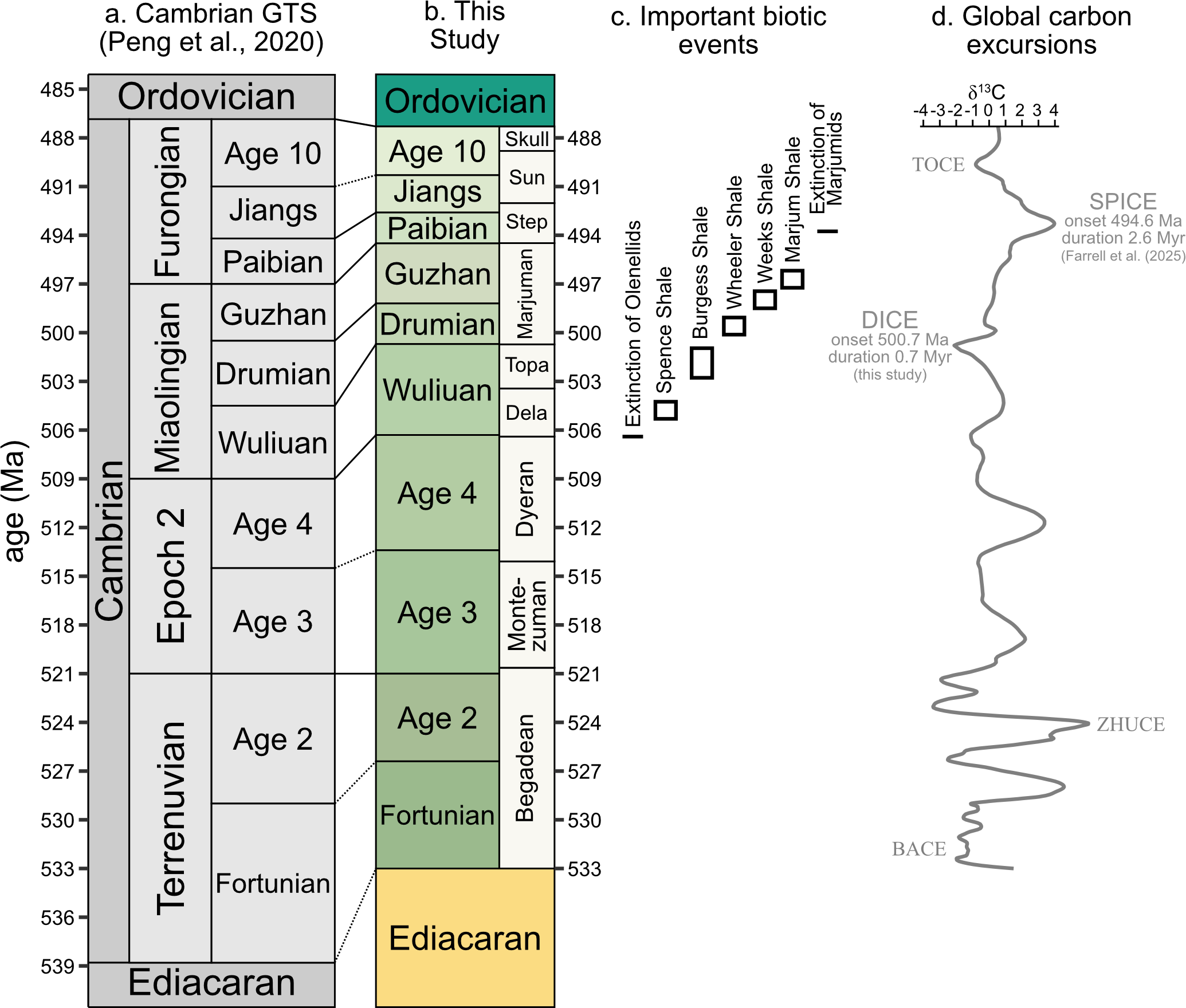
The Tonto Group spans four important regional biostratigraphic horizons (Sundberg et al. Reference Sundberg, Foster, Webster, Miller and Hagadorn2026), closely tied to North American and global Cambrian markers, such that our age model refines the global Cambrian timescale outlined in Figure 7. The Delamaran Stage, punctuated by the extinction of olenellid trilobites, occurs within the transitional beds of the Tapeats Sandstone at Frenchman Mountain. The base of the Delamaran Stage, which our age model places at 506.4 (+0.3/−0.2) Ma, is only slightly older than the base of the global Wuliuan Stage and Miaolingian Epoch when correlated to the Poliella denticulata Biozone (Lin et al. Reference Lin, Sundberg, Jiang, Montañez and Wotte2019), and both are thus 4.6 Myr younger than previously hypothesized (Peng et al. Reference Peng, Babcock, Ahlberg and Gradstein2020). The Topazan Stage, defined by the Ehmaniella Biozone, is constrained at its base to 503.5 (+0.4/−0.3) Ma, ∼3 Myr younger than that estimated by Peng et al. (Reference Peng, Babcock, Ahlberg and Gradstein2020). The Marjuman Stage and global Drumian Stage, placed at the first appearance of the agnostid Ptychagnostus atavus and correlated closely to the Bolaspidella Biozone and the onset of the DICE excursion, are constrained by our model to 500.7 (+0.6/−1.1) Ma (Figure 4). This age is ∼3.8 Myr younger than that estimated by Peng et al. (Reference Peng, Babcock, Ahlberg and Gradstein2020) but agrees with recent U-Pb zircon depositional ages from Avalona of 500.55 ± 0.10 Ma (Landing et al. Reference Landing, Schmitz, Westrop and Geyer2026). The Guzhangian Stage is marked by the agnostid Lejopyge laevigata and is the least biostratigraphically constrained global stage in the Tonto Group. However, using CONOP-based trilobite biozonation (Farrell et al. Reference Farrell, Cothren, Sundberg, Schmitz, Dehler, Landing, Karlstrom, Crossey and Hagadorn2025), we estimate the base of the Guzhangian Stage in the upper Frenchman Mountain Dolostone to be 498.2 (+0.4/−0.6) Ma, ∼2.3 Myr younger than the current global Cambrian timescale (Peng et al. Reference Peng, Babcock, Ahlberg and Gradstein2020). In summation, the Miaolingian Series is now constrained to span 11.8 ± 0.5 Myr, from 506.3 ± 0.2 Ma (Landing et al. Reference Landing, Schmitz, Westrop and Geyer2023) to 494.5 (+0.7/−0.6) Ma (Farrell et al. Reference Farrell, Cothren, Sundberg, Schmitz, Dehler, Landing, Karlstrom, Crossey and Hagadorn2025).
(a) Global Cambrian timescale of Peng et al. (Reference Peng, Babcock, Ahlberg and Gradstein2020). (b) Our new proposed global Cambrian timescale, this work and Landing et al. Reference Landing, Schmitz, Geyer, Trayler and Bowring2021 (Miaolingian Epoch); Nelson et al. Reference Nelson, Crowley, Smith, Schwartz, Hodgin and Schmitz2023 (Terrenuvian Epoch); Farrell et al. Reference Farrell, Cothren, Sundberg, Schmitz, Dehler, Landing, Karlstrom, Crossey and Hagadorn2025 (Furnongian Epoch). Dela – Delamaran Stage; Topa – Topazan Stage; Step – Steptoean Stage; Sun – Sunwaptan Stage; Skull – Skullrockian Stage. (c) Comparison to important biotic events and lagerstätten from Zhu et al. Reference Zhu, Babcock and Peng2006. (d) Rescaled global chemostratigraphic record data from global Cambrian timescale (Peng et al. Reference Peng, Babcock, Ahlberg and Gradstein2020).

Figure 7. Long description
Panel A: A vertical bar chart showing the Cambrian Global Time Scale (GTS) from Peng et al., 2020. The chart is divided into three main periods: Ediacaran, Cambrian, and Ordovician. The Cambrian period is further divided into Epochs 2 and 3, and the Terrenuvian and Furongian Epochs. Each epoch is subdivided into ages, with specific names for each age. The y-axis represents age in million years (Ma), ranging from 539 to 485 Ma. Panel B: A vertical bar chart showing a new proposed global Cambrian timescale from this study and other referenced works. It follows a similar structure to Panel A, with specific stages named Dela, Topa, Step, Sun, and Skull. Panel C: A vertical bar chart comparing important biotic events and lagerstätten. Key events include the extinction of olenellids, the Burgess Shale, Wheeler Shale, and the extinction of marjoleids. The y-axis represents age in million years (Ma), ranging from 539 to 485 Ma. Panel D: A line graph showing global carbon excursions over time. The y-axis represents age in million years (Ma), ranging from 539 to 485 Ma. The x-axis represents delta carbon 13 values. Key events include TOCE, SPICE, DICE, and ZHUCE, with specific onset ages and durations noted.
This reallocation of time within the Cambrian Period has significant consequences for the timing and pace of key biological and geochemical events and processes (Figure 7c, d). For example, iconic Laurentian Fossil Lagerstätten such as the Spence Shale (c. 505 Ma) and Burgess Shale (c. 503 Ma) are younger and more distant in time from the end of the Cambrian Explosion (c. 521 Ma), and therefore even more likely representative of a modern-style marine ecosystem (Paterson et al. Reference Paterson, Edgecombe and Lee2019). A stabilized Miaolingian and reduced Furongian (Farrell et al. Reference Farrell, Cothren, Sundberg, Schmitz, Dehler, Landing, Karlstrom, Crossey and Hagadorn2025) lead to estimated rates of morphological evolution in trilobites that are even more homogeneous throughout the Cambrian (Paterson et al. Reference Paterson, Edgecombe and Lee2019), while median generic longevity is shorter thus enhancing the distinction of the Cambrian and trilobites for higher rates of origination and extinction compared with other, later clades (Foote, Reference Foote1988; Knoll and Nowak, Reference Knoll and Nowak2017). Global carbon isotope excursions are now better calibrated in time with implications for the sequencing between carbon cycle perturbations and paleobiological patterns of origination and extinction (Babcock et al. Reference Babcock, Peng, Brett, Zhu, Ahlberg, Bevis and Robison2015), and quantification of oceanic and atmospheric oxygenation related to carbon cycling (e.g., Maloof et al. Reference Maloof, Poter, Moore, Dudás, Bowring, Higgins, Fike and Eddy2010; Saltzman et al. Reference Saltzman, Young, Kump, Gill, Lyons and Runnegar2011).
4. Conclusion
We demonstrate the effectiveness of integrating CA-ID-TIMS U-Pb detrital zircon geochronology, biostratigraphic constraints, Bayesian age modelling and dynamic time warping to obtain an order-of-magnitude refinement on the chronostratigraphic model for the Cambrian Tonto Group of Grand the Canyon, drastically updating the traditional model of McKee (Reference McKee1945) and adding crucial temporal constraints to the recent model of Dehler et al. (Reference Dehler, Sundberg, Karlstrom, Crossey, Schmitz, Rowland and Hagadorn2024). Our model indicates the timing and distribution of the Sauk II transgression in western Laurentia was predominately controlled by local tectonics and base-level fluctuations which resulted in rapid clastic deposition across the Proterozoic basement. Our results update the Cambrian timescale by reiterating the stabilization of the Miaolingian Epoch from 506 Ma (Landing et al. Reference Landing, Schmitz, Westrop and Geyer2023) to 494.5 Ma (Farrell et al. Reference Farrell, Cothren, Sundberg, Schmitz, Dehler, Landing, Karlstrom, Crossey and Hagadorn2025) and demand a younging of the Drumian and Guzhangian ages. In this contribution we refined the Cambrian depositional history of western Laurentia (Figure 6a) and propose that the Tonto Group should be considered the chronostratigraphic type-section for the global and North American Miaolingian timescale (Figure 7).
Supplementary material
The supplementary material for this article can be found at: https://doi.org/10.1017/S0016756826100909
Acknowledgements
We thank the Grand Canyon National Park for river access and sampling permits; Arizona River Runners and J. Pollack for logistical support; S. Rowland for his help in the field; D. Elston for information on the Lava Falls locality for the Peach Springs-Kanab Canyon contact; D. Schwartz for help with LA-ICPMS analyses; J. Crowley for help with CA-ID-TIMS analyses; and M. Mohr and R. Trayler, for their help with R coding. We recognize this study was conducted on the homeland of Indigenous peoples of the 11 associated tribes that surround Grand Canyon, and we thank them for their timeless stewardship of land. This project was supported through collaborative funding from the National Science Foundation grants EAR-1954583, EAR-1337887, EAR-1954634, EAR-1955078 and EAR-1955115 with additional support from patrons of the Denver Museum of Nature & Science.
Competing interests
The authors declare none.


 Open access

