INTRODUCTION
Tripedalia cystophora Conant, Reference Conant1897 is a box jellyfish in the family Tripedaliidae of the order Carybdeida. Carybdeids are easily identified by the presence of only one tentacle on each pedalium. Most species of this order possess four interradial pedalia, each with a single tentacle. However, species of the genus Tripedalia have two or three pedalia with single tentacles at each interradial corner of the bell (not to be confused with members of the order Chirodropida, which have several tentacles per pedalium) (Daly et al., Reference Daly, Brugler, Cartwright, Collins, Dawson, France, McFadden, Opresko, Rodriguez, Romano and Stake2007). Tripedalia cystophora has been the focus of many studies on feeding behaviour, and vision capabilities (e.g. Nilsson et al., Reference Nilsson, Gislen, Coates, Skogh and Garm2005). Little is known about interactions between this animal and humans. In particular, there do not appear to be any studies about the effects of T. cystophora envenomations.
Tripedalia cystophora was originally described from Jamaica (Conant, Reference Conant1897). Collections at the Smithsonian National Museum of Natural History contain exemplars from Indian, Pacific and Atlantic localities suggesting that the species is distributed around the globe along tropical/subtropical mangrove coastlines. Nevertheless, there are relatively few published records of T. cystophora in the Caribbean and surrounding waters. Observations in the Atlantic include mangrove coastal localities of Brazil (Migotto et al., Reference Migotto, Marques, Morandini and Silveira2002), Jamaica, and Puerto Rico (Coates, Reference Coates2003).
MATERIALS AND METHODS
Tripedalia cystophora was collected in Lake Wyman, Boca Raton, Florida, on 27 September 2009 (26°21′59.26″N 80°04′16.66″W). Lake Wyman is a small lagoon system created along with the formation of the barrier islands and part of the Atlantic Intracoastal Waterway (ICW) since its dredging in the early 19th Century. There are no previously documented reports of T. cystophora in Florida or elsewhere in the continental United States to date. Another specimen was caught and released during a seine in the same area earlier in the year.
The specimen was brought to the Gumbo Limbo Nature Centre in a plastic cup containing natural seawater from Lake Wyman. Tripedalia cystophora was relaxed with 5% ethanol and fixed in 10% formalin/seawater for 4–6 hours. The specimen was then dipped lightly in seawater to remove precipitate and stored in a 50% glycerin solution. A tentacle was excised post-fixation and mounted with glycerin for light microscopy (LM) examination.
SYSTEMATICS
DISCUSSION
Compared with the notoriety of Pacific cubomedusae, particularly Chironex fleckeri and Carukia barnesi, box jellies in the Atlantic go relatively unnoticed. Several species have been recorded in the eastern Atlantic, particularly in the Caribbean and surrounding waters. Two species of carybdeid Alatina alata (Reynaud, 1830), Tamoya sp. (Collins et al., 2011), and the chirodropid Chiropsalmus quadrumanus (F. Müller, 1859) are known to be distributed along the south-east United States coast from the Gulf of Mexico to waters of Cape Hatteras (Calder, Reference Calder2009). This report brings the number of box jellyfish species known from this region to four.
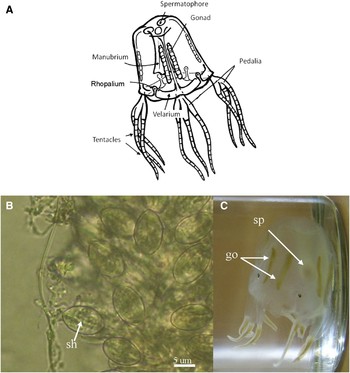
General anatomical features of the specimen collected were recorded post-fixation for species identification (Figure 1). In addition to the presence of multiple pedalia/tentacles at each interradial corner of the bell, species of this family are unique within Cubozoa in being sexually dimorphic and in possessing spermatophores, which apparently evolutionarily arose in tandem (Bentlage et al., Reference Bentlage, Cartwright, Yanagihara, Lewis, Richards and Collins2010). Since the specimen was already fixed discharged nematocysts could not be examined. Two main types of nematocyst were observed under LM, using an Olympus BX50 under 40× magnification, in the tentacle tissue. The predominant type has a visible shaft inside the capsule, identifying them as heteronemes (Figure 1B) (Östman, Reference Östman2000) with an average size (length × width) of 14 × 10 µm, N = 16. The other nematocysts observed were classified as round/oval haplonemes, as no visible shaft was present in the undischarged capsule (Östman, Reference Östman2000). Sizes of the haplonemes varied, 5–10 µm × 6–12 µm, N = 8. These observations of nematocyst types correspond to what Gershwin (Reference Gershwin2005) identified as microbasic euryteles and small oval isorhizas in a specimen from Puerto Rico.
(A) Drawing of Tripedalia cystophora based on initial and light microscopy examination; (B) undishcharged heteronemes from an excised tentacle at lOO×, with visible shaft (sh); (C) specimen post-fixation with gonads (go) and spermatophores (sp) characteristic of breeding males.

The specimen appears to be a breeding male due to the presence of three large spematophores located at the base of the manubrium in the gastric cavity, as well as a set of paired gonads midway on the bell along each interradial axis (Figure 1; Werner, Reference Werner1973; Stewart, Reference Stewart1996). Noted was the absence of a single spermatophore; breeding males normally have a total of four. This can be explained in one of three ways. First, the spematophore may have been ejected, unnoticed, during initial collection. However, the remaining three spermatophores where initially observed in a relaxed state in the gastric cavity, making this explanation unlikely. Second, this specimen may be aberrant in having developed just three spermatophores. Finally, the absence could indicate that a single spermatophore had been transferred to a female during mating (Werner, Reference Werner1973; Stewart, Reference Stewart1996). If the third possibility is correct, it would imply that a breeding population exists in the mangrove lined waters of Lake Wyman and the Florida ICW. Additional specimens should be captured for further assessment of this population.
ACKNOWLEDGEMENTS
Thanks to Dale Calder for all the advice and help; George and his daughter Judith for bringing one of us (E.R.O.) this wonderful animal, Dr Jeanette Wyneken for the use of some quality laboratory equipment, and Cheryl Lewis (Ames) for assistance with literature and sharing her expertise.