



1. Introduction
Within Partial Differential Equation (PDE) theory, the class of non-local interactions equations, involving logarithmic kernels, has gained great interest in the last decades. Such non-local problems have arisen by applications in different contexts, ranging from vortex theory, statistical dynamics of self-gravitating clouds [Reference Suzuki37, Reference Wolansky39], quantum theory for crystals [Reference Dolbeault and Perthame18], to the description of vortices in turbulent Euler flows [Reference Caglioti, Lions, Marchioro and Pulvirenti10].
The first results were based on numerical methods. For a long time, the rigorous analytical study remained a quite open field, due to the difficulties to handle sign-changing kernels, not bounded from above nor from below. Recently, variational results have been employed to treat integro-differential equations, involving logarithmic convolution potentials, where classical PDE theory fails (see [Reference Bonheure, Cingolani and Secchi5, Reference Bonheure, Cingolani and Van Schaftingen6, Reference Cingolani and Jeanjean14, Reference Cingolani and Weth15, Reference Cingolani, Weth and Yu17, Reference Du and Weth20, Reference Masaki28, Reference Masaki29, Reference Stubbe35, Reference Stubbe and Vuffray36]).
Recently, in [Reference Cingolani and Weth16], planar logarithmic Trudinger–Moser type inequalities and characterizations of the critical non-linear growth rates for these inequalities are established.
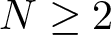
In this article, we wish to extend the results in [Reference Cingolani and Weth16] to any dimension  $N \geq 2$. This problem contains some new and delicate aspects related to the quasilinear context in which the maximization will set up.
Firstly we consider the unit ball
 \begin{equation*}
{\mathcal B}_1:= \{u \in W^{1,N}_0(B_1)\::\: |\nabla u|_N \le 1 \}
\end{equation*}
where  $|\cdot |_N $ is the standard Lebesgue norm of
 $L^N(\mathbb{R}^N)$,
 $N \geq 2$.
We aim to maximize the quantity
 \begin{equation}
m_1(G,N) := \sup_{u \in {\mathcal B}_1} \Phi(u)
\end{equation}
where
 \begin{equation}
\Phi(u)= \int_{B_1} \int_{B_1} \ln \frac{1}{|x-y|}G(u(x))G(u(y))\,dx dy,
\end{equation}
and G satisfies the assumption
(G0)
 $G: \mathbb{R} \to [0,\infty)$ is even, continuous, and strictly increasing on
$[0,\infty)$. Moreover, there exist constants
$\alpha,c \gt 0$ with
(1.3)\begin{equation}
G(t) \le c e^{\alpha |t|^{N/(N-1)}} \qquad \text{for}\ t \in \mathbb{R}.
\end{equation}


Since the logarithmic kernel function in (1.2) changes sign, it is not a priori clear that the double integral in (1.2) has a well-defined value. This can be proved, splitting the kernel  $\ln \frac{1}{|\,\cdot\,|}$ into its positive and negative part and seeing Φ as the difference of two finite functionals
 $\Phi_\pm$.
In order to study the maximization problem, we stress that the value  $\alpha_N:= N \omega_{N-1}^{1/(N-1)}$, where
 $\omega_{N-1}$ is the measure of the surface of the unit ball of
 $\mathbb{R}^N$, plays a key role. We stress that
 $\omega_{N-1}$ tends to zero as the dimension goes to
 $+ \infty$.
We begin to remark that if G satisfies  $(G_0)$ with
 $\alpha \lt \alpha_N$ then
 \begin{equation}
m_1(G,N) := \sup_{u \in {\mathcal B}_1} \Phi(u) \lt \infty.
\end{equation}
Indeed, let  $u \in {\mathcal B}_1 \cap L^\infty(B_1)$, and let
 $v:= 1_{B_1}G(u)$. Then
 $v \le c_1 e^{\alpha |u|^{N/(N-1)}}$ and
 \begin{equation*}
v \ln v \le c_1 e^{\alpha |u|^{N/(N-1)}} \Bigl(\alpha |u|^{N/(N-1)} + \ln c_1 \Bigr) \le c_2 e^{\alpha_N |u|^{N/(N-1)}}
\end{equation*}
with a constant  $c_2 \gt 0$. By the Trudinger–Moser inequality [Reference Moser30, Reference Trudinger38]
 \begin{equation}
\sup_{u \in {\mathcal B}_1} \int_\Omega e^{\alpha_N |u|^{N/(N-1)}} dx = c(B_1) \lt + \infty
\end{equation}
it thus follows that
 \begin{align}
|v|_1 \le c_1 \!\int_{B_1}\! e^{\alpha_N |u|^{N/(N-1)}}dx \le c_1 c(B_1) =:c_3 \quad \!\text{and}\!\quad\int_{\mathbb{R}^N} \! v \ln v \,dx \le c_3 c(B_1)=: c_4. \nonumber\\
\end{align}
From (1.4) and the logarithmic Hardy–Littlewood–Sobolev inequality [Reference Beckner3, theorem 2], we infer that
 \begin{align*}
\Phi(u)= \int_{\mathbb{R}^N} \!\int_{\mathbb{R}^N} \!\ln \frac{1}{|x-y|}v(x)v(y)\,dx dy
&\le \frac{|v|_{1}}{2}\Bigl(|v|_1 \bigl(c_5 +\bigl|\ln |v|_1\bigr|\bigr) + \int_{\mathbb{R}^N}\! v \ln v\,dx\Bigr)\\
&\le \frac{c_3}{2}\bigl(c_3 \bigl(c_5 + |\ln c_3|\bigr) + c_4\bigr) \lt \infty,
\end{align*}
where  $c_5 \gt 0$ is an explicit constant given in [Reference Beckner3, theorem 2]. For general
 $u \in {\mathcal B}_1$, the same inequality follows by approximation, and hence we have
 $m_1(G,N) \lt \infty$. We emphasize that this argument does not apply in the case where G has critical growth.
As in [Reference Cingolani and Weth16], in order to derive Trudinger–Moser type inequalities in  ${\mathcal B}_1$ and the critical non-linear growth rates for these inequalities, we need to distinguish different forms of asymptotic growth of the non-linearity G.
Definition 1.1. Let  $\beta \in \mathbb{R}$. We say that
 $F:\mathbb{R} \to \mathbb{R}$ has
(i) at most β-critical growth if
$|F(s)| \leq c e^{\alpha_N |s|^{N/(N-1)}}(1+|s|)^\beta$ for
$s \in \mathbb{R}$ with some constant c > 0.(ii) at least β-critical growth if there exist
$s_0, c \gt 0$ with the property that
\begin{equation*}
|F(s)| \ge c\ e^{\alpha_N |s|^{N/(N-1)}}|s|^\beta\qquad \text{for}\ |s| \ge s_0.
\end{equation*}


In the following theorem, we deal with the critical growths.
Theorem 1.2. Suppose that G satisfies  $(G_0)$.
(i) If G has at most β-critical growth for some
$\beta \le -\frac{N}{2(N-1)}$, then
\begin{equation*}
m_1(N, G) := \sup_{u \in {\mathcal B}_1} \Phi(u) \lt \infty.
\end{equation*}(ii) If G has at most β-critical growth for some
$\beta \lt -\frac{N}{2(N-1)}$, then
$m_1(N,G)$ is attained, and every maximizer for Φ in
${\mathcal B}_1$ is, up to sign, a radial and radially decreasing function in
${\mathcal B}_1$.(iii) If G has at least β critical growth for some
$\beta \gt -\frac{N}{2(N-1)} $, then
$m_1(N,G)= \infty$.


We remark that it remains an open problem whether the functional Φ attains a maximum in  ${\mathcal B}_1$ if G has at most β-critical growth for
 $\beta = -\frac{N}{2(N-1)}$.
For N = 2 and  $\beta =-1$, a delicate blow-up analysis has been performed for special non-linearity g in the recent article [Reference Cingolani, Weth and Yu17]. We conjecture that a blow-up analysis can be performed in the quasilinear context to prove extremal functions in correspondence of the threshold
 $\beta = -\frac{N}{2(N-1)}$. Next, we wish to state logarithmic Trudinger–Moser type inequalities in the entire space
 $\mathbb{R}^N$.
We define
 \begin{equation*}
{\mathcal B}_{\infty} := \{u \in W^{1,N}(\mathbb{R}^N)\::\: \|u\|_N \le 1\}
\end{equation*}
where  $\|u\|^N_N := ( |\nabla u|^N + |u|^N )$ is the standard norm on
 $W^{1,N}(\mathbb{R}^N)$.
We study the maximization problem
 \begin{equation}
m_\infty(N,G):= \max_{u \in {\mathcal B}_\infty} \Psi(u)
\end{equation}
where
 \begin{equation}
\Psi(u):= \int_{\mathbb{R}^N} \int_{\mathbb{R}^N} \ln \!\frac{1}{|x-y|}\, G(u(x))G(u(y))\,dx dy.
\end{equation}
In view of the Moser–Trudinger inequality in  $\mathbb{R}^N$ [Reference Li and Ruf24, Reference Ruf31], we assume additionally on G:
(G1) satisfies
$(G_0)$, and
$G(t)=O(\vert t\vert^{N/2})$ as t → 0.


We notice that as a consequence of assumption  $(G_1)$, the functional
 \begin{equation*}\Psi_+(u)= \int_{\mathbb{R}^N} \int_{\mathbb{R}^N} \ln^+ \!\frac{1}{|x-y|}\, G(u(x))G(u(y))\,dx dy \lt \infty\end{equation*}
for every  $u \in W^{1,N}(\mathbb{R}^N)$. Therefore set
 \begin{align*}
\Psi_-(u)&= \int_{\mathbb{R}^N} \int_{\mathbb{R}^N} \ln^+\! |x-y|\, G(u(x))G(u(y))\,dx dy
\end{align*}
we have
 \begin{align}
\Psi(u):= \int_{\mathbb{R}^N} \int_{\mathbb{R}^N} \ln \!\frac{1}{|x-y|}\, G(u(x))G(u(y))\,dx dy =
\Psi_+(u) -\Psi_-(u) \quad \in [-\infty,\infty) \nonumber\\
\end{align}
is well defined for every  $u \in W^{1,N}(\mathbb{R}^N)$.
We state our main result.
Theorem 1.3. Suppose that G satisfies  $(G_1)$.
(i) If G has at most β-critical growth for some
$\beta \le -\frac{N}{2(N-1)}$, then
\begin{equation*}
m_\infty(N, G):= \sup_{u \in {\mathcal B}_\infty}\Psi \lt \infty.
\end{equation*}(ii) If G has at most β-critical growth for some
$\beta \lt -\frac{N}{2(N-1)}$, then the value
$m_\infty(N, G)$ is attained, and every maximizer for Ψ in
${\mathcal B}_\infty$ is, up to sign and translation, a radial and radially decreasing function in
${\mathcal B}_\infty$.(iii) If G has at least β critical growth for some
$\beta \gt -\frac{N}{2(N-1)}$, then
\begin{equation*}
m_\infty(N, G)= \infty
\end{equation*}in the sense that there exists a sequence
$(u_n)_n$ in
${\mathcal B}_\infty$ with
$\Psi_\pm(u_n) \lt \infty$ for every
$n \in \mathbb{N}$ and
$\Psi(u_n) \to \infty$ as
$n \to \infty$.


In theorem 1.3, using the Radial Lemma in  $\mathbb{R}^N$, we pass from the maximization problem on
 $\mathbb{R}^N$ to the one on the ball. Compared to [Reference Cingolani and Weth16], this construction is more involved in dimension
 $N \geq 3$ and requires new delicate estimates.
Finally, as theorem 1.2(i) and theorem 1.3(i) yield the existence of maximizers, the question arises whether these maximizers satisfy a corresponding Euler–Lagrange equation. Due to the weak growth conditions imposed on the non-linearity G, this is not immediate. We can give an answer to this problem under natural additional assumptions.
Theorem 1.4. Suppose that  $G \in C^1(\mathbb{R})$, and suppose that
 $g:= G'$ satisfies
 \begin{equation}
g(t) \le c e^{\alpha |t|^{N/(N-1)}} \qquad \text{for}\ t \in \mathbb{R}\ \text{with some constants}\ \alpha,c \gt 0.
\end{equation}
(i) If G satisfies
$(G_0)$ and u is a maximizer of Φ on
${\mathcal B}_1$, then there exists
$\theta \in \mathbb{R}$ such that u satisfies the associated Euler–Lagrange equation in weak sense, i.e.,
(1.11)\begin{align}
\int_{B_1}|\nabla u|^{N-2} \nabla u \nabla \varphi \,dx &= \theta
\int_{B_1} \ln \frac{1}{|\cdot|}*\bigl(1_{B_1} G(u)\bigr)g(u)\varphi\,dx \nonumber\\ &\qquad\qquad\qquad \text{for all}\ \varphi \in W^{1,N}_0(B_1).
\end{align}(ii) If G satisfies
$(G_1)$ and u is a maximizer of Ψ on
${\mathcal B}_\infty$, then there exists
$\theta \in \mathbb{R}$ such that u satisfies the associated Euler–Lagrange equation weak sense, i.e.,
(1.12)\begin{equation}
\int_{\mathbb{R}^N}\bigl(|\nabla u|^{N-2}\nabla u \nabla \varphi + |u|^{N-2} u \varphi\bigr) \,dx = \theta
\int_{\mathbb{R}^N} (\ln \frac{1}{|\cdot|}*G(u))g(u)\varphi\,dx
\end{equation}for all
$\varphi \in W^{1,N}_0(\mathbb{R}^N)$ with bounded support.


Differently to the planar case, the maximization problem in  $\mathbb{R}^N$ leads to a quasilinear Choquard equation. As noticed in [Reference Bucur, Cassani and Tarsi9] (see also remark (6.3)), the integro-differential problem
 $(1.12)$ in
 $\mathbb{R}^N$ can be derived by the N-Laplacian Schrödinger equation strongly coupled with a higher order fractional Poisson equation. When the order of the Riesz potential α is equal to the Euclidean dimension N, the system turns out to be related to a non-local logarithmic Choquard type equation. Let
 $I_N(x) = \frac{1}{\gamma_N}\log \frac{1}{|x|}$ be the logarithmic Riesz potential. By setting
 $w:= I_N \ast G(u)$, Eq. (1.12) becomes formally equivalent to the non-linear system
 \begin{equation}
\left\{
\begin{aligned}
-\Delta_N u + |u|^{N-2}u &= \theta \, w g(u) &&\qquad \text{in}\ \mathbb{R}^N,\\
(-\Delta)^{N/2} w &= G(u) &&\qquad \text{in}\ \mathbb{R}^N.\\
\end{aligned}
\right.
\end{equation}
More precisely, if u is a solution of the logarithmic Choquard equation, then the couple  $(u, I_N \ast G(u))$ gives a distributional solution of the Schrödinger–Poisson system. The contrary it is not still clear, in particular with respect to the functional setting (see [Reference Bucur, Cassani and Tarsi9] and also [Reference Cassani, Liu and Romani12, Reference Cassani, Liu and Romani13] for the quasilinear fractional counterpart).
It remains a challenging question to investigate the qualitative properties of the solution pair (u, w) of the quasilinear and fractional system (1.13) by moving plane techniques. For the planar case, some qualitative results have been obtained in [Reference Cingolani and Weth16]. We also mention the recent article [Reference Cassani, Liu and Romani12] for the fractional quasilinear setting under additional regularity condition on the solution.
An other open problem is the derivation of Trudinger–Moser inequalities for arbitrary subdomains of  $\mathbb{R}^N$. As conjectured in [Reference Cingolani and Weth16] for N = 2, the question whether maximizers exist in critical cases seems quite challenging and might depend on the geometry of the domain.
The article is organized as follows. In §2, we establish some preliminaries related to some non-local interaction energies. In §3, we study Trudinger–Moser inequalities with logarithmic convolution potentials when the domain is a ball and we establish theorem 1.2. Section 4 is concerned with the maximization problem when the domain is the entire space  $\mathbb{R}^N$ and contains the proof of theorem 1.3. In §5, we show that such extremal functions satisfy Euler–Lagrange equations in a weak sense, and we prove theorem 1.4.
2. Two quadratics forms
We first introduce some notation. We denote by  ${\mathcal M}(\mathbb{R}^N)$ the space of real-valued measurable functions
 $\mathbb{R}^N$, and we let
 ${\mathcal M}_+(\mathbb{R}^N)$ to denote the subset of non-negative functions in
 ${\mathcal M}(\mathbb{R}^N)$. If
 $\Omega \subset \mathbb{R}^N$ is a measurable subset and u is a real-valued measurable function on Ω, we also regard u as a function in
 ${\mathcal M}(\mathbb{R}^N)$ by trivial extension. We then define the quadratic forms
 $b_\pm: {\mathcal M}_+(\mathbb{R}^N) \to [0,\infty]$ by
 \begin{equation}
(v,w) \mapsto b_{+}(v,w)=\int_{\mathbb{R}^N} \int_{\mathbb{R}^N} \ln^{+} \frac{1}{\lvert x-y\rvert} v(x)v(y) dxdy,
\end{equation}
 \begin{equation}
(v,w) \mapsto b_{-}(v,w)=\int_{\mathbb{R}^N} \int_{\mathbb{R}^N} \ln^{+} \lvert x-y\rvert v(x)v(y) dxdy.
\end{equation}
Moreover, we define
 \begin{equation*}
b_{0}(v,w):=b_{+}(v,w)-b_{-}(v,w) \in [-\infty, \infty)
\end{equation*}
for all functions v, $w \in \mathcal{M}(\mathbb{R}^N)$ for which
 $b_{+}(v,w) \lt \infty$. For the sake of brevity, we also set
 \begin{equation*}
b_{\pm}(v)=b_{\pm}(v,v) \ \ \ \ \text{and}\ \ \ \ b_0(v):=b_0(v,v) \ \ \text{if} \ \ b_{+}(v) \lt \infty.
\end{equation*}
Next we define
 \begin{equation*}
\lvert v\rvert_{*}:=\int_{\mathbb{R}^N} \ln(1+\lvert x\rvert) \lvert v\rvert dx \quad \in [0, \infty], \ \ \ \text{for}\ v \in \mathcal{M}(\mathbb{R}^N)
\end{equation*}
and we consider the space
 \begin{equation*}
L^{1}_{ln}(\mathbb{R}^N):=\{v \in L^{1}(\mathbb{R}^N), \ \ \lvert v\rvert_{*} \lt \infty \}.
\end{equation*}
Taking into account that
 \begin{equation*}
[\ln^{+} \lvert\cdot\rvert \ast v](x)\leq \ln(1 + \lvert x\rvert)\lvert v\rvert_1+\lvert v\rvert_{*}\,\,\,\,\,\,\,\,\,\,\,\, x \in \mathbb{R}^N
\end{equation*}
we have
 \begin{equation}
\ln^{+} \lvert\cdot\rvert \ast v \in L^{\infty}_{loc}(\mathbb{R}^N)\ \ \ \ \text{for}\ \ v \in L^{1}_{ln}(\mathbb{R}^N)
\end{equation}
We also infer that
 \begin{equation}
b_{-}(v,w)\leq \lvert v\rvert_1 \lvert w\rvert_* + \lvert w\rvert_1\lvert v\rvert_* \lt +\infty\ \text{for } v,w \in L_{ln}^1(\mathbb{R}^N)\cap \mathcal{M}_+(\mathbb{R}^N).
\end{equation}
Lemma 2.1. Let  $v,w \in {\mathcal M}_+(\mathbb{R}^N)$ be given with
 $v \not \equiv 0$,
 $w \in L^1_{loc}(\mathbb{R}^N)$ and
 $b_-(v,w) \lt \infty$. Then
 $w \in L_{ln}^1(\mathbb{R}^N)$.
Proof. Since  $v \not \equiv 0$, there exist constants
 $R \gt 1,c \gt 0$ and a measurable subset
 $A \subset B_{R}$ of positive measure with
 $v \ge c$ on A. Then we have
 $|x-y| \ge \frac{|y|}{2}\ge R$ for
 $x \in A$,
 $y \in \mathbb{R}^{N} \setminus B_{2R}$ and therefore
 \begin{equation*}
b_-(v,w)=\int_{\mathbb{R}^N}\int_{\mathbb{R}^N} \ln ^+\lvert x-y\rvert v(x)w(y)dx dy\geq c\int_{A}\int_{\mathbb{R}^N} w(y)\ln ^+\lvert x-y\rvert dy
\end{equation*}
 \begin{equation*}
\geq c\lvert A\rvert \int_{\mathbb{R}^N\setminus B_{2R}} w(y)\ln ^+\frac{\lvert y\rvert}{2}dy\geq C_1 \int_{\mathbb{R}^N\setminus B_{2R}} w(y) \ln^{+}(1+\lvert y\rvert)dy
\end{equation*}
 \begin{equation*}
\geq c_1 \bigg(\int_{\mathbb{R}^N} w(y)\ln (1+\lvert y\rvert) dy-\ln (1+2R)\int_{B_{2R}}w(y)dy\bigg)
\end{equation*}
 \begin{equation*}
= c_1 (\lvert w\rvert_*-\ln (1+2R)\lVert w\rVert_{L^1(B_{2R})})
\end{equation*}
with a constant  $c_1 \gt 0$. Hence
 $|w|_* \lt \infty$, and therefore
 $w \in L_{ln}^1(\mathbb{R}^N)$.
The following corollary is immediate.
Corollary 2.2. If  $v \in L^1_{loc}(\mathbb{R}^N)$ is non-negative and satisfies
 $b_-(v) \lt \infty$, then
 $v \in L_{ln}^1(\mathbb{R}^N)$.
We also note that by (2.4) we have
 \begin{equation}
b_-(v,w) \le |v|_1 |w|_* +|w|_1 |v|_* \le \bigl(2 \ln 2\bigr) |v|_1 |w|_1 \lt \infty
\end{equation}
for  $v,w \in L^1(\mathbb{R}^N)$ with
 $v \equiv w \equiv 0$ on
 $\mathbb{R}^N \setminus B_1$.
Next, let  $v^*$ denote the Schwarz symmetrization of a function
 $v \in {\mathcal M}(\mathbb{R}^N)$. Thus
 $v^* \in {\mathcal M}_+(\mathbb{R}^N)$ is radial and non-increasing in the radial variable. We recall the following Riesz rearrangement type inequalities that can be derived arguing as in [Reference Cingolani and Weth15].
Lemma 2.3. Let  $v \in {\mathcal M}_+(\mathbb{R}^N)$. Then we have:
(i)
$b_+(v^*) \geq b_+(v)$;(ii)
$b_-(v^*) \leq b_-(v)$;(iii) If
$b_+(v^*) \lt \infty$, then
(2.6)\begin{equation}
b_0(v^*)\ge b_0(v).
\end{equation}If, in addition,
$v \in L^p(\mathbb{R}^N)$ for some
$p \in [1,2]$ and
$b_+(v) \lt \infty$ and
$b_-(v) \lt \infty$, then equality holds in (2.6) if and only if
$v = v^*(\cdot - x_0)$ for some
$x_0 \in \mathbb{R}^N$.


Here we note that, under assumption (iii), both  $b_0(v^*)$ and
 $b_0(v)$ are well defined by the inequalities in (i) and (ii).
Lemma 2.4. Let  $v \in L_{ln}^1 (\mathbb{R}^N)$ be a non-negative radial function. Then the convolution
 $[(\ln |\cdot|) * v](x) \in \mathbb{R}$ is well defined for
 $x \in \mathbb{R}^N \setminus \{0\}$ and given by
 \begin{equation}
[(\ln |\cdot|) * v](x)= \ln |x| \int_{B_{|x|}} v(y)dy + \int_{\mathbb{R}^N \setminus B_{|x|}} \ln |y| v(y)dy.
\end{equation}
Proof. Let  $x \in \mathbb{R}^N \setminus \{0\}$. For non-negative radial functions
 $v \in L^\infty(\mathbb{R}^N)$ with bounded support, both the LHS and RHS of (2.7) are well defined, and the formula holds by Newton’s theorem (see for instance [Reference Lieb and Loss25, theorem 9.7]).
Next we let  $v \in L_{ln}^1 (\mathbb{R}^N)$ be a non-negative radial function. We have
 \begin{equation}
[(\ln^+ \! |\cdot| * v](x) \le \ln (1+ |x|) |v|_1 + |v|_* \lt \infty.
\end{equation}
We consider an increasing sequence of non-negative radial functions  $v_n \in L^\infty(\mathbb{R}^N)$ with bounded support and such that
 $v_n \to v$ pointwisely. Then by monotone convergence theorem
 \begin{align*}
& [(\ln^+ \!|\cdot|) * v_n](x) \le [(\ln^+ \! |\cdot| * v](x) \quad \text{for all}\ n \qquad \text{and}\qquad \\ &\lim_{n \to \infty} [(\ln^+ \!|\cdot|) * v_n](x) = [(\ln^+ \! |\cdot| * v](x).
\end{align*}
Moreover, again by monotone convergence,
 \begin{align*}
[(\ln^+ \!\frac{1}{|\cdot|}) * v](x)& = \lim_{n \to \infty}
[(\ln^+ \!\frac{1}{|\cdot|}) * v_n](x)\\ &= \lim_{n \to \infty} \Bigl(
[(\ln^+ \!|\cdot|) * v_n](x)-
[(\ln |\cdot|) * v_n](x)\Bigr)\\
&= [(\ln^+ \! |\cdot| * v](x)- \Bigl( \ln |x| \int_{B_{|x|}} v(y)dy + \int_{\mathbb{R}^N \setminus B_{|x|}} \ln |y| v(y)dy \Bigr).
\end{align*}
We thus conclude  $(2.7)$.
From lemma 2.1, lemma 2.4, and Fubini’s theorem, we have the following result.
Corollary 2.5. Let  $v,w \in L^1_{loc}(\mathbb{R}^N)$ be non-negative radial functions.
(i) If
$b_\pm(v,w) \lt \infty$ and
$v \not \equiv 0$,
$w \not \equiv 0$, then
$v,w \in L_{ln}^1(\mathbb{R}^N)$ and
(2.9)\begin{align}
\frac{b_0(v,w)}{\omega_{N-1}^2}&=\int_{0}^{\infty} r^{N-1} v(r)\bigg( \ln \frac{1}{r} \int_{0}^{r}\rho^{N-1}w(\rho)d\rho +\int_{r}^{+\infty}\rho^{N-1}\ln\dfrac{1}{\rho}w(\rho)d\rho\bigg)\nonumber\\ & dr
\end{align}(2.10)\begin{align}
& = \int_{0}^{1} r^{N-1} w(r)\bigg( \ln \frac{1}{r} \int_{0}^{r}\rho^{N-1}v(\rho)d\rho +\int_{r}^{+\infty}\rho^{N-1}\ln\dfrac{1}{\rho}v(\rho)d\rho\bigg)dr.
\end{align}(ii) If
$b_\pm(v) \lt \infty$, then
$v \in L_{ln}^1(\mathbb{R}^N)$ and
\begin{equation*}
\dfrac{b_0(v)}{\omega_{N-1}^2}=2\int_{0}^{\infty} r^{N-1} v(r)\ln \frac{1}{r} \int_{0}^{r}\rho^{N-1}v(\rho)d\rho dr.
\end{equation*}


3. Preliminary estimates: the unit ball versus the entire space
From [Reference Lieb and Loss25, lemma 7.17], we can deduce the following Pólya–Szego inequality.
Lemma 3.1. For any  $u \in W^{1,N}(\mathbb{R}^N)$, we have
 $u^* \in W^{1,N}(\mathbb{R}^N)$ and
 \begin{equation*}
|u^*|_N = |u|_N, \quad |\nabla u^*|_N \le |\nabla u|_N.
\end{equation*}
Consequently, we have  $u^* \in {\mathcal B}_1$ if
 $u \in {\mathcal B}_1$ and
 $u^* \in {\mathcal B}_\infty$ if
 $u \in {\mathcal B}_\infty$.
Lemma 3.2. Let  $g: \mathbb{R} \to \mathbb{R}$ be a continuous function satisfying
 \begin{equation}
|g(t)| \le c e^{\alpha |t|^{N/(N-1)}} \qquad \text{for}\ t \in \mathbb{R}\ \text{with constants}\ c,\alpha \gt 0.
\end{equation}
(i) If
$u \in W^{1,N}_0(B_1)$, then we have
$g(u) \in L^s(B_1)$ for
$1 \le s \lt \infty$ and
\begin{equation*}
\ln^+ \frac{1}{|\cdot|} * \bigl(1_{B_1} g(u)\bigr), \quad \ln^+ |\cdot| * \bigl(1_{B_1} g(u)\bigr) \quad \in L^\infty(B_1).
\end{equation*}(ii) If
$u \in W^{1,N}(\mathbb{R}^N)$, then
$g(u) \in L^s_{loc}(\mathbb{R}^N)$ for
$1 \le s \lt \infty$.If, in addition,
$\vert g(t)\vert=O(\vert t\vert^{N/2})$ as t → 0, then
$g(u) \in L^2(\mathbb{R}^N)$ and
\begin{equation*}
\ln^+ \frac{1}{|\cdot|} * g(u) \quad \in L^s(\mathbb{R}^N) \qquad \text{for}\ 2 \le s \le \infty.
\end{equation*}


Proof. We first recall that
 \begin{equation}
\int_{B_1}e^{\delta |u|^{N/(N-1)}}dx \lt \infty \qquad \text{for any}\ u \in W^{1,N}_0(B_1)\ \text{and any}\ \delta \gt 0
\end{equation}
as shown in [Reference Trudinger38] (see also [Reference Lions26, p. 195]). To prove (i), we now let  $u \in W^{1,N}_0(B_1)$ and define
 $v= 1_{B_1} g(u)$. By (3.1) and (3.2), we have
 $v \in L^s(\mathbb{R}^N)$ for
 $s \in [1,\infty)$. In fact
 \begin{equation*}
\int_{\mathbb{R}^N}\lvert v\rvert^s dx=\int_{B_{1}}\lvert g(u)\rvert^s dx \leq c^s \int_{B_{1}}(e^{\alpha |u|^{N/(N-1)}})^s dx \,t +\infty.
\end{equation*}
Moreover,
 \begin{equation*}
\int_{\mathbb{R}^N}\bigg|\ln^+\dfrac{1}{\lvert x\rvert}\bigg|^s dx=\int_{\mathbb{R}^N}\bigg(\ln^+\dfrac{1}{\lvert x\rvert}\bigg)^s dx=\omega_{N-1}\int_0^1 \ln^s\dfrac{1}{r}r^{N-1}dr\,t +\infty;
\end{equation*}
 \begin{equation}
\ln^+ \frac{1}{|\cdot|} \in L^s(\mathbb{R}^N) \qquad \text{for}\ s \in [1,\infty).
\end{equation}
Choosing s = 2, we deduce by Young’s inequality that  $\ln^+\frac{1}{|\cdot|} * v \in L^\infty(\mathbb{R}^N)$. Moreover, we deduce that
 \begin{equation*}
[\ln^+|\cdot| * v](x) = \int_{B_1}\ln^+|x-y|v(y)\,dy \lt \ln 2 |v|_1 \qquad \text{for}\ x \in B_1
\end{equation*}
and therefore  $\ln^+|\cdot| * v \in L^\infty(B_1)$.
(ii) Let  $u \in W^{1,N}(\mathbb{R}^N)$. For given R > 0 and
 $s \in [1,\infty)$, we wish to prove that
 $1_{B_R}g(u) \in L^s(\mathbb{R}^N)$. For this, by (3.1), we may assume without loss of generality that
 $g(t)=e^{\alpha |t|^{N/(N-1)}}$ for
 $t \in \mathbb{R}$. Then we have
 $[1_{B_R}g(u)]^* \le 1_{B_R}[g(u)]^* = 1_{B_R}g(u^*)$ and therefore
 \begin{equation*}
\bigl|1_{B_R}g(u)\bigr|_s = \bigl|[1_{B_R}g(u)]^*\bigr|_s \le \bigl| 1_{B_R}g(u^*) \bigr|_s,
\end{equation*}
so it suffices to consider the case where  $u=u^*$ in the following. Let
 $v := g(u)$. Since u is locally bounded on
 $\mathbb{R}^N \setminus \{0\}$, the same is true for v. It thus suffices to prove that
 $v \in L^s(B_1)$. For this, we consider the function
 \begin{equation*}
U := \Bigl(1 +u(1)^{\frac{N}{N-1}}\Bigr)^{\frac{N-1}{N}}[u^{\frac{N}{2(N-1)}}-u^{\frac{N}{2(N-1)}}(1)]_+^{\frac{2(N-1)}{N}}.
\end{equation*}
We prove that  $U\in W^{1,N}_0(B_1)$. Indeed
 \begin{align*}
&\int_{B_1} |\nabla U|^N\, dx = \Bigl(1 +u(1)^{\frac{N}{N-1}}\Bigr)^{N-1}\int_{B_1} |\nabla [u^{\frac{N}{2(N-1)}}-u^{\frac{N}{2(N-1)}}(1)]_+^{\frac{2(N-1)}{N}}|^N\, dx \\ &
\leq 2^{N-2} \Bigl(1+ u(1)^N\Bigr) \int_{B_1} [u^{\frac{N}{2(N-1)}}-u^{\frac{N}{2(N-1)}}(1)]_+^{N-2} u^{\frac{(2-N)N}{2(N-1)}} |\nabla u|^N\, dx \\ & \leq 2^{N-2} \Bigl(1+u(1)^N\Bigr) \int_{B_1} u^{\frac{N(N-2)}{2(N-1)}} u^{\frac{(2-N)N}{2(N-1)}} |\nabla u|^N\, dx\\ & = 2^{N-2} \Bigl(1+ u(1)^N\Bigr) \int_{B_1}|\nabla u|^N\, dx \lt + \infty.
\end{align*}
Let
 \begin{equation*}
\varphi=u^{\frac{N}{2(N-1)}}
\end{equation*}
for which holds
 \begin{equation*}
\varphi^2=[\varphi-\varphi(1)]^2+2\varphi(1)[\varphi-\varphi(1)]^+ +\varphi^2(1)\leq [\varphi-\varphi(1)]^2+\varphi^2(1)[\varphi-\varphi(1)]^2+1 +\varphi^2(1)
\end{equation*}
 \begin{equation}
=\varphi^2(1)+1+[\varphi-\varphi(1)]^2(1+\varphi^2(1)).
\end{equation}
By (3.4), we have
 \begin{equation*}
u^{\frac{N}{N-1}} \leq u^{\frac{N}{N-1}}(1)+1+ \Bigl(1+ u^{\frac{N}{N-1}}(1)\Bigr)\Bigl[u^{\frac{N}{2(N-1)}}-u^{\frac{N}{2(N-1)}}(1)\Bigr]^{2}_+
\end{equation*}
and thus, by the definition of U,
 \begin{equation}
u^{\frac{N}{N-1}}\leq u^{\frac{N}{N-1}}(1) +1+U^{\frac{N}{N-1}}.
\end{equation}
From (3.5), we have
 \begin{equation*}
\int_{B_1} |v|^s\,dx = \int_{B_1} e^{s\alpha u^{N/(N-1)}}\,dx \le
e^{s \alpha \bigl(1+ u^{N/(N-1)}(1)\bigr)} \int_{B_1}e^{s \alpha U^{N/(N-1)}}\,dx \lt \infty
\end{equation*}
by (3.2). It thus follows that  $v \in L^s_{loc}(\mathbb{R}^N)$. Next we assume that
 $\vert g(t)\vert=O(\vert t\vert^{N/2})$ as t → 0. To prove that
 $v=g(u) \in L^2(\mathbb{R}^N)$, by (3.1), it suffices to consider the case where
 $g(t)=e^{\alpha t^{N/(N-1)}}-1$. It then follows that
 $|g(u)|_N = |[g(u)]^*|_N =|g(u^*)|_N$, so we may assume again that
 $u=u^*$. Then u is bounded on
 $\mathbb{R}^N \setminus B_1$, and therefore it follows
 $\vert v\vert\leq C\vert u\vert^{N/2}$ on
 $\mathbb{R}^N \setminus B_1$, so
 $v 1_{\mathbb{R}^N \setminus B_1} \in L^2(\mathbb{R}^N)$ since
 $u\in L^N(\mathbb{R}^N)$. Since we already proved that
 $v 1_{B_1} \in L^2(\mathbb{R}^N)$, we infer that
 $v \in L^2(\mathbb{R}^N)$. By (3.3) and Young’s inequality, it now follows that
 $\ln^+\frac{1}{|\cdot|} * v \in L^s(\mathbb{R}^N)$ for
 $2 \le s \le \infty$.
From lemma 3.2, applied to g = G, we infer the following corollary.
(i) If G satisfies assumption
$(G_0)$ and
$u \in W^{1,N}_0(B_1)$, then
$\Phi_\pm(u) \lt \infty$.(ii) If G satisfies assumption
$(G_1)$ and
$u \in W^{1,N}(\mathbb{R}^N)$, then
$\Psi_+(u) \lt \infty$.


Remark 3.4. (i) If G satisfies  $(G_0)$, it follows from corollary 3.3(i) and corollary 2.5(ii) that
 \begin{align*}
&\Phi(u)= 2\omega_{N-1}^2\int_{0}^{1} r^{N-1} G(u(r))\ln \frac{1}{r} \int_{0}^{r}\rho^{N-1}G(u(\rho))d\rho dr \\ & \gt 2\omega_{N-1}^2\int_{0}^{1} r^{N-1} G(u(0))\ln \frac{1}{r} \int_{0}^{r}\rho^{N-1}G(u(0))d\rho dr=\Phi(0)
\end{align*}
for every  $u \in W^{1,N}_0(B_1) \setminus \{0\}$. Hence
 $m_1(N, G) \in \bigl(\Phi(0), \infty \bigr]$, and therefore
 $m_1(N, G)$ is not attained at u = 0.
(ii) If G satisfies  $(G_1)$, we have
 \begin{align*}
\Psi(u)=\Phi(u) \gt \Phi(0)= \Psi(0)=0\quad \text{for every function}& \ u \in W^{1,N}_0(B_1) \subset W^{1,N}(\mathbb{R}^N)\ \\ &\qquad\qquad\qquad\quad \text{with}\ u \not \equiv 0.
\end{align*}
In particular, we have  $m_\infty(N, G) \in \bigl(0, \infty \bigr]$, and therefore
 $m_\infty(N, G)$ is not attained at u = 0.
Lemma 3.5. Let  $\beta_1, \beta_2\le 0$ satisfy
 $\beta_1 + \beta_2 \le -\dfrac{N}{N-1}$, and let
 ${\mathcal B}_{1,rad}:= \{u \in {\mathcal B}_1\::\: u\ \text{radial}\}$. Then
 \begin{equation}
\Phi_{\beta_1,\beta_2}(u_1,u_2):= \omega_{N-1}^2\int_0^1 r^{N-1}(1+\lvert u_1(r)\rvert)^{\beta_1}e^{\alpha_N |u_1|^{N/(N-1)}(r)}\ln\dfrac{1}{r} \times\end{equation}
 \begin{equation*}
\times \int_0^r \rho^{N-1}(1+\lvert u_2(\rho)\rvert)^{\beta_2}e^{\alpha_N|u_2|^{N/(N-1)}(\rho)}d\rho\, dr
\end{equation*}
defines a bounded functional  $\Phi_{\beta_1,\beta_2}: {\mathcal B}_{1,rad} \times {\mathcal B}_{1,rad} \to [0,\infty)$.
Proof. We fix  $0 \lt \varepsilon \lt 1 /\alpha_N$. Moreover, we let
 $u_1,u_2 \in {\mathcal B}_{1,rad}$, and we define
 \begin{align*}
A_i^+& := \{r \in (0,1]\::\: u_i(r) \ge [ \varepsilon(-\ln r)]^{(N-1)/N}\},\qquad\\
A_i^-& := \{r \in (0,1]\::\: u_i(r) \lt [\varepsilon(-\ln r)]^{(N-1)/N} \}
\end{align*}
for  $i= 1,2$. With
 $v_i:= (1+|u_i|)^{\beta_i} e^{\alpha_N u_i^{N/(N-1)}}$ we then have
 \begin{equation}
v_i(r) \le e^{\alpha_N |u_i|^{N/(N-1)}(r)} \le r^{-\alpha_N \varepsilon}\qquad \text{for}\ r \in A_i^-,
\end{equation}
and
 \begin{equation}
v_i(r) \le \bigl(1+ [ \varepsilon(-\ln r)]^{(N-1)/N}\bigr)^{\beta_i} e^{\alpha_N |u_i|^{N/(N-1)}(r)} \qquad \text{for}\ r \in A_i^+.
\end{equation}
Moreover,
 \begin{align*}
&\Phi_{\beta_1,\beta_2}(u_1,u_2)
= \omega_{N-1}^2\bigg(\int_{A_1^+} r^{N-1} v_1(r) \ln \frac{1}{r} \int_{A_2^+ \cap [0,r]} \rho^{N-1} v_2(\rho)d\rho dr+\\
&+ \int_{A_1^-} r^{N-1} v_1(r) \ln \frac{1}{r} \int_{A_2^- \cap [0,r]} \rho^{N-1} v_2(\rho)d\rho dr
+ \int_{A_1^+} r^{N-1} v_1(r) \ln \frac{1}{r} \\ & \times \int_{A_2^- \cap [0,r]} \rho^{N-1} v_2(\rho)d\rho dr+\\
&+ \int_{A_1^-} r^{N-1} v_1(r) \ln \frac{1}{r} \int_{A_2^+ \cap [0,r]} \rho^{N-1} v_2(\rho)d\rho dr\bigg),
\end{align*}
where
 \begin{align*}
&\omega_{N-1}^2\int_{A_1^-} r^{N-1}v_1(r) \ln \frac{1}{r} \int_{A_2^- \cap [0,r]} \rho^{N-1} v_2(\rho)d\rho dr\\ &\quad \le\omega_{N-1}^2 \int_{A_1^-} r^{N-1-\alpha_N \varepsilon } \ln \frac{1}{r}
\int_{A_2^- \cap [0,r]} \rho^{N-1-\alpha_N \varepsilon }d\rho dr\\
&\quad \le \omega_{N-1}^2\frac{1}{N-\alpha_N\varepsilon} \int_{0}^1 r^{2N-1-2\alpha_N \varepsilon } \ln \frac{1}{r} dr =C_1 \lt \infty
\end{align*}
and
 \begin{align*}
&\omega_{N-1}^2\int_{A_1^+} r^{N-1}v_1(r) \ln \frac{1}{r} \int_{A_2^+ \cap [0,r]} \rho^{N-1} v_2(\rho)d\rho dr \\
&\le \omega_{N-1}^2\int_{0}^1 \bigl(1+ [\varepsilon(-\ln r)]^{(N-1)/N}\bigr)^{\beta_1} e^{\alpha_{N} |u_1|^{(N-1)/N}(r)}\ln \frac{1}{r} \times \\ &\times
\int_{A_2^+ \cap [0,r]} \rho^{N-1}
\bigl(1+ [\varepsilon(-\ln \rho)]^{(N-1)/N}\bigr)^{\beta_2} e^{\alpha_{N} |u_2|^{N/(N-1)}(\rho)} d\rho dr\\
&\le \omega_{N-1}^2 \int_0^1 (-\ln r)(1+ [\varepsilon(-\ln r)]^{(N-1)/N}\bigr)^{\beta_1+\beta_2}
r^{N-1} e^{\alpha_N |u_1|^{N/(N-1)}(r)} \\ &\times \int_0^r
\rho^{N-1} e^{\alpha_N |u_2|^{N/(N-1)}(\rho)}d\rho dr\\
&\le \omega_{N-1}^2\frac{1}{\varepsilon} \Bigl(\int_0^1 r^{N-1} e^{\alpha_N |u_1|^{N/(N-1)}(r)}dr \Bigr) \omega_{N-1} \Bigl(\int_0^1 \rho^{N-1} e^{\alpha_N |u_2|^{N/(N-1)}(\rho)}d\rho \Bigr)\\ &\le C_2.
\end{align*}
Here we used the assumption  $\beta_1 + \beta_2 \le -\frac{N}{(N-1)}$ and the Trudinger–Moser inequality (1.5). Moreover,
 $C_1,C_2,\dots$ are positive constants independent of
 $u_1,u_2 \in {\mathcal B}_{1,rad}$. We also have
 \begin{align*}
&\omega_{N-1}^2\int_{A_1^+} r^{N-1} v_1(r) \ln \frac{1}{r} \int_{A_2^- \cap [0,r]} \rho^{N-1} v_2(\rho)d\rho dr\\ &\le \omega_{N-1}^2 \int_{0}^1 r^{N-1} \bigl(1+ [\varepsilon(-\ln r)]^{(N-1)/N}\bigr)^{\beta_1} e^{\alpha_N |u_1|^{N/(N-1)}(r)} \ln \frac{1}{r} \\ &\times\int_{0}^r
\rho^{N-1-\alpha_N \varepsilon } d\rho dr\\
&\le \omega_{N-1}^2 \frac{1}{N-\alpha_N \varepsilon} \int_{0}^1 r^{2N-1-\alpha_N \varepsilon} \Bigl(\ln \frac{1}{r}\Bigr)e^{\alpha_N |u_1|^{N/(N-1)}(r)}\,dr \\ &\le C_3 \omega_{N-1} \int_{0}^1 r^{N-1} e^{\alpha_N |u_1|^{N/(N-1)}(r)}\,dr \le C_4
\end{align*}
and
 \begin{align*}
&\omega_{N-1}^2\int_{A_1^-} r^{N-1} v_1(r) \ln \frac{1}{r} \int_{A_2^+ \cap [0,r]} \rho^{N-1} v_2(\rho)d\rho dr\\ & \le \omega_{N-1}^2 \int_{0}^1 r^{N-1-\alpha_N \varepsilon } \ln \frac{1}{r} \int_{0}^r
\rho^{N-1} e^{\alpha_N |u_2|^{N/(N-1)}(\rho)} d\rho dr\\
& \le \omega_{N-1} \int_{0}^1 r^{N-1-\alpha_N \varepsilon} \ln \frac{1}{r}dr \omega_{N-1}\int_{0}^1
\rho^{N-1} e^{\alpha_N |u_2|^{N/(N-1)}(\rho)} d\rho \\ &\le C_5 \omega_{N-1} \int_{0}^1 r^{N-1-\alpha_N \varepsilon} \ln \frac{1}{r}\,dr \le C_6
\end{align*}
again by the Trudinger–Moser inequality (1.5). The proof is thus finished.
4. Maximization problem on the ball
In this section, we complete the proof of theorem 1.2. We recall that  ${\mathcal B}_1:= \{u \in W^{1,N}_0(B_1)\::\: |\nabla u|_N \le 1\}$, and
 \begin{equation*}
{\mathcal B}_1^*:= \{u^* \::\: u \in {\mathcal B}_1\}
\end{equation*}
denotes the corresponding Schwarz symmetrized set. By lemma 3.1, we then have  ${\mathcal B}_1^* \subset {\mathcal B}_1$.
Lemma 4.1. Suppose that G satisfies  $(G_0)$ and has at most 0-critical growth. Then the functional
 $\Phi_-$ is uniformly bounded on
 ${\mathcal B}_1$.
Proof. Let  $u \in {\mathcal B}_1$. By definition and (2.4), we have
 \begin{equation*}
\Phi_-(u)= b_-(1_{B_1}G(u),1_{B_1}G(u)) \le \bigl(2 \ln 2\bigr) |1_{B_1}G(u)|_1^2
\end{equation*}
where
 \begin{equation*}
|1_{B_1} G(u)|_1 \le c_1 \int_{B_1}e^{\alpha_N |u|^{N/(N-1)}}\,dx \le c_2
\end{equation*}
with constants  $c_1,c_2 \gt 0$ independent of u by assumption and the Trudinger–Moser inequality (1.5).
Proposition 4.2. Suppose that G satisfies  $(G_0)$ and has at most β-critical growth for some
 $\beta\le -\frac{N}{2(N-1)}$. Then we have
 \begin{align*}
m_1(N, G) \le m_1^+(N,G) \lt \infty,\qquad \text{where}\qquad m_1(N, G)&:= \sup_{{\mathcal B}_1}\Phi \quad \text{and}\quad\\ m_1^+(N, G)& := \sup_{{\mathcal B}_1}\Phi^+.
\end{align*}
Proof. By lemma 2.3, we have
 \begin{align*}
\Phi^+(u)&= b_+\bigl(1_{B_1}G(u),1_{B_1}G(u)\bigr)\le b_+\bigl([1_{B_1}G(u)]^*,[1_{B_1}G(u)]^*\bigr)\\ & = b_+\bigl(1_{B_1}G(u^*),1_{B_1}G(u^*) \bigr) = \Phi^+(u^*)
\end{align*}
for every  $u \in {\mathcal B}_1$ and since that
 ${\mathcal B}_1^* \subset {\mathcal B}_1$ we have
 \begin{equation}
m_1^+(N,G)= \sup_{u \in {\mathcal B}_1^*} \Phi^+(u).
\end{equation}
By assumption, we have
 \begin{equation}
G(s) \le c_1 \frac{e^{\alpha_N |s|^{N/(N-1)}}}{(1+ |s|)^{\frac{N}{2(N-1)}}} \qquad \text{for every}\ s \in \mathbb{R}
\end{equation}
with a constant  $c_1 \gt 0$. Let
 $u \in {\mathcal B}_1^*$ and
 $v:= 1_{B_1} G(u)$. By corollary 3.3, we then have
 $b_\pm(v) \lt \infty$. Therefore, we have, by corollary 2.5(ii) and (4.2),
 \begin{align*}
&\frac{\Phi(u)}{2\omega_{N-1}^2}=
\frac{b_0(v)}{2 \omega_{N-1}^2}= \int_{0}^{1} r^{N-1} v(r)\ln \frac{1}{r} \int_{0}^{r}\rho^{N-1}v(\rho)d\rho dr \\ &\le \int_{0}^{1} r^{N-1} c_1 \frac{e^{\alpha_N |u|^{N/(N-1)}(r)}}{(1+ |u(r)|)^{\frac{N}{2(N-1)}}}\ln \frac{1}{r} \int_{0}^{r}\rho^{N-1}c_1 \frac{e^{\alpha_N |u|^{N/(N-1)}(\rho)}}{(1+ |u(\rho)|)^{\frac{N}{2(N-1)}}}d\rho dr\\
&\le c_2
\end{align*}
with
 \begin{equation*}
c_2:= c_1^2 \sup_{u \in {\mathcal B}_{1,rad}}\Phi_{\beta_1,\beta_2}(u,u) \lt \infty,
\end{equation*}
where  ${\mathcal B}_{1,rad}$ and
 $\Phi_{\beta_1,\beta_2}$ are defined in lemma 3.5 for
 $\beta_1= \beta_2 = -\frac{N}{2(N-1)}$. Combining this inequality with lemma 4.1, we thus deduce that
 \begin{align}
\Phi_+(u) = \Phi(u) + \Phi_-(u) \le c_3 \quad \text{for}\ u \in {\mathcal B}_1^*\ \text{with}\quad
c_3 := 2\omega_{N-1}^2 c_2 + \sup_{{\mathcal B}_1} \Phi_- \lt \infty.\nonumber\\
\end{align}
Hence  $m_1^+(N, G) \le c_3 \lt \infty$, and therefore also
 $m_1(G) \le m_1^+(N, G) \lt \infty$, as claimed.
Proposition 4.3. Suppose that G satisfies  $(G_0)$ and has at least β-critical growth for some
 $\beta \gt -\frac{N}{2(N-1)}$. Then there exists a sequence of functions
 $u_n \in {\mathcal B}_1 \cap L^\infty(B_1)$ with
 $\Phi(u_n) \to \infty$ as
 $n \to \infty$.
Proof. The assumption implies the existence of a constant  $c_1 \gt 0$ with
 \begin{equation}
G(s) \ge c_1 s^\beta e^{\alpha_N |s|^{N/(N-1)}} \qquad \text{for}\ |s| \ge c_z.
\end{equation}
For  $n \in \mathbb{N}$,
 ${n \geq 2}$, we now define
 $u_n= m_n \in W^{1,N}_0(B_1) \cap L^\infty(B_1)$ as in [Reference do Ó19, p. 309], namely
 \begin{equation*}
m_n:=
\begin{cases}
\frac{1}{{\omega^{1/N}_{N-1}}} {(\ln n)^{(N-1)/N}} \quad \ 0 \leq |x| \leq \frac{1}{n}, \\
\frac{1}{{\omega^{1/N}_{N-1}}} \frac{\ln(\frac{1}{\lvert x\rvert})}{(\ln n)^{1/N}}, \quad \,\,\,\, \,\,\,\,\, \,\,\, \ \frac{1}{n} \leq |x| \leq 1.
\end{cases}
\end{equation*}
As noted in [Reference do Ó19, p. 310], we then have  $|\nabla u_n|_N \le 1$ for n large and thus
 $u_n \in {\mathcal B}_1^*$. Moreover,
 $v_n :=G(u_n) \in L^\infty(B_1)$ and therefore
 \begin{equation*}
\Phi_\pm(u_n) = b_\pm(v_n,v_n) \lt \infty \qquad \text{for}\ n \in \mathbb{N}.
\end{equation*}
By (4.4) we have, for n large,
 \begin{align*}
v_n &\ge c_1
\Bigl(\frac{1}{{\omega^{\frac{1}{N}}_{N-1}}} {(\ln n)^{\frac{N-1}{N}}}\Bigr)^{\beta}
e^{\alpha_N\Bigl(\frac{1}{{\omega^{\frac{1}{N}}_{N-1}}} {(\ln n)^{\frac{N-1}{N}}}\Bigr)^{\frac{N}{N-1}}} \\
&=c_1 \Bigl(\frac{\ln n}{{\omega^{\frac{1}{N-1}}_{N-1}}}\Bigr)^{\frac{N-1}{N}\beta} e^{\alpha_N\Bigl(\frac{\ln n}{{\omega^{\frac{1}{N-1}}_{N-1}}}\Bigr)^{\frac{N}{N-1}\frac{N-1}{N}} }\\
&\ge c_{2} (\ln n)^{\frac{N-1}{N}\beta} n^{N}
\qquad \text{on}\ B_{\frac{1}{n}}(0)
\end{align*}
with a constant  $c_2 \gt 0$. We derive that
 \begin{align*}
\frac{b_0(v_n,v_n)}{\omega_{N-1}^2}& \geq 2\int_{0}^{\frac{1}{n}} r^{N-1} v_n(r) \ln \frac{1}{r} \int_{0}^r \rho^{N-1} v_n(\rho)d\rho dr\\
&\ge 2 \Bigl(c_{2} (\ln n)^{\frac{N-1}{N}\beta} n^{N}
\Bigr)^2 \int_{0}^{\frac{1}{n}} r^{N-1} \ln \frac{1}{r} \int_{0}^{r} \rho^{N-1} d\rho dr\\
&=\frac{1}{N} 2 c_2^2 (\ln n)^{2\frac{N-1}{N}\beta} n^{2N}
\int_{0}^{\frac{1}{n}} r^{2N-1}\ln \frac{1}{r} dr
\\ &=\frac{2}{N} c_2^2 (\ln n)^{2\frac{N-1}{N}\beta} n^{2N} \frac{1}{2N n^{2N}} \Bigr( \ln n +\frac{1}{2N} \Bigl)
\\
& \ge \frac{1}{N^2} c_2^2 (\ln n)^{2\frac{N-1}{N}\beta+1},
\end{align*}
so that  $b_0(v_n,v_n) \to \infty$ as
 $n \to \infty$ since
 $\beta \gt -\frac{N}{2(N-1)}$. This shows that
 $\Phi(u_n) = b_0(v_n,v_n) \to \infty$ as
 $n \to \infty$, as required.
Next we wish to prove the existence of a maximizer  $u \in {\mathcal B}_1^*$ for
 $m_1(N, G)$. We first prove the following convergence result.
Proposition 4.4. Suppose that G satisfies  $(G_0)$ and has at most β-critical growth with
 $\beta \lt -\frac{N}{2(N-1)}$, and let
 $(u_n)_n$ be a sequence in
 ${\mathcal B}_1^*$ with
 $u_n \rightharpoonup 0$ in
 $W^{1,N}_0(B_1)$. Then
 \begin{equation}
\Phi(u_n) \to \Phi(0) \qquad \text{as}\ n \to \infty.
\end{equation}
Proof. Since  $u_n \rightharpoonup 0$ in
 $W^{1,N}_0(B_1)$ and
 $W^{1,N}_0(B_1)$ is compactly embedded into
 $L^p(B_1)$ for
 $N \lt p \lt \infty$, we have
 \begin{equation}
u_n \to 0 \qquad \text{in}\ L^p(B_1)\ \text{for}\ N \lt p \lt \infty.
\end{equation}
Since  $u_n \in {\mathcal B}_1^*$ for every
 $n \in \mathbb{N}$, (4.6) implies that
 \begin{equation}
u_n \to 0 \qquad \text{uniformly in}\ [\delta,1]\ \text{for every}\ \delta \in (0,1).
\end{equation}
We now write  $G= \kappa_0 + \tilde G$ with
 $\kappa_0=G(0)$, where the function
 $\tilde G = G - \kappa_0$ also satisfies
 $(G_0)$,
 $\tilde G(0)=0$ and has at most β-critical growth. Consequently,
 \begin{align}
\tilde G(t)&\le c_1(1 + |t|)^\beta e^{\alpha_N |t|^{N/(N-1)}} \le c_1 e^{\alpha_N |t|^{N/(N-1)}} \nonumber\\ &\qquad\qquad\qquad \text{for}\ t \in \mathbb{R}\ \text{with a constant}\ c_1 \gt 0.
\end{align}
With
 \begin{equation*}
v_n:= 1_{B_1}\tilde G(u_n) \qquad \text{for}\ n \in \mathbb{N},
\end{equation*}
we then have
 \begin{equation*}
\Phi(u_n)= b_0(v_n) + 2
b_0 \bigl(1_{B_1}\kappa_0,v_n\bigr) + b_0(\kappa_0 1_{B_1})
= b_0(v_n) + 2
b_0 \bigl(1_{B_1} \kappa_0,v_n\bigr) + \Phi(0).
\end{equation*}
By corollary 2.5(i), we have
 \begin{align*}
b_0 \bigl(1_{B_1} \kappa_0,v_n \bigr) &= \omega_{N-1}^2 \kappa_0 \int_{0}^1 r^{N-1} v_n(r) g(r)dr \qquad \quad \text{with}\quad \\
g(r)&= \ln \frac{1}{r} \int_{0}^r \rho^{N-1} d\rho + \int_{r}^1 \rho^{N-1} (\ln \frac{1}{\rho}) d\rho.
\end{align*}
Moreover, for any  $\delta \in (0,1)$, we have, by (1.5) and (4.8),
 \begin{align}
\Bigl| \int_{0}^\delta r^{N-1} v_n(r) g(r)dr \Bigr| &\le \frac{c_1}{\omega_{N-1}} \|g\|_{L^\infty(0,\delta)}\int_{B_1}e^{\alpha_N t^{N/(N-1)}} dx \nonumber\\ &\le \frac{c_1 c(B_1)}{\omega_{N-1}} \|g\|_{L^\infty(0,\delta)}.
\end{align}
By (4.7) and since  $\tilde G(0)=0$, we also have
 \begin{equation}
v_n \to 0 \qquad \text{uniformly in}\ [\delta, 1]\ \text{for every}\ \delta \in (0,1).
\end{equation}
Combining (4.9), (4.10) and the fact that  $g(r) \to 0$ as r → 0, we see that
 \begin{equation*}
b_0 \bigl(1_{B_1} \kappa_0,v_n \bigr) \to 0 \qquad \text{as}\ n \to \infty.
\end{equation*}
To prove (4.5), it thus remains to show that
 \begin{equation}
b_0(v_n) \to 0 \qquad \text{as}\ n \to \infty.
\end{equation}
To see (4.11), we note that for every  $\delta \in (0,1)$ we have
 \begin{equation*}
\frac{b_0(v_n)}{2\omega_{N-1}^2} = \int_{0}^1 r^{N-1} v_n(r) \ln \frac{1}{r} \int_{0}^r \rho^{N-1} v_n(\rho)d\rho dr = M_n^\delta + N_n^\delta,
\end{equation*}
where, by (1.5), (4.8), and (4.10)
 \begin{align}
M_n^\delta &:= \int_{\delta}^1 r^{N-1} v_n(r) \ln \frac{1}{r} \int_{0}^r \rho^{N-1} v_n(\rho)d\rho dr \le c_1 \int_{\delta}^1 r^{N-1} v_n(r) \ln \frac{1}{r} \nonumber\\ &\quad\times\int_{0}^1 \rho^{N-1} e^{\alpha_N |u_n|^{N/(N-1)}(\rho)} d\rho dr \nonumber\\
&\le \frac{c_1 c(B_1)}{\omega_{N-1}} \int_{\delta}^1 r^{N-1} v_n(r) \ln \frac{1}{r} dr \to 0 \qquad \text{as}\ n \to \infty.
\end{align}
To estimate
 \begin{equation*}
N_n^\delta:= \int_{0}^\delta r^{N-1} v_n(r) \ln \frac{1}{r} \int_{0}^r \rho^{N-1} v_n(\rho)d\rho dr
\end{equation*}
we fix  $\varepsilon \in (0,\frac{1}{\alpha_N})$ and define, for any
 $n \in \mathbb{N}$,
 \begin{align*}
A_n^+ &= \{r \in (0,1]\::\: u_n(r) &\ge [\varepsilon(-\ln r)]^{\frac{N-1}{N}} \},\qquad\\
A_n^- &:= \{r \in (0,1]\::\: u_n(r) \lt [\varepsilon(-\ln r)]^{\frac{N-1}{N}} \}.
\end{align*}
By (4.8), we have
 \begin{equation}
v_n(r) \le c_1 e^{\alpha_N |u_n|^{\frac{N}{N-1}}(r)} \le \frac{c_1}{r^{\alpha_N \varepsilon}}
\qquad \text{for}\ r \in A_n^-,\ \text{and}
\end{equation}
 \begin{equation}
v_n(r) \le c_1 \bigl(1+ [\varepsilon(-\ln r)]^{\frac{N-1}{N}}\bigr)^\beta e^{\alpha_N u_n^{\frac{N}{N-1}}(r)} \qquad \text{for}\ r \in A_n^+.
\end{equation}
We now write
 \begin{align*}
N_n^\delta&= \int_{A_n^- \cap (0,\delta)} r v_n(r) \ln \frac{1}{r}
\int_{0}^r \rho^{N-1} v_n(\rho)d\rho dr + \int_{A_n^+ \cap (0,\delta)} r^{N-1} v_n(r) \ln \frac{1}{r}\\ &\quad{}\times\int_{0}^r \rho^{N-1} v_n(\rho)d\rho dr,
\end{align*}
 \begin{align*}
&\int_{A_n^- \cap (0,\delta)} r^{N-1} v_n(r) \ln \frac{1}{r}
\int_{0}^r \rho^{N-1} v_n(\rho)d\rho dr \le c_1^2 \int_{0}^\delta r^{N-1- \alpha_N \varepsilon} \ln \frac{1}{r} \\ &\times\int_{0}^1 \rho^{N-1} e^{\alpha_N |u_n|^{N/(N-1)}(\rho)} d\rho dr \\
&\le \frac{c_1^2 c(B_1)}{\omega_{N-1}} \int_{0}^\delta r^{N-1-\alpha_N \varepsilon} \ln \frac{1}{r} dr \lt +\infty
\end{align*}
for all  $n \in \mathbb{N}$. Moreover, we have
 \begin{align*}
&\int_{A_n^+ \cap (0,\delta)} r^{N-1} v_n(r) \ln \frac{1}{r}\int_{0}^r \rho^{N-1} v_n(\rho)d\rho dr \\
&= \int_{A_n^+ \cap (0,\delta)} r^{N-1} v_n(r) \ln \frac{1}{r}\int_{A_n^+\cap (0,r)} \rho^{N-1} v_n(\rho)d\rho dr +\\
&+ \int_{A_n^+ \cap (0,\delta)} r^{N-1} v_n(r) \ln \frac{1}{r}\int_{A_n^- \cap (0,r)} \rho^{N-1} v_n(\rho)d\rho dr,
\end{align*}
where
 \begin{align*}
&\int_{A_n^+ \cap (0,\delta]} r^{N-1}v_n(r) \ln \frac{1}{r} \int_{A_n^+ \cap [0,r]} \rho^{N-1} v_n(\rho)d\rho dr \nonumber\\
&\le c_1^2 \int_{A_n^+ \cap (0,\delta]}
r^{N-1} \bigl(1+
[\varepsilon(-\ln r)]^{(N-1)/N}\bigr)^\beta e^{\alpha_N |u_n|^{N/(N-1)}(r)}
\ln \frac{1}{r} \times \\
& \times \int_{A_n^+ \cap [0,r]} \rho^{N-1} \bigl(1+
[\varepsilon(-\ln \rho)]^{(N-1)/N}\bigr)^\beta e^{\alpha_N |u_n|^{N/(N-1)}(\rho)} d\rho dr \nonumber\\
&\le c_1^2 \int_{A_n^+ \cap (0,\delta]} (-\ln r)\bigl(1+
(\varepsilon(-\ln r))^{(N-1)/N}\bigr)^{2\beta} r^{N-1} e^{\alpha_N |u_n|^{(N-1)/N}(r)}\\ &\times\int_0^r
\rho^{N-1} e^{\alpha_N |u_n|^{(N-1)/N}(\rho)}d\rho dr \\
&\le \frac{c_1^2}{\varepsilon}\int_{A_n^+ \cap (0,\delta]} \bigl(1+
(\varepsilon(-\ln r))^{(N-1)/N}\bigr)^{\frac{N}{N-1}}\bigl(1+
(\varepsilon(-\ln r))^{(N-1)/N}\bigr)^{2\beta} r^{N-1}\\ &\times e^{\alpha_N |u_n|^{(N-1)/N}(r)} \\ & \\ &\times \int_0^r
\rho^{N-1} e^{\alpha_N |u_n|^{(N-1)/N}(\rho)}d\rho dr
\\ &\le \frac{c_1^2}{\omega_{N-1}^2\varepsilon} \bigl(1+
(-\ln \delta)^{(N-1)/N}\bigr)^{N/(N-1)+2\beta} \Bigl(\int_{0}^1
r^{N-1} e^{\alpha_N |u_n|^{N/(N-1)}(r)} dr\Bigr)^2
\\ & \le \frac{\bigl(c_1 c(B_1)\bigr)^2}{\varepsilon\omega_{N-1}^2} (\varepsilon(-\ln \delta))^{(N-1)/N}\bigr)^{N/(N-1)+2\beta}
\end{align*}
again by (1.5). Here we used the assumption  $\beta \lt -\frac{N}{2(N-1)}$. Finally, we have
 \begin{align}
&\int_{A_n^+ \cap [0,\delta]}
r^{N-1} v_n(r) \ln \frac{1}{r} \int_{A_n^- \cap [0,r]} \rho^{N-1} v_n(\rho)d\rho dr
\end{align}
 \begin{align}
& \leq
c_1^2 \int_{A_n^+ \cap [0,\delta]} {r^{N-1} e^{\alpha_N |u_n|^{N/(N-1)}(r)}}
\ln \frac{1}{r} \int_{0}^r
\rho^{N-1- \alpha_N \varepsilon} d\rho dr
\end{align}
 \begin{align}
&\le \frac{c_1^2}{N-\alpha_N \varepsilon} \int_{0}^\delta r^{2N-1-\alpha_N \varepsilon} e^{\alpha_N |u_n|^{N/(N-1)}(r)} \ln \frac{1}{r} \,dr
\end{align}
 \begin{align}
&\leq c_1^2
C_\delta \int_{0}^1 r^{N-1} e^{\alpha_N |u_n|^{N/(N-1)}(r)}\,dr \le \frac{c_1^2
C_\delta c(B_1)}{\omega_{N-1}}
\end{align}
by (1.5) with  $C_\delta = \sup \limits_{r \in [0,\delta]}r^{N-\alpha_N\varepsilon}\ln \frac{1}{r}$. Since, as
 $\varepsilon \in (0,\frac{1}{\alpha_N})$ and
 $\beta \lt -\frac{N}{2(N-1)}$, we infer that
 \begin{equation*}
\lim_{\delta \to 0}\sup_{n \in \mathbb{N}}N_n^\delta =0.
\end{equation*}
Proposition 4.5. Suppose that G satisfies  $(G_0)$ and has at most β-critical growth with
 $\beta \lt -\frac{N}{2(N-1)}$. Then the value
 $m_1(N, G) \lt \infty$ is attained by a function
 $u \in {\mathcal B}_1^*$.
Proof. Let  $(u_n)_n$ be a maximizing sequence in
 ${\mathcal B}_1$ for mG. By lemma 2.3, we may assume that
 $u_n \in {\mathcal B}_1^*$ for
 $n \in \mathbb{N}$. Since
 ${\mathcal B}_1$ is bounded in
 $W^{1,N}_0(B_1)$, we may also assume that
 \begin{equation}
u_n \rightharpoonup u \in W^{1,N}_0(B_1) \qquad \text{with}\ u \in {\mathcal B}_1^*.
\end{equation}
By [Reference Lions26, theorem 1.6], we have two possibilities. Either
(i) u = 0, or
(ii)
$u \not = 0$, and
$\int_{B_1} e^{(\alpha_N +t )u_n^{N/(N-1)} } \ dx$ is bounded for some t > 0 and thus
(4.20)\begin{equation}
e^{\alpha_N u_n^{N/(N-1)}} \to e^{\alpha_N u^{N/(N-1)} } \quad \hbox{in} \ \ L^1(B_1).
\end{equation}


Assume first that (i) holds. In this case, proposition 4.4 implies that
 \begin{equation*}
m_1(N, G) = \lim_{n \to \infty} \Phi(u_n) = \Phi(0),
\end{equation*}
which is impossible by remark 3.4. So this case does not occur.
It remains to consider the case where  $(u_n)_n$ satisfies (ii). Set
 $v_n:= 1_{B_1} G(u_n)$ for
 $n \in \mathbb{N}$ and
 $v:= 1_{B_1}G(u)$. By (ii),
 $\int_{B_1} e^{(\alpha_N +t ) u_n^{N/(N-1)}}\ dx$ is bounded for some t > 0 and thus vn is bounded in
 $L^{s_0}(\mathbb{R}^N)$ with
 $s_0=1 + \frac{t}{\alpha_N} \gt 1$. Moreover, since
 \begin{equation*}
v_n \to v\qquad \text{in}\ L^1(\mathbb{R}^N),
\end{equation*}
interpolation yields that
 \begin{equation*}
v_n \to v \qquad \text{in}\ L^s(\mathbb{R}^N)\qquad\ \text{for}\ 1 \le s \lt s_0.
\end{equation*}
Moreover,
 \begin{align*}
&\frac{\Phi(u_n)-\Phi(u)}{2\omega_{N-1}^2}= \int_{0}^1 r^{N-1} v_n(r) \ln \frac{1}{r} \int_{0}^r \rho^{N-1} v_n(r) d\rho dr - \int_{0}^1 r^{N-1} v(r) \ln \frac{1}{r}\\&\quad\times \int_{0}^r \rho^{N-1} v(\rho) d\rho dr\\
&= \int_{0}^1 r^{N-1} v_n(r) \ln \frac{1}{r} \int_{0}^r \rho^{N-1} [v_n(\rho)-v(\rho)] d\rho dr + \int_{0}^1 r^{N-1} [v_n(r)-v(r)] \ln \frac{1}{r}\\ &\quad\times \int_{0}^r \rho^{N-1} v(\rho) d\rho dr
\end{align*}
where, for fixed  $s \in (1,s_0)$,
 \begin{align*}
&\Bigl|\int_{0}^1 r^{N-1} v_n(r) \ln \frac{1}{r} \int_{0}^r \rho^{N-1} [v_n(\rho)-v(\rho)] d\rho dr\Bigr|\le \frac{|v_n-v|_{s}}{\omega_{N-1}} \int_{0}^1 r^{N-1} |B_r|^{\frac{1}{s'}} v_n(r) \\ &\quad\times\ln \frac{1}{r} dr \\
&=\frac{|v_n-v|_{s}}{\omega_{N-1}} \int_{0}^1 r^{N-1} \bigg|\frac{r^N \pi^{\frac{N}{2}}}{\Gamma(\frac{N}{2}+1 )}\bigg|^{\frac{1}{s'}} v_n(r) \ln \frac{1}{r} dr\\
&\le \frac{|v_n-v|_{s} \pi^{\frac{N}{2s'}}}{\Gamma(\frac{N}{2}+1)\omega_{N-1}}
\int_{0}^1 r^{N-1+\frac{N}{s'}} v_n(r) \ln \frac{1}{r} dr \le C |v_n-v|_{s} |v_n|_{1} \to 0 \qquad \text{as}\ n \to \infty
\end{align*}
with  $C:= \frac{\pi^{{\frac{N}{2s'}}}}{\Gamma(N/2+1)\omega_{N-1}^2}\sup \limits_{r \in (0,1]} r^{\frac{N}{s'}} \ln \frac{1}{r}$ and also
 \begin{align*}
&\Bigl|\int_{0}^1 r^{N-1} [v_n(r)-v(r)] \ln \frac{1}{r} \int_{0}^r \rho^{N-1} v(\rho) d\rho dr\Bigr| \\ &\le \frac{|v|_{s}}{\omega_{N-1}} \int_{0}^1 r^{N-1} |B_r|^{\frac{1}{s'}} [v_n(r)-v(r)] \ln \frac{1}{r} dr \\
&\le \frac{|v|_{s}\pi^{\frac{N}{2s'}}}{\Gamma(\frac{N}{2}+1)\omega_{N-1}}
\int_{0}^1 r^{N-1+\frac{N}{2s'}} [v_n(r)-v(r)] \ln \frac{1}{r} dr \le C |v|_{s} |v_n-v|_{1} \to 0\\ & \qquad\qquad\qquad\qquad\qquad\qquad\qquad\qquad\qquad\qquad\qquad\qquad\qquad\qquad \text{as}\ n \to \infty.
\end{align*}
We thus conclude that
 \begin{equation*}
m_1(N, G) = \lim_{n \to \infty} \Phi(u_n) = \Phi(u),
\end{equation*}
so  $m_1(N,G)$ is attained at
 $u \in {\mathcal B}_1^*$.
The proof of theorem 1.2 is now completed by the following lemma.
Lemma 4.6. Let G satisfy  $(G_0)$, and let
 $u \in {\mathcal B}_1$ be a maximizer for
 $\Phi \big|_{{\mathcal B}_1}$. Then, up to a change of sign, we have
 $u \in {\mathcal B}_1^*$, and u is strictly positive in B 1.
Proof. We already know that  $u \not \equiv 0$. We first assume that
 $u \in {\mathcal B}_1^*$, and we suppose by contradiction that there exists
 $\tau \in (0,1)$ with
 $u(r) \gt 0$ for
 $r \in (0,\tau)$ and
 $u(r)= 0$ for
 $r \in [\tau,1)$. Let then
 $\tilde u \in W^{1,N}_0(B_1)$ be defined by
 $\tilde u(r)= u(\tau r)$. Then we have
 $|\nabla \tilde u|_N = |\nabla u|_N$ and therefore
 $\tilde u \in {\mathcal B}_1^*$. Moreover, with
 $v:= G(u)$, we have
 \begin{equation*}
\Phi(\tilde u) = 2\omega_{N-1}^2 \int_0^1 r^{N-1} v(\tau r) \ln \frac{1}{r}\int_0^r \rho^{N-1} v (\tau \rho) d\rho dr,
\end{equation*}
where
 \begin{align*}
v(\tau r) &\ge v(r)\quad \text{for}\ r \in (0,\tau)\qquad \text{and}\qquad \\ v(\tau r)&= G(u(\tau r)) \gt G(0)=v(r)\quad \text{for}\ r \in [\tau,1),
\end{align*}
since G is strictly increasing on  $[0,\infty)$ by assumption
 $(G_0)$. It thus follows that
 \begin{equation*}
\Phi(\tilde u) \gt 2\omega_{N-1}^2 \int_0^1 r^{N-1} v(r) \ln \frac{1}{r}\int_0^r \rho^{N-1} v (\rho) d\rho dr = \Phi(u),
\end{equation*}
contrary to the maximizing property of u. We thus conclude that u is strictly positive in B 1.
Next, we let  $u \in {\mathcal B}_1$ be a general maximizer of
 $\Phi \big|_{{\mathcal B}_1}$. By lemma 2.3(iii), it then follows that
 $u^* \in {\mathcal B}_1^*$ is also a maximizer of
 $\Phi \big|_{{\mathcal B}_1}$. Moreover, since
 $G(u) \in L^2(\mathbb{R}^N)$ by lemma 3.2 and
 $b_\pm(G(u),G(u)) \lt \infty$, it also follows from lemma 2.3(iii) that G(u) equals
 $G(u)^*$ up to translation. Since G is even and strictly increasing on
 $[0,\infty)$ by assumption
 $(G_0)$, this implies that u equals
 $u^*$ up to sign and translation. Since
 $u \in W^{1,N}_0(B_1)$ and, as we have proved above,
 $u^* \gt 0$ in B 1, it follows that
 $u \equiv u^* \in {\mathcal B}_1^*$ or
 $-u \equiv u^* \in {\mathcal B}_1$. The proof is thus finished.
5. Maximization problem on the entire space
$\mathbb{R}^N$

In this section, we complete the proof of theorem 1.3. We recall that  ${\mathcal B}_{\infty}:= \{u \in W^{1,N}(\mathbb{R}^N)\::\: \|u\|_N\le 1\}$, where
 $\|u\|_N^N:= |\nabla u|_N^N + |u|_N^N$. We let
 \begin{equation*}
{\mathcal B}_\infty^*:= \{u^* \::\: u \in {\mathcal B}_{\infty}\}
\end{equation*}
denote the corresponding Schwarz symmetrized set. By lemma 3.1,  ${\mathcal B}_\infty^*$ is a subset of
 ${\mathcal B}_\infty$.
Throughout this section, we assume that  $G: \mathbb{R} \to \mathbb{R}$ satisfies assumption
 $(G_1)$.
Lemma 5.1. Suppose that G has at most β-critical growth for some  $\beta \le -\frac{N}{2(N-1)}$. Then
 \begin{equation*}
m_\infty^+(N, G) = \sup_{{\mathcal B}_\infty}\Psi_+ \lt \infty.
\end{equation*}
Proof. By assumption, there exists a constant  $c_1 \gt 0$ with
 \begin{equation}
G(s) \le \widetilde G(s):= c_1 \frac{e^{\alpha _N |s|^{\frac{N}{N-1}}}}{(1+ \lvert s\rvert^{\frac{N}{N-1}})^{\frac{N}{2(N-1)}}} \qquad \text{for}\ s \in \mathbb{R}.
\end{equation}
We note that  $\widetilde G$ satisfies assumption
 $(G_0)$. Moreover, we note that
 \begin{align}
\widetilde G((t+ s)^{\frac{(N-1)}{N}})&= c_1 \frac{e^{\alpha _N(t+s)}}{(1+t+s)^{\frac{N}{2(N-1)}}}\le c_1
e^{\alpha _N s}\frac{e^{\alpha _N t}}{(1+t)^{\frac{N}{2(N-1)}}}\nonumber\\ &= e^{\alpha _N s} \widetilde G((t)^{\frac{(N-1)}{N}})\quad \text{for}\ t,s \ge 0.
\end{align}
Since  $\Psi_+(u^*) \ge \Psi_+(u)$ for every
 $u \in W^{1,N}(\mathbb{R}^N)$ by lemma 2.3(i), it now suffices to consider functions
 $u \in {\mathcal B}_\infty^*$. We first note, by the Radial Lemma [Reference Berestycki and Lions4, lemma A.IV] (see also [Reference Cao11]), we have
 \begin{equation}
u(r) \le \frac{C_N}{r}|u|_N\le \frac{C_N}{r}
\end{equation}
where  $C_N:=\big( \frac{N}{\omega_{N-1}}\big)^{1/N}$. Let
 $v= G(u)$. We write
 \begin{equation*}
v= G(u)= G(u 1_{\mathbb{R}^N \setminus B_{1}}) + G(u 1_{B_{1}})= : v_1 + v_2.
\end{equation*}
Since G is non-negative and  $G(t)=O(\vert t\vert^{N/2})$ as t → 0, it follows that
 \begin{equation*}0\leq v(r)\leq c_2\vert u(r)\vert^{N/2}\qquad\text{for}\;r\geq1\end{equation*}
with a constant  $c_2 \gt 0$ and therefore
 \begin{equation}\vert v_1\vert_2\leq c_2\vert u\vert_N\leq c_2\Arrowvert u\Arrowvert_N=:c_3.\end{equation}
To estimate v 2, we now consider the radial function
 \begin{equation*}U= [u - u(1)]_+ \in W^{1,N}(B_1).\end{equation*}
As in [Reference do Ó19, lemma 1], since the function  $h(t) :]0, \infty [ \to \mathbb{R}$ given by
 $h(t)= [(t+1)^{\frac{N}{N-1}} - t^{\frac{N}{N-1}} -1 ] / t^{\frac{1}{N-1}}$ is bounded, there esists
 $A(N) \gt 0$ such that
 \begin{equation}
|u|^{\frac{N}{N-1}} = |U + u(1)|^{\frac{N}{N-1}} \leq U^{\frac{N}{N-1}} +
u^{\frac{N}{N-1}}(1) + A \, U^{\frac{1}{N-1}}\, u(1).
\end{equation}
Again as in [Reference do Ó19, lemma 1], we deduce that for any σ > 0
 \begin{equation}
U^{\frac{1}{N-1}} \, u(1) =
[U^{\frac{N}{N-1}}]^{\frac{1}{N}} \,
[u^{\frac{N}{N-1}}(1)]^{\frac{N-1}{N}} \leq
\frac{\sigma}{A}
U^{\frac{N}{N-1}}
+
(\frac{\sigma}{A})^{\frac{1}{(1-N)}}
u^{\frac{N}{N-1}}(1).
\end{equation}
Therefore from (5.6), we have
 \begin{align}
|u|^{\frac{N}{N-1}} & \leq U^{\frac{N}{N-1}} +
u^{\frac{N}{N-1}}(1)
+
\sigma \, U^{\frac{N}{N-1}}
+
A (\frac{\sigma}{A})^{\frac{1}{1-N}}
u^{\frac{N}{N-1}}(1) \nonumber \\ &=
(1 + \sigma) U^{\frac{N}{N-1}} +
\bigl(1 +A (\frac{\sigma}{A})^{\frac{1}{(1-N)}}\bigr)
u^{\frac{N}{N-1}}(1).
\end{align}
Now choose  $
\sigma = \bigl(1 + \frac{u^{N}(1)}{C_N^{N}}\bigr)^\frac{1}{N-1} -1
$ and
 $W= ( 1 + \frac{u^{N}(1)}{C_N^{N}})^{\frac{1}{N}}U \in W^{1,N}_0(B_1)$. By the Radial Lemma
 \begin{align*}
\int_{B_1}|\nabla W|^N dx & = ( 1 + \frac{u^{N}(1)}{C_N^{N}})
\int_{B_1}|\nabla u|^N \leq
(1+ \frac{C_N^N |u|_N^N}{C_N^N})
\\ &\quad\times \int_{B_1}|\nabla u|^N dx \leq |\nabla u|^N_N + |u|^N_N \leq 1
\end{align*}
and thus  $U \in \mathcal{B}^*_1$, which implies in particular that
 \begin{equation}
|v_2|_1 \le \tilde c_1 \int_{B_1}e^{\alpha_N W^{N/(N-1)}}\,dx \le \tilde c_1 c(B_1)=:c_4
\end{equation}
by the Trudinger–Moser inequality (1.5).
Consequently, by (5.2) and (5.7), we have
 \begin{equation*}
v_2 \le \tilde G((u^{N/(N-1)})^{\frac{N-1}{N}}) \le c_1 e^{\alpha_N
[1 + A(\frac{\sigma}{A})^{\frac{1}{(1-N)}}]u^{\frac{N}{N-1}}(1)} \,
\widetilde G(W) \qquad \text{in}\ B_{1}.
\end{equation*}
We notice that the function  $f(t): ]0, C_N ] \to \mathbb{R}$ defined by
 $f(t):= \Big(1+ \frac{A^{\frac{N}{N-1}}}{\Big(\Big(1+ \frac{t^N}{C_N^N}\Big)^{\frac{1}{N-1}}-1 \Big)^{\frac{1}{N-1}}} \Big) t^{\frac{N}{N-1}}$ is uniformly bounded. Indeed
 $ \lim\limits_{t \to 0^+} f(t) = (N-1)^{\frac{1}{N-1}} (C_N A)^{\frac{N}{N-1}}.$ Then there exists K > 0, depending on N and A (independent of u) such that
 \begin{equation}
f(u(1))\leq K.
\end{equation}
We now have
 \begin{equation}
\Psi_+(u)= b_+(v)= b_+(v_1) + b_+(v_2)+ 2 b_+(v_1,v_2)
\end{equation}
where
 \begin{align*}
b_+(v_2)&=\int_{\mathbb{R}^N}\int_{\mathbb{R}^N}\ln^+\frac{1}{|x-y|}v_2(x)v_2(y)dxdy\\ &\le c_1^2
e^{2\alpha_N [1 + A(\frac{A}{\sigma})^{\frac{1}{(N-1)}}]u^{\frac{N}{N-1}}(1)} \ b_+(\widetilde G(W),\widetilde G(W))
\end{align*}
 \begin{equation*}
\le c_1^2 e^{2\alpha_N K}
m_1^+(\widetilde G)= :c_5 \lt \infty
\end{equation*}
by proposition 4.2 and (5.9).
Moreover, by (ii) of lemma 3.2, Young’s inequality, (5.4), (5.8), (5.9), we have
 \begin{align*}
b_+(v_1,v_2)&=\int_{\mathbb{R}^N}\int_{\mathbb{R}^N}\ln^+\frac{1}{|x-y|}v_1(x)v_2(y)dxdy \le |v_1|_2
\Bigl|\ln^+ \frac{1}{|\cdot|}\Bigr|_{2} |v_2|_1\\ & \le c_3 \Bigl|\ln^+ \frac{1}{|\cdot|}\Bigr|_{2} c_4 =:c_6.
\end{align*}
Moreover, again by (ii) of lemma 3.2 and Young’s inequality,
 \begin{equation*}
b_+(v_1) \le |v_1|_{2}^2 \Bigl|\ln^+ \frac{1}{|\cdot|}\Bigr|_1 \le c_3^2 \Bigl|\ln^+ \frac{1}{|\cdot|}\Bigr|_1 = :c_7.
\end{equation*}
Inserting these estimates in (5.10), we deduce that  $\Psi_+(u) \le c_5 + c_7 + 2c_6 \lt \infty$. Thus the claim is proved.
Proposition 5.2. Suppose that G satisfies  $(G_1)$ and that G has at most β-critical growth for some
 $\beta \lt -\frac{N}{2(N-1)}$. Then the value
 $m_\infty(G) \lt \infty$ is attained by a function
 $u \in {\mathcal B}_\infty^*$.
Proof. Let  $(u_n)_n$ be a maximizing sequence in
 ${\mathcal B}_\infty$ for
 $m_\infty(N, G)$. By lemma 2.3, we may assume that
 $u_n \in {\mathcal B}_\infty^*$ for
 $n \in \mathbb{N}$. Moreover, we have
 $b_-(G(u_n)) \lt \infty$ for every
 $n \in \mathbb{N}$. Hence, by corollary 2.5, we have
 \begin{align*}
\Psi(u_n)= b_0(G(u_n),G(u_n))=b_+(G(u_n))-b_-(G(u_n))&=2 \omega_{N-1}^2 \Bigl(\Psi_2(u_n) -\Psi_1(u_n)\Bigr)\\ &\qquad\qquad\qquad\quad\qquad \text{for}\ n \in \mathbb{N},
\end{align*}
with the non-negative functionals  $\Psi_1, \Psi_2: {\mathcal B}_\infty^* \to [0,\infty)$ given by
 \begin{equation*}
\Psi_1(u) = \int_{1}^\infty r^{N-1} G(u(r)) \ln r \int_{0}^r \rho^{N-1} G(u(\rho))d\rho dr,
\end{equation*}
 \begin{equation*}\Psi_2(u)= \int_{0}^1 r^{N-1} G(u(r)) \ln \frac{1}{r} \int_{0}^r \rho^{N-1} G(u(\rho))d\rho dr.
\end{equation*}
Since  ${\mathcal B}_\infty$ is bounded in
 $W^{1,N}(\mathbb{R}^N)$, we may assume that
 \begin{equation}
u_n \rightharpoonup u \in W^{1,N}(\mathbb{R}^N) \qquad \text{with}\ u \in {\mathcal B}_\infty^*.
\end{equation}
We first claim that
 \begin{equation}
\Psi_2(u) \ge \limsup_{n \to \infty}\Psi_2(u_n).
\end{equation}
By [Reference Lions26, theorem 1.6], we have two possibilities. Either
(i) u = 0, or
(ii)
$u \not = 0$, and
$\int_{B_1} e^{(\alpha_N +t )u_n^{\frac{N}{N-1}} } \ dx$ is bounded for some t > 0 and thus
(5.13)\begin{equation}
e^{(\alpha_N +t )u_n^{\frac{N}{N-1}}} \to e^{(\alpha_N +t )u^{\frac{N}{N-1}}} \quad \hbox{in} \ \ L^1(B_1).
\end{equation}


We first assume that (i) holds. As in the proof of proposition 4.4, we then deduce that
 \begin{equation}
u_n(r) \to 0 \qquad \text{as}\ n \to \infty\ \text{for all}\ r \gt 0.
\end{equation}
Moreover, there exists a constant c > 0 with
 \begin{equation}
G(s) \le \widetilde G(s):= \frac{c}{\alpha_N} (1+ \alpha_N|s|^{\frac{N}{N-1}})^{\frac{\beta}{N}(N-1)}e^{\alpha_N s^{\frac{N}{N-1}}}\qquad \text{for} s \in \mathbb{R}.
\end{equation}
We may assume that  $-\frac{N}{N-1} \lt \beta \lt -\frac{N}{2(N-1)}$ from now on. Then
 \begin{equation*}
{\widetilde G}'(s) =\frac{c}{\alpha_N} \frac{\beta(N-1)}{N} (1+ \alpha_N s^{\frac{N}{N-1}})^{\frac{\beta}{N}(N-1)-1} \alpha_N \frac{N}{N-1} s^{\frac{N}{N-1}-1}e^{\alpha_N s^{\frac{N}{N-1}}}\end{equation*}
 \begin{equation*}
+\frac{c}{\alpha_N} (1+ \alpha_N s^{\frac{N}{N-1}})^{\frac{\beta}{N}(N-1)}\alpha_N \frac{N}{N-1} s^{\frac{N}{N-1}-1}e^{\alpha_N s^{\frac{N}{N-1}}}
\end{equation*}
 \begin{equation*}=c (1+ \alpha_N s^{\frac{N}{N-1}})^{\frac{\beta}{N}(N-1)-1} s^{\frac{N}{N-1}-1}e^{\alpha_N s^{\frac{N}{N-1}}}\frac{N}{N-1} \times
\end{equation*}
 \begin{equation*}\times \Bigl[\beta \frac{N-1}{N} +1+ \alpha_N s^{\frac{N}{N-1}-1}\Bigr] \gt 0
\qquad \text{for}\ s \gt 0
\end{equation*}
and therefore  $\widetilde G$ satisfies assumption
 $(G_0)$. Let
 \begin{equation*} W_n:=\bigl(1 + \frac{u_n^{N}(1)}{C_N^{N}}\bigr)^\frac{1}{N}
(u_n(\cdot )-u_n(1))_+ \in {\mathcal B}^*_1.\end{equation*}
Arguing as in the proof of lemma 5.1, there exists  $A=A(N)$ such that for any
 $n \in \mathbb{N}$ we have
 \begin{equation*} u_n^{\frac{N}{N-1}} \le W_n^{\frac{N}{N-1}}+ (1+A^{\frac{N}{N-1}}\sigma_n^{\frac{1}{1-N}})u_n^{\frac{N}{N-1}}(1)\end{equation*}
where  $\sigma_n = \bigl(1 + \frac{u_n^{N}(1)}{C_N^{N}}\bigr)^\frac{1}{N-1} -1.$ Setting
 $v_n:= G(u_n)$, taking into account
 $(5.9)$, there exists K > 0 such that
 \begin{align*}
v_n &= G\Bigl((u_n^{\frac{N}{N-1}})^\frac{N-1}{N}\Bigr) \\
& \le c e^{\alpha_N \Bigl((1+A^{\frac{N}{N-1}}\sigma_n^{\frac{1}{1-N}})u_n^{\frac{N}{N-1}}(1)\Bigr)} \widetilde G(W_n) \leq c e^{\alpha_N K} \widetilde G(W_n) \qquad \text{for}\ n \in \mathbb{N}.
\end{align*}
For given ɛ > 0, we have by (5.14) and since G is strictly increasing on  $[0,\infty)$,
 \begin{align*}
v_n &= G(u_n) = G\Bigl(\bigl(1 + \frac{u_n^{N}(1)}{C_N^{N}}\bigr)^{-\frac{1}{N}} W_n + u_n(1)\Bigr) \\
&\le G\Bigl(W_n+ u_n(1)\Bigr) \le G\Bigl(W_n+ \varepsilon\Bigr) \quad \text{in}\ B_1\ \text{for}\ n\ \text{sufficiently large}
\end{align*}
by (5.14). We now fix ɛ > 0 and define ɛ > 0 and define  $G_\varepsilon: \mathbb{R} \to \mathbb{R}$ by
 $G_\varepsilon(t)=\min \{G( |t|+\varepsilon ),c e^{\alpha_N K } \widetilde G(|t|) \}$. Then Gɛ has at most β-critical growth, satisfies
 $(G_0)$. Moreover, we have
 $v_n \le G_\varepsilon(U_n)$ and therefore
 \begin{align*}
\Psi_2(u_n) &\le \int_{0}^1 r^{N-1} v_n(r) \ln \frac{1}{r} \int_{0}^r \rho^{N-1}
v_n(\rho) d\rho dr\\ &\le \int_{0}^1 r^{N-1} {G_\varepsilon}(U_n(r)) \ln \frac{1}{r} \int_{0}^r \rho^{N-1}
{G_\varepsilon}(U_n(\rho)) d\rho dr\\
&= \frac{1}{2\omega_{N-1}^2}b_0(1_{B_1} G_\varepsilon(U_n),1_{B_1} G_\varepsilon(U_n))
\end{align*}
for n sufficiently large. We now define
 \begin{equation*}
\Phi_\varepsilon: {\mathcal B}_1 \to \mathbb{R}, \qquad \Phi_\varepsilon(U) = b_0(1_{B_1} G_\varepsilon(U),1_{B_1} G_\varepsilon(U)).
\end{equation*}
Then proposition 4.4 applies to  $\Phi_\varepsilon$ and yields that
 \begin{equation*}
\Psi_2(u_n) \le \Phi_\varepsilon(U_n) \to \Phi_\varepsilon(0) \qquad \text{as}\ n \to \infty,
\end{equation*}
since  $U_n \rightharpoonup 0$ in
 $W^{1,N}_0(B_1)$. Moreover, since
 $G(0)=0$ by assumption, for ɛ > 0 sufficiently small we have
 \begin{equation*}
\Phi_\varepsilon(0)= b_0(1_{B_1} G_\varepsilon(0),1_{B_1} G_\varepsilon(0))= b_0(1_{B_1} G(\varepsilon),
1_{B_1} G(\varepsilon)),
\end{equation*}
whereas
 \begin{equation*}
b_0(1_{B_1} G(\varepsilon),
1_{B_1} G(\varepsilon)) \to b_0 (1_{B_1} G(0),
1_{B_1} G(0))= b_0(0,0)= 0 \qquad \text{as}\ \varepsilon \to 0^+.
\end{equation*}
It thus follows that
 \begin{equation*}
\limsup_{n \to \infty}\Psi_2(u_n) \le 0 = \Psi_2(0) = \Psi_2(u)
\end{equation*}
and therefore (5.12) holds in this case.
We now assume that alternative (ii) holds. With  $v_n= G(u_n)$ and
 $v= G(u)$, we then deduce, as in the proof of proposition 4.5, that vn is bounded in
 $L^{s_0}(\mathbb{R}^N)$ with
 $s_0=1 + \frac{t}{\alpha_N} \gt 1$, and that
 \begin{equation*}
v_n \to v \qquad \text{in}\ L^s(\mathbb{R}^N)\qquad\ \text{for}\ 1 \le s \lt s_0.
\end{equation*}
Moreover, since
 \begin{equation*}
\Psi_2(u_n)= \int_{0}^1 r^{N-1} v_n(r) \ln \frac{1}{r} \int_{0}^r \rho^{N-1} v_n(r) d\rho dr
\end{equation*}
and therefore
 \begin{align*}
&\Psi_2(u_n)-\Psi_2(u)= \int_{0}^1 r^{N-1} v_n(r) \ln \frac{1}{r} \int_{0}^r \rho^{N-1} v_n(r) d\rho dr - \int_{0}^1 r^{N-1} v(r) \ln \frac{1}{r}\\&\quad\times \int_{0}^r \rho^{N-1} v(\rho) d\rho dr\\
&= \int_{0}^1 r^{N-1} v_n(r) \ln \frac{1}{r} \int_{0}^r \rho^{N-1} [v_n(\rho)-v(\rho)] d\rho dr + \int_{0}^1 r^{N-1} [v_n(r)-v(r)] \ln \frac{1}{r} \\&\quad\times\int_{0}^r \rho^{N-1} v(r) d\rho dr
\end{align*}
we may argue exactly as in the proof of proposition 4.5 to see that  $\Psi_2(u_n)-\Psi_2(u) \to 0$ as
 $n \to \infty$. Hence (5.12) also holds in this case.
Finally, by Fatou’s lemma, we also have  $\Psi_1(u) \le \liminf \limits_{n \to \infty}\Psi_1(u_n)$. Combining this with (5.12), we conclude that
 $\Psi(u)\ge \limsup \limits_{n \to \infty}\Psi(u_n)$. Hence u is a maximizer of Ψ in
 ${\mathcal B}_\infty$.
Proposition 5.3. Suppose that G satisfies  $(G_0)$ and has at least β-critical growth for some
 $\beta \gt -\frac{N}{2(N-1)}$. Then there exists a sequence of functions
 $u_n \in {\mathcal B}_\infty \cap L^\infty(\mathbb{R}^N)$ with
 $\Psi(u_n) \to \infty$ as
 $n \to \infty$.
Proof. It suffices to take the sequence un as in the proof of proposition 4.3. Since  $\Psi({u}_n)=\Phi({u}_n)$ for every
 $n \in \mathbb{N}$ and
 $\| u_n\|_N \le 1$ for n sufficiently large, the thesis follows.
The following lemma completes the proof of theorem 1.3.
Lemma 5.4. Let G satisfy  $(G_1)$, and let
 $u \in {\mathcal B}_\infty$ be a maximizer for
 $\Psi \big|_{{\mathcal B}_\infty}$. Then
 $u = u^*$ up to a change of sign and translation.
Proof. Let  $u \in {\mathcal B}_\infty$ be a general maximizer of
 $\Psi \big|_{{\mathcal B}_\infty}$. By lemma 2.3(iii), it then follows that
 $u^* \in {\mathcal B}_\infty^*$ is also a maximizer of
 $\Psi \big|_{{\mathcal B}_\infty}$. Moreover, since
 $G(u) \in L^2(\mathbb{R}^N)$ by lemma 3.2 and
 $b_\pm(G(u),G(u)) \lt \infty$, it also follows from lemma 2.3(iii) that G(u) equals
 $G(u)^*$ up to translation. Since G is even and strictly increasing on
 $[0,\infty)$ by assumption
 $(G_0)$, this implies that u equals
 $u^*$ up to sign and translation.
6. The Euler–Lagrange equation
Theorem 6.1. Suppose that  $G \in C^1(\mathbb{R})$ satisfies
 $(G_0)$, and suppose that
 $g:= G'$ satisfies
 \begin{equation}
g(t) \le c e^{\alpha |t|^{(N-1)/N}}\qquad \text{for}\ t \in \mathbb{R}\ \text{with constants}\ c,\alpha \gt 0.
\end{equation}
Suppose furthermore that  $u \in {\mathcal B}_1$ is a maximizer of
 $\Phi \big|_{{\mathcal B}_1}$. Then there exists θ > 0 such that u satisfies the Euler–Lagrange equation in weak sense, i.e.,
 \begin{align}
\int_{B_1} |\nabla u|^{N-2} \nabla u \nabla \varphi \,dx &= \theta \, b_0(1_{B_1}G(u),1_{B_1}g(u) \varphi)\\
&= \theta \int_{B_1} (\ln \frac{1}{|\cdot|}*\bigl(1_{B_1} G(u)\bigr)g(u)\varphi\,dx\nonumber\\ & \qquad\qquad\qquad \text{for all}\ \varphi \in W^{1,N}_0(B_1).\nonumber
\end{align}
Here we note that the term on the RHS of (6.2) is well defined since  $1_{B_1}G(u), 1_{B_1}g(u) \varphi \in L^1_{ln}(\mathbb{R}^N) \cap L^2(\mathbb{R}^N)$ by lemma 3.2 and since these functions vanish on
 $\mathbb{R}^N \setminus B_1$.
Proof. Let  $u \in \mathcal{B}_1$ is a maximizer of
 $\Phi \big|_{{\mathcal B}_1}$. We first consider
 $\varphi \in C^1_0(B_1)$ satisfying
 \begin{equation}
\int_{B_1}|\nabla u|^{N-2} \nabla u\nabla \varphi \,dx \lt 0.
\end{equation}
We begin to prove that
 \begin{align}
\lim_{t \to 0^+}\frac{\Phi(u+t\varphi)-\Phi(u)}{t}
&= 2b_0(1_{B_1}G(u),1_{B_1}g(u) \varphi)\nonumber\\ &= 2 \int_{B_1} \bigl[\ln \frac{1}{|\cdot|} * 1_{B_1} G(u)\bigr]g(u) \varphi\,dx.
\end{align}
Indeed we show that there exists  $t_0 \gt 0$ such that
 $u+t\varphi \in \mathcal{B}_1$ for
 $0\leq t\leq t_0$.
For convexity, we have
 \begin{equation*}
\int_{B_1} |\nabla u|^{N}dx\geq \int_{B_1} |\nabla u + t\nabla \varphi|^Ndx-Nt\int_{B_1} |\nabla u +t \nabla \varphi|^{N-2} \nabla u \nabla \varphi dx
\end{equation*}
 \begin{equation*}
-Nt^2\int_{B_1} |\nabla u +t \nabla \varphi|^{N-2} |\nabla \varphi|^2dx.
\end{equation*}
We isolate the first right-hand term of the inequality
 \begin{align}
& \int_{B_1} \!|\nabla u|^{N}dx +Nt\int_{B_1} \!|\nabla u +t \nabla \varphi|^{N-2} \nabla u \nabla \varphi dx+ Nt^2\int_{B_1} \!|\nabla u +t \nabla \varphi|^{N-2} | \nabla \varphi|^2 dx
\nonumber \\ & +Nt\int_{B_1} |\nabla u|^{N-2} \nabla u \nabla \varphi dx-Nt\int_{B_1} |\nabla u|^{N-2} \nabla u \nabla \varphi dx
\geq \int_{B_1} |\nabla u + t\nabla \varphi|^Ndx.
\end{align}
We notice that
 \begin{align}
&Nt\int_{\Omega}\bigl(|\nabla u +t\nabla \varphi|^{N-2}- |\nabla u|^{N-2}|\bigr)\nabla u \nabla \varphi \nonumber \\ & \leq
Nt\int_{\Omega}||\nabla u +t\nabla \varphi|^{N-2}- |\nabla u|^{N-2}||\nabla u| |\nabla \varphi|\leq N(N-2)t^2 \int_{\Omega} |\nabla u +t\nabla \varphi|^{N-3}\nonumber\\ &\quad\times |\nabla \varphi |^2 |\nabla u| \nonumber
\\ &
\leq N(N-2) t^2 2^{N-3} \int_{\Omega}
|\nabla u|^{N-2} |\nabla \varphi|^{2} +
N(N-2) t^{N-1} 2^{N-3} \int_{\Omega}
|\nabla u| |\nabla \varphi|^{N-1}.
\end{align}
Moreover, we have
 \begin{align}
& \int_{B_1} |\nabla u + t\nabla \varphi|^{N-2} |\nabla \varphi|^{2} dx \nonumber \\ & \leq 2^{N-2}\bigg(\int_{B_1} |\nabla u|^{N-2} |\nabla \varphi|^2 dx+ t^{N-2} \int_{B_1} |\nabla \varphi |^{N} dx \bigg).
\end{align}
By (6.5), (6.6), and (6.7), we conclude
 \begin{align}
& \int_{B_1} |\nabla u|^{N}dx +
Nt^2
2^{N-2} \int_{B_1} |\nabla u|^{N-2} |\nabla \varphi|^2 dx+
N 2^{N-2} t^{N} \int_{B_1} |\nabla \varphi |^{N} dx \nonumber \\ & + N(N-2)t^2 2^{N-3}\int_{B_1} |\nabla u|^{N-2}|\nabla \varphi|^2\, dx
+ N(N-2) t^{N-1 }2^{N-3}\nonumber\\ &\quad\times \int_{B_1}|\nabla \varphi|^{N-1}|\nabla u|dx \nonumber \\ & + Nt\int_{B_1} |\nabla u|^{N-2} \nabla u \nabla \varphi\, dx
\geq \int_{B_1} |\nabla u + t\nabla \varphi|^N\, dx.
\end{align}
By (6.3) and (6.8),  $\exists$
 $t_0 \gt 0$ s.t.
 \begin{equation}
u+t\varphi \in \mathcal{B}_1\ \text{for}\ 0\leq t\leq t_0.
\end{equation}
Let  $v_t:= 1_{B_1}G(u+t \varphi)$ for
 $0 \le t \le t_0$. Since
 $u + t \varphi \in W^{1,N}_0(B_1)$, lemma 3.2 implies that
 $v_t \in L^s(\mathbb{R}^N)$ for any
 $s \in [1,\infty)$. We therefore see that, for
 $t \in (0,t_0)$,
 \begin{align}
\Phi(u+t\varphi)-\Phi(u) &= b_0(v_t)-
b_0(v_0)=b_0(v_t-v_0,v_t)+ b_0(v_0,v_t-v_0) \nonumber\\
&=t \Bigl(b_0(1_{B_1}g(u+s_t \varphi)\varphi,v_t)+ b_0(v_0,1_{B_1}g(u+s_t \varphi)\varphi)\Bigr)
\end{align}
where st belongs to the interval  $(0,t)$. Here we note that, for fixed
 $s \in [0,\infty)$, the functions vt and
 $w_t:= 1_{B_1}g(u+s_t \varphi)$ are uniformly bounded in
 $L^s(\mathbb{R}^N)$ for
 $0 \le t \le t_0$. To see this, we remark that
 $
\gamma:= |u| + t_0 |\varphi| \in W^{1,N}_0(B_1)$ and that
 \begin{equation*}
\max \{|u+s_t \varphi|, |u+t \varphi|\} \le \gamma \qquad \text{in}\ B_1.
\end{equation*}
Consequently,
 \begin{equation*}
\max \bigl\{e^{\alpha(|u+s_t \varphi|)^{N/(N-1)}}, e^{\alpha(|u+t \varphi|)^{N/(N-1)}}\bigr\} \le e^{\alpha \gamma^{N/(N-1)}} \qquad \text{for}\ 0 \le t \le t_0,
\end{equation*}
and  $e^{\alpha \gamma^{N/(N-1)}} \in L^s(B_1)$ for every
 $s \in [0,\infty)$ by lemma 3.2. The claim thus follows from (1.3) and (6.1). Moreover, since
 $u \not = 0$ by remark 3.4 and
 \begin{equation*}
|u + t \varphi| \to |u|\quad \text{and}\quad |u + s_t \varphi| \to |u| \in W^{1,N}_0(B_1) \qquad \text{as}\ t \to 0^+,
\end{equation*}
[Reference Lions26, theorem 1.6] implies that
 \begin{equation}
v_t \to v_0\quad \text{and}\quad w_t \to 1_{B_1}g(u) \qquad \text{in}\ L^1(\mathbb{R}^N).
\end{equation}
Together with the uniform boundedness property we just proved, this implies, by interpolation, that
 \begin{equation}
v_t \to v_0\quad \text{and}\quad w_t \to 1_{B_1}g(u) \qquad \text{in}\ L^s(\mathbb{R}^N)\ \text{for}\ 1 \le s \lt \infty.
\end{equation}
Since also  $\ln^+ \frac{1}{|\cdot|} \in L^s(\mathbb{R}^N)$ for
 $1 \le s \lt \infty$, Young’s inequality implies that
 \begin{equation}
b_+(w_t \varphi,v_t) \to b_+(1_{B_1}g(u) \varphi,v_0)\quad \text{and}\quad b_+(v_0, w_t \varphi) \to
b_+(v_0,1_{B_1}g(u) \varphi)
\end{equation}
as  $t \to 0^+$. Moreover, using (2.5) and (6.11), we easily see that
 \begin{equation}
b_-(w_t \varphi,v_t) \to b_-(1_{B_1}g(u) \varphi,v_0)\quad \text{and}\quad b_-(v_0, w_t \varphi) \to
b_-(v_0,1_{B_1}g(u) \varphi).
\end{equation}
Combining (6.10), (6.13), and (6.14), we obtain (6.4). Since u is a maximizer of Φ on  ${\mathcal B}_1$, it follows from (6.4) and (6.9) that
 \begin{equation}
b_0(1_{B_1}G(u),1_{B_1}g(u) \varphi) \le 0 \qquad \text{for all}\ \varphi \in C^1_0(B_1)\ \text{satisfying (6.3). }
\end{equation}
Next we let  $\varphi \in C^1_0(B_1)$ satisfy
 \begin{equation}
\int_{B_1} |\nabla u|^{N-2}\nabla u \nabla \varphi \,dx=0.
\end{equation}
Approximating φ and  $-\varphi$ with functions satisfying (6.3), we deduce from (6.15) that
 \begin{equation}
0= b_0(1_{B_1}G(u),1_{B_1}g(u) \varphi) = \int_{B_1} (\ln \frac{1}{|\cdot|}*\bigl(1_{B_1} G(u)\bigr)g(u)\varphi\,dx
\end{equation}
for all  $\varphi \in C^1_0(B_1)$ satisfying (6.16). Since
 $g(u) \in L^s(B_1)$ for
 $s \in [1,\infty)$, it follows from lemma 3.2(i) that
 \begin{equation*}
(\ln \frac{1}{|\cdot|}*\bigl(1_{B_1} G(u)\bigr)g(u) \qquad \in L^s(B_1) \qquad \text{for}\ s \in [1,\infty).
\end{equation*}
Consequently, the RHS of (6.17) defines a continuous linear form on  $W^{1,N}_0(B_1)$. By density, it thus follows that (6.17) holds for all
 $\varphi \in W^{1,N}_0(B_1)$ satisfying (6.16). Hence there exists
 $\Theta \in \mathbb{R}$ with the property that
 \begin{align}
\Theta \int_{B_1} |\nabla u|^{N-2}\nabla u \nabla \varphi \,dx =\int_{B_1} (\ln \frac{1}{|\cdot|}*\bigl(1_{B_1} G(u)\bigr)g(u)\varphi\,dx\qquad \text{for all}\ \varphi \in W^{1,N}_0(B_1).\nonumber\\
\end{align}
Next we claim that  $\Theta \gt 0$. For this, we recall that
 $u \in {\mathcal B}_1^*$ by lemma 4.6. In particular, u is a radial function. Applying (6.18) to
 $\varphi=u$ and using corollary 2.5, we deduce that
 \begin{equation}
\Theta |\nabla u|_N^N = \int_{B_1} (\ln \frac{1}{|\cdot|}*\bigl(1_{B_1} G(u)\bigr)g(u)u\,dx = 2\omega_{N-1}^2 \int_0^1 r^{N-1} h_u g(u)u\,dr
\end{equation}
with the function
 \begin{equation*}
r \mapsto h_u(r)= \ln \frac{1}{r} \int_{0}^r
\rho^{N-1} G(u(\rho)) d\rho + \int_{r}^1 \rho^{N-1} \bigl(\ln \frac{1}{\rho}\bigr)G(u(\rho)) d\rho.
\end{equation*}
By lemma 4.6, we have u > 0 on  $(0,1)$ and therefore also
 $ h_u \gt 0$ on
 $(0,1)$. Moreover, we have g > 0 a.e. on
 $(0,\infty)$ by assumption
 $(G_0)$, which implies in particular that
 $g(u) \ge 0$. Consequently, (6.19) implies that
 $\Theta \ge 0$. Moreover, if we suppose by contradiction that
 $\Theta=0$, then we have
 \begin{equation*}
\int_0^1 r^{N-1}h_u g(u)u\,dr = 0
\end{equation*}
and therefore  $g(u) \equiv 0$. Since u is continuous on
 $(0,1]$ with
 $u(1)=0$ and g > 0 a.e. on
 $(0,\infty)$, it then follows that
 $u \equiv 0$, a contradiction. We thus obtain
 $\Theta \gt 0$, as claimed. We conclude that (6.2) holds with
 $\theta = \frac{1}{\Theta} \gt 0$. The proof is finished.
Next we derive the following result on the entire space.
Theorem 6.2. Suppose that  $G \in C^1(\mathbb{R})$ satisfies
 $(G_0)$ and
 $G(0)=0$. Moreover, suppose that
 $g:= G'$ satisfies (6.1). If
 $u \in {\mathcal B}_\infty$ is a maximizer of
 $\Psi\big|_{{\mathcal B}_\infty}$, then there exists θ > 0 such that u satisfies the Euler–Lagrange equation in weak sense, i.e.,
 \begin{align}
\int_{\mathbb{R}^N}\bigl(|\nabla u|^{N-2} \nabla u\nabla \varphi + |u|^{N-2}u \varphi \bigr) \,dx& = \theta b_0(G(u),g(u)\varphi)\nonumber\\& = \theta
\int_{\mathbb{R}^N} \bigl(\ln \frac{1}{|\cdot|}* G(u)\bigr)g(u)\varphi\,dx
\end{align}
for all  $\varphi \in W^{1,N}(\mathbb{R}^N)$ with bounded support.
Here we note that  $u= u^*$ up to translation by lemma 5.4, so
 $G(u) \in L^2(\mathbb{R}^N)$ and
 $g(u) \varphi \in L^2(\mathbb{R}^N)$ by lemma 3.2. Since φ has compact support, we also see that
 $g(u) \varphi
\in L^1_{ln}(\mathbb{R}^N)$. Moreover,
 $G(u) \in L^1_{ln}(\mathbb{R}^N)$ by corollary 2.2 since
 $\Psi_-(u)= b_-(G(u),G(u)) \lt \infty$. Hence the term on the RHS of (6.20) is well defined.
Proof. First we recall that  $u=u^*$ up to sign and translation, so we may assume that
 $u \in {\mathcal B}_\infty^*$ in the following. Let first
 $\varphi \in C^1_0(\mathbb{R}^N)$, φ radial, and assume that
 \begin{equation}
\int_{B_1}\bigl(|\nabla u|^{N-2} \nabla u\nabla \varphi + |u|^{N-2}u \varphi \bigr) \,dx \lt 0.
\end{equation}
As in the proof of theorem 6.1 exists  $t_0 \gt 0$ with
 \begin{equation}
u + t \varphi \in {\mathcal B}_\infty \qquad \text{for}\ 0 \le t \le t_0.
\end{equation}
We will recognize that
 \begin{align}
\lim_{t \to 0^+}\frac{\Psi(u+t\varphi)-\Psi(u)}{t} = 2 b_0(G(u),g(u)\varphi) = 2\int_{\mathbb{R}^N} \bigl(\ln \frac{1}{|\cdot|}* G(u)\bigr) g(u)\varphi\,dx.\nonumber\\
\end{align}
For this, we first note that  $v_t:= G(u+t \varphi) \in L^s_{loc}(\mathbb{R}^N)\cap L^2(\mathbb{R}^N)$ for
 $1 \le s \lt \infty$ by lemma 3.2. Moreover,
 $v_t \in L^1_{ln}(\mathbb{R}^N)$ since
 $G(u) \in L^1_{ln}(\mathbb{R}^N)$ and φ has bounded support. We therefore see that, for
 $t \in (0,t_0)$,
 \begin{align}
\Phi(u+t\varphi)-\Phi(u) &= b_0(v_t)-
b_0(v_0)=2 b_0(v_t-v_0,v_0) + b_0(v_t-v_0) \nonumber\\
&=t \Bigl(b_0\bigl(g(u+s_t \varphi)\varphi,v_0\bigr)+ t b_0\bigl(g(u+s_t \varphi)\varphi \bigr) \Bigr)
\end{align}
where st belongs to the interval  $(0,t)$. Here we note that, for fixed
 $s \in [0,\infty)$, the functions vt and
 $w_t:= 1_{B_1}g(u+s_t \varphi)$ are uniformly bounded in
 $L^s_{loc}(\mathbb{R}^N)$ for
 $0 \le t \le t_0$. Indeed, set
 $\gamma:=|u|+t_0 |\varphi| \in W^{1,N}(\mathbb{R}^N)$, we have
 \begin{equation*}
\max \bigl\{e^{\alpha(|u+s_t \varphi|)^{N/(N-1)}}, e^{\alpha(|u+t \varphi|)^{N/(N-1)}}\bigr\} \le e^{\alpha \gamma^{N/(N-1)}} \qquad \text{for}\ 0 \le t \le t_0,
\end{equation*}
and  $e^{\alpha \gamma^{N/(N-1)}} \in L^s_{loc}(B_1)$ for every
 $s \in [0,\infty)$ by lemma 3.2. The claim thus follows from (1.3) and (6.1). Moreover, since
 $u \not = 0$ by remark 3.4 and
 \begin{equation*}
|u + t \varphi| \to |u|\quad \text{and}\quad |u + s_t \varphi| \to |u| \in W^{1,N}(\mathbb{R}^N) \qquad \text{as}\ t \to 0^+,
\end{equation*}
[Reference Lions26, theorem 1.6] implies that
 \begin{equation}
v_t \to v_0\quad \text{and}\quad w_t \to g(u) \qquad \text{in}\ L^1_{loc}(\mathbb{R}^N).
\end{equation}
Together with the uniform boundedness property we just proved, this implies, by interpolation, that
 \begin{equation}
w_t \to g(u) \qquad \text{in}\ L^s_{loc}(\mathbb{R}^N)\ \text{for}\ 1 \le s \lt \infty.
\end{equation}
Consequently, since φ has compact support,
 \begin{equation}
w_t \varphi \to g(u)\varphi \qquad \text{in}\ L^s(\mathbb{R}^N)\ \text{for}\ 1 \le s \lt \infty\ \text{and in}\ L^1_{ln}(\mathbb{R}^N).
\end{equation}
Since, as noted earlier,  $v_0 \in L^2(\mathbb{R}^N)$ and
 $\ln^+ \frac{1}{|\cdot|} \in L^s(\mathbb{R}^N)$ for
 $1 \le s \lt \infty$, Young’s inequality implies that
 \begin{equation}
b_+(w_t \varphi,v_0) \to b_+(g(u) \varphi,v_0)\quad \text{and}\quad b_+(w_t \varphi) \to b_+(g(u)\varphi)
\end{equation}
as  $t \to 0^+$. Moreover, since also
 $v_0 \in L^1_{ln}(\mathbb{R}^N)$, we deduce from (2.5) and (6.27) that
 \begin{equation}
b_-(w_t \varphi,v_0) \to b_-(g(u) \varphi,v_0)\quad \text{and}\quad b_-(w_t \varphi) \to b_-(g(u)\varphi).
\end{equation}
Combining (6.24), (6.28), and (6.29), we infer (6.23). Now since u is a maximizer of Φ on  ${\mathcal B}_\infty$, it follows that the RHS in (6.23) is less than or equal to zero for all
 $\varphi \in C^1_0(\mathbb{R}^N)$ satisfying (6.21). Precisely as in the proof of theorem 6.1, we then deduce that
 \begin{equation}
b_0(G(u),g(u)\varphi) = 0
\end{equation}
for all functions  $\varphi \in C^1_0(\mathbb{R}^N)$ satisfying
 \begin{equation}
\int_{\mathbb{R}^N}\bigl(|\nabla u|^{N-2} \nabla u\nabla \varphi + |u|^{N-2}u \varphi \bigr) \,dx=0.
\end{equation}
Moreover, by (1.3), (6.1), and Lemma 3.2, we have
 \begin{equation*}
\bigl(\ln \frac{1}{|\cdot|}* G(u)\bigr)g(u) \qquad \in L^s_{loc}(\mathbb{R}^N) \qquad \text{for}\ s \in [1,\infty).
\end{equation*}
Consequently, for arbitrary fixed R > 0, the RHS of (6.23) defines a continuous linear form on  $W^{1,N}_0(B_R)$. By density, it thus follows that (6.31) holds for all
 $\varphi \in W^{1,N}_0(B_R)$ satisfying (6.16). Hence there exists
 $\Theta \in \mathbb{R}$ with the property that
 \begin{align}
\Theta \int_{\mathbb{R}^N}\bigl(|\nabla u|^{N-2} \nabla u\nabla \varphi + |u|^{N-2}u \varphi \bigr) \,dx& =\int_{\mathbb{R}^N} \bigl(\ln \frac{1}{|\cdot|}* G(u)\bigr)g(u)\varphi\,dx \nonumber\\ &\qquad\qquad \text{for all}\ \varphi \in W^{1,N}_0(B_R).
\end{align}
Since  $W^{1,N}_0(B_R) \subset W^{1,N}_0(B_{R'})$ if
 $R \lt R'$, it follows that Θ does not depend on R and therefore (6.32) holds for all
 $\varphi \in W^{1,N}(\mathbb{R}^N)$ with bounded support.
Next we claim that  $\Theta \not = 0$, and we suppose by contradiction that
 $\Theta = 0$. Then we have
 \begin{equation*}
(\ln \frac{1}{|\cdot|}*\bigl(1_{B_1} G(u)\bigr)g(u) = 0 \qquad \text{a.e. in}\ \mathbb{R}^N.
\end{equation*}
By lemma 2.4 and since u is a radial function, this implies that
 \begin{equation}
h_u(r) g(u(r)) = 0 \quad \text{for a.e.}\ r \in (0,\infty)
\end{equation}
with
 \begin{equation*}
h_u(r)= \ln \frac{1}{r} \int_{0}^r
\rho^{N-1} G(u(\rho)) d\rho + \int_{r}^\infty \rho^{N-1} \bigl(\ln \frac{1}{\rho}\bigr)G(u(\rho)) d\rho.
\end{equation*}
Since  $u \not \equiv 0$ by remark 3.4, we have
 $G(u) \not \equiv 0$ and therefore
 $h_u(r) \lt 0$ for r > 1. Hence (6.33) implies that
 $g(u) \equiv 0$ on
 $(1,\infty)$. Noting again that
 $g(s) \not = 0$ a.e. on
 $\mathbb{R}$ by assumption
 $(G_0)$, we deduce again that u is constant on
 $(1,\infty)$. Since
 $u \in W^{1,N}_0(\mathbb{R}^N)$, this implies that
 $u \equiv 0$ on
 $(1,\infty)$ and therefore
 $G(u) \equiv G(0)= 0$ on
 $(1,\infty)$. As a consequence,
 $G(u) \not \equiv 0$ on
 $(0,1)$ and therefore
 \begin{equation*}
h_u(r)= \ln \frac{1}{r} \int_{0}^r
\rho^{N-1} G(u(\rho)) d\rho + \int_{r}^1 \rho^{N-1} \bigl(\ln \frac{1}{\rho}\bigr)G(u(\rho)) d\rho \gt 0 \qquad \text{for}\ r \in (0,1).
\end{equation*}
Then (6.33) implies that  $g(u) \equiv 0$ on
 $(0,1)$. As above, we then deduce that u is constant on
 $(0,1)$. Since we already know that u is continuous on
 $(0,\infty)$ and satisfies
 $u \equiv 0$ on
 $[1,\infty)$, we conclude that
 $u \equiv 0$ on
 $(0,\infty)$, contradicting remark 3.4. Hence
 $\Theta \not = 0$.
Next we show that  $\Theta \gt 0$. For this, we first note that the radial function
 \begin{align*}
r \mapsto f_u(r)&= \Bigl( \ln \frac{1}{|\cdot|} \ast G(u) \Bigr)(r)=- \omega_{N-1} \Bigl(\ln r \int_{0}^r \rho^{N-1} G(u(\rho))d\rho\\ &\quad + \int_{r}^\infty \rho^{N-1} \ln \rho G(u(\rho)) d\rho \Bigr)
\end{align*}
is decreasing in r. Indeed, we have
 \begin{align*}
f'_u(r) & = - \omega_{N-1} \Bigl(
\frac{1}{r} \int_{0}^r G(u(\rho)) \rho^{N-1} d \rho + r^{N-1} \ln r G(u(r)) - r^{N-1} \ln r G(u(r))\Bigr) \\ & =
-\frac{\omega_{N-1}}{r} \int_0^{r} G(u(\rho)) \rho^{N-1} d \rho \le 0 \qquad \text{for}\ r \in (0,1).
\end{align*}
If  $f_u(r) \leq 0$ for all
 $r \in (0,1)$, then
 \begin{equation*}
\Psi(u)= \int_{\mathbb{R}^N} G(u) f_u dx \leq 0 \le \Psi(0)
\end{equation*}
which is wrong for maximizers by remark 3.4. Hence there exists  $r_0 \in (0,1)$ with
 $h_u(r) \gt 0$ for
 $r \in (0,r_0)$. Making r 0 smaller if necessary, we may also assume that
 $u(r_0) \gt 0$. Applying (6.32) to the function
 $\varphi= [u-u(r_0)]_+ \in W^{1,N}_0(B_1)$, we see that
 \begin{equation}
\Theta \int_{B_{r_0}}\bigl(|\nabla u|^N + |u|^{N-2} u[u-u(r_0)] \bigr) \,dx
= \int_{B_{r_0}}g(u)f_u [u-u(r_0)] \,dx.
\end{equation}
We distinguish two cases.
Case 1:  $u \equiv u_{r_0}$ on
 $B_{r_0}$. In this case, it follows from (6.32) that
 \begin{equation*}
\Theta u^{N-1}(r_0) \int_{B_{r_0}} \varphi \,dx = g(u(r_0)) \int_{B_{r_0}}f_u \varphi \,dx \qquad \text{for all}\ \varphi \in W^{1,N}_0(B_{r_0})
\end{equation*}
and therefore
 \begin{equation}
\Theta u^{N-1}(r_0) = g(u(r_0)) f_u \qquad \text{a.e. on}\ B_{r_0}.
\end{equation}
Since  $\Theta \not = 0$,
 $u(r_0) \gt 0$,
 $g(u(r_0))\ge 0$ and
 $f_u \gt 0$ on
 $B_{r_0}$, we deduce that
 $\Theta \gt 0$ in this case.
Case 2:  $u \not \equiv u_{r_0}$ on
 $B_{r_0}$. In this case it follows from (6.34) that
 \begin{equation*}
\Theta = \Bigl(\int_{B_{r_0}}\bigl(|\nabla u|^N + |u|^{N-2} u [u-u(r_0)] \bigr) \,dx\Bigr)^{-1} \int_{B_{r_0}}g(u)f_u [u-u(r_0)] \,dx \ge 0.
\end{equation*}
Since we have already proved that  $\Theta \not = 0$, we conclude again that
 $\Theta \gt 0$.
So in either case we have  $\Theta \gt 0$, and then (6.20) holds with
 $\theta = \frac{1}{\Theta} \gt 0$. The proof is finished.
Remark 6.3. The formal equivalence between the Choquard type equation and the higher order fractional system has been discussed in [Reference Bucur, Cassani and Tarsi9].
The key step was to consider the limiting case of the fractional Laplacian  $(-\Delta)^{\frac{N}{2}}$ when
 $\frac{N}{2}$ is odd and even. More precisely, let us consider the fractional Poisson’s equation
 \begin{equation}
(-\Delta)^s u=f \ \ \text{in} \ \mathbb{R}^N \ \ \text{with}\ \ 0 \lt s\leq \frac{N}{2}.
\end{equation}
Set for s > 0,
 \begin{equation*}
L_s(\mathbb{R}^N):=\bigg\{u \in L^1_{loc}(\mathbb{R}^N)| \int_{\mathbb{R}^N} \frac{|u(x)|}{1+|x|^{N+2s}} dx \lt +\infty \bigg\},
\end{equation*}
the operator  $(-\Delta)^s u$ is defined for all
 $u \in L_s(\mathbb{R}^N)$ via duality, as
 \begin{equation*}
\langle (-\Delta)^s u, \varphi \rangle =\int_{\mathbb{R}^N} u(-\Delta)^s \varphi dx, \ \ \forall \varphi \in \mathcal{S}(\mathbb{R}^N),
\end{equation*}
where
 \begin{equation*}
(-\Delta)^s \varphi =\mathcal{F}^{-1} \bigg( |\xi|^{2s} \mathcal{F}\varphi (\xi) \bigg), \ \ \ \forall \varphi \in \mathcal{S}(R^N)
\end{equation*}
denoting by  $\mathcal{F}$ the Fourier transform and where
 $\mathcal{S}(\mathbb{R}^N)$ denotes the Schwartz space of rapidly decreasing functions.
If  $s\in (0,1)$, the setting and the representation formulas for solutions of this equation are settled in literature, among which recent studies carried out in [Reference Abatangelo1, Reference Bucur8]. The cases s > 1 has been considered in very recent articles [Reference Abatangelo, Jarohs and Saldana2, Reference Brasco, Gomez-Castro and Vazquez7, Reference Stinga34], whereas a general approach based on the notion of distributional solution dates back to classical works [Reference Landkof23, Reference Samko, Kilbas and Marichev32, Reference Stein33], see also [Reference Galdi21].
Definition 6.4. Given  $f \in \mathcal{S}'(\mathbb{R}^N)$, we say that
 $u \in L_{\frac{N}{2}}(\mathbb{R}^N)$ is a distributional solution of (6.36)
 \begin{equation*}
\int_{\mathbb{R}^N} u (-\Delta)^{\frac{N}{2}}\varphi dx=\langle f, \varphi\rangle
\end{equation*}
for all  $\varphi \in \mathcal{S}(\mathbb{R}^N)$.
It is well know that, if  $s \lt \frac{N}{2}$, the distributional solution of (6.36) is given by
 \begin{equation*}
u(x)=\mathcal{F}^{-1}\bigg(\frac{1}{|\xi|^{2s}}\mathcal{F}f(\xi)\bigg)(x)
\end{equation*}
which is realized also by convolution with the Newtonian potential
 \begin{equation*}
u(x)=(I_{2s} * f)(x), \ \ \text{where}\ \ I_{2s}(x)=\frac{1}{\gamma_{N,s}} |x|^{2s-N}
\end{equation*}
for some  $\gamma_{N,s} \gt 0$ (see [Reference Samko, Kilbas and Marichev32, Chapter 5]). Note that the Newtonian potential, in the case
 $2s=N$, is given by
 \begin{equation*}
I_N(x)=\frac{1}{\gamma_N}\log \frac{1}{|x|}= \mathcal{F} |\xi|^{-N}(x).
\end{equation*}
When  $2s=N$ it is not possible to define the solution to (6.36) by Fourier transform in
 $\mathcal{S}(\mathbb{R}^N)$ in general, due to the singularity of
 $|\xi|^{-N}$.
Notice that when N is even,  $(-\Delta)^{\frac{N}{2}}$ is a integer operator, so its fundamental solution in
 $\mathbb{R}^N$ is known, see, e.g., [Reference Martinazzi27, proposition 22].
When N is odd, the fractional case  $2s=N$ is given in [Reference Hyder22], in which the
 $\frac{N}{2}$-Laplacian can be seen as the composition of the
 $\frac{1}{2}$-Laplacian with the Laplacian of integer order
 $\frac{N-1}{2}$.
Acknowledgements
The authors wish to thank the anonymous referee for the remarkable comments which helped us to improve the article. The second author wishes to thank Prof. Tobias Weth for fruitful discussions on the topic. The authors are supported by PRIN PNRR P2022YFAJH ‘Linear and Nonlinear PDEs: New directions and applications’ (CUP H53D23008950001) and partially supported by INdAM-GNAMPA. The second author thanks acknowledge financial support from PNRR MUR project PE0000023 NQSTI—National Quantum Science and Technology Institute (CUP H93C22000670006).



