This article is essentially about being able to understand the complexity of the remote education system so as to be able to imagine the schooling system differently. School-based education in the ‘mainstream’ world is typically imagined as a simple system, one based on a model that has evolved from the industrial revolution, which is replicated across the world. It is as if there is an invisible international agreement that education systems are those that provide service delivery of education as described by the supply side of education, and all outcomes are measurable and can be reported against targets.
More is known about children's attainment against global and national benchmarks than ever before. In Australia this can be seen in the ‘My School’ website and the data that has been sourced to populate it (Australian Curriculum, Assessment and Reporting Authority [ACARA], 2012a). Funding can be tracked to outcomes at a precise level, and policies can be targeted to apparent deficits in the system (Gonski et al., Reference Gonski, Boston, Greiner, Lawrence, Scales and Tannock2011). This is the era of the standardised test, where the words ‘accountability’ and ‘transparency’ have entered the lexicon, serving to generate even more data and information for the central point of power in the system, out of which decisions are made (Klenowski, Reference Klenowski2011; Ministerial Council on Education, Employment, Training and Youth Affairs, 2008). While the elements of the system are manipulated, as evidenced by programs designed for quality teachers, quality leaders and funding reforms, there appears to have been little done to question the representations used to describe the education systems. The data created by the system is used to inform decision-making, creating a feedback loop that becomes self-supportive.
Data on student achievement are increasingly being used to support effective policy and practice, and to move education systems towards more evidence informed approaches to large-scale improvement.. . . Evaluations and assessments are key elements in the decision-making process. They provide the information on which accountability judgements are made and the means for steering improvement in educational practice. (Nusche, Radinger, Santiago, & Shewbridge, Reference Nusche, Radinger, Santiago and Shewbridge2013, p. 50)
Why then is there a need to rethink the remote education system at all? The Children's Commissioner of the Northern Territory suggests that:
The data on school enrolment and attendance graphically illustrate the extent of the disengagement affecting many remote families and communities. That formal education is the most obvious path out of disadvantage is a fact embraced around the world across cultures, ethnicities and nations – it is a pathway that is blocked for a significant proportion of Indigenous children. (Bath, Reference Bath2012, p. 36)
The last few years in Australia have seen a number of changes in education policy and strategic direction, all of which are designed to improve the system and arguably the quality of education. These changes include standardisation of a national curriculum (ACARA, 2012b), establishment of teacher professional standards (Australian Institute for Teaching and School Leadership, 2011), a range of National Partnerships stemming from National Agreements (COAG Reform Council, 2012; Standing Council on Federal Financial Relations, 2012, 2013), and national ‘closing the gap’ initiatives (Council of Australian Governments, 2009). With each comes considerable investment. However, to date, there is little in the way of improved student performance to show for the effort — a few indicators have changed for the better and some have changed for the worse (COAG Reform Council, 2012). The indicators for remote schools are even less encouraging.
The apparent failure of recent reforms (at least in remote education) is confirmed by a number of reports from within the system and from outside the national education system (Thomson, Bortoli, Nicholas, Hillman, & Buckley, Reference Thomson, Bortoli, Nicholas, Hillman and Buckley2011), showing overwhelming evidence that the remote education system in Australia is not meeting its own stated intentions. One international comparative measure, the Program for International Student Achievement (PISA), has great impact on the member countries of the Organisation for Economic Cooperation and Development (OECD). Through the use of measures such as secondary students’ learning outcomes achieved counterpointed with socio-economic disadvantage, rankings are assigned (OECD, 2011). The OECD countries place great importance on the PISA measures and use them to gauge the success or otherwise of education in their nations (OECD, 2012c). Results such as these are used by the countries’ education systems to reflect on successes, challenges and areas for the focus of policy development (OECD, 2012a). In the analysis of Australia's latest PISA results, one small paragraph is dedicated to remote education and it notes: ‘Solutions to these issues still prove evasive, so new paradigms may be needed to help address them’ (Thomson et al., Reference Thomson, Bortoli, Nicholas, Hillman and Buckley2011, p. 299).
From this analysis of the evidence we pose two questions: (1) Is the system failing to measure success in very remote Australia? and (2) Is the system failing to achieve its stated goals because the system itself is not working? What this article is proposing is that the creation of this new paradigm requires more than thinking about solutions within the existing systems, but also requires a rethink about the very system itself. Education reform work done in Manchester in the United Kingdom generated a large body of work that supports two key propositions around undertaking education reform to support inclusive and equitable education. The first is that in order to undertake any real reform in this space, it is necessary to ‘interrupt your thinking’; and the second is that a communities of practice approach that connects up the local school community of practice into a larger system provides a strong mechanism for implementing change (Ainscow, Reference Ainscow2005, Reference Ainscow2012).
In this article, an approach called ‘Red Dirt Thinking’ is proposed, where the situated practice proposed by Ainscow is occurring in a particular place — remote Australia — a land covered in red dirt and far removed from the concrete covered urban centres. In this way, it is intended to make use of metaphor in order to create a connection between western and Indigenous epistemes surrounding education, as advised by Christie (Reference Christie, Leitner and Malcolm2007). Red Dirt Thinking is intended to evoke the positioning that remote education in Australia is only remote from the system that controls much of it. Each community is not remote, for people are home where they are.
First, the paper will consider the current system at play in terms of ‘wicked problems’ and consider two key pieces of Aboriginal theorising — one from Warlpiri country in central Australia and one from the Yolngu people of the top end of the Northern Territory (Marika, Reference Marika1999; Marika-Mununggiritj & Christie, Reference Marika-Mununggiritj and Christie1995; Patrick, Holmes, & Box, Reference Patrick, Holmes and Box2008; Yunupingu, Reference Yunupingu1993), evidencing the foundation role of the relationships between people in the education system. This will then be extended into a consideration of complex adaptive systems theory (Brownlee, Reference Brownlee2007; Jackson, Reference Jackson2001; Snowden, Reference Snowden2011) to consider what implications there might be for implementing system reform taking this western theoretical approach.
The Wicked Problem of Remote Education in Australia
In considering that the system itself might shift, this article is responding to the call to ‘interrupt our thinking’ about education (Ainscow, Reference Ainscow2005, p. 151) in order to create opportunity for change. The ‘problem’ of remote education in Australia is a complex one, one that sits within the domain of what is known as ‘wicked problems’ (Conklin, Reference Conklin2006). These kinds of problems are not straightforward — it is not a simple case of conducting some research and proposing a solution that works across the board. This is in clear evidence in remote Australia where a myriad of programs have been rolled out as the ‘solution’, only to fail to provide the results that the system has determined are required. There are four characteristics of these problems:
1. The problem is not understood until after a solution has been formulated.
2. Stakeholders have radically different world views and different frames for understanding the problem.
3. Constraints and resources for solving the problem change over time.
4. The problem is never solved (completely). (Conklin, 2003, as cited in Hunter, Reference Hunter2007, p. 37)
There is clear resonance between these characteristics and those of the remote education system in Australia, suggesting that rather than coming up with a solution, the need must be to come up with an approach that generates solutions; an approach that is responsive rather than reactive; one that is local, adaptive and thereby capable of creating capacity and building on success. Wicked problems require thinking about ‘how’ people are working to find solutions rather than the solutions alone. However, as Conklin (Reference Conklin2006, pp. 12–13) suggests, the temptation often is to ‘tame’ the problem; for example, by locking down the problem definition to make it solvable, or by specifying objective parameters that measure success. In the remote education system context, examples of this can be found in the programs addressing the ‘attendance problem’ or measuring success in terms of national test scores.
The Simple ‘Mainstream’ System
A Western education system runs on its policies — written policy that has been politically determined and is supposedly reflective of the society around it. Policies are published and publicised throughout the system and its bureaucratic channels, to be enacted by the people of the system: educators and bureaucrats; parents and leaders; adults and children. The analysis of investment against outcomes at a system level can be seen at all levels of the system, from school reporting up through national to the international reporting of the OECD countries (OECD, 2012b, 2012c).
It is understandable that governments and agencies charged with the education of the people of a nation will need ways to report on the success of their efforts, in terms of outcomes achieved and the costs involved. Just what is measured and reported on and what is important is more often socially and politically determined rather than educationally (Carr, Reference Carr and Siegel2009). Thus, the larger Australian education system is driven by responding not only to measures such as PISA but also to nationally agreed outcomes such as the employability skills framework (Goodwin et al., Reference Goodwin, McDonald, Perkins, Wignall, Gale, O'Callaghan and Hopwood2012) which is a set of skills that industry have decided are those needed for the workers of the next generation.
If the goal is global competitiveness with the other developed nations as evidenced through the PISA results, then ‘Australia's education system achieves good outcomes overall’ (OECD, 2012a, p. 1), with a national education system that is among the best in the world, and competitive among the developed nations (Gonski et al., Reference Gonski, Boston, Greiner, Lawrence, Scales and Tannock2011; Thomson et al., Reference Thomson, Bortoli, Nicholas, Hillman and Buckley2011). According to the OECD (2010), Australia ranks in the top 10 countries internationally. While there are some concerns that Australia is ‘slipping behind’ (Dodd & Mather, Reference Dodd and Mather2012; Jensen, Reference Jensen2012), the analysis of PISA data shows that the Australian system is performing well.
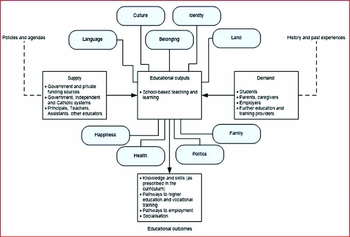
In a simple diagram, Guenther and Bat (Reference Guenther and Bat2012) have captured the essence of the ‘mainstream’ education system that is built on a combination of philosophical, sociological and economic assumptions, as shown below in Figure 1. In this representation the system has supply (service delivery) and demand (service use) elements that intersect in the space of school-based teaching and learning. The products of these educational outputs are a mix of knowledge, skills, career and education pathways as well as socialisation outcomes.
A frame of reference for advantage in the Australian education system.

Through the application of this simple system it is possible to collect vast amounts of data on outcomes and inputs. In this simple representation, it is the government (state, territory and Commonwealth) who sets the bigger agendas, primarily through the political process where legislation, policies and funding priorities are set and enacted through the various programs and agencies across the country. The political agenda is determined through a number of factors — in response to the perceived place that the system has in comparison with other systems — including: ‘borrowing’ from other policy contexts (Lingard, Reference Lingard2010); what the loudest voice in the community is saying through the media; through the government's own understanding of what its constituents are demanding; and through its own consultative systems, which typically connect with the education bureaucracies tasked with implementing the government's programs. Policy making is both a political and globalised process — and in the context of education systems, it is complex, with an array of competing values, philosophies and economic imperatives driving agendas (Rizvi & Lingard, Reference Rizvi and Lingard2013). The government also sets the regulatory framework for the accounting of activity and outcomes to their set targets. This is monitored and supported through the education bureaucracy (ACARA, 2012c). The education bureaucracy in the government education sector is tasked with implementing the agendas set by the government through the funding allocated, often through national agreements and partnerships (see, e.g., Standing Council on Federal Financial Relations, 2012, 2013). The bureaucracies also set the priorities and provide funds. In this model, while the bureaucracy feeds information ‘down’ to schools and parents, there are few direct avenues by which schools and parents can express their views back to the bureaucracy. The community's voice back to the various tiers of the bureaucracy tends to be through representative groups such as unions, and peak bodies such as parents and citizens groups. If we were to show a diagram of the independent school sector, this is where the differences are greatest and where the voices of parents and communities are able to feed back directly to the overarching school associations.
Among the many system reforms, there has been a move in the government education sector to decentralisation, establishing semi-autonomous schools that are ‘self-governing’, with the power of local decision-making and control over things such as the employment of teachers — shifting the model to an approach where the government effectively sidesteps some of the bureaucracy to go straight to the school (Caldwell, Reference Caldwell, Lee and Caldwell2011). The federal government layer is still there and still filtered through the state and territory governments through funding arrangements and national agreements. This shift to deregulation of schools has been attempted in many different parts of the world and there is much to be learnt from the experiences of other systems (Schütz, West, & Wößmann, Reference Schütz, West and Wößmann2007). Most notably, the work in the United States has been extensively analysed, with the recognition that it is possible to achieve successful schools in this way provided that they create ‘organizational firewalls that allow space for successful innovation’ (Darling-Hammond, Reference Darling-Hammond2010, p. 275). More often than not, the schools are not able to achieve this and the result is actually one where the schools are able to innovate in one area, but the system implements heavy-handed regulation in other areas (Darling-Hammond, Reference Darling-Hammond2010).
The current growth of Western Australian Independent Public Schools is one example of a shift in this direction. According to the Department of Education, there will be a total of 255 of these schools by the end of 2013. The independent schools are given their budgets to manage, have a school board that has local and industry representation, select their own staff, and ‘have greater flexibility to respond to their communities’ (Western Australia Department of Education, 2012, p. 1). However, strong criticisms have been made about this reform around the lack of sufficient resourcing to fund the ongoing financial needs of the schools, and the significant risk is that it will actually ‘reinforce inequality and social disadvantage’ (Fitzgerald & Rainnie, Reference Fitzgerald and Rainnie2011, p. 2). The current model is one that requires schools to shift to a competitive model with the school and community carrying the responsibility and the bureaucracy retaining the audit and regulatory authority.
The Education System in Remote Australia
There are many different peoples living in remote Australia. It is a vast geographical area with a relatively sparse population that is incredibly diverse linguistically, culturally and socioeconomically. This diversity is both the challenge and the celebration of remote Australia. The Aboriginal and Torres Strait Islander peoples live, for the most part, in the small, isolated communities of very remote Australia; while the larger non-Indigenous populations either live in the larger towns of remote Australia or are the ‘fly-in-fly-out’ workforce of the very remote mines and related services.
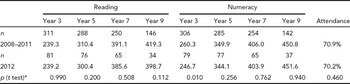
NAPLAN Results for Very Remote Schools With Greater Than 80% Aboriginal and Torres Strait Islander Student Population (2012)

Note: *t test assumes two-tailed, two sample heteroscedastic. Source: Australian Curriculum Assessment and Reporting Authority (2013) or publicly available departmental data where MySchool data not available.
Achievement of Very Remote Year 3 Aboriginal and Torres Strait Islander Students in Reading, by State and Territory, 2012, by Geolocation, Percentage at or Above National Minimum Standard

Source: Australian Curriculum Assessment and Reporting Authority (2012b).
Schools are spread across vast geographical areas and the education system is further delineated along the state/territory lines for the government, Catholic and independent sectors, adding another layer of complexity to the system that is self-representing as simple. When it comes to analysing the performance of the education system in remote Australia there arises a tension between efficiency and quality.
In Australia, across all three sectors according to the overall PISA results, it did not matter what type of school students attended but rather the socioeconomic status of the school (Thomson et al., Reference Thomson, Bortoli, Nicholas, Hillman and Buckley2011, p. 297). In Australia, the effect of the socioeconomic status of the school is larger than in other countries in the OECD. When a closer look is taken at the PISA results, and indeed at the Australian results generated by its own testing regime through the National Assessment Program — Literacy and Numeracy (NAPLAN), students who are living in a very remote location are almost the equivalent of two years of schooling below the average (Thomson et al., Reference Thomson, Bortoli, Nicholas, Hillman and Buckley2011, p. 299). Analysis of the Australian NAPLAN data further shows that very remote schools in Australia with an enrolment of greater than 80% of Aboriginal and Torres Strait Islander students are achieving very low results and the between school difference is not necessarily caused by remoteness or socio-economic disadvantage as is sometimes reported (Miller & Voon, Reference Miller and Voon2011), but is accounted for by race and culture (Guenther, Reference Guenther2012).
Table 1 shows results for reading and numeracy NAPLAN tests for the very remote schools with greater than 80% Aboriginal and Torres Strait Islander student populations. The results are drawn from publicly available data on the My School website. The table compares 2012 published data with an average of the preceding 4 years (2008 to 2011). In almost every instance the differences between 2012 and the previous four years are small and statistically insignificant. Student t tests were carried out using the datasets to determine whether there was any difference in the data. These tests show only one significant difference for Year 3 numeracy where the 2012 data was significantly lower (t test, p < .05). The table also shows that across all these schools attendance has not changed significantly either. In general then, nothing has changed, and where it has changed the data represented above shows that things are worse.
Table 2 presents another important picture, again using the system's own measures of success — in this case the proportion of Aboriginal and Torres Strait Islander students at or above the minimum standard for Year 3 reading. The table shows a consistent pattern of falling results with remoteness. For this year group, across Australia the level of achievement among Aboriginal and Torres Strait Islander students in very remote schools is less than half that found in metropolitan schools.
Generally, then, for students living in metropolitan and provincial Australia, the education system appears to be working fairly well. This is not the case for students living in remote Australia. Non-Indigenous students in very remote Australia are doing almost as well as their more urban counterparts. However, we can deduce from the data that it is the group of remote Aboriginal and Torres Strait Islander students for whom the system, which is predominately a government school system, is not working.
Typically, an education system responds to problems that have been identified at the jurisdictional level or at the national level and then develops solutions for implementation at the local level. This is apparent in much of the reporting across the different jurisdictions and systems (see, e.g., Department Education Employment and Workplace Relations, 2012). One specific example of this is the Gonski report, which identifies great challenges for remote and Indigenous education in Australia through data collated and analysed at the system level and through system filters of system-set outcomes and targets. The solution proposed was for increased funding and a homogenising of the curricula and programs (Gonski et al., Reference Gonski, Boston, Greiner, Lawrence, Scales and Tannock2011, p. 127). This approach is seen as the way to ensure that socio-economic differences between schools are minimised, through increased resourcing for disadvantaged schools. At the same time, the report acknowledges that some of the most effective strategies for overcoming disadvantage are those implemented at the local level. This call for local solutions is not a new one and one that does not appear to have met with any great successes to date because it is attempting to apply local solutions through its existing system. There may be other ways.
Aboriginal and Torres Strait Islander Education Systems
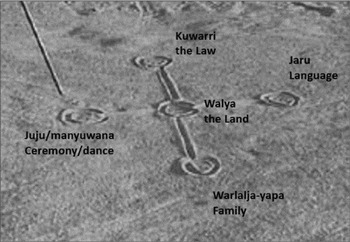
Aboriginal and Torres Strait Islander education thinkers and philosophers have emphasised the integral roles that land, family, story and language play in the formation of identity in the learning context and the absolute importance of community development as part of the education system (Arbon, Reference Arbon2007; Ford, Reference Ford2010; Herbert, Reference Herbert2006b; Patrick et al., Reference Patrick, Holmes and Box2008; Yunupingu, Reference Yunupingu1993). One example of this work comes from Lajamanu in the Northern Territory. In Patrick et al.'s report into the right ways of working with Warlpiri people, Figure 2 is shared. (Note that the labels in this image have been added by the author.)
Ways of working with Warlpiri people (adapted from Patrick et al., Reference Patrick, Holmes and Box2008, pp. 3–4).

In this work, Patrick has shared that it is the way the people work together that will determine the success of a program. This model presents a way that non-Warlpiri people can work with the Warlpiri people in projects and activities so that the local community is strengthened rather than weakened by external intervention. The model provides an example of how an education program could be enacted in a particular local context, in effect creating a community of practice (Wenger et al., Reference Wenger, McDermott and Snyder2002). This is the same recommendation that came from a large school reform program in Manchester in the United Kingdom, with one of the key messages being that local communities of practice can connect together to form the education system rather than the system controlling the practices (Ainscow, Reference Ainscow2005, Reference Ainscow2012).
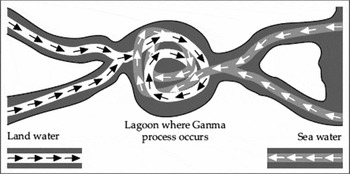
This idea is further expanded by a large body of work published from Yolngu educators in Arnhem Land in the north east of the Northern Territory and their colleagues, making the call for a both-ways education system. This system has been represented through some key metaphors, with perhaps the most recognisable being that of Ganma, the lagoon where the salt water and the fresh water meet (Christie, Reference Christie, Leitner and Malcolm2007; Marika, Reference Marika1999), as shown in Figure 3.
Representation of Ganma (Marika, Reference Marika1999, pp. 12–13).

In this model of knowledge and learning, both Yolngu and Balanda (non-Indigenous) knowledges are shared, coming together in the central space that creates a site of contestation (Ober, Reference Ober2004). The briny lagoon is not calm, nor is it lifeless, but is rather a rich habitat of its own. In this way, the Yolngu have shown that it is possible for a great sharing to happen and for everyone to be strengthened, thus ensuring that education and community development are connected (Yunupingu, Reference Yunupingu1993).
For the last two years I have been on leave from the school touring with the band and passing on the philosophy of my people. One of these is Ganma. This is the philosophy that allows us to open up to white society on common ground. Ganma tells about the place in Gumatj country where the salt and fresh water meet and mix. It is a metaphor with many spiritual and symbolic meanings but at its base it is about a ‘common ground’ understanding of the world. What we are trying to say to Balanda is ‘try to meet us halfway, try to meet us halfway here. (M. Yunupingu, Batchelor College, 1994, p. 26)
This collaborative approach to education is one which has not been generally supported by the education system to date but has rather been a continuous struggle for many decades, as evidenced by the struggle for education in the children's home languages as well as in English (Dhamarrandji, Reference Dhamarrandji2011; House of Representatives Standing Committee on Aboriginal and Torres Strait Islander Affairs, 2012; Nganbe et al., Reference Nganbe, Kinthari, Walbinthith Lantjin, Tchinburrurr, Mirrkun Nemarlak, Bunduck and Nganbe2011). The larger system, in its apparent need to maintain its simple structure, is unable to respond to the demands of the local peoples about the right way of running education in their own communities. Marika (Reference Marika1999) comments on this: ‘Our job as educators is to convince the people who control mainstream education that we wish to be included. Until this happens, reconciliation is an empty word and an intellectual terra nullius’ (p. 9).
Perhaps the reform of the system itself may open a new way of developing local education systems such as have been called for by the Warlpiri and the Yolngu. If the current western education system is not able to respond to the development of local education systems that are built on relationships, then perhaps the system itself needs to change. One way of considering this change is through the lens of western theorising.
Western Theorising: Complex Adaptive Systems
There is another body of knowledge that can be considered in this space — knowledge that has been building since the mid-1960s as a result of an increasingly complex and interactive local and global community. Through this work, various models have been generated that can support the analysis and manipulation of systems, and ranges from the construction of information systems in the business sector through to the mapping of neural networks (McFallan et al., Reference McFallan, Stanley and Fisher2011). This research has typically centred on creating more efficient businesses and provides a useful tool for the discussion presented here.
Typically, it appears that there are two approaches to working with systems; first, using an interpretive paradigm to understand the system; and second, using a radical paradigm to shift them (Jackson, Reference Jackson2001). An interpretive paradigm is one that maps the various factors at play and their relationships and gives information about the current state of the system. Computer simulations are often used to do this and provide a useful tool for predicting outcomes (McFallan, Stanley, & Fisher, Reference McFallan, Stanley and Fisher2011). Using such an approach, it would be possible to map each local community's education systems using an agent-based model. In this way, the simple system presented earlier in this article could be expanded to something more like that presented in Figure 4.
Belonging in the complex education system.

What this representation depicts is the myriad of factors that assist students, teachers and families in engaging with the education system. Our assertion in this paper is that when these factors are ‘inside’ the system, actors ‘belong’ to the system and it collapses to the simple delivery model that appears for the most part to be working for the rest of Australia (Figure 1). In some cases, perhaps, a student's home language might differ from that of the school, but a language intervention program can be implemented and the student will become part of that system. However, where there is a myriad of factors at play, the system is unable to accommodate difference and the system itself collapses. For the Aboriginal and Torres Strait Islander peoples of very remote Australia, it is most likely that all of these are different from the ‘mainstream’ schooling system, creating a gap, not of success and achievement, but of belonging.
Such a model is firmly situated in the service delivery type of thinking, and fits in well with the original economic model of education where supply and demand are counterpointed. This kind of work is typical of that being done in complex adaptive systems, where the interaction of the various factors changes the system so that it is more than the sum of its parts and would be a useful mapping for understanding the complexity of a local very remote education system. However, understanding the interplay of the factors per se may not be sufficient to present new ideas or mechanisms to shift the system.
Jackson (Reference Jackson2001), however, has suggested that we need to shift our thinking into a ‘radical paradigm’ in order to shift the system. In a paper written about the Northern Territory Emergency Response, Hunter makes the proposition that any top-down approach will have its limitations because it perpetuates the ‘learned helplessness’ he says is prevalent in the remote Aboriginal and Torres Strait Islander communities of Australia and that the best approach for engendering change is to support locally generated solutions (Hunter, Reference Hunter2007). In this article, the data has shown that it is the education systems of very remote Aboriginal and Torres Strait Islander communities that require radical change and that the current education model of a place-based service delivery approach is not working. The ‘problem’ of remote education is a wicked one without a simple solution. However, we are suggesting that the system treats the problem in simple terms. It fails to take into account the inherent complexity of the problem itself and further, it struggles to take account of the social complexity that accompanies its wickedness. Conklin (Reference Conklin2006), in his discussion of wicked problems, suggests that this social complexity goes beyond the diversity of individuals to the diversity of disciplines they represent, and beyond that to the diversity of the organisations they represent: ‘Thus, social complexity makes wicked problems even more wicked, raising the bar of collaborative success higher than ever’ (p. 17).
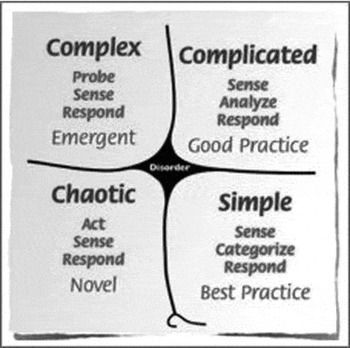
Some very useful work done in this area has generated the Cynefin model, which is known as a ‘sense making’ approach, as shown in Figure 5. In this model, the complexity of the system is presented in a way that allows the data to precede the framework and it is the interaction of the people within the systems that creates the various systems (Snowden, Reference Snowden2011). A simple system is ordered and predictable; the connection between cause and effect is direct and is typical of a bureaucratic model. This is the domain that most organisations aspire to work in. It provides a clear, predictable system where best practice can be developed in response to understanding the system. It is also the self-representational system that the current education system in Australia is using.
Cynefin sense-making model (Snowden, Reference Snowden2011).

Through the application of this simple system, we can collect data on outcomes and inputs. So-called ‘mainstream’ education in Australia, as presented by the very simple supply/demand model proposed by Guenther and Bat (Reference Guenther and Bat2012), is one that is widely applied throughout Australia. Further, in terms of the international models, this is how most people think of an education system. However, this is most often not the case, and most systems are not operating in the ‘simple’ domain. Most organisations are typically working in the disorder domain, in the centre of the figure, looking for order. According to Snowden (Reference Snowden2011), most are operating in this space most of the time, trying to work out what the current situation is and what is required. Where should the remote education system be shifting to if it is not the simple system that it represents itself to be, but is rather one of disorder?
For the system to be a chaotic one in this model, it must be entered deliberately, it needs renovation, but if it is entered accidentally, then it needs to be stabilised quickly. This is not the aim of a system reform. The Cynefin model proposes that in organisational theory, it is the complex/complicated spaces that provide the most effective systems. In a complicated system, this relationship is there but not so obvious, and the organisation brings in experts to help understand what is going on. This is one model that could be used to design an education system in the remote education space but would not provide the local flexibility proposed by Ainscow (Reference Ainscow2012) and Gonski (Australian Government, 2013; Gonski et al., Reference Gonski, Boston, Greiner, Lawrence, Scales and Tannock2011). However, the complexity domain does give that flexibility, requiring experiments that can generate emergent practices which are different and unique. The probe-sense-respond tool for analysis and decision-making in this space generates emergent practice and resonates well with the communities of practice approach proposed by Ainscow as appropriate mechanisms for education reform. With the above discussion in mind, we now turn to consider this complexity in the light of ‘red dirt thinking’.
Red Dirt Thinking: Aboriginal And Torres Strait Islander Education Systems in Very Remote Australia: It's About People
Red dirt thinking is a term that captures the essence of the land on which we learn, and the need to ground education in the needs and aspirations of local peoples and communities. The analysis of education systems is often done in terms of policy and activity rather than people and their relationships. However, this has been countered by the voice of Aboriginal and Torres Strait Islander peoples presented in this article, where relationships are central to all activity. The current thinking around education systems uses simple service delivery models based on national, jurisdictional or sector lines, with centrally located power bases. However, no jurisdiction or sector in Australia is experiencing success in very remote education and there has been a call for a new paradigm to be enacted. This new paradigm can be generated through a shift in thinking as well as the absolute need to keep our feet in the red dirt of remote Australia and remember that the local context is the beginning of learning rather than the end. If it is not policy that will make the difference, and it is not place per se, then perhaps it is about people.
The Aboriginal and Torres Strait Islander peoples of very remote Australia are diverse peoples with rich cultural and linguistic lives that are uniquely Australian. These peoples belong to their land and seas and express their identities as learners through an expression of their identity as Aboriginal and Torres Strait Islanders (Arbon, Reference Arbon2007; Bat, Reference Bat2011; Herbert, Reference Herbert2006a) and ‘recognising learners’ identities is key to their educational engagement (Kickett-Tucker & Coffin, Reference Kickett-Tucker, Coffin, Purdie, Milgate and Bell2011; Wallace, Reference Wallace2008, p. 13). In this context, working from the ground up, means working in an intercultural, multilinguistic space across many epistemes and ontologies, thereby creating a people-based education system; one where everyone belongs in the system, rather than the system insisting that people belong to it.
Conclusion
The issue of remote Aboriginal and Torres Strait Islander education in Australia can be described as a ‘wicked problem’. This kind of problem can be thought about in terms of a complex adaptive system. When using systems approaches, it is possible to use an interpretive approach to map the problem, such as was used in this article to illustrate belonging in the system; but in order to shift a system, a more radical approach is needed. One possible way of thinking about systems in a more radical sense is provided by the Cynefin model, which suggests that it is the relationships between people, the actors in the networks, that are at the heart of the system. What this model brings to the remote education system thinking is another way of conceptualising the system as many systems rather than a one-size-fits-all model. Given the absolute complexity of the remote education system as considered in this paper, it would appear that the system is operating at present in the chaotic domain, where the call to action from government can be heard reverberating through the school walls. Various activities are undertaken using the existing system as the conduits and yet the results are all the same apparent failure.
Across very remote Australia there are three key education sectors at work in six states and territories and in a multiplicity of contexts, with all the complexity that this brings. And yet, a simple education system is at play in Australia, one where a direct link between policy, output and outcomes should be able to be mapped. However, this simple system is not able to respond to the epistemes and ontologies of the Aboriginal and Torres Strait Islander peoples of very remote Australia. There is an acknowledgment that a whole new paradigm is needed and that this should work from the ground up rather than from a top-down service delivery approach.
If the purpose of the system was not the performance of the system itself, but rather the education of children in a way that responds to the needs of the local community, then it is possible to think about the system differently. Such a shift is vital when there is an epistemological and ontological difference between the policy-makers and the learning contexts in the system. After all, the learners and teachers are at the heart of the system. Naturally, this requires a suspension of the current thinking and the entertainment of the possibility that the system could shift the way that it manages accountability.
This scenario, where the whole of the education system itself is generated from the people at the heart of the learning is a radical one that requires further consideration — one that is being explored through the Cooperative Research Centre for Remote Economic Participation's Remote Education Systems project. Such a shift in positioning moves the power in the system to the local community. Policy is still important and central, but could be seen as a supporting mechanism rather than the reason for the system's existence. Thinking about an education system in this way requires a shift from reporting requirements to the needs of the community; from control to support; from accountability to empowerment. Situating the education system in this way allows for the cultural, linguistic and local community context to become the drivers of the system rather than external factors that require servicing. However, this does require a conceptual shift on the reason for the existence of the education system itself, a shift from thinking about excelling in the PISA scores to the local needs of the children and their families, from the cities where the bureaucrats live, to the red dirt where the children live and learn.
Acknowledgments
The work reported in this article was supported by funding from the Australian Government Cooperative Research Centres Program through the Cooperative Research Centre for Remote Economic Participation (CRC-REP). The views expressed herein do not necessarily represent the views of the CRC-REP or Ninti One Limited or its participants. Errors or omissions remain with the author.
About the Authors
Melodie Bat (Guest Co-Editor of this issue) is currently working as an education consultant in her business, Pracademic Solutions. Melodie has been working in Indigenous education for two decades, beginning her career as a remote teacher in the Northern Territory. Her own learning journey has led her through a career that has spanned teaching, project management, leadership and research across the many sectors and spaces of Indigenous education, always with a focus on working towards a more equitable education system.
John Guenther (Guest Co-Editor of this issue) is the Principal Research Leader for the Remote Education Systems project with the Cooperative Research Centre for Remote Economic Participation and Flinders University. John has worked as a researcher and evaluator in remote Australian contexts — particularly the Northern Territory — for the past 10 years on issues related to education, training, families and children, justice, child protection and domestic violence. His current role is focused on understanding how education systems can better respond to the needs of students and families living in very remote Aboriginal and Torres Strait Islander communities. Beyond this, the Remote Education Systems project is looking for innovative models of schooling, teaching and learning that improve livelihood opportunities for students from remote communities.