INTRODUCTION
Immunity is considered costly and it is thus expected to be traded-off against other energy-demanding aspects of life history such as somatic maintenance, growth and reproduction (Sheldon and Verhulst, Reference Sheldon and Verhulst1996; Schmid-Hempel, Reference Schmid-Hempel2003). A number of studies on invertebrates that have examined the possibility that mating results in trade-offs with immunity have found that mating induced down-regulation of immune function (Siva-Jothy et al. Reference Siva-Jothy, Tsubaki and Hooper1998; Fedorka et al. Reference Fedorka, Zuk and Mousseau2004; McKean and Nunney, Reference McKean and Nunney2001; Rolff and Siva-Jothy, Reference Rolff and Siva-Jothy2002). However, an individual's ability to fend off a disease can also increase after mating. For example, non-virgin female crickets, Gryllus texensis, have an enhanced ability to fend off a bacterial disease compared with virgin females (Shoemaker et al. Reference Shoemaker, Parsons and Adamo2006). In addition, in female Drosophila melanogaster, sperm and seminal proteins upregulate genes associated with antimicrobial defence (McGraw et al. Reference McGraw, Gibson, Clark and Wolfner2004; Peng et al. Reference Peng, Zipperlen and Kubli2005). In most cases the link between mating and immunity has been investigated using indirect measures of immunity such as haemocyte load (the amount of immunocytes in the haemolymph) and phenoloxidase activity (PO, which is the key enzyme in the synthesis of melanin). For example, the effects of mating on immunity in the mealworm beetle, Tenebrio molitor, have previously been investigated using assays measuring cellular immunity (Rolff and Siva-Jothy, Reference Rolff and Siva-Jothy2002). Rolff and Siva-Jothy (Reference Rolff and Siva-Jothy2002) found significantly lower PO activities, but no effects on haemocyte load, in male and female beetles 24 h after mating compared with virgins. It was suggested that mating induces the release of juvenile hormone, which acts to down-regulate PO activity in this species (Rolff and Siva-Jothy, Reference Rolff and Siva-Jothy2002). Recent studies on insects have not found any association between PO activity in the haemolymph and resistance against naturally occurring pathogens (Schwarzenbach and Ward, Reference Schwarzenbach and Ward2007). Likewise, it may not be that higher PO activity in the haemolymph also means a stronger encapsulation response to a parasite. For example, in the Autumnal Moth, Epirrita autumnata, starvation reduced the encapsulation response to a nylon monofilament, but increased PO activity (Yang et al. Reference Yang, Ruuhola and Rantala2007).
Recent studies have shown that declines in one aspect of an animal's innate immunity should not be interpreted as impaired overall immunity and, if possible, the measurement of multiple immune parameters should be performed (Adamo, Reference Adamo2004a, Reference Adamob; Fedorka and Zuk, Reference Fedorka and Zuk2005). Declines in some immune parameters may indicate that another immunological defence mechanism is activated (Adamo, Reference Adamo2004a). In addition, a recent study by Fedorka et al. (Reference Fedorka, Linder, Winterhalter and Promislow2007) showed that the estimates of immunity based on immune gene expression did not reflect the actual ability of Drosophila females to fend off pathogens in the hours following mating. This suggested that the discrepancy between different measures of immunity could also be due to when different measures are taken. Assessing whether an activity such as mating has fitness costs such as reduced survival can be measured using host resistance tests, in which the likelihood of survival against an infection is measured (see Adamo, Reference Adamo2004a and the references therein). The aim of this study was to test whether copulation has an effect on the resistance against real pathogens in T. molitor. We thus tested whether mating affects the ability of T. molitor to resist a natural pathogen, the entomopathogenic fungus Beauveria bassiana.
MATERIALS AND METHODS
We established a T. molitor laboratory population from a commercially produced stock obtained from Imazon Company, Sweden. Stock larvae and adults were reared in plastic pots (0·34 m×0·28 m×0·23 m) containing wheat bran and apple, and were maintained in a controlled environment (in 12L:12D, 25±1°C). Pupae were collected 3–4 times a week and sexed visually by assessing the morphology of the 8th abdominal segment (see Bhattacharya et al. Reference Bhattacharya, Ameel and Waldbaer1970). Pupae of each sex were kept in separate plastic dishes until emergence. The dishes containing the pupae were checked daily for the emergence of any adults. After collection, to ensure virginity all adults were housed individually in plastic film roll canisters. All beetles were fed with fresh apple. Beetles used for the experiment were 7–14 days old. Before the experiment, each beetle was weighed to the nearest 0·1 mg.
For the experiment, mated beetles were produced by choosing a random virgin male and a random virgin female, then allowing them to mate once on a plastic Petri disc. The control beetles (virgins) were not allowed to mate but were otherwise treated similarly. Resistance to the entomopathogenic fungus Beauveria bassiana (strain Mycotrol) was tested by exposing both mated (155 males and 169 females) and virgin (139 males and 149 females) beetles to the fungus by dipping them in a LD50 (1·42×106 spores/ml) spore solution for 5 sec. The fungal spores were dissolved in distilled water (for detailed methods see Rantala and Roff (Reference Rantala and Roff2007)). A second set of beetles were dipped in distilled water (150 mated males and 170 mated females; 150 virgin males and 150 virgin females). Both treatments were exposed to disease simultaneously within 3 h after mating treatments.
After treatment each beetle was placed back into the film roll canister from which it was originally kept. All canisters were then placed into a cabinet at room temperature with natural light and fed with fresh apple. Mortality was checked daily for 15 days. After 15 days mortality caused by fungal infection is minimal and mortality is not different from natural mortality (authors' personal observations). Thus, beetles that survived more than 15 days were considered as having survived. We constructed a Cox survival regression model to reveal the predictors in the experiment which best explained measured variance in mortality. Mating status, fungus exposure and sex were used as categorical covariates, and weight was included as a continuous covariate in the model.
RESULTS
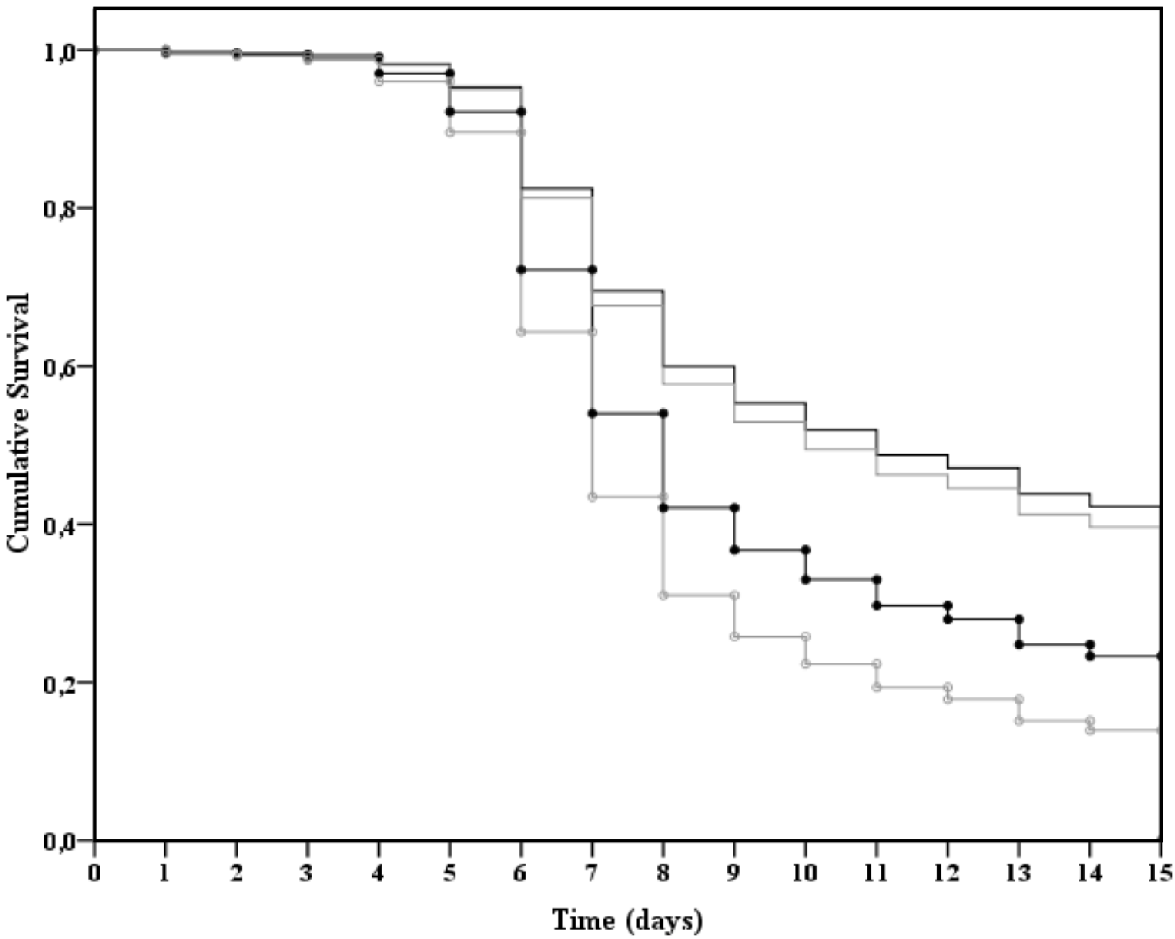
Fungus exposure reduced survival (odds ratio=2·073, Wald=150·836, D.F.=1, P<0·001). Thus, further analyses were conducted separately for fungus exposure and control treatments. When infected with B. bassiana survival was affected by mating status (odds ratio=0·848, Wald=4·104, D.F.=1, P=0·043) and sex (odds ratio=0·521, Wald=61·245, D.F.=1, P<0·001). Mated beetles had significantly lower mortality than virgin beetles (Fig. 1). For infected females the effect of mating was smaller than it was for infected males. In addition, both virgin (odds ratio=0·473, Wald=36·714, D.F.=1, P<0·001) and mated (odds ratio=0·568, Wald=24·931, D.F.=1, P<0·001) female beetles had higher survival after fungal exposure treatment than male beetles. Without infection survival was affected only by sex (odds ratio=0·856, Wald=3·751, D.F.=1, P=0·053).
Survival of infected male and female beetles (mated ♂: black line (•), virgin ♂: grey line (○), mated ♀: black line, virgin ♀: grey line).

DISCUSSION
In our experiment we found that mated beetles were more resistant to the B. bassiana – fungal infection than were virgin beetles. For infected females the effect of mating on survival was smaller than it was for infected males probably because the base level of their immunity is much lower than females. In contrast to our results, previous studies on damselflies, Matrona basilaris japonica (Siva-Jothy et al. Reference Siva-Jothy, Tsubaki and Hooper1998), ground crickets, Allonemobius socius (Fedorka et al. Reference Fedorka, Zuk and Mousseau2004), fruit flies, Drosophila melanogaster (McKean and Nunney, Reference McKean and Nunney2001) and on mealworm beetles, Tenebrio molitor (Rolff and Siva-Jothy, Reference Rolff and Siva-Jothy2002) that have investigated the link between mating and immune defence have shown that mating induces immunosuppression. However, there is conflicting evidence in Drosophila with no difference in the ability of female flies maintained with males in their immune responses to Escherichia coli bacteria compared with virgin females only kept with other females (McKean and Nunney, Reference McKean and Nunney2005). In addition, non-virgin female crickets, Gryllus texensis, were more resistant to infection by the bacterium Serratia marcescens than virgin females (Shoemaker et al. Reference Shoemaker, Parsons and Adamo2006). Enhanced immunity in mated individuals could be an adaptive response to reduce the risk of sexually transmitted diseases and other microbes (McGraw et al. Reference McGraw, Gibson, Clark and Wolfner2004). In addition, sperm and seminal proteins may be seen as non-self molecules that trigger the immune response and, in fact, male sperm and accessory gland proteins have been shown to upregulate genes associated with antimicrobial defence in female D. melanogaster (McGraw et al. Reference McGraw, Gibson, Clark and Wolfner2004). Sexually transmitted diseases in insects can be common, highly pathogenic, and have the ability to sterilize their host (Knell and Webberley, Reference Knell and Webberley2004). Thus, it seems that depending on the species it may be adaptive for females to upregulate their immune function, despite possible energetic costs.
In male drumming wolf spiders and fruit flies immunosuppression was found to be a consequence of either increased courtship or an integrated effect of both mating and courtship (McKean and Nunney, Reference McKean and Nunney2001; Ahtiainen et al. Reference Ahtiainen, Alatalo, Kortet and Rantala2005), whereas in male crickets the number of matings was not found to affect immunity (Gershman, Reference Gershman2008). Interestingly, the reduction in the lifespan of mated soil nematodes was found to be caused by additional sperm production and not by the physiological activity of mating (Van Voorhies, Reference Van Voorhies1992). The costs of courtship and mating will vary between species, and it has been suggested that individuals could moderate their mating frequency to minimize any costs to their immunity (Gershman, Reference Gershman2008). In our study the beetles were allowed to mate only once. Hence, the costs associated with courtship and mating may have been small.
In the present study, the likelihood of dying from the infection was smaller for females (both virgin and mated) than it was for males, which indicates an immunological sex difference in the ability to survive fungal infection in this species. Among many vertebrates, males tend to show a greater susceptibility to parasitic infections and also tend to have reduced immune responses compared with females (Zuk and McKean, Reference Zuk and McKean1996). Among invertebrates the situation has been found to be more complicated (see Rantala and Roff, Reference Rantala and Roff2007) and alternative hypotheses besides the Bateman′s principle, which is traditionally used to explain the observed immunological sex differences, have recently been suggested (McKean and Nunney, Reference McKean and Nunney2005; Rantala and Roff, Reference Rantala and Roff2007).
The beetles in our study received food ad libitum so they were not forced to re-allocate resources from other life-history components to immunity. Immunity is considered costly and it is thus expected to be traded-off against other energy demanding life-history components like reproduction (Sheldon and Verhulst, Reference Sheldon and Verhulst1996; Schmid-Hempel, Reference Schmid-Hempel2003). When food is limited, increased energy intake is not possible and a large allocation to immune defence reduces the energy available to other life-history factors (Moret and Schmid-Hempel, Reference Moret and Schmid-Hempel2000). In a benign environment such as the laboratory, stressed individuals may be able to eat more to compensate for any increased energy demands (see Tyler et al. Reference Tyler, Adams and Mallon2006). Animals may also manipulate their resource allocation to low priority fitness components before reducing their energetic commitment to high-priority fitness components like immune defence (Rigby and Moret, Reference Rigby, Moret, Poulin, Morand and Skorping2000). However, a trade-off between mating and immune defence does not always disappear under conditions of excess food. In a study on fruit flies food availability did not explain the observed immunosuppression in mated male flies (McKean and Nunney, Reference McKean and Nunney2001). Repeating the study comparing starved and well-fed beetles would thus be of great interest for future work.
One could think that our study would have been biased by the fact that some males failed to mate. Low-quality males with low immunity might be more frequently rejected by females and dropped from the study (see Rantala et al. Reference Rantala, Jokinen, Kortet, Vainikka and Suhonen2002, Reference Rantala, Kortet and Vainikka2003a, Reference Rantala, Kortet, Kotiaho, Vainikka and Suhonenb), raising the average immunity of males retained in the study. However, we found that only 13 males out of 318 (4%) were not able to mate which is too small to bias the result. Furthermore, it is important to note that females may fail to mate due to the low quality of their partners, not their own quality, so the set of females retained in our study were not biased by this factor.
A previous study on Tenebrio molitor suggested that copulation corrupts immunity because, after mating, PO activity in the haemolymph was reduced after mating (Rolff and Siva-Jothy, Reference Rolff and Siva-Jothy2002). Instead, no effect of mating on haemocyte load was found. However, a decline in only one parameter of immunity, such as PO activity, following mating gives very little information about an individual's overall immune response. In addition, PO activity has not been shown to correlate well with resistance against naturally occurring pathogens (Shoemaker et al. Reference Shoemaker, Parsons and Adamo2006; Schwarzenbach and Ward, Reference Schwarzenbach and Ward2007) and studies using Drosophila mutants that lack prophenoloxidase-activating enzyme suggests that PO does not play a role in resistance against bacterial or fungal infections (Leclerc et al. Reference Leclerc, Pelte, El Chamy, Martinelli, Ligoxygakis, Hoffmann and Reichhart2006). Thus, it seems that PO may not be a good proxy for disease resistance. Our experiment found that non-virgin individuals were more resistant to a fungal disease than were virgin individuals. We thus suggest that until the discrepancy between the different measures of the immune system is solved, a cautionary approach is needed and studies should be repeated in many different populations before any generalizations are made.
ACKNOWLEDGEMENTS
Special thanks to Derek Dunn for his constructive comments on the manuscript. This study was funded by the Academy of Finland to M. J. R. and by the Finnish Cultural Foundation's Varsinais-Suomi Regional Fund to Terhi Valtonen.