Reviewing recent writing on the Hanoverian church for this journal in 2003, Mark Goldie complained that the subject was ‘overcast by what must be the longest shadow in modern historiography’: a ‘Victorian benchmark’ still determined research agendas.Footnote 1 The same could have been said of the historiography of Victorian Anglicanism, with its institutional focus and enduring preoccupations with church parties (especially the Oxford Movement) and church reform.
Goldie partly attributed the failure of new strains of church history to sprout to the sterile ‘historiographical mulch’ of an introspective church-history tradition. Actually, even in 2003 and away from its traditional nurseries, a new, hybrid, religious history was germinating, which has since rendered the older strain an endangered species. Now that the soil has recovered, however, interest in Anglicanism's place in the national culture is encouraging some to re-engage with institutionally focused church history.Footnote 2 If we are to have a ‘new’ ecclesiastical history, even one now informed by the insights of other traditions in religious and non-religious history, we should nevertheless make a close inspection of the contents of the historiographical toolshed inherited from our Victorian precursors to establish whether or not they are still fit for use.
There are other reasons why Victorian frames persist in Anglican ecclesiastical historiography. Not only was the later Victorian period a key moment in the emergence of the British historical profession,Footnote 3 but its print culture, sheltering a range of evolving humanistic disciplines, also favoured the Victorian fashion for taxonomy that supplied ready-made categories for later historians. For church history, William John Conybeare's seminal Edinburgh Review article on ‘Church parties’ of 1853 established the tradition of interpretation in terms of ‘high’, ‘low’, and ‘broad’ traditions.Footnote 4 Conybeare also made an enduring contribution to the embryonic professional sociology encouraged by Victorian professional differentiation, when he identified a class of financially and educationally impoverished clerics in Wales and Cumbria as ‘mountain clergy’.Footnote 5 He was joined by such luminaries as Anthony Trollope in proto-sociological investigations which generally concentrated attention on the higher and lowest ranks of the profession.Footnote 6
There are arguments both for and against historians adopting terms in contemporary usage as terms of art and analysis. It certainly requires care in establishing precisely what was intended by the coinage of a term in its historical setting. Moreover, newly minted terms are particularly susceptible to rapid evolution and conflicting interpretations, even before longer-term shifts in usage are considered. A historian may need to make a conscious and explicit choice between contemporary usages in order to avoid confusion among his or her readers.
Where a term purports to offer an account of a social formation, moreover, it is also necessary to assess whether the account was based on rigorous analysis or was, instead, either a journalistic conceit or a rhetorical weapon forged for polemical purposes.Footnote 7 But even where the sociological credentials of a term are poor, much can be learned by investigating not the ‘accuracy’ of its representation of a contemporary ‘reality’, but what can be recovered from charting the history of the classificatory scheme itself and the stereotyping to which it contributed: its origins, its illocutionary force, and its impact on, and reception into, contemporary and later usage (all of which themselves forge new ‘realities’).
What follows offers such an approach to an enduring term in Victorian clerical sociology recently awarded the kitemark status of a theme entry in the Oxford dictionary of national biography:Footnote 8 the ‘Greek-play bishop’. Hitherto, few have investigated Victorian clerical sociology itself, historians preferring to attempt to establish an accurate account of the ecclesiastical career paths to which it spoke.Footnote 9 This article concentrates on the emergence and usage of this key term in Victorian discussions. In doing so, it illuminates the curious and changing ways in which the association of episcopacy and classical scholarship could be invoked. It also, however, seeks to highlight how interactions among the rapidly developing and overlapping print cultures that characterized early Victorian Britain could facilitate particularly rapid shifts in meaning and connotation in ways that have not as yet received sufficient historical attention.
I
The ‘Greek-play bishop’ has long featured in discussions of the nineteenth-century Church of England, and, to a lesser extent, of the history of classical scholarship. As recently as 2001, Richard Foulkes noted that ‘many a [Victorian] bishop’ received preferment ‘on the strength of his Greek textual scholarship – hence the term “Greek-play bishop”’, in the process summarizing the standard modern historical understanding of the term's meaning. A year before, in his study of Palmerston's bishops, Nigel Scotland noted that ‘some of the old “Greek-play” academic bishops … survived into the Palmerston era’, while Norman Vance, editing Jude the Obscure, explained that a ‘romantically old-fashioned’ aspect of Jude's ecclesiastical ambitions ‘harks back several generations to the days of the “Greek-play bishops”, when scholarship, narrowly defined as editing a Greek play, could lead to advancement in the church’ (thus showing stronger historical credentials in this respect than the 1987 editor of Barchester towers who glossed the phrase as referring to ‘play-bishops’ in antiquity!). According to Michael Brock in 1997, reflecting on the relevance of classics to the prospects of Oxbridge fellows in the 1820s, ‘The “Greek-play bishops” were prominent in the early Victorian scene.’Footnote 10
Behind such recent citations, usage stretches back to the first appearance of the phrase ‘Greek-play bishop’ it has proved possible to trace, in The Times for 8 April 1857.Footnote 11 It would figure shortly thereafter in the clerical ‘sociology’ mentioned above. That readers were assumed familiar with the term is apparent from widespread use of variants across a range of publications between 1860 and 1900. From leaders in The Times, it might be plagiarized by provincial newspapers which also found their own occasions to invoke the Greek-play bishop.Footnote 12 Characters in novels spoke of Greek-play bishops, while letters and reports in the press indicate that ‘real’ people, too, adopted the term. It is hardly surprising that they also figured in the reviews, or that by the 1890s, historians with no particular interest in the ecclesiastical might invoke them in delineating change over the nineteenth century. Such scholarly usage no doubt encouraged less frequent, but still regular, occurrences in the early twentieth century, in newspapers (the last Times citation coming on 20 January 1934), and in nascent scholarly literature on the histories of both classics and Anglicanism. Important in projecting the term into post-1945 understandings were two mid-century academic studies: above all a discussion in M. L. Clarke's Greek studies in England, 1700–1830 (1945), which inspired use of the term in the second, C. K. Francis Brown's History of the English clergy, 1800–1900 (1953), for some thirty years the standard work.Footnote 13
In 1932, The Times cast its eye back to the early nineteenth century ‘when Greek play bishops were plentiful’. Half a century before, commentators recalled a period when for putative bishops ‘the surest passport was the successful editing of a Greek play’ (1880), or ‘the accepted qualification for a chief pastorate in our church was to have brought out a learned and scholarly edition of a Greek play’ (1895).Footnote 14 Since they were apparently ‘so common in the Anglican church in the early part of the nineteenth century’ (1898), it seemed appropriate to write of ‘the age of the Greek play bishops’ (1881, 1885).Footnote 15
Such references imply that Greek-play bishops ought easily to be flushed out from the forest of texts mentioning them. But rarely were exemplary names or a total number volunteered. Even the personal pen-portraits in which individuals are most often described as Greek-play bishops generate a feeble roll-call. The generalized and fuzzy usage current at the end of the nineteenth century saw the term settle momentarily on several prelates. Thus in 1895, the Society for the Promotion of Christian Knowledge diocesan history of Chester identified William Cleaver (1742–1815, bishop of Chester 1787–1800) as ‘one of the Greek play bishops’. Reviewing an 1883 sister volume on Worcester, Charles J. Robinson saw in Richard Hurd (1720–1808, bishop 1783–1808) ‘an admirable specimen’ of a type it was now fashionable to disparage. A more exotic example was Joseph Stock (1740–1813, bishop of Waterford and Lismore 1810–13 and Killala 1798–1810), so described in an 1898 centenary article discussing his eye-witness account of the French occupation of his first diocese.Footnote 16 All three had decent scholarly records: Cleaver was principal of Brasenose College Oxford while bishop, published De rhythmo Graecorum in 1775, and edited the ‘Grenville’ Homer (1801); Hurd edited Horace; Stock had published editions of Aeschines, Demonsthenes, Lucian, and Tacitus. Yet none engaged with plays, and their episcopal careers, commencing in the eighteenth century, barely stretched beyond the first decade of the period customarily identified as the age of the Greek-play bishop. These labels did not stick.
A far more plausible candidate prompted the reference in The Times of 1932: Samuel Butler (1774–1839), bishop of Coventry and Lichfield for the last three years of a life chiefly remarkable for his headmastership at Shrewsbury School (1798–1836). A distinguished classicist, meriting an entry in the Dictionary of national biography and a weighty Life and letters (1896), Butler had published an edition of the plays of Aeschylus (1809–16). But he, too, was a belated and rarely observed recruit, not described as a Greek-play bishop in the term's Victorian heyday.Footnote 17
Just three prelates were mentioned more than once by name in later Victorian and Edwardian discussions. Edward Maltby (1770–1859, bishop of Chichester 1831–6, of Durham 1836–56) was once described as ‘the last of the Greek play bishops’. This he certainly was among the core trio in terms of frequency of mention.Footnote 18 A distinguished scholar, who produced a Lexicon Graeco-prosodiacum in 1815, Maltby did not engage with the Greek stage. Plays were, however, central to the scholarship of the two most frequently cited Greek-play bishops. James Henry Monk (1784–1856, bishop of Gloucester from 1830),Footnote 19 picked up where Richard Porson left off in his work on Euripides's plays with enduring editions of Hippolytus and Alcestis in the 1810s, and in the 1840s, despite failing eyesight, of Iphigeneia in Aulis and Iphigeneia in Tauris. In contrast, the single most commonly cited Greek-play bishop, Charles James Blomfield (1786–1857, bishop of Chester 1824–8, of London 1828–56),Footnote 20 effectively abandoned scholarship once installed in the most demanding episcopal postings of industrializing England. By then, however, he had produced between 1810 and 1824 a formidable portfolio of editions including five out of the seven works of Aesychlus. Blomfield and Monk were key figures in English classics in the 1810s and 1820s, not least in co-editing the Museum Criticum (1813–26), a collaboration based on common membership of Porson's college, Trinity College, Cambridge, personal friendship, and shared allegiance to Porson.Footnote 21
A brief consideration of the place of Greek plays in English classical education at the time underlines the significance of Blomfield's and Monk's contribution to classics. Greek plays had been very little studied in schools before the second half of the eighteenth century and the beginnings of romantic Hellenism. In 1748, four plays were published for use at Eton, and ten years later John Burton's Pentalogia, a collection of five plays, was used there and in Oxford. At Christ's Hospital towards the end of the century plays were read by the upper sixth, known as the Grecians;Footnote 22 at Samuel Parr's school in Stanmore in the 1770s, several tragedies were acted by his pupils. At the level of scholarship, the crucial factor was Porson's work, mostly on Euripides, but also on Aeschylus. The influence of his work was magnified by the campaigns of his Trinity disciples as they followed their master's lead and celebrated his achievements. Monk and Blomfield were the leaders of this movement, whose impact was magnified by their quarrels with Parr and his protégé Edmund Henry Barker. The Museum Criticum was begun partly in response to Abraham Valpy's Classical Journal, with which Barker was closely associated. For several years fusillades were exchanged between the two journals, and Barker conducted guerrilla warfare in the Monthly Review and other periodicals under a variety of pseudonyms, even on one occasion using Monk's initials. Monk and Blomfield denounced Barker from on high; Samuel Butler referred to their idolatry of Porson as ‘Porsoniasm’.
The fact that Blomfield and Monk did important work on Greek plays, however, ought not to distract from the oddity that, with one occasional companion, this exhausts the list from the supposed ‘age of the Greek-play bishop’. Why no Butler? And if Maltby, why not other bishops with powerful reputations as classicists, if not as editors of plays: Thomas Burgess (1756–1837, bishop of St David's 1803–25, then of Salisbury), who while an undergraduate had produced a new edition of a textbook on Greek tragedies later followed by an updating of Dawes's Miscellanea critica; John Kaye (1783–1853, bishop of Bristol 1820–7, then of Lincoln), a student of Porson who graduated both senior wrangler and chancellor's medallist, was elected master of Christ's at the age of thirty and who narrowly missed being appointed Cambridge regius professor of Greek in 1808; or even Connop Thirlwall (1797–1875, bishop of St David's from 1840), a precocious student of Greek at the age of four who went on to apply his classical scholarship to biblical studies, the co-editorship of the Philological Museum (1831–3) and an eight-volume history of Greece? Clearly something other than a straightforward tally of episcopal scholarly credentials was involved in the idea of the Greek-play bishop.
Does the small number reflect a tighter criterion for inclusion: namely that scholarship had to be instrumental in the mitring of a Greek-play bishop? Oddly, a fine example of this relates to a figure identified above as of an earlier cohort: Joseph Stock. In 1806, the death of the bishop of Limerick prompted Charles James Fox to sound out Stock's prospects, even though they had never met, ‘as one of the few [Irish] bishops who are eminent for their learning’.Footnote 23 When another candidate was advanced, Fox promised
no more at present about Bishop Stock, but on the next occasion I shall return to the charge. As to his not attending much to the duty of a diocese where there are no protestants, I do not value that much; while on the other hand I do value very highly his learning and in particular his edition of Demosthenes. If I had my own way, except in very particular cases, I never would make a man a bishop who was not eminent in some branch of learning. I do not care which, but classical learning is of course my favourite.Footnote 24
Even here, however, this was not the whole story. Fox wanted to reward Stock for the ‘moderation’ he had displayed during the French incursion and more generally towards the Catholics whose emancipation Fox desired. By the time Stock was translated to Waterford and Lismore in 1810, Fox was dead and a Tory ministry had taken office.
In the cases of the three ‘core’ Greek-play bishops, too, classics were a bonus in men whose candidacy rested on other credentials. Blomfield's scholarship was instrumental when the classically learned Earl Spencer (to whom he was otherwise unknown) presented him to the rectory of Dunton in 1811, when Blomfield acknowledged Spencer's ‘unlooked for goodness towards me’.Footnote 25 In 1820, Bishop Howley of London approved of Lord Liverpool's selection for the rectory of St Botolph Bishopgate of ‘the first classical scholar in Cambridge, perhaps [!] a very sound and able divine, & man of the strictest principle’.Footnote 26 But when in 1824 Liverpool informed George IV that Blomfield was his choice for Chester (‘the most laborious and important diocesce [sic] in the Kingdom after London’), while noting the candidate's standing as a divine and scholar, clearly it was his ‘full health and vigour’ and experience as one of the ‘archdeacons of London and minister of the important and populous parish of Bishopgate’ that was assumed to speak most in his favour.Footnote 27 Edmund Richardson, in the course of a stimulating discussion of the place of classics in personal advancement in nineteenth-century England, which also independently notes the scarcity of episcopal appointments directly attributable to classical scholarship, has recently argued that
a bishop's classical knowledge might be widely advertised (not least by himself) as the principal reason for his promotion; such mock confessions … served to grant a meritocratic (albeit eccentric) air to an appointment process that was anything but. The classic case of this process at work is, perhaps, that of Charles James Blomfield.
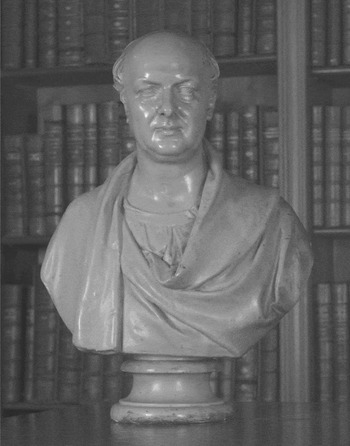
In support of his argument he cites William Behnes's 1833 portrait bust of Blomfield, claiming that ‘the bishop's artfully arranged drapery occupies a delicate middle ground between classical and clerical’.Footnote 28 However, Blomfield himself had good reason not to cultivate the identity of a Greek-play bishop (and indeed more generally not only did no bishop identify himself as a Greek-play bishop, but classical knowledge was rarely, if ever, ‘widely advertised’ as the explanation of one's own advancement, for reasons that will become apparent). Blomfield's portrait bust has in fact little clerical about it. It is more plausibly interpreted as an assertion of his identity as a statesman rather than a classic, commissioned as he took an increasingly prominent place in national policy debates and initiatives concerning the church and social policy. Any public assertion of his career's debt to his scholarship would have to await the publication of his son Alfred's posthumous biography of 1863, to which Behnes's bust served as a frontispiece.Footnote 29
Charles James Blomfield, bishop of London: portrait bust by William Behnes, 1833. Photo: by permission of the Trustees of Lambeth Palace Library.

Monk's ODNB biographer attributes his 1822 promotion to the deanery of Peterborough to Liverpool's recognition of his work as Whitehall preacher; it may also have been consolation for the dashing of hopes for the mastership at Trinity College in 1820 and reward for his subsequent support for Christopher Wordsworth as master. Once Monk had failed in his initial plan of retaining his regius professorship of Greek, he proved an energetic dean, and this probably combined with his consistent toryism (including, as will be seen, a particularly effective assault on Henry Brougham in the Quarterly) to persuade Wellington to make him a bishop.Footnote 30 Maltby's elevation is most easily explained. A long-standing whig ‘bishop in waiting’, rather than underpinning his appointment to the bench, his prolonged scholarly career may have been the unwelcome consequence of an equally prolonged tory administration. Once a whig premier was in place – and one in desperate need of votes in the upper house – Maltby's promotion was almost shameless in its haste as he took office as the only active whig bishop.Footnote 31
It is, therefore, not the case that Greek-play bishops identified by name were promoted on account of their scholarship. More obviously, many distinguished classicists were not considered for the episcopate or refused promotion. They were more likely to become clerical headmasters or attain cathedral offices (posts, some argued, specifically designed to nurture learning of benefit to church and nation, a function deemed incompatible with the activity demanded of a prelate – ‘the bench for honour, and the stall for ease’ as George Crabbe put it).Footnote 32 One example is Thomas Gaisford, regius professor of Greek at Oxford from 1812, who held stalls – in some cases simultaneously – at St Paul's, Llandaff, Worcester, and Durham, and served as dean of Christ Church from 1831 to 1855, but who declined the bishopric of Oxford in 1829, perhaps in a deliberate effort to keep his desk clear for scholarship.Footnote 33
To take stock: what was later claimed to be the ‘age of the Greek-play bishops’ harboured only two or three prelates who were, or might be, explicitly identified as such. So how did this retrospective view of the bench gain currency? What were the origins of the ‘Greek-play bishop’?
II
By the time of the first known use of the exact phrase, ‘Greek-play bishop’, in 1857, the concept had been gestating for a quarter of a century. Its origins lie in a very different context from the genteel discourse of the post-1850 Times and elite literature.
We can first observe the association of ideas characteristic of the Greek-play bishop in radical critiques of ‘Old Corruption’ during the reform crisis of 1828–32. The church was more vulnerable and unpopular than at any point since Peterloo, and the role of the bishops in the defeat of the first reform bill in the Lords ensured that bishops drew plenty of fire.Footnote 34 In the 1831 edition of John Wade's Extraordinary black book, the church came first in that unitarian radical's audit of the ancien régime. In a fiercely critical account of episcopal preferment, Wade made mischief with the classical careers of Blomfield and Monk. The former ‘owed his first preferment to a noble lord whom he had pleased by his mode of rendering some Greek verses’; the latter was ‘also an eminent haberdasher in “points and particles”’.Footnote 35
Wade's memorable formulation in one of the most widely read radical publications was more influential than the more prosaic and less specific contemporaneous observation of Thomas Jefferson Hogg that, if Oxbridge tutors published at all, it was ‘scanty work … put forth as a job, not for the advancement of letters; a Greek play, for example, with poor, meagre, grammatical notes; … the stupid pages are admired, and the author is advanced to a station of great dignity, possibly to a bishoprick’.Footnote 36 Hogg's comment came in the course of an attack in the radical Westminster Review on ‘The universities of Oxford and Cambridge’, both also feeling the heat from radical critics. For this anticlerical, sceptical radical, expelled with his friend Shelley from Oxford in 1811 for writing The necessity of atheism, the universities and church were related targets. The same was true for another disaffected former student, the Trinity Cambridge-educated ex-Anglican Yorkshire dissenter and radical, Robert Mackenzie Beverley. A prolific antagonist of the Church of England, Beverley too deployed the Greek-play bishop in a university critique, his ‘invidious, envenomed and offensive’ Letter to H. R. H. the duke of Gloucester, chancellor, on the present corrupt state of the University of Cambridge of 1833.Footnote 37 Like Hogg, Beverley noted ‘that we are assured … that a future bishop should be a complete master of Greek tragedies and comedies’, and followed Wade in pointing the finger:
It was no small cause of the elevation of the present Bishop of London, that he had edited some of the tragedies of Æschylus: and a successful article in the Quarterly Review in favour of the then ministry, together with a few of the tragedies of Euripides, promoted the present Bishop of Gloucester to the bench. These are strange motives for selecting Christian bishops! and, if this system be continued and should be universal (and the Church of England will of course be eternal and universal), we may, some two thousand years hence, expect that the then bishops of Africa or Botany Bay will owe their dignities to successful commentaries on Shakspeare's Hamlet and Othello, Foot's Farces, or Massinger's Plays, or to learned notes on Tom Thumb or Bombastes Furioso.Footnote 38
In these instances, the Greek-play bishop motif contributed to a wide-ranging critique of the operation of aristocratic patronage. As Wade emphasized, ‘In this roll of services, of accident of birth, of situation, and connexion, there is evidently no claim of public service or utility to entitle the bishops to their princely revenues and vast patronage.’Footnote 39 These critiques made little distinction between whigs and tories, or between one current ground for episcopal appointment and another. At this point, the motif might have disappeared as the reform crisis and the relevant appointments retreated in public consciousness, and both political radicals and dissenters addressed new targets.Footnote 40 However, the Greek-play bishop now found a new, and less ephemeral, literary context which ensured its survival.
The life-support system was Edward Bulwer Lytton. Discussing public discourse in England and the English (1833), Bulwer reflected on the dire effects of fashion on the pulpit exemplified by the ‘due decorum’ of monotonous and lazy preaching on issues of eternal import. He imagined a preacher: ‘a very learned man, people say he will be a bishop one of these days, for he edited a Greek play, and was private tutor to Lord Glitter’.Footnote 41 Bulwer liked the conceit, recycling it in Alice, or the mysteries, published in March 1838, when Lord Vargrave evaluates the Revd Charles Merton's prospects of a mitre. When Merton dismisses them, Vargrave affirms his confidence in him despite Merton having ‘disdained to exhibit any one of the three orthodox qualifications for a mitre: … editing a Greek play, writing a political pamphlet, and apostasizing at the proper moment’.Footnote 42 Bulwer's first Greek-play bishop moment attracted significant attention (he could, at the time, be described as ‘without doubt, the most popular author now living’), being excerpted in a variety of prints.Footnote 43 When England and the English appeared, Bulwer sat as an independent radical MP for Lincoln, who nevertheless remained a supporter of whig–liberal administrations. Thus the Greek-play bishop was repositioned a bit nearer the mainstream of elite politics, but still far from the heartland of either whig or tory party.
The Greek-play bishop in Alice clearly sought comic rather than polemical effect, suggesting that a further blurring of meaning might follow the loss of political focus apparent in England and the English. In fact, quite the opposite occurred, and with a bite presaged in a less widely read intervention from the mid-1830s, that of Walter Savage Landor. Landor's bitterly anticlerical Letters of a Conservative (1836) instructed Lord Melbourne that only thoroughgoing reform could prevent popular spoliation of the church. The clergy were too remote, and appointed for the wrong reasons:
I know not why bishopricks should be given, as they often are, for merely classical attainments; since, from the moment a scholar becomes a bishop, his study of the classics and his earnestness in correcting them is over. This grant of episcopalities for greek plays is like marrying for musick … When the minster throws open its portals, the greek surrenders its charms in favour of the gothick. My lord bishop enters, mounts his throne, and, instead of strophe and antistrophe, hears the responses sung to the Ten Commandments. Thenceforward ‘What's Hecuba to him, or he to Hecuba?’Footnote 44
The next significant intervention would echo Landor's fire, but not his radical purpose.
III
In 1886, an aside from the clerical novelist James Pycroft offered a rare contemporary account of the Greek-play bishop's origins. The story told so far was unfamiliar to him: instead, he noted that ‘Sydney Smith used to speak of Greek Play bishops – adverting to Blomfield and Monk – and of their “orthodox views of the middle verb”.’Footnote 45 Perhaps Smith did pronounce the exact phrase, but it is not found in his surviving writings. It was, however, Smith who now took up the concept and gave it one of its most influential outings.
In 1837, Smith was dismayed at the direction taken by church reform under the Ecclesiastical Commission. A canon of St Paul's, he perceived its designs on cathedral estates as the work of self-satisfied, authoritarian bishops serving their own interests with scant regard for the sanctity of property. In a polemical and outspoken Letter to Archdeacon Singleton he portrayed his own diocesan, Blomfield – on the verge of enjoying ‘a greater power than … any churchman since the days of Laud’ – as the commission incarnate. The bishop's arrogance could be explained by the ego-inflating effect of a mitre on ‘a man who has had no opportunities of seeing the world, whose parents were in very humble life, and who has given up all his thoughts to the Frogs of Aristophanes and the Targum of Onkelos’.Footnote 46 The letter was followed by two more, the third appearing early in 1839. Here, Smith resumed his theme, quoting the classicist Gottfried Hermann's verdict on Blomfield's Aeschylus:
‘We find’, he says, ‘a great arbitrariness of proceeding and much boldness of innovation guided by no sure principle’; here it is: qualis ab incepto.Footnote 47 He begins with Æschylus and ends with the Church of England; begins with profane and ends with holy innovations – scratching out old readings which every commentator had sanctioned, abolishing ecclesiastical dignities which every reformer had spared; thrusting an anapœst into a verse which will not bear it; and intruding a Canon into a Cathedral, which does not want it.Footnote 48
This time, however, Monk took a hit alongside Blomfield. The assault ignored Monk's classical scholarship, and even dismissed his membership of the Ecclesiastical Commission. As Smith explained to Lady Grey, Monk was attacked
because he has attacked me in his [episcopal] charge,Footnote 49 almost by name; I will repay him with 5 p. cent compound interest – Oh Simon, Simon, I have something to say unto thee. The Bishop of London has also defended the Commission; with the blessing of God I will overturn them both, and smite them sorely.Footnote 50
Monk had himself been brutal:
Among the adversaries of the Commission some, I regret to say, have adopted a species of hostility seldom found even in the feuds of political controversy … Those who have assigned to the prelates, who sat at that board, sordid and unworthy motives … will sooner or later reap a harvest of disgrace from their railing accusations … Some of them have thought it not unbecoming their station as Dignitaries, and their character as Christian Divines, to assail the heads of their Church with all the licence of personal invective and unbridled scurrility: … a sense of shame and humiliation affects every serious churchman, at beholding places which ought to be seats of piety, learning and dignity, occupied by the scoffer and the jester.Footnote 51
Smith's affront at this rebuke aggravated an existing complaint against Monk. In February 1819, whigs took umbrage at a scathing treatment of Henry Brougham in the Quarterly Review which had been judged such a success that the issue had been reprinted. Monk, reputed the author, basked in tory approbation. Smith was less impressed, informing Francis Jeffrey that ‘The Review of Brougham was written by Professor Monk, as stupid a rascal as ever lived; I'm sure he must have been much assisted.’Footnote 52 Twenty years later, Smith went public with the charge:
I was afraid the Bishop would attribute my promotion to the Edinburgh Review: but upon the subject of promotion by Reviews he preserves an impenetrable silence. If my excellent patron Earl Grey had any reasons of this kind, he may at least be sure that the Reviews commonly attributed to me were really written by me. I should have considered myself as the lowest of created beings to have disguised myself in another man's wit, and to have received a reward to which I was not entitled.Footnote 53
The gestation of Monk's Quarterly article was complex, involving as many as ten hands. Monk's share was first curtailed, then reinstated. His ‘solid parts’ were certainly substantial, however, even if others supplied the ‘wit, sparkle & sarcasm’.Footnote 54 Monk's role was debated both in the 1850s and 1870s; both times, Smith's observations were a key reference, indicating the enduring place of the Singleton letters in Victorian elite consciousness. They went through several editions – a critic lamented that they had found ‘their way into the office of the attorney, the counting-house of the merchant, the study of my lord and the boudoir of my lady – that they should be ordered into circulating libraries, voted for at book-societies, and travel from house to house, cheek-by-jowl with “Nicholas Nickleby”’; they were also incorporated in the repeatedly reprinted collected works Smith published in 1839.Footnote 55
Though the punch of the Singleton letters was widely admired, some readers judged them second-rate Smith: Blomfield himself found the first letter ‘less funny than I had expected’; the Revd Andrew Sayers scoffed at the ‘septegenarian reviewer, in the “winter of his discontent”’.Footnote 56 Such responses reflected the fact that the politics of Smith's polemic were complex. It was a characteristically bruising Holland House assault by an ageing whig on two ageing tories (for Smith there was no possibility that the impeccably liberal, but otherwise potential Greek-play, bishops, Butler and Maltby, could be tarred with the same brush). Monk's politics were unambiguous,Footnote 57 and his 1838 charge spoke with a clearly partisan voice. Blomfield perhaps aggravated his affront to Smith by apparent apostasy: a former contributor to the Edinburgh (and how to read the wonderfully ambiguous forenames ‘Charles James’, Fox or Stuart?), he had ratted on Catholic emancipation and became Peel's right-hand man in ecclesiastical policy. Yet Blomfield had led the bishops to accept the 1832 Reform Act, and worked closely with the liberal end of the reforming ministries of the 1830s on both poor-law and church reform; the policies which Smith attacked were as much those of Russell as of his diocesan. In consequence, although Smith deployed the Greek-play bishop motif for whiggish ends, the relentless advance of liberalism ensured that, even within high politics, Smith's invective could be redeployed by others, unsympathetic to whiggery, but sharing his hostility to the ecclesiastical policies of liberally minded administrations.
It was a misfortune for Blomfield's subsequent reputation that, having suffered the invective of a leading ‘progressive’ satirist, this situation made it possible for him now to find himself pilloried in the same terms by a very different, but almost as widely read, polemicist: Benjamin Disraeli. In Coningsby (1844), the Young England novelist echoed Bulwer in having Oswald Millbank, the Oriel-educated scion of a northern industrialist, opine that ‘a priest is scarcely deemed in our day a fit successor to the authors of the gospels, if he be not the editor of a Greek play’. This time, however, the context was more serious-minded: an extended Tractarian-influenced diatribe against a ‘latitudinarian’ and degraded state church.Footnote 58 Five years later, in Tancred, Smith was more the model for a character assassination aimed squarely at the liberal tory Blomfield, thinly disguised as the episcopal confidant of the duchess of Bellamont. This ‘bustling intermeddler’, combining ‘a great talent for action with very limited powers of thought … stimulated by an ambition that knew no repose … perpetually involved in transactions which were either failures or blunders’, temporizing, ‘totally destitute of genius’, had been advanced through the patronage of an ‘Arch-Mediocrity’ (Liverpool) whose ‘test of priestly celebrity was the decent editorship of a Greek play. He sought for the successors of the apostles, of the stewards of the mysteries of Sinai and of Calvary, among third rate hunters after syllables.’Footnote 59 Disraeli's works, like Smith's, would outlive the immediate political context of their composition to become standard fare on library shelves.
The Greek-play bishop – at least in the person of Blomfield – had now been pilloried from the radical, whig, and conservative camps: all that was lacking to complete the set was a mainstream liberal caricature. One duly appeared in the mid-1850s, again from an author whose distinction would ensure a long shelf-life. If The Times leader of April 1857 saw the first public articulation of the precise phrase ‘Greek-play bishop’, it had already been set down in a manuscript written between April 1855 and November 1856, but only published in May 1857: Anthony Trollope's Barchester towers. Here a gentler reference represented a step back from satire. In The warden (written 1853–4, published 1855), Blomfield had appeared as Charles James Grantly, who ‘never committed himself … and had not the great talents of his younger brothers’, suffering ‘an over-attention to words instead of things; there was a thought too much finesse about him … and he was too fond of a compromise’.Footnote 60 In Barchester towers, however, came a first hint of the elegiac note later sometimes associated with the Greek-play bishop. The phrase was not presented in the authorial voice, but ventriloquized through the orthodox high-churchman Dr Gwynne, reflecting on the usurpation of episcopal authority apparent when Bishop Proudie's wife announced a key diocesan appointment: ‘“That comes of the Reform Bill”, he said to himself … “Well, at any rate the Greek play bishops were not so bad as that.”’Footnote 61
Before pursuing the change in direction apparent in this quotation, we should take stock. From the mid-1830s the Greek-play bishop motif found new homes in the novel and high-political pamphlet (and indeed the high-political novel). In marked contrast to the early 1830s, it was often deployed in highly specific, high-political assaults on a named individual, Blomfield, with no necessary bearing on other bishops. Indeed, although Pycroft reminisced that Smith had identified Monk as a Greek-play bishop, this was not publicly so, despite the fact that earlier Monk had been associated with the trope.
Pycroft's apparent confusion may instance what may have been a more general development. The motif was now accessible and transmitted via literature (both fiction and essays) that formed part of the common culture of the elite reading public. By the 1850s, repeated high-profile variations of the Greek-play bishop read in the context of Smith's seminal intervention assembled in readers’ minds a cluster of related statements, some on the classicist's route to episcopal office, but others on the character of Blomfield and his editorial work, and on the one occasion, of Monk. Out of these it had become possible for the novelist Trollope and the Times leader writer not to ‘invent’ the idea of a Greek-play bishop, but to invoke an apparently fully fledged concept with which a broad readership was assumed to be familiar.
This crystallization was facilitated by the fact that no effective counter-action to promote a different understanding of either Blomfield or his episcopal generation had been mounted. Monk was now in poor health; and though Blomfield regularly and robustly defended the Commission and his other work, he did not assuage his critics. In fact, Monk and Blomfield generated new enemies. As orthodox high churchmen they suffered damaging run-ins with Tractarians, while failing to take a sufficiently strong line to satisfy evangelicals. The utilitarian erastianism of their Peelite Conservatism alienated many. Meanwhile, the Ecclesiastical Commission gave critics additional offence, notably in mismanaging the building of episcopal residences (including Horfield Manor, for the newly merged dioceses of Gloucester and Bristol, in which Monk appeared complicit). The lack of a strong lobby rejecting the critique made it easier to miss the irony that in the ongoing evolution of the Greek-play bishop a polemical argument originally forged by radicals, then seized by a whig, should be used to assault bishops by conservatives who took umbrage at their liberalism.
IV
Around 1860, the Greek-play bishop motif took another turn. For the next thirty years it would be repeatedly invoked by newspaper columnists, leader- and letter-writers, and by essayists in the reviews, to the extent that this period was the true ‘age of the Greek-play bishop’. It would also be deployed – whether in the course of a single sentence, or in an extended argument – as one element in a sociological dissection of the episcopate.
It is this latter development to which we turn first. As he began work on the Last chronicle of Barset in 1865–6, Trollope recycled the close, whimsical but dispassionate observation of the clerical profession that served Barchester so well, in articles on ‘Clergymen of the Church of England’ for the Pall Mall Gazette (later republished in book form).Footnote 62 An essay on ‘English bishops, old and new’ appeared on 27 November 1865. Discussing the prelates appointed in ‘the days when Lord Eldon was first consulted as to the making of a bishop’, Trollope identified four routes to success. Ahead of ‘the tutor of a noble pupil, whose ladder was the political bias of his patron’, ‘he who could charm the royal ear’ and ‘the political aspirant, – the clergyman who could write a pamphlet or advocate a semi-ecclesiastical cause’ – came ‘the editor of the Greek play, whose ladder was generally an acquaintance with Greek punctuation’. Trollope argued that scholarship deserved reward, but judged that the bench so constituted ‘was not conspicuous for its clerical energy’ or ‘for its theological attainments’, in comparison with ‘new bishops’, ‘selected in order that [they] may work’.Footnote 63 Trollope discussed the whole clerical profession; another later conspectus was more focused. In 1875, the Revd Frederick Arnold surveyed Our bishops and deans. Trollope's articles did not name names; Arnold singled out Blomfield as
the most remarkable of a set of bishops who are called ‘Greek Play bishops’. The ‘Greek play bishops’ often were men of a more robust nature than the ‘Courtier bishops’. The Greek Play was his earliest distinction, but not his latest or his best … Some of his contemporaries became Greek Play bishops like himself. Such a one was Maltby, who loved Blomfield because Blomfield was a Greek … Another man was Monk … These were among a dozen men in England who really studied the minutiae of Greek scholarship.
For Arnold, the Greek-play bishop was a subset of ‘literary bishops’: ‘Bishops fall into batches. There were the Greek-play bishops, the Head-master bishops, the Exegesis bishops, men who have written works on the sacred writings, and what may be called the political prelates.’Footnote 64
Other mid-century publications also dissected the episcopate. One of the first was George Roberts's initially anonymous Speculum episcopi: The mirror of a bishop of 1849. Coming before the watershed we have identified, however, this Cambridge-educated high churchman's conspectus of Anglican episcopacy was less systematic in discussing episcopal types than the later accounts. Among his categories (the [Sir James] ‘Graham’ bishop, the ‘drawing-room prelate’, the ‘schoolmaster bishop’, the ‘fossil bishop’), there was no place for the Greek-play bishop, only ‘University bishops’, in whose selection it was suggested that a minor recommendation ‘at certain junctures and seasons’ might be ‘the compilation of a ponderous lexicon [and] the elucidation of the Greek drama’.Footnote 65 Roberts's failure to make sport with the Greek-play bishop perhaps indicates that in the 1840s its Smithian associations limited its appeal to high churchmen. It also highlights again the significant change of direction following Trollope's and The Times's invocations in 1857.
Why did this year see such widespread taxonomical usage of the Greek-play bishop begin? The wide dissemination of literature invoking the motif cannot explain the shift in usage. One factor was that Monk died in June 1856 and in the same year Blomfield resigned his see (as did Maltby) and would die the following August, making ad personam use of the motif less likely. Ruth apRoberts once suggested that, by the 1860s, a less frantic ecclesiastical scene ensured ‘enough stability for Trollope to exercise his sociological sense of types’.Footnote 66 The later 1850s indeed saw church–party conflict dissipate sufficiently to make the priority of classification in terms of churchmanship alone less self-evident. Broader intellectual currents also encouraged social-scientific investigations and the sociological analysis of institutions in the higher periodicals, not least state-sponsored investigations published as parliamentary papers, many focusing on education and public religion.Footnote 67
Most significant for the timing was, however, another development in both the discussion and character of the episcopate. From the later 1850s, a group of bishops was identified who, it was believed, shared political, social and theological attributes requiring them to be treated as a discreet cohort. The ‘Palmerston bishops’ were those promoted through the patronage of Henry John Temple, 3rd Viscount Palmerston, as prime minister (1855–8, 1859–65). Comment on the politics of appointments was not new, but the way Palmerston's appointments were identified as sharing a whole range of characteristics was novel, and no doubt owed something to those developments in intellectual and literary culture indicated in the previous paragraph, as well as appreciation of genuine differences in his appointment policy. The first press reference to ‘Lord Palmerston's bishops’ came, conveniently for our argument, in 1857; after 1860, ‘Palmerston bishops’ could appear unqualified as a heading for editorial commentary.
Political enemies saw Palmerston dangerously combining populism and a Foxite contempt for conventional religion. High-church commentators deplored his reputed reliance for counsel in bishop-making on his evangelical son-in-law, Lord Shaftesbury (who himself opined that Palmerston ‘does not know, in theology, Moses from Sydney Smith’). His approach was judged to have resulted in a string of intellectually challenged, well-born bishops that pandered to the prejudices of a popular Protestantism that offered the politician useful electoral constituencies.Footnote 68
The Palmerston bishops were neither as uniform or uninspiring as critics alleged, not least given that – as was true for whigs more generally – the premier's religious policy was less superficial than claimed.Footnote 69 The Saturday Review conceded that
the attempt to generalize a Palmerston bishop cannot be sustained. The resemblance among the clergymen promoted to the episcopate during Lord Palmerston's Ministry is superficial. Each individual does not present the same characteristics. Some it is true are high-born; some are very deficient in Greek; some are known as professors of the straitest sect of Evangelicalism. These are said to be the true marks of a Palmerston bishop, but it is only in the late bishop of Durham [Henry Montagu Villiers] that all these characteristics happened to meet.
Especially during his first term in office, debate over Palmerston's appointments nevertheless significantly changed discussion of the episcopate. It encouraged close scrutiny rather than generalizations, and of cohorts rather than of individuals. As the same Saturday Reviewer noted in 1861, ‘the death of Bishop Villiers has drawn attention to what has been classified as a variety of the Genus, Clergyman – Species, Bishop. We have heard of the “Palmerston Bishop”, as though it were, within its own limits, as ascertainable and marked as the pouter or tumbler among pigeons.’Footnote 70 The conceptualization of the Palmerston bishop raised the question of what had preceded him, and how best to characterize the episcopate as a whole past and present. The significance of 1857 in the story told here is now more readily explained.
The Times leader in which the precise phrase ‘Greek-play bishop’ first appeared illustrates this point well. It was responding to the appointment of John Thomas Pelham as bishop of Norwich. During 1856, Palmerston had nominated to five bishoprics; Pelham would be the last appointment of his first ministry, and the fourth of an evangelical. The writer thought this a ‘provocation to controversy’ – though all ‘excellent men, popular men, preachers to the people, and accepted by the people and with other good qualities’, they were ‘yet not men of much learning or genius and apparently selected because, caeteris paribus, they are members of a party, and have their names down, not only in the Book of Life, but in the Peerage’.
For our part, we have no great faith in Lexicon and Greek-play Bishops, or in controversial Bishops, or in entomological Bishops, or mere Episcopal pedagogues, or metaphysical Bishops, or in fact Bishops of any one kind; but for that reason we think it safer to mix them. It would never do for the whole Bench to be unable to construe a verse in the Greek Testament.Footnote 71
The arrival of the Palmerston bishop also explains why it was in Barchester that we first encounter an elegiac version of the motif, a wistful reminiscence of the way things had been and were no longer. In 1860, the Saturday Review explored the ‘perverse distinction’ of the ‘intellectual mediocrity’ of Palmerston's appointments: a ‘partial excuse’ lay in
some prejudice against the old school of Greek-play editing bishops; but on this it may be said that, while the Aeschylean and Euripidean prelates were not a bit worse, and in some cases, considerably better than the average of their brethren, there has been a considerable change in our notion of what constitutes learning since blomfield, monk and maltby took their seats on the bench.Footnote 72
The topicality of the discussion of Palmerston's appointments, combined with the fact that each episcopal vacancy had national implications, thanks to the episcopate's role in the Lords, and important local consequences in a particular diocese, cemented the Greek-play bishop's place in both discussions of the composition of the bench and of specific appointments. It did so in ways divorcing the term from its earlier specificity and party political associations. Indeed, the popularity of the trope and the end of its personal associations increasingly saw the Greek-play bishop invoked not as one variety of bishop among several, but as the defining characteristic of the episcopate of the 1820s and 1830s.
Free of its earlier associations, the motif was available to meet new exigencies and adapt to new contexts. Over the next thirty years, it was regularly invoked in scrutiny of new bishops. It was now clear, however, that it referred to a historical, not a current figure: ‘the days are past when the editing of a Greek play was a passport to a bishopric’, as the Contemporary Review noted in 1879.Footnote 73 This was generally presented as a ‘good thing’. Yet the Greek-play bishops’ perceived shortcomings were not necessarily those that earlier generations would have remarked. In the era of Gladstone, Disraeli, and Salisbury as opposed to Palmerston, the contrast was made, not with an apparently unlearned contemporary episcopate, as with an active and professionally experienced one. As the habit of using the motif to characterize an entire episcopal generation developed, it increasingly stood proxy for a common understanding of the late Hanoverian prelate as leisured and amateurish – the implication being that classical interests had compromised professional work. In parliament in 1876, Sir John Kennaway, discussing the extension of the episcopate, remarked that in
the days of their forefathers the idea regarding a Bishop was that he was an elaborate piece of church furniture, not to be approached too closely by common eyes and not to have much dealing with the clergy, but rather to spend his time writing elaborate treatises on Divinity in his study, or on the Greek particles or Greek plays. But all that was changed now.Footnote 74
The anonymous author of an article on ‘Squarsons’ in London Society for July 1881 similarly argued that this was the situation of ‘Lord Houghton [Richard Monckton Milnes]'s ideal bishop’ (identified as the Greek-play bishop), a bishop ‘with plenty of leisure, [who] could devote a large part of his life, if he were so disposed, to the “dative case”’.Footnote 75 In its obituary of Connop Thirlwall in 1875, John Bull observed that ‘Greek play and Latin verse, even of the highest literary merit, are not now the sort of credentials for a position that has become episcopal quite as much as it is scholarly.’ In 1891, the Saturday Review described Harvey Goodwin as ‘happily equidistant between the serene immobility of the “Greek play” prelate of old time and the pragmaticalness of the “fussy bishop”, the fashion of whom has with more truth than kindness been said to have been set by Bishop Wilberforce.’ Seven years earlier, the same journal had recalled ‘the easygoing, scholarly’ Monk as the ‘last of the Greek-play Bishops’, while in 1885, The Times had spoken of ‘the somnolent days of the Greek-play bishops’ and the Manchester Guardian of the ‘slow-paced scholarly bishop of the old school, who won his mitre by the edition of a Greek play’.Footnote 76
Such invocations also, however, increasingly stressed that to welcome the passing of the Greek-play bishop was not to dismiss the importance of learning – even classical learning – to the bench. This was the period in which, alongside the challenge of Darwinian science, conventional Anglicanism faced an even more immediate threat from German biblical criticism and its local followers. In 1860, the infamous Essays and Reviews were published; John William Colenso's commentaries on the Pentateuch began appearing in 1862. The tools of Greek scholarship were therefore relevant. Many commentators were clear that bishops ought to be able to give their clergy an informed and intellectually defensible line to convey to troubled congregations of graduates and professionals, which would require not just intelligence, but learning. Thus, The Times welcomed the elevation of Frederick Temple to Exeter in 1885: he was
a man of high intellectual force, a good mathematician and sound classical scholar, one who in the age of the Greek-play bishops would have risen to office on the claim of his attainments alone, and whose selection in the present day will command the more general approval for his resemblance thus far to the old traditional type.
Thirteen years later, The Times insisted again that ‘high scholarship, in combination with other qualities, is still an ornament to the Episcopal Bench’.Footnote 77
By the 1890s, thirty years during which the motif coloured journalistic characterizations of the pre-Palmerston episcopate spawned the final variant we will encounter, one which survived into the late twentieth century: as a term of art in historical description of the nineteenth-century church. The motif was deployed by W. E. H. Lecky (1838–1903) in his Democracy and liberty of 1896. Discussing reform of the House of Lords, he offered a fairly conventional if misleading assessment: ‘Appointments to the episcopacy are now made in a much more rational fashion than in the days of what were called the “Greek-play bishops” when this dignity was chiefly reserved for men who had attained distinction in classical scholarship’ – thus erroneously implying contemporary use of the phrase in the 1830s.Footnote 78 More striking still is the case of Sir Charles Oman, whose History of England (1895) discussed the state of the church between 1832 and 1852. Oman noted the need for reform: the church's ‘higher ranks were still filled by “Greek-play bishops” and promoted royal chaplains’. For Oman, however, the Greek-play bishop was nothing new: his account of the mid-eighteenth-century church noted that
the Whig bishops were generally of two classes – either they were prominent clergy, court chaplains or the like, who laid themselves out to win preferment by their services or they were ‘Greek-play bishops’, to use an expressive phrase – mere scholars, whose title to promotion was to have edited a classic author or ruled a public school.Footnote 79
If modern scholarship would also acknowledge continuities between the eighteenth-century whig bishop and his supposedly ‘tory’ successors in the 1820s, the supposed connection would not have been apparent to Sydney Smith, who would have been equally taken aback by some later newspaper references. In 1898, a Times leader on the schoolmaster James Welldon's appointment to Calcutta noted that ‘The days of mere “Greek-play bishops” are over, and it is well that it should be so. But even the Greek-Play bishop regime produced the great bishop blomfield’.Footnote 80
Just when the Greek-play bishop began to appear in a more serious ‘academic’ context, so it began to evacuate the newspaper and periodical literature which it had so comfortably inhabited for the previous thirty years. The last newspaper appearance in its traditional form that has been identified came in the Manchester Guardian in 1910.Footnote 81 After 1900, perhaps the fact that the intellectual front-line for the defence of Anglicanism increasingly appeared to lie in questions of science and religion or ethics, rather than higher criticism, made the motif appear less relevant. Certainly, some of the few references that can be traced in the early twentieth century came in contexts relating more to the status of classics than of the church in English society, and in schools as much as universities: thus the two last references in The Times arose in discussions of Shrewsbury School in 1932 and of professors of classics in the Royal Academy of Arts in 1934.Footnote 82 It would be left to the post-1945 growth of scholarly interest in the Victorian period for the term once more to find a favourable environment. Perhaps inevitably, it would be the later Victorian taxonomical usage rather than its earlier political form which would be taken up, as seen at the outset of this article.
V
What conclusions and questions arise from this article? First, and most obviously, any modern scholarly use of the Greek-play bishop label requires more attention to the complexities of the motif's history than has hitherto been apparent. It cannot stand as a value-free term in clerical sociology. We have seen how, in the space of sixty years, the concept was turned to a variety of radical, whig, liberal, and tory purposes, before morphing from polemic towards more sociological and then historical usages; from a term used to characterize the entire bench, into a category deployed against individuals, and back again into a generalization.
Rarely was any commentator employing the term interested in, or able to speak to, its derivation, as its transference among genres, literatures, and generations removed earlier usages from easy sight. And this leads to a second point. The foregoing account clearly illustrates under-explored consequences of the rapidly changing dimensions of the Victorian public sphere and the literature which nourished it. Rhetorical tropes and terms of art could be rapidly reconfigured and adapted to meet new contexts and address new audiences, often with scant regard to their earlier thrust. Historians now routinely attend to language and its use in accounting for developments in this period, notably in charting the redundancy or rise of political discourses.Footnote 83 There is still, however, very important work to be done on the significance of parallel usage of ‘keywords’ (in the Raymond Williams sense) in discourses which overlapped, but which nonetheless served very different social and political constituencies; how the meaning and usage of terms developed as they moved from one discursive world to another; and the extent to, and ways in which, parallel usage could exert ‘gravitational pull’ between discourses. It is clear, for example, that the ways in which the Greek-play bishop trope could be deployed were very different among a popular radical constituency where command of classical languages would have been rare, and among the Times-reading professionals for whom it may well have represented a key marker of their own status. The kinds of adaptation and appropriation we have set out merit much further investigation, and the transformations which affected this motif could also be observed in more politically or socially charged words or tropes.Footnote 84 There is no reason, moreover, why such investigation should confine itself to literary texts; it would be interesting to explore, for example, how far painted and photographic representations of the Victorian episcopate reveal traces of, or offer a counterpoint to, developments explored here.
Having said this, however, it is nonetheless worth raising the issue of whether there might not be some life left in the Greek-play bishop as a tool for the new ecclesiastical history before it is consigned to the scrapheap. It has, after all, already been retooled many times. It is demonstrably the case that there were different routes to the bench in the 1830s and 1840s which might equip those who made the journey with significantly different skill sets. By this, we do not want to suggest that the Greek-play bishop becomes a shorthand for prelates immersed in the classics which scholars such as Frank Turner and Simon Goldhill have emphasized as crucial to understanding the elite Victorian psyche,Footnote 85 since this was common to much of the professional elite. Instead, there might be mileage in investigating the manners of controversy characteristic of different forms of literary production. One reason why contemporaries so readily accepted the notion of Blomfield as a Greek-play bishop was that they detected, in his high-handed and straight-talking episcopal style, echoes of his former incarnation as a brutal Porsonian controversialist, entering the lists in the reviews against classicists associated with Abraham Valpy. In contrast, his contemporary and sometimes chief opponent on the bench, Henry Phillpotts, had won his spurs through overtly political writing and activism, in which the habits and stratagems of the inns of court were more relevant than those of the common room. Though well connected, neither could have been regarded as a ‘courtier bishop’, for contemporaries associated this again with style as much as a social context, in this case the supposedly oily and slippery discursive habits associated with efforts to ingratiate oneself with power attributed to Charles Sumner and Samuel Wilberforce (‘Soapy Sam’). Might it be possible that a close reading of the arguments and rhetorical habits of Blomfield, Butler, Monk, Kaye, Butler, Burgess, and Thirlwall would reveal similarities which indeed derived from their participation in the lively and demanding controversies and enterprises of early Victorian classicis, and which would mark them out from their contemporaries who ceased their active engagement with the classics as they left their undergraduate careers behind?