Introduction
Rice is an extremely important staple food in China, where more than 65% of the population eat it almost every day (Hsiaoping, Reference Hsiaoping, Toriyama, Heong and Hardy2005). In recent years, the demand for high-quality rice has substantially increased as people’s living standards have risen in China (Huang and Hu, Reference Huang and Hu2021). Consequently, developing cultivars with high grain quality has become a major objective in rice breeding programs (Zeng et al., Reference Zeng, Zhong and Guo2019).
Rice grain quality is a composite trait that includes milling, appearance, cooking, eating, and nutritional qualities (Graham-Acquaah et al., Reference Graham-Acquaah, Saito, Traore, Dieng, Alognon, Bah, Sow and Manful2018). Among these aspects, appearance most directly affects customer selection when buying rice and hence defines the market value (Zhou et al., Reference Zhou, Yun, He and Bao2019). Chalkiness (i.e., opacity in the endosperm) is an important indicator of the appearance quality for rice, and reducing the occurrence of chalkiness has been a major goal in the breeding of high-quality rice cultivars (Guo et al., Reference Guo, Liu, Wan, Weng, Liu, Liu, Chen, Li, Su, Wu, Cheng, Guo, Lei, Wang, Jiang and Wan2011).
New cultivars of hybrid rice in China have generally shown decreased occurrence of chalkiness (Feng et al., Reference Feng, Li, Qin, Liao and Siddique2017; Zeng et al., Reference Zeng, Tan, Zeng, Xie, Pan, Shi and Zhang2019). However, there is limited information to interpret this change. It has previously been shown that chalkiness is caused by incompletely filled starchy endosperm, which leads to air gaps between starch granules, disrupting light transmission and resulting in opaque regions (Clarke and Orchard, Reference Clarke, Orchard and Proctor1994). Hence, improving starch biosynthesis and accumulation is critical to reduce the occurrence of chalkiness (Jin et al., Reference Jin, Li, Guo, Liu, Su, Wu and Wan2010; Peng et al., Reference Peng, Kong, Nassirou, Peng, He, Sun, Pang, Song, Peng, Li, Guo, Li, Liu, Song, Zhou, Duan and Yuan2018; Ryoo et al., Reference Ryoo, Yu, Park, Baik, Park, Cho, Bhoo, An, Hahn and Jeon2007).
In addition, the biosynthesis of starch also plays a key role in determining the size distribution of the starch granules, since the formation of the granules are highly integrated and regulated by the synthesis of the starch molecules (Zhang et al., Reference Zhang, Jiang, Liu, Cai, Dai and Cao2010; Zhou et al., Reference Zhou, Huang, Huang, Liu, Wang, Cai, Dai, Cao and Jiang2018). Therefore, we hypothesized that there may be a correlation between chalkiness occurrence and starch granule size, and this may partially explain the decreased chalkiness occurrence in the newly released hybrid rice cultivars.
To test this hypothesis, a field experiment was conducted over eight environments (two years × four sowing dates) to (1) compare the starch granule size between two hybrid rice cultivars that were released 18 years apart, in 1999 and 2017, and differ in chalkiness occurrence and (2) evaluate the relationship between the chalkiness occurrence and starch granule size.
Materials and Methods
Two hybrid rice cultivars, Jingliangyou 1468 (JLY1468) and Liangyoupeijiu (LYPJ), were grown at the research farm of the Hengyang Academy of Agricultural Sciences (26°53’ N, 112°28’ E, 71 m asl), Hunan Province, China, in 2019 and 2020. JLY1468 is a high-quality cultivar (Jing 4155S × R1468) released in 2017, while LYPJ is a high-yielding cultivar (Peiai 64S × 9311) released in 1999. These two cultivars were selected because they differ in chalkiness occurrence, which is much higher in LYPJ compared to JLY1468 (E et al., Reference E, Cheng, Sun, Wang, Zhu, Lin, Wang, Tong and Chen2019; Huang et al., Reference Huang, Shan, Chen, Cao, Jiang, Zou and Li2017). The soil of the experimental field was clay with pH = 5.86, organic matter = 31.0 g kg–1, available nitrogen (N) = 145 mg kg–1, available phosphorous (P) = 14.1 mg kg–1, and available potassium (K) = 187 mg kg–1.
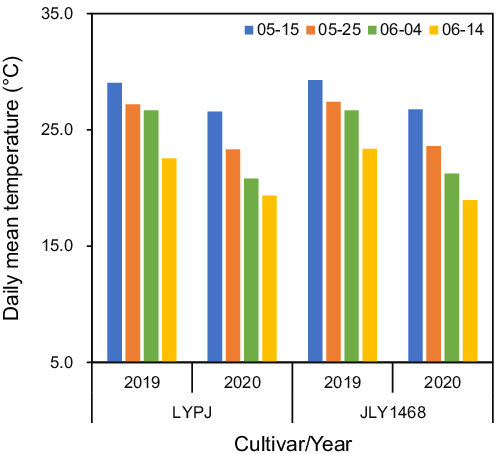
In order to run the experiment over various environments, four sowing dates (15 and 25 May and on 4 and 14 June) were employed in each year. The daily mean temperature during the ripening period was 19.4–29.0 °C for LYPJ and 19.0–29.3 °C for JLY1468 over eight environments (two years × four sowing dates) (Figure 1). For each sowing date, pregerminated seeds were sown in a seedbed, and 25-day-old seedlings were manually transplanted at a hill spacing of 20 cm × 20 cm with two seedlings per hill. The two cultivars were arranged in a completely randomized block design with three replicates and a plot size of 30 m2 for each sowing date. N fertilizer (150 kg N ha–1) was added in three applications: 50% one day before transplanting, 30% seven days after transplanting, and 20% at panicle initiation. P fertilizer (75 kg P2O5 ha–1) was applied one day before transplanting. Half of the K fertilizer (150 kg K2O ha–1) was applied one day before transplanting and the other half at panicle initiation. A floodwater depth of 5–10 cm was maintained from transplanting until seven days before maturity, when plots were drained. Insects, diseases, and weeds were controlled by chemicals as required.
Daily mean temperature during the ripening period in two hybrid rice cultivars, Liangyoupeijiu (LYPJ) and Jingliangyou 1468 (JLY1468), grown over eight environments (two years × four sowing dates).

Approximately 500 g of grains were collected from each plot and dried in the sun for three days. The sun-dried grains were stored at room temperature and humidity for three months before analysis. A subsample of 100 g of grains was randomly taken from each sample to prepare whole milled rice samples with a laboratory-scale milling machine (JGMJ8098, Shanghai Jiading Cereals and Oils Instrument Co., Ltd., Shanghai, China). The whole milled rice samples were weighted and counted. Grain weight of milled rice was calculated by dividing the whole milled rice weight by the grain number.
Chalky grain rate (i.e., the percentage of chalky grains in total whole milled rice grains) and chalkiness degree (i.e., the ratio in percentage for the respective projected areas of chalky part to the whole rice grain) were measured from the whole milled rice samples, using a scanner (MRS-9600TFU2L; Shanghai Zhongjing Technology Co. Ltd., Shanghai, China) and image analysis software (SC-E; Hangzhou Wanshen Detection Technology Co., Ltd., Hangzhou, China).
Rice starch was extracted using an alkali method with the following procedure: 30 g of whole milled rice was soaked in ultrapure water at 4ºC for 12 h, then the soaked rice was disintegrated in a high-speed blender, and the pulp obtained was squeezed through four layers of gauze. The filtrate was centrifuged at 3000 g for 20 min and the sediment was suspended by adding approximately fourfold volume of 0.4% NaOH solution. The suspension was shaken mechanically at room temperature for 4 h and then passed successively through 200- and 400-mesh screens. The filtrate was centrifuged at 3000 g for 20 min. The supernatant was replaced with a similar volume of ultrapure water to obtain a suspension and then centrifuged at 3000 g for 20 min; this step was repeated two times. The supernatant was replaced by a similar volume of ultrapure water to obtain a suspension, and the suspension was adjusted to a pH of 7 with 1 mol L–1 HCl solution and then centrifuged at 3000 g for 20 min. The supernatant was replaced with a similar volume of ultrapure water obtain a suspension, and the suspension was centrifuged at 3000 g for 20 min; this step was repeated until the supernatant was colorless. The supernatant was replaced by a similar volume of absolute ethyl alcohol to obtain a suspension and the suspension was centrifuged at 3000 g for 20 min; this step was repeated two times. The sediment (starch) was oven-dried at 40 ºC for 48 h. The dried starch was ground and passed through a 100-mesh screen for determining starch granule diameter distribution and mean starch granule diameter using a laser particle size analyzer (LS-POP6, OMEC Instruments Co. Ltd., Guangzhou, China). Relative starch granule size was calculated by dividing the mean starch granule size by the grain weight of milled rice.
Data were analyzed by ANOVA (Statistix 8.0 software, Tallahasse, FL, USA) and linear or nonlinear regression analysis (CurveExpert 1.4 software, Hyams Development, Chattanooga, TN, USA). The statistical model of the ANOVA included replication, cultivar, environment (i.e., the combination of one of four sowing dates and one of two years), and the interaction between cultivar and environment. The regression model was chosen according to the level of significance and the coefficient of determination.
Results
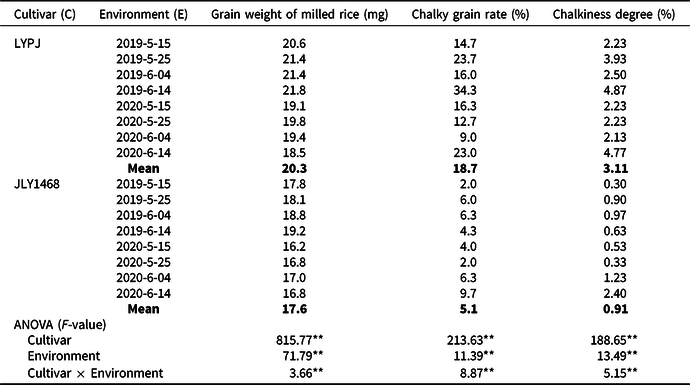
There were significant differences in grain weight of milled rice, chalky grain rate, and chalkiness degree between JLY1468 and LYPJ (Table 1). The grain weight of milled rice was 13% lower in JLY1468 than in LYPJ. JLY1468 had less than one-third the chalky grain rate and chalkiness degree compared to LYPJ. Grain weight of milled rice, chalky grain rate, and chalkiness degree was significantly affected by environment and the interaction between cultivar and environment.
Grain weight of milled rice, chalky grain rate, and chalkiness degree of two hybrid rice cultivars, Liangyoupeijiu (LYPJ) and Jingliangyou 1468 (JLY1468), grown over eight environments (two years × four sowing dates)

**denotes significance at the 0.01 probability level.
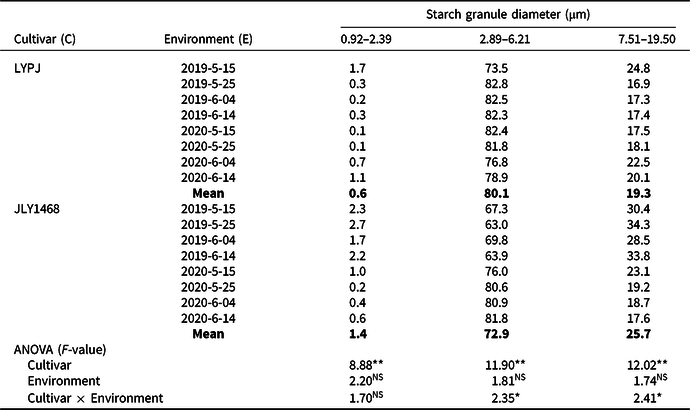
The differential and cumulative distribution of starch granule diameter significantly differed between JLY1468 and LYPJ (Figure 2 and Table 2). Compared to LYPJ, JLY1468 had a higher cumulative distribution of starch granules with diameters from 0.92 to 2.39 μm, a lower cumulative distribution of starch granules with diameters from 2.89 to 6.21 μm, and a higher cumulative distribution of starch granules from 7.51 to 19.50 μm (Table 2). The cumulative distribution of starch granules with diameters from 0.92 to 2.39 μm was not significantly affected by environment or the interaction between cultivar and environment, while the cumulative distributions of starch granules from 2.89 to 6.21 μm and from 7.51 to 19.50 μm were not significantly affected by environment but significantly affected by the interaction between cultivar and environment.
Differential distribution of starch granule diameter of two hybrid rice cultivars, Liangyoupeijiu (LYPJ) and Jingliangyou 1468 (JLY1468), grown over eight environments (two years × four sowing dates).

Cumulative distribution (%) of starch granule diameter of two hybrid rice cultivars, Liangyoupeijiu (LYPJ) and Jingliangyou 1468 (JLY1468), grown over eight environments (two years × four sowing dates)

* and **denote significance at the 0.05 and 0.01 probability levels, respectively. NSdenotes non-significance at the 0.05 probability level.
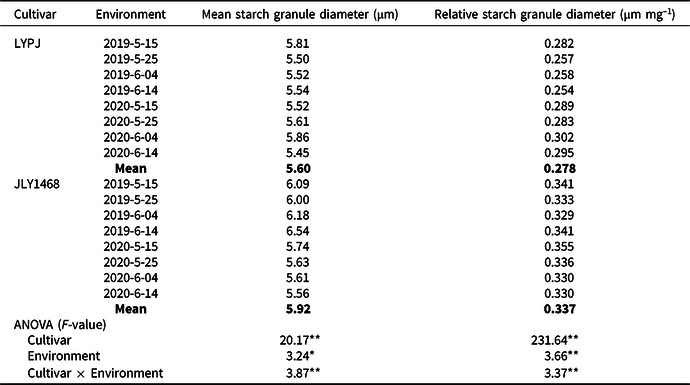
There were significant differences in mean and relative starch granule diameters between JLY1468 and LYPJ (Table 3). JLY1468 had 6% and 21% higher mean and relative starch granule diameters compared to LYPJ, respectively. Mean and relative starch granule diameters were significantly affected by environment and the interaction between cultivar and environment.
Mean and relative starch granule diameters of two hybrid rice cultivars, Liangyoupeijiu (LYPJ) and Jingliangyou 1468 (JLY1468), grown over eight environments (two years × four sowing dates)

* and **denote significance at the 0.05 and 0.01 probability levels, respectively.
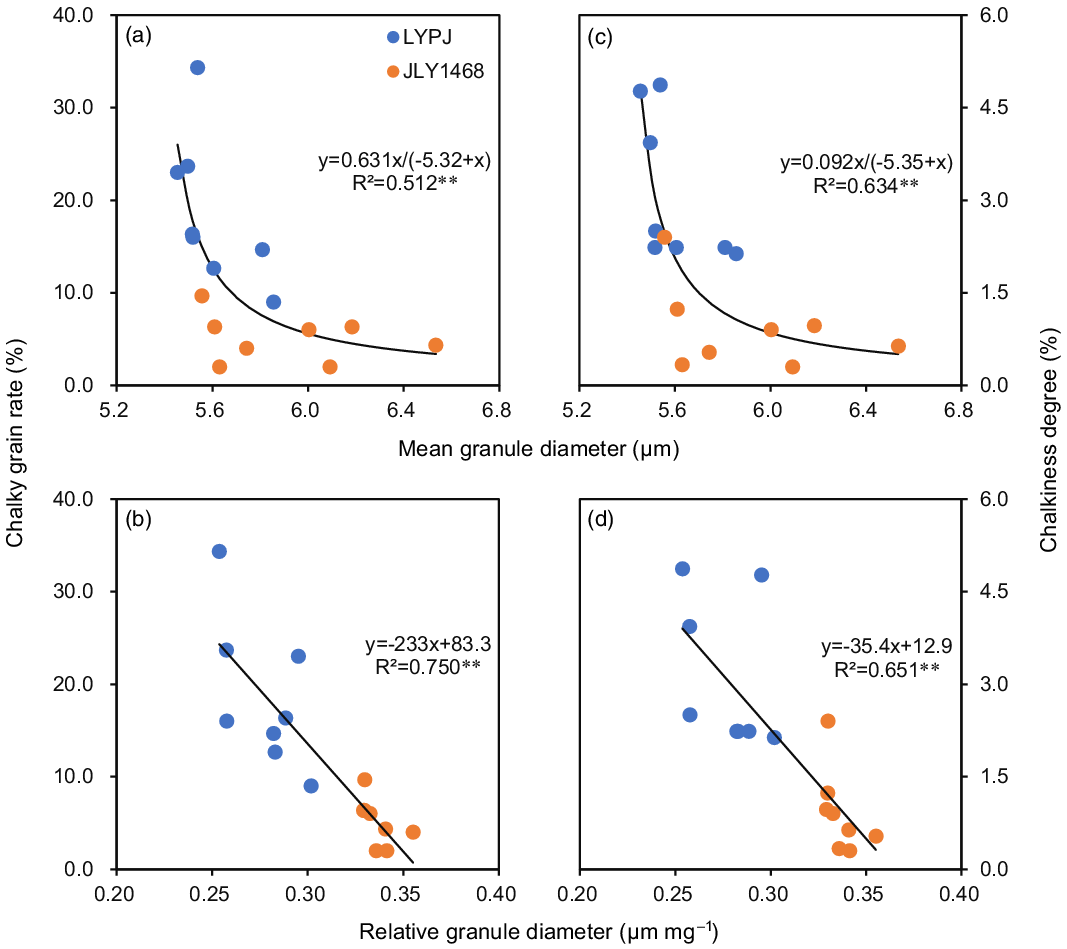
Chalkiness traits were significantly correlated with starch granule diameter across two hybrid rice cultivars grown over eight environments (Figure 3a–d). Overall, both the chalky grain rate and chalkiness degree showed a negative correlation with mean and relative starch granule diameter. However, changes in the relative starch granule diameter explained more variation in both the chalky grain rate and chalkiness degree than changes in the mean starch granule diameter did, with changes in the mean starch granule diameter explaining ∼51% and 63% of the variation in chalky grain rate and chalkiness degree, respectively (Figure 3a and c), and changes in the relative starch granule diameter explaining ∼75% and 65% of the variation in the chalky grain rate and chalkiness degree, respectively (Figure 3b and d).
Relationships of chalky grain rate with (a) mean and (b) relative starch granule diameter, and of chalkiness degree with (c) mean and (d) relative starch granule diameter across two hybrid rice cultivars, Liangyoupeijiu (LYPJ) and Jingliangyou 1468 (JLY1468), grown over eight environments (two years × four sowing dates). Each data point is the mean of three replicates per environment. ** denotes significant relationship at the 0.01 probability level.

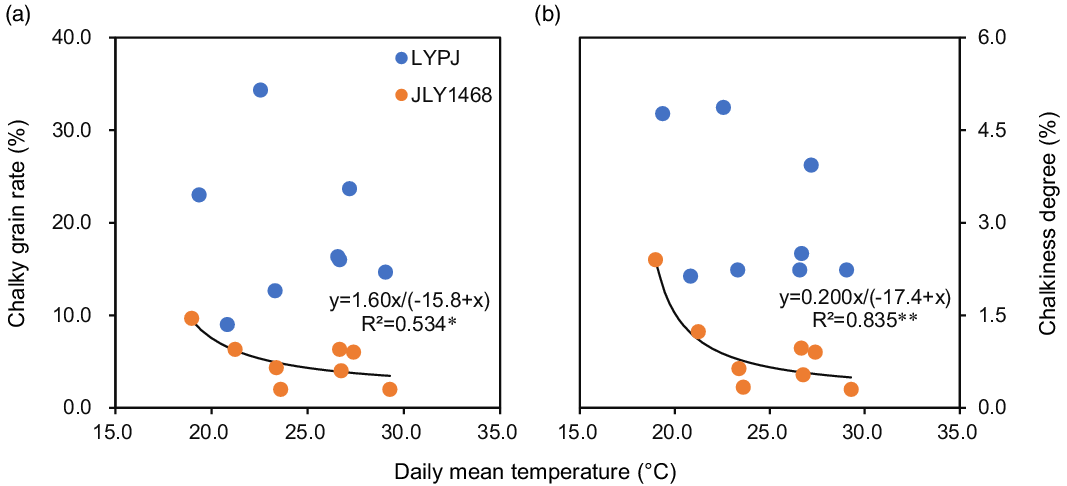
The relationship between chalkiness occurrence and the daily mean temperature during the ripening period varied between two cultivars (Figure 4a and b). For JLY1468, both chalky grain rate and chalkiness degree were significantly negative related to the daily mean temperature during the ripening period. However, for LYPJ, either chalky grain rate or chalkiness degree was not significantly related to the daily mean temperature during the ripening period.
Relationships of (a) chalky grain rate and (b) chalkiness degree with the daily mean temperature during the ripening period in two hybrid rice cultivars, Liangyoupeijiu (LYPJ) and Jingliangyou 1468 (JLY1468), across eight environments (two years × four sowing dates). Each data point is the mean of three replicates per environment. * and ** denote significant relationship at the 0.05 and 0.01 probability levels, respectively.

Discussion
Consistent with previous studies (E et al., Reference E, Cheng, Sun, Wang, Zhu, Lin, Wang, Tong and Chen2019; Huang et al., Reference Huang, Shan, Chen, Cao, Jiang, Zou and Li2017), we observed much lower chalkiness occurrence in JLY1468 than in LYPJ, indicating that the cultivars selected for this study were appropriately representative of hybrid rice with low and high chalkiness occurrence. Furthermore, we found that JLY1468 had significantly larger mean and relative starch granule diameters compared to LYPJ, and that there was a negative correlation of starch granule size with the chalky grain rate and chalkiness degree. These findings support our hypothesis that changes in starch granule size may be partially responsible for the decreased chalkiness occurrence in newer cultivars of hybrid rice and indicate that selecting for increased starch granule size may be beneficial in decreasing chalkiness occurrence in hybrid rice.
An overall increase in starch granule size can be achieved either by reducing the distribution of small-diameter size starch granules or by increasing the distribution of large-diameter size starch granules. In this study, because the distribution of small-diameter starch granules (0.92 –2.39 μm) was higher in JLY1468 than in LYPJ, the larger mean starch granule size in JLY1468 was mainly attributable to a higher distribution of large-diameter (7.51–19.50 μm) starch granules compared to LYPJ. This finding suggests that specific attention should be paid increasing large-diameter starch granules in terms of decreasing chalkiness occurrence in hybrid rice.
There have been reports that the enlargement or better development of starch granules can be achieved by improving starch biosynthesis and accumulation through regulating the expression of starch synthesis enzymes, including the granule-bound starch synthase and soluble starch synthase (Zhang et al., Reference Zhang, Jiang, Liu, Cai, Dai and Cao2010; Zhou et al., Reference Zhou, Huang, Huang, Liu, Wang, Cai, Dai, Cao and Jiang2018). Additionally, it has been well documented that improving starch biosynthesis and accumulation is beneficial to reduce the chalkiness occurrence (Jin et al., Reference Jin, Li, Guo, Liu, Su, Wu and Wan2010; Peng et al., Reference Peng, Kong, Nassirou, Peng, He, Sun, Pang, Song, Peng, Li, Guo, Li, Liu, Song, Zhou, Duan and Yuan2018; Ryoo et al., Reference Ryoo, Yu, Park, Baik, Park, Cho, Bhoo, An, Hahn and Jeon2007). Therefore, we propose that a higher distribution of large-diameter starch granules means better development of starch granules (or improved starch biosynthesis and accumulation), thus contributing to a lower chalkiness occurrence.
The better development of starch granules (or higher distribution of large-diameter starch granules) and lower chalkiness occurrence in JLY1468 could be attributable to more abundant substrates for starch biosynthesis and accumulation compared to LYPJ (Liu et al., Reference Liu, Zhao, Zhou, Cao, Shi and Cheng2017). This could be supported by that (1) JLY148 had higher biomass production during the ripening period and higher source-sink ratio (i.e., the ratio of biomass production during the ripening period to the number of spikelets) than LYPJ (data not shown) and (2) there is a negative association between chalkiness occurrence and assimilate supply (Hayashi et al., Reference Hayashi, Hayashi, Kuno, Tani, Endo, Higashino, Nakata-Kano and Yamauchi2013; Tsukaguchi and Iida, Reference Tsukaguchi and Iida2008). These highlight the need for fundamental understanding of source–sink interactions regulating the development of starch granules and the occurrence of chalkiness in hybrid rice.
Starch granule size has previously been evaluated using the absolute starch granule diameter (Deng et al., Reference Deng, Li, Chen, Zeng, Li, Zhong, Wang and Ren2021; Zhang et al., Reference Zhang, Huang, Wei, Chen, Shan, Cao, Chen and Zou2019; Zhu et al., Reference Zhu, Fang, Qian, Guo and Huo2021). Here, in addition to using the absolute starch granule diameter, we also introduced the relative starch granule diameter in order to control for differences in grain weight when comparing the starch granule size between cultivars. We showed that the chalky grain rate and chalkiness degree were more closely correlated with the relative granule diameter than the absolute mean starch granule diameter. This outcome suggests that the relative starch granule diameter is a relevant parameter in understanding the occurrence of chalkiness in hybrid rice.
Chalkiness in rice is known to be affected by environmental conditions, especially the temperature during the ripening period (Siebenmorgen et al. Reference Siebenmorgen, Grigg and Lanning2013). In this study, delayed sowing resulted in lower daily mean temperature during the ripening period, and both chalky grain rate and chalkiness degree were significantly negatively related to the daily mean temperature during the ripening period in JLY1468. This finding suggests that JLY1468 is susceptible to chalkiness occurrence due to low temperature, and a too-late sowing should be avoided to reduce the occurrence of chalkiness in its production. This is not in agreement with the general consideration that delaying sowing can improve rice quality by lowering the temperature during the ripening period (Deng et al., Reference Deng, Zhang, He, Liao, Li, Li, Zhu, Gao, Tao, Zhou, Lei, Wang, Hu, Chen and Ren2022), highlighting the need for further investigations with more cultivars to re-evaluate the feasibility of adopting the strategy of delaying sowing to improve rice quality.
Although this study obtained some information about why the occurrence of chalkiness has decreased in the newly released hybrid rice cultivars by evaluating the association between chalkiness occurrence and starch granule size, many researches on rice chalkiness have reached down to the gene level (Li et al., Reference Li, Fan, Xing, Yun, Luo, Yan, Peng, Xie, Wang, Li, Xiao, Xu and He2014; Sun et al., Reference Sun, Zhou, Yao, Qiu, Xie and Yu2015; Tabassum et al., Reference Tabassum, Dosaka, Ichida, Morita, Ding, Abe and Katsube-Tanaka2020). Therefore, it is necessary to undertake further investigations to provide insights into the genetic mechanisms underlying the decreased chalkiness occurrence in the new hybrid rice cultivars.
Conclusions
In this study, we found that the lower chalkiness occurrence was associated with a higher distribution of large-diameter starch granules in a recently developed hybrid rice cultivar JLY1468 compared to a relatively older hybrid rice cultivar LYPJ. This finding suggests that selective breeding cultivars with a high concentration of relatively large-diameter starch granules are expected to decrease chalkiness occurrence in hybrid rice. In addition, our study also suggests that the relative starch granule diameter (which controls of grain weight) is a relevant parameter in understanding the occurrence of chalkiness in hybrid rice.
Acknowledgements
This study was supported by the National Key R&D Program of China (2016YFD0300509).
Financial Support
None.
Conflicts of Interest
The authors declare none.