1. Introduction
An analogy is a relation of similarity between two domains, where a domain is a fixed representation of certain aspects of a phenomenon, situation, process, model, problem, conceptual structure, etc., that are relevant for a particular analogy. A domain consists of a class of elements, referred to as objects, and a number of relations that hold between them.Footnote 1 Thus, when a domain is given, the relations are given explicitly, too. How these objects and relations are identified in the first place, for example, because of their relevance or salience, is an open problem, which has not been solved satisfactorily in any of the current explications of analogies.Footnote 2 Characterizing analogies in terms of domains allows for the same phenomena to enter relations of analogy in very different ways. For example, if light is considered to be analogous to a water wave and also analogous to a stream of particles, different aspects of light are relevant for the respective analogies to work. In the first case, light is represented by a continuous set of elements, in the second one, the objects of the domain are discrete particles (see Sterrett Reference Sterrett1998).
The features in which two analogues resemble each other constitute the positive analogy, features in which they differ are the negative analogy, and features are called neutral if they are present in one analogue, but it is not known whether they are also present in the other.Footnote 3 Two main aspects of analogical reasoning are abstraction, whereby an abstract concept is introduced that subsumes the analogues, and analogical transfer, where a given analogy between a source and a target is exploited to conjecture a property or relation in the target that is present in the source. Although inferences by analogical transfer are neither truth-preserving nor infallible, this kind of reasoning plays a prominent role in advancing science and mathematics. Because of this, many philosophers and scientists alike have taken an interest in analogies.Footnote 4 Since the 1980s cognitive psychologists also have investigated analogical reasoning, and they have elaborated their accounts into empirically tested computational models.Footnote 5 By far the most attention has been devoted to the use of analogies in everyday contexts and in science. Analogical reasoning in mathematics has been studied to a much smaller degree (mainly in Polya Reference Polya1954, Reference Polya1981; see also Poser Reference Poser1989 and Knobloch Reference Knobloch1989), and, as I shall argue below, insights gained from these investigations have not yet been properly incorporated into the mainstream view of analogies.
What appears to be the current paradigm in the study of analogies is that they are best characterized in terms of structure-preserving mappings between the domains. Gentner's (Reference Gentner1983) structure-mapping theory of analogies, or variants thereof, have become widely accepted in cognitive science and it is not uncommon for philosophers of science to refer to it as their favored explication (see, e.g., Nersessian Reference Nersessian and Giere1992, Magnani and Nersessian Reference Magnani and Nersessian2002, and Shelley Reference Shelley2003). A second construal of analogies, which is much less popular nowadays, considers two domains as analogous if they satisfy the same laws or axioms (i.e., if they are models of the same set of axioms). I shall refer to this as the axiomatic account of analogies. (Particular practical advantages of this approach are discussed in Section 4.) A third construal of analogies takes the notion of metaphor as fundamental, but it also makes use of structure-preserving mappings or axiomatic characterizations to account for the similarity between analogous domains. Because of this, I shall consider only the first two approaches in my main argument (Sections 2 and 3), and afterwards extend the discussion to the third one (Section 5). No matter which of these techniques for finding and expressing analogies is favored, it is usually assumed to be universally applicable to all domains alike. In contrast, I introduce below a distinction between two kinds of domains and argue that these domains demand different ways of explicating analogies between them.
2. Two Explications of Analogies
2.1. Axiomatic Explications of Analogies
Following the development of formal methods and a noticeable increase of the use of models in scientific reasoning in the late nineteenth century, analogies became a focus of attention, since the relation between a model and what is being modeled was considered to be one of analogy (see, e.g., Boltzmann Reference Boltzmann1911). Most famously, J. C. Maxwell motivated the use of models, or “scientific illustrations,” to highlight the “mathematical form which is common to the corresponding ideas in the two sciences” that are deemed analogous (Maxwell Reference Maxwell1870, 219). The mathematical form is expressed by laws or axioms, which, if interpreted properly, hold in both domains. Similarly, Duhem, who vehemently criticized use of mechanical models, understood analogies as being expressed by a set of common laws.Footnote 6 Such a view has also been put forward in the twentieth century by the philosophers Suppes, Nagel, and Hempel.Footnote 7 According to the latter, analogies are characterized by a sameness of syntactical structure of the underlying laws (“nomic isomorphism”; Hempel Reference Hempel1965, 436). An example is the analogy between the flow of an electric current in a wire and the flow of a liquid in a pipe, which is based on the structural similarity of Poiselle's and Ohm's laws.Footnote 8
Against this tradition, Hesse argued in her influential book Models and Analogies in Science (Reference Hesse1966) that analogies cannot be “formal,” where she understands a formal analogy as one in which all similarities (i.e., positive analogies) between the analogous domains are expressed by a formal system. Thus, since all positive analogies must follow deductively in that system, formal analogies cannot yield any additional information that could be exploited for making novel predictions by analogical transfer (Hesse Reference Hesse1966, 69, 100; Reference Hesse and Edwards1972, 355–357; a similar point is also made in Leatherdale Reference Leatherdale1974). This argument, however, depends on her very narrow construal of formal analogies, which does not, for example, agree with that of Maxwell, who explicitly speaks of only a “partial similarity between the laws of one science and those of another” (Reference Maxwell1855, 156). In her own analysis of analogies, Hesse speaks of a similarity relation between the analogs. Attempts to make this relation precise have resulted in the structure-mapping theory of analogy.
2.2. The Structure-Mapping Theory of Analogy
The main constituent of an analogy between two domains, according to the structure-mapping theory of analogy (SMT) (Gentner Reference Gentner1983), is a mapping f between the objects and relations of one domain (source) and another (target), such that, if a relation R holds of some objects
 $a_{1},\, a_{2},\ldots $
in the source domain, the corresponding relation
 $f( R) $
also holds of the objects
 $f( a_{1}) ,\, f( a_{2}) ,\ldots $
in the target. Such mappings, also called morphisms, are said to preserve the structure of the source domain. Using such mappings, an analogy is explicated as a ‘structural alignment’ of two domains, which is characterized by structural consistency, relational focus, and systematicity: structural consistency means that every matching relation must have matching arguments (‘parallel connectivity’) and that any element is matched to at most one element of the other domain (‘one-to-one correspondence’); relational focus is obtained by matching only objects and relations, but not predicates, while systematicity requires the mapping to include as many higher-order and interrelated connections as possible (see also Gentner and Markman Reference Gentner and Markman1997, 47; Gentner and Wolff Reference Gentner, Wolff, Dietrich and Markman2000, 304).
In mathematical terms, an analogy can thus be characterized by an isomorphism (where [i] every object of the source is mapped to a unique object of the target and [ii] every object of the target is assigned an object of the source), by an embedding (in case [ii] fails to hold), or by a partial embedding (in case both [i] and [ii] fail). Sometimes these requirements are loosened in such a way as to admit also homomorphisms (where more than one object from the source can be mapped to a single object in the target) to characterize analogies (Gentner and Markman Reference Gentner and Markman2005, 2).
Analogical transfer can now be described as follows. The morphism determines a substructure that is common to the source and target domains, and those features (objects or relations) that are connected to this substructure and present in the source, but not in the target, are projected into the target. With regard to Huygens's often-discussed analogy between sound and light, “air,” which is part of the source domain and connected to the substructure that is common to the domains of sound and light, is projected into the target domain, where it is called “ether.”
Several versions of SMT have been developed and implemented. These differ considerably with regard to the underlying mechanisms (e.g., procedural or connectionist) that are employed for determining the relevant mappings. Furthermore, additional constraints on the mappings have also been proposed, for example, semantic considerations concerning similarities between relations, and pragmatic ones concerning the purpose of the analogies.Footnote 9 Based on observations that people show some tolerance for violations of these requirements, Holyoak and Thagard regard these constraints as “pressures” (Holyoak and Thagard Reference Holyoak and Thagard1989) rather than requirements, so that the mappings are not restricted to morphisms and even one-to-many correspondences are allowed. Nevertheless, enough of the basic ideas of these theories are similar to those described above that there is no need to go into further details at this point.
2.3. Analogies in Mathematics
Explications of analogies using axioms and using structure-preserving mappings are often presented as alternatives, of which one is to be given preference (e.g., in Hesse Reference Hesse1966). A notable exception is the mathematician George Polya, who studied extensively the methods by which mathematics progresses and who emphasized the importance of analogies.Footnote 10 He has certainly given the most informed and comprehensive discussion of analogical reasoning in mathematics. For Polya, an important part of mathematical discovery consists in clarifying analogies, which initially are often vague and ambiguous, and he mentions three kinds of possible clarifications. First, analogies can be based on “relations that are governed by the same laws,”Footnote 11 and as example he mentions the analogy between addition and multiplication of numbers, since they are both commutative, associative, and admit an inverse relation. In accordance with the axiomatic approach to analogies Polya infers that “in general, systems of objects subject to the same fundamental laws (or axioms) may be considered as analogous to each other, and this kind of analogy has a completely clear meaning.” Second, an isomorphism, understood as “one-to-one correspondence that preserves the laws of certain relations” provides “a fully clarified sort of analogy,” while the third kind of analogies are explicated by a homomorphism, which Polya describes as a “systematically abridged translation” in which subtleties might get lost, but where everything in the original finds a representation and the relations are preserved on a reduced scale. Thus, Polya mentions both a common set of laws or axioms, and structure-preserving mappings as means for making analogies precise. I will now extend Polya's discussion by showing that the successful application of these two different kinds of explications of analogies depends on the kinds of domains that are considered to be analogous.
3. Comparison of the Two Approaches
3.1. Relation-Rich and Object-Rich Domains
The distinction between relation-rich and object-rich domains is based on the ratio between the number of objects and the number of relations in a domain.Footnote 12 If the number of objects is greater than the number of relations the domain we speak of an object-rich domain, otherwise of a relation-rich domain.Footnote 13 Notice that this distinction admits of gradations, and that domains with the same number of objects and relations can be classified either way.
As it turns out, relation-rich domains are the ones most often discussed and evaluated in the literature on analogy and analogical reasoning. They typically have only very few objects, but the number of different relations is relatively large and the relations hold only between some, but not all, objects. For example, Gentner's analysis of Rutherford's analogy between an atom and our solar system is based on the two domains consisting of the objects sun, planet and nucleus, electron, and the binary predicates attracts, revolves around, and more massive than (Gentner Reference Gentner1983). Carnot's analogy between water flow and heat flow has been analyzed in terms of two domains each of which consists of three objects and eight relations, and Boyle's analogy between ants moving eggs and wind moving leaves has been presented by two domains each of which have three objects and seven relations (see Gentner and Jeziorski Reference Gentner and Jeziorski1987). Similarly, the analogy between the Persian Gulf War of 1991 and World War II, used as the motivating example in Holyoak and Thagard Reference Holyoak and Thagard1997 consists of domains with more relations than objects. (For a number of other examples, all of which are of this kind, see Holyoak and Thagard Reference Holyoak and Thagard1989 and Keane, Ledgeway, and Duff Reference Keane, Ledgeway and Duff1994.)
The domains investigated in mathematics, however, differ from these in that they typically have many objects (often infinitely many), but only a very small number of relevant relations or operations which hold between most of the objects.Footnote 14 In arithmetic, for example, we have countably many natural numbers, but only the two basic operations of addition and multiplication; algebraic structures like groups, fields, lattices, and Boolean algebras have an arbitrary number of objects, but only one or two operations; Hilbert's famous presentation of Euclidean plane geometry is based on uncountably many points and lines, but the only primitive relations are those of incidence, betweenness, and congruence (Hilbert Reference Hilbert1899); other examples of this kind are matrices with multiplication and addition, binary forms with composition, and functions with composition. All of these domains are object-rich, which motivates the reference to “mathematical domains” in the title.
3.2. Some Simple Object-Rich Domains
For the purpose of illustration, let us first consider two simple object-rich domains, consisting of rotations and numbers modulo 3, and then extend the discussion to a few more instances from the theory of groups, namely, the simplest cases of finite groups with two, three, and four elements. The results, however, are very general and hold for a wide variety of object-rich domains.
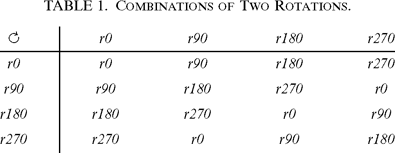
Consider the letter M and the following positions into which it can be put by rotating it around its center: M,


Combinations of Two Rotations.

| ↻ | r0 | r90 | r180 | r270 |
|---|---|---|---|---|
| r0 | r0 | r90 | r180 | r270 |
| r90 | r90 | r180 | r270 | r0 |
| r180 | r180 | r270 | r0 | r90 |
| r270 | r270 | r0 | r90 | r180 |
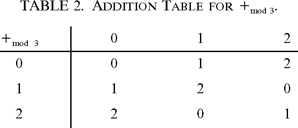
As a second object-rich domain consider the numbers 0, 1, and 2, under the operation of addition modulo 3, which is like usual addition if the result is less than 3, and the remainder of division by 3 otherwise. Thus,
 $1+_{\mathrm{mod}\,\,3}2=0$
and
 $2+_{\mathrm{mod}\,\,3}2=1$
. The complete addition table for
 $+_{\mathrm{mod}\,\,3}$
is in Table 2.

 $+_{\mathrm{mod}\,\,3}$ |
0 | 1 | 2 |
|---|---|---|---|
| 0 | 0 | 1 | 2 |
| 1 | 1 | 2 | 0 |
| 2 | 2 | 0 | 1 |
Both of these domains are considered analogous by mathematicians (which is expressed by regarding both as mathematical groups), but, as I will show below, their structural similarity cannot be captured in terms of a structure-preserving mapping between the objects and relations of the two domains. However, it can be expressed in terms of a common set of axioms that the two domains satisfy. Let us look at a few more examples of mathematical groups to make this claim more precise.
A group is a domain consisting of a set of elements that are closed under an associative binary operation, such that there is one neutral element, and each element has a unique inverse. Thus, there is only one operation on the elements of a group, but it can be applied to any two of these elements. Given two distinct elements a and b, and a binary operation
 $*_{1}$
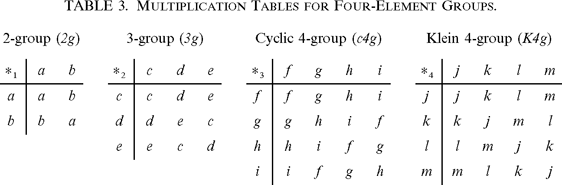
there is only one way (up to renaming of the elements) in which they satisfy all of the above conditions, that is, in which they can form a group. Similarly, there is (up to renaming) only one group with three elements, but there are two structurally different groups with four elements. These groups, with the operations
 $*_{1}$
,
 $*_{2}$
,
 $*_{3}$
, and
 $*_{4}$
respectively, are presented by the multiplication tables in Table 3. (For easier reference the elements have been named differently in each of the groups.)

| 2-group (2g) | 3-group (3g) | Cyclic 4-group (c4g) | Klein 4-group (K4g) | |||||||||||||
|---|---|---|---|---|---|---|---|---|---|---|---|---|---|---|---|---|
 $*_{1}$ |
a | b |
 $*_{2}$ |
c | d | e |
 $*_{3}$ |
f | g | h | i |
 $*_{4}$ |
j | k | l | m |
| a | a | b | c | c | d | e | f | f | g | h | i | j | j | k | l | m |
| b | b | a | d | d | e | c | g | g | h | i | f | k | k | j | m | l |
| e | e | c | d | h | h | i | f | g | l | l | m | j | k | |||
| i | i | f | g | h | m | m | l | k | j | |||||||
Notice that the domain of rotations discussed above is an instance of the cyclic 4-group, while the set of numbers with addition modulo 3 is an instance of the 3-group, that is, that with appropriate renaming of the operation and the elements, and possibly rearranging the rows and columns, their multiplication tables are identical. In these cases, that is, when the domains have the same cardinality and they yield the same multiplication table, one can use a structure-preserving mapping between the domains to express their similarity. As is shown below, however, this does not work in general, namely, when the domains consist of a different number of objects or have structurally different multiplication tables.
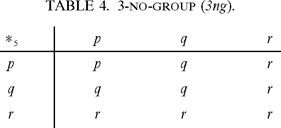
In addition, I shall consider a three-element domain, called “3-no-group” (3ng), that is closed under the binary operation
 $*_{5}$
, and has a neutral element p, but that is not a group, since not every element has an inverse. It is represented in Table 4.

 $*_{5}$ |
p | q | r |
|---|---|---|---|
| p | p | q | r |
| q | q | q | r |
| r | r | r | r |
The domains 2g, 3g, c4g, and K4g are, up to renaming of the elements and operations, the only groups of two, three, and four elements; that is, other operations on sets of elements of these cardinalities that cannot be presented by the same tables (up to renaming of the elements, of course) do not satisfy conditions for being a group. The elements a, c, f, and j are the neutral elements. Notice that in these domains, the number of elements is larger than the number of relations, so that they are indeed object-rich domains.
The representation in terms of the multiplication tables above is a useful, but not an essential feature of groups. Since the binary operation can be expressed as a ternary relation, an equivalent LISP representation of the information coded in the tables—as it is often used for the computer implementations in cognitive science—would be, in case of the 2-group: (
 $*_{1}\,a\,a\,a$
), (
 $*_{1}\,a\,b\,b$
), (
 $*_{1}\,b\,a\,b$
), (
 $*_{1}\,b\,b\,a$
).
The problem of explicating the analogies between these domains can be formulated as follows:
Assume you are given two of the simple object-rich domains presented above. By what means can you best assess their structural alikeness, and, in particular, how can you express the analogies between those domains that are groups and an appropriate disanalogy to the domain 3ng, which is not a group?
3.3. Failure of the Structure-Mapping Account in Object-Rich Domains
According to SMT, an analogy between two domains is analyzed in terms of morphisms between the domains or parts of the domains. The more objects and relations that are mapped, the better the analogy is. Thus, we can determine the maximal morphisms, that is, isomorphisms, homomorphisms, or embeddings, involving the greatest number of elements and relations that can be established between the domains. (See Section 2.2 for the mathematical terminology.) These maximal morphisms are considered to be most informative with regard to the degree of structural similarity they express.
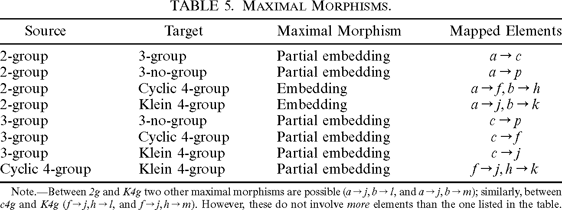
Since all domains under consideration have only a single relation, these must be mapped to each other by the morphisms. What remains to be investigated is how the elements can be mapped to achieve parallel connectivity and one-to-one correspondence. For example, between the 2-group and the 3-group, this can be achieved in only two ways: either by considering only the neutral elements (a and c) and mapping them to each other (partial embedding), or by mapping all elements of the 2-group to the neutral element of the 3-group (homomorphism). The latter morphism is considered trivial, since only a single element of the target domain is assigned elements from the source domain. Such a morphism can be established between a vast number of domains (e.g., between each of the domains considered here) and therefore indicates only a minimal degree of similarity between them. We see that in both structure-preserving mappings between the 2-group and the 3-group, not all elements from the two domains enter into the morphism. This is the crucial difference from the axiomatic approach, which allows the quantification over all elements of a domain, regardless of their number. Table 5 shows the maximal morphisms between the domains presented above.

| Source | Target | Maximal Morphism | Mapped Elements |
|---|---|---|---|
| 2-group | 3-group | Partial embedding |
 $a\rightarrow c$ |
| 2-group | 3-no-group | Partial embedding |
 $a\rightarrow p$ |
| 2-group | Cyclic 4-group | Embedding |
 $a\rightarrow f,\, b\rightarrow h$ |
| 2-group | Klein 4-group | Embedding |
 $a\rightarrow j,\, b\rightarrow k$ |
| 3-group | 3-no-group | Partial embedding |
 $c\rightarrow p$ |
| 3-group | Cyclic 4-group | Partial embedding |
 $c\rightarrow f$ |
| 3-group | Klein 4-group | Partial embedding |
 $c\rightarrow j$ |
| Cyclic 4-group | Klein 4-group | Partial embedding |
 $f\rightarrow j,\, h\rightarrow k$ |
Note.—Between 2g and K4g two other maximal morphisms are possible (
 $a\rightarrow j,\, b\rightarrow l$
, and
 $a\rightarrow j,\, b\rightarrow m$
); similarly, between c4g and K4g (
 $f\rightarrow j,\, h\rightarrow l$
, and
 $f\rightarrow j,\, h\rightarrow m$
). However, these do not involve more elements than the one listed in the table.
As in the case of the maximal structure-preserving mapping between 2g and 3g, also those between 2g and 3ng, as well as between 3g and 3ng, 3g and c4g, and 3g and K4g do not involve all elements from the respective domains. Moreover, by comparing the maximal morphisms from 2g to 3g and to 3ng we see that both consist only of a single mapping of the neutral element to one element of the target domain. Thus, there is no way to distinguish between the analogy of the 2-group to the 3-group and the disanalogy to the 3-no-group by using only structure-preserving mappings between the domains. This result is not limited to the comparison between the 2-element group and a domain with 3 elements, but it holds for any domain with n elements, where n is a prime number (since only one cyclic group exists with each of these cardinalities). Thus, using only morphisms between two given domains to characterize their structural similarity, the difference between between groups and domains that are not groups cannot be expressed in general.Footnote 15
In addition, there are other structural similarities shared by some of the examples that also cannot be captured using morphisms alone. Regarding the relation between the 2-group and the two 4-groups, an equally informative embedding is the maximal morphism possible in both cases. So, according to this measure of similarity, both 4-groups are alike in regard to their structural similarity to the 2-group. However, in both the 2-group and the Klein 4-group, every element, when multiplied with itself, yields the neutral element.Footnote 16 The cyclic 4-group does not share this property; thus, these additional analogies and disanalogies also cannot be expressed purely in terms of the structure-preserving mappings.
It follows from these considerations that morphisms between two analogs can characterize only very weak structural relations between the object-rich domains of different cardinalities used as examples. In particular, it is not possible to distinguish those domains that are groups from those that are not groups on the basis of structure-preserving mappings between the domains. In other words, the structure-mapping approach fails to characterize the similarities of an important class of structures that occur frequently in mathematics. Moreover, these results are of a very general nature, since they hold for all domains that are characterized by a non-categorical system of axioms, that is, where the domains that satisfy the axioms are not isomorphic. Algebraic structures, number systems, and many geometries, are all domains of this kind. As a result, the approach of explicating analogies based on structure-preserving mappings has severe limitations of applicability.
3.4. Axiomatic Characterizations of Analogies
The assessment of the structural alikeness of two domains in terms of axioms depends on being able to find formal statements (axioms) that, when appropriately interpreted, are true in both domains. These statements then express commonalities between the domains, that is, the positive analogies.
In the case of the domains discussed in the previous section, all of the four axioms shown in Table 6 are true in 2g, 3g, c4g, and K4g, if the operation
 $\circ $
is interpreted as
 $*_{1}$
,
 $*_{2}$
,
 $*_{3}$
, and
 $*_{4}$
, respectively.

| (1) |
 $\forall x\,\forall y\,\exists z$
. |
 $x\circ y=z$ |
(closedness) |
| (2) |
 $\forall x\,\forall y\,\forall z$
. |
 $( x\circ y) \circ z=x\circ ( y\circ z) $ |
(associativity) |
| (3) |
 $\exists x\,\forall y$
. |
 $x\circ y=y$ |
(left identity element) |
| (4) |
 $\exists x\,\forall y\,\exists z$
. |
 $( x\circ y=y) \,\& \,( z\circ y=x) $ |
(existence of left inverses) |
Indeed, it is by such axioms, or equivalent formulations thereof, that the notion of group is usually introduced (e.g., van der Waerden Reference van der Waerden1930, 15; Rotman Reference Rotman1996, 67). They clearly demarcate groups from domains that are not groups, as is illustrated by the fact that the domain 3ng does not satisfy all of them, since axiom (4) does not hold. Other algebraic structures, number systems, geometries, and other mathematical domains are also usually presented by a set of axioms.
Since a great appeal of the structure-mapping theory of analogies lies in the fact that it has been studied extensively by cognitive psychologists, that is, that it has actually been implemented and tested against experimental data, let me briefly argue that the process of finding axiomatic characterizations of analogies can equally well be automated. As a consequence, the underlying mechanisms for expressing analogies axiomatically do not have to involve complex cognitive abilities.Footnote 17
Beginning with Lenat's AM and EURISKO programs, which generate conjectures based on a very large number of heuristics, considerable progress has been made in the past three decades in the field of automated discovery (Lenat Reference Lenat1976, Reference Lenat1983; for an insightful discussion, see Ritchie and Hanna Reference Ritchie and Hanna1984 and Lenat and Brown Reference Lenat and Brown1984). In particular, Colton's HR program, which makes use of a model generator and an automated theorem prover, and relies only an a few production rules to manipulate representations of mathematical concepts, has been applied to the theory of groups. Given a set of groups, represented by multiplication tables like the ones above, “HR takes these tables and extracts the group operation, identity and inverse concepts” (Colton and Bundy Reference Colton, Bundy, Walsh and Dean1999), that is, those concepts that are expressed by the axioms of group theory listed above. By manipulating simple expressions of the form
 $V_{1}\circ \,V_{2}=V_{3}$
, for example, via introduction of conjunctions, negations, and quantifiers, HR was able to generate the concepts of commutative and non-commutative groups, and to show that “all groups of size 6 can be classified up to isomorphism as either Abelian [commutative] or non-Abelian [non-commutative]” (Colton et al. Reference Colton, Meier, Sorge, McCasland, Basin and Rusinowitch2004, 401). In short, HR can automatically generate sets of formulas that are true in a given domain, as well as sets of formulas that hold in more than one given domain. Once such a set of formulas (axioms) has been found, techniques from automated theorem proving can be used to simplify it and determine whether certain axioms can be dispensed with (e.g., McCune Reference McCune1992 and McCune et al. Reference McCune2002).
As illustration for the expressive power of axiomatic characterizations, let us have a look at the properties that can be expressed by formulas of the simple form

that are satisfied by the example domains mentioned above, if the operation
 $\circ $
is replaced by
 $*_{1}$
,
 $*_{2}$
,
 $*_{3}$
,
 $*_{4}$
, and
 $*_{5}$
, respectively, where
 $Q_{1}$
and
 $Q_{2}$
can be replaced by the quantifiers
 $\forall $
(for all),
 $\exists $
(there exists), and
 $\exists !$
(there exists exactly one), and either of
 $V_{1}$
,
 $V_{2}$
, and
 $V_{3}$
can be instantiated by the bound variables x and y. Such formulas can express, among other things, the following four properties that hold in all four groups under consideration:
a) Only one element yields itself when multiplied by itself (
 $\exists !x\thinspace{:}\thinspace x\circ x=x$
).
b) For every element x there is exactly one element that is the result of
$x\circ x$
, implying that the domain is closed under multiplication of an element with itself.c) There is a unique left neutral element x, which yields
$x\circ y=y$
, for all y.d) There is a unique right neutral element x, which yields
$y\circ x=y$
, for all y.



The following two properties, which refer to the objects in the top-left to bottom-right diagonal of the multiplication table, can also be expressed by formulas of this form and can be used to differentiate further between the groups, since they are satisfied by some, but not all, of the four groups:
e 1) Every element is on the diagonal once (
$\forall x\exists !y\thinspace{:}\thinspace y\circ y=x$
; valid only in 3g).e 2) A unique element is on the diagonal (
$\exists !x\forall y\thinspace{:}\thinspace y\circ y=x$
; valid only in 2g and K4g).


Because of the structural simplicity of the formulas under consideration, not all characteristic properties for groups, for example, associativity, can be expressed. Notice, however, that even with these simple formulas, properties can be expressed that characterize the commonalities and differences between the domains under consideration in an informative way, including the differences in the distribution of the elements on the diagonals. Comparing the three element group with a domain of three elements that is not a group (3ng) yields that all of the properties (b), (c), (d) and (e 1), but only weaker versions of (a) and (e 1) are common to these two domains. Thus, the axiomatic approach allows us to distinguish groups from domains that are not groups, and, moreover, it allows us to express in what regard these domains differ from each other.
To summarize, we have seen in this section that the structure-mapping explication of analogies fails in certain object-rich domains, whereas the axiomatic approach to analogies is not subject to the same limitations and can characterize analogies in an informative way.
4. Using Axiomatic Characterizations of Analogies in Practice
In addition to the above conclusion, the process of explicating analogies by means of a common axiomatization has also a number of important practical consequences, which can strongly influence further developments and prompt new discoveries.
4.1. Positive and Negative Analogies
As shown in the discussion of the examples in the previous section, an axiomatic characterization allows for the explicit formulation of both positive and negative analogies, that is, features that are common to both domains and features in which they differ. While positive analogies encourage abstraction and analogical transfer, negative analogies can directly motivate further investigations of the domains in question (Hochwald Reference Hochwald1991). If analogies are expressed by morphisms, the negative analogies are indicated only by the absence of particular mappings, that is, by the non-mapped objects and relations of the source domain. Particular implementations of SMT can also provide some information about partially successful mappings (e.g., Holyoak and Thagard Reference Holyoak and Thagard1989 and Falkenhainer et al. Reference Falkenhainer, Forbus and Gentner1990), but I do not see a way by which particular properties of the domains (like those that hold only in some of the examples discussed above, but not in others), can be extracted from the information about negative analogies in any of the variants of the structure-mapping approach.
4.2. Incremental Deepening of Analogies
Determining an axiomatic characterization of what two domains have in common is a procedure that can be applied incrementally, that is, the analogy can be deepened in the course of the investigation by examining whether more and more formulas hold in the domains, so that further commonalities or differences can be made explicit.Footnote 18 Such a refinement is no longer possible once a maximal morphism between two domains has been established. Although there are versions of SMT that construct the morphisms incrementally, they require occasional backtracking; that is, previously established mappings have to be discarded (Keane and Brayshaw Reference Keane, Brayshaw and Sleeman1988). This is not the case with the axiomatic approach, where, once a formula is determined to hold in a domain, it continues to hold also when additional formulas are being considered.
Since any number of formulas of any degree of complexity can be used as the starting point for an axiomatic investigation of two analogous domains, previous knowledge about the domains or about certain properties that are deemed interesting (e.g., commutativity and associativity of operations, or the unique existence of particular elements) can be easily exploited. In the approach based on morphisms, such selective inquiries about particular properties that are shared by the analogues are not possible without adding them explicitly as relations to the domain and also adding semantic constraints on the morphisms, which go beyond purely structural considerations (e.g., Gentner and Wolff Reference Gentner, Wolff, Dietrich and Markman2000). Moreover, the addition of particular predicates to identify the neutral elements or to express the commutativity of operations would also violate SMT's requirement of relational focus.
4.3. Representation and Hierarchies
Studies of analogical reasoning in cognitive psychology often distinguish between five different stages: representation, retrieval, mapping, adaption, and learning (Kedar-Cabelli Reference Kedar-Cabelli1988, 69; Thagard Reference Thagard1988, 107–118; Gentner and Holyoak Reference Gentner and Holyoak1997, 33). The approach to analogies that is based on axioms, besides characterizing the structural relations common to two domains, also yields a concise representation of these structural properties. Since analogies between many different domains can be expressed by the same set of axioms, this representation is very economical. Furthermore, adding or removing an axiom from a set of axioms determines other classes of analogous structures.Footnote 19 In this way, axioms can be used to set up a hierarchy of classes of analogical structures, which can enhance our understanding of the analogies (see Section 5), and which is also exploited in common classifications of algebraic structures (van der Waerden Reference van der Waerden1930; Bourbaki Reference Bourbaki1950).
4.4. Abstraction
For expressing analogies in object-rich domains it is sufficient to compare the underlying axiomatizations of the given domains; that is, no general notion has to be introduced that encompasses the analogous domains. However, once the commonalities are expressed axiomatically, the introduction of such a general notion almost imposes itself, which then allows for the unification and unified treatment of previously unrelated domains (see Morrison Reference Morrison2000). A compelling example is Aristotle's account of the unification of the conceptions of numbers, lines, solids, and durations.Footnote 20 Thus, axiomatic characterizations of analogies can serve as basis for the formulation and introduction of an abstract notion of which the analogs are instances.
The relation between analogies and abstraction is well known by cognitive psychologists: “Analogy is a powerful cognitive mechanism that people use to make inferences and learn new abstractions” (Gentner and Holyoak Reference Gentner and Holyoak1997, 32). This aspect of analogies has been studied under the name of schema abstraction by Gick and Holyoak (Reference Gick and Holyoak1983) in the context of problem solving. Their investigations have shown that subjects are much better at analogical reasoning if they are made aware of the positive analogies, and that they are more likely to use an analogy if they are given two analogs rather than just one. Gick and Holyoak conclude that in these cases an ‘abstract schema’ is generated which is responsible for the observed behavior. In light of these findings, the importance of axiomatizations becomes even more perspicuous, since an axiomatic explication of an analogy makes the positive analogies explicit and it also makes it relatively easy to determine further analogs. Thus, we can understand axioms as determining an abstract schema, which confirms that once an analogy has been expressed by axioms, the psychological conditions are favorable for introducing abstractions and finding more analogs. A quick glance at some historical developments in mathematics reveals that the proliferation of abstract notions indeed went hand in hand with a widespread usage of axiomatic characterizations of domains (Corry Reference Corry1996; Schlimm Reference Schlimm2008b).
4.5. Extending Analogies to New Domains
The starting point of the axiomatic approach can be a single domain, or two or more domains. Once a system of axioms that characterizes that domain, or the commonalities between the different domains, has been found, it can be used to determine whether this kind of analogy holds also between other structures, that is, for finding new analogues. The axioms focus the researcher's attention, and all that remains to do is to check whether the primitive terms can be given an interpretation such that the axioms are satisfied by the new domain. In other words, axiomatically expressed knowledge about the structural similarity of two domains can be used directly to determine the similarity to other domains. The historical developments of group theory and lattice theory support this observation (Wussing [1969] Reference Wussing1984; Schlimm Reference Schlimm, van Bendegem and Kerkhove2008a, Reference Schlimm2008b).
Such a straightforward extension of given analogies to other domains is more difficult if the analogies are explicated by morphisms. In case of the domains discussed above, for example, a mapping between 3g and c4g does not help in finding a mapping between any of these and K4g, since the approach based on mappings yields only a characterization of an analogy between two particular domains. Generally, given three domains A, B, and C, if
 $f\thinspace{:}\thinspace A\rightarrow B$
and
 $g\thinspace{:}\thinspace B\rightarrow C$
are isomorphisms (or homomorphisms), then the composition
 $g\circ f$
is also an isomorphism (homomorphism) between A and C. However, knowledge about f alone does not give us any means for determining g, other than the fact that if f singles out a substructure of B, this can be used as the starting point for finding the mapping g. Thus, to extend analogies, proponents of SMT often invoke additional knowledge about the domains, that is, that goes beyond their purely structural features (e.g., “repeated alignments” [Gentner and Wolff Reference Gentner, Wolff, Dietrich and Markman2000, 314]; see also Shelley Reference Shelley2003 for a discussion of these difficulties). No such additional knowledge is required if the analogy between the two domains A and B is characterized axiomatically, since in this case it is often very easy to check whether C also satisfies all, or a subset, of the axioms.
5. Analogies as Metaphors
5.1. Conceptual Metaphors
Lakoff and Núñez (Reference Lakoff and Núñez2000) presented the first comprehensive attempt at accounting for mathematical practice from a cognitive science perspective. They identify conceptual metaphors, which they consider central also in everyday thought, as the main mechanism for dealing with abstract mathematical concepts (Lakoff and Johnson Reference Lakoff and Johnson2003). A metaphor maps a source domain to a target domain, allowing us to conceptualize the target in terms of the source. Lakoff and Núñez devote an entire chapter to the discussion of algebraic structures, and they use three different commutative groups with three elements (rotations by 120
 $^{\circ }$
, numbers with addition modulo 3, and a group consisting of three abstract elements I, A, B) to illustrate the point that these domains are analogous due to “Algebraic Essence metaphors.” The authors present these metaphorical mappings by tables that contain both a structure-preserving mapping between the individual elements of the domains and a correlation of the underlying laws (e.g., associativity, commutativity, existence of inverses; see Lakoff and Núñez Reference Lakoff and Núñez2000, 113, 116–118). Thus, in their account Lakoff and Núñez combine the axiomatic with the structure-preserving mapping approach to analogies. However, this works only because they are considering different instances of the same abstract group (called 3g in Section 3.2 above), that is, the special case of object-rich domains of the same cardinality. Under the heading “General form of algebraic essence metaphors” they explicitly map the algebraic identity element(s) to the identity element(s) of the target domain D, and write “Other abstract element(s)
 $\rightarrow $
Other element(s) in Domain D” (2000, 118), apparently implying a mapping between every element of the source to one of the target. As discussed above (Section 3.3), such a mapping is in general not possible if the domains in question are object-rich domains of different cardinalities. Here, only the axiomatic approach, which appears in Lakoff and Núñez's metaphorical mapping as “Abstract laws
 $\rightarrow $
Laws governing Domain D,” can adequately characterize the analogies. Thus, Lakoff and Núñez do not address the subtleties that are necessary to consider certain object-rich domains as analogous, but they leave room for both the structure-mapping approach and the axiomatic approach in their account of analogies.
5.2. Dynamic Type Hierarchies
Some aspects of the practical use of axiomatic explications of analogies discussed in Section 4 are closely related to the conception of analogies that is based on dynamic type hierarchies, where concepts, or types, are understood as nodes in a semantic network (Way Reference Way1991, Reference Way, Nagle, Nagle, Gerholz and Eklund1992).Footnote 21 According to this view, what makes a source and a target domain analogous cannot be determined by merely comparing the source with the target, but by considering a metaphor that generates the analogy: “The way in which metaphors generate analogy is through inheritance in the type hierarchy, that is, the relationships and properties of the supertype are passed on to its subtypes” (Way Reference Way1991, 161).
Although this conception of analogies positions itself in opposition to explications of analogies that are based solely on a comparison between source and target domains, there are situations in which such comparisons are necessary even in this account, namely, when the type hierarchy does not yet contain a common node of which the two analogs are subtypes. For example, one can have the notion of a set of rotations that is closed under composition and the notion of numbers with addition modulo 3, without possessing the group concept under which they can both be subsumed. Historically, this corresponds to the time period before the introduction of the abstract group concept (see Wussing [1969] Reference Wussing1984). In this case “a new node will have to be created” (Way Reference Way1991, 130) in the semantic network of concepts, based only on the information available from the analogous domains. The discovery of a new unifying concept corresponds then to the introduction of a new node. In case of object-rich domains, the axiomatic approach to analogies can be used to achieve exactly this (see Sections 3.4 and 4.4, above).
Moreover, axiomatic characterizations of concepts can be instrumental for the creation of conceptual hierarchies. By adding, removing, or changing axioms, new concepts are determined, and the underlying axioms can be used to arrange these concepts in a hierarchy (see Section 4.3, above). For example, by adding an axiom that expresses the commutativity of the basic operation to the axioms for groups, we obtain the notion of commutative group, which is a subtype of groups; by removing the requirement of the existence of inverse elements from the group axioms, we obtain the concept of monoid, that is, a generalization of the group concept. The fact that algebraic domains can be classified in such a hierarchical fashion had become commonplace by the 1930s, and is an essential part of the structural image of algebra (Corry Reference Corry1996). A perspicuous example is the diagram of the hierarchical organization of van der Waerden's seminal textbook Moderne Algebra (van der Waerden Reference van der Waerden1930, viii), which reflects the hierarchical organization of the domains discussed. This diagram corresponds exactly to the semantic network of algebraic concepts that a proponent of the dynamic type hierarchies view of analogies would put forward (see, e.g., the diagrams in Way Reference Way1991, 220 and Aronson, Harré, and Way Reference Aronson, Harré and Way1995, 134).
Thus, the discussion of an adequate explication of analogies between certain object-rich domains is relevant also for the view of analogies that is based on dynamic type hierarchies, in particular for the creation of new nodes in semantic networks, and axiomatic characterizations of analogies lend themselves easily to be incorporated into this framework.
6. Conclusion
Analogies have been studied extensively both in philosophy and cognitive psychology, where the structure-mapping theory of analogies has become the de facto standard, despite the fact that scientists and mathematicians have also successfully employed axiomatic explications of analogies. In order to bring together these two diverging ways of explicating analogies I have suggested a distinction between two different kinds of domains (object-rich and relation-rich), and I have pointed out principled limitations of using the approach based on structure-preserving mappings for finding and expressing analogies between certain object-rich domains.Footnote 22 In contrast, I have shown that in these domains, the approach of characterizing analogies in terms of a common set of axioms fares much better. The almost exclusive focus of philosophers of science and cognitive psychologists on relation-rich domains can be explained by the fact that domains of this kind occur more often in everyday and scientific contexts, and that they are also easier to present to subjects in controlled experiments. Object-rich domains do occur, however, very frequently in mathematics, and so it is of no surprise that philosophers who discussed axiomatic explications of analogies were often, like George Polya, very familiar with mathematics. In addition, I have presented a number of features of axiomatic characterizations of analogies that are conducive to mathematical practice, and I have argued that axiomatic explications of analogies are also compatible with two recent proposals that understand analogies in terms of metaphors.