INTRODUCTION
Aplysia dactylomela Rang, Reference Rang and Férussac1828 is a large yellowish-brownish opistobranch with black rings and a reticulation. Until recently, it was known to be distributed worldwide in tropical and warm temperate waters (e.g. Bebbington, Reference Bebbington1977; Wirtz, Reference Wirtz1999; Dekker & Orlin, Reference Dekker and Orlin2000; Ortea et al., Reference Ortea, Moro, Bacallado and Herrera2001; Burn, Reference Burn2006). However, a recent molecular study showed that the Indo-Pacific populations may belong to another morphologically similar species, Aplysia argus (Rüppel & Leuckart, Reference Rüppell, Leuckart, Rüppell and Leuckart1828) (Alexander & Valdés, Reference Alexander and Valdés2013). The species, considered an alien in the Mediterranean, was first recorded in the Mediterranean Sea, from the Island of Lampedusa (AG), Sicily Channel (Trainito, Reference Trainito2003). The actual distribution of A. dactylomela is restricted to the central and eastern Mediterranean (Pasternak & Galil, Reference Pasternak and Galil2010; Crocetta et al., Reference Crocetta, Zibrowius, Bitar, Templado and Oliverio2013), thus suggesting it to be of Indo-Pacific origin (Yokeş, Reference Yokeş2006; Crocetta & Galil, Reference Crocetta and Galil2012; Kout, Reference Kout and Nicolaidou2012; Pirkenseer, Reference Pirkenseer2013).
However, the molecular studies conducted on the Mediterranean specimens revealed that in the Mediterranean there is only A. dactylomela, originating from the Atlantic (Valdés et al., Reference Valdés, Alexander, Crocetta, Yokeş, Giacobbe, Poursanidis, Zenetos, Cervera, Caballer, Galil and Schembri2013). At present it remains still unresolved if the introduction of A. dactylomela has been a human-mediated or a natural event, even though the second hypothesis seems to be the more likely (Valdés et al., Reference Valdés, Alexander, Crocetta, Yokeş, Giacobbe, Poursanidis, Zenetos, Cervera, Caballer, Galil and Schembri2013) thereby changing its status from alien to new comer. Sicilian records of this species include till now the eastern Sicilian shores from Messina to Syracuse (see Table 1).
Records of Aplysia dactylomela in Sicily.

RESULTS AND DISCUSSION
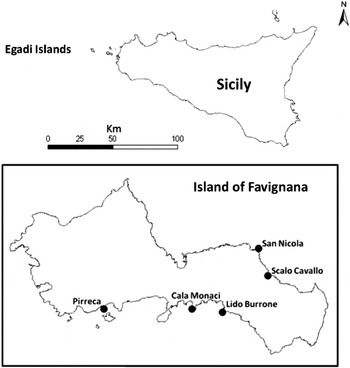
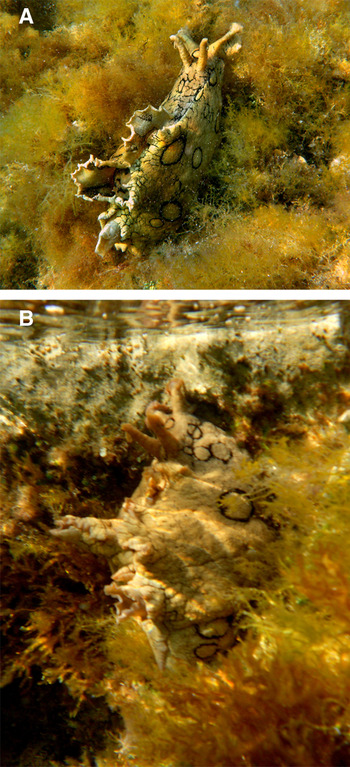
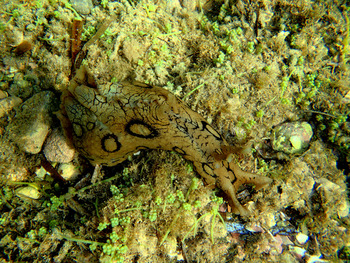
A total of 18 specimens were found along the coasts of the Island of Favignana (Egadi Islands marine protected area, western Sicily) in July 2013 (Figure 1; Table 2). At first, two specimens of Aplysia dactylomela were recorded at Cala Monaci, on the southern coast of the Island (Figure 2). One specimen was found at a depth of 75 cm on a rocky shore characterized by high sedimentation and irradiance and was feeding on algae, mainly Dictyotaceae and Laurencia sp. It was also observed on the fronds of Caulerpa racemosa var. cylindracea (Sonder) Verlaque, Huisman & Boudouresque.
Map showing the records of Aplysia dactylomela in the Island of Favignana.

Aplysia dactylomela from Cala Monaci (Island of Favignana): (A) specimen (35 cm length) feeding on algae; (B) specimen (35 cm length) resting on algae.

Records of Aplysia dactylomela in the Egadi Islands.

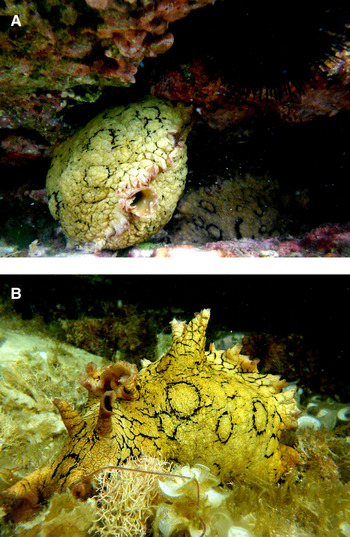
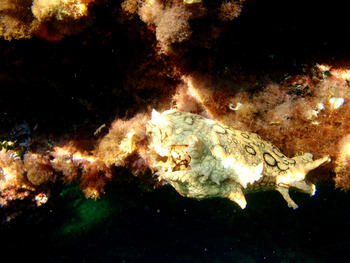
The other specimen was recorded, not far from the first one, at a 0 m water depth, resting on a bare rock. Afterwards the sea hare was sighted in different localities of the Island along both the southern and the north-eastern coast (Figures 1, 3–4; Table 2). Furthermore, in August three specimens of A. dactylomela were recorded in the Island of Marettimo, the furthest Island of the Egadi Islands, at Scalo Vecchio. The specimens, approximately 20 cm long, were found at a depth of 5 m on a rocky shore on C. racemosa var. cylindracea (Figure 5; Table 2).
Aplysia dactylomela from Cala Pirreca (Island of Favignana): (A) specimen (35 cm length) at rest; (B) specimen (35 cm length) feeding on algae.

Aplysia dactylomela: specimen (20 cm length) from Scalo San Nicola (Island of Favignana) (photograph by Alessandro Bevilacqua).

Aplysia dactylomela: specimen (20 cm length) from the Island of Marettimo (photograph by Stefano Melchioni).

As the Egadi Islands are highly frequented by tourists and divers, it is unlikely that such a large and slow mollusc had not been seen before. Therefore, we may suppose that its presence along the coasts of the Egadi Islands is a recent event. As the closest established populations are those on the Islands of Lampedusa and Malta (Schembri, Reference Schembri2008) and on the eastern coast of Sicily, A. dactylomela might have been dispersed naturally with veliger larvae carried by the current or by marine traffic. Specimens are generally found feeding on algae, and we know that A. dactylomela is able to convert secondary metabolites from algae into chemical deterrents (Bezerra et al., Reference Bezerra, Carvalho, Barreira, Nogueira, Silva, Vasconselos and Melo2004; Kamio et al., Reference Kamio, Grimes, Hutchins, van Dama and Derby2010). The ability to make itself protected by local predators might facilitate and accelerate the establishment and expansion of this alien species. It is likely that soon new populations will be sighted in the whole Egadi Islands and on the western and southern coasts of Sicily.