The diagnosis of Clostridioides difficile infection (CDI) requires the presence of appropriate clinical signs and symptoms in combination with a positive test for toxigenic C. difficile.Reference Dubberke, Han and Bobo1 Historically, toxin enzyme immunoassays (T-EIAs) have been the most commonly used test. Due to concern regarding the low sensitivity of toxin T-EIA tests, a common misconception exists that 3 sequential tests are necessary to “rule out” CDI.Reference Manabe, Vinetz, Moore, Merz, Charache and Bartlett2, Reference Peterson and Robicsek3 This practice has led to a decrease in the positive predictive value of each subsequent test and, therefore, to an increase in the likelihood of false-positive results. Previous data at our institution indicate that false-positive results may elevate the reported CDI rate by up to 32%.Reference Peterson and Robicsek3, Reference Litvin, Reske and Mayfield4 This finding is significant because false-positive tests can lead to unnecessary treatment, which can lead to adverse drug side effects, unnecessary costs, and a paradoxical increase in the risk of developing actual CDI.Reference Stevens, Dumyati, Fine, Fisher and van Wijngaarden5
Diagnostic stewardship can be used to improve the appropriate utilization of the C. difficile T-EIA test. Specifically, the use of a computerized clinical decision support tools have been shown to improve practitioner laboratory test ordering practices.Reference Hunt, Haynes, Hanna and Smith6 Our objectives were (1) to improve C. difficile T-EIA test utilization by implementing a hard-stop clinical decision support tool to limit repeat C. difficile T-EIA testing within 96 hours of a negative T-EIA test and (2) to measure the impact of this intervention on test utilization.
Materials and Methods
Setting
This quality improvement project was performed at Barnes-Jewish Hospital, a 1,250-bed tertiary-care hospital in St Louis, Missouri, from January 2015 to August 2015. Inpatients ≥18 years old were eligible if they had had a C. difficile T-EIA test ordered. Publication of these results was approved by the Washington University Human Research Protection Office.
Intervention
A hard-stop intervention was placed in the electronic medical record (EMR) system during the project period that limited repeat C. difficile T-EIA testing within 96 hours of a previous negative test.Reference Litvin, Reske and Mayfield4, Reference Cardona and Rand7 If the clinician felt that a repeat test was indicated, he or she could contact the laboratory medicine resident on-call to request a repeat test. Appropriate testing parameters, including the presence of clinically significant diarrheaReference Dubberke, Han and Bobo1 and the absence of a laxative, were discussed with the provider. Ultimately, the decision to order the repeat test was at the discretion of the treating clinician. A hard-stop clinical decision support intervention limiting repeat C. difficile T-EIA testing within 10 days of a positive test was also implemented.
Education and washout period
Institution-wide education was provided to ordering providers on appropriate C. difficile test utilization and the quality improvement intervention. In-person education and presentations were provided to any individual, division, or department who requested it. Prior to implementation and ongoing through the intervention, education and training were provided to laboratory medicine residents.
Laboratory testing for C. difficile
Fecal samples submitted to the clinical laboratory were tested using the TechLab Toxin A/B II EIA (Alere, Blacksburg, VA); testing was rejected on formed fecal specimens. If available, remnant feces was frozen at −80°C. Before and after the intervention, cultures for toxigenic C. difficile and Xpert C. difficile/Epi polymerase chain reaction (PCR) testing (Cepheid, Sunnyvale, CA) were retrospectively performed on index and repeat stool specimens from patients for whom repeat testing was requested and remnant stool was available. C. difficile culture and identification were performed according to previously published procedures.Reference Hink, Burnham and Dubberke8
Statistical analysis
Patient demographics, C. difficile testing frequency and rates, and patient outcomes during the 3 months before the intervention (January to March 2015) and the 3 months after the intervention (June to August 2015) were compared. The education phase was considered a washout period (April to May 2015) and was excluded from all analyses. Data were collected electronically from the hospital’s medical informatics databases and through chart review. Data obtained included receipt of an International Classification of Disease, Ninth Revision (ICD-9) code for CDI (008.45), discharge location, death within 30 days, colectomy due to CDI, and antimicrobials for CDI. ICD-9 codes were used to classify comorbidities according to the Quan adaptation of the Charlson-Deyo index.Reference Quan, Sundararajan and Halfon9 We used χ2 analyses and univariate logistic regression for categorical variables and the Mann-Whitney U tests for continuous variables using SPSS version 21 statistical software (IBM, Armonk, NY).
Results
Demographics
Overall, this study included 1,146 admissions with C. difficile tests during the preintervention period (rate, 6.86 per 100 admissions) and 982 admissions with C. difficile tests during the postintervention period (rate, 5.67 per 100 admissions). There was no difference in the Charlson composite score between the 2 groups (data not shown).
Test utilization
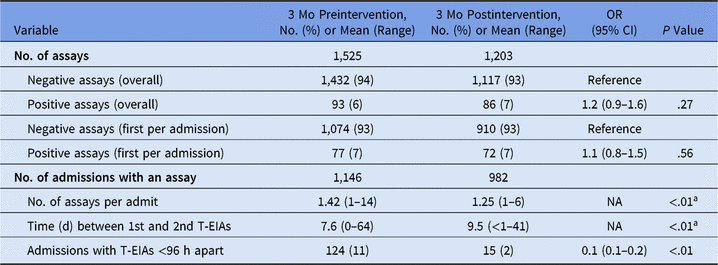
The testing rates were 9.12 per 100 admissions during the preintervention period versus 6.94 per 100 admissions during the postintervention period (P < .01) (Table 1). The hard-stop clinical decision support alert fired a total of 293 times during the postintervention period. Of these, 156 were “duplicate alerts,” in which the alert was shown repeatedly to the same ordering provider multiple times on the same calendar day for the same patient (median, 2 alerts; range, 1–25 alerts per patient). There was no significant difference in the overall percentage of all positive assays before and after the intervention (6% vs 7%; P = .27) or in the percentage of first assays per admission that were positive (7% vs 7%; P = .56). We observed a significant reduction in the number of admissions with repeat tests <96 hours from an initial negative test, from 124 admissions (11% among those with a test) during the preintervention period versus 15 (2%) during the postintervention period (P < .01). Among admissions during which a test was ordered, the mean number of tests per admission decreased significantly (1.42 vs 1.25; P < .01) as did the mean number of assays <96 hours apart per admission (0.13 vs 0.02; P < .01), and the number of days between the first and second test increased significantly (7.6 vs 9.5; P < .01).
Testing Practices Before and After Clinical Decision Support Intervention

Note. OR, odds ratio; CI, confidence interval; NA, not applicable.
a Mann-Whitney U test.
Clinical outcomes
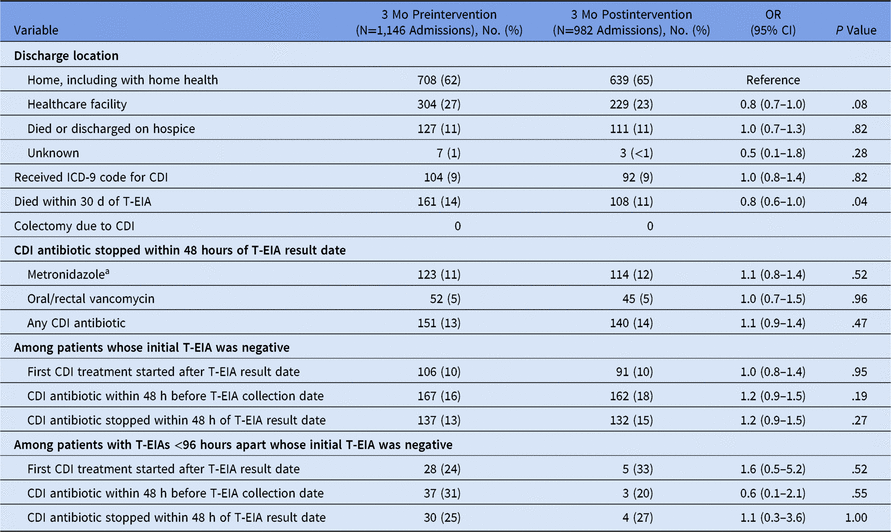
We detected no significant differences after the intervention in patient discharge location, patients who received the CDI ICD-9 code, all-cause death within 30 days, or colectomy due to CDI (Table 2). There were no significant differences in the proportion of patients on an antibiotic targeting C. difficile before or after the stool collection date, either overall, among patients with a negative test first, or among patients with repeat tests (Table 2).
Clinical Outcomes and C. difficile Treatment Before and After Clinical Decision Support Intervention

Note. OR, odds ratio; CI, confidence interval; ICD-9, International Classification of Disease, Ninth Revision; CDI, Clostridioides difficile infection; T-EIA, toxin enzyme immunoassay.
aMetronidazole orders may have been for conditions other than CDI.
Repeat testing for the preintervention period
During the preintervention period, there were 124 admissions during which repeat tests were performed within 96 hours of an index negative test. Of these, remnant stool samples from the index C. difficile test were available from 88 patients (all T-EIA negative) for toxigenic culture and PCR testing; 70 (80%) had a negative T-EIA, toxigenic culture, and PCR result from the index fecal specimen, and a negative T-EIA from the repeat sample. However, 9 (10%) had a T-EIA and toxigenic culture negative index fecal specimen and a negative T-EIA from the repeat fecal specimen, but not enough remnant specimen was available for PCR. Also, 9 patients had discordant test results via T-EIA, toxigenic culture, and/or PCR. Of those 9 patients, 1 patient had a negative index T-EIA result but a positive index toxigenic culture and positive PCR. This patient had a subsequent positive repeat T-EIA result and was diagnosed with CDI. None of the other 8 patients were diagnosed with CDI during their index hospitalization.
Repeat testing for C. difficile during the postintervention period
During the postintervention period, there were 15 admissions postintervention with a repeat test within 96 hours of an index negative test. Of these admissions, remnant stool from the index test was available from 11 patients for toxigenic culture and PCR. All 11 patients had a negative index T-EIA. Of the 11 patients, 7 were negative for C. difficile via T-EIA, PCR, and toxigenic culture on both their index and repeat tests; none were diagnosed with CDI. In addition, 4 patients had either discordant test results or a specimen too small for further testing; of these, 3 were diagnosed with CDI via T-EIA on repeat testing.
Discussion
The primary concern surrounding the use of T-EIA tests alone for C. difficile detection is poor sensitivity;Reference Burnham and Carroll10 thus repeat testing may seem to “protect” against missed CDI diagnoses due to false-negative T-EIAs. Multiple studies have shown that repeating T-EIA tests within a short period of time has limited diagnostic utility.Reference Cardona and Rand7, Reference Deshpande, Pasupuleti and Patel11, Reference Mohan, McDermott, Parchuri and Cunha12 The purpose of this quality improvement study was to evaluate the impact of an electronic hard-stop clinical decision support intervention limiting repeat C. difficile T-EIA testing. Our intervention resulted in significant decreases in CDI testing rates and mean number of tests per admission. There were no significant differences in patient discharge location or increases in 30-day mortality postintervention. Antibiotic utilization data indicated that clinicians were not treating empirically for missed cases of CDI. In addition, the overall rate of positive tests did not change postintervention, but the rate of CDI diagnosis after repeat test increased from 1 patient (of the 88 with remnant stool available) preintervention to 3 patients (of 11 with remnant stool) postintervention. These numbers are small, but they suggest that the intervention improved the selection of patients for repeat testing. Together, these findings suggest that an EMR-based hard-stop intervention effectively reduced unnecessary testing without negatively impacting the variables measured.
Most previous studies evaluating EMR-based interventions designed to reduce repeat C. difficile testing have been performed in the context of molecular testing for C. difficile detection.Reference Luo, Spradley and Banaei13–Reference Quan, Yim and Merrill16 Our intervention was unique in that it focused on a T-EIA test. One prior study evaluated repeated T-EIA testing for C. difficile, but their conclusion was the same: positive T-EIA results after initial negative results were rare (1.9%).Reference Aichinger, Schleck, Harmsen, Nyre and Patel14 The results of our study also suggest that even among facilities that use T-EIA tests alone, without a PCR or other molecular test, the practice of repeat testing may result in unnecessary testing. From a hospital administration perspective, C. difficile infection is a Centers for Medicare and Medicaid Services (CMS) value-based program; false-positive test results can falsely elevate hospital CDI rates, thereby reducing reimbursements.
This study has several limitations. It was conducted in a limited time frame at a single institution. Some cases of CDI may have been “missed” or empirically treated despite a negative test; however, clinicians were given the opportunity for repeat testing if clinically indicated, and antibiotic prescribing practices do not suggest this occurred. Further studies of the outcomes related to interventions to reduce repeat C. difficile T-EIA testing are necessary to draw more definitive conclusions about patient outcomes.
Our study supports the use of a hard-stop clinical decision support tool to reduce repeat T-EIA testing for C. difficile within 96 hours of an initial negative test. In some scenarios, a repeat test is clinically indicated, so a mechanism to allow for testing in a clinically appropriate setting is necessary. Interventions to improve diagnostic stewardship for C. difficile in the EMR system should be considered even among hospitals that use a T-EIA instead of a PCR-based test for C. difficile identification. In era of increasing focus on diagnostic stewardship and appropriate test utilization, this study provides evidence supporting the role of clinical decision support in improving C. difficile test utilization, regardless of whether the diagnostic method used is PCR or T-EIA.
Acknowledgements
None.
Financial support
This work was supported by funding from the Foundation of Barnes Jewish Hospital (grant no. 7915-77). J.H.K. was supported by the Washington University Institute of Clinical and Translational Sciences (grant no. UL1TR000448, subaward KL2TR000450), from the National Center for Advancing Translational Sciences of the National Institutes of Health (NIH), and the National Institute of Allergy and Infectious Diseases of the NIH (grant no. 1K23AI137321). The content is solely the responsibility of the authors and does not necessarily represent the official view of the NIH.
Conflicts of interest
J.H.K., K.A.R. R.J., and T.H. report no conflicts of interest. C.D.B. reports grants from bioMerieux, Biofire, Accelerate Diagnostics, Theravance, Luminex, and Cepheid outside this submitted work. E.R.D. reports grants and personal fees from Sanofi Pasteur, Merck, Rebiotix, as well as personal fees from Valneva, GlaxoSmithKline, and Summit, outside this work.