INTRODUCTION
The current knowledge on the life cycle of all five species of the family Anguillicolidae is mainly based on one species. Moravec (Reference Moravec2006) split the genus Anguillicola into the two genera Anguillicola and Anguillicoloides due to morphological differences. The phylogenetic study of Laetsch et al. (Reference Laetsch, Heitlinger, Taraschewski, Nadler and Blaxter2012) on Anguillicolidae, however, found no support for the maintenance of these two genera, therefore all species of the family are referred to as Anguillicola in the following. Anguillicola crassus is the only species that was intensively studied under laboratory conditions. After its spread throughout the European eel population in the 1980s, this species was studied intensively in wild eel populations (reviewed in Jakob et al. Reference Jakob, Walter and Hanel2009) as well as in experimental infection studies of copepod intermediate hosts (Kennedy and Fitch, Reference Kennedy and Fitch1990; Petter et al. Reference Petter, Cassone and Lebelle1990; Bonneau et al. Reference Bonneau, Blanc and Petter1991; Moravec et al. Reference Moravec, Di Cave, Orecchia and Paggi1993; Thomas and Ollevier, Reference Thomas and Ollevier1993; Moravec and Konecny, Reference Moravec and Konecny1994; Ashworth et al. Reference Ashworth, Kennedy and Blanc1996) and eel final hosts (Haenen et al. Reference Haenen, Grisez, De Charleroy, Belpaire and Ollevier1989, Reference Haenen, Grisez, De Charleroy, Belpaire and Ollevier1991, Reference Haenen, Van Wijngaarden, Van der Heijden, Hoglund, Cornelissen, Van Leengoed, Borgsteede and Van Muiswinkel1996; De Charleroy et al. Reference De Charleroy, Grisez, Thomas, Belpaire and Ollevier1990; Moravec et al. Reference Moravec, Di Cave, Orecchia and Paggi1994a; Knopf et al. Reference Knopf, Würtz, Sures and Taraschewski1998; Ashworth and Kennedy, Reference Ashworth and Kennedy1999; Knopf and Mahnke, Reference Knopf and Mahnke2004; Fazio et al. Reference Fazio, Sasal, Fumet, Boissier, Lecomte-Finiger and Mone2008; Weclawski et al. Reference Weclawski, Heitlinger, Baust, Klar, Petney, Han and Taraschewski2013).
However, only few studies on the other species have been performed. One study of Taraschewski et al. (Reference Taraschewski, Boomker, Knopf and Moravec2005) proved that Anguillicola papernai can infect the European eel. But as only two eels were successfully infected, only limited information on the duration of the life cycle or on infrapopulation composition is available. Wang and Zhao (Reference Wang and Zhao1980) studied the life cycle of Anguillicola globiceps in experimentally infected Japanese eels. Until now the life cycle of Anguillicola australiensis has not been studied. Moravec et al. (Reference Moravec, Di Cave, Orecchia and Paggi1994b) studied the life cycle of Anguillicola novaezelandiae by infecting the copepod intermediate host experimentally. Studies on the life cycle in eel have not yet been performed apart from a co-infection study of A. novaezelandiae and A. crassus in European eels focusing on possible hybridization between these species (Grabner et al. Reference Grabner, Dangel and Sures2012).
Thus, in the present study European eels were infected with A. novaezelandiae under controlled laboratory conditions in order to study the life cycle of this parasite for the first time at the final host level. This will help to unravel possible differences to its close relative A. crassus, which in turn may help to explain differences in invasion success of both species. As the final host, the European eel was used for several reasons: (i) the main interest in research on Anguillicola is the invasive potential of the different parasite species in the European eel; (ii) as most laboratory studies on A. crassus have been performed with the European eel, comparability is given; (iii) this eel species is easily available in Europe.
MATERIALS AND METHODS
Source and maintenance of parasites and hosts
Anguillicola novaezelandiae was collected from Anguilla australis originating from New Zealand in December 2007 as second stage larvae (L2, for details see Dangel and Sures, Reference Dangel and Sures2013). The larvae were stored in tap water at ∼8 °C until use. The second stage larvae of A. crassus were collected from the swim bladder of naturally infected Anguilla anguilla from Lake Müggelsee in Berlin, Germany. Copepoda of the order Cyclopoida were collected as intermediate hosts from an eel-free pond. They were kept at 20 °C and fed 3 times a week with ground fish flakes (TetraMin, Tetra).
European eels (A. anguilla) were obtained from a commercial fish farm (Albe Fischfarm, Haren/Rütenbrock, Germany) known to be free of A. crassus. The eels were placed in 300 L tanks and maintained in aerated tap water at 20 °C. Eels were fed twice a week ad libitum with eel pellets (Dan-Ex 2848, BioMar A/S, Brande, Denmark). Polypropylene tubes were provided as a hide-out. In order to confirm the absence of parasites, 10 eels were killed, dissected and examined for the presence of parasites prior to infection experiments. In order to prevent A. novaezelandiae from escaping to the environment, all wastewater from tanks with infected eels was heated to 80 °C to kill all potentially occurring L2 stage larvae.
Infection of hosts
Infective third stage larvae (L3) were produced based on the method of Haenen et al. (Reference Haenen, Van Wijngaarden and Borgsteede1994). Copepods and L2 were put together in 24-well plates containing tap water in a ratio of 1 : 3. The plates were kept at 20 °C with a 12 h light cycle. Copepods were fed three times a week. After 24 days, A. novaezelandiae were collected as L3 by using a tissue potter (55 mL Tissue Grinder, Wheaton) as described by Haenen et al. (Reference Haenen, Van Wijngaarden and Borgsteede1994). Anguillicola crassus L3 were collected 20 days post infection (dpi). The pottered suspension was poured into a paper tea filter (Tee-Filter standard, Profissimo, dm-drogerie markt) and put into a 50 mL centrifuge falcon tube. The tube was filled with 50 mL Minimum Essential Medium Eagle (Sigma-Aldrich Chemie GmbH, Steinheim, Germany) and the larvae were allowed to migrate through the filter for at least 2 h at 20 °C. The larvae could then be collected with a Pasteur pipette from the bottom of the tube and were stored at 8 °C in fresh medium until use.
Eels were infected by administering the third stage larvae as a suspension in medium with a stomach tube (1·5 mm diameter; B. Braun Melsungen AG, Melsungen, Germany) as described in Sures and Knopf (Reference Sures and Knopf2004). Thereto the eels were gently wrapped in a wet towel and their eyes covered. The calm eels could then be infected easily without the use of anaesthesia. This method usually allows eel infection within one minute. All infection experiments were conducted in compliance with national and institutional guidelines for the care and use of animals.
Experimental design
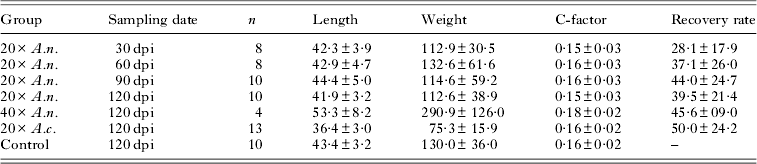
An overview on the experimental design and the number of eels for each group is given in Table 1. The composition of the parasites' infrapopulation and the duration of the life cycle were studied by infecting eels with 20 L3 of A. novaezelandiae (20×-A.n. group). About 10 eels of this group were dissected every 30 dpi.
Data on all groups of A. anguilla. Length, weight, C-factor and parasite recovery rate of all eels as mean±s.d.

n: number of eels; C-factor: condition factor; length in cm; weight in g; recovery rate in per cent. A.n.: A. novaezelandiae; A.c.: A. crassus.
In order to study density-dependent effects on the infrapopulation, a group of eels was infected with 40 L3 of A. novaezelandiae (40×-A.n. group). In order to confirm the comparability of this study with literature data, a group of eels was infected with 20 L3 of A. crassus (20×-A.c. group). As a control group of the eels’ condition, 10 eels were sham-infected with medium only (control group). All groups were kept in different tanks and fed twice a week.
Eels of the 20×-A.n. group were killed by decapitation and examined immediately 30, 60, 90 and 120 dpi each. All other eels (control, 40×-A.n. and 20×-A.c. groups) were killed after 120 days and examined immediately. The length and weight of the eels were measured, whereupon the swim bladder was removed and examined for the presence of Anguillicola. The condition factor (C-factor) was calculated as described by Schäperclaus (Reference Schäperclaus1990) with C as the ratio of the fish somatic mass×100×total length−3.
All parasites were removed from the swim bladder lumen, identified and their number and sex was recorded. About half of the parasites were stored in 70% alcohol for subsequent morphometric studies whereas the other parasites were each stored in 2 mL microtubes (Sarstedt) at −80 °C for future molecular studies. The swim bladder was then examined between two plexiglass plates with a stereomicroscope (magnification ×8 to ×50) for all larval stages (L3 and L4). Since the differentiation between L3 and L4 stage is not always possible, all larvae longer than 1·5 mm were considered as L4 stage, as described in Blanc et al. (Reference Blanc, Bonneau, Biaganti and Petter1992).
Prevalence (P) and mean intensity (MI) of parasites in the eels were calculated as described in Bush et al. (Reference Bush, Lafferty, Lotz and Shostak1997). The recovery rate was calculated as the ratio of all recovered parasites divided by the number of parasites administered, in per cent. Reproduction of the nematodes was recorded by the presence of eggs and L2 in the swim bladder lumen.
RESULTS
Data on eel infection
Meristic data on eels and parasite recovery are presented in Table 1. Condition factors varied between 0·15 and 0·18. All eels had inconspicuous swim bladders without any signs of pathological damage due to the infection with either of the Anguillicola species. Recovery rate of A. novaezelandiae ranged between 28 and 44% for eels of the 20×-A.n. group. The highest recovery rate of 50% was found in eels of the 20×-A.c. groups, while eels of the 40×-A.n. group showed a rate of 46% (Table 1).
Development of A. novaezelandiae
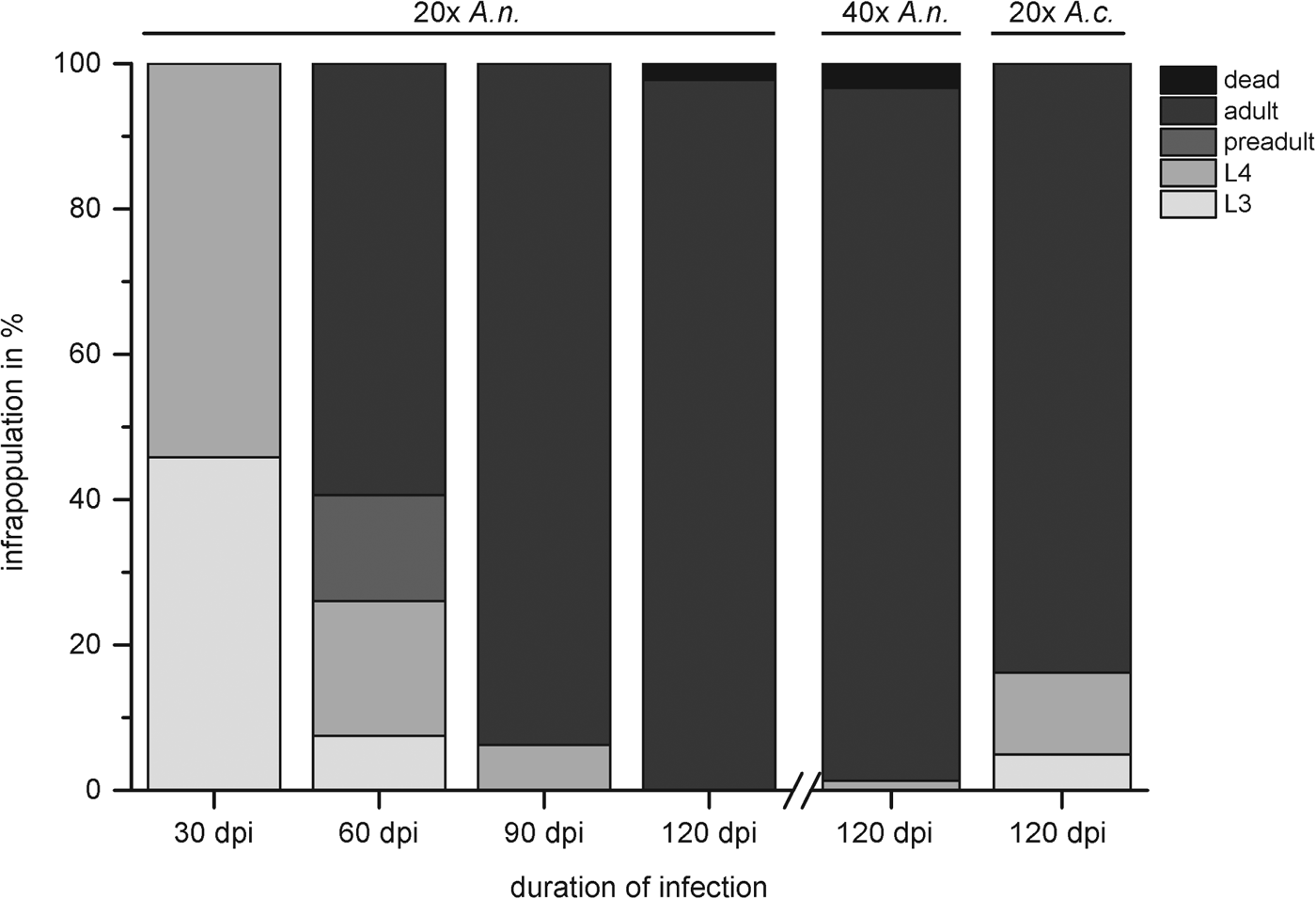
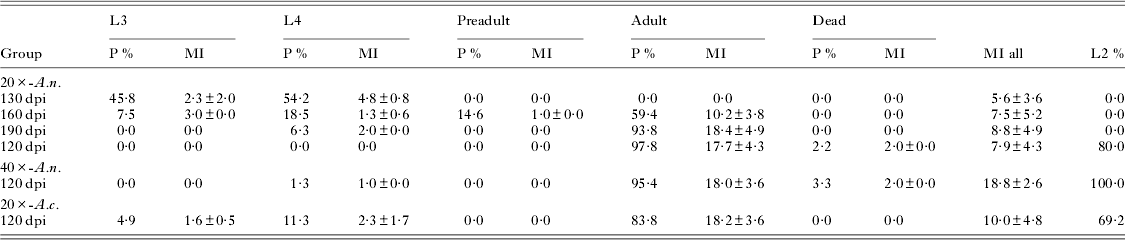
Figure 1 shows the relative composition of the infrapopulations of all A. novaezelandiae stages in the 20×-A.n. group at different dpi. After 30 dpi, 46% of the parasites were still in L3 stage, while after 90 dpi no more L3 were found. First adult stages were found at 60 dpi. As soon as adult stages occurred, they dominated the infrapopulation composition. After 120 days, the first dead parasites were found in the swim bladder lumen (2%). Eels had mean intensities of 5·6–8·8 parasites (Table 2). Only eels dissected at 120 dpi harboured L2 (Table 2).
Anguillicola sp. infrapopulation of eels. 20× A.n. group: After 30 days all parasites were still in larval stages; first adult stages were visible after 60 days; 90 days after infection all parasites were in L4- and adult stage; the swim bladder of eels sampled at 120 dpi contains mainly adult stages and some dead parasites. 120 dpi: Eels infected with 20× A. novaezelandiae showed no larval stages, while L4 stage larvae were present in both other groups. In the swim bladder of eels infected with 20× A. crassus, more than 16% of the parasites recovered were still in larval stages.
Infrapopulation of eels infected with Anguillicola sp. Number of parasites, prevalence and mean intensity for all eels examined±s.d.
n: number of parasites; P: prevalence in per cent; MI: mean intensity; L2: presence of eggs/L2 in swim bladder lumen of eels in per cent.
Differences in relative infrapopulation composition between all eel groups dissected after 120 days are shown in Fig. 1. Eels of the 20×-A.n. group showed exclusively adult and dead stages. Only 84% of the parasites found were adult in eels of the 20×-A.c. group, compared with 98% (20×-A.n. group) and 95% (40×-A.n. group). The 20×-A.c. group still harboured L3 (5%) and 11% L4. No dead parasites were found in this group.
DISCUSSION
The number of recovered worms in the swim bladder of infected eels in the 20×-A.n. group varied between 1–16 parasites (MI 6–9), while eels of the 20×-A.c. group were infected with 3–18 parasites (MI 10). These data are comparable to natural infections of the European eel with other Anguillicola parasites. Mean intensity of A. novaezelandiae from Lake Bracciano eels varied between 2–11 (Moravec et al. Reference Moravec, Di Cave, Orecchia and Paggi1994b), while records of A. crassus infection of the European eel showed mean intensities between 1–17 (overview in Jakob et al. Reference Jakob, Walter and Hanel2009). Recovery rate of all groups is similar to laboratory infections of the European eel with A. crassus (Knopf et al. Reference Knopf, Würtz, Sures and Taraschewski1998; Knopf and Mahnke, Reference Knopf and Mahnke2004; Fazio et al. Reference Fazio, Sasal, Fumet, Boissier, Lecomte-Finiger and Mone2008; Weclawski et al. Reference Weclawski, Heitlinger, Baust, Klar, Petney, Han and Taraschewski2013).
The data presented here give first information on the life-cycle duration of A. novaezelandiae in the eel final host and the infrapopulation composition during its maturation. Development to L4 was first recorded at 30 dpi and was completed at 90 dpi. First adult stages were found in the lumen of the eels’ swim bladders at 60 dpi. The life cycle was completed at 120 dpi when no more larval parasites were found and eggs with L2 were recovered from the swim bladder. This infrapopulation composition of A. novaezelandiae differs strongly from the pattern of A. crassus infections. Whilst all studies performed with comparable infection doses and duration on the latter species show L3 and L4 (30× A.c. at 98 dpi at 23 °C, Knopf and Mahnke, Reference Knopf and Mahnke2004; 20× A.c. at 119 dpi at 19 °C, Knopf et al. Reference Knopf, Würtz, Sures and Taraschewski1998) like eels of the 20×-A.c. group in this experiment, no larval stages were found at 120 dpi in eels of the 20×-A.n. group. Anguillicola novaezelandiae specimens seem to grow equally fast, in contrast to the non-uniform growth of A. crassus.
Anguillicola novaezelandiae L2 were first found at 120 dpi, while L2 of A. crassus were detected at 84 dpi at 20–25 °C by Fazio et al. (Reference Fazio, Sasal, Fumet, Boissier, Lecomte-Finiger and Mone2008) and at 50 dpi at 22 °C by Weclawski et al. (Reference Weclawski, Heitlinger, Baust, Klar, Petney, Han and Taraschewski2013). Anguillicola novaezelandiae needs thus more time to complete its life cycle and to produce second stage larvae infective to the copepod intermediate host. By comparing our findings with literature data, we found that in Taraschewski et al. (Reference Taraschewski, Boomker, Knopf and Moravec2005) the European eel infected with an unknown number of L3 of A. papernai, only harboured adult parasites with eggs when dissected 131 days after infection. In an unpublished study performed in our laboratory, we infected European eels with 13 or 20 L3 of A. papernai (the experiment was performed at 20 °C). One eel infected with 13 parasites was dissected after 56 days. Only larval stages (1× L3, 4× L4) were found. Three other eels were dissected at 140 and 168 dpi. While we found four adult parasites in two eels (both infected with 20× A.p.) and three adult parasites in the other eel (infected with 13× A.p.), no larval stages were recovered in the swim bladder wall of these eels. These findings suggest that parasites of A. papernai might also develop rather equally fast, but for reliable data more experimental infections should be performed to prove this hypothesis. In contrast to these findings, Knopf et al. (Reference Knopf, Würtz, Sures and Taraschewski1998, 25× A.c. at 18 °C) still recovered L3 and L4 of A. crassus after 195 days, while first adult stages were recorded after 50 days.
Only one eel infected with 40× A. novaezelandiae harboured a single fourth stage larva, which seems more likely due to a simple coincidence than a true density-dependent effect. While in the literature the development of A. crassus is stated to be density dependent (Ashworth and Kennedy, Reference Ashworth and Kennedy1999; Fazio et al. Reference Fazio, Sasal, Fumet, Boissier, Lecomte-Finiger and Mone2008; Weclawski et al. Reference Weclawski, Heitlinger, Baust, Klar, Petney, Han and Taraschewski2013), no such effect could be found in this study. Moreover our study shows a highly synchronized development pattern, which is the first finding of such a pattern in Anguillicola parasites.
The synchronized development of A. novaezelandiae may be beneficial for parasite populations with seasonal occurrence, where all host specimens are infected at the same time. As discussed in Dangel and Sures (Reference Dangel and Sures2013), this could be possible for A. novaezelandiae in its original distribution area in New Zealand. As an alien species in Europe, the synchronized development could have been a disadvantage in competition with the related species A. crassus in Lake Bracciano. Assuming that both parasite species can produce the same amount of eggs with L2, the non-uniform growth of A. crassus will lead to L2 over a longer period, while the synchronized development of A. novaezelandiae will lead to production of L2 over a shorter period. This duration of L2 release could be an advantage, even though the density during the longer period may be lower. Accordingly, the non-uniform growth of A. crassus could be one important factor for its more successful invasion. However, other factors such as the involvement of paratenic hosts or the longevity of adult worms may also be important but are unknown for A. novaezelandiae.
These results show that there are differences in the life cycles of A. novaezelandiae and A. crassus. Not only infrapopulation composition, but also the periods until the first egg release vary strongly. Anguillicola crassus is often used as a model species for the whole genus, but this study proves that there are great differences between different Anguillicola species. Further studies should be performed with short-finned eels (Anguilla australis) infected with A. novaezelandiae to determine how the native host influences the development of the parasite in terms of the infrapopulation composition and the duration until the first egg release. In order to study the temperature range of the parasites in Europe, infection studies of European eels with different water temperatures should be performed.
ACKNOWLEDGEMENTS
We are grateful to R. Poulin (University of Otago) for his support in sampling L2 of A. novaezelandiae from naturally infected Anguilla australis. For her help with the life cycle of A. papernai we would like to thank S. Vieten (University of Duisburg-Essen).
FINANCIAL SUPPORT
This work was supported by Deutsche Forschungsgemeinschaft via grant SU217/12-1.