End-of-life care (EOLC) communication consists of discussions among patients, families, and healthcare providers with the goals of determining patients’ EOLC preferences and developing plans based on patients’ wishes for continued care (Zhang et al., Reference Zhang, Wright and Huskamp2009). These discussions may include prognostic information, advance care planning, and information about palliative care and hospice care. EOLC communication, including advance care planning, is critical for patients with life-limiting illness and has been demonstrated to prevent the use of unwanted and costly interventions and improve patient quality of life (Zhang et al., Reference Zhang, Wright and Huskamp2009; Mack et al., Reference Mack, Weeks and Wright2010; Dalal and Bruera, Reference Dalal and Bruera2017; Schichtel et al., Reference Schichtel, Wee and Perera2020; Bhatia et al., Reference Bhatia, Geidner and Mirchandani2021). However, EOLC communication is underutilized, especially in conditions characterized by prognostic ambiguity such as chronic obstructive pulmonary disease (COPD), congestive heart failure (CHF), and more recently, COVID-19 (Janssen et al., Reference Janssen, Spruit and Schols2011; Tavares et al., Reference Tavares, Jarrett and Hunt2017; Bhatia et al., Reference Bhatia, Geidner and Mirchandani2021). Research identifying disparities in EOLC suggests barriers to EOLC communication may have a more severe impact on quality of care for patients with COPD and CHF than those with cancer (Lastrucci et al., Reference Lastrucci, D’Arienzo and Collini2018).
The literature documents a wide variety of cultural, institutional, physician, and patient-level barriers to effective EOLC communication (Schwarzkopf et al., Reference Schwarzkopf, Westermann and Skupin2015; You et al., Reference You, Downar and Fowler2015; Brown et al., Reference Brown, Shen and Urbauer2016; Blackwood et al., Reference Blackwood, Walker and Mythen2019). Physicians’ concerns about the emotional demands of EOLC communication have been a frequently cited barrier in theoretical, anecdotal, and empirical papers (Pavlish et al., Reference Pavlish, Brown-Saltzman and Fine2015; Tirgari et al., Reference Tirgari, Forouzi and Razban2016; Blackwood et al., Reference Blackwood, Walker and Mythen2019).
Physicians’ concerns about EOLC communication can be understood within the framework of emotion regulation and distress tolerance theory. Emotion regulation refers to the “processes by which we influence which emotions we have, when we have them, and how we experience and express them” (Gross, Reference Gross2002). According to Gross’ extended process model, emotion regulation involves cost–benefit evaluations of emotional stimuli which are used to select and implement situation-specific emotion regulation strategies (Sheppes et al., Reference Sheppes, Suri and Gross2015).
Adaptive and maladaptive emotion regulation strategies have been broadly distinguished by the extent to which they permit active engagement with the emotional demands of a given situation. Research on physician's emotion regulation suggests strategies involving cognitive and emotional engagement (e.g., acceptance, problem-solving, reappraisal) are generally considered adaptive and likely to support well-being, whereas attempts to avoid, suppress, or detach from emotional experience are linked with negative psychological consequences including burnout (Vaes and Muratore, Reference Vaes and Muratore2013; De Vries et al., Reference De Vries, Gholamrezaee and Verdonck-de Leeuw2018; Jackson-Koku and Grime, Reference Jackson-Koku and Grime2019).
Distress tolerance theory suggests that the selection and implementation of adaptive emotion regulation strategies depends on one's perceived capacity to experience and endure psychic pain/negative emotions, uncertainty, ambiguity, and frustration (Zvolensky et al., Reference Zvolensky, Vujanovic and Bernstein2010). Lower distress tolerance has been linked with the use of emotion regulation strategies such as suppression and avoidance. In contrast, high distress tolerance is associated with effective emotional regulation and behavioral engagement even in emotionally demanding situations (Jeffries et al., Reference Jeffries, McLeish and Kraemer2016).
Physicians generally display a remarkable capacity for tolerating many forms of physical distress. However, medical education may not provide sufficient support for the development of emotional distress tolerance, potentially limiting the use of adaptive emotion regulation strategies in EOLC communication (Shapiro, Reference Shapiro2011). For example, medical training and practice may sometimes encourage detachment, suppression, and avoidance as strategies for managing emotional distress (Vaes and Muratore, Reference Vaes and Muratore2013; Weilenmann et al., Reference Weilenmann, Schnyder and Parkinson2018; Scholz et al., Reference Scholz, Goncharov and Emmerich2020). Consequently, physicians with limited emotional distress intolerance may elect to avoid or delay emotionally demanding EOLC discussions.
Distress tolerance is multidimensional, with theoretical and factor analytic literature identifying and replicating dimensions involving tolerance of ambiguity, uncertainty, negative emotions, frustration, and physical discomfort (Zvolensky et al., Reference Zvolensky, Vujanovic and Bernstein2010). Although difficulties with distress intolerance and related domains have been recognized as barriers to EOLC communication, there are limitations to the empirical evaluation of distress tolerance in the context of EOLC communication. One limitation to the study of distress tolerance in the EOLC context is a lack of situation-specific free-standing measurement tools assessing physician distress tolerance that adequately capture the multidimensional nature of the construct. A free-standing measure of multiple dimensions of distress tolerance is warranted to enable the identification of individuals experiencing distress intolerance and to facilitate the effective targeting of interventions to improve distress tolerance.
In the context of EOLC, physicians may experience multiple dimensions of emotional distress intolerance, including anticipating negative emotions and concerns about uncertainty, and ambiguity (Friedenberg et al., Reference Friedenberg, Levy and Ross2012; McHugh et al., Reference McHugh, Reynolds and Leyro2013; Blackwood et al., Reference Blackwood, Walker and Mythen2019). For example, during EOLC conversations, physicians may anticipate experiencing negative emotions and also experience uncertainty about their capacity to tolerate these negative emotions. They also may have concerns about tolerating uncertainty about the patient's medical prognosis and tolerating ambiguity about the benefits and costs of EOLC. Specifically, physicians’ may be concerned if they raise end-of-life issues, they may increase their patients’ knowledge but may also worry they will inflict iatrogenic harm, causing patients to feel hopeless and lose motivation for self-care.
These three dimensions of emotional distress intolerance may have differential effects on physicians’ engagement in EOLC discussions. For example, anticipated negative emotions may increase the physicians’ concerns about the emotional costs of initiating EOLC communication and make them less likely to engage. Uncertainty and ambiguity, particularly about the emotional costs for their patients, may reduce their perceptions of the benefits, making them more likely to delay or avoid communication.
Physicians’ concerns about anticipated negative emotions, intolerance of uncertainty, and iatrogenic harm may be more salient when working with patients with COPD and CHF. The course of these illnesses is often uncertain and characterized by a gradual functional decline typically involving multiple severe exacerbations requiring hospitalization followed by periods of recovery (Murray et al., Reference Murray, Kendall and Boyd2005). The variable course of illness may leave physicians uneasy about communicating information about the life-limiting nature of these illnesses. Periods of recovery can leave patients unaware of the terminal nature of their illness (Batzlaff et al., Reference Batzlaff, Karpman and Afessa2014). Primary care physicians, including family medicine and internal medicine physicians, may need to engage in EOLC discussions proactively and early in the illness course in order to meet patients’ EOLC needs (Weiner and Cole, Reference Weiner and Cole2004; Ankuda et al., Reference Ankuda, Jetty and Bazemore2017; Schichtel et al., Reference Schichtel, Wee and Perera2020).
Interventions have developed new communication techniques for EOLC discussions to address these emotional barriers (Walczak et al., Reference Walczak, Butow and Bu2016). However, physicians’ underlying concerns about emotional distress may decrease physicians’ motivation to acquire new communication skills and their capacity to deploy these skills. Understanding physicians’ perceptions of their own emotional distress intolerance in the context of EOLC communication may improve the development of these interventions and aid in their evaluation.
However, there are significant limitations to existing measures of physicians’ emotional distress intolerance in the context of EOLC communication. Researchers have employed clinician-rated measures of psychological defense mechanisms to assess physician emotional barriers to EOLC communication (Despland et al., Reference Despland, Bernard and Favre2009; De Vries et al., Reference De Vries, Gholamrezaee and Verdonck-de Leeuw2018). Such measures are advantaged by their ability to assess observable but unconscious emotional barriers to communication, but the need for trained raters may pose challenges in some research contexts.
Though emotional barriers to EOLC communication have been assessed with self-report measures, to our knowledge there are only three existing measures that include more than one item appearing to assess more than one dimension of emotional distress intolerance (Perry et al., Reference Perry, Swartz and Smith-Wheelock1996; Otani et al., Reference Otani, Morita and Esaki2011; Greutmann et al., Reference Greutmann, Tobler and Colman2013). All three measures were unnamed investigator-developed questionnaires for which no factor analytic data was available, and as such it is unclear whether these measures align with theoretical models of distress tolerance or adequately capture the multidimensional nature of emotional distress intolerance in content. None of the articles describing these scales included an assessment of the reliability (internal consistency) of the items related to emotional distress intolerance, and none included a formal test of construct validity to determine if scores on emotional distress items predicted physicians’ engagement in EOLC discussions. There is a need for a brief, self-report measure of multiple dimensions of emotional distress intolerance.
To address this gap, we developed a new instrument, the Physician Distress Intolerance (PDI) scale. Development and validation of the measure reflect COSMIN criteria recommendations for the evaluation of health measures (Mokkink et al., Reference Mokkink, Terwee and Patrick2010). We evaluate the validity of the measure and provide estimates of its reliability. We focused item development on emotional distress intolerance in the context of EOLC communication for patients with COPD and CHF. These conditions present particular challenges for EOLC discussions due to variable illness trajectories and prognostic ambiguity (Batzlaff et al., Reference Batzlaff, Karpman and Afessa2014).
Approach to psychometric testing
Item development and content validity
Items were developed through a collaboration of palliative care physicians and psychologists with a specialization in distress tolerance. Content validity was evaluated via focus group interviews with family medicine and internal medicine residents discussing the relevance, comprehensibility, and comprehensiveness of scale items. Additional details are presented in the method section.
Tests of validity
Further tests of validity were conducted in a sample of residents and attending physicians. We focused on family medicine and internal medicine physicians as they are often the first line of communication with patients as they are diagnosed with and recovering from exacerbations of chronic life-limiting illnesses (Ankuda et al., Reference Ankuda, Jetty and Bazemore2017).
Following the COSMIN criteria, we evaluated construct validity by examining structural validity and testing theoretically derived hypotheses. To examine structural validity, we conducted exploratory and confirmatory factor analyses (CFA) to identify the dimensions assessed by the scale and to confirm these dimensions correspond to known dimensions of distress tolerance. Next, we generated a series of hypotheses about the relations of the PDI scores to physician characteristics and behaviors which are consistent with distress tolerance theory. First, we conducted known-groups comparisons to test the hypothesis that scores on the PDI measure differ by physician characteristics hypothesized to be associated with greater emotional distress intolerance during EOLC discussions. We predicted that members of groups with higher levels of experience (i.e., attendings vs. residents and those with higher vs. lower levels of experience delivering bad news) will have lower scores on the PDI. Greater clinical experience handling the emotional demands associated with caring for very ill patients is likely to decrease the unpredictability and threat associated with caring for future patients at the end of life (Liu and Chiang, Reference Liu and Chiang2017).
Additional testing evaluated the hypothesis that the PDI is positively associated with trait anxiety. Trait anxiety reflects both experiences of anxiety and the degree to which the individuals can tolerate the experience of anxiety (Beck and Steer, Reference Beck and Steer1990; Fydrich et al., Reference Fydrich, Dowdall and Chambless1992). We hypothesized that physicians higher in trait anxiety would report more concerns about emotional distress tolerance in the context of EOLC.
Finally, we tested hypotheses about the association of the PDI to measures of other constructs predicted by distress tolerance theory. The underlying theory of distress tolerance suggests that those with poorer distress tolerance will be likely to avoid emotionally disturbing activities (Zvolensky et al., Reference Zvolensky, Vujanovic and Bernstein2010). Therefore, we predicted PDI scores will be negatively associated with physicians’ reports of initiating EOLC communication and positively associated with reports of delaying EOLC communication.
Method
Measure development
To develop the PDI scale, a preliminary questionnaire assessing physicians’ emotional distress intolerance in EOLC discussions was developed by clinical psychologists with specializations in distress tolerance (n = 2) in collaboration with the directors (n = 2) and fellows (n = 2) serving in palliative care fellowship programs at one hospital-medical center in the New York City (NYC) area. We used items from existing self-report measures of emotional barriers to EOLC communication as a starting point for item development and referenced emotion regulation and distress tolerance theory in the generation of new items (Perry et al., Reference Perry, Swartz and Smith-Wheelock1996; Otani et al., Reference Otani, Morita and Esaki2011; Greutmann et al., Reference Greutmann, Tobler and Colman2013). Content validity was discussed and evaluated in meetings with experts in each field. In a series of in-service workshops, family medicine residents (n = 30) were asked to further evaluate content validity by providing feedback about the meaning and acceptability of existing items and were asked to generate new items.
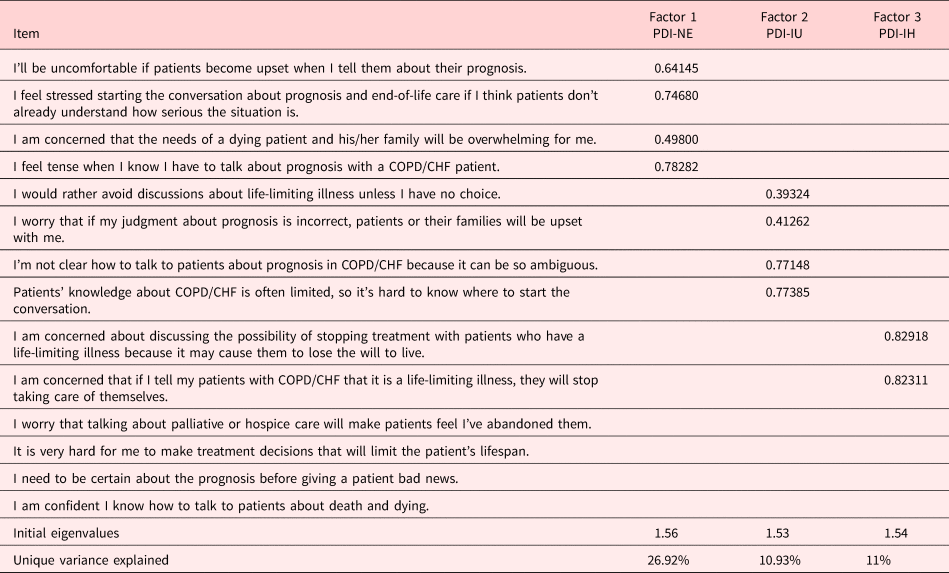
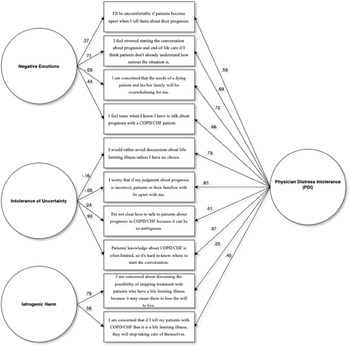
These discussions yielded a set of 18 items. Items were included if they reached consensus in focus groups as to their relevance and comprehensibility. Four of these items assessed concerns related to EOLC but were unrelated to emotional distress intolerance (e.g., fear of legal or social ramifications and attitudes toward life-prolonging treatment). We subsequently included only items assessing concerns directly related to emotional distress intolerance in the PDI (Table 1). Initial item lists are provided in Supplementary Appendix A.
Rotated factor loadings for PDI items

NE, negative emotions; IU, intolerance of uncertainty; IH, iatrogenic harm.
Surveys were administered to attending and resident physicians in six family medicine and internal medicine residency training programs in New York State. Surveys contained measures of demographic and professional characteristics, as well as other measures needed to evaluate validity. Surveys contained two vignettes describing patients with moderate and high illness severity (Supplementary Appendix B). Physicians were asked to complete measures indicating the degree to which they engaged in EOLC discussions (EOLC-Communication) or delayed EOLC discussions (EOLC-Delay) with patients of their own who had similar symptoms. Participants in four residency programs were given surveys in which the clinical vignettes described patients with COPD (n = 147, 66%), whereas in other programs, the vignettes described patients with CHF (n = 77, 34%). We returned to two residency programs that participated in the initial COPD survey and gave the CHF survey to residents who had not previously participated.
Participants
All protocols were approved by Institutional Review Boards (IRBs) of St. John's University and each hospital center with participating residency programs. Physicians were recruited during in-service workshops at their respective facilities. To participate, physicians were required to currently provide medical care and not have participated in the initial item development focus groups. Participants were given study information sheets and voluntarily agreed to participate. Physicians were given light snacks for their participation, but no financial compensation.
Data were collected from 237 physicians. 13 surveys were excluded due to missing data. The final analytic sample included 224 physicians, about half of whom were women (52%). The sample was ethnically and racially diverse [Asian (n = 76, 35%), Black (n = 26, 12%), Hawaiian (n = 2, 1%), Latino/a (n = 29, 13%), White (n = 65, 30%), Other (n = 20, 9%)]. The majority were resident (vs. attending) physicians (84%). Sample details are presented in Table 3.
Measures
Demographics and training variables
Participants completed items regarding their gender, age, and ethnicity/race. Work-related items included level of training, specialty, formal training in EOLC, and experience delivering negative prognostic information.
Anxiety
Symptoms of anxiety were measured with the Beck Anxiety Inventory (BAI) (Beck and Steer, Reference Beck and Steer1990). The BAI is a 21-item validated self-report measure assessing anxiety symptoms during the past week rated on a 4-point Likert scale (Fydrich et al., Reference Fydrich, Dowdall and Chambless1992).
EOLC-Communication and EOLC-Delay
For each vignette, physicians were asked to think about their own patients with symptoms of similar severity to the patients described in the vignette and report the degree to which they had engaged in EOLC discussions with these patients. Item lists of both scales are provided in Supplementary Appendix C.
EOLC-Communication
Physicians indicated the proportion of their patients with whom they engaged in communications about eight aspects of EOLC, including communication about illness course and prognosis, establishing a healthcare proxy, advance directives, intubation, palliative care consultation, spiritual/religious concerns, placement/homecare services, and discussions with family about the patient's condition. The scale had high internal consistency (α = 0.89).
EOLC-Delay
Physicians indicated how often they delayed EOLC discussions with their patients until the patient asked for information. Physicians responded on a 5-point Likert scale from never delayed (0) to delayed all of the time (5).
Analytic plan
To identify potential dimensions of emotional distress intolerance in EOLC discussions, iterated principal factor analysis was performed on the CHF dataset. The appropriateness of the data for factor analysis was confirmed using Bartlett's test of sphericity and the Kaiser–Meyer–Olkin measure of sampling adequacy. CFA was performed on the COPD dataset to further validate the multicomponent nature of distress intolerance. Models were considered to have adequate fit if they had RMSEA values below 0.09 and Bentler CFI values >0.90 (Sharma et al., Reference Sharma, Mukherjee and Kumar2005; Jackson et al., Reference Jackson, Gillaspy and Purc-Stephenson2009).
Next, using the combined COPD and CHF dataset, demographic variations in distress intolerance and EOLC communication were tested using a series of analyses of variance (ANOVA). Two linear mixed model regression analyses using Proc Mixed (SAS 9.4) were used to identify the between-person effects of condition/cohort (COPD vs. CHF) and the within-person effects of case severity (moderate vs. high) on EOLC-Communication and EOLC-Delay scores.
Hypothesis-testing about known-groups differences in the PDI employed a series of ANOVAs. Hypothesis-testing to evaluate relations between the PDI and trait anxiety employed bivariate correlations. Finally, to test hypotheses about the relations of the PDI to engagement in or avoidance of EOLC communication, a series of linear mixed model regression analyses were conducted to examine relations of the PDI-Full scale and subscale scores to EOLC-Communication and EOLC-Delay scores. Analyses were performed using SAS 9.4.
Results
Results of Bartlett's test of sphericity [χ 2(91, n = 79) 419.1137, p < 0.0001] and the Kaiser–Meyer–Olkin measure of sampling adequacy (KMO MSA) (overall MSA = 0.74) indicated that the inter-item correlations are adequate for factor analysis. To identify potential subdimensions of emotional distress intolerance, iterated principal factor analysis was performed using Proc Factor in SAS 9.4. on responses in the CHF dataset to the 14 emotional distress intolerance items. Three factors with eigenvalues greater than one were extracted and subjected to oblique varimax rotation. Factor 1 included four items reflecting physicians’ anticipation of negative emotions during EOLC discussions, Factor 2 included four items about physicians’ intolerance of uncertainty in prognosis and EOLC discussions, and Factor 3 included two items about physicians’ concerns about patients’ distress intolerance (i.e., concerns about causing iatrogenic harm by increasing their patients’ distress) (Table 1). The remaining four items did not load on any factor at a level above 0.35 and were excluded from further analyses. The factor analysis was performed again using an orthogonal (varimax) rotation and including only the 10 retained items. Together, the three factors accounted for 68.91% of the variance (Factor 1: 26.92%; Factor 2: 25.01%; Factor 3: 16.98%).
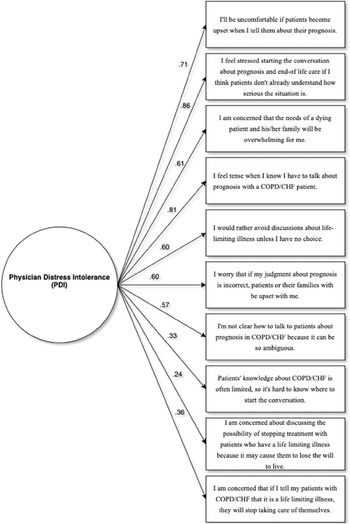
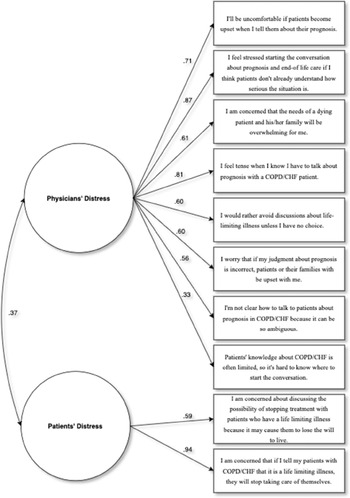
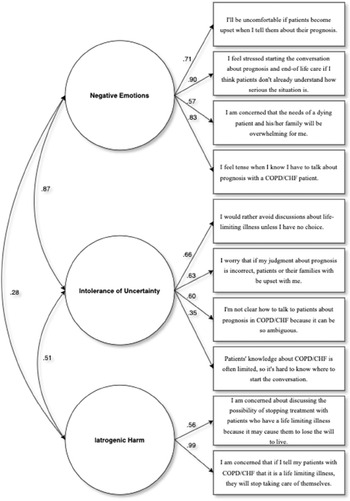
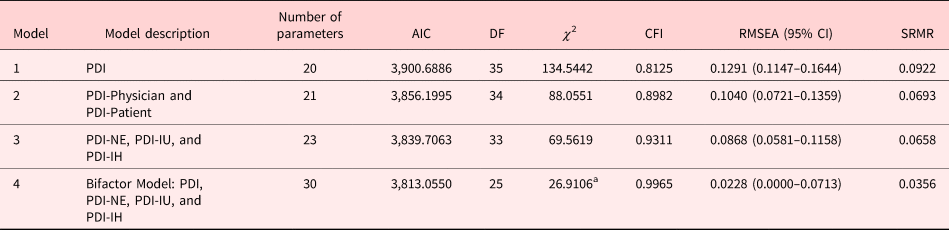
To evaluate structural validity, CFA on the COPD dataset was conducted using Proc Calis in SAS 9.4 using full information maximum likelihood estimation. We evaluated whether a three-factor model incorporating these three dimensions fits the data better than a two-factor model incorporating two broader dimensions (i.e., physicians’ own emotional distress intolerance and concerns their patients’ distress intolerance) or a one-factor model incorporating all 10 emotional distress intolerance items that loaded on any factor at a level above 0.35 in the initial factor analysis. Next, we examined whether a bifactor model consisting of a general factor and the three identified distress tolerance dimensions fit the data better than a three-factor correlated factor model. In both three-factor models, one factor included four items related to physicians’ anticipation of negative emotions, the second included four items related to physicians’ intolerance of uncertainty, and the third included two items reflecting physician concerns about causing iatrogenic harm to their patients. The three-factor correlated factor model yielded one negative error variance parameter (i.e., for item “I am concerned that if I tell my patients with COPD/CHF that it is a life-limiting illness, they will stop taking care of themselves.”) which was constrained at >0 to aid in interpretation. Path diagrams for the unidimensional (Figure 1), two-factor (Figure 2), three-factor correlated factors (Figure 3), and three-factor bifactor (Figure 4) are presented in Figures 1–4. As shown in Table 2, both three-factor models demonstrated an adequate fit to the data. Comparisons of the χ 2 for each model indicated that both three-factor models had a superior fit to the two-factor and the one-factor model. The bifactor model fits the data well and was superior to all other models. The three-factor correlated factor model fits the data well, suggesting the three subscales provide unique information and represent the data well. Superior fit of the bifactor model suggests that the full 10-item scale provides unique information when accounting for the multidimensionality of the construct.
Model 1: a unidimensional model.

Model 2: a two-factor model.

Model 3: a three-factor correlated factor model.

Model 4: a three-factor bifactor model.

Goodness-of-fit indices for each model

AIC, Akaike's information criterion; DF, degrees of freedom; χ 2, Chi-square; CFI, Bentler's comparative fit index; RMSEA, root-mean-square error of approximation; SRMR, standardized root-mean residual; PDI-NE, Physicians’ Distress Intolerance — Negative Emotions; PDI-IU, Physicians’ Distress Intolerance — Intolerance of Uncertainty; PDI-IH, Physicians’ Distress Intolerance — Iatrogenic Harm.
a Indicates a significant χ 2 test for the model.
Consequently, a full scale (PDI) and three subscales: Anticipating Negative Emotions (PDI-NE), Intolerance of Uncertainty (PDI-IU) and Iatrogenic Harm PDI-IH) were created. Items were included if they had rotated factor loadings on the EFA greater than 0.35 on the respective factor. To respond, physicians reported their level of agreement with each item on a 5-point Likert scale from 0 (Strongly Disagree) to 4 (Strongly Agree). The full 10-item scale and all subscales had adequate internal consistency reliability (PDI-Full: α = 0.84, PDI-NE: α = 0.84, PDI-IU: α = 0.70, PDI-IH: α = 0.73). Analyses and theory indicate that the subscales are interrelated but are not redundant. The two subscales referring to physicians’ own distress intolerance (PDI-NE and PDI-IU) are intercorrelated (r(224) = 0.63, p < 0.001). Both scales are correlated with concerns about iatrogenic harm (r(224) = 0.23–0.27, p < 0.001).
Preliminary analyses: variations by sociodemographics, condition and illness severity
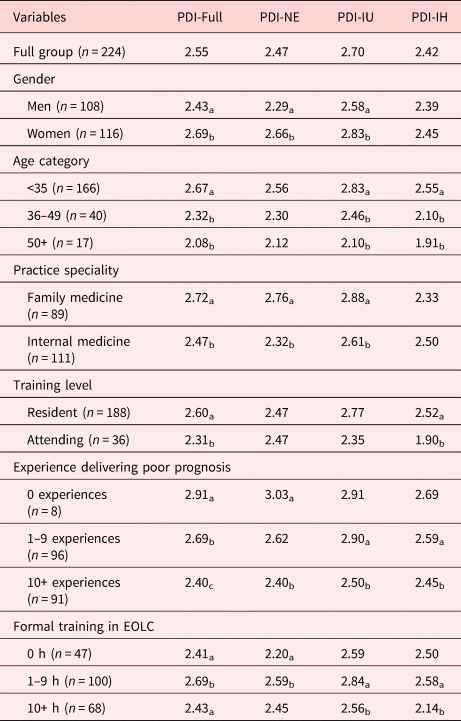
Analyses of demographic variations in the PDI were conducted using the combined COPD and CHF dataset (n = 224). Table 3 provides the means of the full scale and three subscales and results of analyses examining group differences. There were gender differences, with women reporting greater overall distress intolerance than men (PDI-Full). There were significant age differences in distress tolerance. Post hoc tests indicated that the youngest participants (i.e., those 35 years of age or younger) had greater overall distress intolerance than those in the two older age groups. We included gender and age as covariates in tests of construct validity.
Demographic and known-groups comparisons

Notes: Different subscripts within the column reflect significant differences between groups (p < 0.05). N's do not always add to 224 due to missing data.
PDI-NE, Physicians’ Distress Intolerance — Negative Emotions; PDI-IU, Physicians’ Distress Intolerance — Intolerance of Uncertainty; PDI-IH, Physicians’ Distress Intolerance — Iatrogenic Harm.
Effects for age: PDI-Full: F(2,220) = 9.34, p < 0.0001, PDI-IU: F(2,220) = 10.75, p < 0.001, PDI-IH: F(2,220) = 5.96, p < 0.003.
Gender: PDI-Full: F(2,221) = 8.38, p < 0.005, PDI-NE: F(2,221) = 9.85, p < 0.002, PDI-IU: F(2,221) = 6.46, p < 0.02.
Practice specialty: PDI-Full: F(1,198) = 6.84, p < 0.01, PDI-NE: F(1,198) = 12.64, p < 0.001, PDI-IU: F(1,198) = 6.38, p < 0.02.
Training level (resident/attending): PDI-Full: F(1,222) = 5.72, p = 0.018, PDI-IU: F(1,222) = 9.74, p = 0.002, PDI-IH: F(1,222) = 12.50, p = 0.001.
Experience delivering negative prognosis: PDI-Full: F(2,213) = 5.96, p = 0.003, PDI-IU: F(2,213) = 8.06, p < 0.001, PDI-IH: F(2,213) = 3.45, p = 0.033.
Formal training: PDI-Full: F(2,212) = 4.25, p = 0.015, PDI-NE: F(2,212) = 3.08, p = 0.048, PDI-IU: F(2,212) = 3.65, p = 0.028, PDI-IH: F(2,212) = 4.20, p = 0.016.
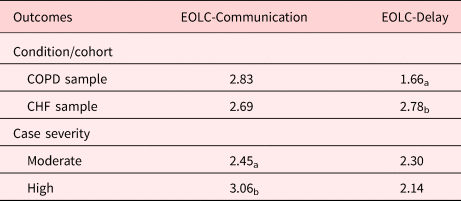
Prior to testing the relationship of PDI to EOLC-Communication and EOLC-Delay, preliminary mixed model analysis of variance examined condition/cohort and case severity as predictors of EOLC discussion outcomes. As shown in Table 4, physicians were significantly more likely to delay EOLC discussion with CHF patients than with COPD patients and significantly more likely to engage in EOLC discussion at higher levels of illness severity. As such, condition/cohort and case severity are included as additional covariates in subsequent analyses.
Condition and case severity effects

Note: Different subscripts within the column reflect significant differences between groups (p < 0.05).
Hypothesis-testing for construct validity
We hypothesized that known-groups comparisons would reveal that physicians with less professional experience and/or less training would report greater emotional distress intolerance. Consistent with this hypothesis and shown in Table 3, resident physicians reported greater overall distress intolerance than attending physicians. Similarly, physicians with limited experience in delivering negative prognostic information reported significantly greater distress intolerance than those with more experience. Physicians with limited formal training in EOLC (1–9 h) reported significantly greater overall distress intolerance than those who had received more training. However, those with no formal training did not differ from those with the most training on overall distress intolerance. Furthermore, as predicted, PDI was also positively correlated with trait anxiety (r(222) = 0.36, p < 0.001).
Consistent with predictions derived from distress tolerance theory, scores on the PDI predicted EOLC communication. Specifically, controlling for age, gender, condition/cohort, and case severity, mixed-model analyses revealed the PDI-Full scale was significantly negatively associated with physicians’ reports of initiating EOLC discussions with their patients (EOLC-Communication) (β = −0.29, SE = 0.08, t(222) = −3.76, p < 0.01) and significantly positively associated with physicians’ reports of delaying EOLC discussions with their patients until the patient requested information (EOLC-Delay) (β = 0.34, SE = 0.11, t(223) = 3.04, p < 0.01). These effects remained significant after additional controls for trait anxiety (EOLC-Communication: β = −0.30, SE= 0.08, t(221) = −3.60, p < 0.001; EOLC-Delay: β = 0.32, SE = 0.12, t(222) = 2.69, p < 0.01).
The PDI subscales are uniquely related to EOLC communication. With all three subscales included as predictors, and controlling for age, gender, case severity, and condition, only the PDI-IU subscale was significantly negatively associated with EOLC-Communication (β = −0.23, SE = 0.10, t(223) = −2.39, p < 0.05). In contrast, only the PDI-Iatrogenic Harm subscale was significantly positively associated with EOLC-Delay (β = 0.32, SE = 0.08, t(227) = 3.97, p < 0.001). Both effects remained significant controlling for trait anxiety (PDI-IU: β = −0.23, SE = 0.10, t(221) = −2.39, p < 0.05; PDI-IH: β = 0.31, SE = 0.08, t(226) = 3.70, p < 0.001).
Discussion
Qualitative data consistently cite physician concerns about emotional distress intolerance as a barrier to EOLC discussions (De Vleminck et al., Reference De Vleminck, Houttekier and Pardon2013). This study provides psychometric data for a new measure, the PDI scale, intended to permit quantitative investigations of the role of emotional distress intolerance in EOLC discussions. The data collected in a sample of over two hundred physicians indicate that the full scale and its subscales show evidence of reliability and preliminary evidence of validity.
Consistent with COSMIN criteria, two approaches to evaluating construct validity, hypothesis-testing, and assessing structural validity were employed. Results of hypothesis-testing about known-groups differences support the validity of the scale, as those who have less training overall (i.e., were residents vs. attending physicians), less experience delivering a bad prognosis, and less formal training in EOLC reporting greater concerns about emotion regulation on the PDI-Full scale or one of the subscales. Trait anxiety, a construct reflecting a stable tendency to view a wide range of events and negative emotional experiences as potentially threatening, was positively associated with the PDI-Full scale.
Analyses of the relations between PDI scores and EOLC discussion outcomes also support the construct validity of the scale. Higher scores on the PDI Full scale were associated with lower scores on measures of EOLC discussion initiation and higher scores on a measure of delayed EOLC discussions. The PDI scale and subscales were associated with EOLC discussion outcomes even when controlling for trait anxiety. This suggests that the scale assesses distress intolerance that is specific to emotionally demanding patient-physician interactions and does not simply reflect a presence of or sensitivity to emotional distress in general.
The PDI scale has three subscales reflecting dimensions of physicians’ emotional distress intolerance that support the structural validity of the measure. Two subscales, Anticipating Negative Emotions and Intolerance of Uncertainty, correspond with dimensions of distress tolerance previously identified and replicated in factor analytic studies of distress tolerance in the general population (Zvolensky et al., Reference Zvolensky, Vujanovic and Bernstein2010; Bardeen et al., Reference Bardeen, Fergus and Orcutt2013). The third subscale, Iatrogenic Harm, reflects an additional dimension specific to the EOLC communication context, but related to the established distress tolerance domain of ambiguity. Only physicians’ concerns about their ability to tolerate uncertainty (PDI-IU) were negatively associated with initiating EOLC discussions. In contrast, only physicians’ concerns about causing iatrogenic harm to their patients (PDI-IH) were associated with delaying EOLC discussions until the patient requested them. Differential effects of the subscales support the additional utility of the subscales and their capacity to assess different dimensions of distress intolerance with unique functional outcomes. These data suggest that emotional barriers to EOLC discussions are complex; each dimension of emotional distress intolerance may have different consequences for EOLC communication and may require different interventions.
The findings linking PDI-IH to EOLC-Delay are consistent with reports on physicians’ concerns about iatrogenic harm as a barrier to EOLC discussions, with physicians reporting concerns about undermining their patients’ will to live (Weiner and Roth, Reference Weiner and Roth2006). The findings linking PDI-IU to the initiation of EOLC-Communication are consistent with the broader literature on the relationship of intolerance of uncertainty to avoidant behavior. Intolerance of uncertainty, a construct reflecting negative beliefs about and interpretations of uncertainty and its consequences, is a well-established predictor of worry and use of avoidant emotion regulation strategies (Birrell et al., Reference Birrell, Meares and Wilkinson2011).
Clinical implications
Efforts to improve EOLC communication may require attention to a broad range of underlying concerns about emotional distress tolerance. Physicians, especially new physicians, may need strategies to manage their own emotions to be able to effectively initiate EOLC discussions. They might also benefit from interventions to build skills which can help them to support their patients’ ability to manage emotions and tolerate distress in EOLC. The clinical literature suggests that targeted training can help even anxious individuals to overcome their concerns and engage in new behavior (Barlow, Reference Barlow2004). Specifically, treatment for anxiety and distress intolerance generally includes exposure to feared stimuli and guided practice to develop distress tolerance in the specific contexts which evoke fear or avoidance. Targeted skills training may permit physicians to gain distress tolerance and communication skills specific to the EOLC context. Systematic reviews of existing EOLC communication skill programs suggest that interventions improve knowledge and self-efficacy, but there is limited evidence suggesting improvements in physician comfort in EOLC communication, an indicator of distress tolerance (Lord et al., Reference Lord, Clark-Carter and Grove2016; Walczak et al., Reference Walczak, Butow and Bu2016). The addition of interventions which incorporate experiential or exposure-based components may lead to greater improvement in emotional distress tolerance than interventions focused on communication skills alone (Smith et al., Reference Smith, Macieira and Bumbach2018). However, the measurement of emotional distress tolerance outcomes is limited. The PDI may help both to identify specific targets for intervention and evaluate change in emotional distress intolerance over time, increasing the efficiency of communication skill intervention in EOLC.
Limitations
Interpretation of these findings should be considered in the context of several limitations. Our sample consisted primarily of residents and was largely made up of physicians 35 years of age or younger. All hospitals from which participants were recruited were located in the greater NYC area. Physicians’ views on emotion regulation and EOLC may differ across countries or regions in the USA (Barnato et al., Reference Barnato, Herndon and Anthony2007). In responding to questionnaires, physicians read clinical vignettes and were instructed to consider their own similar patients when responding. Physicians’ reports of emotional distress intolerance and engagement in EOLC communication may differ in the context of active vs. recollected clinical consultation with their own patients. Some processes involved in emotional distress intolerance operate without conscious awareness and may not be accessible via retrospective self-report (De Vries et al., Reference De Vries, Gholamrezaee and Verdonck-de Leeuw2018). Therefore, future research may benefit from multi-method approaches including interviews and observational methods, such as the Defense Mechanism Rating Scales for Clinicians (Despland et al., Reference Despland, Bernard and Favre2009) to supplement the understanding obtained through self-report measures alone.
Our initial iterated principal factor analysis did not meet the criteria of 10 cases per variable due to sample size limitations. This analysis was used to guide the initial construction of subscales and CFA was conducted on a different sample to determine the replicability of the initially observed factor structure. Further studies will be needed to replicate these findings. Future studies may be necessary to identify the effects of emotional distress intolerance on EOLC communication in older physicians and physicians who work in outpatient settings. The PDI has been tested only in the context of COPD and CHF, limiting our knowledge about physician emotional distress intolerance in response to other conditions, particularly those that vary in prognostic ambiguity. Intolerance of uncertainty (PDI-IU), in particular, may operate differently for conditions with less prognostic ambiguity, such as many cancers, as physicians may not experience the same degree of uncertainty and associated emotional concerns when considering EOLC discussion. Future research may further evaluate the dimensions of physician emotional distress intolerance reflected in the subscales of the PDI in different contexts and for different patient populations. Furthermore, although we considered each aspect of the COSMIN criteria for evaluating content validity, we employed qualitative focus group discussions and not quantitative methods for evaluating content validity.
Physicians’ engagement in EOLC communication may also be affected by top-down factors, including their hospital's tacit and explicit policies concerning EOLC communication and the specific guidance and recommendations of governing medical associations (Shapiro, Reference Shapiro2011; Weilenmann et al., Reference Weilenmann, Schnyder and Parkinson2018). Institutions and departments may vary in the degree to which they explicitly value and directly support the development of emotional distress tolerance in their physicians in the context of EOLC communication. Future research would benefit from evaluating the extent to which physicians perceive support from both their institutions and training and governance associations as they develop skills in emotional distress tolerance. Understanding the extent to which physician emotional distress intolerance is responsive to intervention has important implications for improving EOLC communication. We are currently testing whether didactic and experiential EOLC communication training improves physician emotional distress tolerance.
Conclusion
The PDI scale is a brief measure of emotional distress tolerance relevant to EOLC communication. The scale has good psychometric properties, exhibiting evidence of reliability and preliminary evidence of validity. The findings of the current study highlight the importance of physicians’ emotional distress tolerance and emotion regulation when engaging in EOLC discussions and the need to address physicians’ underlying emotional distress intolerance as they face demanding interpersonal situations with significant impact on medical and psychosocial outcomes for patients and their families.
Supplementary material
The supplementary material for this article can be found at https://doi.org/10.1017/S1478951522000219.
Acknowledgement
We would like to acknowledge Perihan El Shanawany, MD and Peter W. Lobl, JD, Ph.D. who made valuable contributions to the development and implementation of this study.
Conflict of interest
The authors have no conflicts of interest to disclose.