Introduction
Pork is one of the most consumed meats worldwide (OECD and FAO, 2019) and an essential animal protein source for the human diet (Lo Fiego et al., Reference Lo Fiego, Belmonte and Mezzetti2018). Over the last few decades, research has been conducted with the aim of improving swine meat and carcass quality (Peterla and Scanes, Reference Peterla and Scanes1990; Athayde et al., Reference Athayde, Dalla Costa, Roça, Guidoni, Ludtke and Lima2012; Hoa et al., Reference Hoa, Seong, Cho, Kang, Kim, Moon, Choi, Kim and Seol2019; Silva et al., Reference Silva, Callegari, Dias, Bridi, Pierozan, Foppa, Martins, Dias, Passos and Hermes2019). However, the final pork quality continues to be an issue for the swine industry since several intrinsic and extrinsic factors can influence this attribute, such as animal's sexual condition, breed, diet, welfare, slaughter method, post mortem processes and the proteome profile (Paredi et al., Reference Paredi, Raboni, Bendixen, Almeida and Mozarelli2012, Reference Paredi, Mori, Marino, Raboni, Marchi, Galati, Buschini, Lo Fiego and Mozzarelli2019). According to Paredi et al. (Reference Paredi, Raboni, Bendixen, Almeida and Mozarelli2012), optimizing pork quality differs from beef, where the tenderization process is the main target of researchers. The principal challenges in pork are related to flavour (boar taint), colour, water holding capacity (WHC) and the lack of intramuscular fat in the meat (Paredi et al., Reference Paredi, Raboni, Bendixen, Almeida and Mozarelli2012; Hoa et al., Reference Hoa, Seong, Cho, Kang, Kim, Moon, Choi, Kim and Seol2019).
To address these challenges, particularly the problem of sex odour of boar meat carcasses, that is due to androsterone, and skatole sexual hormones in males, the castration of male piglets is a common practice in pig production (Weiler et al., Reference Weiler, Font i Furnols, Fischer, Kemmer, Oliver, Gispert, Dobrowolski and Claus2000; Čandek-Potokar et al., Reference Čandek-Potokar, Škrlep, Zamaratskaia and Carreira2017). Although surgical castration is efficient in blocking androsterone and skatole formation, this practice is associated with decreased feed efficiency and lean meat percentage in the carcass. Moreover, welfare defenders criticize it as an invasive and painful procedure (Čandek-Potokar et al., Reference Čandek-Potokar, Škrlep, Zamaratskaia and Carreira2017). As an alternative to this procedure, immunization against the gonadotropin-releasing hormone, GnRH (immune castration), has been shown to be efficient in reducing the synthesis of anabolic steroids, including androsterone, and to minimize skatole levels, resolving the boar taint problem (Jaros et al., Reference Jaros, Bürgi, Stärk, Claus, Hennessy and Thun2005; Čandek-Potokar et al., Reference Čandek-Potokar, Škrlep, Zamaratskaia and Carreira2017). Immune castrated animals have better average daily gain than physically castrated and entire males, with superior lean meat yield and an adequate amount of backfat and intramuscular fat fulfilling the requirements for cured products (Nautrup et al., Reference Nautrup, Van Vlaenderen, Aldaz and Mah2018).
Another common practice used in swine production to improve growth performance and the percentage of lean meat in the carcasses without altering the meat quality is the supplementation with ractopamine hydrochloride (RAC). RAC is a β-adrenergic agonist used as growth-promoting in swine finishing diets that acts as a repartitioning agent, reducing adipose tissue nutrients and redirecting them to muscle protein synthesis (Almeida et al., Reference Almeida, Nuñez and Miyada2012; Athayde et al., Reference Athayde, Dalla Costa, Roça, Guidoni, Ludtke and Lima2012; Costa et al., Reference Costa, Feddern, Athayde, Manzke, Roça, Lopes and Lima2018). Several studies demonstrated that both immune castration and RAC supplementation add value to the swine meat and carcass (Athayde et al., Reference Athayde, Dalla Costa, Roça, Guidoni, Ludtke and Lima2012; Lowe et al., Reference Lowe, Gerlemann, Carr, Rincker, Schroeder, Petry, McKeithy, Alle and Dilger2014; Rocha et al., Reference Rocha, Bridi, Foury, Mormède, Weschenfelder, Devillers, Bertoloni and Faucitano2014; Costa et al., Reference Costa, Feddern, Athayde, Manzke, Roça, Lopes and Lima2018). Rocha et al. (Reference Rocha, Bridi, Foury, Mormède, Weschenfelder, Devillers, Bertoloni and Faucitano2014) demonstrated that immune castrated males (IC) receiving 7.5 mg/kg of RAC exhibited leaner carcasses compared to surgically castrated (SC) with or without RAC inclusion in the diet, maintaining pork quality and good welfare indicators. Costa et al. (Reference Costa, Feddern, Athayde, Manzke, Roça, Lopes and Lima2018) investigated the effects of feeding RAC to SC and IC male piglets during the growth and finishing phases. The authors found an independent effect of RAC dietary inclusion (at least 5 mg/kg) and immune castration both increased body weight and benefited muscle growth in finishing pigs, but with a separate effect.
Despite numerous studies on the impacts of gender and diet in growing and finishing pigs, there is still a lack of knowledge about the molecular processes and key molecules that lead to differences in the meat protein profile impacting meat quality attributes (Paredi et al., Reference Paredi, Mori, Marino, Raboni, Marchi, Galati, Buschini, Lo Fiego and Mozzarelli2019). To overcome this issue, proteomic techniques have been applied in meat science to obtain information on the structure and functions of complex protein systems; interpret biochemical changes associated with molecular mechanisms; catalogue molecules, and found biological markers related to meat quality attributes (Bendixen, Reference Bendixen2005; Paredi et al., Reference Paredi, Raboni, Bendixen, Almeida and Mozarelli2012). The proteome can also be seen as a bridge between the genome and the phenotype since it reflects the genes expressed at a given time with specific environmental and processing conditions (Bendixen, Reference Bendixen2005; Hollung et al., Reference Hollung, Veiseth, Jia, Færgestad and Hildrum2007). The main goal of this work was to study the proteomic profile of non-aged pork meat under different sexual conditions and RAC dietary supplementation, and determine how the combination of these two factors impacts meat quality attributes.
Materials and methods
Animals, slaughter and samples
The swine population, slaughter procedures and sampling were fully described in previous work (Oliveira et al., Reference Oliveira, Duarte, Moncau, Almeida, Silva-Vignato and Balieiro2019). A population of 48 animals raised in a commercial farm (Agropecuária Bressiani, Bressiani Group, Capivari, SP, Brazil) was distributed to six treatments (3 sexual conditions × 2 diets): male surgically castrated (SC), male immune castrated (IC) and female (F), with and without RAC supplementation in the diet (WR and NR, respectively). In the SC, surgical castration procedure occurred in the first week of the animal's life. For the IC, 2.0 ml of Vivax® (Pfizer Animal Health, New York, NY, USA) was administered to the animals 8 and 4 weeks before slaughter, following the manufacturer's instructions. To avoid vaccine failures, 15 days after the second dose of Vivax®, a visual inspection of the animals was performed looking for sexual behaviours, like the mounting of pen mates, penis exposure and high levels of aggressivity. RAC supplementation in the diet occurred 28 days before slaughter. Eight animals of each sexual condition received 10 ppm/kg of food, following the manufacturer's recommendations. At the end of the finishing phase (164 days), the average weight per group was: 123.3 and 114.4 kg for males SC, diet WR and NR, respectively; 131.7 (WR) and 126.0 kg (NR) for males IC; and 122.5 (WR) and 114.0 kg (NR) for females.
The animals were slaughtered at the slaughterhouse Frigodeliss Ltda (Bressiani Group, Capivari, SP, Brazil), according to Brazilian legislation (Brasil, 1952, 1995). Then, all carcasses were cooled for 24 h at 2°C, according to the current legislation (Brasil, 1952, 1995). For proteomic analysis, a sample of the Longissimus dorsi (LD) muscle was collected from the half carcass (after the 24 h cooling period), immediately frozen in liquid nitrogen, and then kept at −80°C until the analysis.
Meat quality evaluation
The pH, drip loss and colour were measured in the carcass 24 h after slaughter. For drip loss analysis, a sample of the LD muscle of approximately 100 g was collected (4th rib), put inside a polyethylene packing, avoiding sample contact with the plastic or with the liquid deposited on the bottom, and kept at 4°C for 48 h until weighing. The drip loss percentage was calculated according to Honikel (Reference Honikel1998). For pH (Oakton, pH300 pHmeter, Vernon Hills, Illinois, USA) and colour measurements, the left half carcasses were cut between the 10th and 11th ribs. For colour assessment, a Minolta colorimeter (Chroma Meter, CR-400, Mahway, New Jersey, USA) with a D65 light source, 10° observer and 8 mm aperture was used. Three colour measurements were made in the loin muscle area after 15 min of oxygen exposure. The L*, a* and b* values were determined in agreement with the CIE-Lab evaluation system (CIE, 1978).
The shear force, cooking and thawing losses were analysed in the Meat Quality Laboratory at the College of Agriculture ‘Luiz de Queiroz’ (University of São Paulo, Piracicaba – SP, Brazil). Samples of the LD muscle with 2.5 cm thick were vacuum packaged and then frozen in a fast tunnel until the analysis. Freezing losses (%) were calculated as the difference between the initial pork weight and the weight after thawing at 4°C for 48 h. For the cooking losses (%) measurements followed by shear force analysis, two pork samples per animal were used. The samples were cooked in a water-bath (at 80°C) until the internal temperature arrived at 70°C. The samples were cooled at 4°C overnight. Following the cooling period, eight cores with 1.27 cm diameter were removed from the cooked pork samples parallel to muscle fibres (AMSA, 1995). The cores were sheared perpendicularly to the muscle fibres using a Warner Bratzler 3 mm blade coupled with a texturometer Stable TaTx (Model TA.XT2i, Texture Analyzer, Goldaming, Surrey, England), and the shear force values were expressed in Newton (N). More details can be found in Oliveira et al. (Reference Oliveira, Duarte, Moncau, Almeida, Silva-Vignato and Balieiro2019).
Muscle protein extraction and quantification
Protein extraction from the meat samples was carried out according to Lametsch et al. (Reference Lametsch, Karlsson, Rosenvold, Andersen, Roepstorff and Bendixen2003), where 500 mg of each sample was added to an extraction buffer (Urea 8 M, Tiourea 2 M, CHAPS 2%, DTT 65 mm) with 1% protease inhibitor (GE Healthcare, Chicago, Illinois, USA). The samples were then homogenized (IKA, Ultra Turratec T-10, Staufen im Breisgau, Germany) at 30 000 rpm for 60 s. The formed extract was mixed vigorously for 30 min at 4°C and centrifuged at 10 000 g for an additional 30 min at 4°C. Thus, the supernatants were transferred to identified microtubes and kept at −80°C. Protein quantification was performed using the PlusOne 2-D Quant kit (GE Healthcare), following the manufacturer's instructions.
Proteomic analysis
One-dimensional Sodium Dodecyl Sulfate Polyacrylamide (SDS/PAGE) gel electrophoresis was performed to draw the treatments' meat proteomic profile. Eight electrophoretic runs with six samples per gel, representing each of the treatments, were realized. Before the analysis, each gel was submitted to a pre-run of 12 min at 160 V using a running buffer (GE Healthcare, AmershamTM ECLTM Gel Running Buffer, 10x) diluted 1x, as recommended by the manufacturer. Samples containing 50 μg of protein from each treatment were diluted in sample buffer (0.5 m Tris-HCl – pH 6.8, glycerol, 10% SDS, 2-mercaptoethanol, 1% bromophenol blue), heated for 4 min at 100°C, and then placed in wells side by side. The weight standard Pageruler™ Prestained Protein Ladder, 10–180 kDa, was used in each gel. The parameters applied by the electrophoretic run were 160 V by 65 min. A Coomassie blue G-250 solution (Invitrogen, Novex – Colloidal Blue Staining Kit) was used to dye the gels for 60 min under constant agitation. The gels were then kept in Milli-Q water overnight, and their images were scanned using an ImageScanner (EPSON, Image Scanner III – Expression 10000XL, Suwa, Japan). The Image Quant TL Security 1D Gel Analysis software (GE Healthcare) was used for image analysis. The protein amount in each band was expressed as volume, that is, the sum of pixel intensity within the band limit. Moreover, the relative volume (% volume) was used to assess the differences in protein amount in each gel band, which is a normalized value that remains relatively independent of variations.
Statistical analysis
A completely randomized design was used to carry out the statistical analyses with the degree of freedom of treatment unfolding in a 2 × 3 factorial scheme (2 diets × 3 sexual conditions). To assess the implications of the results associated with meat quality traits and the SDS/PAGE, the variables indicating the meat quality traits and the normalized bands' intensities were used as dependent variables. So, to test the treatment effects, the mathematical model was:

where, Yijk is the observed value for the meat quality traits variables or for the intensities of normalized bands; μ is a constant inherent to all observations; Ri is the fixed effect of using or not ractopamine in the diet i, being i = 1 (NR, 0 ppm) or 2 (WR, 10 ppm); Cj is the fixed effect of the sexual condition j, being j = 1 (SC), 2 (IC) or 3 (F); RCij is the interaction effect between diet i and sexual condition j; eijk represents the residual error associated to the traits (Yijk), with average = 0 and variance δ2e. All analyses were performed using the PROC MIXED procedure from SAS v. 9.1.3 (Statistical Analysis System, SAS Institute Inc., Cary, NC, USA).
Results
Meat quality
Among the evaluated meat quality attributes, the ultimate pH (pHu), measured in the LD muscle, showed significant differences regarding the sexual condition and dietary inclusion of RAC. In the groups fed with RAC (WR), the females presented higher ultimate pH mean values than males (SC and IC). In the groups without RAC dietary supplementation (NR), the IC males showed the lower pHu mean value. When considering just the diet effects, females and IC males WR had higher pHu mean values. With respect to the colour parameter Lightness (L*), a significant difference was observed between IC males concerning RAC supplementation in the diet, with a higher L* mean value in IC-NR males. The a* and b* colour parameters did not show significant differences concerning sexual conditions and diet, neither the percentages of drip, cooking and thawing losses. Finally, the tenderness only demonstrated differences in dietary effects. Females and IC males fed RAC had higher shear force mean values than NR group animals (Table 1). These results were fully described in Oliveira et al. (Reference Oliveira, Duarte, Moncau, Almeida, Silva-Vignato and Balieiro2019).
Measurements of pH, colour (L*, a* and b*), drip loss (DL), thawing loss (TL), cooking loss (CL) and shear force (SF) in the LD (Longissimus dorsi) muscle of swine under different sexual conditions, and with (WR) or without (NR) dietary ractopamine inclusion

F, female; IC, immune castrated male; SC, male surgically castrated.
a Standard error.
Protein profile of the meat
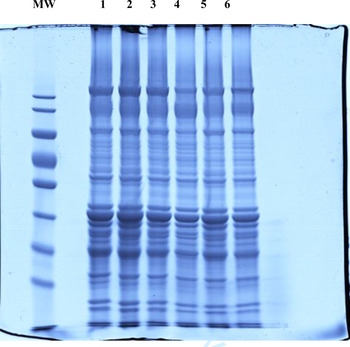
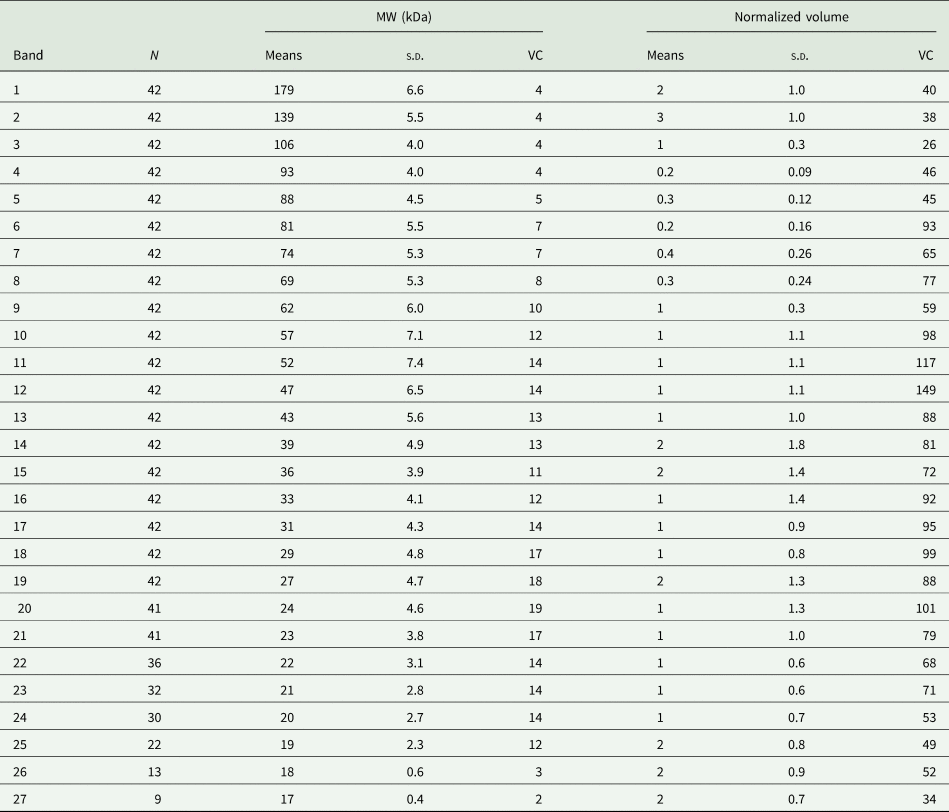
The separation of total proteins (myofibrillar and sarcoplasmic) using SDS-PAGE can be seen in Fig. 1. Twenty-seven protein bands were found in the present study (described in Table 2). One of the protein gels was removed from the analysis due to not reaching quality parameters, so the total number of observations, considering 7 gels × 6 treatments, was equal to 42. As shown in Table 2, bands 1–19 were common to all the studied traits, as they demonstrated the maximum number of observations (42). Similarly, bands 20 and 21 were presented in almost all traits, showing 41 observations. From bands 22 to 27, the number of observations per band decreased from 36 (band 22) to 9 (band 27). Bands 2 and 6 showed the highest and lowest mean normalized volume, 3 and 0.2%, respectively. In total, there was a variation of 99.86% in the protein normalized volume between the maximum (7.01%, band 14) and minimum (0.01%, band 23) values.
Colour online. One-dimensional Sodium Dodecyl Sulfate Polyacrylamide (SDS/PAGE) gel, showing the protein's separation by molecular weight. MW – molecular weight standard (10–180 kDa); 1 – female with ractopamine; 2 – surgically castrated with ractopamine; 3 – immune castrated with ractopamine; 4 – surgically castrated without ractopamine; 5 – female without ractopamine; 6 – immune castrated without ractopamine.

Average estimates (mean), standard deviations (s.d.) and variation coefficients (VC) for proteins molecular weight (MW) and normalized volume (%) of each evaluated band

Tukey analysis at 5%.
RAC supplementation in the diet (WR and NR) had a significant effect on the protein abundance of six bands (1, 2, 3, 9, 15 and 17), considering 25 representative bands – bands presenting at least three valid information within the combination of sexual condition and RAC supplementation (Fig. 2). As shown in Fig. 2, bands 1, 3, 9, 15 and 17 showed higher percentages of mean normalized volume (P < 0.05) for the supplemented group compared with the non-supplemented animals. Conversely, band 2 demonstrated a lower percentage of normalized volume (P < 0.05) for the supplemented group. Among those bands, the higher value of normalized volume (%) occurred in band 2 and the lowest in band 9. Band 17 showed the highest percentage variation between minimum and maximum values (95.26%), and band 3 showed the lowest, 68.21%.
Differences in the percentages of protein normalized volume between groups supplemented (WR) or not (NR) with ractopamine, for the protein bands significantly affected by diet.

After verifying a significant effect of RAC supplementation over the protein abundance of the cited six protein bands, the intercept estimates and regression coefficients (β 0 and β 1) were calculated to obtain t-statistic values and probabilities for the regressions of the meat quality attributes as a function of the normalized volume of each band (bands 1, 2, 3, 9, 15 and 17; Supplementary Tables 1 to 6). As a result, for band 1, the b* value demonstrated a tendency to decrease in the presence of RAC (P = 0.0978; Supplementary Table 1). In other words, for every 1% increase in the normalized protein volume, a decrease of −0.28 units in b* can occur. For band 2, a positive effect of RAC dietary inclusion was detected concerning the meat tenderness. Again, for every 1% increase in protein abundance, the shear force decreases 0.7 N in the WR group (P < 0.05; Supplementary Table 2). The variation in protein abundance of the third band presented significant effects on drip loss, thawing loss and L* (P < 0.05; Supplementary Table 3). For the WR group, a decrease in L* and thawing loss can occur in the function of protein volume, as well as an increase in drip loss for the NR group.
For band 9, contrarily as occurred in band 3, we verified that variation in protein volume can cause an increase in thawing loss percentage for the NR group (P < 0.05; Supplementary Table 4). RAC addition in the diet showed a positive effect on meat tenderness, with a decrease of −1.05 N as the protein abundance increases (P = 0.0867; Supplementary Table 4). On band 15, an increase in drip loss percentage of 1.27 was verified due to variations in protein volume (P < 0.01; Supplementary Table 5). Again, a positive effect on meat tenderness was found for the WR group. As protein volume increases, a decrease of −0.31 N is expected (P = 0.0535; Supplementary Table 5). Lastly, although band 17 was significantly affected by RAC supplementation, presenting higher protein abundance for the WR group, this effect was not reflected on the meat quality attributes (Supplementary Table 6).
The sexual condition (SC, IC and F) and the interaction of sexual condition and RAC supplementation did not impact the normalized volume of protein in each of the representative bands, showing no significant effects (Supplementary Table 7).
Discussion
To achieve the goal of studying the proteomic profile of non-aged pork meat under different sexual conditions and ractopamine dietary supplementation, first, the impacts of these factors on the final meat quality of the animals were observed. It is well-established that castration, surgically or by GnRH immunization, is necessary for pig production since it controls the boar taint in pork meat (Weiler et al., Reference Weiler, Font i Furnols, Fischer, Kemmer, Oliver, Gispert, Dobrowolski and Claus2000; Čandek-Potokar et al., Reference Čandek-Potokar, Škrlep, Zamaratskaia and Carreira2017). Moreover, RAC is a β-adrenergic agonist, usually used as dietary supplementation in pigs, increasing growth rate and carcass lean meat without impairing the final meat quality (Athayde et al., Reference Athayde, Dalla Costa, Roça, Guidoni, Ludtke and Lima2012; Rocha et al., Reference Rocha, Bridi, Foury, Mormède, Weschenfelder, Devillers, Bertoloni and Faucitano2014). The combination of castration techniques and different RAC inclusion levels in pig diets, and its impacts on carcass and meat quality traits, was already explored in previous studies (Athayde et al., Reference Athayde, Dalla Costa, Roça, Guidoni, Ludtke and Lima2012; Garbossa et al., Reference Garbossa, Sousa, Cantarelli, Pimenta, Zangeronimo, Silveira, Kuribayashi and Cerqueira2013; Rocha et al., Reference Rocha, Bridi, Foury, Mormède, Weschenfelder, Devillers, Bertoloni and Faucitano2014; Costa et al., Reference Costa, Feddern, Athayde, Manzke, Roça, Lopes and Lima2018), but its benefits for pig production had not yet been established.
In the current study, the interaction of sexual conditions and RAC dietary supplementation affected the pHu and the meat lightness (L*). The higher values of ultimate pH (mean value 5.7) were found for the females fed with RAC and, when comparing just the supplementation effects, females and IC males presented higher pHu values in the supplemented group. Although pHu values between 5.5 and 5.8 can be considered in a normal range for pork (Bridi and Silva, Reference Bridi and Silva2009; Costa et al., Reference Costa, Ludke, Costa, Faucitano, Peloso and Roza2010), to find higher values of pHu in RAC-supplemented animals is in accordance with the literature since β-adrenergic agonists can consume the glycogen stores leading to a lactic acid accumulation in the muscle after slaughter, resulting in higher pHu values (Costa-Lima et al., Reference Costa-Lima, Suman, Li, Beach, Silva, Silveira, Bohrer and Boler2015; Parr et al., Reference Parr, Mareko, Ryan, Hemmings, Brown and Brameld2016). A more extensive discussion concerning pHu can be found in previous work (Oliveira et al., Reference Oliveira, Duarte, Moncau, Almeida, Silva-Vignato and Balieiro2019). In relation to the colour parameters, the L* was the only one to show a significant treatment effect, with higher values in the IC-NR group. Costa et al. (Reference Costa, Feddern, Athayde, Manzke, Roça, Lopes and Lima2018), also evaluating the impact of different RAC supplementation levels in the diet and castration methods (SC × IC) in carcass and meat quality of pigs, verified that pigs fed 5 mg/kg of RAC presented higher L* in the ham (P = 0.030), but no differences were verified in the loin. Conversely, the authors observed an increase in loin redness (a*, P = 0.001) for all supplemented groups (regardless the inclusion level – 5, 10 or 15 mg/kg), and when comparing just the sexual condition, lower values of a* and b* (P < 0.05) were verified in the loin of IC compared to SC. These findings show that RAC inclusion and different sexual conditions influence the pork colour, but other intrinsic and extrinsic factors such as breed, handling, proteolysis, ageing period, etc., will also contribute to the establishment of the final meat colour.
The percentages of drip, thawing and cooking losses demonstrated no statistical differences in relation to gender and/or diet. For meat tenderness, higher shear force values were observed in supplemented animals (F and IC). A diet with higher levels of protein can influence muscle growth, and therefore, the increase in shear force values in RAC-supplemented groups may be due to an increase in the diameter of the muscle fibre, which was also detected by Dunshea et al. (Reference Dunshea, D'Souza, Pethick, Harper and Warner2005), Athayde et al. (Reference Athayde, Dalla Costa, Roça, Guidoni, Ludtke and Lima2012) and Costa et al. (Reference Costa, Feddern, Athayde, Manzke, Roça, Lopes and Lima2018). On the other hand, Garbossa et al. (Reference Garbossa, Sousa, Cantarelli, Pimenta, Zangeronimo, Silveira, Kuribayashi and Cerqueira2013) evaluated only the effect of different RAC levels on the diet of a crossbreed pig population and did not find significant differences in shear force values among the groups. According to Bridi and Silva (Reference Bridi and Silva2013), Warner Braztler shear force values <31.38 N are considered acceptable for pork aged for 7 days. Shear force mean values were less than or similar to 31.38 N in the meat collected at 24 h, so all of the evaluated samples can be considered tender, regardless of treatment. Despite that, pork meat cannot be evaluated considering just one particular attribute (Bridi and Silva, Reference Bridi and Silva2009). In the current study, neither the sexual conditions nor the ractopamine inclusion in the diet caused an effect on the animals' overall meat quality that could be reflected in consumer intention to purchase.
To expand the knowledge about muscle protein deposition of the studied pig population, a one-dimensional SDS-PAGE analysis of the LD muscle collected 24 h after slaughter was performed. With this analysis, a more profound understanding of the biochemical and molecular changes that could have occurred in the muscle due to different gender and diet, resulting in changes in the final meat quality, will be achieved. The SDS-PAGE is a well-known method widely used for the separation and molecular weight (MW) estimation of proteins, based on SDS's ability to complex with proteins (Pavlova et al., Reference Pavlova, Dyudeeva, Kupryushkin, Amirkhanov, Pyshnyi and Pyshnaya IA2018). A total of 27 protein bands were identified in the present study. The interaction between sexual conditions and diet did not show any significant effects. Conversely, when only diet effects were considered, higher percentages of protein normalized volume were observed for the WR group, indicating that the RAC dietary inclusion altered the animals' proteomic profile. Bergen et al. (Reference Bergen, Johnson, Skjaerlund, Babiker, Ames, Merkel and Anderson1989) and Adeola et al. (Reference Adeola, Balogun and Young1993) observed an increase in total protein content and protein synthesis in the skeletal muscle of barrows RAC-supplemented. More recently, Costa-Lima et al. (Reference Costa-Lima, Suman, Li, Beach, Silva, Silveira, Bohrer and Boler2015) and Wu et al. (Reference Wu, Nair, Suman, Li, Luo, Beach, Bohrer and Boler2017) also reported proteomic alterations in the skeletal muscle of pigs fed ractopamine-supplemented diets.
The five protein bands that presented significant alterations on their protein abundance regarding diet effects – bands 1, 2, 3, 9 and 15 – were consulted in pig protein databases (SWISS-PROT, Bairoch and Apweiler, Reference Bairoch and Apweiler1996; NCBI, National Center for Biotechnology Information, https://www.ncbi.nlm.nih.gov/) to infer which peptides could be expressed on those bands based on the MW. Band 17 was disregarded since its variation in protein abundance was not reflected in significant changes in meat quality attributes. Within protein bands 1 to 3 – MW ranging from 197.68 kDa (maximum) to 98.12 kDa (minimum) – the proteins with MWs within or close to this range were myosin heavy chain (223.3 kDa), vinculin (123.95 kDa), α-actinin (103.85 kDa), glycogen phosphorylase (97.29 kDa) and HSPH1 (96.73 kDa). The putative proteins present on band 9 – MW ranging from 73.45 kDa (maximum) to 43.43 kDa (minimum) – were some heat-shock protein (HSP) family members, such as HSP70A and B (71.21 kDa), HSP71A and B (70.10/70.08 kDa), pyruvate kinase (63 kDa), stress-induced-phosphoprotein 1 (62.4 kDa), phosphoglucomutase (61.5 kDa), pyruvate kinase M1 and M2 (58.06/57.94 kDa), desmin (53.63 kDa), enolase 1, 3 and β-enolase (47.2/47.13/47.1 kDa), isocitrate dehydrogenase (46.79 kDa), calsequestrin (46 kDa) and 3-phosphoglycerate kinase (44.16 kDa). At last, for band 15 – MW ranging from 43.60 kDa (maximum) to 27.83 kDa (minimum) – the list of inferred proteins encompassed troponin and troponin T (43/31.3 kDa), actin and β-actin (42.05/29.41 kDa), fructose-bisphosphate aldolase A (39.42 kDa), l-lactate dehydrogenase A chain (36.62 kDa), lactate and malate dehydrogenase (37/36.45 kDa), aldose reductase (35.87 kDa), glyceraldehyde-3-phosphate dehydrogenase (35.84 kDa), tropomyosin, tropomyosin-α and -β (33.37/32.71/33.35 kDa) and carbonic anhydrase (28.94 kDa).
Within those protein bands, band 2 was the only one to show a greater protein abundance for the non-supplemented group. The differences in band 2 abundance reflected a positive effect on the meat shear force of the WR group according to the regression analyses. Lower values of shear force were found in the NR group (F and IC). The MWs on this band varied from 151.64 to 128.87 kDa. Thus, neither of the potential proteins listed above has MW fitting this range. However, Lametsch et al. (Reference Lametsch, Roepstorff and Bendixen2002) reported that structural proteins like the myosin heavy chain (MHC, 223.3 kDa) could be found fragmented in proteomic studies because of the proteolysis process. Over the years, several authors associated MHC and its isoforms with tenderness, pH and WHC in swine (Lametsch et al., Reference Lametsch, Karlsson, Rosenvold, Andersen, Roepstorff and Bendixen2003; Kang et al., Reference Kang, Choi, Lee, Choe, Hong and Kim2011; Te Pas et al., Reference Te Pas, Kruijt, Pierzchala, Crump, Boeren, Keuning, Hoving-Bolink, Hortós, Gispert, Arnau, Diestre and Mulder2013; Velotto et al., Reference Velotto, Ashkezary, Camillis, Alfeo and Todaro2018). Recently, Park et al. (Reference Park, Ryu, Kim, Ko and Kim2020), studying MHC isoforms collected in vivo by doing a biopsy of the Longissimus thoracis muscle, reported that MHC is associated with muscle fibre type and meat quality evaluated post mortem. The authors concluded that biopsied MHC isoforms could be used as an indirect indicator of meat quality in pigs, evaluated prior to slaughter.
In the range of bands 1 and 3 – mean MWs 179 and 106 kDa – there were five putative proteins predicted according to the swine databases. Proteomics results demonstrated that diet effects could cause a decrease in L*, b*, and thawing loss related to an increase in protein abundance for the WR group. Conversely, an increase in drip loss can occur with increased protein abundance for the NR group. Again, we could infer that a fragment of MHC was detected on band 1; the importance of this protein for the overall pork quality was already discussed. The other two structural proteins potentially abundant on band 3 are α-actinin and vinculin, the α-actinin is highly expressed on the cell, binding actin filaments, and is essential for cellular adhesion. α-actinin interacts with vinculin, and together these proteins are responsible for the reorganization of the actin cytoskeletal (Bois et al., Reference Bois, Borgon, Vonrhein and Izard2005). Kristensen and Purslow (Reference Kristensen and Purslow2001), studying the role of cytoskeletal proteins on the WHC of pork, found a relationship between the degradation of structural proteins, such as vinculin and desmin (a putative protein on band 9), and the increase in WHC after ageing. The authors stated that, due to the strong net formed by the myofibrillar proteins in the cell, the proteolysis of many of them would be necessary to break this connection and then permit water to escape from the cells. It is only achieved by an extensive period of ageing. Although there were no significant treatment effects on the drip and thawing losses, according to Torres Filho et al. (Reference Torres Filho, Cazedey, Fontes, Ramos and Ramos2017), the percentages of drip loss found here were higher than that for normal pork, tending to exudative meat.
In pork meat, adequate WHC and colour stability remains a challenge for the industry (Paredi et al., Reference Paredi, Raboni, Bendixen, Almeida and Mozarelli2012, Reference Paredi, Mori, Marino, Raboni, Marchi, Galati, Buschini, Lo Fiego and Mozzarelli2019). These two intercorrelated attributes affect consumer preference by appearance, and the meat yield for the industry by its exudation (Torres Filho et al., Reference Torres Filho, Cazedey, Fontes, Ramos and Ramos2017). In the studied samples, meat lightness (L*) showed a lower mean value for the IC-WR, establishing a relationship between the proteomics results and the phenotype. Costa-Lima et al. (Reference Costa-Lima, Canto, Suman, Conte-Junior, Silveira and Silva2014), working with a similar experimental design (three sexual conditions and diet with and without RAC inclusion), also found lower L* values for IC-WR males when evaluating colour parameters of pork frankfurters. In relation to the inferred proteins, Paredi et al. (Reference Paredi, Mori, Marino, Raboni, Marchi, Galati, Buschini, Lo Fiego and Mozzarelli2019) found an association between glycogen phosphorylase (a putative protein on band 3) and glycerol-3-phosphate dehydrogenase (a putative protein on band 15), and meat colour stability evaluated on the Longissimus lumborum muscle of pigs. Glycogen phosphorylase is a key enzyme in glycogen metabolism, transforming the glycogen into glucose-1-phosphate and making it available to the muscle (Bender, Reference Bender, Caballero, Allen and Prentice2013; Komoda and Matsunaga, Reference Komoda and Matsunaga2015). Moreover, the RAC accretion in the diet could affect glycogen phosphorylase action since muscle β-adrenergic agonist receptors can act by modulating enzyme activity, for example, via phosphorylation cascades, resulting in glycogen degradation to glucose-1-phosphate as well (Parr et al., Reference Parr, Mareko, Ryan, Hemmings, Brown and Brameld2016).
For band 9, most potential peptides predicted based on MW were HSPs. HSPs are molecular chaperones ubiquitously expressed in different cell types (Heck et al., Reference Heck, Scomazzon, Ludwig, Bittencourt and Cseri2012). In the skeletal muscle, these proteins can act in protein transport, protein denaturation and cell protection, preventing protein aggregation during folding and protecting against misfolding (Heck et al., Reference Heck, Scomazzon, Ludwig, Bittencourt and Cseri2012; Zhang et al., Reference Zhang, Wang, Geng, Bian, Liu, Zhu and Xu2014). HSPs usually are activated in response to a stress condition (Heck et al., Reference Heck, Scomazzon, Ludwig, Bittencourt and Cseri2012), and they can be triggered in the first hours post mortem due to the stress generated by the apoptosis process, exerting anti-apoptotic activity, and trying to maintain cellular homeostasis (Lomiwes et al., Reference Lomiwes, Farouk, Wiklund and Young2014; Zhang et al., Reference Zhang, Wang, Geng, Bian, Liu, Zhu and Xu2014). Several authors have demonstrated that the HSPs are associated with changes in the final meat quality, influencing tenderness, juiciness and flavour, in livestock animals (Lomiwes et al., Reference Lomiwes, Farouk, Wiklund and Young2014; Zhang et al., Reference Zhang, Wang, Geng, Bian, Liu, Zhu and Xu2014; Xing et al., Reference Xing, Wang, Zhao, Liu, Zhao, Xu and Zhou2016; Oh et al., Reference Oh, Lee and Choi2019). An increase in protein abundance on band 9 could lead to decreased shear force values for supplemented animals and an increase in thawing loss for the NR. Di Luca et al. (Reference Di Luca, Mullen, Elia, Davey and Hamill2011, Reference Di Luca, Hamill, Mullen, Slavov and Elia2016), using proteomics to identify proteins associated with WHC in crossbred animals, reported an association between HSP70 and other family members to higher drip loss values in swine. As mentioned before, in the current study, the phenotypes related to WHC were not significantly affected by treatments. Therefore, slightly higher shear force values were found in supplemented animals, contrary to the calculated regressions for this band regarding meat tenderness.
For band 15, as occurred on band 9, an increase in protein abundance could result in a decrease of shear force values for the WR group; and an increase in drip loss percentage for the NR group. Unfortunately, those results were not observed in the final meat quality. Within the peptides that could be present on this band, there were the structural proteins troponin, troponin-T, tropomyosin, tropomyosin-α and -β, actin, and β-actin. These proteins are part of the contractile machinery, contributing to cell shape, morphological integrity, mechanical resistance, and signal transduction (Kostin et al., Reference Kostin, Hein, Arnon, Scholz and Schaper2000). The importance of structural proteins for meat quality was discussed above. Moreover, some metabolic enzymes were predicted on this band, like the l-lactate dehydrogenase A chain, lactate dehydrogenase, malate dehydrogenase and glyceraldehyde-3-phosphate dehydrogenase. Polati et al. (Reference Polati, Menini, Robotti, Millioni, Marengo, Novelli, Balzan and Cecconi2012) identified all of these metabolic enzymes on the LD from bovine when studying proteomic changes involved in the tenderization process. Costa-Lima et al. (Reference Costa-Lima, Suman, Li, Beach, Silva, Silveira, Bohrer and Boler2015), investigating proteomic alterations on Longissimus thoracis muscle of barrows due to RAC dietary inclusion, found the fructose-bisphosphate aldolase A, l-lactate dehydrogenase A chain and carbonic anhydrase-3 over-abundant on RAC-supplemented animals.
In conclusion, the results presented achieved the goal of understanding better biochemical and molecular changes occurring on the skeletal muscle from pigs under different sexual conditions and diets. Sexual conditions and the diet with RAC inclusion did not have much influence on the final quality of pork, although differences were observed in the pork's proteome between the groups with or without dietary ractopamine inclusion. However, it is evident that more research is needed to identify the proteins involved, as well as to explore the sensory properties of pork in order to confirm these effects.
Supplementary material
The supplementary material for this article can be found at https://doi.org/10.1017/S0021859621000599.
Acknowledgements
The authors thank Bressiani Group (http://grupobressiani.com.br/) for raising and slaughtering the animals, and for meat donation. The authors also thank Pfizer Animal Health for Vivax® donation.
Financial support
This research received no specific grant from any funding agency, commercial or not-for-profit sectors.
Conflict of interest
None.
Ethical standards
Not applicable.