The apparently premature demise of the duel in England has always provided something of a puzzle for historians. The duel was to survive in France, Germany, and Italy until the Great War, yet in England dueling was spent by 1845. However, in 1830 the English duel had appeared to be in very rude health. The prime minister himself had dueled in the previous year, and the sovereign had expressed his approbation.Footnote 1 Few then, could have predicted that in England the duel would be extinct some fifteen years or so after the duke of Wellington's encounter.
Various explanations for this apparently untimely end have been offered. In immediate instrumentalist terms, the final years of dueling saw a steady tightening of legal provisions and a redrafting of the Articles of War, which may have been significant in dissuading military gentlemen from taking the field. In terms of a broader explanation, however, most commentators have stressed the rapid socioeconomic developments that were brought about by the Industrial Revolution. They assert that the newly important middling orders rejected the duel as supposedly inimical to their values of restraint, religiosity, rational planning, and social conformity. So the argument goes, as the middle class progressed, it succeeded in suppressing the culture of honor espoused by the upper class.Footnote 2
To assess this argument, this article first uses newspaper evidence to identify the class characteristics of duelists. Then, I consider the manner in which images of masculinity, so important for the survival of honor culture, were transformed by socioeconomic progress. It is in the third and fourth parts, however, that I hope to contribute most to the debate by considering the changing tactics of those opposed to dueling and, more particularly, the way that the internal dynamics of dueling changed in response to the changing mores of society. Viewed from outside, and with little attempt to comprehend its internal logic, the duel can easily be represented as a mode of behavior essentially frozen and incapable of evolution. Presented as such, the premise that the duel's demise was inevitable as society changed may seem sufficient in itself. The French duel, for example, came within a whisker of extinction at the same time as the English duel met its demise.Footnote 3 But on the Continent the duel succeeded in adapting itself and reinventing itself as a facet of the liberal republican man. Admittedly, the contrast between those different historical trajectories can be drawn too strongly. The fact remains, though, that the French model, based upon the sword, survived, whereas the English model, based upon the pistol, did not. The external pressures upon the English duel will later be acknowledged, but since they are well rehearsed elsewhere, they will not be fully pursued. Rather, I will suggest that analyzing the internal logic of the English pistol duel provides us with a further clue as to why English dueling disappeared. Once we understand the duel on its own terms, we can observe that by the 1830s the very ethos of English dueling had not merely begun to be undermined by social developments; it had also become fatally weakened by its internal contradictions.
Who was Dueling and When? The Evidence
Antony Simpson hypothesized that after the Napoleonic War dueling “became a ‘bourgeois phenomena’ adopted by the middling classes.”Footnote 4 Thus, aristocratic supporters became alienated from dueling: “Upper class aversion was largely determined by the perception that in this, as in other areas of life, democracy had gone quite too far.”Footnote 5 However, Simpson relied on newspaper accounts of lower-class dueling that were clearly apocryphal and crafted so as to appeal to the particular prejudices of the readers. To be sure, some readers indeed believed such tales. As late as 1829 The Times was citing with a straight face a report from the Cheltenham Chronicle of a meeting between a draper and a tailor and promising details of a duel between chimney sweeps that was expected shortly.Footnote 6
Newspaper evidence is, of course, not without its difficulties, and I will not rehearse here all the potential problems occasioned by patchy reporting, the vagaries of editorial choice, and so forth.Footnote 7 One must distinguish between authentic reports of duels and mere apocryphal tales designed to amuse the reader and to confirm his social prejudices. A stock theme of such tales was that members of the lower orders, shop boys, hairdressers, and the like, were taking to the pistol—with predictable comic results.Footnote 8 Such encounters are not independently verifiable; they do not, for example, find their way into law reports, reliable social commentaries, or memoirs. Invariably such fictitious encounters did not rebound to the credit of their participants. Cowardice was the most common fault on display. Allegations that such parties tipped off the police before the actual duel abounded or else that the pistols were not loaded and the parties were thus at no real hazard.Footnote 9 A particular comic effect could be achieved if the parties did not know this—for instance, when a draper and a silversmith met to duel and were unaware of this duplicity, and “each with trembling hand and shaking knees took the death-like weapon.”Footnote 10
To identify more correctly the class identities of duelists, the types of dispute that might occasion a duel, and the mores of the men who fought them, this article assesses the chronological incidence and geographic distribution of dueling up until the moment of its expiry in England. I have predominantly relied upon reports of duels in The Times Digital Archive, eight years' worth of local newspapers (one for every five years) from each of three different regions of England, and archival sources.
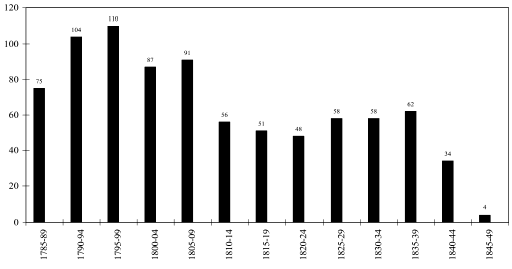
In figure 1, which represents duels reported in The Times, I have excluded those reports subsequently shown to have been false or else so replete with stock comic motifs that I feel confident in regarding them as apocryphal; that is to say, duels where the parties or seconds are not named and where the tale is clearly related in a comic fashion. Duels occurring between foreign nationals within Britain are included. The first thing to note is that the graph seems to indicate that dueling was more common during the Napoleonic Wars than either before or thereafter. However, Simpson has contended that “there is no apparent link between dueling and the influence of war. It underwent no marked period of increase or decline during or immediately after the Napoleonic Wars, and cannot therefore be explained as a generalised consequence of war induced violence.”Footnote 11
—Duels of British subjects reported in The Times, 1785–1849
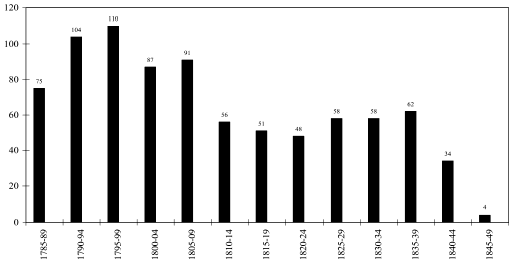
This is a contention that is not sustainable, for when one examines the geographic distribution of duels during the wars with France, one observes a very close correlation between the distribution of fleets and garrisons around the country and the incidence of dueling. For example, by separating out twelve major military ports one can observe that between 1790 and 1815 there were thirty-nine reported duels at those ports but between 1815 and 1840 only five.Footnote 12 Almost all those duels were the product of military quarrels. This fact was reflected in the proportion of duelists who can be identified as having held military rank. My analysis of The Times reports identified some 63 percent of the duelists who fought between 1795 and 1799 as having possessed a military rank, but the figure for the period from 1820 to 1824 falls to only 52 percent, and for the period from 1824 to 1844, the figure is but 31 percent. Upon commonsense reasoning, it would indeed have been remarkable if the induction of young men into a life of violence, the rapid dispersal of weapons training, and the stresses of war had not resulted in an increase in challenges and duels. As it is, the evidence from the reports seems unequivocal: during the war there were more duels, and, in them, military officers were particularly prominent.
After 1815 the numbers declined, but the presence of the armies of occupation occasioned not a few duels. Sieveking reports that after Waterloo and the occupation of Paris, French officers intent on a restoration of national honor would seek out British officers and provoke them into duels.Footnote 13 There were at least twelve duels fought on the Continent between 1815 and 1819 by officers serving in the army of occupation in France and Belgium. In his memoirs, Captain Gronow records duels in 1815 between French and British officers in Paris, Lyon, Boulogne, and Beauvais.Footnote 14
A high percentage of duels during the Napoleonic Wars were fought by military officers because a larger proportion of gentlemen held commissions during that period. In addition, it seems that military life was peculiarly productive of the types of disputes that lead to duels. The late Georgian elite were both competitive and jealous over honors and promotions. Disputes were at least as likely to arise among officers of the same mess as between officers from different units. In military service it was impossible to not requite a slur, and there were many cases of officers who had failed to respond to an insult appropriately being ostracized by fellow officers or even dismissed from their ships or regiments.Footnote 15 William Douglas remarked that army regulations prohibiting dueling “were rendered completely unavailing by long-established custom, and merely caused a mock kind of concealment, which, but for the dangers underlying it, would have been ludicrous. When, for instance, an officer was wounded in a duel, it was represented to the authorities—although every man in the corps knew otherwise—that he had sprained his ankle or broken his leg; and when one of the combatants fell, it was only put down to disease.”Footnote 16
Douglas recalled a young ensign of the 173rd Regiment in India in 1842. Having drunkenly disagreed with a notorious marksman, he was foolish enough to sign an apology for his conduct. Thereafter no one in the regiment would associate with him until he had issued a challenge. He eventually did so but was killed at the first fire. The Poonah Gazette announced that he had died, “suddenly of cholera, in the officer's lines,” and the regimental doctor supplied a death certificate to that effect.Footnote 17 Deaths at home were investigated by a coroner's inquest, but the implication of Douglas's account is that there may have been many more duels in the services abroad than we can hope to identify.
The substantial, perhaps even fundamental, role that military officers played in sustaining the duel is apparent. Sometimes, though, it was civilians with whom they dueled, and some civilian gentlemen also dueled among themselves. The term “gentleman” is a broad one applied in various contexts to the very bluest of landed aristocrats or to the merest of provincial clerks with pretensions. However, by examining the geographic distribution of duels in England as reported in The Times, we can learn quite a lot about the type of gentleman who might fight a duel. I have identified the location of 413 duels fought in England. Of these more than half, 213, were fought in London or within twenty miles (London quarrels were often settled by riding out to the country). Yet London, in 1800, for example, comprised only 11 percent of the total population.Footnote 18 The disproportionate role that London life played in sustaining dueling supports the impression gleaned from the London diaries of Lord Lennox, Scrope Davies, and others that the practice was to a degree fashionable among the young, well-connected, and often riotous metropolitan elite who frequented London coffeehouses. It may have been this particular social milieu, or it may have been the sheer competitiveness of life in London, that led to a greater incidence of those types of dispute that might end in a duel. By contrast, though, The Times reported few duels from the ten largest provincial towns.Footnote 19 Manchester scarcely figures at all in the reports, nor Birmingham, Leeds, or Sheffield. Duels then were exceedingly rare in the newer centers of manufacture, but there were duels reported from the older coastal towns, such as Liverpool, Norwich, Bristol, and Plymouth. Although this study confines itself to the English gentleman, I note that very few duels were attested in Wales. The largest concentration was at Haverford West, a troop embarkation port for Ireland.
The objection might be raised, though, that perhaps The Times was ignorant of, or simply chose not to report, many encounters that occurred outside London. To investigate whether such might have been the case, I have read eight years of newspapers from Manchester, Bristol, and Portsmouth, beginning in 1800, moving on to 1805, 1810, and so on, until 1840. In Manchester, the Manchester Mercury and the later Manchester Guardian reported only twenty-four duels over the eight years considered.Footnote 20 Eighteen of those duels (75 percent) were also noticed by The Times. Significantly, none of the duels reported took place in or near Manchester.Footnote 21 The Mercury and the Guardian noticed some of the duels occurring in London and abroad, and therefore it seems unlikely that editors would have ignored local encounters had they known of them. The Bristol Gazette reported local events throughout its wide distribution area of the West Country and South Wales but failed in those eight years to notice a single duel not reported by The Times.Footnote 22 However, when it came to using Portsmouth newspapers that were particularly connected to the military, I discovered reports of sixty-four duels between 1800 and 1840, of which The Times noticed forty-two.Footnote 23 Many of the twenty-two reports that failed to find mention in The Times involved military officers.Footnote 24 Only four of the duels omitted from The Times actually took place in Hampshire, and significantly they all involved military officers and occurred during the period 1800–1815.Footnote 25 None of the aforementioned newspapers suggests the existence of a substantial reservoir of civilian duels that escaped the attention of the best source, The Times. The comparative dearth of newspaper reports concerning provincial duels, especially in the new manufacturing towns, is further confirmed by the fact that there are few references to such duels contained in the erratic indexes to local and regional newspapers available in the British Newspaper Library.Footnote 26 Provincial newspapers were interested in dueling, for they reported encounters in London and abroad; they simply had comparatively few duels to report from their own localities.
Nevertheless, there were some duels occurring in the counties, and by supplementing newspaper evidence with archival material one can observe that such duels were mainly fought by large-landed proprietors, men of the class that provided the local justices and led the militia. To study such duels is to study exceptions where the normal discourse between gentlemen had broken down. Whatever romantic memoirs may suggest, a vibrant social gathering did not invariably conclude in a bloodbath. Such, of course, was quite as true of metropolitan life as of county living. However, it may be that the comparative dearth of duels outside London can be particularly explained by realities of landed power.
Many honor disputes arose as struggles over social image, induced by events calling status into question. Parties were often induced to take the field because the only way they could succeed in restoring their social image was by hazarding their life. However, where an individual exerted substantial control over the society around him, or where he was part of a controlling group displaying mutual solidarity, he was better equipped to resist attempts to impugn him. Social attacks were simply of lesser significance where one had the power to resist their implications. Country society was often rather intimate; there a limited number of gentlemen exerted a degree of control more comprehensive than that possible in London. Where power so self-evidently existed, it was often concealed; it did not need to be articulated. Whatever theorists might suggest, rural magnates did not feel obliged to offer satisfaction to a person who purported to be a gentleman. Such men had power to control the interpretations placed by society upon their acts; they did not need to fear rival interpretations espoused by the disadvantaged.
An 1822 case from Queenborough illustrates my point. The Queenborough Corporation had attempted to sell the town's oyster fishery against the wishes of the burgesses, who, as mere fishermen, were dependent upon this resource. The burgesses had appealed to the courts. However, in April 1822, Thomas Greet, JP, the head of the corporation, began the criminal prosecution of John Jones, the representative of the burgesses, accusing Jones of challenging him to a duel. However, Jones had merely been responding to a challenge that had already been issued by Greet.Footnote 27 Both had committed the same misdemeanor, but the matter did not touch Greet, for Greet's fellow JP would not entertain a complaint by the burgesses against him. Rather, Jones was imprisoned upon such sureties that were impossible for any burgess to meet; he was only released once he had signed a letter admitting responsibility for the challenge and repudiating it. By comparison with customary dealing, he was treated with exceptional severity, for even after an actual duel, detention was rarely resorted to unless there had been a fatality. A highly effective demonstration of local social power, though, had served to quash his false sensibilities of equality.
The Queenborough case illustrates a more general point as well. When one examines evidence of dueling in the counties, one does not meet with contests between men of such disparities of status such as one finds in military life, where a mere ensign might successfully challenge a colonel. The duels in the counties seem to have been between men more nearly socially equal, and when such duels are examined, common causes frequently emerge: contests over borough politics, disputes over property and sporting rights, and arguments over the conduct of the local militia.
In 1770 Thomas de Grey of the Manor of Merton and William Tooke of the neighboring Manor of Thompson quarreled. Tooke threatened to prosecute de Grey for having constructed a sheep walk that trespassed on his land. De Grey responded:
Sir, you will consider, I am not only member for the county, but an Officer under Lord Townshend; whatever may be my own opinion upon this subject, I must not hear an Insult. To your court I will not come. … If you will stay until I can come out of the house to examine only the respectable part of the Parish and such evidence as may be credited and they say there has been an encroachment, the Poles shall be removed; but I will not be bound by the Rabble, such as you treat at alehouses. … If you cast down the poles by violence, or hire the Mob, I will consider it as a personal Insult, and a Gentleman shall wait upon you for this purpose.Footnote 28
It is important that de Grey referred to his status as militia officer when describing himself as one who must not hear an insult. Militia officers were bound by the same constraints of honor as professionals and accounted for a goodly proportion of the county duels.Footnote 29 De Grey also referred to Tooke's association with the rabble or mob, which presumably reflects a difference of political affiliation. Yet, in view of the continual differences in matters of property, it seems unlikely that the challenge was politically motivated. Similarly, Thomas Greet had referred to the burgesses at Queenborough as radicals, but the challenge was in truth issued in the context of a bitter dispute over fishing rights. John Sainsbury has, to my mind somewhat unconvincingly, asserted that John Wilkes adopted the duel as a tool of political campaigning, but it seems clear at least that thereafter dueling was rarely resorted to as a calculated political act.Footnote 30 What one does observe is that, in the hurly-burly of electioneering, the passion of campaigning did inspire challenges that were, in that sense, political. William Peel challenged the election agent of Sir Charles Townshend following the Tamworth election of 1818.Footnote 31 A Captain Barrie challenged the Whig candidate at Preston in 1826, and Sir Thomas Hastings challenged Richard Cobden in Manchester in 1850.Footnote 32 Most of these challenges were ignored, but Sir James Egerton and Viscount Belgrave met after the Chester elections in 1818.Footnote 33
Duels in the shires and the country towns were mainly fought by large-landed magnates, and there is little evidence to suggest that the duel had much currency among the farmers and the small parochial elites. At Bletchingly in Sussex in 1810, a group of regimental officers quarreled with local farmers who had forbidden them to hunt upon their land. When the local magistrate took the part of the regiment and invited the farmers’ leader to duel with the regiment's colonel, he received the scornful response from the farmer that he had a family but he would fight the colonel with horsewhips.Footnote 34 When the Hereford Times reported a duel at Brecon in 1837, it was able to declare that it had “caused a great sensation in this town, such a circumstance not having occurred for a great number of years.”Footnote 35
Dueling then was rare in the shires and county towns, and after the end of the French wars the incidence of dueling declined to levels from which it never fully recovered. However, returning to Figure 1, there is some evidence of a modest revival between about 1825 and 1835. The Times reported an increased number of encounters and so too the Hampshire Telegraph. In 1830 the Telegraph had reported five encounters; in 1835 it reported six. Furthermore, if one examines the data gathered by Cockburn from the indictments and coroners’ inquests in the assize files for Kent, one sees that the percentage of homicides by shooting declined significantly after 1810, only to revive somewhat by 1820, before declining to become a very rare occurrence after 1840.Footnote 36 Of course, the data encompass different classes of shooting, but it is interesting that the apparent decline in the use of firearms in Kent coincides with the decline in the frequency of dueling, and indeed the incidence of such shootings declines to almost nothing at around the same time as the duel expires.
If there were indeed such a revival, one may wonder whether it was caused by a modest increase in dueling among the traditional groups or whether it was caused by new groups adopting the duel. The latter would fit rather well with Simpson's hypothesis that as the duel moved toward its demise, middle-class “dandelions” were increasingly intruding upon the field of honor. Local newspapers do not imply that dueling ever became fashionable among traditional groups in the shires. One obvious place, therefore, to look for such “dandelions” would be among the new emerging professions, particularly among lawyers and doctors. However, in respect of Irish lawyers, Kelly has surveyed already the numbers dueling in Ireland during the period from 1761–1810, and his conclusion was that lawyerly dueling in Ireland reached its peak much earlier, between 1786 and 1790.Footnote 37 My examination of English dueling suggests that in England the peak was between 1790 and 1794.Footnote 38 It seems that the lawyers had a penchant for dueling toward the end of the eighteenth century but that this soon dissipated in both England and Ireland. English lawyers very occasionally dueled, but they were certainly not prominent among the duelists of the nineteenth century.
The case of the doctors is rather different. When The Times in 1829 chose to present a whimsical view of the contemporary duelist, it typified him not as a lawyer but as a medical lad in his teens. Indeed, the very last duel The Times reported from Scotland in 1840 was between two medical students who went into an Edinburgh park with three others and fought.Footnote 39 That year a Scottish doctor and a surgeon had exchanged four fruitless shots over the right to claim credit for an anatomical discovery. The Times does not report if each had hoped to demonstrate their discovery upon the cadaver of the other.Footnote 40The Times also records an anecdote, quite possibly apocryphal, that two doctors fought with lancets in 1841 and more reliably that a surgeon fought a regimental captain in Mauritius in 1843.Footnote 41 It seems that doctors were rather slower to adopt dueling than their legal counterparts and that among at least some of the medical fraternity dueling was fashionable right up until the moment of its final demise. How did the medical profession become inculcated with the values of the duel? It is impossible to know for sure, but it seems probable that military service was important in this regard. Of eight doctors who dueled between 1800 and 1804, each was serving as a military surgeon.
In summary then, looking at civilian duels in rural England shows that there were few duelists and that they were predominantly drawn from the county leaders, the men who also commanded the militia and held the magistracy. These duelists were supplemented to an extent by retired officers and by a small number of professionals who had gained their qualifications and values in the metropolitan environment. There is little evidence that their values had spread to those of the substantial farming class. Ensigns might duel, even apothecaries, but rarely farmers. Substantially more duels were fought in and around the metropolis by those in the small but riotous society of young bucks, and such men also carried some duels out into the countryside as they followed the races and other sporting events. Even within London however, dueling remained, I believe, characteristic of only a limited section of society. When Bell, a city merchant, was indicted for issuing a challenge, Justice Le Blanc remarked that the high honor of London merchants “had never caused any of the merchants to stand in a disgraceful situation on that floor to receive the judgement of the court.”Footnote 42 Perhaps most important of all was the fact that the duel does not appear to have penetrated into the new or rapidly expanding towns of manufacture, and overall there is evidence of only the most modest appearance of “dandelions” upon the field of honor. Indeed, Grantley Berkeley, in declining an invitation to join the Anti-Dueling Association in 1845, precisely regretted that the penumbra of the duel had not been socially extended to the entrepreneurial orders. He lamented the hardship of “a man having an undoubted source of income from trade being considered as one having no claim except by statute law upon the protection of society.”Footnote 43
By 1830 the duelist was in fact a rare and rather exotic figure. That is not to say, however, that an interest in dueling was not displayed that was out of proportion to its actual incidence in society. Dueling in the 1820s seemed to attract a great deal of public interest, much of it pejorative. There remained, though, a constituency of gentlemen who, although they had no personal experience of the duel, nevertheless admired the duelist and included the possibility of dueling among the list of attributes by which they defined themselves as gentlemen. Indeed, honor culture was dependent upon the approbation of such men. For a duelist the receptive audience was quite as important as the ready opponent, and, without that audience, the rhetoric of honor was in vain. Dueling could endure only so long as the notions of honor that it espoused conformed to an accepted model of what it was to be an appropriate male in society. It could hardly, then, remain unaffected by the fact that during this period notions of appropriate masculinity fundamentally changed.
The Duelist and the Changing Faces of Masculinity
Commentators on honor argued in the late eighteenth and early nineteenth centuries that no gentleman was appropriately masculine unless he accepted the tenets of honor. All gentlemen had to be prepared to assert their privileges and to defend them to the point of hazarding their lives. Such theorists espoused a Hobbesian view that the state of nature was but a “chaos of violence.” The duel was to be justified both as a controlled mode of resolution, absent which men would indiscriminately war upon each other, and as a putative sanction that served to deter men from unwarranted trespass upon the interests of others. In no small measure, though, the views of honor theorists were self-fulfilling. Much as they professed to regret the necessity of the duel, it was their view of the operation of society that did much to foster the types of disputes that led to duels and did much to prevent them being peaceably resolved.
No complex society can function without a degree of compromise, but it was not always easy to persuade men to compromise when they had been educated to be continually anxious about their honor and their manliness. Anxiety played a most important role in honor society; the honorable gentleman had to constantly question both his own conduct and the conduct of others. Had others behaved toward him as they should; had he behaved toward them as he should? Had he been slighted; had he not? If so, how should he respond; what forms were appropriate? Could he conciliate; how might that be interpreted; what would be the proper form? According to Connell any form of masculinity “is never fully possessed, but must be perpetually achieved, asserted and renegotiated.”Footnote 44 Perhaps that is so, but there are forms of masculine identity that are more stressful to sustain than others. The honorable life necessitated constant self-examination and doubt. At the extreme, some honorable men were unable to feel satisfactorily masculine while at rest; they could only feel appropriately masculine while actively prevailing over the interests of others. Such men were, for obvious reasons, to be avoided, even feared. Other, less troubled men viewed society more equably, but even they had to fear that some inadvertent conduct might make them victims of the obligations of honor. The history of dueling is in no small part a history of men carried on to ends that they did not actively desire because to have acted otherwise would have irreparably damaged their self-image or their social situation. The existence of honor culture was synonymous with a species of social fear.
In a society where courage was an unquestioned virtue, a man could not easily publicly declare that he was taking to the field because he was afraid of the consequences—psychological, social, or material—of not doing so. Within this system of thought and action, however, elements contradicted the central claim of honor culture to be based on courage and appropriate sensibility. The duel could be viewed either as a demonstration of a gentleman's high personal integrity and courage or as the blameworthy consequence of his lack of moral conviction and his slavish addiction to the demands of society. Antidueling campaigners, who were themselves intimate with honor culture, fully recognized this duality. They arrayed their arguments against the duel accordingly. At the higher ethical level, the dictates of Christianity were advanced. Although one may doubt the final effectiveness of the Christian ethical argument in suppressing dueling, at the very least they created a background tone of disapprobation and almost certainly played a role in preventing the spread of dueling into the middling orders. More immediately and practically, abolitionists engaged in a contest of representation with honor theorists, probing the causes of dueling and seeking to expose the frailties on which it was based. Their attempts to attribute specious public courage to private incontinence and cowardice did not demonstrably prevail in the eighteenth century. However, as the utility of the type of martial courage displayed in dueling came to be doubted in the nineteenth century, so the premise that dueling was not based upon true courage at all became more and more persuasive. To explain, though, why this was so, one must look more generally at masculinity and the way in which masculine values came to be reconfigured.
Beginning with the eighteenth century, there were many components of normative masculinity that were derived from entirely different values to those expressed in the duel. Reference to honor was made in many different contexts and with many different nuances, for although here I am reserving the term “honor culture” for that set of mores and attitudes clustered around the duel, no one supposed that his own set of social values made him part of a “dishonorable” culture. Alexandra Shephard has identified normative concepts of manhood in the early modern period as having been informed by courtesy and chivalric literature, which, of course, served to legitimate the duel but also by the biblical and civic traditions that opposed it. Masculine virtues ranged all the way from virtue and liberality, sobriety and thrift, self-mastery and civility, to the spirited antipatriarchal characteristics such as drunkenness and licentiousness. Of the development of masculinity in the sixteenth and seventeenth centuries, she remarks, “What is also striking is the increasing plurality and fluidity of their configuration, informing a diverse range of male identities that existed in tension with each other and with normative expectations.”Footnote 45 This remained the case through the eighteenth century, and Philip Carter, writing of Boswell, declares that “manliness was an essential but also complex and fluid identity, configured differently with respect to the sex, class and nationality of one's companions, and the geographical location and time of day when meetings took place.”Footnote 46
Mediating the relations between appropriately manly men were the values of politeness and sensibility—politeness being “situated in company, in the realm of social interaction and exchange, where it governed the relationship of the self to others. While allowing for differences among selves, politeness was concerned with coordinating, reconciling or integrating them.”Footnote 47 Politeness was not a value-free step toward general civility; rather, as Langford asserts, the values of politeness signified a claim, even a demand, on the part of the relatively well placed to be acknowledged and accommodated. “The politeness of the turn of the seventeenth and eighteenth centuries had helped to provide a means of escape on the part of the well born from the trammels of the even better born.”Footnote 48 Politeness, then, was based upon the recognition of interests and did not stand in contradiction to the values of honor; one protected one's interests, one acknowledged the interests of others, and, for the most part, this prevented conflict.
The difficulty, of course, was that some men who held a particularly Hobbesian view of society were extremely competitive and were unable to accept that one could protect one's own interests while at the same time fully acknowledging the interests of others. Hazlitt characterized such men as social bores, ever anticipating and looking for an insult, every ready to requite an imagined offense, and ever seeking to wrest some form of advantage over their fellows.Footnote 49 Such men gained not a little succor from those facets of the national stereotype that extolled bluff speaking and simplicity in contrast to the supposedly feigned and foreign politeness and sensibility. If, in general, politeness prevailed, nevertheless during this period, sensibility and politeness may indeed have been in something of a retreat. In her study of seventeenth- and eighteenth-century masculinity, Karen Harvey has detected a cyclical pattern that “seems to have brought a revival of older types of manhood, suggesting that the dominance of politeness was relatively short-lived, sandwiched between early modern and nineteenth century ideals that had much in common. … Certainly some things have endured through the move from manhood to masculinity, including a core notion of self-discipline and an (often specifically English) roughness that remained while codes of manners waxed and waned.”Footnote 50
This English roughness was fully reflected in the intense physicality of the English elite, in the modes of their education and in the manner in which they conducted themselves in public space. It also connected them with the broader values of a popular culture that was strongly predicated upon the performance of violent acts. As Grantley Berkeley recollected of the beginning of the nineteenth century, “Nothing was said then of ‘muscular Christianity’[;] the art of self-defence was considered to be as necessary to the education of a gentleman as dancing a minuet or speaking French. It was a rough time, when, if a dispute arose, a word and a blow became a matter of course—the last not infrequently coming first—and men of rank who could rely on their ‘science’ as it was termed, did not shrink from displaying it at the expense of their inferiors, when the latter were insolently aggressive.” Footnote 51
Such a competence, however, was as useful in offense as defense. Lord Lennox reflected that the training of young men in self-defense resulted in “the disgraceful fights that constantly took place in the streets.”Footnote 52 What is striking is the ease with which gentlemen were able to move between a world of polite society and the world of popular living and the dexterity they exhibited in both. Lord Lennox recalled that “wrenching knockers, pulling off bell handles, breaking lamps, smashing chemist's huge coloured bottles, carrying off golden canisters, barber's poles, red boots, cocked hats … flooring Charleys (as the guardians of the night were called) and upsetting their boxes were the fashion of the days that I refer to.”Footnote 53
Honor culture connected the gentleman to a value system based upon “honest violence” that contributed to the appreciation of and formation of the general national character; hence, the sympathy of jurors of lesser social status when judging duelists and the institution from which they were themselves were excluded. More broadly, violent popular performance culture legitimated the notion that disputes must be personally resolved and negated the obligation or impulse to deliver their resolution up to authority. The strength of the duel lay not merely in its espousal by subgroups within the social elites but also in its relation to popular values to which, superficially, it might appear the very antithesis. The capacity to adeptly perform acts of violence was one frame of reference by which young men might define themselves, and young bucks who frequented the coffeehouses displayed an intuitive connection with the rough popular culture around them.
As the period progressed, however, there was an increasing deprecation of popular culture. The intuitive connection between high and low was severed in time. In its place emerged new ideas as to the behavior of the appropriate wellborn male. The process was indeed already underway during the eighteenth century, which according to Tosh was “pivotal in entrenching an entrepreneurial, individualistic masculinity, organised around a punishing work ethic, a compensating validation of the home and a restraint upon physical aggression.”Footnote 54 By the end of the eighteenth century a broad constituency of opinion was forming that urged the suppression of this rough culture, especially if conducted in public space, and that deprecated of many classes of violent acts.
This process of depreciation of violent acts can be observed through the work of Lawrence Stone and the observation that by the end of the eighteenth century men were being imprisoned for assaults that a half a century before would have occasioned no more than a quite modest fine.Footnote 55 Judges were frequently at the head of what might be called progressive opinion, but as Wiener has shown, they struggled to persuade juries that men who had bludgeoned their wives should not escape the capital sentence on the pretext of a slight provocation or undue intoxication.Footnote 56
The public, though, long inured to the sight of violence, was gradually being weaned away from it. I have written elsewhere about the reformation of London's public space and its importance in reconfiguring punishment: the end of the Tyburn procession; the disappearance of the pillory and the gibbet; the decline and final abolition of public whipping; reappropriated public spaces for transit, business, and well-ordered leisure;Footnote 57 so too the displacement of blood sports. Public space, in short, became space where one did not, or should not, commit violent acts, and this made violence, and gentlemen were particularly sensitive to this, quite simply inappropriate.
For duelists, one immediate practical consequence followed. As Robert Shoemaker has suggested, the public at large became increasingly willing to intervene to prevent the conduct of duels, either physically preventing them themselves or else summoning the magistrate and the new police.Footnote 58 Duels became physically marginalized, conducted at dawn away from prying eyes. When so much of the duel was sustained by symbolic acts, the increasingly furtive nature of such affairs sent out a message of its own.
More importantly, the changing physical environment began to change the mental environment of gentlemen. Assertive physicality had perhaps been a matter of a certain cultural choice but had also been one of necessity in the face of insolence from lower orders and the aggressive intentions of one's peers. However, the reformation of public space prioritized interests—the interests, of course, of the better orders. With lighting, paving, and policing came a society in which gentlemen no longer had to anticipate conflict as they attempted to move through public space, they no longer had to rely upon their fists to quell their inferiors, and as they traveled they no longer furrowed their brows and dared anyone to defy them.
This affected not merely the way that gentlemen interacted with their inferiors but also in time the way that they interacted with their equals. Spirit, hitherto approved, even extolled, began to seem but self-indulgence and immaturity when judged against the new expectations of continence and decorum. The declining temperature of public life steadily, if indirectly, served to undermine the claim that honor theorists had long advanced to support their cause—that the duel or the possibility of dueling had a real social utility. Something of a virtuous circle developed. As a smaller and smaller proportion of gentlemen dueled, so the need for a gentleman to be psychologically and constitutionally prepared for a possible duel declined, and, in turn, as fewer gentlemen began to display the acute sensibilities of those prepared for the duel, so fewer challenges and actual duels resulted. It became increasingly difficult to sustain the argument that without the fear of a challenge and its consequences, gentlemen would take unrestrained advantage of each other and civil society would dissolve. It became clear that civic peace could be entirely sustained without the duel. The value hitherto attributed to physical prowess and to ostentatious courage declined, eventually to a point where it became possible to sustain one's reputation without either. As Robert Connell simply observes, “Mr Gladstone did not fight duels or lead armies.”Footnote 59
However, dangers to society might come from without as well as from within. Linda Colley has declared that the English are a nation that has defined itself largely through fighting.Footnote 60 A particular success of honor culture had been that it had early associated itself with a whole nexus of attitudes about martial culture and national military prowess. Honor theorists had taken a mode of behavior that had clearly been of foreign import, assimilated it to the national stereotype, claimed it for their own, and then used its existence as evidence of an innate superiority over other nations. Dueling had early become successfully associated with national and particularly martial virility. In 1803, during his trial for killing in a duel, Captain MacNamara made explicit the connection between appropriate honor and military authority, “I am a Captain of the British navy … to maintain my character in that situation I must be respected. When called upon to lead others into honourable danger, I must not be supposed to be a man who sought safety by submitting to what custom has taught others to consider as a disgrace.”Footnote 61
A generation later civilian society was no longer so impressed by military virtues, and within the military itself constituencies of opinion had formed that began to question whether honor culture was actually synonymous with military virtues at all. In respect of society, developments within the armed forces and in the nature of warfare itself were slowly serving to draw apart the civilian and the soldier or sailor. The age of the amateur gentleman officer was slowly passing. As Tosh puts it, “Military manliness was still at a premium during the Napoleonic Wars, but it rapidly lost ground after 1815. With the abandonment of the duel, the growing professionalism of the armed forces, the exercise of violence became specialised.”Footnote 62 Gentlemen might choose to become specialists in violence, but for those who did not, the expectation that they would have to perform violent acts became greatly diminished. Such civilian gentlemen defined themselves in different ways, and they no longer had reference to martial virtues.
Martial virtues, however, were also changing. The increasing technical complexity of warfare and its sheer scale began to render acts of individual courage of negligible import. In an address against dueling, delivered at Oxford in 1807, John Taylor Allen declared, “The important changes which have, of late years, taken place in military tactics and the ancient mode of warfare, have rendered the plea of utility no longer tenable. The fortune of the field does not now depend upon the exertion of individual warfare; it is from the concentrated efforts of a well-disciplined army; from the bravery and firmness of united battalions, that the fate of battles and empires must now be decided.”Footnote 63
The duelist was a man who fought for himself, a man who could conceive of no greater duty or higher purpose than the maintenance of his own reputation. However, as Gen. Sir Rupert Smith has recently argued, the Napoleonic Wars marked the beginning of the era of “industrial war” during which society's aspirations, accomplishments, and endeavors were to be subsumed into the collective national patriotic struggle.Footnote 64 Under such circumstances men who advanced their own honor ahead of collective purposes could act in ways profoundly harmful to military discipline and the military enterprise. When in 1788 a colonel attempted to discipline junior officers for misbehavior by canceling their leave, the result was a duel in which the colonel was killed.Footnote 65 Colonel Aston was killed in India in 1799 by his second in command on the very eve of his regiment taking the field against Tipoo Sahib.Footnote 66 There were many other lesser cases in which military discipline was compromised by a subordinate officer challenging the authority of his superior.
The potential for the subversion of military discipline had long been appreciated. When in 1789 HRH the Duke of York was obliged to give satisfaction to Lieutenant Colonel Lennox, the officers of the Coldstream Regiment in a meeting of the mess concluded with the utmost delicacy, “that, Lieutenant Colonel Lennox has behaved with courage; but, from the peculiar difficulty of his position, not with judgment.”Footnote 67 Enforcing military law, though, which theoretically at least strongly depreciated dueling, proved difficult when so many officers were imbued with the values of honor culture. It was significant therefore that during the Napoleonic Wars the officer ranks began to be penetrated by men of humble station, men who in time were to regard themselves rather less as gentlemen and more as military professionals.Footnote 68 Such men orientated themselves toward the acquisition of knowledge, viewed themselves with a certain detachment, and espoused the virtues of coherent, consistent endeavor in which they clearly prioritized the functionalist achievement of goals both collectively in the achievement of the military enterprise and personally in the advancement of their situations. In service they were able to exercise personal restraint; in command they expected such to be exercised by others and were constitutionally opposed to the subversion of discipline. As military professionalism advanced, their presence seems to have effected a change in the ethos of military organizations.
As William Hough's Casebook of Court Martials attests, by 1825 courts-martial were disciplining officers for dueling.Footnote 69 In particular, while those who had fought in a duel often had sentences of cashiering remitted, those found guilty of inciting others to duel were likely to be dismissed from service. Others were well aware of the change in attitudes within the services. In 1835, a conman, Thomas Hasker, elicited money from Lord Somerset and the earl of Sandwich by presenting himself as an army officer dismissed for assisting in a duel.Footnote 70 For the ruse to succeed, the tale had to be one that would invite sympathy from his potential victims and yet one which was at the same time plausible. By 1835, then, it was entirely plausible to suggest that a man had lost his commission for dueling, although this was a circumstance that invited gentlemen to offer their commiseration. There were, it appears, by this time, whole regiments in which dueling had become unknown. Sir Henry Hardinge was able to state in Parliament in 1844 that from his own personal knowledge there had not been a single duel fought in the Corps of Artillery at Woolwich for more than twenty-five years.Footnote 71 That same year the Association for the Discouragement of Duelling was founded, and it was able to list senior military figures such as Lieutenant General Orde and Lieutenant General Maitland among its founding members.
There is no doubt that there had always been men who had espoused an entirely different view of the military enterprise to that which had been advanced by Captain MacNamara. Personal conviction had not been powerful enough to prevail against a collective fear of dishonor. However, as warfare advanced to become a “social technique of bureaucratically rationalised violence,” military men were forced to adopt functionalist and calculating mentalities.Footnote 72 Such men no longer indulged their immediate passions, and they calculated the consequences of their acts. Slowly then, the way in which duelists were perceived began to change. Many no longer viewed them as men who had upheld the traditions of their service, the honor of their occupation. They were men who had forgotten their duty of subordination and who had forgotten their obligation to restrain their personal inclinations in order to further the greater cause. In time there formed a distinct and powerful military constituency against dueling, and the presence of such a constituency played its part in severing the connection between dueling and national virility. After the Napoleonic Wars it became increasingly difficult to claim that dueling existed as a species of martial virtue absent which there would be a disastrous decline in military prowess.
Yet the duel stubbornly endured. By the 1830s it had become extremely improbable that any particular gentleman would find himself obliged to duel. The possibility of such a course continued to tantalize, and the construction of many a gentleman's self-identity included a reference to that dueling potentiality. As Graham Dawson suggests, “Masculine identities are lived out in the flesh, but fashioned in the imagination. … An imagined identity is something that has been made up in the positive sense of active creation, but has real effects in the world of everyday relationships. … Representations furnish a repertoire of cultural forms that can be drawn upon in the imagining of lived identities. These may be aspired to rather than ever actually being achieved or achievable. … Imagined identities are shot through with wish-fulfilling fantasies.”Footnote 73
The fantasy of the duel was, and is, a very powerful one; the notion of combat was not easily rejected. The decline of dueling within the military was clearly very significant. However, it is noteworthy that in France and Italy the duel was able to survive in civil society, largely unaided by the military. After the early nineteenth century, it was reinvented as an increasingly stylized form of swordplay wherein aspirations of martial virtue could be satiated while the prospects of death or serious injury were substantially reduced. It remained a very close thing as to whether the duel would survive at all. By 1840 there remained only ten fencing schools in the whole of France.Footnote 74 The full complexities of why it was that critics in England achieved the final success that eluded their Continental counterparts are beyond the scope of a single essay. However, perhaps part of the answer lies in the way that criticism of dueling had evolved in England from the general to the personal and, in effect, from the spiritual to the practical.
Respectability and Ridicule: The Power of Persuasion and Press
Space prevents a rehearsal of all those arguments against dueling that had been propounded by its opponents since the time of Bacon, except to say that they had taken the form by and large of general homilies or pleas for general social reformation. However, the nature of such homilies began to change in the 1830s as antidueling campaigners became more confident, aware that they were at the head of a constituency of opinion that had real social power and could apply significant social sanctions against duelists.
The Times had published editorials both favorable and unfavorable toward dueling, but in 1831 it declined to print any more free copy for duelists whose encounters were “of interest to no one except the parties concerned.” Footnote 75 The newspaper would continue to publish details of the more sensational society duels, but it would no longer uncritically allow its pages to be used as a medium through which duelists might conduct honor disputes or seek publicity.
That dueling was no longer socially advantageous can be illustrated by the private correspondence that passed between two election agents, William Bulwer and William Rous, in 1834.Footnote 76 Both had candidates for the forthcoming Yarmouth election. Rous was horrified to discover that his candidate, Wodehouse, had challenged his opponent, Windham, and that Windham had considered accepting. Rous wrote immediately to Bulwer to declare that Wodehouse had acted “without the knowledge, (as it must be without the approbation) of any man whatsoever.”Footnote 77 He proposed that the two act immediately to publish a joint statement that both men had been reconciled before the intervention of any other party and had no intention of proceeding with the affair. He and Bulwer were agreed upon the “ruinous consequences to the credit of the parties concerned in case the business had not been amicably settled.”Footnote 78 Bulwer and Rous wrote a humble apology to be published on the candidates’ behalf in the local newspapers and instructed their men to say nothing of the affair. The matter was smoothed over with alacrity. In Yarmouth, at least, although a challenge was still a social possibility, it was not to be boasted of and publicized for political capital.
In April 1839 the archdeacon and clergy of Bath placed an advertisement in the Bath Chronicle referring to the conduct of a Bath MP, Lord Powerscourt, in having dueled with Roebuck. The clergy expressed “deep regret that, by a recent duel, your Lordship's sanction should have been given to a practice so injurious to the best interests of society, at variance with the laws of the land, and in direct violation of the precepts of the Gospel.”Footnote 79 The churchmen called upon him to publicly express his remorse. This was both an organized collective act and an expression of confident opinion. This was not a generalized speech from the pulpit to a congregation but rather a direct admonition of the conduct of a named prominent individual. This was circulated throughout society by the ecclesiastical representatives of the diocese within the Powerscourt family's interest. At the same time Powerscourt received deputations from his constituents threatening to withdraw their political support unless he publicly disavowed his actions. The press, so often the tool of the duelist, was now being employed to counter the public face of the culture of honor. What was advanced against the duelist, though, was not merely the claim that he was immoral or unchristian but rather that he was cowardly. He was, in effect, now being challenged upon his own terms. Powerscourt was declared to have “lacked moral courage.”
As previously mentioned, antiduelists had long sought to break the connection between dueling and appropriate virility, to characterize the duel as impelled by fear rather than urged by manly virtue. By the 1830s such a strategy was at last bearing fruit. What was significant about Powerscourt's response was not that he acknowledged that his conduct had been unethical but that he was prepared to publicly declare that his conduct had been governed by fear rather than by courage or conviction. He acknowledged that his own personal judgment had been suborned by the fear of being called a coward and accepted the supposition that weakness and not strength had been the source of his conduct. “My own opinion upon the subject of dueling coincides with that expressed in your address. … I do not however, urge this either to justify the practice or vindicate myself from an act … which my judgment and conscience must condemn.”Footnote 80
Many who had not supported the duel had nevertheless admired the duelist as a man whose conduct was governed by internal principles that were held higher than life itself. Now they were becoming persuaded that the duelist was in fact but a lightweight social dupe, in the thrall of social practices that were increasingly archaic or peculiar. The duelist was becoming a man of timid and even servile mentality. In 1847 The Times characterized this “old style gentleman” as someone terrorized by rules of behavior that prioritized form over substance. “He may be seen in a stall inside a theatre, but not at a stall outside one. … He may kill a man in a duel, but must not eat peas with his knife. He may thrash a coal heaver but mustn’t ask twice for soup.”Footnote 81
In 1848, however, the new gentleman was shown to be free of the tyranny of such social peccadilloes and had “never proved his cowardice by fighting a duel. … He does not bully his servants or joke with them.”Footnote 82The Times, though, cannot be credited with changing the sensibilities of its readers; it seemed rather to lag behind changes in society, to reflect what had already occurred rather than to lead the way forward. The duel was spent long before these editorials were written. The newspaper was doing little more than acknowledging this and adapting its copy according to the sentiments of subscribers.
The antidueling campaigners had correctly recognized that ethical principles alone were unlikely to prevail against dueling. Courage was to remain a preeminent virtue, and there was no lack of courage in Victorian society. Their success was to relocate true courage elsewhere. They were able to do so because they understood the weaknesses of honor culture, that its dynamics were maintained as much by fear as by courage, and that this could be exploited. Again, though, mere argument might not suffice against those species of men able to resist material or political loss, ignore moral censure, and bear the prospect of pain or punishment. However, campaigners did not depend upon mere rational argument, for they also understood that the very way that honorable men defined themselves made them peculiarly vulnerable to a further and a very particular form of social criticism. Duelists might bear being loathed or lectured and resist being reasoned with or rebuked; few of them could tolerate being laughed at.
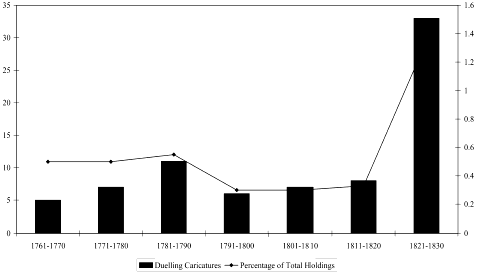
When the duel underwent something of a modest revival in the 1820s, this occasioned in response not merely an increase in antidueling sentiments, sermons, and literature but also a comical and withering counterblast from the popular caricaturists. There was nothing new about the comic portrayal of duelists, and some of these caricatures merely represented the political affiliations of the cartoonist, reflecting nothing more than a partisan desire to attack character. However, others were rather more sophisticated and conveyed general sentiments about the duel itself. A distant gibbet, for example, was a popular augment to the background, reminding the observer of both the illegality of the act and perhaps also causing the observer to reflect sardonically upon the inactivity of the law. By the 1820s those caricatures had become even more savage and more critical of the institution of dueling itself. When Edward Landseer, for example, portrayed two typical duelists in 1827, he depicted them as monkeys gathering under a sign, “Rubbish may be shot here!”Footnote 83 The frequency of mocking depictions of the duel had increased substantially. To get some measure of the manner and frequency with which dueling was depicted in popular caricature, I have surveyed the descriptions of some 14,000 caricatures and prints in the paper catalogs of the British Museum collection.Footnote 84Figure 2 represents, first, the number of depictions, factual or fictional, of duels as recorded in those catalogs for the period from 1750 to 1830. Second, since the holdings are unevenly distributed, it also represents the proportion of images of dueling as a percentage of the total collection holdings for each of the ten years in question. What one observes is that between 1821 and 1830 there was a substantial increase in the number of dueling representations both in absolute terms and as a percentage of the total cataloged holdings. These representations were uniformly hostile to dueling.
—Caricatures in the British Museum collection
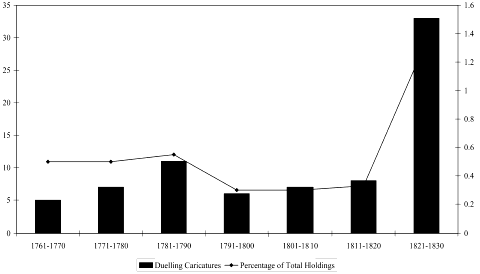
At the same time, then, that the antidueling campaigners were endeavoring, through speech (typically via the sermon) and through print in essays, pamphlets, and advertisements, to break any supposed connection among admirable masculinity, courage, and dueling, the caricaturists were pictorially advancing the attack. The duelists in caricature are not primarily unethical monstrous beings (although they are that as well), for that would not have suited the caricaturists’ purpose. They were rather vain, silly, ludicrous creatures—often cowardly, often fraudulent. When Osea came to the field to fight in 1791, he had declared, “die nobly, die like demi-gods!”Footnote 85 Such a man might be reproached or even hated, but reproach can contain within it a certain grudging admiration; vehement hatred so often serves but to increase the stature of those upon whom it is bestowed. Ridicule, however, deflates and never dignifies; it disenchants absolutely. Ridicule was precisely the right sort of instrument with which to bring such demigods down to earth.
By the 1820s dueling was taking place in a society that was becoming steadily less violent and in the face of an opposition that was growing ever more confident. Slowly that opposition was beginning to prevail in the contest of interpretation and representation. It was successfully representing the duelist as the moral coward and dissipating the aura of the duelist as the exemplar of personal courage. Ridicule played a most important role in this, for men of honor were perhaps more vulnerable to this form of critique than to any other.
The Decadent Duelist and the Crisis of Honor
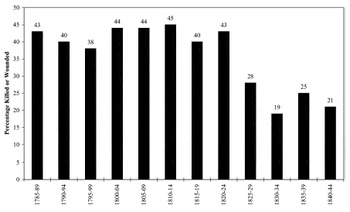
Respectable public attitudes to dueling were changing, but duelists too were part of the respectable public, and changes in sentiment could hardly but affect their own views of what might constitute an appropriate honorable act. As society changed, so, to a degree, did the duel. Men of honor attempted to accommodate themselves to the changing mores of the world around them. One consequence of this was that casualty rates in dueling began to decline somewhat. Simpson calculated that the fatality rate among English duelists during the nineteenth century was some 15 percent. According to my own calculations, between 1785 and 1844 some 277 duelists were reported killed (16.6 percent of the total), and, in addition, 341 were reported wounded, making an average death or injury rate of 37 percent. When one analyzes the figures in more detail, however, as in figure 3, one observes that after 1825 the numbers of duelists who were killed or wounded in their encounters seems to have significantly declined.Footnote 86 According to my own calculations, from 1785 to 1804 some 41 percent of participants were recorded as killed or wounded, from 1805 to 1824 the figure was 43 percent, but from 1825 to 1844 the rate declined to just 23 percent.
—Casualties reported by The Times in British duels, 1785–1844

All things being equal, one would have expected casualty rates to rise for, as time progressed, so too did the power and accuracy of firearms. However, duelists had early adopted a number of conventions that served to negate the full potential of the weaponry available to them. Pistols were to remain smoothbored, parties were expected to raise weapons and fire in one movement without pausing for steady aim, and practice beforehand was frowned upon.Footnote 87 It does not appear, however, that there were any new innovations in the way that the mechanics of the encounters were managed that would account for an actual decline in casualties after 1825. There is, though, a body of rather difficult anecdotal evidence that seems to suggest that the duel was becoming remodeled in such a way as to diminish the dangers of the encounter.
A notable feature of earlier honor codes was that they seemed to offer little opportunity for reconciliation once offense had been given. In part this was to protect the gentlemen concerned from the accusation that fear for their own safety had induced them to make an inappropriate compromise. In 1777 a group of well-known duelists met during an assize held at the town of Clonmel in County Tipperary, Ireland. There they agreed on a code that was intended to govern the conduct of all duels throughout the country. This code was widely reproduced in dueling literature and subsequently became influential in determining the proper form for duels in England and its colonies. The code stipulated that the victim of a blow could accept no verbal apology; he must either strike the other party with a cane or they must both fire at each other until one was hit or until three shots had been exchanged.Footnote 88 Once both parties had arrived at the spot for an intended duel, no apology could be accepted for any type of offense until one party had fired at another. Furthermore, the code was explicit; when a gentleman fired, he had to do so with the genuine intention of hitting his opponent. Under rule 13: “No dumb-shooting or firing in the air admissible in any case. The challenger ought not to have challenged without receiving offence, and the challenged ought to have made an apology before he came on the ground; therefore children's play must be dishonourable on one side or the other, and is accordingly prohibited.”Footnote 89
Were such strict rules actually followed? The case of Jonah Barrington suggests that they were. Barrington was once challenged by Richard Daly, in a case of mistaken identity. Realizing he had challenged the wrong man, Daly proposed on the day to abandon the duel. However, his own second pointed out that honor demanded at least one shot be fired. Barrington kindly obliged by shooting Daly in the chest, although the ball did not penetrate.Footnote 90
Misguided ideas of humanity could not allow a gentleman to evade his obligations. In 1789 a letter from officers of the Coldstream Regiment fiercely criticized an officer who had agreed to a duel but who had then refused to fire at his opponent. “In such a case as this, is not a breach of Promise a breach of Honour? And does a man's public assent to terms which he is Privately determined not to abide by, become an act of duplicity incompatible with the character of an Officer and a Gentleman. … Can he, according to the laws of honour, come into the field under a solemn engagement to fire his pistol on a certain signal, and yet when that signal was given, reserve his fire, and refuse openly to fulfil what he had publically engaged to perform?”Footnote 91 In 1790 Curran complained that his opponent Major Hobart had refused to fire at him. “I am sorry Sir, you have taken this advantage; but you have made it impossible for me not to be satisfied.”Footnote 92 Gentlemen who had deprived their opponents of this elemental courtesy could expect social vilification.
However, by 1839 things had clearly changed. No such criticism was visited upon the Marquis of Londonderry in 1839 when he received the fire of Gratton on Wimbledon Common and terminated the dispute by firing into the air.Footnote 93 That same year, Roebuck behaved in the same fashion having received a shot from Lord Powerscourt, as did Fiske during his meeting with Lord Paget.Footnote 94 Where shots were fired, marksmanship was at a low ebb; Roebuck, Fiske, and Londonderry were not injured, but neither were Lord Loftus nor Lord Harley, who managed to miss each other despite exchanging several salvos at Boulogne.Footnote 95 In some quarters, and I stress some, there had been an adjustment during the period between 1789 and 1839 in the notion of what constituted honorable satisfaction.
Throughout the eighteenth and early nineteenth centuries there had always been some men unwilling to fire at their opponent. For some, this may have been due to reasons of humanity. For some, though, it may have been a matter of calculated self-interest. Suppose one's opponent has fired but has missed. If one returns the fire and hits the opponent, then there may be the possibility of legal consequences, albeit remote. If one misses, then the duel may simply go on to the next exchange of shots; one's life is again in danger. By firing into the air, a gentleman appears humane, he demonstrates his lack of animosity toward his opponent, but he also ensures that his own life is no longer at hazard, assuming, that is, that having refused to fire at the other party, that party returns the compliment by deciding not to fire a second time.
However, it took some time before social convention made the continuation of the meeting after such pacific conduct unconscionable. In October 1803 a Mr. B. and a Mr. H. met on Hampstead Heath. Mr. H. apologized for an offense given, but his opponent would not accept his apology. Mr. B. fired, and Mr. H. responded by firing in the air, but Mr. B. insisted on firing again. His ball passed through Mr. H.'s hat, and Mr. H. again responded by firing into the air. Mr. B. merely declared that he still was not satisfied and shot again. Mr. H. again shot into the air, and the parties left the ground without being reconciled.Footnote 96 The attitude of the pugnacious Mr. B. is not as significant as the fact that at this point in time neither of the seconds felt that the action of Mr. H. obliged them to intervene. Similarly, when in October 1805 at an exchange of shots the offending party was observed to fire into the air, the seconds merely asked his opponent if he were now satisfied. He, however, declared that he was not, and each fired again in earnest, this time wounding each other.Footnote 97
Why did the seconds not intervene in such circumstances; were they indeed so determined for blood? The answer, I think, is that they were not, but both they and the authors of the Clonmel Code possessed a rather more sophisticated understanding of the mechanisms of the duel than most modern scholars. The authors of the Clonmel Code had identified a potential threat to dueling that might unravel the institution itself. The problem was both specific and general. Specifically, the problem was one of individual vindication; more generally, what would happen to the duel if the refusal to return fire became a more frequent occurrence?
For honorable men the duel was not a system of adjudication or reparation; rather, it existed as a mechanism to expunge the stain upon one's honor cast by a scurrilous act or insult. Restoration of honor was to be achieved by a display of compensatory courage—not by the firing of shots but by hazarding the danger of receiving them. The danger of the duel cleansed the offended of the consequences of the insult or the blow. Such a system depended, though, on both parties displaying equal determination. If offending parties were to consistently refuse to fire in earnest at their opponents, then the duel would lose its restorative capacity. The party whose honor had been violated would have set little or nothing at hazard by his challenge. Instead, only the offender's courage would be affirmed. True, he may be regarded as having transgressed upon the honor of another, but in a virile society, who would not secretly admire him for doing so? By setting himself at hazard in reparation he would have shown not merely courage but also generosity. For an offended party, however, honor as traditionally formulated would not have been satisfied by the mere act of having fired at his opponent should that opponent not have undertaken to return the courtesy. In such a circumstance the offended party would not have expunged the blow or insult that had been laid upon him. He would have failed to demonstrate that he was worthy to remain in the society of gentlemen.
Yet by the 1820s seconds were routinely interfering to prevent the continuance of duels after the aggrieved fired a single shot. A cynicism about the authenticity of such duels ensued. To resist such cynicism, some parties who had indeed been deeply offended were, somewhat paradoxically to the modern mind, insisting that the parties that had offended them should indeed attempt to kill them in the course of the duel. For example, in 1828 Sir Jacob Astley met a Captain Garth in consequence of his alleged relationship with Astley's wife. Garth received Astley's first fire but refused to return it. This was most unsatisfactory, and the friends of both parties subsequently met to consider “the necessity of Captain Garth's giving his pledge to return the Hon. Baronet's next fire.”Footnote 98
Yet such was by no means a ubiquitous attitude among duelists and their seconds. Some embraced a change in the values of the duel that readjusted the encounter and that increasingly focused on personal recompense as opposed to public expiation. Now the offended party was to be satisfied by the admission of responsibility made by the transgressor, either when he apologized or when he agreed to receive fire. Society, in return, was to respond as if the expression or demonstration of regret or even shame on the part of the offender nullified the stain on the honor of the offended. It was to be as though the mere apologetic will of the transgressor could reestablish the equilibrium between the party he had transgressed against and the rest of society. To critics of such new values, it might appear that this new dueling indeed resembled an exercise in balancing the books, a rationalized system of dueling for shopkeepers. For adherents to the Clonmel Code, the bilateral relationship between parties had been but incidental. The code had been predicated upon the assumption that the offender did not have full power to make restitution to the offended nor was the offended at full liberty to accept offered restitution. The offender might, by taking the field, become the medium through which the honor of the offended party was restored, but he had not had the power to will it, for he had not been endowed with the authority to reestablish serene and honorable relations between the offended party and the society of gentlemen.
There were, of course, plenty of duels post-1825 in which both parties went to the field determined, whatever the formal niceties, to do the utmost harm to each other. Perhaps because of the choice of the medium of the pistol as the instrument of the English duelist, it was never possible to finesse and stylize the duel to the point where most of the inherent risks could be removed. Pistol dueling in England, so long as it existed, never descended to the absurdities of the French duel parodied by Twain nor of the Italian duels reported by Iacopo Gelli, where the fatality rate was as low as half of one percent.Footnote 99 Nevertheless, the increasing number of duels decided by the passage of a single ball threatened to lead to the failure of “necessary ambiguity.”
In terms of the duel's original system of logic, the honor of a man who had been deeply offended could only be restored by danger. There had to be a very real possibility that during the duel the offended party would be fired upon in earnest. Over time this prospect became somewhat ambiguous, but in a sense this merely served to confer the maximum of possible advantages on the offended party. When he challenged, he gained the right of a shot to satisfy his animosity, while at the same time there had developed a considerable likelihood that this opponent would not attempt to kill him in return. His honor was still restored, since he had risked fire, yet the danger of being harmed by such was much diminished. The difficulty of course, was that the likelihood of being hit by return fire might diminish to such a point that society would refuse to accept that one had been in appreciable danger and the social capital hitherto acquired from having dueled would completely dissipate.
This in a sense brings us back to 1829, when the duke of Wellington challenged Winchilsea after the latter slanderously attacked him. On the field Wellington discharged a single shot. He had not aimed to kill his opponent but had fired at his legs. Winchilsea in return had merely discharged into the air. There were plenty of depreciating noises made thereafter from the antidueling fraternity. However, among those who supported the duel, no one dared suggest that Winchilsea should have done the unthinkable and shot down the duke. Similarly, no one dared to suggest that Wellington had failed to demonstrate his courage or rebuked him for not aiming to kill.
Although superficially the outward appearance of the duel remained much the same during the period from 1785 to 1845, for many duelists its internal logic had nevertheless changed. Originally conceptualized as a mode by which a dishonored party could restore his reputation and repay the debt owed to the collective, it had steadily evolved into a system of reparation for fault in which the emphasis lay upon the individual relations between the parties and upon the acknowledgment of fault upon the part of the offender. However, in disturbing the rough equality of hazard that had hitherto been deemed necessary for a meeting of honor, these new duelists risked not merely being ridiculed themselves, but they also came to create insurmountable difficulties for more traditional duelists such as Sir Jacob Astley. Such men had never desired to be killed or maimed, but they had risked this outcome in anticipation that, should they emerge unscathed, then they would garner the appropriate social capital. Such could not be the case, however, in a society that was growing increasingly cynical of specious duels. If one did so emerge, one might merely be confounded by indifference or by the assumption, spoken or unspoken, that one had not really been at hazard in the first place. For men of courage, the advantages of the duel had been first expropriated by others and then fatally diminished. There was no general lack of courage among the elite of the 1840s. Such courage could endure through the horrors of battle, but it could not sustain a duel fought to satisfy society, a society that now so often greeted it with disinterest or even derision.
The duel is still alive and very well today but operating in the realm of the imagination. It is not to be dismissed as a cultural form simply because it does not create a corresponding manifestation in the realm of the real. In England in the eighteenth and nineteenth centuries, the duel existed as a genuine occurrence, a contemporary phenomenon. For some in the military or within a small section of metropolitan society it was yet likely that they knew of someone, of distant or intimate acquaintance, who had dueled. Yet most gentlemen were not intimate with it. Most gentlemen of the first half of the nineteenth century were never challenged and never contemplated issuing a challenge themselves. To them the duel was known through the medium of print or image. These gentlemen may have read of a duel with a sense of thrill or scandal, but certainly by the 1820s the affairs of the duelist must have seemed to them no less distant and fantastical than to our modern eyes are the doings of the small coterie of self-promoters who participate in our celebrity culture.
In truth by the time that the nineteenth century began, the duel had not sufficiently embedded itself in actual social practice to survive the coming changes in the mores of society. There were many gentlemanly groups that were not participating in dueling, and it is small wonder then that it subsequently failed to recommend itself to the new middling classes. As the general population grew, so too the number of gentlemen grew, and the proportion of gentlemen who had direct experience of the duel, never high, dwindled accordingly. By the time that the duke of Wellington took to the field, the duelist was well on his way to becoming a marginalized, somewhat quixotic creature. Furthermore, the encounter in which the duelist hazarded himself had not remained immune to the changes that were happening in the wider society. By 1829 the internal logic and dynamics of dueling had substantially changed, but this was not a successful transformation and hence was resisted within the dueling fraternity itself. That resistance was aroused in no part by the appreciation that the move toward formulaic single-shot encounters merely invited the cynicism that critics of honor culture wished to heap upon the participants. There were many practical reasons why the duel became more and more marginalized in the nineteenth century: the development of functionalist mentalities, notably within the military, clearly played a fundamental role in this. Finally, although society was never fully dispossessed of the notion of the duel as a romantic, even chivalric, encounter, the victory was not to make the actual practice of the duel abhorrent but to make it utterly absurd.