1. Introduction
Nowadays, the main reason for global warming has been recognized as the increase of greenhouse gases (GHGs) concentration and specifically carbon dioxide (CO2). Before the industrial revolution, there was a balance between inflows of GHGs and outflows of carbon absorbed by oceans and plants, but increasing the use of fossil fuels including coal, natural gas and oil is recognized as the main human activity which has changed that balance and led to an increase in CO2 emissions by more than 3 per cent per year on average in the 2000s (Garnaut, Reference Garnaut2011). Figure 1 illustrates the rising dynamics of CO2 concentration between 1959 and 2019.
CO2 concentration (1958–2019).
Notes: The figure displays interpolated data. Original data are the monthly mean CO2 mole fraction determined from daily averages. The mole fraction of CO2, expressed as parts per million (ppm), is defined as the number of molecules of carbon dioxide divided by the number of all molecules in the air, including CO2 itself, after water vapor has been removed.
Source: NOAA Earth System Research Laboratories, ESRL; Data from March 1958 through April 1974 have been obtained by C. David Keeling of the Scripps Institution of Oceanography.

To limit global warming, we need to limit the total cumulative global emissions of CO2.Footnote 1 So, the feasibility and design of mitigation policies have attracted considerable attention.Footnote 2 Policies designed to limit GHGs in fact imply domestic tradeoffs and international externalities, which influence their implementation and lead to both domestic and international conflicts (Böhringer, Reference Böhringer2014; Nordhaus, Reference Nordhaus2015). International cooperation is a significant way to combat global externalities.Footnote 3 In this context, incentives such as the urgency of the climate change problem, technology transfer, agricultural issues, sustainable development, poverty alleviation, and economic benefits and financial supports can motivate both governments and private sectors to participate in an international environmental agreement.Footnote 4 Moreover, the impact of climate policy hugely depends on the policy horizon considered by policymakers (e.g., Schiermeier, Reference Schiermeier2004; Di Bartolomeo et al., Reference Di Bartolomeo, Saltari, Semmler, Dawid and Arifovic2021).
Accounting for the above-described aspects, this paper aims at investigating two quantitative issues. First, we quantify the gains stemming from the internalization of global externalities. Second, we quantify the damage associated with a short-term view of climate policies. To this extent, we adopt an innovative methodology in this field, i.e., non-linear model predictive control. This methodology permits formalizing moving-horizon strategies and considering counterfactuals where policymakers have different policy horizons.
Specifically, we introduce the idea of moving-horizon strategic interaction in the context of environmental economics assuming that, in each instant of time, policymakers can predict the effects of their actions and those of their opponents on a finite moving horizon. The policymakers' problems involve then the repetitive solution of an optimal control problem at each sampling instant in a receding time horizon fashion, but, in each instant of time, policymakers only implement the initial control action. A policy equilibrium consistent with this kind of optimization is introduced. In such an equilibrium, different lengths of the policymakers' time horizons imply different dynamics of the relevant variables. To the best of our knowledge, we are the first to apply predictive control in a policy game in the field of environmental economics.
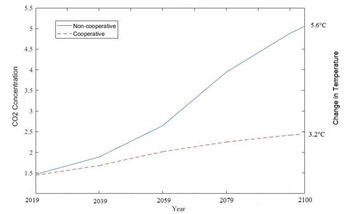
Our findings show that the outcomes associated with non-cooperative strategies are close to the upper bound (worst prediction) of existing forecasts, while coordination is particularly effective in reducing emissions by internalizing the global externalities. In a scenario without international coordination, we predict a level of CO2 concentration that implies an increase in the surface temperature around 5.6°C above the pre-industrial level. Coordination reduces this value by about 2.4°C because of the lower concentration. Our work also has an added value from a methodological point of view. In fact, it introduces the strategic model predictive control approach in the context of environmental economics, i.e., the possibility of considering the relevance of a limited policy horizon in a strategic context. In this respect, we find that even marginal changes in policymakers' horizons have first-order effects in reducing global warming. Consequently, it is important to raise awareness among voters about the issue of emissions in such a way that it can be persistently on the agenda of politicians.
Our paper is related to many studies in the area of environmental economics. A complete review is, however, beyond the scope of the present paper. Here we limit ourselves to mentioning the main references for our specific purposes.Footnote 5
We built on games that compare individual emission levels generated by polluters acting non-cooperatively with the cooperative solution (among others, Dockner and Van Long, Reference Dockner and Van Long1993; Wirl, Reference Wirl2007; Nkuiya and Plantinga, Reference Nkuiya and Plantinga2021). Such papers methodologically differ with respect to our work in two ways. (i) In such papers, the planning horizon is infinite, while we assume a finite moving-horizon planning. (ii) Our cooperative solution is derived by maximizing the net present value of the product of individual utility flows from pollution emissions (Nash product). Instead, in those papers, the cooperative solution is derived by maximizing the net present value of the sum of individual utility flows from pollution emissions. The main novelty of our approach is that of generalizing the planning horizon allowing moving-horizon strategies and thus, qualitatively, allowing us to consider different degrees of myopia or political constraints.
We follow a traditional approach that integrates the economic activity and the climate system to evaluate the effect of mitigation policies on GHG emissions (integrated assessment models).Footnote 6 Among these, the most related are those considering ‘different nations’ as environmental policymakers and different scenarios, e.g., non-cooperative versus cooperative (cf., among others, Nordhaus and Yang, Reference Nordhaus and Yang1996; Tol, Reference Tol1997; Semmler et al., Reference Semmler, Maurer, Bonen, Feichtinger, Kovacevic and Tragler2018).Footnote 7
In the above perspective, we use as a benchmark for comparison, the results obtained from the Regional Integrated model of Climate and the Economy (RICE) developed by Nordhaus and Yang (Reference Nordhaus and Yang1996). Our theoretical framework is instead largely based on Greiner and Semmler (Reference Greiner and Semmler2005) and Greiner et al. (Reference Greiner, Gruene and Semmler2014). The former studies the effects of emission tax rates on global warming and economic activities. The latter considers the transition of an economy from non-renewable to renewable energy. However, both papers use a non-linear model predictive approach to approximate an optimal control solution in a single-player setup. By contrast, we use model predictive control to formalize moving horizon strategic interactions between several policymakers and we do not aim to approximate an open-loop or feedback Nash equilibrium.
In terms of methodology, the paper is related to the literature on model predictive control, which is experiencing a growing interest in economics (Grüne et al., Reference Grüne, Semmler and Stieler2015). We augment an integrated assessment model with policy time horizons in the fashion of Wong et al. (Reference Wong, Chuah and Hope2015), who investigate the impact of changing the policy horizon specification dynamics of concentration of carbon dioxide. They capture the effects of a different time horizon indirectly by considering different effects on the social cost of carbon dioxide. Instead, we directly formalized the policy horizon by introducing model predictive control techniques. We are thus indebted to some studies that adopt model predictive control methodology to strategic interactions, focusing on public debt dynamics (Van den Broek, Reference Van den Broek2002; Saltari et al., Reference Saltari, Di Bartolomeo and Semmler2022). We borrow the concept of policy equilibrium from the latterFootnote 8 and interpret it along the lines of Di Bartolomeo et al. (Reference Di Bartolomeo, Di Pietro, Saltari and Semmler2018) by using a traditional public choice view.
The remainder of the paper is organized as follows. Section 2 describes our model and the equilibrium concept used to solve the policy game. Section 3 presents our results. Section 4 concludes.
2. The model and the equilibrium concept
We formalize a simple global public good game between two countries (or two coalitions of countries). Each faces a domestic tradeoff between boosting economic activities and limiting the use of fossil fuels, which leads to changes in climate on Earth, which is a global public good. The novelty of our paper is the equilibrium concept used to solve it. As said, we consider strategic interactions where the policymakers optimize according to a rolling horizon scheme that periodically updates input data information.
To grasp the intuition, consider policymakers who interact strategically along a defined fixed policy horizon (e.g., 20 years). In 2022, each calculates its optimal policy by considering the reaction of the other along this fixed horizon (2022–2042). The derived optimal policies (open-loop Nash equilibrium) are however implemented only for the first period (2022). In the second (2023), optimal policies are recalculated by considering the same fixed time horizon which, however, is now moved forward by a period (e.g., 2023–2043). Again, only the first period (2023) policy is implemented. The same is applied in the following periods. Along the lines of Di Bartolomeo et al. (Reference Di Bartolomeo, Di Pietro, Saltari and Semmler2018), by using a public choice view which goes back to Buchanan and Stubblebine (Reference Buchanan, Stubblebine and Gopalakrishnan1962), we interpret this concept of equilibrium as the result of myopia or limited rationality. It is worth noting that our equilibrium does not lead to a time-consistent solution. However, we exactly aim at modelling institutions as ‘players’ with bounded rationality in a Herbert Simon fashion.Footnote 9
Formally, the use of non-renewable energy in country $i \in \{{1,2} \}$ $({x_i}(t))$
 leads to an increase of CO2 global concentration $(g(t))$
 , i.e.,Footnote 10

where $\mu \in ({0,1} )$ is the inverse of the atmospheric lifetime of CO2; $\beta \in ({0,1} )$
 gives that portion of CO2 that is not absorbed by oceans.
Both policymakers, operating in our economy, aim to maximize the net social benefits. Social preferences are captured by a simple instantaneous utility function of the class of those used by, e.g., Greiner et al. (Reference Greiner, Gruene and Semmler2014):Footnote 11

where $\bar{g}$ is the pre-industrial level of CO2 concentration; $\gamma > 0$
 is the (dis)utility of the CO2 concentration exceeding the pre-industrial level, i.e., $\gamma$
 expresses the effect of disutility (or the disaster effects) on our well-being; $\sigma > 0$
 is the inverse inter-temporal elasticity of substitution of consumption between two points in time.Footnote 12
The policymakers aim at choosing a level of emissions that maximizes net social benefits along with considering the CO2 concentration. In this respect, following the lines of model predictive control, at each instant of time, policymakers determine their optimal policies for a policy horizon of finite length. However, they only implement the initial control action. We then define as policy equilibrium, a situation where, at every instant of time, each policymaker has no incentive to vary its decision given that of the other.Footnote 13 Hence, our equilibrium solution is a sequence of open-loop Nash equilibria, where, in each instant of time, policymakers only implement the first-period control.
The solution involving non-linear model predictive control can be formally described as follows. In each instant of time $t \in \mathbb{R}_0^ +$ , given the policy of the opponent j, each policymaker i solves the following problem:

s.t. equation (1) and $g(0 )= {g_t}$ .
The above-described problem involves the repetitive solution of an optimal control problem at each sampling instant in a receding horizon fashion. The length T defines the agent's policy horizon.
In each instant of time $t \in \mathbb{R}_0^ +$ , the simultaneous solution of problem (3) for both agents provides a tuple $\{{{x_1}(t ),\; {x_2}(t )} \}$
 .Footnote 14 The set of all the tuples represents our policy equilibrium. It is worth noting that for $T \to \infty$
 , our equilibrium collapses to the Nash open-loop equilibrium. However, strategies based on different policy horizons will lead to different outcomes.
We also introduce a different policy equilibrium, where the idea of policy horizon is kept, but externalities are internalized by international coordination. We solve a problem like (3), where ${x_1}$ and ${x_2}$
 are set to jointly maximize the following Nash product:

where $\omega$ and $1 - \omega \;$
 measure policymakers' relative bargaining powers. In the simulation, we assume an equal bargaining power, i.e., $\omega = 1/2$
 .
3. Results
3.1 Calibration
The model is calibrated to match the observed path of CO2 concentration between 1959 and 2019. The simulation starts by assuming $g(0 )= 1.128$ (which is equal to 315.97 ppm) and ends in 2019 with CO2 concentration equal to 1.47 (411.44 ppm). The inverse of the atmospheric lifetime of CO2 ($\mu$
 ) is fixed at 0.1 and the part of CO2 that is not taken up by oceans ($\beta$
 ) is set to 0.5 (unit of both parameters are in percentage).Footnote 15 According to the IPCC data, the pre-industrial level of CO2 concentration is considered around 280 ppm, which is normalized to one (i.e., $\bar{g}$
 = 1). We fix $\sigma = 1$
 , i.e., the utility function is logarithmic in consumption and pollution. We introduce a small heterogeneity in the disutility $\gamma$
 to avoid symmetrical solutions that may ‘hide’ some potentially relevant effects. In one of the two countries we consider a value for $\gamma$
 that is about 5 per cent lower than that assumed in the other. The time horizon is fixed at $3$
 .Footnote 16 The discount factor is $\rho = 0.03$
 . The value for the disutility is fixed to match the observed data, i.e., $\gamma = 2.5$
 .
Figure 2 reports the implied dynamics, i.e., the evolution of CO2 concentration (left scale) and of the global mean temperature (right scale).Footnote 17 The curve fits observed data of CO2 concentration and temperature.Footnote 18 For the sake of brevity, we do not plot the time series of the observed data, but, as examples, we report observed values in 1989 and 2004. Levels of CO2 concentration in 1989 and 2004 were equal to 353.20 ppm and 377.7 ppm (normalized they are equal to 1.26 and 1.34), respectively.Footnote 19
CO2 concentration and global mean surface temperature (1959–2019).

3.2 Noncooperative and cooperative solution
This section presents the predictions obtained in two different scenarios. In the first, our calibration is projected forward by assuming that policymakers do not internalize international externalities (baseline scenario). The second is characterized by a solution implied by a credible coordination on a global level. Formally, in the first scenario we solve problem (3) assuming the policymakers maximize (2), while in the second we assume that they aim to maximize (4). Solutions are obtained by using numerical simulations based on the tools described in Grüne et al. (Reference Grüne, Semmler and Stieler2015).Footnote 20
Our results are described in figure 3, which reports the CO2 concentration and its equivalent temperature in the two scenarios during the next 80 years (2019–2100). The numerical analysis starts from 2019, assuming $g(0 )= 1.47$ (411.44 ppm).
CO2 concentration and global mean surface temperature under different scenarios.

As expected, the non-cooperative equilibrium (Scenario 1) leads to a higher level of CO2 concentration compared with the cooperative policy (Scenario 2). In the beginning, there is not a great difference in CO2 concentration for the two policies, but after 2039 we can observe a notable increase in its level under the non-cooperative scenario, which eventually will reach 1456 ppm (5.2 as a normalized form) in 2100. This level of CO2 concentration shows an increase in the surface temperature of around 5.6°C above the pre-industrial level. By contrast, assuming coordinate policies, CO2 concentration reaches 700 ppm (2.5 after our normalization) in 2100, which leads to 3.2°C above pre-industrial temperatures.Footnote 21 Our results fit the large confidence interval individuated by IPCC (Reference Pachauri and Meyer2014). By using about 300 scenarios (i.e., those without additional mitigation), IPCC (Reference Pachauri and Meyer2014) forecast CO2 equivalent concentration levels between 750 ppm and 1,300 ppm in 2100. This implies an increase in the global mean surface temperature in the range of 2.5°C to 7.8°C.
Our results show that although coordination leads to a much lower temperature by the year 2100, more efforts are required to avoid large damages from the CO2 emissions. In this respect it is useful to compare our findings with the results stemming from the RICE model. In 2100, the RICE model predicts lower level of CO2 concentration under both scenarios, i.e., around 753 ppm and 730 ppm under the non-cooperative and cooperative situations, respectively. One reason for this difference could be related to the different information sets assumed, i.e., policymakers' short termism. In the RICE model, Nordhaus and Yang (Reference Nordhaus and Yang1996) look for the Nash equilibrium in a finite game with perfect information. By contrast, here we assume model predictive control to formalize moving horizon strategic interactions between several policymakers. The role of policy horizons will be explored in the next section.
3.3 The relevance of the policy horizon
In this section, we aim to assess the effects of policymakers' time horizons on the CO2 concentration. As we mentioned, policymakers could face political economy constraints incentivizing them to have short-time horizon decisions. The model predictive control is a suitable technique to deal with this issue, since it assumes that the policymaker's problem does not involve the optimization over an entire long-run planning horizon, but it just involves repetitive solutions of dynamic decision problems at each instant of time in a receding horizon fashion. The length of the policymaker's horizon can be considered an exogenous parameter, which describes the political economy constraint by governments (see Di Bartolomeo et al., Reference Di Bartolomeo, Di Pietro, Saltari and Semmler2018). Similarly, considering information costs, the rationale for a shorter horizon can be based on the idea that policymakers need to weigh the short-run cost of information rising with the longer horizon, against the long-run benefits in a sort of ‘rational’ policy myopia.
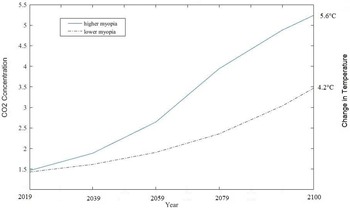
We consider a marginal change in the policy horizon, incrementing it just by one year. Our results are displayed in figure 4, where two different values of the forecasting horizon are considered, labelled as the higher (T = 4) and lower (T = 3) myopia. The figure shows that myopic policies will lead to a higher level of CO2 concentration compared to the less myopic ones.
CO2 concentration and policy myopia (T = 3 and T = 4, respectively).

Assessing the temperature in the next 80 years, we see that compared to the outcomes from myopic policymakers (5.6°C above preindustrial level), less myopic policymakers anticipate much less CO2 concentration which leads to an increase in the surface temperature of around 4.2°C above the pre-industrial level. Short-termism leads to under-evaluating the relative cost of CO2 concentration compared to the case of the less myopic policymaker. Moreover, while assuming high myopic policies, we observe that CO2 concentration follows concave dynamics; interestingly, lower myopia exhibits convex dynamics, which is closer to the outcomes from the RICE model in shape.
4. Conclusions
In this paper, we have studied the level of CO2 concentration and the dynamics of the global mean surface temperature. We considered the gain from international cooperation on combating global externalities and the damages from short-termism of policies in a setup where policymakers' moving-horizon strategies are formalized by non-linear model predictive control techniques. This approach is the most natural for considering the impact of policy horizons on policymakers' choices, which are of specific importance in the policy debates about environmental economics issues.
We simulated the dynamics of the CO2 concentration and temperature during the next 80 years (2019–2100). We showed that if policymakers are unable to engage in international agreements, relying on their preferences for consuming non-renewal resources instead of considering the global warming, the negative externalities and damaging effects are quite severe in line with the worst existing forecasts. We observe an increase in the surface temperature of around 5.6°C above the pre-industrial level in 2100.
Our simulations also indicated that CO2 concentration will be lower if governments coordinate their actions. By implementing cooperative policies, CO2 concentration can be significantly reduced compared to a non-cooperative path. Comparing the two scenarios, we observe a reduction in the global mean surface temperature of 2.4°C in 2100. However, coordination still does not lead to a sustainable emission pathway and thus the need of other climate policy to further reduce the CO2 concentration levels remains.Footnote 22
Considering that policymakers usually are subject to policy constraints that can reduce their policy horizons or operate under limited information processing capacity, we assessed the effect of short-termism in our predictions. Our results show that even small differences in the policy time horizons may lead to different results. Assuming slightly different values in the decision horizon length, results show a significant difference between higher myopic and lower myopic policymakers. However, in the absence of any cooperation, if we continue to emit at the same rate, even less myopic policymakers imply unsustainable paths for emissions and severe temperatures in 2100.
Finally, it should be mentioned that our results might be sensitive to our assumptions and calibration. Therefore, they must be considered with some caution, although our qualitative predictions are consistent with a wide range of alternative calibrations we have used for robustness.Footnote 23
Acknowledgements
The authors are grateful for comments from the Journal Co-Editor, Carlos Chávez, two anonymous referees, and Lars Grüne.
Conflict of interest
The authors declare none.