Introduction
The word sarcopenia derives from the Greek roots sarx (flesh) and penia (loss). Although it is now a common term in geriatric medicine, both at academic forums and in clinical practice, and is rapidly extending to other clinical disciplines, the term was first used only 25 years ago. It was proposed by Irwin Rosenberg in 1988, at a meeting convened in Albuquerque (USA) to discuss the assessment of health and nutrition in older populations, to describe the age-related decline in muscle mass and function, affecting ambulation, mobility, nutrient intake and status and functional independence.Reference Rosenberg1 Sarcopenia is a complex age-related problem that may be understood as an organ failure (muscle insufficiency), is usually chronic but can develop acutely (i.e. during hospital admission or acute immobilization), and is linked, through physical frailty, to the development of physical disability.Reference Vandewoude, Cederholm and Cruz-Jentoft2
This review will focus on the definition of sarcopenia, the links between sarcopenia and frailty, and the detection, diagnostic work-up, and management of this condition in older individuals.
Publications were identified by searching the PubMed MEDLINE database from 2010 to July 2013. The main search term was the word ‘sarcopenia’ (1118 references). Studies were considered for inclusion if they were written in English or Spanish and included older populations; basic science studies and animal studies were excluded. Additional publications were identified by searching the reference lists of retrieved articles. A recent textbook on sarcopenia was used as reference for some sections and readers are referred to this textbook to find additional information.Reference Cruz-Jentoft and Morley3
Definitions of sarcopenia
When the word sarcopenia was first used, it was acknowledged by most experts that it referred to a loss of muscle mass, muscle function and muscle quality. However, most epidemiological studies on the prevalence and characteristics of sarcopenia used only definitions based on muscle mass, as there was no clear agreement on what parameters should be used to measure muscle function.Reference Janssen4 Magnetic resonance imaging (MRI) and computed tomography (CT) were used in experimental settings, and dual-energy X-ray absorptiometry (DXA) and bioelectrical impedance analysis (BIA) in epidemiological studies. However, muscle mass has not been shown to be a good predictor of relevant clinical outcomes (mortality or physical disability).Reference Manini and Clark5 Moreover, both DXA and BIA have important limitations in measuring muscle mass, with a huge variability depending on the equation used to estimate lean body mass.Reference Mijnarends, Meijers and Halfens6, Reference Bijlsma, Meskers and Ling7
Definitions based only on the loss of muscle mass are not used in clinical practice and research on interventions that increase muscle mass have shown equivocal results, as muscle function and functional capacity do not improve in parallel with muscle mass.Reference Papanicolaou, Ather and Zhu8 Unlike the measurements of bone mineral density, the measurement of muscle mass has not been widely adopted by clinicians. In recent years, some organizations have put efforts in to developing new definitions that incorporate muscle function to the definition.
Recent definitions of sarcopenia
Two special interest groups of the European Society for Clinical Nutrition and Metabolism (ESPEN) defined sarcopenia as a condition characterized by loss of muscle mass and muscle strength, and proposed that the diagnosis of sarcopenia should be based on the combined presence of low muscle mass (defined as a muscle mass below 2 SD below the mean measured in young adults of the same sex and ethnic background) and low gait speed (a walking speed below 0.8 m/s in the 4-m walking test).Reference Muscaritoli, Anker and Argiles9 Low gait speed can be replaced by one of the well-established functional tests utilized locally as part of comprehensive geriatric assessment.
A second group of experts, the International Working Group on Sarcopenia, used a similar approach (sarcopenia as the age-associated loss of skeletal muscle mass and function), cautioning that sarcopenia is a complex syndrome where muscle mass loss may be present alone or in conjunction with increased fat mass. Thus, this group proposed a diagnostic approach based on a low whole body or appendicular fat-free mass (standard: lean mass less than 20% of values for healthy young adults) in combination with poor physical functioning (most easily identified using gait speed of than 1 m/s).Reference Fielding, Vellas and Evans10
The Society for Sarcopenia, Cachexia and Wasting Disorders proposed to use the term ‘sarcopenia with limited mobility’ to define people with a need for therapeutic intervention.Reference Morley, Abbatecola and Argiles11 Sarcopenia with limited mobility is defined as a person with muscle mass loss (lean appendicular mass corrected for height squared of more than two standard deviations below that of healthy people between 20 and 30 years of age of the same ethnic group) and low walking speed (≤1 m/s during a 4-m walking test or less than 400 m during a 6-min walking test).
All these definitions add a measure of physical performance to a measure of muscle mass. However, tools and cut-off points differ from one another.
The European Working Group on Sarcopenia in Older People (EWGSOP), an expert group conveyed in 2010 by the European Union Geriatric Medicine Society (EUGMS), the ESPEN and other international societies proposed a more formal and inclusive definition of sarcopenia. This group defined sarcopenia as a syndrome characterized by progressive and generalized loss of skeletal muscle mass and strength with a risk of adverse outcomes, such as physical disability, poor quality of life and death.Reference Cruz-Jentoft, Baeyens and Bauer12 Thus sarcopenia is considered a geriatric syndrome, is defined as progressive, includes muscle strength, and the relevance of this condition has to do with adverse outcomes that are relevant for older people.
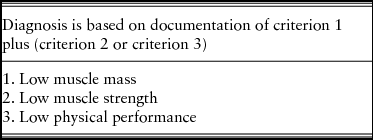
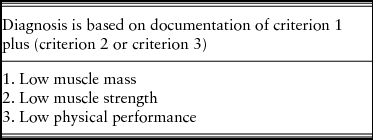
Both in clinical practice and for research purposes, the EWGSOP recommends using the presence of both low muscle mass and low muscle function (low muscle strength or reduced physical performance) for the diagnosis of sarcopenia. Thus diagnosis requires documentation of criterion 1 plus documentation of either criterion 2 or criterion 3 (Table 1). This definition has been shown to be useful both for community and nursing home populationsReference Patel, Syddall and Jameson13, Reference Landi, Liperoti and Fusco14 and is strongly linked with adverse outcomes (mortality and falls).Reference Landi, Liperoti and Fusco15–Reference Arango-Lopera, Arroyo, Gutiérrez-Robledo, Pérez-Zepeda and Cesari17
Criteria for the diagnosis of sarcopenia
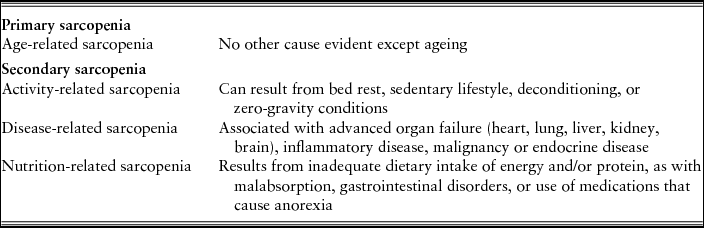
The EWGSOP also divides sarcopenia into categories, and proposes the use of the terms ‘primary sarcopenia’ and ‘secondary sarcopenia’. Sarcopenia can be considered primary (or age-related) when no other cause is evident but ageing itself, while sarcopenia can be considered secondary when one or more other causes are evident (Table 2). Being a geriatric syndrome, in many if not most older subjects the aetiology of sarcopenia is multi-factorial, so that it may not be possible to characterize each individual as having a primary or secondary condition.
Sarcopenia categories by cause

The EWGSOP definition is now the most widely used and cited, and research will have to prove if its use in clinical practice can lead to prevention of disability and other adverse outcomes. However, there are still many open areas for discussion, including measurement of muscle mass in clinical practice, cut-off values for each parameter used in definitions, measurement of muscle quality, the role of fat and sarcopenic obesity, approaches to case finding, and what are the most relevant outcomes for therapeutic or preventive intervention. Ongoing research is also trying to ascertain the true prevalence of sarcopenia using newer definitions that do not use only muscle mass.Reference Lee, Liu, Peng, Lin and Chen18
Sarcopenia and physical frailty
Frailty is a biological syndrome of decreased reserve and resistance to stressors, resulting from cumulative declines across multiple physiological systems and causing vulnerability to adverse outcomes.Reference Fried, Tangen and Walston19 However, there is still a high degree of controversy and variability in the concept and application of frailty.Reference Rodriguez-Mañas, Feart and Mann20, Reference Rockwood and Bergman21 Frailty is a broad concept that includes physical, cognitive, socioeconomic and other domains that make old individuals vulnerable. A recent update has been published in this journal.Reference Deane and Jaafar22
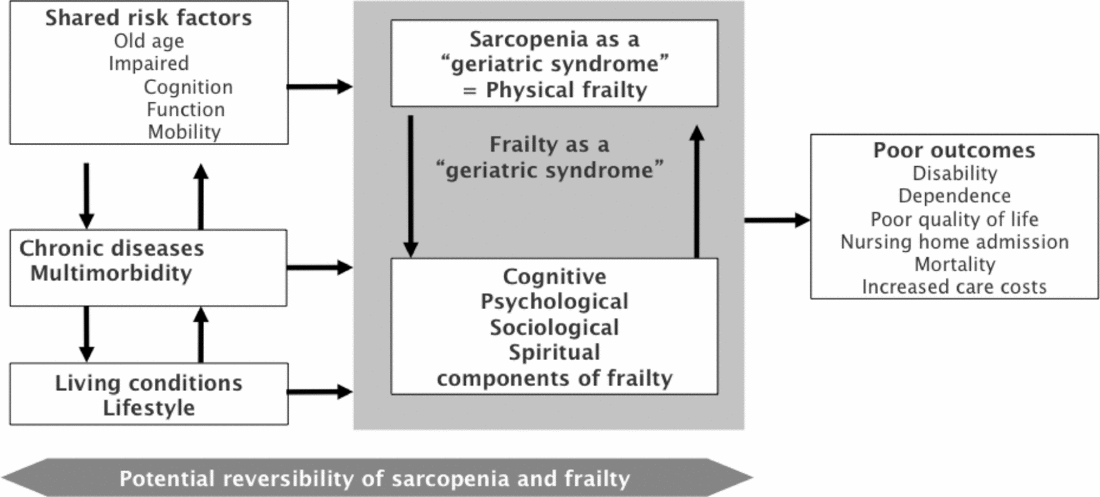
Most research in frailty has focused on physical frailty,Reference Bouillon, Kivimaki and Hamer23 and the preferred approach is the phenotype of physical frailty proposed by Linda Fried.Reference Fried, Tangen and Walston19 Physical frailty is closely linked to muscle function, and three of the five-item phenotypic definition of frailty are in fact linked with the three domains proposed by the EWGSOP definition of sarcopenia.Reference Michel and Cruz-Jentoft24 There is an overlap of clinical features between sarcopenia, frailty and other close conditionsReference Michel and Cruz-Jentoft24–Reference Rizzoli, Reginster and Arnal27 (Fig. 1). The identification of frailty or sarcopenia in clinical practice should lead to preventive or therapeutic interventions that improve relevant clinical outcomes. Ongoing research is trying to test these concepts.
The relation between sarcopenia and frailty (adapted from Michel & Cruz-Jentoft, 2013Reference Michel and Cruz-Jentoft24)
Detection of sarcopenia in clinical practice
Sarcopenia is not yet listed in international classifications of disease. However, for any practitioner who cares for older subjects, it is quite evident that sarcopenia is a relevant clinical problem and a burden for many of them. Moreover, some interventions to prevent or improve sarcopenia can be used in such patients. An accurate identification of sarcopenia in clinical practice is an important step if age-associated disability is to be prevented.
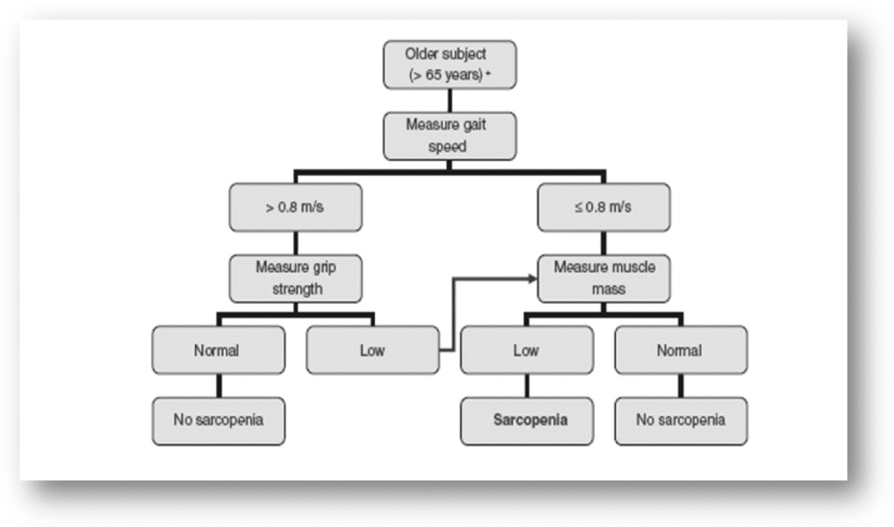
Diagnosis and case finding are directly linked with the definition used. Screening can be done either in populations or in selected groups of high-risk subjects. The EWGSOP chooses a population approach, and recommends screening all subjects over 65 years.Reference Cruz-Jentoft, Baeyens and Bauer12 However, it proposes a stepwise method, starting with the measure of usual gait speed (simple and not time consuming), and using a cut-off of less than 0.8 m/s to identify a group at risk for sarcopenia. Those with low gait speed will undertake further testing to determine if they reach full diagnostic criteria for sarcopenia, by measuring muscle strength first (simple and fast, but needs a specific device) and muscle mass last (more complex and expensive, DXA or BIA may be used) (Fig. 2). The SSCWD opts for targeting detection of sarcopenia with mobility impairment in all patients over 60 years of age who are falling, who feel that their walking speed has decreased, who have had a recent hospitalization, who have been on a prolonged bed rest, have problems rising from a chair or need to use an assistive device for walking.Reference Morley, Abbatecola and Argiles11 In such patients, measurement of gait speed or distance travelled during a 6-min walk should be measured in all these patients, and a DXA performed to measure muscle mass in those with confirmed mobility impairment.
ESGSOP sarcopenia case finding algorithm (adapted from Cruz-Jentoft et al., 2010Reference Cruz-Jentoft, Baeyens and Bauer12)
When sarcopenia is suspected in a given individual, a muscle mass measure and a physical performance measure would be the minimum requirement by any definition to confirm the diagnosis of this condition. Biomarkers may help confirming diagnosis in the future.Reference Drey, Sieber, Bauer, Uter, Dahinden and Fariello28
Diagnostic work-up: a syndromic approach
Sarcopenia is best managed when it is regarded as a geriatric syndrome rather than a classic medical syndrome.Reference Cruz-Jentoft, Landi, Topinkova and Michel29 Geriatric syndromes have been defined as common, complex, and costly states of impaired health in older individuals, that result from misunderstood interactions of disease and age on multiple systems, producing a constellation of signs and symptoms.Reference Olde Rikkert, Rigaud, Van Hoeyweghen and de Graaf30, Reference Inouye, Studenski, Tinetti and Kuchel31 When sarcopenia has been confirmed in a given individual, a syndromic diagnostic approach searching for any underlying causes, especially for those that may improve with interventions, is mandated. A comprehensive multidimensional assessment is probably key to investigate its aetiology in affected individuals and helps to disentangle the treatable and non-treatable risk factors and contributing conditions, much in the same way as delirium or falls are managed in usual geriatric practice.
Many of the most relevant causes of sarcopenia are listed in Table 2. However, a special emphasis should be placed on lifestyle, and specially on nutrition and physical activity, as problems in both are usually prominent in most individuals with sarcopenia; furthermore, specific nutritional approaches and physical exercise programmes represent the most efficient interventions to prevent and treat sarcopenia.
The skeletal and the muscular organ systems are tightly intertwined to provide mobility to human beings. It is thus not surprising that muscle weakness, fear of falls, falls and subsequent fractures are associated with concurrent sarcopenia and osteoporosisReference Sjöblom, Suuronen, Rikkonen, Honkanen, Kröger and Sirola32 and lead to restricted mobility, loss of autonomy and reduced life expectancy.Reference Cederholm, Cruz-Jentoft and Maggi33 The degenerative processes leading to osteoporosis and sarcopenia show many common pathogenic pathways,Reference Kaji34 and they may also respond to the same kind of treatments. It seems sensible to include an assessment of osteoporosis on the risk of falling in patients with sarcopenia, as part of the comprehensive geriatric assessment.
Differential diagnosis
Sarcopenia is only one in a list of conditions associated with prominent muscle wasting, with malnutrition and cachexia perhaps the most evident. These conditions interact so deeply, that defining them as different entities is a complex task, but a careful differential diagnosis helps in choosing proper management.Reference Thomas35 Starvation causes a loss of body fat and non-fat mass due to inadequate intake of protein and energy, while in sarcopenia body fat is preserved or increased (sarcopenic obesity). Cachexia is severe muscle wasting (fat and non-fat mass) accompanying disease states such as cancer. Definitions of cachexia are also evolving in the last decade, but in most cases they include the concept of inflammation as a leading mechanism in muscle wasting.Reference Muscaritoli, Anker and Argiles9, Reference Evans, Morley and Argiles36 Thus most cachectic individuals are also sarcopenic, but most sarcopenic individuals are not considered cachectic.
Interventions
Although there is no standard treatment of sarcopenia, and many risk factors cannot be changed (weight at birth being a good exampleReference Dodds, Denison and Ntani37), nutrition and physical exercise seem to be at present the cornerstones of intervention in sarcopenia.Reference Candow, Forbes, Little, Cornish, Pinkoski and Chilibeck38
Exercise and physical activity
Exercise and physical activity are not the same. Physical activity is usually defined as any bodily movement produced by skeletal muscles that results in energy expenditure, and can be linked to occupational, sports, household, or other activities. Exercise is a subset of physical activity that is planned, structured and repetitive, and has as a final or an intermediate objective the improvement or maintenance of physical fitness.Reference Caspersen, Powell and Christenson39
Low physical activity is clearly linked to the development of sarcopenia, and this fact is being confirmed in most recent epidemiological studies,Reference Chastin, Ferriolli, Stephens, Fearon and Greig40–Reference Kim, Kim and Hwang42 although not all sedentary activities may have the same impact on sarcopenia.Reference Hamer and Stamatakis43 Thus a general recommendation to increase physical activity seems to be a sensible intervention for any sarcopenic patient – in fact, for any ageing or older patient, and has a sound biological basis.Reference Timmerman, Dhanani and Glynn44
Resistance exercise training increases muscle mass, muscle strength and even muscle morphology, and improves protein accretion in skeletal muscles in older people.Reference Scanlon, Fragala and Stout45, Reference Fry, Drummond and Glynn46 Aerobic exercise training may also benefit ageing skeletal muscle and improve insulin sensitivity.Reference Forbes, Little and Candow47 Exercise may be more effective when started early,Reference Peterson, Sen and Gordon48 but can be useful even in very old and frail people.Reference Serra-Rexach, Bustamante-Ara and Hierro49 At least in clinical trials, resistance exercise programmes can have a good long-term (24 weeks) compliance.Reference Tieland, Dirks and van der Zwaluw50 Whenever possible, exercise has to be prescribed for the treatment of sarcopenia, and is most probably beneficial when properly supervised and sustained over a long period of time.
Nutritional interventions
Nutrition-related sarcopenia is common, and undernutrition plays a role in a large number of sarcopenic patients.Reference Vandewoude, Alish, Sauer and Hegazi51 Correction of nutritional deficits is also a sensible step in the management of sarcopenic patients. Caloric intake should be increased to cover increased demands posed by activity and exercise, which is not usually the case. Protein requirements are also increased, and recommended intakes of proteins in such patients may be over 1.2 g of body weight per kilogram and day, with the only exception of subjects with advanced renal failure, as per the most recent recommendations.Reference Bauer, Biolo and Cederholm52 This can be done with protein supplements, or by increasing protein content in usual diet.Reference Aleman-Mateo, Macias, Esparza-Romero, Astiazaran-Garcia and Blancas53 Leucine,Reference Leenders and van Loon54 HMB,Reference Deutz, Pereira and Hays55 creatineReference Candow56 and some milk-based proteinsReference Burd, Yang, Moore, Tang, Tarnopolsky and Phillips57, Reference Björkman, Pilvi, Kekkonen, Korpela and Tilvis58 may have some beneficial effects on protein balance, mass and function of the skeletal muscle. Quality of proteins and timing of protein intake may influence the impact of nutritional intervention.Reference Bauer, Biolo and Cederholm52 Correction of vitamin D deficiencies is needed for proper muscle function, but the role of vitamin D when blood levels are normal it is yet to be determined.
Exercise and nutrition seem to have additive effects,Reference Tieland, Dirks and van der Zwaluw50 and protein supplements may be more effective in improving muscle mass and function when incorporated into an exercise programme.Reference Bauer, Biolo and Cederholm52
Drug treatments
No drug is still approved for the treatment of sarcopenia.Reference Brotto and Abreu59, Reference Rolland, Onder, Morley, Gillette-Guyonet, Abellan van Kan and Vellas60 Studies with anabolic hormones have been disappointing in subjects with no clear deficits of such hormones.Reference Papanicolaou, Ather and Zhu8, Reference Maggio, Lauretani and Ceda61 Many different approaches are now being explored in basic science and preliminary trials;Reference Gumucio and Mendias62–Reference Marzetti, Calvani, Bernabei and Leeuwenburgh64 the most promising seem to be those inhibiting the function of myostatinReference Elliott, Renshaw, Getting and Mackenzie65 and the manipulation of the neuromuscular junction.Reference Clark and Fielding66
Regulatory standards for sarcopenia drug intervention trials are not yet fully established by regulatory agencies.Reference Brass and Sietsema67 Increases in muscle mass or strength will probably not be sufficient: drugs will have to improve physical function, falls or other clinically relevant outcomes. Exercise and nutrition will probably remain the cornerstone of interventions in sarcopenia for a couple of years.
Conflicts of interest
None declared.