INTRODUCTION
The pointing gesture may be one of the first ways that infants communicate with others. It usually emerges in human infants at about age 1;0 (e.g. Carpenter, Nagell & Tomasello, Reference Carpenter, Nagell and Tomasello1998; Leung & Rheingold, Reference Leung and Rheingold1981). Previous studies have shown both a concurrent and a longitudinal relationship between pointing and language development (for a review, see Colonnesi, Stams, Koster & Noom, Reference Colonnesi, Geert Jan, Stams, Koster and Noom2010). Besides the pointing gesture, prelinguistic vocalizations have also been noted by some researchers to serve communicative functions, or at least be interpreted by parents as communicative to some degree (Bates, Camaioni & Volterra, Reference Bates, Camaioni and Volterra1975; Harding & Golinkoff, Reference Harding and Golinkoff1979). However, unlike pointing, infants' total production of vocalizations is not related to their language outcomes (Camaioni, Castelli, Longobardi & Volterra, Reference Camaioni, Castelli, Longobardi and Volterra1991). One possibility may be that, compared to vocalizations, pointing gestures elicit more language input from caregivers in typical, day-to-day interactions, which results in a robust correlation between pointing gestures and language learning but not a correlation between vocalizations and language outcomes. Thus, the primary aim of this study was to determine if pointing and vocalizations elicit different caregiver responses.
Numerous studies have demonstrated a positive relationship between infants' early pointing skill and subsequent language outcomes. For example, the onset of the pointing gesture has been shown to be related to infants' animal sound comprehension and gesture production at age 1;2 (Butterworth & Morissette, Reference Butterworth and Morissette1996). In addition, the frequency of pointing has been found to predict both subsequent receptive and expressive language outcomes (Blake, Vitale, Osborne & Olshansky, Reference Blake, Vitale, Osborne and Olshansky2005; Brooks & Meltzoff, Reference Brooks and Meltzoff2008; Butterworth & Morissette, Reference Butterworth and Morissette1996; Camaioni et al., Reference Camaioni, Castelli, Longobardi and Volterra1991; Desrochers, Morissette & Ricard, Reference Desrochers, Morissette, Ricard, Moore and Dunham1995; Masur, Reference Masur1982). Moreover, the number of objects to which children pointed at 1;2 predicted their vocabulary comprehension at 3;6 (Rowe & Goldin-Meadow, Reference Rowe and Goldin-Meadow2009; Rowe, Özçalışkan & Goldin-Meadow, Reference Rowe, Özçalışkan and Goldin-Meadow2008). Lastly, experimentally increasing children's pointing gestures led to an increase in overall gesture production, which correlated to children's speech production during follow-up interactions with their parents (LeBarton, Goldin-Meadow & Raudenbush, in press).
Multiple theoretical frameworks have been proposed to explain why pointing skills relate to subsequent language development. Some researchers argue that pointing gestures have a special status with respect to their relationship with communication. For example, pointing has been suggested to be a precursor of labeling (Clark, Reference Clark and Lock1978; Werner & Kaplan, Reference Werner and Kaplan1964), a symbolic instrument (Vygotsky, Reference Vygotsky and Kozulin1986), or a “quintessential act of reference”, that is, one person picks out an object of interest and indicates it to another person for consideration (Bates, O'Connell & Shore, Reference Bates, O'Connell, Shore and Osofsky1987). The ‘social pragmatic’ account further considers infants' pointing as a referential communicative tool that enables children to initiatively direct adults' interests and attention to external events and objects (Liszkowski, Reference Liszkowski2008; Liszkowski, Carpenter, Henning, Striano & Tomasello, Reference Liszkowski, Carpenter, Henning, Striano and Tomasello2004; Liszkowski, Carpenter & Tomasello, Reference Liszkowski, Carpenter and Tomasello2007; Tomasello, Carpenter & Liszkowski, Reference Liszkowski, Carpenter and Tomasello2007). This account thus proposes that pointing and speech share common cognitive processes, in particular the ability to represent and influence another person's mental states, as well as the cooperative motivation to communicate (Tomasello et al., Reference Tomasello, Carpenter and Liszkowski2007). On the basis of these accounts, pointing gestures produced by infants are hypothesized to be infants' ‘royal road to language’ (Butterworth, Reference Butterworth and Kita2003).
In addition to the possible special status of pointing gestures in communication as proposed above, the observed correlations between pointing and language development could be attributed to the social function of the pointing gesture, that is, pointing elicits verbal responses from social partners, which facilitate language development (Goldin-Meadow, Goodrich, Sauer & Iverson, Reference Goldin-Meadow, Goodrich, Sauer and Iverson2007; Kishimoto, Shizawa, Yasuda, Hinobayashi & Minami, Reference Kishimoto, Shizawa, Yasuda, Hinobayashi and Minami2007). Empirical studies have provided support for this hypothesis. Caregivers have been shown to provide more verbal comments after children produce pointing gestures compared to when they do not produce pointing gestures (Kishimoto et al., Reference Kishimoto, Shizawa, Yasuda, Hinobayashi and Minami2007). Moreover, the rates of mothers' object labeling responses after infants pointed predicted infants' cumulative object-labeling vocabularies (Masur, Reference Masur1982). In addition, the words produced by mothers in response to infants' points (i.e. translations of infants' points) are more likely to enter children's vocabulary than the words referred to by gestures that are not translated by mothers (Goldin-Meadow et al., Reference Goldin-Meadow, Goodrich, Sauer and Iverson2007). These findings suggest that mothers' label responses to infants' pointing gestures might be highly facilitative of infants' acquisition of object labels, which largely make up infants' early vocabularies (Goldfield & Reznick, Reference Goldfield and Reznick1990).
In addition to a relationship between pointing and language outcomes, recent studies have suggested a relationship between object-directed vocalizations (ODVs) and vocabulary learning. Infants better learned word–object associations if a social partner offered a label when infants uttered ODVs than when infants were just looking at an object, but did not vocalize (Goldstein, Schwade, Briesch & Syal, Reference Goldstein, Schwade, Briesch and Syal2010). In addition, caregivers' labeling responses to infants' ODVs when infants were aged 0;9 positively related to their vocabulary size at 1;3 (Goldstein & Schwade, Reference Goldstein, Schwade, Blumberg, Freeman and Robinson2010). Therefore, infants' pointing gestures and ODVs have both been found to benefit infants' word learning if the social partner follows infants' attention and labels the target object. Yet, unlike pointing, infants' total production of vocalizations is not related to their language outcomes (Camaioni et al., Reference Camaioni, Castelli, Longobardi and Volterra1991), suggesting that maybe pointing gestures and ODVs elicit different response patterns from caregivers in typical, day-to-day interactions. Therefore, the first goal of the current study was to test this possibility.
Recently, Olson and Masur (Reference Olson and Masur2013) compared mothers' responses to children's gestural and non-gestural bids in three communicative contexts: proto-declarative, proto-imperative, and ambiguous. Gestural bids referred to bids that contained gestures, such as pointing, reaching, object extension, and showing, while non-gestural bids included vocalizations, looks toward objects, and gaze to the mother. Results showed that mothers were more likely to provide verbal responses to infants' gestures as compared to non-gestural communication, even when comparing gestural and non-gestural bids that were accompanied by vocalizations. This suggests that it is the gestural component of the bid that elicits more verbal responses. Furthermore, mothers responded with object labels to gestural bids more than non-gestural bids in proto-declarative and ambiguous communicative contexts, but not the proto-imperative context. Thus, results showed that both infants' communicative modality and communicative intent influenced maternal responsiveness; however, because vocalizations often co-occurred with gestural bids in the contexts in which mothers provided more label responses, and gestural bids included a range of gestures, it was difficult to determine exactly which behavior elicited the responses. Prior studies have shown that social partners respond differently to pointing compared to other gestures such as reaching or showing, with pointing eliciting the most object labels (e.g. Masur, Reference Masur1982; Olson & Masur, Reference Olson and Masur2011). Furthermore, infants' reaching or object extending do not show the same strength of relationship to vocabulary development as pointing does (Blake et al., Reference Blake, Vitale, Osborne and Olshansky2005). Therefore, the current study aimed to extend the experimental findings by Olson and Masur (Reference Olson and Masur2013) to naturalistic interactions and to directly compare pointing and object-directed vocalizations, both of which have been shown to be related to language development.
The second aim of the study was to investigate whether mothers and fathers differ in their responses to infants' points and ODVs. Most prior studies have focused on mother–infant interactions and maternal responsiveness. Maternal responsiveness has been shown to play a key role in the development of linguistic milestones in the second year (50-word vocabulary, using the past tense; for example-Rollins, Reference Rollins2003; Tamis-LeMonda, Bornstein & Baumwell, Reference Tamis-LeMonda, Bornstein and Baumwell2001); however, fathers also make contributions to children's language development (e.g. Majorano, Rainieri & Corsano, Reference Majorano, Rainieri and Corsano2013; Pancsofar & Vernon-Feagans, Reference Pancsofar and Vernon-Feagans2006, Reference Pancsofar and Vernon-Feagans2010; Shannon, Tamis-LeMonda, London & Cabrera, Reference Shannon, Tamis-LeMonda, London and Cabrera2002; Tamis-LeMonda, Shannon, Cabrera & Lamb, Reference Tamis-LeMonda, Shannon, Cabrera and Lamb2004). Gleason (Reference Gleason and Data1975) proposed that fathers may represent a kind of linguistic ‘bridge’ to the wider community of speakers outside the home environment. Fathers are usually secondary caregivers, thus are less familiar with the young child's routine behaviors and communicative abilities than mothers. Consequently, fathers are less able to understand and interpret young children's language, acting as more challenging communicative partners than mothers. However, fathers are not like completely unfamiliar adults, thus fathers are seen as a linguistic ‘bridge’ that help prepare young children for communication with unfamiliar partners.
Studies have reported contradictory findings regarding the Bridge Hypothesis. Fathers have been found to have fewer and/or shorter conversations with young children than mothers did (Golinkoff & Ames, Reference Golinkoff and Ames1979; Hiadek & Edwards, Reference Hiadek and Edwards1984; Rondal, Reference Rondal1980); fathers also produce more communication breakdowns than mothers do, such as requests for clarification, topic changes, and non-acknowledgements (Tomasello, Conti-Ramsden & Ewert, Reference Tomasello, Conti-Ramsden and Ewert1990), and fathers challenge children by asking more open-ended questions and fewer yes/no questions than mothers (Rondal, Reference Rondal1980; Rowe, Coker & Pan, Reference Rowe, Coker and Pan2004). On the other hand, Pancsofar and Vernon-Feagans (Reference Pancsofar and Vernon-Feagans2006) indicated that fathers and mothers did not differ in the mean length of utterance, word type–token ratio, and proportion of questions (see also Tamis-LeMonda, Baumwell & Cristofaro, Reference Tamis-LeMonda, Baumwell and Cristofaro2012). In addition, some researchers have not found differences in the characteristics of child-directed speech produced by mothers and fathers (e.g. McLaughlin, White, McDevitt & Raskin, Reference McLaughlin, White, McDevitt and Raskin1983). These studies investigating differences in parents' speech mainly focus on children who are old enough to produce words, yet we do not know whether these parental differences are already apparent in younger, preverbal infants. This is particularly important because fathers have become increasingly involved in caretaking in the last decade, and recent studies have revealed an influence of fathers on children's cognitive, emotional, and language development (Cabrera, Shannon & Tamis-LeMonda, Reference Cabrera, Shannon and Tamis-LeMonda2007; Lamb, Reference Lamb and Lamb2010; Pancsofar & Vernon-Feagans, Reference Pancsofar and Vernon-Feagans2006; Pleck, Reference Pleck and Lamb2010). Do fathers represent more challenging conversation partners than mothers even for preverbal infants? To address this question, in the current study, we directly compared fathers' and mothers' speech acts in responses to prelinguistic infants' pointing and vocalizations.
In sum, in the current study, we examined if infants' pointing gestures and object-directed vocalizations at age 1;0 elicit different object labeling responses when interacting naturally with mothers and fathers. This age was chosen because, around this time, infants communicate mainly through gestures (e.g. Bates, Reference Bates1979) and they are building their early lexicons, thus the social partner's verbal input might be especially important (e.g. Bornstein, Tamis-LeMonda & Haynes, Reference Bornstein, Tamis-LeMonda and Haynes1999; Huttenlocher, Haight, Bryk, Seltzer & Lyons, Reference Huttenlocher, Haight, Bryk, Seltzer and Lyons1991; Pan, Rowe, Singer & Snow, Reference Pan, Rowe, Singer and Snow2005). We focused on parents' object labeling responses because object labels largely make up infants' early vocabularies (Goldfield & Reznick, Reference Goldfield and Reznick1990). In addition, we aimed to investigate whether mothers' and fathers' contents of verbal responses were different after infants pointed and vocalized. We expected more object-labeling responses following infants' pointing gestures, based on prior research (e.g. Masur, Reference Masur1982; Olson & Masur, Reference Olson and Masur2011, Reference Olson and Masur2013), yet we had no specific predictions regarding whether mothers and fathers would provide different responses because previous studies have reported inconsistent findings (McLaughlin et al., Reference McLaughlin, White, McDevitt and Raskin1983; Pancsofar & Vernon-Feagans; Reference Pancsofar and Vernon-Feagans2006; Rondal, Reference Rondal1980; Rowe et al., Reference Rowe, Coker and Pan2004; Tomasello et al., Reference Tomasello, Conti-Ramsden and Ewert1990).
METHOD
Participants
Forty-seven infants aged 1;0 (29 males) and their parents participated in the study. However, only twenty-five infants (12 males, M age = 366·96 days, SD = 9·58 days) pointed with both mother and father; eight infants (6 males, M age = 369·88 days, SD = 8·53 days) pointed with only one parent: five (3 males) pointed only with mother, and three (3 males) pointed only with father; fourteen (11 males, M age = 364·64 days, SD = 12·82 days) did not show pointing with either mother or father. These three groups of infants (pointed with both parents, only with one parent, or with neither parent) did not differ significantly in their ages (F(2,44) = 0·64, p = ·53, η p2 = ·03).
Participants were recruited through a volunteer child registry or through county birth records if they had not participated in prior studies. Participants were primarily Caucasian, middle socioeconomic status, and the majority of parents had completed at least some college, based on a demographics questionnaire that they completed prior to starting the study.
Procedure
Infants interacted with their mothers and fathers separately in a playroom that contained a variety of age-appropriate toys. Each interaction lasted 30 minutes, and parents were instructed to play as they would at home. Three wall-mounted video cameras (Sony EVI-D100) recorded interactions. Videofeed was routed through an audio-video mixer (Datavideo SE-800AVK) to allow for selection of the best camera angle or picture-in-picture recording for observations of parent–infant interactions. Audio-recordings were made using a wireless microphone (Sennheiser ew112G2) sewn into overalls worn by the infant. The order of parent visit was counterbalanced. Infants received a prize for their participation.
Coding and reliability
All coding was done using ELAN (EUDICO Linguistic Annotator: Max Planck Institute for Psycholinguistics, Nijmegen, The Netherlands <http://www.lat-mpi.eu/tools/elan/>; Lausberg & Sloetjes, Reference Lausberg and Sloetjes2009), a free software program that allows for coding that is timelocked with the video data. The coding focused on three aspects of the interaction: (i) infants' pointing and vocal behavior; (ii) the object to which infants pointed or vocalized; and (iii) parents' responses to infants' points and vocalizations.
Pointing was identified based on the behavioral appearance of the arm either fully or half extended toward a discernible object or location, from the onset of the movement which resulted in a point until the arm was drawn back and the index finger or hand was no longer extended (Liszkowski et al., Reference Liszkowski, Carpenter, Henning, Striano and Tomasello2004). Pointing was distinguished from a clear attempt to only grab or touch something and from loose arm movements or undirected excitement. Following Goldin-Meadow et al. (Reference Goldin-Meadow, Goodrich, Sauer and Iverson2007) and Tomasello et al. (Reference Tomasello, Carpenter and Liszkowski2007), eye-contact to the parent was not necessary for a pointing gesture to be considered communicative. In fact, only eighteen infants ever displayed gaze shift to a caregiver when they pointed and, on average, about 40·78% of points were accompanied with a gaze shift to a caregiver. Therefore, we combined points that occurred with or without eye-contact to the parent. infants' points were further categorized into ‘point and vocalization’ or ‘point only’. If vocalizations occurred 2 seconds before, during, or after infants' pointing, then this was coded as ‘point and vocalization’.
Object-directed vocalizations included sounds that infants produced when looking at an object (ODVs without gaze alternation), or shifting eye-gaze from an object to caregiver or vice versa within 1 second (ODVs with gaze alternation). We combined ODVs that occurred with or without gaze alternation to the caregiver in the data analyses because vocalizing with or without gaze alternation to the caregiver did not influence parents' provision of label responses (see ‘Label responses’ below; M with GA = ·11, M without GA = ·10) (F(1,43) = 0·74, p = ·39). Negative vocalizations (e.g. fusses and cries), vegetative sounds (e.g. hiccups, burps), and effort sounds (e.g. grunts) were excluded. Vocalizations that occurred in bouts with perceivable silence in between were coded as separate vocalizations (Gros-Louis, West, Goldstein & King, Reference Gros-Louis, West, Goldstein and King2006).
The name of the object to which infants pointed or vocalized was also coded. This was coded to investigate whether infants repeated their points or vocalizations to the same object, and to see whether the repeated pointing or vocalizing influenced parents' responses. There were a variety of age-appropriate toys in the playroom: a school bus, a book, a monkey puppet, a block with images of animals on it, a pop-up toy so that if one presses a button an animal pops up, a cookie jar with several cookies that can be taken out and put into the jar, a spinning top with a button to push to make it spin, a ring stacker with several colorful rings, a barn shape sorter, a farm toy with individual animals (cow, sheep, horse), and two foam triangle blocks, one of which had a mirror on it. In addition, infants also vocalized or pointed to the facilities in the room, such as the door, window, light, fire alarm, camera, and wall, or something parents had, such as a cellphone, ring, necklace, water bottle, kleenex, hat, shoes, etc. Because it is difficult to determine from the video which part of the toy the child vocalized or pointed to exactly, we only coded the name of the whole object.
Parental responses were defined as the first behavior (or set of behaviors) that occurred from the onset of each point or vocalization until 2 seconds after the offset of each point or vocalization (Gros-Louis et al., Reference Gros-Louis, West, Goldstein and King2006). These responses fell into two mutually exclusive categories (Olson & Masur, Reference Olson and Masur2011): the category of ‘No Verbal Response’ included non-verbal responses (e.g. laughter, smiling, and actions) or no response, that is, the parent did not say or do anything. All the other responses that included words were coded as ‘Verbal Response’. Verbal responses were further coded for the presence or absence of an object label. The object label contained in each ‘Label Response’ was also coded (e.g. tiger, bus).
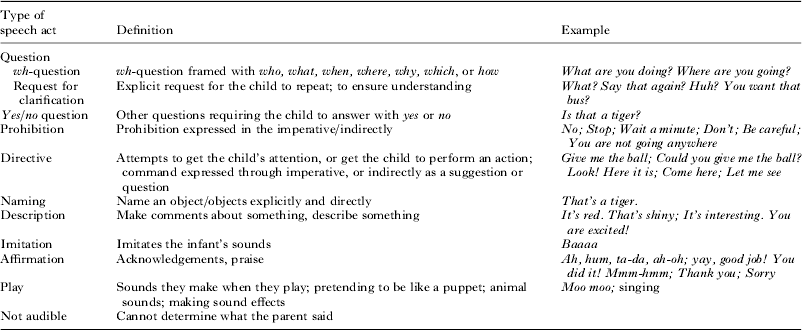
To assess differences in mothers' and fathers' responses, we adapted speech act coding schemes from prior studies (e.g. Rowe et al., Reference Rowe, Coker and Pan2004; Tomasello et al., Reference Tomasello, Conti-Ramsden and Ewert1990). The content of parents' verbal responses was first transcribed verbatim using ELAN. We then classified parental speech based on pragmatic features, including use of wh-questions, yes/no questions, explicit clarification requests, directives, prohibitions, affirmations, descriptives, imitations, play, and naming (see Table 1). Note that the speech act of ‘Naming’ is a label response with more conservative criterion than the ‘Label Response’ described above. The above ‘Label Response’ is a verbal response that contained an object label in it. For example, if a parent said Is that a cow?, according to the above definition, it is a ‘Label Response’; but it is a ‘Yes-or-no Question’ in the speech act coding scheme. Therefore, a speech act of ‘Naming’ is a ‘Label Response’, but a ‘Label Response’ is not necessarily a speech act of ‘Naming’.
Pragmatic speech coding scheme

A randomly selected 25% of videos were recoded for parental responses and pointing gestures by a second, trained assistant. For pointing gesture, Kappa's value was 0·81; for parental response, Kappa's value was 0·95; for object name, Kappa's value was 0·93. Kappa's values were 1·00 for pointing gesture combined with vocalization or not, and the presence or absence of an object label in parental utterance (ps < ·001). For speech acts, the agreement between two independent coders was 96%; Kappa's value was ·95 (p < ·001). Eight assistants coded infants' directed vocalizations because the coding of vocalizations was part of another project with a much larger sample. To accommodate multiple coders of the vocal behavioral data, we calculated Krippendorf's alpha for reliability for 20% of the sample. We used the ‘bootstrapping’ method to obtain a 95% confidence interval for alpha (Hayes & Krippendorff, Reference Hayes and Krippendorff2007). Krippendorff's alpha for agreement among eight coders was 0·7247 and the 95% bootstrapping confidence interval for the true alpha coefficient was [0·6841, 0·7648].
Measures
infants' interactive behavior
‘Frequency of infants' three different behaviors’ is the number of ODVs, points only, and points with vocalizations during the 30-minute free play with each parent. ‘The mean number of infants' ODVs, points, or points with vocalizations per toy’ was the total number of ODVs, points, and points with vocalizations divided by the total number of toys to which infants vocalized, pointed, or pointed and vocalized, respectively.
Verbal responses
‘Proportion of verbal responses’ was the number of ODVs, points, or points with vocalizations that received verbal responses divided by the total number of each behavior.
Object label tokens and types
For each individual child, ‘object label token’ was calculated as the total number of object labels provided by each parent in response to infants' different interactive behaviors; ‘object label type’ was calculated as the number of different object labels provided by each parent in response to infants' interactive behaviors. Variations in the words were not counted as separate types of label. For instance, cookie and cookies would be considered the same object label type.
Label responses
To control for effects of repeated vocalizations or points to a certain toy on parents' label responses, for each individual infant, we calculated the proportion of parents' labeling responses to each toy that infants vocalized to or pointed to, and then calculated the mean proportion of parents' label responses across different toys that infants pointed to or vocalized to. ‘Proportion of toys receiving labels’ was the number of toys that received labels divided by the total number of toys to which infants vocalized or pointed.
Speech acts. ‘Proportion of each speech act’ was the total number of each speech act divided by the total number of responses provided by each parent.
RESULTS
Preliminary data analysis did not show any significant gender differences in infants' behaviors or parental responses. Therefore, the following data analysis was conducted by collapsing the data across females and males. We first report results of infants' interactive behaviors and parental responses regarding whether they were pointers or not, then we present analyses comparing mothers' and fathers' verbal responses and label responses to their children's different interactive behaviors.
Pointers vs. non-pointers
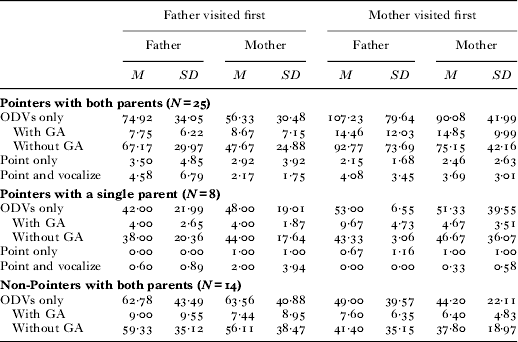
Infants were categorized into three groups based on their pointing behavior: pointed with both parents (N = 25), pointed with a single parent (N = 8), did not point with either parent (N = 14). As shown in Table 2, these three groups of infants did not differ in the frequency of vocalizations with mothers (F(2,44) = 1·82, p = ·17); however, they differed in the frequency of vocalizations with fathers (F(2,44) = 3·26, p = ·048, η p2 = ·13). Bonferroni corrected pair-wise comparisons showed that infants who pointed with both parents vocalized more when interacting with fathers than infants who pointed only with a single parent (p = ·04).
Descriptive data for the frequency of infants' different interactive behaviors as a function of parent and visiting order
notes: ODVs = object-directed vocalizations; GA = gaze alternation between the object and the caregiver.
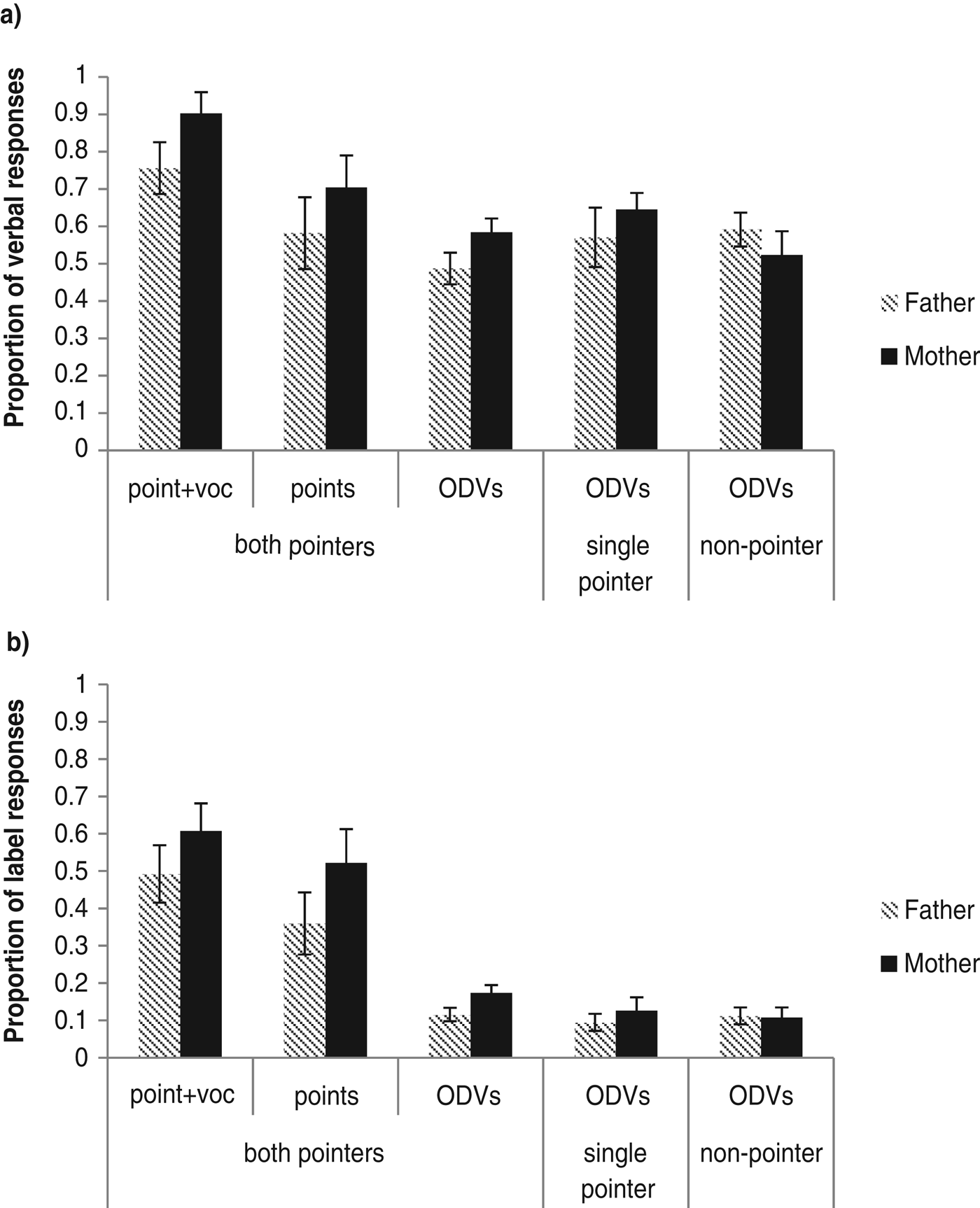
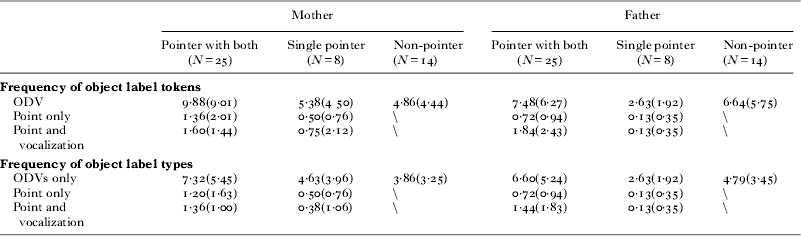
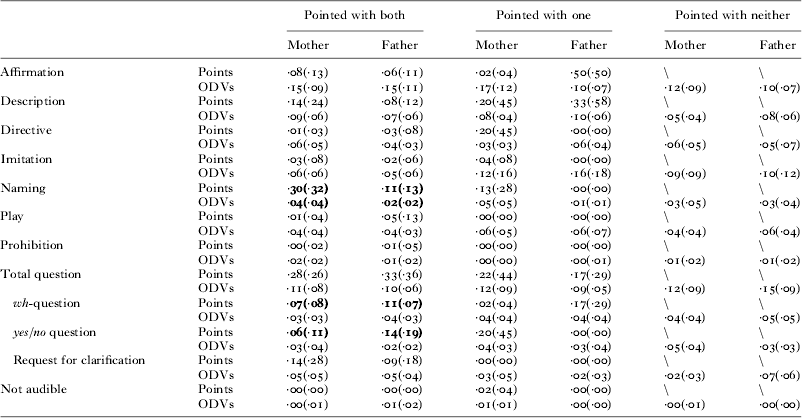
Next, we investigated whether these three groups of infants' vocalizations differed in eliciting parents' verbal/label responses, object label tokens and types, as well as speech acts. We conducted multiple 2 (parent: mother vs. father; within-subject) × 3 (pointer: both, single, neither; between-subject) mixed-design analyses of variance. As shown in Figures 1a and 1b, for verbal responses and label responses, respectively, there was no interactive effect of parent and pointer (F(2,44) = 1·97, 1·53), no significant main effect of pointer (F(2,44) = 0·39, 1·16), and no significant main effect of parent (F(1,44) = 0·62, 2·60, ps > ·10). With similar mixed-design analyses of variance, results showed that parents' provision of object label tokens and types in response to infants' vocalizations did not differ regarding whether infants pointed or not during the 30-minute play session (F(2,44) = 2·66, 2·70), for object label tokens and types, respectively (ps > ·10) (see Table 3). Furthermore, there was no significant effect of pointer for any individual speech act (ps > ·05) (see Table 4). These results suggest that pointers' and non-pointers' ODVs elicited the same proportion of verbal/label responses, the same amount of object label tokens and types, and the same types of speech acts, from both mothers and fathers. Therefore, parents' responses to ODVs in the pointer group were likely representative of responses to ODVs by parents overall. The data analyses below thus focused on the twenty-five pointers, to allow for direct comparisons of mothers' and fathers' responses to infants' ODVs, points, and points + vocalizations.
The mean proportion (± SE) of caregivers' verbal responses (a) and label responses (b) to infants' different behavior types. ODVs = object-directed vocalizations; point + voc = point and vocalize; both pointers = the twenty-five infants who pointed with both parents; single pointer = the eight infants who pointed with only one parent; non-pointer = the fourteen infants who did not point with either parent.
Mean value (± SD) of parents' provision of object label tokens and types
Mean proportion (± SD) of parents' speech acts in response to infants' vocalizations and points as a function of pointer and parent
note: Marginally significant and significant comparisons are indicated in boldface type.
infants' interactive behavior
Regarding the twenty-five infants who pointed with both parents, a 3 (behavior: ODV, point only, point and vocalization; within-subject) × 2 (parent: mother, father; within-subject) × 2 (visit order: mother first, father first; between-subject) mixed-design analysis of variance was conducted, with the frequency of each behavior as the dependent variable. As shown in Table 1, there was a significant main effect of behavior (F(2,22) = 39·03, p < ·001, η p2 = ·78) and a significant interactive effect of behavior and visit order (F(2,22) = 3·90, p = ·04, η p2 = ·20). No other significant effects were found (ps > ·10). To explore the interactive effects, Bonferroni corrected pairwise comparisons showed that the group of infants who interacted with their fathers first showed significantly fewer ODVs than the group of infants who interacted with their mothers first (p = ·03), but there were no significant differences in infants' pointing gestures between these groups (ps > ·10).
Next, we conducted a 2 (parent: mother, father) × 3 (behavior: ODV, point only, point and vocalization) repeated measure analysis of variance, with the mean number of each kind of behavior per object as the dependent variable. Results showed that infants vocalized (M = 6·55, SD = 4·18) to each toy significantly more than they pointed (M = 1·65, SD = 1·74) or pointed with vocalization (M = 2·10, SD = 1·99) (F(2,24) = 19·33, p < ·001, η p2 = ·62). No significant main effects of parent or interactive effects were found (ps > ·10).
Together, these results showed that infants produced significantly more ODVs in total, as well as per toy, than points and point+vocalization.
Parents' responses
Object label tokens and types
To explore potential differences between mothers and fathers in their responses to infants' ODVs, points, and point + vocalization, we first examined object label tokens and object label types. The mean numbers of object label tokens and types are shown in Table 3. Two 2 (parent: mother, father; within-subject) × 3 (behavior: ODV, point only, point and vocalization) mixed-design analyses of variance were conducted, with the frequency of object label tokens and types, respectively, as the dependent variable. For object label tokens and types, respectively, there was a significant main effect of behavior (F(2,23) = 15·25, 23·14, ps < ·001, η p2 = ·57, ·67); however, there was no significant interactive effect of parent and behavior (F(2,23) = 2·69, 1·15, p = ·09, ·34, η p2 = ·19, ·09) nor significant main effect of parent (F(1,24) = 2·33, ·72, p = ·14, ·41, η p2 = ·09, ·03). Corrected Bonferroni pairwise comparisons showed that there were significantly more object label tokens and types in response to ODVs (M tokens = 8·68, SD tokens = 6·73; M types = 6·96, SD types = 4·58) than to points (M tokens=1·04, SD tokens = 1·08; M types = 0·96, SD types = 0·91) and to point+vocalization (M tokens = 1·72, SD tokens = 1·58; M types = 1·40, SD types = 1·23) (ps < ·05).
These results thus showed that infants' ODVs elicited more object label tokens and types than points or point+vocalization; however, the total number of ODVs was also significantly more than points or point+vocalization (see Table 2). Therefore, we examine the proportion of verbal and label responses below, aiming to see whether pointing gestures were more effective in eliciting verbal and label responses.
Verbal responses
To examine whether parents' provision of verbal responses differed among the twenty-five pointers' different interactive behaviors – ODVs, points only, and points with vocalizations – we conducted a 2 (parent: mother, father; within-subject) × 3 (behavior: ODV, point only, point and vocalization) mixed-design analysis of variance with the proportion of verbal responses as the dependent variable. As shown in Figure 1a, there was a significant interactive effect of parent and behavior (F(2,13) = 5·08, p = ·02, η p2 = ·44), a significant main effect of behavior (F(2,13) = 9·92, p = ·002, η p2 = ·60), but the main effect of parent was only marginally significant (F(1,14) = 4·32, p = ·06, η p2 = ·24). To explore the interactive effects, further analyses showed that mothers differed significantly in their response to those three interactive behaviors (F(2,13) = 22·39, p < ·001, η p2 = ·78) but fathers did not (F(2,13) = 2·64, p = ·11, η p2 = ·29). Corrected Bonferroni pairwise comparisons showed that mothers provided significantly more verbal responses to point + vocalization than to ODVs (p < ·001); in addition, mothers provided significantly more verbal responses to point+vocalization than did fathers (p = ·01); other comparisons were not significant (ps > ·05).
Label responses
Because the above results showed that there were no significant differences between pointing only and pointing + vocalizations in terms of the frequency, the mean number of points per toy, and parents' verbal responses, we combined pointing gestures alone and pointing + vocalizations together in the category ‘point’ to examine label responses to ODVs and pointing. We conducted a 2 (parent: mother, father) × 2 (behavior: ODV, point) repeated-measure analysis of variance, with the mean proportion of label responses as the dependent variable. Results showed that there was a significant main effect of behavior (F(1,24) = 60·54, p < ·001, η p2 = ·72), and a significant main effect of parent (F(1,24) = 4·86, p = ·04, η p2 = ·17), but not a significant interactive effect (F(1,24) = ·10, p = ·11, η p2 = ·10). Mothers (M = 0·31, SD = 0·15) overall provided significantly more label responses than fathers (M = 0·23, SD = 0·14); in addition, pointing gestures (M = 0·42, SD = 0·20) elicited significantly more label responses than vocalizations (M = 0·11, SD = 0·08).
The above data analyses were conducted on ‘behavior’ level, that is, we focused on the proportion of label responses elicited by each vocalization and each point. Next, we conducted data analyses on the ‘toy’ level to examine the possibility of each toy receiving a label when infants pointed to it or vocalized to it. We conducted a 2 (parent: mother, father) × 2 (behavior: ODV, point) repeated-measure analysis of variance, with the proportion of toys receiving labels as the dependent variable. Results showed that there was a significant main effect of behavior (F(1,24) = 7·59, p = ·01, η p2 = ·24). Even though infants vocalized, on average, 6·51 times to each toy, only 39% out of 12·54 toys to which infants vocalized received labels; in contrast, infants pointed, on average, 1·60 times to each toy, yet 53% out of 3·67 toys to which infants pointed received labels. These results showed that a toy to which infants pointed had a significantly higher chance of being labeled than a toy to which infants only vocalized.
Speech acts
The above data analyses showed that fathers overall provided as many verbal responses to infants' points and vocalizations as mothers did, but their responses included fewer noun labels. Therefore, to examine what fathers included in their verbal responses, we analyzed parents' speech acts to determine whether the proportion of each speech act varied as a function of parent and pointer (see Table 4). Consistent with the previous findings for label responses, fathers provided fewer speech acts of naming in response to infants' points than mothers did (t(24) = −2·59, p = ·02), as well as to infants' vocalizations (t(24) = −2·24, p = ·03). In addition, in response to infants' points, they tended to ask more wh-questions (t(24) = 1·88, p = ·07) and more yes/no questions (t(24) = 1·82, p = ·08). No other significant differences were found in parents' production of various speech acts (ps > ·10).
DISCUSSION
In this study, we compared caregiver's response patterns to infants' pointing gestures and object-directed vocalizations. We also investigated whether mothers and fathers provided different responses to infants' pointing gestures and vocalizations. Firstly, our results confirmed the hypothesis that pointing gestures (and pointing + vocalization) elicit proportionally more verbal responses, as well as more label responses, from both mothers and fathers, than object-directed vocalizations. It should be noted that although infants heard more object label tokens and object label types overall to the objects they vocalized to, because the frequency of vocalizing was much higher than the frequency of pointing, pointing was more predictive of receiving a label response. In addition, the toys to which infants vocalized had a significantly lower chance of being labeled than the toys to which infants pointed. That is, when infants point they receive a label more reliably than after they vocalize. Secondly, we found that mothers provided more verbal responses to infants' pointing gestures than to object-directed vocalizations, whereas fathers did not differ in their verbal responsiveness to infants' different behaviors. In addition, fathers named objects significantly less in response to infants' points and vocalizations than mothers did, but they tended to ask more wh-questions and yes/no questions in response to infants' points compared to mothers.
There are a number of possible reasons why pointing gestures are more effective in eliciting label responses from parents. The social pragmatic theory considers pointing behavior as a significant communicative act, which indicates infants' motivation to share their attention and interest with others (e.g. Liszkowski, 2011; Liszkowski, Albrecht, Carpenter & Tomasello, Reference Liszkowski, Albrecht, Carpenter and Tomasello2008; Liszkowski et al., Reference Liszkowski, Carpenter, Henning, Striano and Tomasello2004, Reference Liszkowski, Carpenter and Tomasello2007; Tomasello et al., Reference Tomasello, Carpenter and Liszkowski2007). According to this account, social partners respond to infants' pointing with verbal responses, which contain the name of the object to which infants point, because they are cooperatively exchanging information in their common knowledge state. Furthermore, pointing may be considered by social partners to be more referentially communicative about the specific target object than vocalizations (Tomasello, Reference Tomasello2008). The pedagogy hypothesis makes an even stronger claim that infants point in order to actively solicit information (e.g. the name of the target object) from a knowledgeable adult partner; meanwhile, the adult partner also takes this as a good opportunity to teach infants information (Begus & Southgate, Reference Begus and Southgate2012; Southgate, Van Maanen & Csibra, Reference Southgate, Van Maanen and Csibra2007). These perspectives, though assuming the maturity of young infants' social cognitive skills to be at different levels, agree that parents interpret infants' pointing as a communicative act, thus they respond by talking about the target object to which infants point. Because of these various accounts, further studies are needed to explore the associations between infants' own motivations (e.g. sharing intention and interests, information solicitation) underlying their communicative behaviors, caregivers' responses, and language development.
The finding that pointing gestures are more effective in eliciting label responses contributes to the understanding of observed correlations between infants' pointing gestures and vocabulary growth (for a review, see Colonnesi et al., Reference Colonnesi, Geert Jan, Stams, Koster and Noom2010). It is suggested that children may point to an object because s/he cannot express the idea in words yet, and caregivers actively translate this pointing gesture into the words that children are ready to hear (Goldin-Meadow, Reference Goldin-Meadow2007). Therefore, parents translate pointing gestures into object labels at a time in development when most infants at this age – the end of their first year – are acquiring object labels, and nouns predominately comprise their lexicons (e.g. Goldfield & Reznick, Reference Goldfield and Reznick1990; Nelson, Reference Nelson1988). Studies have shown that these translations support word learning; words translated from gestures by caregivers were more likely to enter children's subsequent vocabulary than the words that gestures referred to but were not translated (Goldin-Meadow et al., Reference Goldin-Meadow, Goodrich, Sauer and Iverson2007). Our study supplements these findings by showing that parents are more likely to translate pointing gestures into words than to translate vocalizations, which might be why pointing bears a relation to vocabulary growth while vocalizations do not.
In addition, Brooks and Meltzoff (Reference Brooks and Meltzoff2008) have speculated that pointing gestures help infants learn words because they elicit labeling responses from caregivers at a moment when both infants and caregivers are attending to the same object – a ‘joint attention’ framework. Previous studies have shown that mothers' follow-in responses within a joint attention framework are positively related to better language outcomes (Bornstein et al., Reference Bornstein, Tamis-LeMonda and Haynes1999; Paavola, Kunnari & Moilanen, Reference Paavola, Kunnari and Moilanen2005; Paavola, Kunnari, Moilanen & Lehtihalmes, Reference Paavola, Kunnari, Moilanen and Lehtihalmes2005; Rollins, Reference Rollins2003; Tomasello & Farrar, Reference Tomasello and Farrar1986; Yoder & Warren, Reference Yoder and Warren1998). Thus, a second possibility for why vocalizations are not related to language outcomes is that object-directed vocalizations do not occur in, or establish, joint attention episodes as pointing does. However, in our study, infants played with their parents together on the floor, and parents very rarely attended to things other than their child, which made it hard to test this possibility. Future empirical studies are needed to test these hypotheses.
The second finding of the current study is that, even though both fathers and mothers were more likely to provide label responses to pointing gestures than to vocalizations, their specificity and types of response differed. Interestingly, mothers were more differential in their verbal responses to infants' points and vocalizations than fathers. That is, mothers provided more verbal responses to infants' point+vocalizations than to ODVs alone, but fathers did not vary in their proportion of verbal responses to infants' different behaviors. Furthermore, fathers' verbal responses contained fewer object labels than mothers' responses did, and they also directly named objects (e.g. “This is a lion”) much less frequently than mothers did. This suggests that mothers are more sensitive to the communicative function of pointing as compared to vocalizations. Or, it may be that mothers more readily interpret pointing as a request for information. Therefore, one source of difference between mothers and fathers, or even across mothers, in responsiveness may relate to their perception or interpretation of infants' communicative behaviors, which can vary on some dimensions during the first year (e.g. Elias, Meadows & Bain, Reference Elias, Meadows and Bain2003; but see Adamson, Bakeman, Smith & Walters, Reference Adamson, Bakeman, Smith and Walters1987). It is known that mothers change their responsiveness as a function of infants' developmental changes (e.g. Bornstein, Tamis-LeMonda, Hahn & Haynes, Reference Bornstein, Tamis-LeMonda, Hahn and Haynes2008). This may also be true at any given time-point in development across caregivers as a function of their interpretation of particular behaviors.
In contrast to mothers being more differentially responsive and providing more labels and names than fathers, fathers tended to produce more wh-questions and yes/no questions in response to infants' pointing gestures than did mothers. This finding is in accord with prior studies that have found that fathers ask more wh-questions, but we did not confirm prior findings that fathers produced more requests for clarifications than mothers (e.g. Rowe et al., Reference Rowe, Coker and Pan2004; Masur & Gleason, Reference Masur and Gleason1980; but see Pancsofar & Vernon-Feagans, Reference Pancsofar and Vernon-Feagans2006). One possible explanation for this difference is that children in the current study were considerably younger, aged 1;0, than children in prior studies that have examined parent–child interactions. Prior studies of conversations between parents and their children (aged 2–4 + years) have shown that fathers produce responses that are framed in such a way that they ‘anticipate’ a verbal response (wh-questions and requests for clarification), suggesting that fathers are more challenging conversation partners. Therefore, this suggests that fathers are becoming more challenging partners at the prelinguistic stage, but the differences documented in prior studies become more apparent after infants further develop their verbal skills.
Several features of this study limit its generalization and require further investigation. First, the number of pointing gestures was low in general, while the number of vocalizations was much higher. Children generally pointed very few times in the unstructured free-play interactions in the current playroom setting (see also Puccini, Hassemer, Salomo & Liszkowski, Reference Puccini, Hassemer, Salomo and Liszkowski2010). Future studies using experimental settings to elicit infants' pointing gestures (see Liszkowski et al., Reference Liszkowski, Carpenter, Henning, Striano and Tomasello2004; Olson & Masur, Reference Olson and Masur2013) may add more evidence to the current findings. Second, we did not longitudinally track infants' language outcomes. Thus, we could not conclude that parents' labeling responses after infants' points play a causal role in children's vocabulary growth; however, these results are consistent with previous findings that mothers' noun production is associated with infants' noun vocabularies (Goodman, Dale & Li, Reference Goodman, Dale and Li2008). A longitudinal study documenting infants' language development will shed more light on this issue. Finally, the sample in the current study was relatively small and drawn largely from urban, middle-class neighborhoods in the Midwestern United States. Given the finding that socioeconomic status strongly influences father–infant and mother–infant conversations and their relations to language development (e.g. Rowe et al., Reference Rowe, Coker and Pan2004; Pancsofar & Vernon-Feagans, Reference Pancsofar and Vernon-Feagans2006, Reference Pancsofar and Vernon-Feagans2010), future studies with larger and more diverse samples can further inform questions about the differences in mothers' and fathers' interactions with prelinguistic infants and possible effects on language development.
In sum, the current study highlights one difference between pointing and prelinguistic vocalizations in communicative interactions that sheds light on why pointing, in particular, is associated with language development. Pointing is more effective in eliciting object labeling responses than vocalizing. It also extends previous findings on maternal responsiveness to include paternal responsiveness, showing that, similar to mothers, fathers also provided more label responses to pointing gestures than to vocalizations; however, fathers did not name objects directly (i.e. “This is a lion”) as often as mothers did, and they tended to ask more wh-questions and yes/no questions when infants pointed. Future studies are required to investigate why pointing gestures elicit more label responses, and how these parental responses mediate the association between gestures and vocabulary growth.