Introduction
Co-occurring mental health disorders are common. Epidemiological studies estimate that 17% of US adults meet past-year criteria for multiple diagnoses, representing half of those with any psychiatric disorder (Kessler et al. Reference Kessler, Chiu, Demler, Merikangas and Walters2005). Even conceptually distinct disorders frequently co-occur, such as internalizing (e.g. related to anxiety, mood) and externalizing (e.g. related to substance use, impulse control) disorders. For example, individuals with a past-year alcohol use disorder (AUD), relative to those without, are 2.3 times more likely to meet criteria for major depressive disorder (MDD; Grant et al. Reference Grant, Stinson, Dawson, Chou, Dufour, Compton, Pickering and Kaplan2004). Further, individuals with multiple mental health diagnoses receive more treatment but have greater disability after treatment than those with one diagnosis (Burns et al. Reference Burns, Teesson and O'Neill2005). Therefore, understanding the common mechanisms underlying diverse forms of psychopathology is of great public health importance. The current study investigated whether phenotypic and genetic variance in negative emotionality and behavioral control account for the covariation between two conceptually distinct disorders: MDD and AUD.
Factor analytic work has consistently demonstrated that internalizing and externalizing factors capture a large degree of covariation among common mental health disorders (see Krueger & Markon, Reference Krueger and Markon2006 for a review). A similar two-factor model also fits genetic covariation among mental health disorders (Kendler et al. Reference Kendler, Aggen, Knudsen, Røysamb, Neale and Reichborn-Kjennerud2011). These two distinct classes of psychopathology have been consistently identified across research groups, samples, and analytic approaches. It is often overlooked, however, that these two factors demonstrate moderate phenotypic (r = 0.41–0.66; Gjone & Stevenson, Reference Gjone and Stevenson1997; Lahey et al. Reference Lahey, Applegate, Waldman, Loft, Hankin and Rick2004; Krueger & Markon, Reference Krueger and Markon2006; Lahey et al. Reference Lahey, Applegate, Hakes, Zald, Hariri and Rathouz2012) and genetic (r G = 0.52–0.53; Kendler & Myers, Reference Kendler and Myers2014) correlation, suggesting that common risk processes may be involved in both. Focusing on transdiagnostic risk factors, including personality and genetic factors, is consistent with the aim of NIMH's Research Domain Criteria (RDoC) Project to identify fundamental risk factors that span multiple disorders (Insel et al. Reference Insel, Cuthbert, Garvey, Heinssen, Pine, Quinn, Sanislow and Wang2010; Sanislow et al. Reference Sanislow, Pine, Quinn, Kozak, Garvey, Heinssen, Wang and Cuthbert2010). Identifying these common risk factors is pertinent to improving etiologic models of how distinct disorders co-occur, as well as their diagnostic classification and criteria. Further, such risk factors may inform intervention efforts aimed at more effectively addressing co-occurring problems.
Empirical work on the internalizing and externalizing disorders suggests at least two mechanisms that may underlie their co-occurrence. First, negative emotionality, or general distress, is often linked to internalizing psychopathology (Andrews et al. Reference Andrews, Stewart, Morris-Yates, Holt and Henderson1990; Clark & Watson, Reference Clark and Watson1991). For example, neuroticism loads onto an internalizing spectrum factor (Hettema et al. Reference Hettema, Neale, Myers, Prescott and Kendler2006; Eaton et al. Reference Eaton, Krueger and Oltmanns2011), and it has substantial genetic overlap with major depression (r G = 0.49–0.67; Fanous et al. Reference Fanous, Gardner, Prescott, Cancro and Kendler2002). Further, neuroticism is correlated with substance use disorders (Malouff et al. Reference Malouff, Thorsteinsson, Rooke and Schutte2007), and affect regulation models suggest that individuals high in trait neuroticism may use alcohol to regulate emotions (Cooper et al. Reference Cooper, Frone, Russell and Mudar1995). In addition to being associated with internalizing and externalizing disorders, negative emotionality explains a substantial proportion of the phenotypic covariation among these disorders (Khan et al. Reference Khan, Jacobson, Gardner, Prescott and Kendler2005; Ellingson et al. Reference Ellingson, Richmond-Rakerd and Slutske2015). Notably, this risk factor resembles the negative valence system, highlighted in the RDoC proposal, which includes subconstructs related to anxiety (e.g. potential threat) and sadness (e.g. loss).
Second, theoretical work suggests that trait disinhibition, defined as behavior ‘arising from lessened controls on response inclinations’, broadly confers risk for externalizing disorders (Gorenstein & Newman, Reference Gorenstein and Newman1980, p. 302, Sher & Trull, Reference Sher and Trull1994; Nigg, Reference Nigg2003). Specifically, disinhibition is attributable to an imbalance between reward sensitivity and behavioral (under)control, resulting in greater consideration being given to proximal outcomes (e.g. getting drunk/high) over more distal outcomes (e.g. social or occupational goals). Reward sensitivity maps onto appetitive motivation (e.g. for getting drunk/high; Gray, Reference Gray1990) and may be specific to externalizing disorders. In contrast, behavioral undercontrol maps onto executive functioning (Miyake et al. Reference Miyake, Friedman, Emerson, Witzki, Howerter and Wager2000), or executive control (Nigg, Reference Nigg2003), and appears to more broadly underlie psychopathology.
Behavioral control (reverse-scored) loads onto an externalizing spectrum factor and is related to phenotypic and genetic liability for externalizing psychopathology (Krueger et al. Reference Krueger, Hicks, Patrick, Carlson, Iacono and McGue2002). Similarly, control-based risk factors appear to be involved in internalizing disorders, with conscientiousness being the second-strongest personality correlate of MDD, after neuroticism (Kendler & Myers, Reference Kendler and Myers2010). The parallels between conscientiousness and behavioral control have been highlighted in the impulsivity literature, with both loading onto the construct of lack of planning (Whiteside & Lynam, Reference Whiteside and Lynam2001). Therefore, the definition of behavioral control in the current study was adapted from Whiteside & Lynam's (Reference Whiteside and Lynam2001) definition of lack of planning (the tendency to act on the spur of the moment and at the cost of long-term goals). Empirical work suggests mechanisms by which behavioral control may underlie both MDD and AUD, including attentional biases (Hankin et al. Reference Hankin, Gibb, Abela and Flory2010; Sharbanee et al. Reference Sharbanee, Stritzke, Jamalludin and Wiers2014), delay discounting (Bickel & Marsch, Reference Bickel and Marsch2001; Pulcu et al. Reference Pulcu, Trotter, Thomas, McFarquhar, Juhasz, Sahakian, Deakin, Zahn, Anderson and Elliott2014), and effortful/inhibitory control (Field et al. Reference Field, Wiers, Christiansen, Fillmore and Verster2010; Kanske & Kotz, Reference Kanske and Kotz2012). Consistent with this literature, prior work by our group has shown that trait effortful control (comprised of attentional, activational, and inhibitory control) explains phenotypic covariation between MDD and AUD, beyond what can be explained by negative emotionality (Ellingson et al. Reference Ellingson, Richmond-Rakerd and Slutske2015). Further, behavioral control fits within the RDoC cognitive system, which includes constructs related to attention, response selection, and response inhibition.
The present study aimed to extend these findings using a national sample of adult twins. First, we attempted to replicate work showing that trait measures of negative emotionality and behavioral control account for unique covariation between MDD and AUD (Ellingson et al. Reference Ellingson, Richmond-Rakerd and Slutske2015). Second, behavior genetic models were used to investigate whether negative emotionality and behavioral control account for the genetic covariation between MDD and AUD. Given that no prior research has investigated the role of these personality measures in explaining the genetic covariation between internalizing and externalizing psychopathology, these analyses were largely exploratory. We proposed three hypotheses for these models. First, we hypothesized that genetic factors would comprise most of the phenotypic covariation between MDD and AUD, as is typically the case for phenotypic covariance among disorders (e.g. Krueger et al. Reference Krueger, Hicks, Patrick, Carlson, Iacono and McGue2002; Kendler et al. Reference Kendler, Aggen, Knudsen, Røysamb, Neale and Reichborn-Kjennerud2011). Second, given the large body of evidence implicating negative emotionality as a risk factor for internalizing and externalizing disorders (e.g. Khan et al. Reference Khan, Jacobson, Gardner, Prescott and Kendler2005; Tackett et al. Reference Tackett, Lahey, van Hulle, Waldman, Krueger and Rathouz2013), we expected that it would explain a significant proportion of the covariation among MDD and AUD. Finally, mounting evidence suggests that behavioral control is involved in risk for internalizing and externalizing psychopathology (e.g. Field et al. Reference Field, Wiers, Christiansen, Fillmore and Verster2010; Kanske & Kotz, Reference Kanske and Kotz2012), and we hypothesized that it would explain some degree of covariance, beyond what is accounted for by negative emotionality. The degree to which these factors account for covariation among these conceptually distinct disorders will help determine the extent to which they may be important targets for broad intervention efforts.
Method
Participants
Participants were 3623 members of the Australian Twin Registry (ATR) Cohort II. In 1980–1982, a sample of 4268 twin pairs born during 1964–1971 were registered with the ATR, in response to appeals though the media and Australian school systems. They were first surveyed in 1989–1992. Data in the current study were collected in 2004–2007, for a study primarily focused on gambling (Slutske et al. Reference Slutske, Meier, Zhu, Statham, Blaszczynski and Martin2009), via structured diagnostic telephone interview and mailed self-report questionnaire [interview: n = 4764 twins, mean age = 37.7 years (range = 32–43), response rate = 80%; questionnaire: n = 4369 twins, response rate = 92%]. The current study was based on data from same-sex monozygotic (MZ) and dizygotic (DZ) twins. There were 1461 complete twin pairs [867 MZ (347 male, 520 female), 594 DZ (227 male, 367 female)] and 701 twins from incomplete pairs [304 MZ (153 male, 151 female), 397 DZ (216 male, 181 female)].
Procedures
Interviews were conducted by trained lay-interviewers who were blind to the psychiatric status (e.g. diagnoses) of the co-twin. Informed consent was obtained from all participants.
Retest data were collected for a small subsample of the participants (n = 166) several months after their initial interview [mean interval = 3.4 months (standard deviation (s.d.) = 1.4 months, range = 1.2–9.5 months]. These data were used to evaluate the test-retest reliability of the diagnostic measures, using the kappa (κ) (Cohen, Reference Cohen1968) and Yule's Y (Spitznagel & Helzer, Reference Spitznagel and Helzer1985) coefficients.
Measures
Personality
Participants who completed the diagnostic interview were also administered the 196-item Multidimensional Personality Questionnaire (MPQ; Tellegen, Reference Tellegen1982), a Big Three measure of personality. The MPQ consists of three higher-order scales that are each composed of 3–4 lower-order subscales: Constraint (Control, Traditionalism, and Harm Avoidance), Negative Emotionality (Stress Reaction, Alienation, and Aggression), and Positive Emotionality (Wellbeing, Social Potency, Social Closeness, and Achievement). The current study used the 14-item Stress Reaction subscale (SR; e.g. ‘I am too sensitive for my own good’) and the 20-item Control subscale (CON; e.g. ‘I often act without thinking’). As a subscale of negative emotionality, SR correlates strongly with other indicators of the tendency to experience negative affective states, such as Neuroticism from the NEO Five-Factor Inventory (NEO-FFI; McCrae & Costa, Reference McCrae and Costa1987) (r = 0.73; Tellegen & Waller, Reference Tellegen, Waller, Boyle, Matthews and Saklofske2008). In contrast, the CON subscale was developed to assess self-regulation and correlates moderately with Conscientiousness from the NEO-FFI (r = 0.52). Adequate internal consistency was demonstrated for both SR (α = 0.86) and CON (α = 0.81) in the current sample.
AUD
The AUD section from the WHO Composite International Diagnostic Interview (CIDI) was used to assess lifetime AUD symptoms (Robins et al. Reference Robins, Wing, Wittchen, Helzer, Babor, Burke, Farmer, Jablenski, Pickens, Regier, Sartorius and Towle1988). These symptoms were used to create an approximate DSM-5 AUD diagnosis based on a cut-off of endorsing two or more symptoms (excluding ‘craving,’ which was not included in this version of the CIDI). About one-third of participants met criteria for AUD (30.5%). The estimated test–retest reliability for this measure of AUD was 0.57 based on κ [95% confidence interval (CI) 0.42–0.71] and 0.63 based on Y (95% CI 0.47–0.79).
MDD
The assessment of MDD was a modified version of the depression assessment from the Alcohol Use Disorder and Associated Disabilities Interview Schedule – IV used in the National Epidemiologic Survey of Alcohol and Related Conditions (Grant et al. Reference Grant, Stinson, Dawson, Chou, Dufour, Compton, Pickering and Kaplan2004). To be administered all MDD criteria, individuals had to endorse having experienced a period of at least 2 weeks during which depressed mood or loss of interest/pleasure in daily activities was present. These symptoms were used to create a DSM-5 MDD diagnosis based on a cut-off of endorsing five or more symptoms. Distress, impairment, and exclusionary criteria (e.g. depression due to physical causes) were not assessed, resulting in a broad diagnosis of MDD. About one-third of participants met criteria for MDD (33.0%), and the estimated test–retest reliability was 0.71 based on κ (95% CI 0.59–0.84) and 0.73 based on Y (95% CI 0.60–0.85).
Statistical analyses
A series of biometric models was fitted directly to the raw twin data by the method of robust weighted least squares (for the analysis of categorical phenotypes) or maximum likelihood (for the analysis of continuous phenotypes) using the Mplus program version 7 (Muthén & Muthén, Reference Muthén and Muthén1998–2012). To account for missing data, including incomplete twin pairs, analyses were conducted using full information maximum likelihood (FIML; Enders & Bandalos, Reference Enders and Bandalos2001). Models were iteratively fit to all phenotypes to determine the best-fitting reduced models to carry forward for the final parameter estimates. As described below, variance due to the shared family environment was negligible in univariate models (i.e. for each phenotype) and in a quadrivariate model (i.e. including all phenotypes), resulting in reduced models estimating only genetic and unique environmental contributions. Bivariate model fitting was conducted with (1) MDD and CON, (2) MDD and SR, (3) AUD and CON, and (4) AUD and SR, in order to partition the covariation between each pair of variables into genetic and environmental factors.
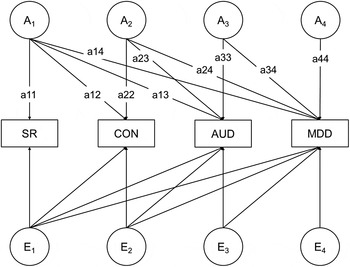
Fig. 1 depicts one of two quadrivariate Cholesky models (Neale & Cardon, Reference Neale and Cardon1992; Loehlin, Reference Loehlin1996) that were fitted to quantify the extent to which (a) the phenotypic covariation between MDD and AUD was explained by SR and CON, and (b) the genetic and environmental covariation between MDD and AUD was explained by additive genetic and unique environmental factors due to SR and CON. In this first model, factor A1 accounts for all of the genetic variation in SR (the variable entered first) and the genetic variation in CON (path a12), AUD (a13), and MDD (a14) that is explained by SR. Factor A2 then accounts for the residual genetic variation (i.e. after accounting for variation in SR) in CON (a22), and any residual genetic variation in AUD (a23) and MDD (a24) that is due to CON. Factor A3 accounts for any residual genetic variation (i.e. after accounting for variation in SR and CON) in AUD (a33), and any residual genetic variation in MDD (a34) due to AUD. Finally, factor A4 accounts for any genetic variation in the risk for MDD, unexplained by SR, CON, and AUD. This same approach was applied to decompose the unique environmental variation using factors E1, E2, E3, and E4.
A model quantifying the extent to which the genetic and environmental covariation between major depressive disorder (MDD) and alcohol use disorder (AUD) is explained by (1) additive genetic and unique environmental factors that influence stress reaction (SR), (2) additive genetic and unique environmental factors that influence behavioral control (CON), and (3) additive genetic and unique environmental factors that influence both SR and CON. For simplicity, this model is illustrated for only one individual from a twin pair. In this model, SR is entered first; thus, the proportion of genetic covariation between MDD and AUD that is attributable to CON (after accounting for genetic variation shared with SR) is [(a23 × a24)/(a13 × a14 + a23 × a24 + a33 × a34)]. To determine the proportion of genetic covariation attributable to SR (after accounting for genetic variation shared with CON), this model was re-run with CON entered first.

The total genetic covariation between MDD and AUD is the sum of pathways (a13 × a14), (a23 × a24), and (a33 × a34). The proportion of genetic covariation between MDD and AUD that is attributable to CON (after accounting for genetic variation shared with SR) is [(a23 × a24)/(a13 × a14 + a23 × a24 + a33 × a34)] and the covariation not explained by CON or SR is [(a33 × a34)/(a13 × a14 + a23 × a24 + a33 × a34)]. The proportion of phenotypic covariation between MDD and AUD that is explained by variance specific to CON is [(a23 × a24) + (e23 × e24)/(a13 × a14 + a23 × a24 + a33 × a34) + (e13 × e14 + e23 × e24 + e33e34)]. To determine the proportion of phenotypic, genetic, and environmental covariation that was unique to SR (i.e. after accounting for CON), the quadrivariate model was re-run with CON entered first and SR entered second. Therefore, the quadrivariate models estimated the proportion of phenotypic, genetic, and environmental covariation between MDD and AUD due to (1) SR only, (2) CON only, (3) both SR and CON, and (4) neither SR nor CON.
Ethical standards
The authors assert that all procedures contributing to this work comply with the ethical standards of the relevant national and institutional committees on human experimentation and with the Helsinki Declaration of 1975, as revised in 2008. The Institutional Review Board at the University of Missouri and the Human Research Ethics Committee at the Queensland Institute of Medical Research approved all data collection.
Results
Phenotypic analyses
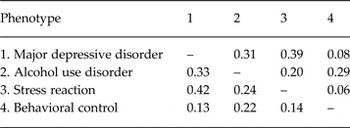
Phenotypic correlations were estimated using proc corr in SAS version 9.4 (SAS Institute, 2002–2010; see Table 1). Subsequently, phenotypic structural equation models (similar to the biometric models) were fitted to determine the proportions of covariance between MDD and AUD that were attributable to SR and CON. Estimates from the quadrivariate model suggested that MDD and AUD were comparably correlated among men (r = 0.34, 95% CI 0.20–0.48) and women [r = 0.32, 95% CI 0.22–0.42)]Footnote † Footnote 1 . The correlation between SR and CON was higher among men [0.14 (0.08–0.19)] than women [0.06 (0.01–0.10)]. Among men, a statistically significant proportion of the correlation between MDD and AUD was accounted for by variance specific to SR [0.31 (0.18–0.44)] and CON [0.20 (0.07–0.33)]. Similar estimates were obtained among women [SR = 0.27 (0.14–0.40); CON = 0.19 (0.06–0.33)]. Therefore, there was evidence that CON explains unique covariation between MDD and AUD, above what is explained by SR. A small proportion of the correlation was also due to variance common to SR and CON. In total, variance unique to and shared by SR and CON explained approximately half of the phenotypic correlation between MDD and AUD. Biometric analyses were conducted to determine the degree to which this covariation was explained by genetic and/or environmental influences on SR and CON.
Phenotypic correlations between major depressive disorder, alcohol use disorder, stress reaction, and behavioral control

Estimates for men are on the lower diagonal, women on the upper diagonal.
Correlations between major depressive disorder (MDD) and alcohol use disorder (AUD) are tetrachoric coefficients. Correlations between MDD and stress reaction (SR), MDD and behavioral control (CON), AUD and SR, and AUD and CON are biserial coefficients. Correlations between SR and CON are Pearson coefficients.
Twin correlations
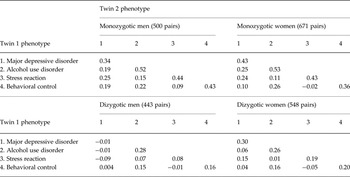
Table 2 displays the within-trait and cross-trait twin correlations. Inspection reveals that the within-trait MZ correlations were larger than the DZ correlations for MDD, AUD, SR, and CON, which implicates genetic influences for all of the phenotypes studied. In addition, the cross-trait MZ correlations were larger than the DZ correlations for MDD, AUD, SR, and CON, which implicates genetic influences on the covariation between these traits.
Within-trait and cross-trait twin correlations between major depressive disorder, alcohol use disorder, stress reaction, and control

There were also 701 twins from incomplete pairs (153 monozygotic men, 151 monozygotic women, 216 dizygotic men, 181 dizygotic women).
Biometric model fitting
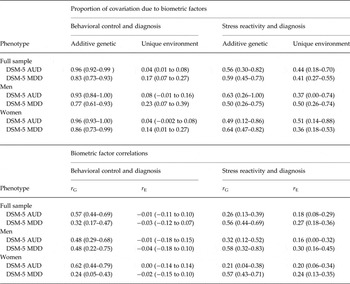
Results from the bivariate biometric models are displayed in Table 3. These models fit very well (root mean square error of approximation <0.02). Notably, additive genetic factors explained nearly all of the covariation between CON and AUD (0.96) and a substantial proportion of the covariation between CON and MDD (0.83). Genetic contributions to the covariation between SR and the two disorders were less substantial (AUD: proportion A = 0.56, MDD: proportion A = 0.59). Genetic and environmental correlations were also estimated between the psychiatric and personality measures. Whereas SR demonstrated genetic and environmental overlap with psychiatric outcomes, CON demonstrated only genetic overlap.
Bivariate behavior genetic model estimates of the proportion of covariation for psychiatric diagnoses [major depressive disorder (MDD), alcohol use disorder (AUD)] and personality measures (behavioral control, stress reactivity) attributed to genetic and environmental factors, and genetic and environmental correlation estimates

AUD, Alcohol use disorder; MDD, major depressive disorder.
Values in parentheses are 95% confidence intervals. Some confidence intervals exceeded possible values and were bounded at 1.00.
Not shown are model estimates for the proportion of covariation between AUD-MDD [A = 0.63 (0.41–0.85), E = 0.37 (0.15–0.59)], and the biometrical factor correlations among AUD and MDD [full sample: r G = 0.44 (0.28–0.60), r E = 0.22 (0.09–0.36); men: r G = 0.40 (0.11–0.68), r E = 0.31 (0.11–0.50); and women: r G = 0.47 (0.28–0.66), r E = 0.15 (−0.03 to 0.34)].
A quadrivariate biometric model was constructed to decompose the genetic and environmental covariance between AUD and MDD into CON and SR (see Supplementary material for model-fitting results). An initial model included all three biometric factors (ACE), and a nested model fixed variance due to C at zero without a significant decrement in fit. Given the negligible influence of C, AE models were carried forward. We first fit an AE model in which SR was entered first, in order to derive genetic and environmental estimates specific to CON. Within this model, constraining parameters to be the same across men and women did not provide a significant decrement in fit, suggesting that there were no sex differences in the sources of covariation between MDD and AUD (see Supplementary material). The phenotypic correlation between MDD and AUD in the constrained model was 0.33, of which approximately two-thirds was explained by genetic influences [A = 0.63 (0.41–0.85)] and one-third was explained by unique environmental influences [E = 0.37 (0.15–0.59)].
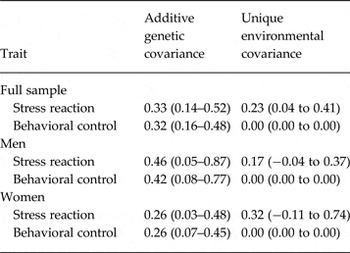
The standardized estimate for the genetic parameter from SR to CON (path a12) was low and non-significant [0.002 (−0.01 to 0.02)], and constraining it to zero did not significantly worsen model fit. Further, after accounting for SR, the proportion of environmental covariance explained by environmental influences on CON [(e23 × e24)/(e13 × e14 + e23 × e24 + e33 × e34)] was negligible [0.01 (−0.03 to 0.05)], and paths e23 and e24 could be constrained to zero without a significant decrement in fit (see online Supplementary material). Therefore, CON explained the covariation between MDD and AUD solely via genetic mechanisms: a moderate proportion of the genetic covariance was explained by genetic influences on CON (0.32; see Table 4). In this model, genetic influences both specific to and shared between CON and SR accounted for 66% of the genetic covariation [A = 0.66 (0.38–0.94)], and unique environmental influences explained 20% of the unique environmental covariation [E = 0.20 (0.03–0.38)].
Proportions of the genetic and environmental covariation between major depressive disorder and alcohol use disorder accounted for by genetic and environmental influences specific to stress reaction and behavioral control

Values in parentheses are 95% confidence intervals.
The proportion of environmental covariance explained by environmental influences on Control was negligible (0.01) and was constrained to 0.00 for model-fitting.
We subsequently fit a model in which CON was entered first. Results indicated that both genetic and environmental influences unique to SR accounted for a significant proportion of the genetic (0.33) and environmental (0.23) covariance between MDD and AUD (Table 4). In this model, 71% of the genetic and 23% of the unique environmental covariation between AUD and MDD was explained by both CON and SR [A = 0.71 (0.42–0.995), E = 0.23 (0.04–0.41)].
Discussion
The current study investigated whether transdiagnostic factors, negative emotionality and behavioral control, account for the covariation between MDD and AUD. Consistent with prior work, results suggest that both risk factors account for a statistically significant proportion of the covariation between MDD and AUD (Ellingson et al. Reference Ellingson, Richmond-Rakerd and Slutske2015). Further, nearly all of the covariation explained by control was due to genetic factors, and negative emotionality explained the covariation via genetic and environmental factors. These findings are of particular interest with regard to NIMH's RDoC initiative, which involves ‘shifting the central research focus of the field away from clinical description to more squarely examine aberrant mechanisms. RDoC first aims to identify reliable and valid psychological and biological mechanisms and their disruptions, with an eventual goal of understanding how anomalies in these mechanisms drive psychiatric symptoms’ (p. 631, Sanislow et al. Reference Sanislow, Pine, Quinn, Kozak, Garvey, Heinssen, Wang and Cuthbert2010). As outlined by the RDoC proposal, the trait measures of negative emotionality and behavioral control used in the current study map onto the negative valence (e.g. potential threat) and cognitive (e.g. cognitive/effortful control) systems, respectively (Morris & Cuthbert, Reference Morris and Cuthbert2012).
The extant literature suggests that negative emotionality may increase risk for MDD and other internalizing psychopathology, as distress and negative affect are central to these disorders (Clark & Watson, Reference Clark and Watson1991; Eaton et al. Reference Eaton, Krueger and Oltmanns2011). In contrast, evidence suggests that negative emotionality increases risk for AUD by way of coping motives and alcohol use as a means of affect regulation (Cooper et al. Reference Cooper, Frone, Russell and Mudar1995), which may then increase liability for alcohol-related consequences. Supporting this relation, longitudinal research has found that changes in coping-related drinking motives mediate the association between changes in neuroticism and alcohol-related problems (Littlefield et al. Reference Littlefield, Sher and Wood2010), and genetically-informed research has shown that coping-related drinking motives mediate the genetic overlap between neuroticism and alcohol-related problems (Littlefield et al. Reference Littlefield, Agrawal, Ellingson, Kristjansson, Madden, Bucholz, Slutske, Heath and Sher2011).
With respect to behavioral control, measures such as disinhibition have been linked with AUD and other externalizing psychopathology, as these disorders are characterized by impulsive behavior (Gorenstein & Newman, Reference Gorenstein and Newman1980; Sher & Trull, Reference Sher and Trull1994). There has been considerably less work concerning behavioral control as a risk factor for MDD and other internalizing disorders, but a lack of self-control has been linked to general, negative outcomes (e.g. health behaviors, mortality; Bogg & Roberts, Reference Bogg and Roberts2004). There are several processes by which control-based risk may underlie MDD and AUD. Prior work by our group found that the Effortful Control Scale (subscales of inhibitory control, activational control, attentional control; Derryberry & Rothbart, Reference Derryberry and Rothbart1988) explained a substantial proportion of the covariation between MDD and AUD (Ellingson et al. Reference Ellingson, Richmond-Rakerd and Slutske2015). Given the content of the Effortful Control and MPQ Control scales, low behavioral control may be a risk mechanism via diminished ability to inhibit urges to drink, thus increasing liability for AUD (Sharbanee et al. Reference Sharbanee, Stritzke, Jamalludin and Wiers2014). Similarly, low behavioral control may decrease one's tendency to initiate adaptive activities when a depressed mood is present, thus increasing liability for MDD (Dimidjian et al. Reference Dimidjian, Barrera, Martell, Muñoz and Lewinsohn2011). Alternatively, cognitive/attentional control may increase attentional biases toward stimuli high in emotional valence, such as fixations on potential reward (e.g. craving; Field et al. Reference Field, Mogg, Bradley, Wiers and Stacy2006) or loss/threat (e.g. rumination; Ouimet et al. Reference Ouimet, Gawronski and Dozois2009). Finally, behavioral control may confer risk broadly via maladaptive decision making, resulting in problematic alcohol use, as well as negative life circumstances that make depressive episodes more likely. It will be important for future research to elucidate how control-based processes are associated with MDD and AUD, and potentially general psychopathology (Caspi et al. Reference Caspi, Houts, Belsky, Goldman-Mellor, Harrington, Israel, Meier, Ramrakha, Shalev, Poulton and Moffitt2013).
These findings do not identify specific genetic or environmental factors related to SR or CON that contribute to MDD and AUD. Molecular genetic research is needed to further the progress in this area. Notably, the RDoC proposal suggests that transdiagnostic risk factors, such as the negative valence and control systems, are more likely to map onto the biological systems that drive psychopathology. That being said, the search for genetic markers of personality traits has not yet yielded robust findings, and the current understanding is that any genes identified will be of extremely small effect and require very large samples to be discovered (e.g. Genetics of Personality Consortium et al. Reference de Moor, Verweij, van den Berg, Krueger, Luciano, Arias Vasquez, Matteson, Derringer, Esko, Amin, Gordon, Hansell, Hart, Seppälä, Huffman, Konte, Lahti, Lee, Miller, Nutile, Tanaka, Teumer, Viktorin, Wedenoja, Abecasis, Adkins, Agrawal, Allik, Appel, Bigdeli, Busonero, Campbell, Costa, Davey Smith, Davies, de Wit, Ding, Engelhardt, Eriksson, Fedko, Ferrucci, Franke, Giegling, Grucza, Hartmann, Heath, Heinonen, Henders, Homuth, Hottenga, Iacono, Janzing, Jokela, Karlsson, Kemp, Kirkpatrick, Latvala, Lehtimäki, Liewald, Madden, Magri, Magnusson, Marten, Maschio, Medland, Mihailov, Milaneschi, Montgomery, Nauck, Ouwens, Palotie, Pettersson, Polasek, Qian, Pulkki-Råback, Raitakari, Realo, Rose, Ruggiero, Schmidt, Slutske, Sorice, Starr, St Pourcain, Sutin, Timpson, Trochet, Vermeulen, Vuoksimaa, Widen, Wouda, Wright, Zgaga, Porteous, Minelli, Palmer, Rujescu, Ciullo, Hayward, Rudan, Metspalu, Kaprio, Deary, Räikkönen, Wilson, Keltikangas-Järvinen, Bierut, Hettema, Grabe, van Duijn, Evans, Schlessinger, Pedersen, Terracciano, McGue, Penninx, Martin and Boomsma2015, n > 50 000, 100 + significant genetic associations; Schizophrenia Working Group of the Psychiatric Genomics Consortium et al. Reference Ripke, Neale, Corvin, Walters, Farh, Holmans, Lee, Bulik-Sullivan, Collier, Huang, Pers, Agartz, Agerbo, Albus, Alexander, Amin, Bacanu, Begemann, Belliveau, Bene, Bergen, Bevilacqua, Bigdeli, Black, Bruggeman, Buccola, Buckner, Byerley, Cahn, Cai, Campion, Cantor, Carr, Carrera, Catts, Chambert, Chan, Chan, Chen, Cheng, Cheung, Chong, Cloninger, Cohen, Cohen, Cormican, Craddock, Crowley, Curtis, Davidson, Davis, Degenhardt, Favero, Demontis, Dikeos, Dinan, Djurovic, Donohoe, Drapeau, Duan, Dudbridge, Durmishi, Eichhammer, Eriksson, Escott-Price, Essioux, Fanous, Farrell, Frank, Franke, Freedman, Freimer, Friedl, Friedman, Fromer, Genovese, Georgieva, Giegling, Giusti-Rodríguez, Godard, Goldstein, Golimbet, Gopal, Gratten, Haan, Hammer, Hamshere, Hansen, Hansen, Haroutunian, Hartmann, Henskens, Herms, Hirschhorn, Hoffmann, Hofman, Hollegaard, Hougaard, Ikeda, Joa, Julià, Kahn, Kalaydjieva, Karachanak-Yankova, Karjalainen, Kavanagh, Keller, Kennedy, Khrunin, Kim, Klovins, Knowles, Konte, Kucinskas, Kucinskiene, Kuzelova-Ptackova, Kähler, Laurent, Lee, Lee, Legge, Lerer, Li, Li, Liang, Lieberman, Limborska, Loughland, Lubinski, Lönnqvist, Macek, Magnusson, Maher, Maier, Mallet, Marsal, Mattheisen, Mattingsdal, McCarley, McDonald, McIntosh, Meier, Meijer, Melegh, Melle, Mesholam-Gately, Metspalu, Michie, Milani, Milanova, Mokrab, Morris, Mors, Murphy, Murray, Myin-Germeys, Müller-Myhsok, Nelis, Nenadic, Nertney, Nestadt, Nicodemus, Nikitina-Zake, Nisenbaum, Nordin, O'Callaghan, O'Dushlaine, O'Neill, Oh, Olincy, Olsen, Os, Pantelis, Papadimitriou, Papiol, Parkhomenko, Pato, Paunio, Pejovic-Milovancevic, Perkins, Pietiläinen, Pimm, Pocklington, Powell, Price, Pulver, Purcell, Quested, Rasmussen, Reichenberg, Reimers, Richards, Roffman, Roussos, Ruderfer, Salomaa, Sanders, Schall, Schubert, Schulze, Schwab, Scolnick, Scott, Seidman, Shi, Sigurdsson, Silagadze, Silverman, Sim, Slominsky, Smoller, So, A Spencer CC, Stahl, Stefansson, Steinberg, Stogmann, Straub, Strengman, Strohmaier, Stroup, Subramaniam, Suvisaari, Svrakic, Szatkiewicz, Söderman, Thirumalai, Toncheva, Tosato, Veijola, Waddington, Walsh, Wang, Wang, Webb, Weiser, Wildenauer, Williams, Williams, Witt, Wolen, Wong, Wormley, Xi, Zai, Zheng, Zimprich, Wray, Stefansson, Visscher, Adolfsson, Andreassen, Blackwood, Bramon, Buxbaum, Børglum, Cichon, Darvasi, Domenici, Ehrenreich, Esko, Gejman, Gill, Gurling, Hultman, Iwata, Jablensky, Jönsson, Kendler, Kirov, Knight, Lencz, Levinson, Li, Liu, Malhotra, McCarroll, McQuillin, Moran, Mortensen, Mowry, Nöthen, Ophoff, Owen, Palotie, Pato, Petryshen, Posthuma, Rietschel, Riley, Rujescu, Sham, Sklar, Clair, Weinberger, Wendland, Werge, Daly, Sullivan and O'Donovan2014). Notably, de Moor et al. (Reference de Moor, Verweij, van den Berg, Krueger, Luciano, Arias Vasquez, Matteson, Derringer, Esko, Amin, Gordon, Hansell, Hart, Seppälä, Huffman, Konte, Lahti, Lee, Miller, Nutile, Tanaka, Teumer, Viktorin, Wedenoja, Abecasis, Adkins, Agrawal, Allik, Appel, Bigdeli, Busonero, Campbell, Costa, Davey Smith, Davies, de Wit, Ding, Engelhardt, Eriksson, Fedko, Ferrucci, Franke, Giegling, Grucza, Hartmann, Heath, Heinonen, Henders, Homuth, Hottenga, Iacono, Janzing, Jokela, Karlsson, Kemp, Kirkpatrick, Latvala, Lehtimäki, Liewald, Madden, Magri, Magnusson, Marten, Maschio, Medland, Mihailov, Milaneschi, Montgomery, Nauck, Ouwens, Palotie, Pettersson, Polasek, Qian, Pulkki-Råback, Raitakari, Realo, Rose, Ruggiero, Schmidt, Slutske, Sorice, Starr, St Pourcain, Sutin, Timpson, Trochet, Vermeulen, Vuoksimaa, Widen, Wouda, Wright, Zgaga, Porteous, Minelli, Palmer, Rujescu, Ciullo, Hayward, Rudan, Metspalu, Kaprio, Deary, Räikkönen, Wilson, Keltikangas-Järvinen, Bierut, Hettema, Grabe, van Duijn, Evans, Schlessinger, Pedersen, Terracciano, McGue, Penninx, Martin and Boomsma2015) used polygenic risk scores (i.e. a composite of the top risk alleles) to explain 1% of the variance in neuroticism from the top markers via meta-analysis of 27 studies and over 63 000 participants.
The twin correlations in the current study also suggest potential sex differences in how behavioral control and negative emotionality confer risk for psychopathology. In particular, there was a notable difference in DZ correlations involving MDD for men and women, but MZ correlations were similar for men and women. Future research may benefit from including opposite-sex twin pairs to investigate whether quantitative or qualitative sex differences confer risk for psychopathology via behavioral control and negative emotionality (Neale & Maes, Reference Neale and Maes1999; Neale et al. Reference Neale, Røysamb and Jacobson2006).
Limitations
There are at least three limitations that should be considered when interpreting the findings of the current study. Given that the sample was a cohort of middle-aged Australian adults, the results may not generalize to other ages or samples, particularly those with different degrees of risk for alcohol or mood-related problems (e.g. adolescence, emerging adulthood). In addition, self-report measures of personality were used. Much of the work on ‘bottom-up’ emotional reactivity and ‘top-down’ cognitive control uses laboratory-based measures and/or neuroimaging methods. Applying these alternative measurement methods to similar cognitive and affective factors will be important for understanding how these factors confer risk for both MDD and AUD. Regarding the application of these findings to constructs described in RDoCs, the use of categorical diagnoses rather than symptom counts may be viewed as a limitation. These concerns may be allayed by the analytic approach, however, which assumes that the distributions of liability for MDD and AUD are continuous and normal, and diagnoses represent cases in which liability crosses a threshold (i.e. liability-threshold model; Neale & Cardon, Reference Neale and Cardon1992). Finally, and as noted above, the current analytic approach allows important inferences to be made about the aggregate genetic liability to these disorders, but molecular genetic research will be important for identifying specific genes that contribute to the risk for internalizing and externalizing psychopathology related to cognitive and negative valence systems. In addition, the cross-twin, cross-trait correlations in the current study suggest the presence of non-additive genetic influences (i.e. dominance or epistasis), with MZ twin estimates more than twice that of DZ twin estimates. The current sample was underpowered to adequately investigate these possibilities, but future behavior and molecular genetic studies could address this possibility.
Conclusions
The current study shows that trait measures of behavioral control account for the covariation between MDD and AUD (Li & Sinha, Reference Li and Sinha2008; Field et al. Reference Field, Wiers, Christiansen, Fillmore and Verster2010; Kanske & Kotz, Reference Kanske and Kotz2012; Ellingson et al. Reference Ellingson, Richmond-Rakerd and Slutske2015) beyond what is accounted for by negative emotionality (Khan et al. Reference Khan, Jacobson, Gardner, Prescott and Kendler2005). Importantly, this is the first study to demonstrate that both behavioral control and negative emotionality confer risk for this covariation via genetic factors, and that negative emotionality also confers risk for this covariation via environmental factors. Given the distinct role that behavioral control appears to play in the covariation between these two distinct disorders, future research could investigate whether behavioral control underlies risk for general psychopathology, as has been shown for negative emotionality (Tackett et al. Reference Tackett, Lahey, van Hulle, Waldman, Krueger and Rathouz2013). Additional research will also be needed for identifying specific risk factors that comprise this genetic and environmental risk. In addition, longitudinal research will be important for disentangling the temporal relation between MDD, AUD, behavioral control, and negative emotionality. Finally, these findings suggest that behavioral control and negative emotionality may be important intervention targets to address a wide range of mental health problems.
Supplementary material
For supplementary material accompanying this paper visit http://dx.doi.org/10.1017/S0033291716001525.
Acknowledgements
Thanks to Bronwyn Morris and Megan Fergusson for coordinating the data collection for the twins, and to David Smyth, Olivia Zheng, and Harry Beeby for data management of the Australian Twin Registry. We thank the Australian Twin Registry twins for their continued participation.
Funding for this study was provided by the National Institutes of Health grants R01MH66206 (W.S.S.), F31AA022294 (J.M.E.), and F31AA023419 (L.S.R.).
Declaration of Interest
None.