INTRODUCTION
The biodiversity of the Mediterranean is gradually increasing due to the continual penetration of biota through the Suez Canal and the Strait of Gibraltar. Among the 573 alien metazoans reported from the Mediterranean, 116 are fish (Galil, Reference Galil2008, Reference Galil2009; Golani et al., Reference Golani, Massuti, Orsi-Relini and Quignard2009). The number of alien fish species in the Levantine basin exceeds 75, the great majority of which are of Red Sea origin (Goren et al., Reference Goren, Srern, Galil and Diamant2010).
In recent years, divers have reported observing an unknown grouper in shallow rocky habitats along the Mediterranean coast of Israel. Recently, a fishermen managed to spear a specimen that was identified as Mycteroperca fusca (Lowe, Reference Lowe1838), an eastern Atlantic species known from the Azores, Madeira, Cape Verde, and the Canary Islands (Heemstra & Randall, Reference Heemstra and Randall1993; Froese & Pauly, Reference Froese and Pauly2009).
Abbreviations: MMF, Museum Municipal do Funchal, Madeira; TAU, fish collection of Tel Aviv University; SL, standard length; TL, total length.
SYSTEMATICS
Serranus fuscus Lowe, Reference Lowe1838: 196, type locality: off Madeira. Neotype: MMF 24928. designated by Heemstra, Reference Heemstra1991: 48–49.
Mycteroperca fusca: Heemstra, Reference Heemstra1991: 48–51, figure 14, plate 1, figure 2; Heemstra & Randall, Reference Heemstra and Randall1993: 265, figure 462, plate 26, figures a, b, c.
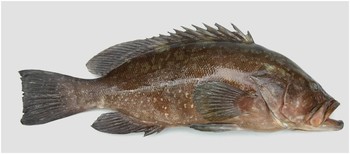
Mycteroperca fusca (Lowe, Reference Lowe1838) collected off Ga'ash, Israel (TAU–P. 13727). Photograph: O. Riter.

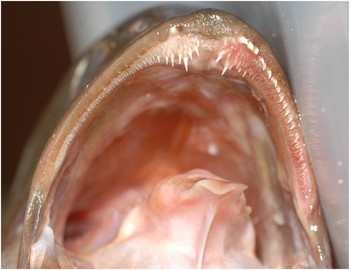
Upper jaw of Mycteroperca fusca (TAU–P. 13727). Photograph: O. Riter.

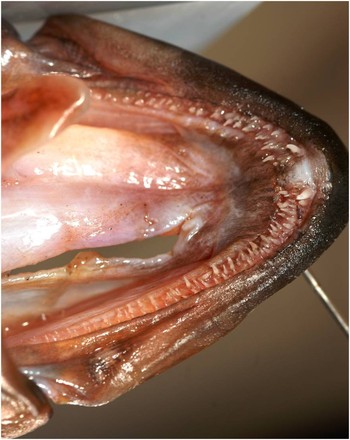
Lower jaw of Mycteroperca fusca (TAU–P. 13727). Photograph: O. Riter.

MATERIAL EXAMINED
TAU–P. 13727, off Ga'ash (near Tel Aviv) Israel 32°13′38″N 34°48′47″E, 12 m depth, coll. by A. Zilberg, 25 March 2010; SL, 352 mm; TL, 436 mm. Additional data from 30 specimens of Mycteroperca fusca (including measurements from 18 specimens of 13–51 cm SL) are given in parentheses.
DESCRIPTION
Brief description of the specimen: head and body brown with irregular pale blotches and spots of various sizes scattered on body and head. The larger blotches are more prominent on the upper half of the body (Figure 1). Maxillary pale streak is visible. Preopercle rear edge serrate, with a shallow notch above the rounded corner, which forms a low lobe with serrae slightly larger than those on its upper edge. Teeth on upper jaw arranged in a band that widens anteriorly with 13 caniniform outer teeth. Front teeth brush-like (Figure 2). Teeth on lower jaw, slender, caniniform, arranged in two rows; the two anterior teeth are enlarged (Figure 3). Fine teeth on palatines and vomer.
Meristic data: lateral scale series 96 (96–106); scale rows between lateral line and middle dorsal fin spines 16 (16, 17); lateral line scales 86 (72–78); 16 rows of scales between lateral line and middle dorsal fin spines; 22 rows of scales between lateral line and anus. Caudal fin truncate, with 15 branched rays (15 branched rays); dorsal fin with 11 spines and 16 rays (11 spines and 14–16 rays); the interspinous membranes distinctly incised; the rear end of fin slightly pointed; anal fin with three spines and ten rays (3 spines and 10–12 rays), the fin margin distinctly pointed posteriorly; pectoral fin, rounded, symmetric, with 17 rays (15–17 rays). Gill-rakers count: 10 / 22 (11–15 / 20–24).
Body proportions: standard length (SL) 81% total length; head length (HL) 36% SL (30–36% SL); body depth at origin of dorsal fin 33% SL (30–36% SL); body depth at origin of anal fin 31% SL; eye diameter 12% HL; interorbital width 26% HL; distance between orbit and upper lip 9% HL; distance from upper lip to origin of dorsal fin 28% SL; distance between upper lip–orbit 26% HL; distance from upper lip to origin of anal fin 67% SL; distance from upper lip to origin of dorsal fin 40% SL; longest pectoral-fin ray 24% SL; longest pelvic-fin ray 22% SL.
Mycteroperca fusca is distinguished from its two Atlantic congeners, M. rubra and M. acutirostris, by the following key:
1 Total gill-rakers 48–55; maxilla width 4.4–5.8% SL (for fish 10–34 cm SL); (western Atlantic) … … … … … … … … … … … … … … … … … …M. acutirostris
— Total gill-rakers 32–49; maxilla width 3.8–5.2% SL (for fish 13–55 cm SL) … … … … … … … … … … … .2
2 Lower limb gill-rakers 28–31 (eastern Atlantic) … … … … … … … … … … … … … … … … … . M. rubra
— Lower-limb gill-rakers 20–24 (Azores, Madeira, Canary and Cape Verde Islands plus Mediterranean coast of Israel) … … … … … … … … … … … … . .M. fusca
DISCUSSION
Mycteroperca fusca is an additional fish species to the list of 34 alien species of Atlantic origin found in the Mediterranean (Golani et al., Reference Golani, Massuti, Orsi-Relini and Quignard2009). The great majority of these species are known from the western Mediterranean, and some of them were also reported from the eastern Mediterranean (Ben-Tuvia & Golani, Reference Ben-Tuvia and Golani1984; Golani & Sonin, Reference Golani and Sonin1996; Ben Souissi et al., Reference Ben Souissi, Golani, Méjri and Capapé2005), but only a few, such as Arius parkii Günther, 1864, have been reported solely from the Levantine basin (Golani et al., Reference Golani, Massuti, Orsi-Relini and Quignard2009). This appearance of M. fusca, a large Atlantic fish, at the eastern margin of the Mediterranean, and without having been spotted on the way, raises the question of the route of its arrival. A reasonable possibility is that M. fusca entered the Mediterranean through the Strait of Gibraltar, as many Atlantic species do, then expanded its distribution along the North African coast and was overlooked or confused with Mycteroperca rubra. It is also possible that the fish was introduced in the ballast water of a ship. The recent finding of two fish species that probably arrived in ballast water (Goren et al., Reference Goren, Gayer and Lazarus2009) indicates this as a realistic option. Another option is that this fish is an escapee from a mariculture farm. As far as we know, no cultivation of this species has been reported, but as farmers are often discreet in reporting attempts to cultivate wild fish, this possibility should not be ignored.
According to Heemstra (Reference Heemstra1991), Mycteroperca fusca is known only from the Macaronesian Islands: Madeira, the Azores, Canaries, and the Cape Verde Islands.
Mycteroperca fusca has been declared an endangered species by the IUCN (Rocha et al., Reference Rocha, Ferreira, Choat, Craig, Sadovy, Bertoncini and Sampaio2010). The presence of a population of this species in the eastern Mediterranean and the possibility that the fish might occur along the entire southern Mediterranean, raises the need to reassess its status in the IUCN Red List.
ACKNOWLEDGEMENTS
We are very grateful to Mr A. Zilberg who took up the challenge to catch the fish. We thank Ms N. Paz for editing the manuscript and O. Riter for the photographs.