1 Introduction
‘Coronal harmonies’ are phonological patterns in which certain coronal consonants in a morphological domain are required to match along some dimension, such as the posture of the tongue tip-blade or place of constriction (dental vs. alveolar vs. postalveolar). Cross-linguistic surveys of coronal harmony are found in Shaw (Reference Shaw, Paradis and Prunet1991), Gafos (Reference Gafos1996), Hansson (2001) and Rose & Walker (Reference Rose and Walker2004). Kinyarwanda (Bantu; Rwanda) displays an example of coronal harmony. In Kinyarwanda, restrictions are enforced over combinations of sibilant fricatives in a stem. If a postalveolar (retroflex) fricative is preceded by another coronal sibilant fricative, the preceding fricative must also be postalveolar. Thus, a stem like [-ʂiːʐe] ‘level off (perf)’ is acceptable, whereas one like [-siːʐe] does not occur. When sibilant fricatives are in non-adjacent syllables, harmony is optional. In this context, intervening non-coronal consonants do not interfere, as in [-aʂamuʐe] ‘open one's mouth wide (perf)’. Coronal harmonies are long-distance in the sense that the matching requirement is enforced not only over coronal consonants in clusters (if such clusters exist in the language) but also over coronals separated by an intervening segment. In some languages, Kinyarwanda included, harmony operates even among coronals separated by multiple syllables. These contexts where consonants intervene form the pivot of our focus.
The long-distance nature of coronal harmony has given rise to a debate that spans phonology and phonetics. Some researchers have claimed or speculated that the tongue tip-blade gesture or feature for which harmony is enforced can occur continuously through segments that intervene between harmonising coronals (Flemming Reference Flemming1995, Steriade Reference Steriade1995, Gafos Reference Gafos1996, Ní Chiosáin & Padgett Reference Ní Chiosáin and Padgett1997, Wiltshire & Goldstein Reference Wiltshire, Goldstein, Austin and Lawson1997, Hamann Reference Hamann2003). This scenario, which we refer to as the Gesture Extension model, grew out of the observation that tip-blade gestures are largely independent of the articulators involved in non-coronal consonants (e.g. lips for labials, tongue dorsum for velars) and of tongue postures for vowels (involving the tongue body). This model posits that the tip-blade gesture involved in the harmony is present during intervening segments but without significant perceptible effect, with the result that intervening segments are seemingly transparent, i.e. they have no perceived coronal quality. For example, in the case of Kinyarwanda coronal harmony, the tip-blade gesture characterising postalveolar fricatives would persist during segments that intervene between harmonising sibilants, but without having sufficient acoustic consequences to be noticed as such by listeners. However, an alternative scenario has been posited for (certain) coronal harmonies, namely one in which the relevant tip-blade gesture is genuinely interrupted by intervening segments, resulting in separate instances of the tip-blade gesture in the harmonising consonants (Clements Reference Clements and Hall2001, Hansson Reference Hansson2001, Rose & Walker Reference Rose and Walker2004, McCarthy Reference McCarthy, Bateman, O'Keefe, Reilly and Werle2007).Footnote 1 We call this the Repeated Gesture model. An observation cited in support of this model is that coronal harmonies typically do not show blocking effects, i.e. they are not obstructed by the occurrence of certain intervening segments (cf. Hansson Reference Hansson2007).Footnote 2
This debate invites the instrumental investigation of coronal harmonies to examine whether the relevant tongue tip-blade gesture can be evidenced to occur in a systematic fashion during transparent segments. The present study pursues this by investigating the production of consonants in Kinyarwanda coronal harmony. The Kinyarwanda harmony system has previously been referred to as ‘sibilant harmony’; however, here we leave open the question of whether other segments besides sibilants are affected by the harmony system. This research examines the production of sibilant fricatives in the language, as well as the production of certain consonants that appear to be transparent in the harmony and of ones that block harmony. Blocking in coronal harmonies is quite rare; the only other language for which it has been reported is Sanskrit (see the discussion in Hansson Reference Hansson2001 and Rose & Walker Reference Rose and Walker2004). Kinyarwanda therefore offers a unique opportunity to explore transparency together with blocking in the coronal harmony of a contemporary language. This study reports on kinematic data collected to examine Kinyarwanda coronal harmony. The data provide a means of examining whether transparent consonants are articulatorily transparent, as claimed in the Repeated Gesture model, or whether they are merely perceived as transparent, because of the tip-blade gesture's minimal acoustic-auditory effect, as postulated in the Gesture Extension model.
1.1 Coronal harmony in Kinyarwanda
This study examines the standard dialect of Kinyarwanda, which is taught in schools and used in mass media.Footnote 3 The consonants of Kinyarwanda are given in (1).
(1) Kinyarwanda consonant inventory

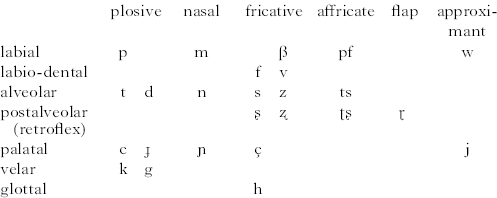
There has been debate about the articulation of certain coronal consonants. Walker & Mpiranya (Reference Walker and Mpiranya2006) report preliminary acoustic and articulatory observations that are consistent with characterising the postalveolar obstruents and flap as retroflex. Kimenyi (Reference Kimenyi1979: 2) labelled the postalveolar obstruents as ‘alveopalatal’, but did not report any instrumental analysis. Classification of the flap with the postalveolar consonants is consistent with Sibomana (Reference Sibomana1974: 5) (cf. Kimenyi Reference Kimenyi1979). We transcribe and refer to the coronals in question as retroflex here, but also investigate their articulation in our study. The following nasal–obstruent articulatory sequences occur in the language: [mb ɱf ɱv ns nz ɳʂ ɳʐ ɳɖ ɲc ɲː ɲg].Footnote 4 The stop that we transcribe as [ɳɖ] has usually been characterised as alveolar in prior descriptions (e.g. Kimenyi Reference Kimenyi1979: 3), which we presume were based on auditory perception, but Sibomana (Reference Sibomana1974: 8) characterised it as postalveolar. As we discuss in §3.1, we find articulatory evidence that this consonant is retroflex. Kinyarwanda has the following vowels /i iː e eː a aː o oː u uː/. Tones are low, high, rising and falling.
Kinyarwanda displays a canonical Bantu morphological structure, in which the stem consists of the root+suffixes, with prefixes external to the stem domain. Coronal harmony is enforced within Kinyarwanda stems only. In those transcriptions below that exclude prefixes, the root is preceded by ‘-’, according to convention.
The data in (2) show that sibilant fricatives occur in a contrastive distribution when the stem does not contain another coronal consonant.
(2)
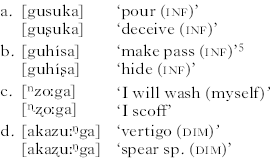
We base our description of Kinyarwanda coronal harmony on Walker & Mpiranya (Reference Walker and Mpiranya2006). Previous descriptions include Kimenyi (Reference Kimenyi1979) and Coupez (Reference Coupez1980). The harmony requires that a sibilant fricative be realised as retroflex when it precedes [ʂ ʐ] in an adjacent syllable. The phonotactics of Kinyarwanda prevent clusters of sibilants; so sibilants are minimally separated by a vowel. As a result of the harmony, sequences in adjacent syllables such as [… s … ʐ …] are excluded (under any voicing combination in the fricatives), whereas sequences like [… ʂ … ʐ …] are permissible (again, under any voicing combination). Prenasalised fricatives also participate.
Stems illustrating the harmony are given in (3). (It may be observed in these stems that the agentive suffix /-i/ and the perfective formation /-i-e/ cause a stem-final alveolar fricative to become retroflex. In some contexts with an underlying suffix /-i-/, the perfective is expressed with the allomorph [-iʐe], which becomes [-eʐe] in (5) below, through vowel-height harmony.)
(3)

Following terminological custom, the retroflex fricative that comes later in the stem is referred to as the trigger in this harmony system and the sibilant fricative that precedes it as the target.
The harmony enforces agreement only in sibilant fricatives that precede a retroflex fricative, as evident by comparing the stem [-ʂise] ‘penetrated’ with the harmonising stems in (3). The example [-ʂise] also demonstrates that the harmony is asymmetric in the sense that alveolar fricatives do not trigger harmony in a preceding retroflex fricative.
Coronal harmony is optional when the trigger and target are in non-adjacent syllables, as shown in (4).Footnote 6 Segments that intervene between harmonising sibilants are characterised as transparent, because they are not perceived as noticeably different from their counterparts in non-harmony contexts. Transparent consonants are non-coronals and [ɽ]. Comparison with infinitive or imperfective forms that lack a harmony trigger demonstrates that optional retroflex fricatives arise from coronal harmony.
(4)

A notable property of the harmony system is that it involves blocking by alveolar and retroflex stops (5a, b), palatal consonants (5c) and the alveolar affricate, which also does not undergo harmony (5d).
(5)
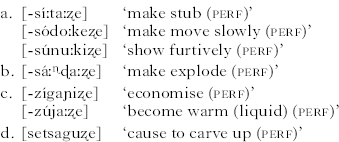
Unlike the data in (4), an alternative form where the first sibilant is retroflex is not available in (5). Yet there is no general distributional restriction that would prevent a retroflex fricative from occurring in a syllable preceding the consonants in question, as shown by examples like [guʂiːtura] ‘to scrape off’, [umuʐiɲá] ‘anger’, [imiʂáːjaːjo] ‘slow dance (sp.)’, [guʂáːɳɖika] ‘to attach’, [kuʐuːɳɖika] ‘to keep in mouth’.
Only retroflex sibilants trigger harmony. That [ɳɖ] does not trigger retroflex harmony is seen in (5b). In the absence of a sibilant trigger for harmony, retroflex and alveolar fricatives display a contrastive distribution before [ɽ], as seen in (6a) vs. (b). As [ʈʂ] is rare in post-initial position in the stem, there are no examples with which to test whether it would trigger harmony.
(6)
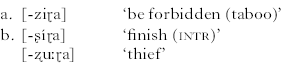
In summary, Kinyarwanda coronal harmony requires that a sibilant fricative preceding a retroflex fricative be realised as retroflex. Intervening segments are not perceptibly affected. The harmony is obligatory in adjacent syllables and optional in non-adjacent syllables. As for the other coronals, [ɽ] is transparent, but retroflex stops, palatal consonants, and alveolar stops and affricates block harmony.
1.2 Research questions for this study
Our research questions concern the characterisation of various consonants' articulations and their roles within Kinyarwanda coronal harmony. In what follows, contexts are schematised with ‘V’ symbolising a vowel and the embedded square brackets indicating the consonant whose articulation is being measured.
General articulation. We investigate the geometry of the tongue tip and blade in the following consonants: [ʂ ʐ] (vs. [s z] respectively), [ɳɖ] (vs. [t]) and [ɽ] (vs. [t]).Footnote 7
Simple harmony. We investigate whether retroflex fricatives in a target context for coronal harmony (harmony context […[ʂ]Vʂ…]) are produced with a tongue tip-blade geometry that is not distinct from their counterparts in a non-harmony context ([…[ʂ]Vt…]).
Blocking:
(i) Blocking consonants. Cross-linguistically, blocking consonants may differ in whether they are affected by or exhibit the harmonising gesture. With this in mind, we investigate whether there is a difference in the geometry of the tongue tip-blade during [t] and [ɳɖ] in a blocking context ([…sV[t]Vʐ…, …sV[ɳɖ]Vʐ…]) vs. a non-harmony context ([…sV[t]Vz…, …sV[ɳɖ]Vz…]).
(ii) Potential targets that precede blockers. We investigate whether consonants that are reported to block harmony genuinely block it. We examine whether there is a difference in the geometry of the tongue tip-blade during an alveolar fricative in a blocking context ([…[s]VtVʐ…, …[s]VɳɖVʐ…]) vs. a non-harmony context ([…[s]VtVz…, …[s]VɳɖVz…]). If [t] and [ɳɖ] block coronal harmony, the fricatives under comparison should not differ significantly in their tip-blade posture, whereas if harmony affects the fricative in the blocking context, the fricatives should differ significantly in this respect.
(iii) The non-trigger status of [ɳɖ]. We examine whether [ɳɖ] triggers harmony (although it is not reported to). We evaluate whether there is a difference in the geometry of the tongue tip-blade during an alveolar fricative in an [ɳɖ] context ([…[s]Vɳɖ…]) vs. during a retroflex fricative (pooling across the contexts of non-harmony […[ʂ]Vt…] and harmony […[ʂ]Vʂ…]). If [ɳɖ] triggers harmony, one could expect the alveolar and retroflex fricatives under comparison not to differ significantly in tip-blade posture; otherwise they should differ significantly in this regard.
‘Transparent’ non-coronal consonants. To empirically assess the Gesture Extension vs. Repeated Gesture models for Kinyarwanda coronal harmony, we investigate whether retroflexion is present in harmony contexts during non-coronal consonants that are perceived as transparent. We ask whether there is a difference in the geometry of the tongue tip-blade during [m] and [k] in a harmony context ([…ʂV[m]Vʐ…, …ʂV[k]Vʐ…]) vs. a failed harmony context ([…sV[m]Vʐ…, …sV[k]Vʐ…]) vs. a non-harmony context ([…sV[m]Vz…, …sV[k]Vz…]). ‘Failed harmony’ refers to the pronunciation option in which coronal harmony fails to occur in non-adjacent syllables. A finding of no significant difference for the tip-blade posture during [m] and [k] across these contexts would be consistent with the Repeated Gesture model. If the tip-blade posture during [m] and [k] in the harmony context was like that of the retroflex fricatives, and significant differences were only found between the harmony context vs. each of the others, then the Gesture Extension model would be supported for Kinyarwanda.
The status of [ɽ] in harmony: (i) The non-trigger status of [ɽ]. We examine whether there is a difference in the geometry of the tongue tip-blade during an alveolar fricative in an [ɽ] context ([…[s]Vɽ…]) vs. a non-harmony context ([…[s]Vz…]). If no significant difference was found in the two contexts, that would be consistent with [ɽ] not triggering harmony. If a difference was found in the two contexts, then it would be necessary to examine the difference further to assess its implications.
(ii) ‘Transparent’ [ɽ]. We ask if there is a difference in the geometry of the tongue tip-blade during [ɽ] in a harmony context ([…ʂV[ɽ]Vʐ…]) vs. a failed harmony context ([…sV[ɽ]Vʐ…]) vs. a non-harmony context ([…sV[ɽ]Vz…]). A finding of no significant difference for [ɽ] in the harmony context vs. the other contexts would be consistent with harmony not affecting [ɽ]. If differences were found, further data analysis would be necessary to assess their source and theoretical implications.
2 Method
The Carstens Articulograph AG200 EMA magnetometer system was used to track horizontal and vertical movements of receivers adhered to the tongue tip and blade. In addition to two reference receivers on the bridge of the nose and on the maxillary gum, two receivers were placed on the tongue: on the tongue tip, 7 mm behind the extended tip, and on the tongue blade, 7 mm behind the receiver on the tongue tip. All receivers were placed in the midsagittal plane. The kinematic data were sampled at 200 Hz, and the resulting position function (and velocities) were low-pass filtered at 15 Hz. An audio recording, sampled at 16 kHz, was made simultaneously with the collection of articulatory data. Articulatory data were corrected for head movement and rotated to the occlusal (bite) plane, which defines the x-axis in the head-based coordinate system.
Subject. Articulatory kinematic data were acquired from one native male speaker of the standard dialect of Kinyarwanda (the third author of this paper), using the EMA magnetometer system. This subject was raised in Rwanda, where he lived until he was 28, after which he resided in France, where he continued to speak Kinyarwanda at home. At the time the data were collected, he had been residing in the United States for five months. In addition to Kinyarwanda, which is his first language, the subject is fluent in Swahili, French and English. This is the only articulatory/kinematic dataset of Kinyarwanda of which we are aware, and as such, it contributes not just to the phonological questions of interest but also to the phonetic knowledge of the language. Our findings are for the particular speaker under study. Although we do not have reason to expect our findings to be unique to this speaker, we have no direct evidence which would allow us to extend them to other speakers of this dialect (see Gick et al. Reference Gick, Pulleyblank, Campbell and Mutaka2006 for a recent acoustic and lingual ultrasound study on related topics in Kinande vowel harmony).
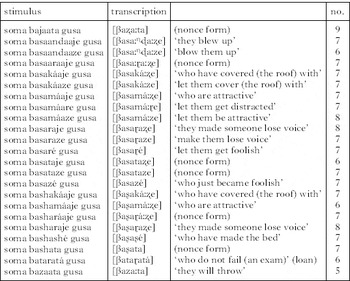
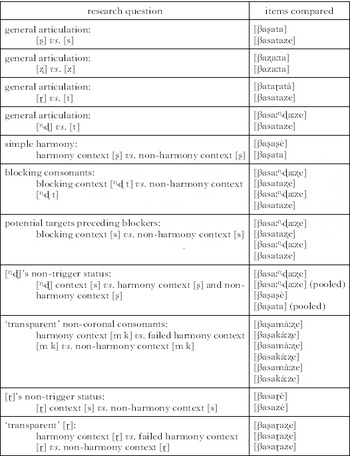
Stimuli. The target words for this study are given in Table I and the comparisons in Table II (seven additional words were recorded that are not analysed here).Footnote 8 Where possible, actual words of Kinyarwanda were used; only six nonce forms were used, all morphophonologically well-formed in the language. Words were pronounced in the carrier phrase [soma]—[gusa] ‘read—only’. Words were separated into seven blocks. Each word occurred once within a block, resulting in seven tokens for each word; the order within each block was randomised. Words were printed with their carrier phrases on a page that was presented to the subject to speak aloud at a normal speech rate.Footnote 9 Pairs of word forms in which harmony has optionally applied or not applied between fricatives in non-adjacent syllables have the same meaning. The spelling of the stimuli indicated to the subject whether to produce the word with or without harmony. It was later verified that the speaker produced the form that matched the spelling by listening to the audio recording. Three stimuli are not included in the comparisons in the table, but were analysed in follow-up to results obtained for [ɽ]. The number of viable recordings for each word is notated in Table I. The total number of tokens collected for analysis in this study was 160.Footnote 10
The collected data. The first column gives the stimuli as presented to the subject to speak aloud. The second column gives the transcription of the target word; its English gloss is given in the third column. The final column gives the number of viable tokens recorded for each target word.

Target words compared for each research question. Where indicated, an item is pooled with the one immediately above it.

As is evident in Table II, the stimuli do not form a fully crossed factorial design. In order to test our hypotheses, we examine subsets of the data with specific contrasts that address the specific questions laid out in §1.2. In our analyses, we look at the data both globally and in specifically controlled segmental contexts.
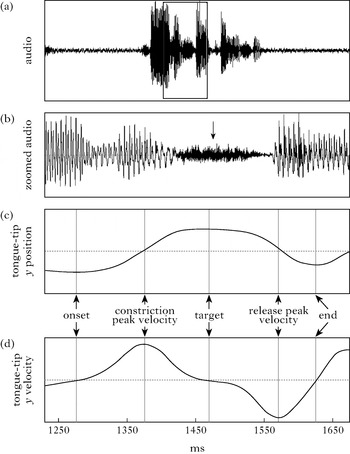
Data analysis: kinematic landmarks. Kinematic landmarks were algorithmically identified for the alveolar and postalveolar consonants on the basis of the movement trajectory of the tongue-tip receiver in the vertical (y) dimension for the creation of the coronal consonant constriction. Over the course of a consonantal constriction and release, five significant articulatory landmarks were identified, based on tongue-tip y-velocity trajectory (see Fig. 1). Marking the onset of the constriction movement, a y-velocity zero-crossing occurs, generally during the acoustic interval of the preceding vowel. This is followed by a point at which y-velocity reaches a peak as the coronal constriction is taking place. Next, the consonant's constriction extremum is defined by a second y-velocity zero-crossing. As the constriction is released, a second y-velocity extremum occurs. The end of the interval of articulatory consonant release is identified by a third tongue-tip velocity zero-crossing.
A token of [soma baʂata gusa] ‘read (nonce word) only’, showing the audio signal (a), zoomed audio signal (b), the tongue-tip y-position trajectory (c) and tongue-tip y-velocity trajectory (d). Maximum displayed tongue-tip y position is −15 mm and minimum is −26 mm. In the trajectories, the algorithmically defined timepoints of consonant onset, target and end (determined by velocity zero crossings) and of constriction and release peak velocities (determined by velocity extrema) are shown. The arrow indicates the [ʂ] of [baʂata].

Using a modified version of the Matlab-based MAVIS environment (Tiede et al. Reference Tiede, Vatikiotis-Bateson, Hoole and Yehia1999) and a synchronised waveform display, the time and tip and blade y-position were recorded at each of the five articulatory landmarks for the consonant.Footnote 11Figure 1 provides an example data token [baʂata] with the timepoints marked (onset, constriction peak velocity, target, release peak velocity, end). The interval from consonant onset to end is the constriction+release interval. Henceforth, we refer to this as the ‘constriction interval’.
Statistical testing. In statistical tests, the levels for the harmony context factor varied as appropriate for the particular question under examination, but they included the following, using the labels identified in §1.2: harmony, non-harmony, failed harmony, blocking, [ɳɖ] and [ɽ]. Consonant identity was an additional factor in many tests. For statistical tests, a criterial p value was set at p<0·05.
Preanalysis testing. Inspection of a variety of measures derived from the five articulatory landmarks identified a measure we call ‘mean angle’, in (7a), as the ideal articulatory variable of interest for our questions about the articulation of consonants in Kinyarwanda coronal harmony. To identify the interval for the bilabial and velar consonants under study ([m k]), the acoustic beginning and end were marked using information from the speech signal spectrogram and waveform, giving rise to the separate definition in (7b).Footnote 12
- (7)
a. Mean angle
Mean of the angle (in degrees) formed by the line defined by the x (horizontal) and y (vertical) positions of the transducers adhered to the tongue tip and tongue blade relative to the occlusal plane over the entire constriction interval.
b. Mean angle for [m] and [k] intervals
Mean of the angle (in degrees) formed by the line defined by the x and y positions of the transducers adhered to the tongue tip and tongue blade relative to the occlusal plane over the [m] or [k] consonant's acoustic interval.
Crucially, the mean angle variable reliably and robustly distinguishes the alveolar and retroflex consonant series (see §3.1), and directly characterises the tongue tip-blade orientation. In other kinematic research, Wiltshire & Goldstein (Reference Wiltshire, Goldstein, Austin and Lawson1997) used an angle measurement for comparison of dental and retroflex consonants in Tamil.
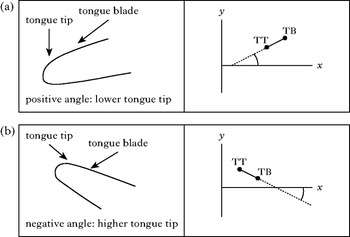
Figure 2 illustrates relative orientations of the tongue tip and tongue blade that correspond to positive vs. negative angles and their corresponding coordinate systems. The midsagittal section of the occlusal plane forms the x-axis, with the positive direction pointing to the posterior of the mouth. The positive direction of the y-axis points to the top of the oral cavity. The x- and y-positions of the tongue tip and blade transducers define a line. The angle between this line and the x-axis was measured. Positive angle values correspond to a lower tongue tip relative to blade, i.e. when the y-coordinate of the tongue blade transducer is higher than that of the tongue tip (a). The lower the tongue tip in relation to the blade, the greater the angle. Conversely, when the tongue tip is higher than the blade, the angle measured is negative (b). The lower the negative angle value, the higher the tongue tip is in relation to blade. When the transducers adhered to the tongue tip and tongue blade are level with each other, i.e. their value for y is the same, the angle is zero. Alveolar consonants are characterised by a tip-blade angle that is greater than that in retroflex postalveolar consonants, whose tip is raised.
Illustration of a positive angle measurement (a) and negative angle measurement (b). Left panels depict the height of tongue tip (TT) relative to tongue blade (TB) in the occlusal plane. The corresponding coordinate systems showing the angle measured are depicted in the right panels.

3 Results
3.1 The articulation of postalveolar consonants under study
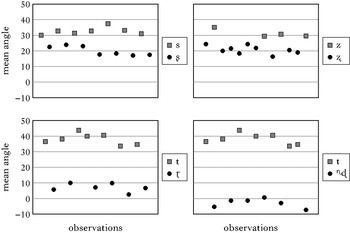
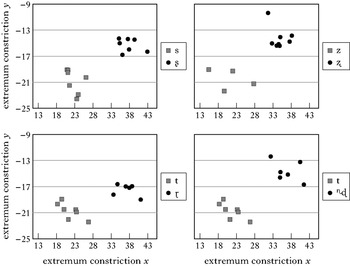
To evaluate the geometry of the tongue tip-blade in the alveolar and postalveolar consonant pairs [s ʂ], [z ʐ], [t ɳɖ], [t ɽ], scattergrams were generated to compare measurements for the mean angle variable (Fig. 3) and, for descriptive purposes, the articulatory variable of tongue-tip extremum constriction position, plotting x-position against y-position (Fig. 4).
Scattergrams for the variable of mean angle showing observations for different tokens of the relevant segments as produced by the subject speaking aloud the target words for the research question of ‘general articulation’ in Table II: [s ʂ], [z ʐ], [t ɽ], [t ɳɖ].

Scattergrams for the variables of tongue-tip extremum constriction position x and y for [s ʂ], [z ʐ], [t ɽ], [t ɳɖ].

As can be seen, the variables of mean angle and extremum constriction position differentiate postalveolar from alveolar consonants. The postalveolar fricatives are produced with a tongue-tip position that is higher and more retracted at the target timepoint than the alveolar fricatives. This is also true of the flap and prenasalised stop in comparison to [t]. (There was one exception: for the variable of extremum constriction position y, one token's value for [t] fell in the lower range of values observed for [ɽ].)
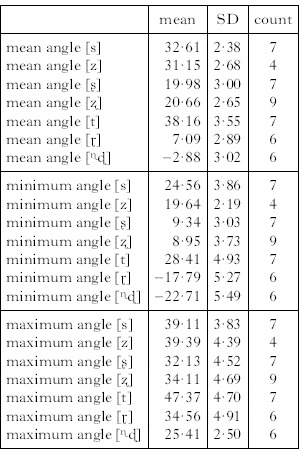
All fricatives show a positive mean angle in Fig. 3. The mean angle for the tongue tip-blade over the consonant constriction interval was lower in postalveolar consonants, indicating that the tongue tip is higher relative to tongue blade in the postalveolar consonants than in alveolar ones. Table III gives details of the mean and standard deviation for the following variables for tongue tip-blade angle within the consonant constriction interval: mean angle, minimum angle and maximum angle. The latter is defined in (8). The minimum angle variable is defined in the same way, with ‘minimum’ in place of ‘maximum’.
(8)

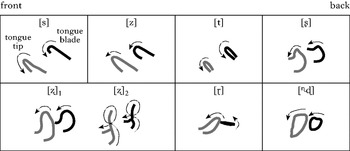
The maximum angle during a constriction interval corresponds to the point at which the tongue tip is lowest relative to the tongue blade; the minimum angle corresponds to the point at which the tongue tip is highest relative to the blade. These measurements provide information about tip-blade angle extrema that occurred during the consonants' production. Figure 5 provides a visual record of the course of tongue tip and blade movement during the consonants' production.
Means table for tongue tip-blade angle in contexts independent of coronal harmony. Measurements are from tokens of the following: [s] in [βasataze], [ʂ] in [βaʂata], [z] in [βazaːta], [ʐ] in [βaʐaːta], [t] in [βasataze], [ɽ] in [βataɽatˡ], [ɳɖ] in [βasaːɳɖaːze].

Sample position trajectories of the tongue tip and blade for consonants under study for the research question of general articulation. View is of the head from the left. Arrows indicate direction of movement. The intervals for which trajectories are shown are from the points of minimum tongue tip height preceding and following the target constriction. All retroflex consonants are generally produced in a counterclockwise direction, from back-to-front, although [ʐ] is sometimes produced with a slight clockwise rotation near the peak of constriction. Two types of curvature path were witnessed for [ʐ], indicated as [ʐ]1 and [ʐ]2.

The minimum angle occurring during a postalveolar fricative is positive. However, minimum angles for [ɽ] and [ɳɖ] are consistently negative. The postalveolar flap and prenasalised stop therefore involve retroflex articulations in which the tongue tip is markedly up and raised higher than the tongue blade. A static palatogram made for this subject's [ɳɖ] showed that the rearmost extent of linguo-palatal contact was in line with the secondmost-posterior molar – indicating that the tongue is high in the palatal vault – and that the contact is extended forward, as seen in Fig. 5, consistent with a strongly retroflex articulation.Footnote 13 On the other hand, the postalveolar fricatives involve retroflex postures in which the tongue tip is only slightly curled up. That the tongue tip was indeed curled up was verified on a separate occasion by inserting a toothpick through the centre of the subject's mouth during production of each postalveolar fricative. The toothpick touched the underside of the tongue, indicating the presence of tongue-tip raising.
In characterising tongue tip-blade orientation in postalveolar consonants, Ladefoged & Maddieson (Reference Ladefoged and Maddieson1996) and Ladefoged (Reference Ladefoged2005) draw a distinction between strong retroflexion, similar to what we found in [ɽ] and [ɳɖ], and intermediate retroflexion, which we found in the postalveolar fricatives of Kinyarwanda, where the tongue tip is raised to produce a sublingual cavity, but is curled up to a lesser degree. In ‘retroflex’ articulations of the latter type, the tongue tip is raised higher than the blade than in alveolars, but the tip is not necessarily higher than the blade. The practice of Ladefoged & Maddieson (Reference Ladefoged and Maddieson1996) and Ladefoged (Reference Ladefoged2005) is to transcribe fricatives of this type with the (non-IPA) symbols [ṣ ẓ]. Here we use the standard IPA transcriptions [ʂ ʐ], but a transcription system that distinguishes two degrees of retroflexion would be more precise.
Other examples of fricatives with the lesser degree of retroflexion are found in Standard Chinese and Polish. Our classification of Kinyarwanda postalveolar fricatives as retroflexes of this kind rather than alveolo-palatals (or alveo-palatals) is consistent with articulatory findings on fricative contrasts in these languages. Ladefoged & Maddieson (Reference Ladefoged and Maddieson1996: 151) present x-ray tracings of Chinese for alveolar fricatives and two postalveolar fricative series, characterised as ‘flat postalveolar (retroflex)’ and ‘palatalised postalveolar (alveolo-palatal)’. Alveolo-palatal fricatives show a higher tongue body than retroflex ones, and the tongue-body raising drags the blade higher than in alveolars. Ladefoged & Maddieson (Reference Ladefoged and Maddieson1996: 154) also present diagrams of three coronal fricative series in Polish (based on x-ray data from Puppel et al. Reference Puppel, Nawrocka-Fisiak and Krassowska1977), using the same descriptive labels as for those in Chinese. Given Ladefoged & Maddieson's diagrams and articulatory descriptions, we expect an alveolo-palatal fricative to present a shape where tongue tip is lower relative to blade than in alveolar fricatives. Yet this is not what we found in our articulatory data for Kinyarwanda; rather, postalveolar fricatives showed a higher tip relative to blade than alveolars. This is consistent with our characterisation of Kinyarwanda postalveolar fricatives as retroflex in shape.
Further, Walker & Mpiranya (Reference Walker and Mpiranya2006) report that F3 is lower in a vowel preceding a postalveolar fricative than in one preceding an alveolar fricative in Kinyarwanda. As they note, this is consistent with a retroflex classification for these consonants. Walker & Mpiranya also find evidence of F3 lowering in a vowel preceding the flap.
While we have no reason to believe that our subject is unique in his production of the consonants under study, it is conceivable that some speakers produce them as non-retroflex, with postalveolar alveolo-palatal fricatives. However, given that auditory distinctions in this region can be subtle and that no instrumental data has yet confirmed that description, it is very possible that previous descriptions classifying them as alveolo-palatal were articulatorily inaccurate in this regard.
To summarise, our findings indicate that postalveolar fricatives in Kinyarwanda are produced with a geometry that involves a higher tongue tip relative to blade in comparison to alveolar fricatives, leading us to classify them as retroflexes. In addition, the tongue tip is positioned higher and further back for postalveolar fricatives than for alveolar fricatives. The same contrasts hold of the flap and prenasalised stop vs. [t]. In the flap and prenasalised stop, the tongue tip is raised higher than the blade at a point during the constriction formation, while in the postalveolar fricatives, the height of the tongue tip remains lower than the blade, i.e. they involve a lesser degree of retroflexion than [ɽ] or [ɳɖ].
3.2 Articulations in contexts for (potential) coronal harmony
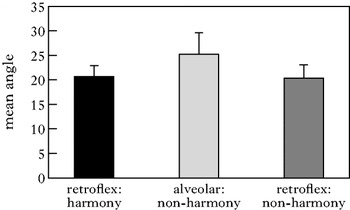
The first approach we take in the statistical analysis is an overarching comparison across forms containing disyllabic stems in which no consonant intervenes between the test consonant and the following conditioning consonant. Disyllabic stems were examined first because they include the context in which harmony is obligatory, where the trigger and target are in adjacent syllables. Mean angle was examined in the first coronal fricative in tokens of the following words: [βaʂaʂé] (retroflex fricative; harmony context), [βasaɽé, βasazé, βazaːta] (alveolar fricative; non-harmony context) and [βaʂata, βaʐaːta] (retroflex fricative; non-harmony context). A one-way ANOVA found a significant effect of the factor of context on the fricatives' mean angle (F(2, 39)=9·576, p=0·0004). Figure 6 compares the group mean for each context, showing, as expected, that the means for the retroflex fricative groups were lower than that of the alveolar fricatives. Post hoc Fisher's PLSD tests indicate that these differences are significant (for alveolar, non-harmony vs. retroflex, harmony, p=0·0059, and for alveolar, non-harmony vs. retroflex, non-harmony, p=0·0002). Further, as expected, the retroflex groups did not differ significantly (p=0·83).
Mean angle by harmony context factor. Error bars mark standard deviation.

3.2.1 Fricative targets
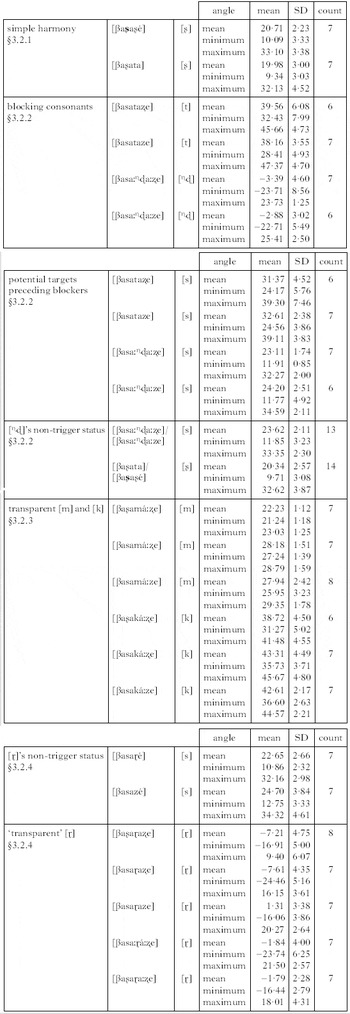
In what follows we explore further comparisons with respect to the specific hypotheses of interest. Narrowing our focus to a more controlled segmental context, mean angle was examined in the retroflex fricatives in the second syllable in tokens of [βaʂaʂé] (harmony context) and [βaʂata] (non-harmony context). A one-way ANOVA found no significant effect of the factor of context on mean angle in these groups (F(1, 12)=0·27, p=0·62). This is consistent with reports that retroflex fricatives that occur in a harmony target context are not distinct in their tip-blade posture from their counterparts in non-harmony contexts. The Appendix provides means and standard deviations for the variables of mean angle, minimum angle and maximum angle for the research questions examined in §§3.2.1–4.
3.2.2 Blocking stops
To examine the effect of intervening consonants, we turn our attention to trisyllabic stems, which include the following contexts: blocking, non-harmony, [ɳɖ], harmony and failed harmony. With regard to blocking consonants, we explore whether there is a difference in the tip-blade geometry during coronal stops in blocking context vs. non-harmony context. To address this issue, we consider mean angle for [ɳɖ] and [t] in [βasaːɳɖaːʐe, βasataʐe] (blocking context) and [βasaːɳɖaːze, βasataze] (non-harmony context). To test for effects on the dependent variable of mean angle, a two-factor ANOVA was used, with factors of harmony context (levels: blocking, non-harmony) and consonant (levels: [ɳɖ], [t]). Harmony context did not show a significant effect (F(1, 22)=0·06, p=0·8). The factor of consonant was significant (F(1, 22)=579·02, p<0·0001). This was expected, because [t] and [ɳɖ] are produced with different mean angles for tongue tip-blade (§3.1). No interaction was found between harmony context and consonant (F(1, 22)=0·3, p=0·59). These results suggest that coronal harmony does not systematically alter the tip-blade articulation of [ɳɖ] and [t]. Given that [t] did not show a distinct articulation across the blocking and non-harmony contexts, we interpret that it is not a target for retroflex harmony. While [ɳɖ] also did not show a distinct mean angle in these contexts, whether it is a target of coronal harmony is a more complicated matter, because it is already retroflex. We return to this issue in §4.2.
Our next question is concerned with whether there is a difference in tongue tip-blade angle in alveolar fricatives that occur in a non-harmony context vs. alveolar fricatives that occur prior to a retroflex fricative with an intervening blocking consonant. Mean angle for [s] was measured in tokens of the same words as those that were examined for blocking stops above. A two-factor ANOVA was used with mean angle as the dependent variable and factors of harmony context and consonant, as above. The factor of context was not significant (F(1, 22)=1·033, p=0·32). This is consistent with the claim that retroflex fricatives do not cause harmony in an alveolar fricative in blocking context. The factor of consonant was significant, presumably due to different articulatory influences from a following [t] vs. [ɳɖ] (F(1, 22)=53·1, p<0·0001), but no interaction was found between harmony context and consonant (F(1, 22)=0·004, p=0·95).
As harmony is optional in non-adjacent syllables, even if harmony were available across [t] and [ɳɖ], there should be an option available to produce a potential target as alveolar. Nevertheless, the evidence for blocking by coronal stops is twofold. First, Kinyarwanda speakers explicitly report that a variant retroflex pronunciation of an alveolar fricative in blocking context is not available. Second, our kinematic data indicates no evidence of systematic (partial) retroflexion of an alveolar fricative caused by a retroflex fricative in blocking context.
To test whether [ɳɖ] triggers harmony, we compared the mean angle for [s] pooled across tokens of [βasaːɳɖaːʐe] and [βasaːɳɖaːze] ([ɳɖ] context) to the mean angle for [ʂ] pooled across tokens of [βaʂata] and [βaʂaʂé] (the [ʂ] in the second syllable). A one-way ANOVA revealed a significant difference between the two groups (F(1, 25)=12·97, p=0·0014). The mean tip-blade angle during [s] preceding [ɳɖ] was significantly greater (less retroflex) than the mean angle during [ʂ]. We did not find that retroflexion in [ʂ] was distinct across harmony ([βaʂaʂé]) and non-harmony contexts ([βaʂata]); if [ɳɖ] had triggered harmony, we would have expected to find no difference in the retroflexion in the preceding coronal fricative from that of [ʂ] in other contexts. Nevertheless, we have seen that the execution of retroflexion can differ to some extent across consonants. If [ɳɖ] were to trigger harmony in a target fricative in such a way as to produce some geometry particular to this trigger, even greater retroflexion might be expected in the target than when harmony was triggered by a retroflex fricative, as [ɳɖ] has a lesser mean angle. Yet this is not what we found. In addition, the fricative in the second syllable of [βasaːɳɖaːʐe] and [βasaːɳɖaːze] is reported by Kinyarwanda speakers to be [s] and not [ʂ].
3.2.3 Transparent bilabial and velar consonants
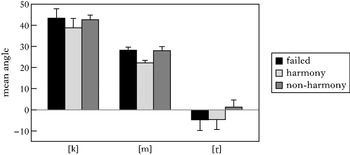
In examining transparent consonants, we first implemented an overarching test of words containing [m], [k] or [ɽ] in the following contexts: harmony ([βaʂamáːʐe, βaʂakáːʐe, βaʂaɽáːʐe, βaʂaɽaʐe]), failed harmony ([βasamáːʐe, βasakáːʐe, βasaːɽaːʐe, βasaɽaʐe]) and non-harmony ([βasamáːze, βasakáːze, βasaɽaze]). A two-factor ANOVA tested the dependent variable of mean angle with factors of harmony context (levels: harmony, failed harmony, non-harmony) and consonant (levels: [m, k, r]). Figure 7 compares the means for each consonant, split by context. A main effect of context was found (F(2, 69)=11·163, p<0·0001). The factor of consonant was also significant (F(2, 69)=899·06, p<0·0001), as expected. This is because a qualitative difference was found in the retroflex shape of [ɽ] vs. postalveolar fricatives. Also, the articulation of bilabial consonants is independent of the tongue, but velar consonants involve raising of the tongue body, which was anticipated to raise the tongue blade to some extent, as indeed occurred. An interaction between the factors of harmony context and consonant was found (F(4, 69)=2·706, p=0·037). This, too, was expected, given the different shape of retroflexion in [ɽ].
Mean angle by consonant ([k m ɽ]) and harmony factor (harmony, failed harmony, non-harmony). Error bars mark standard deviation.

Next we narrowed our focus to the items containing non-coronal consonants [m] and [k]. A two-factor ANOVA for mean angle was used, where the independent factors were again harmony context and consonant. A main effect for both context (F(2, 36)=13·09, p<0·0001) and consonant (F(1, 36)=286·18, p<0·0001) was found, as expected. However, there was no interaction between the factors of harmony context and consonant (F(2, 36)=0·35, p=0·71).
Post hoc Fisher's PLSD tests reveal that mean angle in the harmony context was significantly different from both the failed harmony context (p<0·0001) and the non-harmony context (p<0·0001). No significant difference for mean angle was found between the failed harmony and non-harmony contexts (p=0·39). The mean angle during [m] and [k] was smaller (more retroflex) in the harmony context than in the other contexts. These results are indicative that an angle associated with retroflexion actually occurs during intervening ‘transparent’ bilabial and velar consonants.
To follow up, the mean tip-blade angle during [m] in the harmony context was compared with the mean angle of [ʂ] and [ʐ] in tokens of words where they occur independent of harmony: [βaʂata] and [βaʐaːta]. The intent was to examine whether the mean angle during ‘transparent’ [m] was distinct from that of retroflex fricatives. Mean angle for [m] alone was compared with the fricatives, because, as mentioned above, its distinctive consonantal constriction is formed independently of the tongue. A one-way ANOVA tested first whether the mean angle for [ʂ] vs. [ʐ] was different in [βaʂata] and [βaʐaːta]. No significant difference was found (F(1, 14)=0·23, p=0·64). Next, a one-way ANOVA tested for a difference in mean angle during [m] in the harmony context vs. mean angles for [ʂ] and [ʐ] (pooled). No significant difference was found (F(1, 21)=3, p=0·1). These findings are consistent with the retroflexed tip-blade angle being systematically sustained over the interval that separates the harmonising retroflex sibilants, even though it does not produce a reported perceptible effect for intervening consonants.
While mean angle during ‘transparent’ [m] in the harmony context (mean=22·23) was similar to that of retroflex fricatives ([βaʂata, βaʐaːta]; mean=20·36), mean angle during ‘transparent’ [k] in the harmony context was noticeably greater (mean=38·72). This is presumably due to biomechanical articulatory coupling during [k] in the harmony context, such that when the tongue body raises to produce the velar constriction, the tongue blade is dragged along with it.
We had a closer look at the tongue-tip posture of [k], to verify that it was raised in harmony contexts. Tongue-tip y-position was examined at the acoustic centre of [m] and [k] (i.e. the extremum constriction position variable in y for these consonants) in the harmony and non-harmony contexts. The consonant centre for [m] and [k] was taken as the midpoint in duration from the consonant's beginning to its end (based on acoustic boundary markings). With tongue-tip y-position as the dependent variable, a two-factor ANOVA was used to test for effects of consonant and harmony context. As expected, for tongue-tip y-position, the context factor was significant (F(1, 24)=22·74, p<0·0001), but no significant difference was found for the factor of consonant (F(1, 24)=0·35, p=0·56). There was no interaction between the factors of context and consonant (F(1, 24)=0·38, p=0·54). These results confirm that a raised tongue tip is present in both [m] and [k] in the harmony context (means: [m]: −22·06 (SD=1·46), [k]: −21·39 (SD=1·9)), while a lower tongue-tip posture occurs in the non-harmony context (means: [m]: −24·37 (SD=1·21), [k]: −24·39 (SD=1·31)). Further, tongue-tip position shows no significant difference across the bilabial and velar consonants within harmony contexts and within non-harmony contexts.
To sum up, bilabial and velar consonants show a mean angle with higher tongue tip relative to blade during harmony contexts vs. contexts where harmony does not occur. During ‘transparent’ [m], the mean angle is not distinct from that of the Kinyarwanda retroflex fricatives. During [k], mean angle is affected to some extent by tongue-body raising, but during ‘transparent’ [k] it is nevertheless closer to that of a retroflex fricative than during [k] in non-harmony context. Our interpretation is that aspects of a retroflex tip-blade posture are systematically present during so-called transparent non-coronal consonants.
3.2.4 The retroflex flap
To investigate [ɽ]'s reported failure to trigger retroflex harmony, we examined whether mean angle differed in the sibilant in the second syllable in tokens of [βasaɽe] ([ɽ] context) and [βasaze] (non-harmony context). With mean angle as the dependent variable, a one-way ANOVA showed no effect of context (F(1, 12)=1·35, p=0·27). This result is consistent with the claim that [ɽ] is not a trigger.
Our next question relates to the apparent transparency of [ɽ]. In contexts where harmony transmits across [ɽ], this consonant is not perceived as different from its occurrence in the non-harmony context. To examine whether [ɽ] is affected by harmony, we compared its mean angle in tokens of [βaʂaɽaʐe] (harmony context), [βasaɽaʐe] (failed harmony context) and [βasaɽaze] (non-harmony context). With mean angle as the dependent variable, an ANOVA tested for differences across the three contexts. A main effect was found (F(2, 19)=10·13, p=0·001). Post hoc tests examined context pairs for differences. Mean angle in the harmony context (mean=−7·21) was significantly different from the non-harmony context (mean=1·31) (p=0·001).Footnote 14 More remarkably, mean angle in the failed harmony context (mean=−7·61) vs. the non-harmony context was significantly different (p=0·0009), while the mean angle of [ɽ] in the contexts of failed harmony vs. harmony did not show a significant difference (p=0·86). This differs from the findings for ‘transparent’ [m] and [k]. For [m] and [k], mean angle differed in the harmony context vs. the failed harmony context, but it was not distinguished in the failed harmony context vs. the non-harmony context. Thus for [ɽ] the failed harmony context groups with the harmony context, but for [m] and [k] it groups with the non-harmony context.
We consider three interpretations with respect to the results for ‘transparent’ [ɽ].
(9)

Comparison of the mean angle of [ɽ] in various contexts does not lend support to (9b). Because this issue with [ɽ] was not anticipated, data were not collected with [ɽ] between syllables containing non-coronal consonants within the same word. However, that context occurs in our data across word boundaries. Mean angle for [ɽ] in tokens of [βasamáːɽe gusa] is 14·12 (SD=6·58). This mean angle is less retroflex than in the non-harmony context ([βasaɽaze]), where [ɽ] is flanked by alveolar fricatives (mean=1·31). The results do not point to [ɽ] being the recipient of a comparatively strong articulatory influence from flanking alveolar fricatives for tip-blade angle posture (in the direction of having a lower tip relative to blade). When [ɽ] occurred in a context flanked by syllables with alveolar stops ([bataɽatá]), it also showed lesser mean angle retroflexion (mean=7·09) than in the context of flanking alveolar fricatives. Further, the mean angle for [ɽ] in a syllable immediately preceding [ʐ] is similar whether the context is harmony or failed harmony. In the latter context, an alveolar fricative occurs in the preceding syllable without effect on the mean tip-blade angle of [ɽ]. These various findings argue against (9b), because they suggest that the alveolar fricatives have a comparatively weak articulatory influence on [ɽ] for tongue tip-blade.
The data we have available suggest that (9c) is not correct. In the words examined for ‘transparent’ [ɽ] above, [ɽ] occurred before a short vowel. We compared mean angle in [ɽ] in a syllable preceding a retroflex fricative where the consonants were separated by a long vowel rather than a short one. Mean angle for [ɽ] in [βaʂaɽáːʐe] (harmony context) was −1·8, while mean angle in [βasaːɽaːʐe] (failed harmony context) was −1·84. A one-way ANOVA found no significant difference across these contexts (F(1, 12)=0·001, p=0·98). If the lack of difference in mean angle for [ɽ] in harmony context vs. failed harmony context was simply because of biomechanical interaction with a following retroflex fricative, we might well expect a difference in mean angle to emerge when the intervening vowel is long, while given our findings for non-coronal consonants in harmony context, any effect on retroflexion in [ɽ] caused by harmony between retroflex fricatives in flanking syllables is expected to be systematically present. Vowel-length differences should not alter an effect on retroflexion that is due to harmony. However, biomechanical interaction is sensitive to proximity in time, and could be weaker across a long vowel than a short one. The lack of difference for mean angle during [ɽ] in harmony and failed harmony contexts even before a long vowel therefore suggests that it is targeting of [ɽ], as in (9a), rather than biomechanical interaction that underlies the effects involving [ɽ].
The data actually support a drop-off in strength of biomechanical articulatory influence across a long vs. a short vowel. Mean angle for [ɽ] in words where a short vowel intervenes between [ɽ] and [ʐ] (means: [βaʂaɽaʐe]=−7·21; [βasaɽaʐe]=−7·61) is lower than in words where a long vowel intervenes (means: [βaʂaɽáːʐe]=−1·79; [βasaːɽaːʐe]=−1·84). These results are consistent with a weakening of biomechanical interaction across a long vowel simultaneous with equivalent ‘targeting’ of [ɽ] in retroflex harmony in harmony and failed harmony contexts.Footnote 15 We conclude that of the hypotheses under consideration it is (9a) that is best supported by the available data. That is, we speculate that [ɽ] is targeted by harmony from a following retroflex fricative, unlike [m] and [k], which are only affected by harmony if a preceding consonant is targeted.
4 Discussion
4.1 Blocking and transparency in the harmony system
The theoretical issues that motivated this study involve the phonological representations for coronal harmony and their relation to the existence of blocking and transparency in the Kinyarwanda system. Our study found that the retroflex fricatives that occur in a target context for harmony are not distinct in mean angle from those that occur outside harmony contexts. This is consistent with the view that harmony affects fricatives in a categorical fashion, as would be expected for a phonological phenomenon. Our findings are consistent with reports that blockers in Kinyarwanda genuinely prevent coronal harmony from operating across them; also that non-retroflex blockers ([t]) are not affected by harmony, and that retroflex blockers ([ɳɖ]) do not trigger harmony. These conclusions hold, conservatively, at least for the consonants examined, and, by extension, for all reported blockers. On the issue of transparency, we found that characteristics of a retroflex tongue tip-blade posture were systematically sustained during ‘transparent’ bilabial and velar consonants when they occurred between harmonising fricatives. These findings point to Kinyarwanda coronal harmony involving a continuous retroflex gesture whose duration extends from the target consonant to the trigger consonant.
These results bear on the assessment of a Gesture Extension model vs. a Repeated Gesture model for Kinyarwanda harmony. Under the Gesture Extension proposal, the retroflex gesture persists continuously over the interval separating a harmonising target consonant and trigger, even though it might not yield a perceptible effect on intervening segments. Gesture Extension thus predicts that a retroflex tip-blade posture will occur during non-coronal consonants that are perceived as transparent. This prediction is borne out by our findings.
Under the Repeated Gesture proposal, the retroflex gesture is interrupted by intervening segments, and separate instances of the gesture occur for the trigger and target consonants. This model does not predict that transparent non-coronal segments will show a retroflex gesture. Our finding that these transparent consonants actually display retroflexion therefore does not support a Repeated Gesture representation. The existence of a retroflex posture during [m] or [k] in the harmony context would require an independent explanation.
While phonological assimilation is one way in which segments can acquire articulatory properties of a following segment, biomechanical interaction among articulators is another possible source.Footnote 16 We have reason to believe that the sustained retroflexion we found during transparent non-coronal consonants was not due to the latter. We did not find evidence that anticipatory biomechanical interaction with retroflexion – which is typically stronger than perseveratory effectsFootnote 17 – produced a significant effect on [m] and [k] in the failed harmony context (vs. non-harmony), nor did it approach significance (p=0·39). Further, our comparison of mean angle during [ɽ] preceding a retroflex fricative pointed to a drop-off in biomechanical articulatory influence across a long vowel vs. a short vowel. Therefore, if biomechanical interaction were the source of retroflexion during [m] and [k] in the harmony context, where they preceded a long vowel, it would be surprising that we found evidence of a retroflex posture during [m] that was not distinct from that of retroflex fricatives, while at the same time we found no evidence that biomechanical articulatory influence from a retroflex fricative caused retroflexion in a preceding non-coronal consonant in the failed harmony context. In addition, if the retroflexion in transparent [m] were solely the product of biomechanical influence in the harmony context, it could be expected to show a lesser degree of retroflexion than that of a retroflex fricative. Our results instead suggest a phonological assimilatory source that causes retroflexion in transparent consonants in harmony contexts.Footnote 18 That is, they point to the existence of a systematic and sustained retroflex posture during the transparent consonant, as expected under Gesture Extension.Footnote 19
Because the Gesture Extension model posits a retroflex gesture to be continuously active during the interval from target to trigger, it offers a straightforward explanation for the blocking of harmony by alveolar stops and affricates and palatals (blocking by [ɳɖ] is addressed below). A retroflex tip-blade gesture distinguishes retroflex consonants from alveolars. Producing retroflexion during an intended alveolar will thus interfere with a fundamental dimension of the consonant's articulation, and it has the potential to produce perceptible effects. The production of a palatal or palatalised articulation has been observed to be antagonistic to retroflexion (Gafos Reference Gafos1996, Clements Reference Clements and Hall2001, Flemming Reference Flemming2003, Hamann Reference Hamann2003). The blocking of Kinyarwanda harmony by certain coronal consonants could pose a difficulty for the Repeated Gesture model. Under a Repeated Gesture scenario, the harmony relation is postulated to exist only between triggers and targets, and the harmonising gesture or feature is represented on these segments alone. The occurrence of blocking in Kinyarwanda, together with the persistence of retroflexion in transparent segments, points to a different conclusion for this harmony system, namely that in addition to the targets and triggers, intervening segments show involvement in the harmony – they either display the harmonising gesture or they prevent it from continuing through them.Footnote 20
Our finding that a retroflex tip-blade posture is sustained in a significant and systematic manner during transparent non-coronal consonants resonates in certain respects with some articulatory research on vowel harmony. Instrumental investigation of certain vowels reported to be transparent in vowel harmony has revealed that they systematically display the harmonising property to at least some degree. Gick et al. (Reference Gick, Pulleyblank, Campbell and Mutaka2006) examined transparent /a/ in the tongue-root harmony of Kinande, using lingual ultrasound imaging. Their findings revealed that /a/ shows advanced and retracted tongue-root articulations according to the dictates of the harmony system, and they conclude it is actually targeted in the harmony pattern. A study by Benus & Gafos (Reference Benus and Gafos2007) investigated transparent vowels in the front-back harmony of Hungarian, using electromagnetic midsagittal articulometry and ultrasound (see also Gafos & Benus Reference Gafos, Benus, Solé, Recasens and Romero2003, Reference Gafos and Benus2006, Benus et al. Reference Benus, Gafos and Goldstein2004). Their research investigated the articulation of transparent or ‘neutral’ vowels [i iː eː]. Among their findings were that transparent vowels in front harmony contexts show a tongue-body position that is significantly more advanced than in back harmony contexts. Further, in Hungarian, monosyllabic stems containing neutral vowels usually consistently select either front vowel suffixes or back vowel suffixes. The vowels in monosyllabic stems that regularly select front vowel suffixes had a more advanced tongue position than the corresponding vowels in roots that regularly select back suffixes (measured in the absence of suffixes). Benus & Gafos (Reference Benus and Gafos2007) characterise these systematic differences in the neutral vowels' articulation as subphonemic properties, usually not perceived.
Like the findings of this vowel harmony research, transparent segments in Kinyarwanda coronal harmony show subphonemic differences in articulation in accordance with the harmony system. While significant differences conditioned by harmony context are observed in the ‘transparent’ segments across these studies, we may wonder whether the magnitude of the harmonising gesture in transparent segments is as great as in reported targets of harmony. There is reason to expect the magnitude could be lesser in at least some languages. In the above vowel harmonies, the harmonising property is not perceived or is less salient on the transparent vowels. This could be due to a lesser activation of the harmonising gesture in the transparent vowel. Other factors such as the gesture's lack of perceptible effect on the particular segment or the influence of the lexical contrast system (Ní Chiosáin & Padgett Reference Ní Chiosáin and Padgett1997, Reference Ní Chiosáin, Padgett and Lombardi2001) could also play a role.
The transparent non-coronal consonants in our data bear on this issue for coronal harmony. We found no significant difference in the mean angle during [m] in harmony contexts vs. during a phonologically retroflex fricative. This suggests that the magnitude of the retroflex gesture during transparent [m] is not distinct from that during trigger or target fricatives. However, in [k], tongue-body raising for the velar closure also raises the tongue blade, causing the mean tip-blade angle to be less retroflex in the harmony context than during a retroflex fricative. At the same time, the mean angle during [k] in the harmony context was more retroflex than in the non-harmony context, and no difference was found in tongue-tip raising for [m] vs. [k] in harmony contexts. To understand these effects, we suggest that the gesture producing a retroflex tip-blade angle could be realised in a range of magnitudes over the interval from trigger to target. During [m], the independence of retroflex tip-blade posture and bilabial closure allows the retroflex gesture to have a magnitude equivalent to that of a retroflex fricative. During [k], the stop involving the tongue body occurs simultaneously with a retroflex posture. As these two postures are not entirely independent, the result could be some reduction in magnitude of the retroflex gesture during this consonant in harmony contexts.Footnote 21 Despite this potential for varying degrees in magnitude of retroflexion over the harmony interval in Kinyarwanda, it seems that a definite degree of retroflexion is certainly present. And in turn, consonants that are incompatible with retroflexion in this language's system block retroflex harmony.
Thus, while our study finds support for a Gesture Extension model for Kinyarwanda coronal harmony, we see a benefit to elaborating this with a more nuanced view allowing for a certain range of gestural magnitude; this may be language-particular. Whether it is appropriate to augment phonological representations with information about the degree of gestural activation is a question that we leave for future research.
4.2 The status of [ɽ] and [ɳɖ] in Kinyarwanda harmony
Our investigation of [ɽ] found results consistent with reports that it does not trigger harmony. This supports a divide in Kinyarwanda retroflex consonants with respect to trigger status: while [ʂ ʐ] are triggers, [ɽ] and [ɳɖ] are not. On the question of the transparency of [ɽ], our results support an interpretation that it is actually targeted by harmony from a following retroflex fricative.
Because retroflex [ɽ] and [ɳɖ] pattern differently from [ʂ ʐ] in certain ways in Kinyarwanda harmony, it is valuable to compare these two consonants with respect to blocking effects and target status. Our data suggest that [ɳɖ] blocks retroflex harmony, but [ɽ] does not. This difference might have a source in their different strictures. Related to this are our findings that differences exist in the retroflex posture of [ʂ ʐ] vs. [ɳɖ ɽ] and that a retroflex posture is present during the interval between harmonising consonants. Retroflexion from a fricative could thus be expected to affect [ɳɖ] and [ɽ] in harmony contexts, but these consonants' manner difference could affect their potential to submit to harmony. Stone (Reference Stone1991) has argued that anterior tongue bracing against the palate provides a base that facilitates the execution of certain tongue shapes and movements. On the assumption that [ɳɖ] involves more palate contact and bracing than [ɽ], its retroflex posture could be more fixed across phonological contexts than that of [ɽ]. Thus, while [ɽ] could be more flexible in its execution of retroflexion across contexts, consistent with its failure to obstruct harmony, [ɳɖ] could interrupt Gesture Extension-based retroflex harmony by virtue of its rigid retroflex posture.Footnote 22 This interpretation is supported by the difference in mean angle for [ɽ] preceding a retroflex fricative vs. preceding an alveolar fricative (means: [βasaɽaʐe]=−7·61; [βasaɽaze]=1·31), while mean angle for [ɳɖ] is comparatively close in parallel contexts (means: [βasaːɳɖaːʐe]=−3·39; [βasaːɳɖaːze]=−2·85).Footnote 23
Historical factors could also contribute to blocking by [ɳɖ] but not [ɽ]. In closely related Kirundi (Ntihirageza Reference Ntihirageza1993) and Kiha (Harjula Reference Harjula2004), the prenasalised coronal stop is reported to be alveolar, not retroflex. While this description merits further instrumental study in these languages, it is possible that retroflexion in the Kinyarwanda prenasalised coronal stop is a relatively recent innovation. If the prenasalised coronal stop was actually [nd] at the inception of retroflex harmony, then it would have been expected to block harmony by virtue of its alveolar articulation. When [nd] later became [ɳɖ] for some or all speakers of Kinyarwanda, its blocking status in the harmony could have remained a frozen property.Footnote 24
While [ɳɖ] blocks harmony, we may ask whether it is a target. Comparison with [ɽ], which we infer is a target, suggests that [ɳɖ] is not. The retroflex flap shows a difference in mean angle preceding a retroflex fricative vs. preceding an alveolar fricative, but no significant difference was found for the mean angle of [ɽ] in the harmony context vs. the failed harmony context. Unlike [ɽ], no significant difference was found for the mean angle of [ɳɖ] when it occurs followed by an alveolar fricative vs. followed by a retroflex fricative. The lack of difference for [ɳɖ] across these contexts suggests that it is not targeted by harmony.
5 Conclusion
This study has provided a first glimpse into the articulation of transparent consonants in coronal harmony. Our research has found that coronal harmony in Kinyarwanda involves tongue tip-blade retroflexion. While this harmony audibly affects sibilant fricatives, a primary finding is that the retroflex articulation also persists during transparent consonants. The significance of these results reaches beyond the description of Kinyarwanda coronal harmony. This work adds to a growing body of experimental research on harmony that finds instrumental evidence of the harmonising property in transparent segments of certain harmony systems, even though it is not perceived during these segments.
On a comparative note, while our study of Kinyarwanda shows the necessity for a Gesture Extension model for certain coronal harmonies, it does not negate the possibility that coronal harmonies of other particular languages could best be represented in terms of a Repeated Gesture model. Studies of other consonant harmonies, such as laryngeal harmony and nasal harmony, point strongly to the existence of transparent segments in which the harmonising gesture is truly interrupted (Hansson Reference Hansson2001, Rose & Walker Reference Rose and Walker2004), as predicted by the Repeated Gesture model. The same is true of patterns that produce full identity between consonants at a distance (Gafos Reference Gafos1996, Reference Gafos1998). These studies have postulated representations involving separate gesture occurrences in the segments that show identity effects. Articulatorily based investigation of different harmonies in a variety of languages is therefore necessary in order to discover how transparent segments are produced in those systems and to evaluate which phonological representations are most consistent with the articulatory facts.
6 Appendix
Means table for tongue tip-blade angle. Contexts are related to questions involving coronal harmony. The section numbers in which the relevant questions are discussed are given in the left column.