Models for chronic disease management maximise quality of life and health by promoting healthy lifestyles that reduce risk for deterioration and disease-related complications. One mechanism of deterioration following traumatic brain injury (TBI) results from engaging in behaviours that increase health risks, in particular substance misuse. Among persons with TBI, a history of substance misuse has been associated with increased risk of re-injury, suicide attempt and poor life satisfaction (Baguley et al., Reference Baguley, Felmingham, Lahz, Gordan, Lazzaro and Schotte1997; Corrigan, Bogner, Mysiw, Clinchot, & Fugate, Reference Corrigan, Bogner, Mysiw, Clinchot and Fugate2001; Drubach, Kelly, Winslow, & Flynn, Reference Drubach, Kelly, Winslow and Flynn1993; Mainio et al., Reference Mainio, Kyllönen, Viilo, Hakko, Särkioja and Räsänen2007; Winqvist et al., Reference Winqvist, Luukinen, Jokelainen, Lehtilahti, Näyhä and Hillbom2008).
Based on studies that utilised a prospective method of detection to evaluate inpatient TBI rehabilitation populations under age 65, it is reasonable to estimate that one-third to one-half have histories of alcohol misuse or illicit drug use (Bombardier, Rimmele, & Zintel, Reference Bombardier, Rimmele and Zintel2002; Corrigan, Reference Corrigan1995; Parry-Jones, Vaughen, & Miles, Reference Parry-Jones, Vaughen and Miles2006; Taylor, Kreutzer, Demm, & Meade, Reference Taylor, Kreutzer, Demm and Meade2003). Persons with a history of substance misuse are at 10 times greater risk for resuming substance misuse within 1 year after the index TBI, in comparison to those without a history (Bombardier, Temkin, Machamer, & Dikmen, Reference Bombardier, Temkin, Machamer and Dikmen2003). Though use may initially decline following injury, many people resume or commence use at later periods (Bombardier et al., Reference Bombardier, Temkin, Machamer and Dikmen2003; Kreutzer et al., Reference Kreutzer, Witol, Sander, Cifu, Martvitz and Delmonico1996; Ponsford, Whelan-Goodinson, & Bahar-Fuchs, Reference Ponsford, Whelan-Goodinson and Bahar-Fuchs2007). Notably, individuals with a history of substance misuse are often lost to follow-up in longitudinal studies, suggesting that the rate of substance misuse after TBI is underestimated (Corrigan, Bogner, Mysiw, Clinchot, & Fugate, Reference Corrigan, Bogner, Mysiw, Clinchot and Fugate1997; Corrigan et al., Reference Corrigan, Harrison-Felix, Bogner, Dijkers, Terrill and Whiteneck2003).
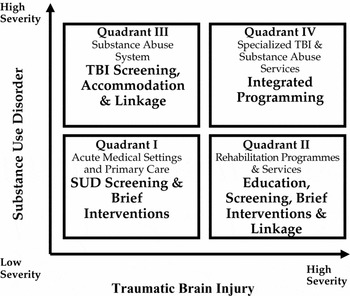
While there is agreement in the field that co-occurring TBI and substance misuse are highly prevalent and can have a negative impact on outcome, much less is known about the most effective course of treatment. Corrigan (Reference Corrigan, High, Sander, Struchen and Hart2005, Reference Corrigan, Zasler, Katz and Zafonte2006) proposed a four-quadrant model to describe the service-delivery systems where individuals of varying severity levels of TBI and substance use disorders (SUD) may be exposed to treatment opportunities (Figure 1). Dichotomising the severity of each condition as either high or low defines four quadrants. In the model, TBI is dichotomised as mild TBI versus moderate–severe TBI. SUD is dichotomised into substance misuse (characterised by excessive, risky use, but few, if any, symptoms of a SUD are present) and into more severe SUD with multiple symptoms (characterised by significant difficulty controlling drug-seeking behaviour). Persons with low-severity SUD (i.e., substance misuse) and low-severity TBI have the greatest opportunity for intervention when they are in primary-care settings, emergency departments or trauma units (Quadrant I). With more severe SUD or TBI the opportunity for effective intervention is in programmes for treatment of chemical dependency or rehabilitation of TBI, respectively.
Four-quadrant model of opportunities for substance misuse intervention with persons with traumatic brain injury.
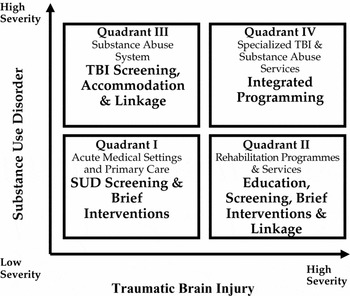
Differences in the service delivery systems where there is the greatest opportunity for intervention dictate different treatment approaches. For instance, in Quadrant I, the most effective interventions will need to be compact in order to accommodate the more pressing agenda of primary care or emergency treatment of an injury. Thus, screening and brief intervention (SBI) are best suited to those settings. Quadrant II, the TBI rehabilitation setting, can potentially provide screening, education, brief interventions and linkages to community-based SUD specialists, but is less suited for more intensive SUD treatment due to the lack of SUD specialists on the rehabilitation team. Quadrants III and IV require a different service delivery mechanism because the opportunities for intervention are normally outside acute and post-acute medical settings. For Quadrant III, the severity of the substance use dictates intensive SUD interventions; however, screening for TBI is needed to identify those clients who may benefit from accommodations for cognitive and executive functioning deficits. The co-occurrence of severe presentations of both TBI and SUD may require specialised treatment programmes with providers having knowledge of both conditions (Quadrant IV); unfortunately few such programmes exist.
The benefit of postulating the four-quadrant model has been identification of gaps in healthcare delivery systems and articulation of research questions specific to each quadrant. In regard to Quadrant I, while we know that SBI is efficacious and effective in reducing substance misuse in the general population, a recent systematic review by Corrigan, Bogner, Hungerford and Schomer (Reference Corrigan, Bogner, Hungerford and Schomer2010) concluded that some caution about generalisability to persons with TBI was necessary. Almost all studies excluded any patients who were not completely oriented and free of any confusion, because they were not considered capable of providing informed consent. Although it would be reasonable to expect that patients with the mildest TBIs may have been included in these studies, those with more serious TBIs (whether by the standards of the typical emergency department or trauma unit case mix) would have been excluded, as would anyone who had a pre-existing cognitive impairment. Corrigan and colleagues observed that SBI was a potentially important tool for persons with TBI and that, while it was conceivable that the insight needed to benefit from the intervention may be less likely with acute impairment of functional brain abilities, it may also be possible to adapt the technique to accommodate diminished cognition associated with TBI.
As little as is understood about SBI for persons with TBI in Quadrant I, even less is known about efficacious and effective treatments in other settings. The purpose of the current study was to conduct a systematic review to evaluate the literature on interventions that may be available in Quadrants II, III and IV. Specifically, we searched the literature to answer the following question: What is the evidence for effective treatment to mitigate substance misuse and SUD following TBI? We were interested in controlled trials conducted with persons with TBI that compared interventions for substance misuse against a control or comparison condition.
Methods
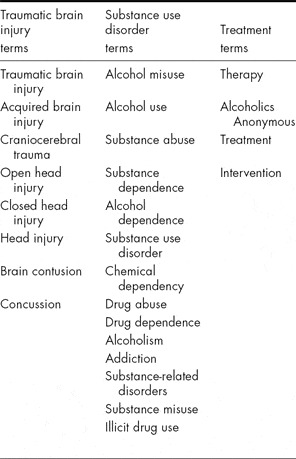
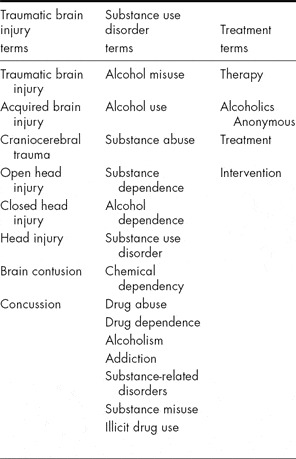
The SCOPUS database was used for the literature search because it includes Medline and Embase coverage, as well as conference papers. The search terms listed in Table 1 were used to identify studies for review, with no limits applied (all languages, years (1960 through date of last search: November, 2012), document types and topic areas were used). Three terms were applied in each search, using one term each for TBI, substance misuse and treatment. All combinations were used to search the title, abstract and keywords. Quotes were used to denote phrases. The reference lists of full text articles that were reviewed were also examined.
Search Terms
A study was considered eligible for review if (a) the intended population specifically included persons with TBI; (b) the experimental intervention targeted misuse of alcohol, illegal drugs or prescription drugs; (c) the intervention was compared to the standard of care, control or another intervention; (d) the outcomes under study included substance use or misuse; and (e) the study design was a controlled trial.
After studies were identified with each of the search term combinations, all searches were combined and duplicates were eliminated. Titles were then screened to evaluate the potential that studies met the eligibility criteria. Abstracts with titles suggesting that the study included persons with TBI and could potentially be investigating a substance use intervention were reviewed. If the abstract suggested that the study involved a substance use intervention with persons with TBI, had a comparison group and provided some outcome data (e.g., the article was not just a programme description), the full text of the article was reviewed for eligibility. Those studies found eligible were evaluated using a checklist based on the American Academy of Neurology's criteria for classifying levels of evidence and identifying potential sources of bias (Edlund, Gronseth, So, & Franklin, Reference Edlund, Gronseth, So and Franklin2004).
Results
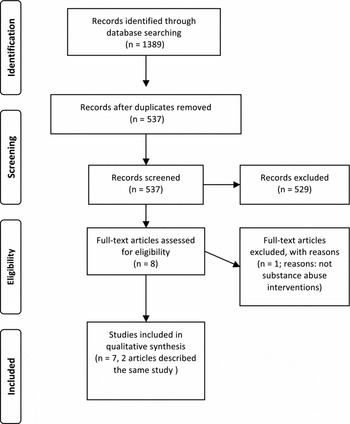
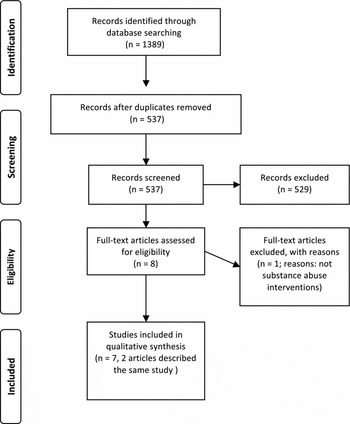
The PRISMA flow diagram illustrates the number of studies considered at each stage (Figure 2). Of the 537 articles found, 529 were screened out after reviewing the title and/or abstract because they: were not intervention studies, studied an intervention not targeting substance misuse, did not include persons with TBI in the target population, did not include substance misuse as an outcome measure and/or did not include a comparison group. Of the eight full-text articles reviewed for eligibility, one study was excluded (Hanks, Rapport, Wertheimer, & Koviak, Reference Hanks, Rapport, Wertheimer and Koviak2012) because it tested a peer mentoring intervention designed to improve coping, but did not specifically target substance misuse (and therefore no baseline measures of substance misuse were reported).
PRISMA flow diagram.
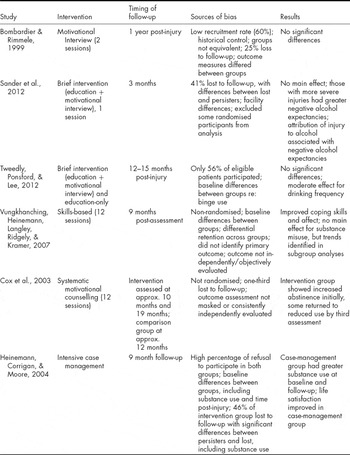
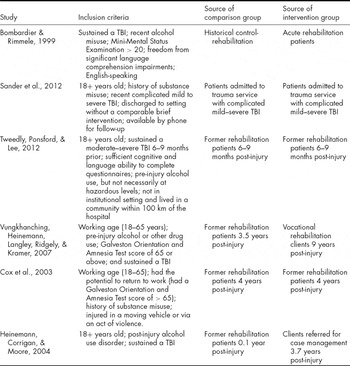
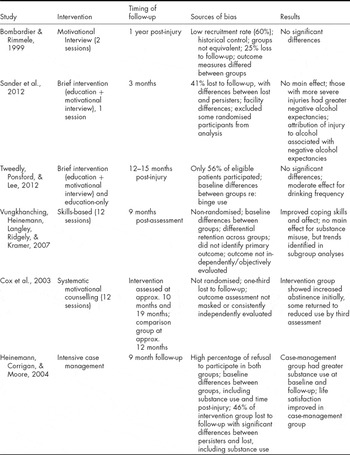
Seven articles describing six studies were identified as eligible for inclusion in the review (Table 2) (Bombardier & Rimmele, Reference Bombardier and Rimmele1999; Cox et al., Reference Cox, Heinemann, Vincent Miranti, Schmidt, Klinger and Blount2003; Heinemann, Corrigan, & Moore, Reference Heinemann, Corrigan and Moore2004; Ponsford, Tweedly, Lee, & Taffe, Reference Ponsford, Tweedly, Lee and Taffe2012; Sander et al., Reference Sander, Bogner, Nick, Clark, Corrigan and Rozzell2012; Tweedly, Ponsford, & Lee, Reference Tweedly, Ponsford and Lee2012; Vungkhanching, Heinemann, Langley, Ridgely, & Kramer, Reference Vungkhanching, Heinemann, Langley, Ridgely and Kramer2007). One study was described in two articles: Tweedly et al. (Reference Tweedly, Ponsford and Lee2012) and Ponsford et al. (Reference Ponsford, Tweedly, Lee and Taffe2012) (both studies were included to provide additional information on factors that may influence treatment response). The treatments in the reviewed studies included skills-based training, case management, education and brief interventions. The settings for the interventions are best characterised as Quadrants II and IV. No studies evaluating interventions with persons with TBI within a SUD treatment setting were identified in this review.
Summary of Reviewed Studies
Quadrant II
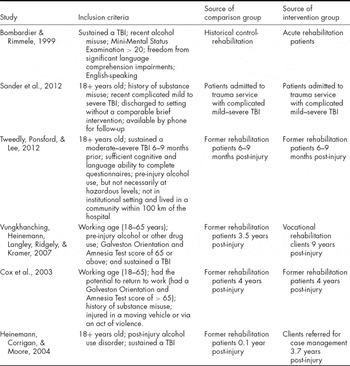
In an early study, Bombardier and Rimmele (Reference Bombardier and Rimmele1999) used a convenience rehabilitation sample for the intervention group, enrolled 12 of 20 eligible participants, and compared their outcomes to a historical comparison group of 20 persons, who received rehabilitation 10 years earlier, met the inclusion criteria (see Table 3) and who provided data on substance use at 1-year post-injury. Data at 1 year post-discharge were available for 9 of the persons who received the intervention. The methods for obtaining outcome data differed between the two groups (structured interview with intervention participants; unstructured with comparison group). The intervention included two motivational interviewing sessions, with feedback on the effects of alcohol and other drug use on recovery from TBI, and accommodations to assist retention of information. The first session occurred late in the rehabilitation stay to maximise cognitive recovery. Differences between the two groups were not significant at 1 year; however, the authors reported some dramatic changes when describing the case series. Eighty-nine per cent of those who received the intervention and who participated in follow-up were not drinking any alcohol in the typical week at 1 year post-injury. In comparison to the historical control group, 34% more people in the intervention group reported no drinking in the typical week at 1 year follow-up. The strength of the conclusions to be drawn from this preliminary study was necessarily limited by multiple sources of bias (sampling, measurement, non-equivalent groups).
Sample Characteristics
Two recent studies were conducted using an adapted SBI methodology with persons who had sustained a TBI. A multicentre study evaluated a brief intervention composed of a psychoeducational session utilising a booklet containing eight messages illustrating the negative consequences of alcohol or drug use following TBI, and a 12-minute videotape portraying the same messages, followed by a brief motivational interview (Sander et al., Reference Sander, Bogner, Nick, Clark, Corrigan and Rozzell2012). Sander et al. (Reference Sander, Bogner, Nick, Clark, Corrigan and Rozzell2012) targeted consecutive admissions who met the inclusion criteria to three trauma centres in Texas and Ohio. Participants were assigned to an experimental intervention group (n = 108 randomised) or standard of care control group (n = 94 randomised) using concealed random allocation. The intervention could be administered in the trauma setting, rehabilitation setting or at home, depending on when the person cleared post-traumatic amnesia (PTA). In Texas, the motivational interview, DVD and booklet were provided in Spanish if that was the primary language of the participant. The control group received the standard of care, consisting of screening, information and referral services for those identified as at-risk for substance misuse.
Three-month follow-up phone interviews were conducted by research assistants masked to the intervention, assessing positive and negative alcohol expectancies (primary outcome variables), readiness to change and alcohol use. Forty-one per cent were lost to follow-up, with those lost being less educated and more likely to be non-White, in comparison to those found. Those in the treatment and control groups who had follow-up data were similar in terms of demographic and injury characteristics, as well as alcohol misuse. There were facility differences, with participants from Ohio being better educated, more likely to be White, having less severe injuries, and lower attribution of their injuries to substance misuse. Prior to analysis, 15 additional participants were excluded because they only abused drugs other than alcohol, and the outcome measures only targeted alcohol (final n analysed = 104).
The only intervention effect was that those with more severe injuries in the experimental group reported greater expectations that alcohol use would result in physical and cognitive impairment (negative alcohol expectancies). No intervention effects were found for problem alcohol use, positive alcohol expectancies or readiness to change, although those who attributed their injury to alcohol use were also more likely to expect that alcohol use would be associated with cognitive and physical impairment. In Ohio, but not Texas, attribution of injury to alcohol was also associated with greater readiness to change. In all, conclusions based on this study must be tempered by the multiple potential sampling biases (i.e., loss to follow-up, dropping randomised participants from the analysis, and facility differences).
A third study, conducted in Australia (Tweedly et al., Reference Tweedly, Ponsford and Lee2012), compared the effects of (a) a brief intervention consisting of a motivational interview and the DVD and booklet from the previous study; (b) an information-only condition (DVD, booklet); and (c) an attention control condition (informal discussion about changes since the injury, unrelated to substance misuse). The study design included concealed random allocation and masked independent evaluation of the outcomes. Of 238 consecutive admissions, 108 were found to be eligible and 60 agreed to participate (56% of eligible participants)(see Table 3 for inclusion criteria). Those who did not participate had longer PTA duration. Fifty participants (83%) completed the in-person, 6-month follow-up (12–15 months post-injury); there were no significant differences between those who completed follow-up and those lost to follow-up with regard to demographics or injury severity. Only those who completed follow-up were included in the analysis. At baseline, no significant group differences were noted in frequency of drinking; however, those in the control condition were more likely to binge drink. Across all groups, only 17% were drinking at hazardous levels during the month prior to the intervention. No significant intervention effects were reported; however, a moderate effect size for frequency of drinking days suggested that a larger sample might have yielded significant findings for both intervention groups in comparison to the control group. A small, non-significant intervention effect was noted for number of drinks per day, and a low correlation was also reported between number of drinks per day and readiness to change. In addition to being underpowered, the low recruitment rate suggested caution regarding generalisability.
A strength of this study is the use of the Timeline Followback method to evaluate alcohol use, which allows for patterns of use to be readily assessed. The authors graphically displayed how more of those in the attention control condition increased the frequency of drinking days during the follow-up period, while those who received either intervention remained stable or reduced their drinking; however, the effect was not statistically significant. In subgroup analyses, Ponsford et al. (Reference Ponsford, Whelan-Goodinson and Bahar-Fuchs2012) found that being in the action stage was associated with lower frequency and quantity of drinking, regardless of group assignment. Higher education and depressive symptoms were found to be associated with measures of alcohol use. Cognitive functioning was not found to be associated with alcohol use.
Quadrant IV
Three studies did not use random assignment and instead used a comparison group drawn from a registry of former inpatients and outpatients of the Rehabilitation Institute of Chicago (RIC), with the intervention groups drawn from different facilities and treatment environments (Cox et al., Reference Cox, Heinemann, Vincent Miranti, Schmidt, Klinger and Blount2003; Heinemann et al., Reference Heinemann, Corrigan and Moore2004; Vungkhanching et al., Reference Vungkhanching, Heinemann, Langley, Ridgely and Kramer2007). Given that randomisation was not utilised, in addition to any identified demographic, injury and facility-related differences between groups, the intervention groups in all three studies may have differed from the comparison group in motivation to seek treatment, as well as other unidentified factors.
Vungkhanching et al. (Reference Vungkhanching, Heinemann, Langley, Ridgely and Kramer2007) tested a skills-based intervention (12 sessions) with vocational rehabilitation clients as compared to the RIC sample. Substantial baseline differences between groups were noted for race/ethnicity, marital status, time post-injury (average of 9 years for intervention group versus 3.5 years for the comparison group), injury severity (intervention group more severe), employment, and intoxication at the time of the injury. They retained 83% of the intervention participants (n = 30 analysed), but only retained 67% of the comparison group participants (n = 54 analysed) (significant difference in retention). Longer time post-injury and Caucasian race were associated with dropout. Outcomes were not independently assessed or masked. Multiple tests were run, without identification of a primary outcome variable. Adjusting for baseline mean differences, the intervention group showed improvement at 9-month follow-up in coping skills and affect. Overall, significant differences were not found regarding change in alcohol and/or other drug use, although post-hoc comparisons showed a trend indicating that a greater than expected proportion of persons in the intervention group stopped drinking or using other drugs (28.6% for the intervention group, 7.5% for the comparison group). Substantial proportions of both groups were abstinent at baseline and remained abstinent at follow-up (35.7% for intervention group and 41.5% for comparison group). Approximately 7% of each of the groups initiated alcohol use between baseline and follow-up. The substantial baseline differences between groups, coupled with differential dropout and a lack of independent/masked measures of outcomes suggest that changes in the outcome variables may be due to factors other than the intervention.
Cox et al. (Reference Cox, Heinemann, Vincent Miranti, Schmidt, Klinger and Blount2003) tested a manualised Systematic Motivational Counseling intervention consisting of 12 sessions conducted over several months (mean = 10 months) compared to usual care for the RIC group. Participants for the intervention group were drawn from another Chicago rehabilitation centre; both groups consisted of persons who had received inpatient or outpatient rehabilitation for a TBI that occurred an average of 4 years earlier. Approximately two-thirds of both groups were retained through follow-up (n = 40 retained for the intervention group and n = 54 for the comparison group). Except for cause of injury, the groups were similar on the reported baseline characteristics. The intervention group was assessed at baseline, following treatment (about 10 months after baseline), and approximately 9 months later, while the comparison group completed baseline and one follow-up assessment 12 months after baseline. Only those who had used any substances at a minimum of one of the measurement points were included in the analysis (n = 22 for intervention group and n = 31 for comparison group). The intervention group showed significantly increased abstinence between baseline and the second assessment, while the comparison group did not. Some participants in the intervention group returned to alcohol use by the third assessment, but they used fewer substances than at baseline. Motivational structure and negative affect improved in the intervention group, but not the comparison group. The different time points for outcome measurement used with the two groups complicates the evaluation of the treatment effect, and potential baseline differences in motivation to seek treatment may account for some of the effects observed. The low follow-up rate also introduces potential sampling bias, which is partially mitigated by the lack of identifiable differences in demographics.
The third study tested the effects of intensive case management with integrated programming for TBI and SUD (Heinemann et al., Reference Heinemann, Corrigan and Moore2004). Two case-management programmes, based on the same model, were included in the treatment group. Only 54% of eligible participants agreed to participate from the RIC group, and 61% of eligible clients of one of the case-management programmes (the other programme only had one refusal). The treatment group contained fewer women, fewer who were currently married, fewer from minority backgrounds, and persons with lower educational level, lower family satisfaction, lower physical and mental well being, and greater use of alcohol and other drugs. The median time post-injury for the treatment group was 3.7 years while the median for the comparison group was 0.1 years; no differences in cognitive status were noted. While 79% of the comparison group completed the 9 month follow-up, only 54% of the case-management group completed follow-up (total n analysed = 197). Study persisters differed from those who dropped out on several important variables, including less baseline alcohol and drug use. Findings indicated that the case-management group had higher alcohol and drug use at both baseline and follow-up; however, life satisfaction improved relative to the comparison group. Substantial baseline differences between groups limits any conclusions that may be drawn regarding intervention effects; low recruitment rate and attrition reduce the generalisability of the findings.
Discussion
A systematic review of the literature indicates that very few controlled studies have been conducted to investigate the efficacy or effectiveness of substance misuse interventions for persons with TBI. No studies were identified that fit into Quadrant III; that is, intervention studies were conducted within TBI acute and post-acute rehabilitation settings with persons with greater severity of TBI, but not within substance use disorder treatment settings where persons with less severe TBI and more severe SUD are likely to be found. While each of the six studies identified were of a preliminary nature, with methodological issues that prevent firm conclusions from being drawn, each study provided important information that can guide the refinement of interventions and the design of future studies.
The identified studies aptly illustrated that designing and conducting methodologically sound and clinically useful studies of substance misuse interventions for persons with TBI is challenging, for multiple reasons. Difficulties are associated with all components of the research question (PICOS: Participants/population, Intervention, Comparison Group, Outcome and Study Design; Liberati et al., Reference Liberati, Altman, Teslaff, Mulrow, Gotzsche, Ioannidis and Moher2009), as discussed below.
Participants/Population
When determining the population of interest, the investigator must consider the range of TBI severity, relative to time post-injury, that will be amenable to the intervention and the other study procedures. As found in a previous systematic review (Corrigan et al., Reference Corrigan, Bogner, Hungerford and Schomer2010), studies of brief interventions conducted immediately post-injury either in emergency departments or trauma units excluded persons with moderate–severe TBI because they were either unable to consent to, or unable to participate in, the intervention. In contrast, the studies included in the current review enrolled persons with a range of TBI severity, with each study including at least some persons with moderate–severe TBI. The interventions were administered later post-injury, with the earliest being a study that enrolled trauma patients after they cleared PTA, which in many cases meant post-discharge. At the other end of the range, another study administered the intervention to individuals who were 9 years post-injury. Allowing additional time to recover after TBI increases the likelihood that an individual will be cognitively able to participate in the intervention.
The presence and severity of the substance misuse being targeted must also be determined a priori. Studies of brief interventions in trauma settings have had smaller effect sizes when the samples included persons with more severe, highly symptomatic substance use disorders (termed ‘dependence’ in DSM-IV), while larger effect sizes have been observed when the samples were limited to persons who misused substances but exhibited few, if any, symptoms of a substance use disorder (Jonas et al., Reference Jonas, Garbutt, Brown, Amick, Brownley, Council and Harris2012). For persons without an identified TBI, more severe SUD has been found to require more intensive long-term treatment, and the same is likely to be the case with persons with TBI. We do not know if persons who have not previously misused substances benefit from brief interventions, reducing the likelihood that they would begin misusing post-injury. Given that a large proportion of those without a substance misuse history will never misuse, their inclusion could potentially dilute treatment effects. Subgroup analyses can be very useful in determining if efficacy for the various interventions differs based on the severity of the SUD.
After choosing the population of interest, the task becomes recruitment and retention of a representative sample large enough to detect the hypothesised effects. Many of the studies in the current review reported difficulties with recruitment and/or retention; of the three that reported the ratio of those eligible to those recruited (Bombardier & Rimmele, Reference Bombardier and Rimmele1999; Heinemann et al., Reference Heinemann, Corrigan and Moore2004; Tweedly et al., Reference Tweedly, Ponsford and Lee2012), recruitment rates were as low as 54%. In terms of retention, five studies had rates below the commonly accepted retention rate of 80%. Study reports also suggested that those recruited and those retained in the studies differed from those who refused to enrol or ceased participation, with some of the differences being clearly related to the outcome variables. Thus, conclusions drawn from any of these studies cannot be applied with confidence to the original population. Findings regarding a treatment effect, or lack thereof, may be related to a truncated range of the outcome variable due to sample selection factors.
Fortunately, strategies have been developed for recruiting and retaining participants with SUD in research studies (Scott, Reference Scott2004; Zweben, Barrett, Berger, & Murray, Reference Zweben, Barrett, Berger and Murray2005). Scott (Reference Scott2004) developed a follow-up protocol that resulted in 90% follow-up rates across multiple studies. The protocol incorporates effective strategies for maintaining participant involvement across four phases of the follow-up process: engagement, verification, maintenance and confirmation. Ongoing participant involvement is maximised by: increasing participant motivation and understanding of study procedures; obtaining and maintaining full contact information for the participant and collaterals; maintaining frequent contact with the participant to detect upcoming moves or changes in contact information; and employing quick and efficient tracking strategies after contact information has been found to be no longer valid. Staffing patterns that allow for contact all days of the week and evenings greatly increase successful contact attempts. Consistent incorporation of similar strategies into the National Institute on Disability and Rehabilitation Research's TBI Model Systems longitudinal study has improved retention from an average of 60% at the first annual follow-up to over 90% (Corrigan et al., Reference Corrigan, Harrison-Felix, Bogner, Dijkers, Terrill and Whiteneck2003; Harrison-Felix, pers. comm.).
Intervention
Whether the intervention will be focused on preventing resumption of use versus reducing current use will be highly dependent on time post-injury, as the resumption of use increases with time. Immediately post-injury, individuals are receiving acute care or rehabilitation (Quadrants I and II), calling for brief interventions that can be easily incorporated into care and have the goal of preventing resumption of substance misuse after discharge. Brief interventions, such as those utilised by Bombardier and Rimmele (Reference Bombardier and Rimmele1999), Sander et al. (Reference Sander, Bogner, Nick, Clark, Corrigan and Rozzell2012) and Tweedly et al. (Reference Tweedly, Ponsford and Lee2012) were designed to take advantage of the ‘teachable moment’ that occurs when the individual realises the causal role that substance misuse may have played in the injury (Vaca & Winn, Reference Vaca and Winn2007); while the assumption has been that the teachable moment occurs immediately post-injury, for persons with the most severe injuries the moment may occur during acute or post-acute rehabilitation, after clearing PTA and the resumption of the ability to make rational causal inferences. As noted earlier, for persons with a history of severe SUD, they would most likely also benefit from referral for ongoing treatment, though the current studies did not directly address the importance of this additional component. Considered together, the results of two of the three brief intervention studies suggest that multimedia psychoeducational materials may be a key component of the brief intervention for facilitating change in knowledge, attitudes and behaviour. The only intervention effect found in the Sander et al. (Reference Sander, Bogner, Nick, Clark, Corrigan and Rozzell2012) study was that those with more severe injuries had greater expectations of the negative consequences of substance use, which was the focus of the educational materials. Tweedly et al. (Reference Tweedly, Ponsford and Lee2012) found a moderate, non-significant effect on alcohol use with both experimental interventions that shared the educational component. Thus it appears that the multimedia educational materials may have an impact on knowledge and beliefs, and perhaps an indirect effect on substance use, although these findings need verification in studies with greater power that are specifically designed to test the intervening role of belief change.
The dearth of significant findings for brief interventions beyond the effects associated with the multimedia psychoeducational components suggests a need for modifications to strengthen the impact of the intervention. Bombardier and Rimmele's (Reference Bombardier and Rimmele1999) early study specified some accommodations that may have utility; unfortunately methodological challenges likely decreased the power to detect effects. Clinically, we suspect that additional accommodations for cognitive and executive functioning deficits associated with TBI are needed, including the use of booster sessions and/or involvement of family and significant others. Studies that incorporate subgroup analyses of the relationship between cognitive deficits and outcome, as was done by Sander et al. (Reference Sander, Bogner, Nick, Clark, Corrigan and Rozzell2012) and Ponsford et al. (Reference Ponsford, Tweedly, Lee and Taffe2012), can provide additional insights into the accessibility of the intervention.
After discharge from the inpatient setting and with increased time post-injury, the likelihood that the person will resume substance misuse increases (Corrigan & Mysiw, Reference Corrigan, Mysiw, Zasler, Katz and Zafonte2012), making the goal of the intervention to reduce rather than prevent substance misuse. Given that the severity of the SUD and its consequences may have increased with time, more intensive treatment may be required (Quadrant III for less severe TBI and IV for more severe TBI). The Vungkhanching et al. (Reference Vungkhanching, Heinemann, Langley, Ridgely and Kramer2007), Cox et al. (Reference Cox, Heinemann, Vincent Miranti, Schmidt, Klinger and Blount2003) and Heinemann et al. (Reference Heinemann, Corrigan and Moore2004) studies provide examples of the types of programming that may be helpful to persons with severe TBI and SUD. While the most consistent significant finding across studies was change in a mechanism thought to be associated with substance misuse, intervention effects on substance misuse were observed with Cox's Structured Motivational Counseling intervention, and post-hoc analysis suggested an effect on substance misuse in the Vungkhanching et al. study of coping skills training. No effects on substance misuse were observed by Heinemann et al. (Reference Heinemann, Corrigan and Moore2004). However, given the potential for sampling biases associated with each of these studies, additional work will need to be done before drawing any conclusions regarding the efficacy of any of these interventions.
Comparison Condition
To allow definitive conclusions to be drawn, the intervention should be compared against a control condition that is identical in all respects to the intervention, with the exception that the control lacks the key components of the intervention. For behavioural interventions, an ideal control would include an equivalent amount and quality of attention as provided by the intervention, minus the active ingredients of the intervention. Unfortunately, defining what form the attention should take can be difficult, and greater amounts of time increase the difficulty of providing a face valid attention control condition. Further, since the key components of an effective intervention remain largely unknown, one cannot be entirely certain that some activities used in control conditions are indeed lacking in an effect. For example, the Tweedly et al. (Reference Tweedly, Ponsford and Lee2012) study used an informal discussion about changes the person experienced since the injury as the control condition. While comments regarding substance use were not permitted, it is possible that the control discussion could have had an indirect effect on substance use by increasing awareness of the effects of brain injury.
Ethical concerns can also interfere with the choice of a control or comparison condition. Given the potential for substantial negative consequences of substance misuse following TBI, intentionally withholding any treatment, even if unproven, may be questioned. For this reason, at a minimum, most institutional review boards require that the comparison group be provided with the standard of care. In medical settings, the standard of care for substance misuse has historically been limited to inconsistent screening and referral for treatment ‘as needed’, although recently the American College of Surgeons requirements changed such that all patients in Level I or II trauma centres are to be screened for substance misuse and those in Level I centres provided a brief intervention (American College of Surgeons, 2006). The standard of care for participants many years post-injury is even more limited, with the clearest description provided by Cox et al. (Reference Cox, Heinemann, Vincent Miranti, Schmidt, Klinger and Blount2003): ‘medical, psychosocial and vocational support as needed’. Given that it is unlikely that the standard of care provides the equivalent amount of attention as the intervention, the standard of care is often insufficient from both the ethical and scientific perspective.
One solution for future studies may be the use of a comparative effectiveness approach. An intervention that has been shown to have at least some efficacy can be compared against another intervention that is hypothesised to be superior due to some specific components or mechanisms. Superiority/inferiority of the interventions can be assessed for the population as a whole and/or for specific subgroups. For example, a brief intervention with the individual could be compared to a brief intervention conducted with both the individual and family members to evaluate whether the addition of the family component improves efficacy for the full sample, or perhaps only for those individuals with more severe TBI and/or more severe SUD. An assessment of circumstances when the addition of family members decreases efficacy can also be conducted, assuming that important variables are included in the study (e.g., family member's own substance misuse).
Outcomes
While reduction in substance misuse is the clear aim of the interventions, the field needs to decide if the ultimate goal is abstinence versus the reduction of use to ‘safe’ levels. Some would argue that we have yet to determine an amount that is safe to consume following TBI. The American Dietary Guidelines–2010 (US Department of Agriculture and US Department of Health and Human Services, 2010) provide metrics for moderate drinking among healthy individuals, but caution that persons with medical conditions that may be worsened by alcohol should abstain from use. While studies have suggested that substance misuse is associated with poorer outcomes following TBI, the field has not yet reached consensus on whether any use is harmful. Certainly for individuals with impulse control problems, it may not be possible to control consumption of alcohol such that they do not exceed a ‘safe’ level, unless the person completely abstains.
One study in the current review only considered alcohol misuse in the outcome analysis, and they did not report an intervention effect for this outcome (Sander et al., Reference Sander, Bogner, Nick, Clark, Corrigan and Rozzell2012). The remaining studies examined the rate of abstinence and/or frequency and quantity of substance use, and all but one (Heinemann et al., Reference Heinemann, Corrigan and Moore2004) reported some clinically meaningful effects of the interventions for at least a portion of their sample, although the results were not always statistically significant due to purported lack of power and other methodological factors. Detecting any effect on substance misuse (versus use) is made even more difficult when examining outcomes within the first year post-injury, due to the low base rate of substance misuse during the early recovery period. As noted above, studies of the natural history of substance misuse following injury suggest that few people misuse substances immediately post-discharge, but the rate increases during the years that follow (Corrigan & Mysiw, Reference Corrigan, Mysiw, Zasler, Katz and Zafonte2012).
If a brief intervention were effective with preventing resumption of use, one would expect the size of the effect to increase with greater time post-injury. As was shown in the graphics provided by Tweedly et al. (Reference Tweedly, Ponsford and Lee2012), one sign of a potentially effective intervention is that the comparison group will have a positive slope of increasing use across time, while the intervention group's slope will remain flat. Even with a relatively low base rate of substance misuse in her groups, a non-significant moderate effect by 1 year post-injury was reported in frequency of drinking. Notably, only a small effect was observed with number of drinks consumed per day. The study of Tweedly et al. illustrates the advantage of taking detailed measures of use at multiple time points, using tools like the Timeline Followback Method. Their methodology provided important information about possible course and pattern of resumption of substance use after injury that can guide the design of future studies.
In contrast, studies with interventions applied later post-injury aim to reduce substance misuse or attain abstinence. Studies of SUD treatment with the general population commonly find the largest effects immediately following treatment, with smaller (but often still significant) effects at follow-up (Magill & Ray, Reference Magill and Ray2009; Smedslund et al., Reference Smedslund, Berg, Hammerstrom, Steiro, Leiknes, Dahl and Karlsen2011; Tripodi, Bender, Litschge, & Vaughn, Reference Tripodi, Bender, Litschge and Vaughn2010). This was the pattern observed with the Cox et al. (Reference Cox, Heinemann, Vincent Miranti, Schmidt, Klinger and Blount2003) study with the intervention group, although the comparison group did not provide data at three time points. Unfortunately, Vungkhanching et al. (Reference Vungkhanching, Heinemann, Langley, Ridgely and Kramer2007) did not report the findings from the assessment immediately post-intervention and Heinemann et al. (Reference Heinemann, Corrigan and Moore2004) did not have equivalent groups at baseline, so it is not possible to determine if the same pattern would have been observed in these studies.
In addition to examining behaviour change (substance use or misuse), investigators also examined outcomes thought to act as mechanisms or triggers for behaviour change, such as alcohol expectancies (Sander et al., Reference Sander, Bogner, Nick, Clark, Corrigan and Rozzell2012), readiness to change (Bombardier & Rimmele, Reference Bombardier and Rimmele1999; Sander et al., Reference Sander, Bogner, Nick, Clark, Corrigan and Rozzell2012; Tweedly et al., Reference Tweedly, Ponsford and Lee2012), coping skills (Vungkhanching et al., Reference Vungkhanching, Heinemann, Langley, Ridgely and Kramer2007) and motivational structure (Cox et al., Reference Cox, Heinemann, Vincent Miranti, Schmidt, Klinger and Blount2003). Investigators have also examined outcomes that may be associated with reduced substance use: life satisfaction (Heinemann et al., Reference Heinemann, Corrigan and Moore2004), employment, (Vungkhanching et al., Reference Vungkhanching, Heinemann, Langley, Ridgely and Kramer2007) and affect (Cox et al., Reference Cox, Heinemann, Vincent Miranti, Schmidt, Klinger and Blount2003; Vungkhanching et al., Reference Vungkhanching, Heinemann, Langley, Ridgely and Kramer2007). Generally, in comparison to behaviour change, intervention effects were more easily detected for internal processes (knowledge, attitudes, beliefs) and consequences associated with substance misuse. In addition, associations were found between the internal processes and substance use. Thus, the theoretical models may have some merit; with additional refinement of the models and improvements to the interventions and study designs, it may be possible to begin to detect more direct effects on behaviour in future studies.
Study Design
The strongest level of evidence is provided by randomised controlled trials (RCT) that are free of methodological bias and have significant results (or a systematic review of RCTs with homogeneous results) (Oxford Center for Evidence-Based Medicine, 2011). However, early in intervention development it is often necessary to use less robust designs to evaluate feasibility and identify key components of future studies. While two of the studies in the current review used a RCT design, these and the remaining studies lacked key design features necessary to qualify as ‘Level I’ evidence by the American Academy of Neurology and other organisations. Yet, all of the studies have added to the body of literature by providing important information to be used in the design of future studies.
Four of the studies in the current review did not randomise group membership, increasing probability for baseline differences that may have enhanced or prevented the observation of a treatment effect (Bombardier & Rimmele, Reference Bombardier and Rimmele1999; Cox et al., Reference Cox, Heinemann, Vincent Miranti, Schmidt, Klinger and Blount2003; Heinemann et al., Reference Heinemann, Corrigan and Moore2004; Vungkhanching et al., Reference Vungkhanching, Heinemann, Langley, Ridgely and Kramer2007). The lack of equivalence of the groups was detectable for some variables, such as time post-injury, demographics and extent of baseline substance misuse. The impact of these variables on outcomes can be variable; however, baseline differences on the outcome variable (i.e., substance misuse) and other highly influential factors (e.g., time post-injury) can nearly guarantee confounding of the results. Unfortunately, not all baseline differences are, or can be, measured. For example, participants in the intervention groups for the non-randomised studies may have all been treatment seekers or at least more open to behavioural change, while those in the comparison groups may have been less likely to be seeking treatment.
The isolation of placebo effects in behavioural intervention studies is very challenging for two reasons. First, it is extremely difficult to completely mask the participant to the group assignment in behavioural studies. The placebo effect is less likely to be controlled if the participant does not perceive the comparison condition as an intervention. Four of the studies in the current review used the standard of care as the comparison condition, with the care provided on an as-needed basis – therefore some participants may have received no intervention. Second, the use of self-report to measure outcomes is by nature subjective, further increasing susceptibility to a placebo effect. Two of the studies took steps to reduce the subjectivity of the outcome measurement by masking the person conducting the outcome assessment to the group assignment, though they could not mask the participant. Objective measures of the outcomes, such as toxicology screening, substantially increase the ability to attribute change to the intervention. However, most objective measures may also be considered invasive by participants, which could reduce recruitment and retention.
Another consideration when designing the study is a plan for characterising responders versus non-responders. The studies reviewed suggested several baseline characteristics that may be predictive of treatment response, including educational level (Ponsford et al., Reference Ponsford, Tweedly, Lee and Taffe2012), mood disturbance (Ponsford et al., Reference Ponsford, Tweedly, Lee and Taffe2012), cognitive functioning (Ponsford et al., Reference Ponsford, Tweedly, Lee and Taffe2012; Sander et al., Reference Sander, Bogner, Nick, Clark, Corrigan and Rozzell2012), attribution (Sander et al., Reference Sander, Bogner, Nick, Clark, Corrigan and Rozzell2012) and readiness to change (Ponsford et al., Reference Ponsford, Tweedly, Lee and Taffe2012). A generic intervention may not be equally effective across the heterogeneous TBI population, but it may be possible to identify subgroups of individuals who are maximally responsive to specific interventions.
Conclusions
This systematic review of effective treatments to mitigate substance misuse and SUD following TBI revealed disappointing results. Searches of the extent literature revealed few (6) intervention studies meeting minimum standards; and those identified were marked by methodological weaknesses that limited the conclusions that could be drawn. Multiple inherent challenges to studying interventions for substance misuse among persons with TBI are described; and choices researchers will have to make are delineated. Comparative effectiveness studies may provide an opportunity for studies with sound scientific designs that are both practical and ethical.
Acknowledgements
The contents of this article were developed under grants from the Department of Education, NIDRR grant number H133070029 and H133A120086. This work greatly benefited from the assistance of Frantz Moise PhD and Monica Lichi MS Ed, MBA, in conducting the bibliographic search.