Introduction
From the year 1998 through 2008, over 57,000 chemical incidents were reported in nine states. These events resulted in over 15,000 injuries, of which 1,398 were medical responders.Reference Belsky, Klausner, Karson and Dunne 1 The effects of a hazardous chemical agent usually are seen almost immediately, and the treatment of victims becomes the responsibility of the emergency response team and ultimately the emergency department (ED). This was apparent in 1995 when Sarin was released into a Tokyo (Japan) subway, resulting in 640 patients reporting to a single ED with signs of organophosphate poisoning.Reference Duncan, Wu and Neu 2 Since the hazardous material is often unknown upon entry into the ED, it is important to isolate and decontaminate a patient with a suspected exposure in order to prevent further damage to the patient and secondary exposure to other patients and hospital staff.
Previous surveys have shown a lack of hazardous material preparedness in hospitals. In 1997, only 44% of hospitals in the state of Washington (USA) reported the ability to receive patients exposed to hazardous chemical materials.Reference Okumura, Takasu and Ishimatsu 3 A 2002 survey in Kentucky (USA) indicated that only one-half of hospitals reported having a dedicated decontamination facility, six percent had an adequate amount of Level A personal protective equipment (PPE), and overall concluded that isolation, decontamination, and syndromic surveillance were underdeveloped.Reference Burgess, Blackmon and Brodkin 4
In 2005, the Michigan College of Emergency Physicians (MCEP; Lansing, Michigan USA) sought to identify the state of disaster preparedness with an emphasis on hazardous material capabilities in Michigan, USA using a survey sent to all ED directors. In order to track the progress made since 2005, the survey was re-sent in 2012 to identify areas that need improvement.
Methods
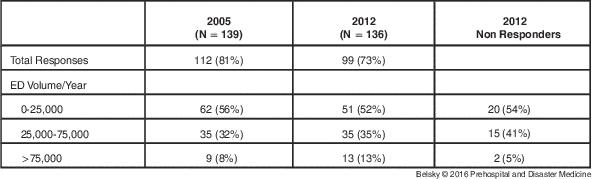
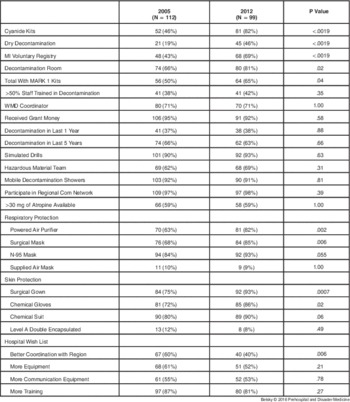
The Institutional Review Board at Henry Ford Hospital (Detroit, Michigan USA) approved this project. This study method included a longitudinal survey involving EDs in the state of Michigan in 2005 and in 2012. The MCEP Emergency Preparedness Task Force mailed a 30 question survey to all ED directors listed in the MCEP directory in 2005 and then again in 2012 (Appendix 1; available online only). The first MCEP directory was created in 2004 after obtaining a list of hospitals from the Michigan Hospital Association (MHA; Okemos, Michigan USA) and determining which had EDs. With the assistance of the MCEP Board of Directors, free standing EDs were added. Every year, a survey is sent to all EDs and hospitals to obtain updated information which is then compared with the MHA list. The list is then cross checked by staff of the MCEP for any EDs that may have been missed. Those who did not respond were mailed a second survey, and those who still did not respond received a phone call and email (if available) follow up. A representative other than the ED director was substituted, when appropriate (ie, disaster preparedness specialist for that hospital or emergency director preference), or the director was unable to be contacted. The questionnaire was developed by the MCEP Emergency Preparedness Task Force with guidance from toxicologists and poison center personnel from diverse areas of Michigan using available literature on the subject. The project was funded by an American College of Emergency Physicians (Irving, Texas USA) chapter grant. The surveys contained questions relating to chemical, biological, radiological, nuclear, and explosive events, and general preparedness with a focus on ED capacity and hazardous materials. The survey was trialed at a few EDs during development. Demographic and geographic questions also were included in this survey and are descriptive in nature (Table 1). The analysis did not have pre-specified hypothesis testing. However, the survey responses other than demographic and geographic between 2005 and 2012 were analyzed using Fisher’s exact test (Table 2). Traditionally, a two-tailed P value of less than .05 is considered statistically significant. If a Bonferroni correction is used to account for multiple comparisons from the 27 survey questions that were compared between 2005 and 2012, a P value of <.0019 is considered statistically significant. Unadjusted P values are presented in Table 2.
Characteristics of Emergency Departments (responses reported as number (%))

Abbreviation: ED, emergency department.
Survey Responses (responses reported as number (%))

Abbreviations: MI, Michigan; WMD, weapons of mass destruction.
Results
Characteristics of responding EDs are presented in Table 1. Table 2 displays the results of survey questions. Ten of 27 survey questions were statistically significant at a P value of <.05, and all differences favored an improvement in disaster preparedness in 2012 versus 2005. These include (listed % 2012 versus % 2005): EDs participating in the Michigan voluntary registry (69% versus 43%); EDs with decontamination rooms (81% versus 66%); MARK 1 Kits (65% versus 50%); cyanide kits (82% versus 46%); planning to use dry decontamination (46% versus 19%), powered air purifiers (82% versus 63%), surgical masks (85% versus 68%), chemical gloves (86% versus 72%), and surgical gowns (93% versus 75%); and wishing for better coordination with local and regional resources (40% versus 60%).
No statistical differences existed for the following questions: hospitals with weapons of mass destruction coordinators (71% versus 71%); those receiving government disaster preparedness funding (92% versus 95%); decontamination in the last one (38% versus 37%) or five years (63% versus 66%); simulated drills (93% versus 90%); hazardous material team (69% versus 62%); mobile decontamination showers (91% versus 92%); greater than 50% of staff trained in decontamination (42% versus 38%); participation in regional emergency disaster communications network (98% versus 97%); N-95 Masks (93% versus 84%); supplied air masks (9% versus 10%); chemical suits (90% versus 80%); Level A double encapsulated gloves (8% versus 12%); >30 mg of atropine available (59% versus 59%); desire for more equipment (52% versus 61%); desire for more communication equipment (53% versus 55%); and increased disaster preparedness training (81% versus 87%).
Eighty-four percent of responders believed that they were more prepared to manage a disaster event in 2012 versus seven years prior, 13% thought their preparedness was the same, and three percent were less prepared.
Discussion
Overall, the state of disaster preparedness in EDs in Michigan has improved from 2005 to 2012 based on survey responses. Eighty-four percent of EDs surveyed believed that they were more prepared in disaster preparedness in 2012 versus seven years prior. Additionally, all survey questions with statistical differences exhibited an improvement in 2012. Below is an analysis of changes observed between 2005 and 2012.
Decontamination
Lack of early decontamination has led to numerous reports of secondary exposure and harm to hospital employees.Reference Higgins, Wainright and Lu 5 For this reason, it is important that all EDs in Michigan have the capabilities to isolate and decontaminate a patient with a possible exposure to hazardous materials effectively. In 2012, 81% of EDs in Michigan contained a decontamination room versus 66% in 2005. Additionally, 91% of EDs have the capacity to create mobile decontamination showers, if required, in 2012. There has also been an increase in the percentage of EDs with hazardous material teams and those with simulated decontamination drills. This increase is important because 63% of EDs in 2012 reported a decontamination event in the previous five years. Despite these improvements, only 42% of EDs had greater than 50% of their staff trained in decontamination in 2012, which statistically was similar to 38% in 2005. This objective lack of training is consistent with the fact that 81% of EDs wished for more disaster preparedness training in 2012.
Overall, decontamination preparedness in the state of Michigan has improved from 2005 to 2012; however, a concerted focus should go towards improving staff training in decontamination and hazardous material events moving forward.
Supplies
Michigan had a remarkable improvement in inventory available to counteract chemical disasters. The percentage of those with MARK 1 kits has improved from 50% to 65% while the largest gain was seen in those with cyanide kits, 82% up from 46%. Mark 1 kits contain atropine sulfate and pralidoxime chloride and have been replaced with DuoDote (2.1 mg atropine and 600 mg pralidoxime chloride autoinjector) in some EDs.
A study conducted in four northwestern states in 2001 found that the median amount of atropine in urban hospitals was 103 mg while it was 60 mg in rural ones (30–50 mg of atropine may be needed to treat one patient).Reference Stacey, Morfey and Payne 6 Despite a large improvement in other supplies to counteract chemical disasters, the current report found that only 59% of EDs in Michigan have more than 30 mg of atropine available for decontamination. It is paramount that EDs purchase and stock more atropine as 41% of emergency rooms are incapable of treating a single patient with organophosphate poisoning (however, 65% have MARK 1 Kits with some capability to treat this poisoning). Currently, in the event of a large organophosphate poisoning, a significant number of EDs in Michigan would not be prepared for effective treatment of this condition.
Respiratory protection has also improved in regards to powered air purifiers, surgical masks, and an uptrend in N-95 Masks. Supplied air masks were still under stocked with only nine percent of EDs reporting availability.
Skin protection saw similar improvements in 2012 with increases in those with PPE such as surgical gowns, chemical gloves, and chemical suits. Level A double encapsulated gloves saw a minor but not statistically significant decrease from 12% to eight percent.
Staffing
Seventy-one percent of hospitals had a weapons of mass destruction coordinator, or what they designated to be a disaster coordinator, who was responsible for mobilization of hospital resources in the event of a disaster. This number was similar to the previous survey in 2005. Some hospitals reported that no specific person was designated in this role; however, decisions would likely be made by the director of the ED or the responsible clinician during the time of a disaster. The authors of this study propose that all EDs identify a leader who will be responsible during a time of disaster to increase effective communication and mobilization of resources. An improvement in the number of EDs with a staff member enrolled in the Michigan voluntary registry was seen (43% improved to 69%). This is likely secondary to the increased awareness of this registry.
Limitations
There were several limitations in this survey, the most dominant involving the accuracy that surveys were completed. The individuals completing the survey may not have taken the time to check the ED stock or have entered inaccurate or out of date responses. Additionally, the survey questions mainly focused on the capacity of each ED without verification of capabilities. The survey demonstrated that many EDs in Michigan have supplies, drug kits, and decontamination rooms; however; it is unclear if these EDs would be able to utilize these resources effectively given an actual disaster event. This will need to be addressed in future studies. Although surveys were blinded, the responder may have adjusted his/her answers to look less prepared in hopes of increased funding for the state of Michigan or adjusted them to look more prepared so that others would view Michigan as having robust disaster preparedness capabilities. Another limitation was multiple interpretations to survey questions. For example, the survey did not specify the minimum requirements to be considered a decontamination room and one might consider a small room with a hose to be classified as one. This would be significantly different from a decontamination room with controlled drainage and air handling. Additionally, some responders may have considered emergency managers as a weapons of mass destruction coordinator. Finally, this study may have limited generalizability to other states; however, given the mid-western location of Michigan, as well as the diverse socioeconomic background of the patient population, it is likely that this survey has moderate generalizability to other states.
Conclusions
Overall, EDs in Michigan have showed an improvement in preparedness for hazardous material disaster events between 2005 and 2012 based on survey responses. Despite this progress, a deficiency in staff training in hazardous material events and decontamination remains a weakness for the state of Michigan.
Acknowledgements
The authors acknowledge the Michigan College of Emergency Physicians Disaster Preparedness Committee for the support and guidance.
Supplementary Material
To view supplementary material for this article, please visit http://dx.doi./org/10.1017/S1049023X16000108