Introduction
Parotidectomy is a relatively common surgical procedure for treating parotid neoplasms. It is occasionally performed for inflammatory and autoimmune conditions. Potential complications include haemorrhage, infection, seroma formation, salivary fistula, keloid formation, facial nerve paralysis or paresis, auriculotemporal syndrome (gustatory sweating or Frey syndrome), and great auricular nerve anaesthesia.Reference Powell and Clairmont1–Reference Beahrs4 Although facial nerve injury and Frey syndrome receive much attention, the consequences of great auricular nerve sacrifice have not been extensively investigated. During parotidectomy, this nerve is frequently sacrificed to expedite mobilisation of the inferior pole. Studies have shown that great auricular nerve sensory loss can lead to anaesthesia, paraesthesia, discomfort and functional deficits (e.g. difficulties in wearing ear-rings and using the telephone), and increases the risk of traumatic injury.Reference Laccourreye, Laccourreye, Cauchois, Jouffre, Ménard and Brasnu5–Reference Biglioli, D'Orto, Bozzetti and Brusati12 Although clinical experience and anecdotal reports have clearly identified the morbidities associated with great auricular nerve sacrifice during parotidectomy, no study has systematically evaluated the short- and long-term consequences on patient quality of life.Reference Brown and Ord13–Reference Christensen and Jacobsen15 This study aimed to evaluate sensory dysfunction and its impact on patient quality of life after great auricular nerve sacrifice during parotidectomy, particularly focusing on the time elapsed after sacrifice of both the anterior and posterior branches, the degree of recovery, patient perception of the neurological dysfunction, and any resulting functional problems.
Materials and methods
At follow up in 2006–2011, a total of 191 consecutive patients treated in our department who underwent parotidectomy with sacrifice of both the anterior and posterior branches of the great auricular nerve were fully evaluated. Data obtained from their medical charts included age, sex, time since surgery, surgical procedure and pathology findings.
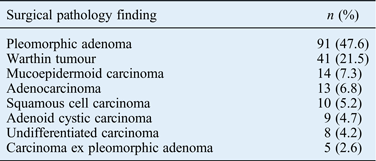
All patients who underwent surgery at least 6 months prior to enrolment and were aged more than 17 years were included. Patients who had died or were lost to follow up were excluded. The mean ± standard deviation age was 50 ± 14 years (range 17–81 years). Eighty-four (44.0 per cent) patients underwent superficial parotidectomy, 26 underwent subtotal parotidectomy (13.6 per cent) and 81 (42.4 per cent) underwent total parotidectomy. The most common surgical pathology finding was pleomorphic adenoma (47.6 per cent), followed by Warthin tumour (21.5 per cent), mucoepidermoid carcinoma (7.3 per cent), adenocarcinoma (6.8 per cent), squamous cell carcinoma (5.2 per cent), adenoid cystic carcinoma (4.7 per cent) undifferentiated carcinoma (4.2 per cent) and carcinoma ex pleomorphic adenoma (2.6 per cent; Table I).
Distribution by surgical pathology finding

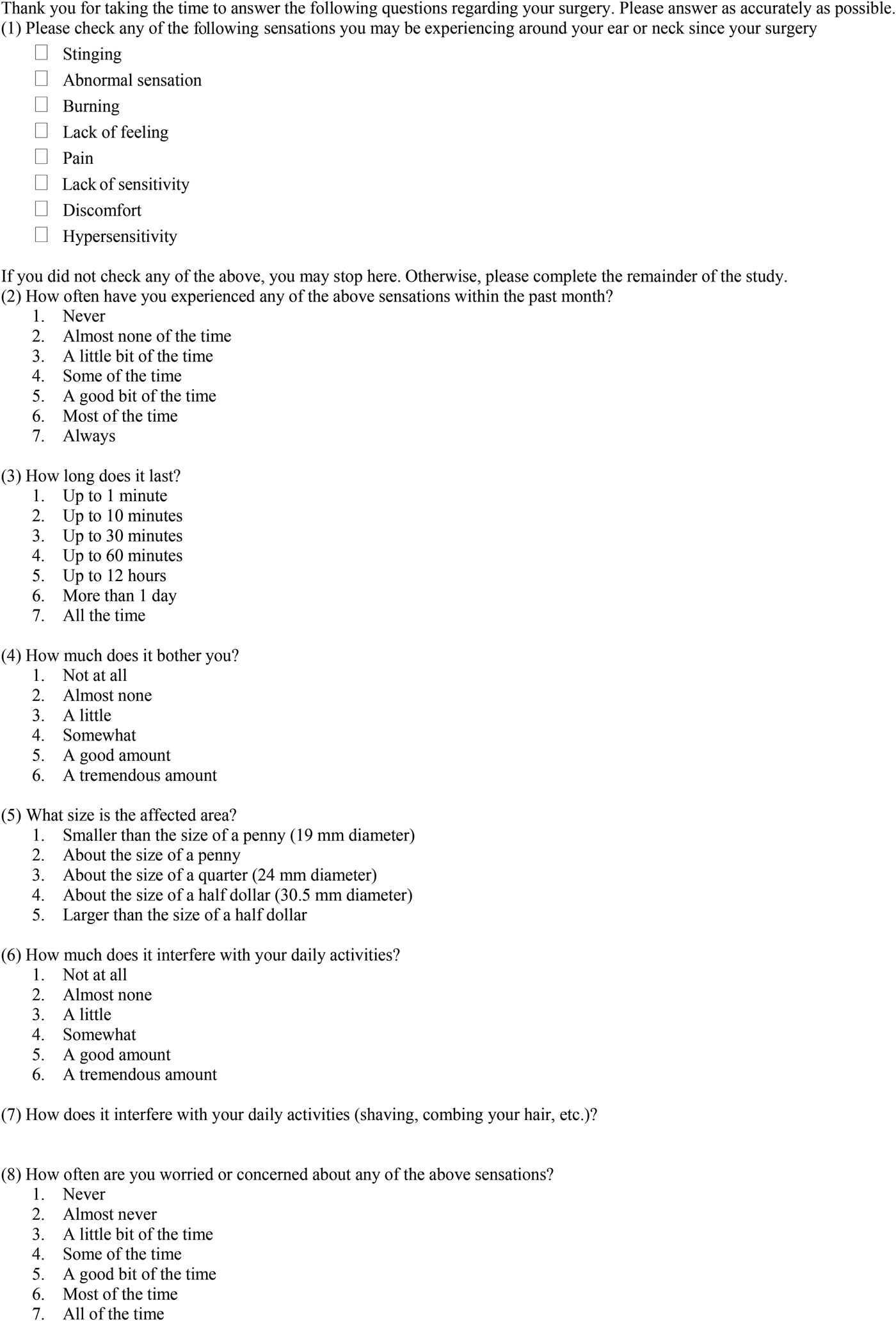
A quality of life survey consisting of eight questions prepared and validated by other authors was used to measure the outcome of great auricular nerve sacrifice during parotidectomy (Figure 1).Reference Streiner and Norman16–Reference Patel, Har-El and Rosenfeld19 The survey was administered and completed by patients between 5 and 81 months after surgery. The number of patients who had anaesthesia, paraesthesia and referred sensation in any of the predefined sensory regions were determined. The presence of sensory dysfunction in different regions (item 5) was evaluated to show changes in the area of anaesthesia and paraesthesia over time and to identify the degree of sensory dysfunction in different specific regions.
Eight-item quality of life survey.
Informed consent was obtained from each patient prior to enrolment.
Statistical analysis
Statistical analysis of the data was performed using MatLab (The Matworks, Natick, Massachusetts, USA), a commercially available software for medical statistics. The analysis was performed to find out whether sacrifice of the great auricular nerve influences the quality of life in a positive or negative manner. Non-parametric tests were used because the data collected was non-normally distributed. Kruskal–Wallis non-parametric testing and analogous analysis of variance (ANOVA) one-way parametric testing were used to determine whether the answers to the quality of life questionnaire changed significantly over time. Spearman rank correlation testing was performed to identify correlations among the different variables. The Friedman test, analogous to non-parametric two-way ANOVA, was performed to predict how the related variables would change over time. Finally, the analysis focused on a large subgroup of patients who complained of the same symptom (lack of sensitivity) to identify relationships that may indicate interference on quality of life in a positive or negative manner.
Statistical significance was set at a p value of 0.05. Relationships among responses to the survey questions were assessed using correlation coefficients based on an a priori hypothesis (that sacrifice of the great auricular nerve influences quality of life).
Results
In this study, a total of 191 patients were analysed: 54 had no symptoms, but 137 (71.7 per cent) reported experiencing at least one or more abnormal sensations in the ear or neck region after surgery, including a lack of sensitivity, discomfort, hypersensitivity, pain, stinging and burning.
Symptoms after surgery
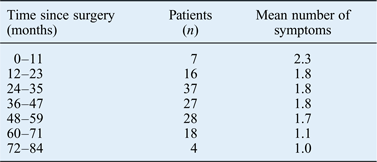
Data from the 137 symptomatic patients were analysed further: 87 patients (63.5 per cent) reported experiencing only one symptom (lack of sensitivity), 46 (33.5 per cent) experienced two different symptoms (lack of sensitivity and another kind of abnormal sensation) and only 4 (2.9 per cent) complained of at least 3 symptoms. The number of abnormal sensations reported had a moderate inverse correlation with time since surgery (shown by Spearman's coefficient of rank correlation, r, and probability, p), suggesting gradual symptom resolution. As shown in Table II, the mean number of reported symptoms was 2.3 during the first year after surgery and only 1.0 at six or more years after surgery. The number of reported symptoms did not correlate with patient age (r = 0.05, p = 0.89).
Relationship of symptom prevalence to time since surgery
Sensory dysfunction
A correlation analysis was performed after patients were subdivided into large, homogeneous subgroups according to symptoms. In the subgroup of 87 patients who experienced lack of sensitivity only, this symptom was experienced ‘most of the time’ by 15 patients (17.2 per cent) and ‘always’ by 38 patients (43.7 per cent; Table III). Symptom duration showed a non-normal distribution (Table III): for 1 patient (1.1 per cent), the symptom lasted 10 minutes or less; for 33 patients (37.9 per cent), it lasted longer than 1 hour. Fifty-three patients (60.9 per cent) reported the same symptom as being always present. The degree of bother caused by lack of sensitivity was generally mild (Table III), with 57 patients (65.6 per cent) reporting mild symptoms (i.e., ‘none at all’ or ‘almost none’), and only two patients (2.3 per cent) who considered the sensation ‘moderate’. Spearman's coefficient of rank correlation analysis showed that the degree of bother correlated significantly with the frequency of symptom occurrence (r = 0.4, p < 0.001) and with the duration of the abnormal sensation (r = 0.7, p < 0.001; Table III). Moreover, there was a relationship between the degree of bother and the size of the affected area (p < 0.001, r = 0.52; Table III). Relationships among these responses were evaluated using Spearman's coefficient of rank correlation.
Test question responses of 87 patients reporting abnormal sensations

min = minute
Interference in daily activities
Friedman non-parametric testing was used to determine how symptom perception affects daily activities. It showed a significant correlation (p < 0.001) between the degree of bother and both the frequency and duration of symptoms, and also showed a significant correlation between the degree of interference with daily activities and both the number of sensations and the time elapsed since surgery (p < 0.001). This analysis also identified a relationship among the answers given to questions relating to the degree of bother, symptom perception and interference with daily activities. This result indicates that the perception of discomfort (related to how often and for how long the symptom occurs) affects daily life.
Quality of life
The statistical variability of answers given by the 137 symptomatic patients to the eight-question quality of life survey over time was analysed by Kruskal–Wallis non-parametric testing. A highly significant correlation was found (p < 0.001) among the answers to questions 2, 3, 4, 5, 6 and 8.
For the subgroup of 87 patients who experienced only one symptom (lack of sensitivity), the degree of interference showed a moderate correlation with both the number of sensations reported (r = −0.34, p < 0.0001), and the time elapsed since surgery (r = 0.30, p < 0.003). This was confirmed by the degree of worry, which had a similar trend. In fact, only one patient (1.1 per cent) reported having at least some worry or concern because of his symptoms, while all other patients reported being never (81.6 per cent) or almost never (17.2 per cent) worried (Table III). Only 18 patients (20.7 per cent) thought that their abnormal sensations significantly interfered with their daily activities (Table III).
Discussion
The great auricular nerve is a sensory nerve arising from the cervical plexus and composed of branches of the C2 and C3 spinal nerves. As it ascends across the sternocleidomastoid muscle toward the parotid gland, it splits into anterior and posterior branches. The anterior branch provides sensory innervation to the skin overlying the parotid gland and the angle of the mandible, while the posterior branch innervates the skin over the mastoid, the posterior inferior surface of the auricle, the lobule and the concha. Conventionally, surgeons have to sacrifice the great auricular nerve during parotidectomy to facilitate access to the parotid gland.Reference Beahrs4 Although morbidity following nerve section is clearly recognised, few studies have specifically evaluated its effect on patient quality of life. Schultz et al. evaluated donor site morbidity in 29 patients who underwent great auricular nerve graft procedure to repair lingual or inferior alveolar nerves.Reference Schultz, Dodson and Meyer18 They reported symptomatic nerve injury in 46 per cent of patients, with spontaneous resolution in 54 per cent of those. They concluded that, while morbidity following great auricular nerve harvesting for reconstruction following ablative tumour surgery may be perceived as minor, nerve removal for repair of the lingual or inferior alveolar nerve injuries following elective orthognathic or dentoalveolar surgery may have a greater effect. Patel et al. showed that abnormal sensations following great auricular nerve sacrifice during parotidectomy were common, occurring in 30 patients in their cohort (57 per cent).Reference Patel, Har-El and Rosenfeld19 Twelve of these (23 per cent) reported one abnormal sensation only, with 10 (19 per cent) reporting two, and 8 (15 per cent) reporting three or more. The most commonly reported problems were lack of feeling and lack of sensation. However, there was a significant decrease in the number of reported symptoms over time.
Out of eight possible abnormal symptoms, patients reported an average of 2.3 in the first year after surgery, 0.5 between the second and third post-operative years, and only 0.2 at five or more years after surgery. This finding could be related to several factors, including partial regeneration of cutaneous sensory nerve fibres, collateral innervation from the lesser occipital nerve posteriorly and the transverse cutaneous nerve anteriorly, and patient acclimation to any deficit. Patel et al. also showed that 23 patients in their cohort (77 per cent) reported little or no bother caused by sensory symptoms, 27 (90 per cent) reported no to almost no interference in their daily activities, and 22 patients (73 per cent) reported little to no anxiety about the sensory dysfunction.Reference Patel, Har-El and Rosenfeld19 Other studies reported similar activity deficits such as difficulty in using the telephone, shaving, combing their hair, wearing ear-rings, and perceiving facial contact during intimacy, and discomfort when wearing glasses.Reference Christensen and Jacobsen20–Reference Vieira, Maia and Ribeiro22 Ryan and Fee indicated that after four to five years, approximately one-third of patients (27 per cent) reported a specific functional deficit because of either or both anaesthesia and paraesthesia, but only a few patients had problems when using the telephone, shaving, combing their hair etc.Reference Ryan and Fee23
Our study aimed to verify Patel and colleagues' observation in a larger sample. It showed that abnormal sensations are common following great auricular nerve sacrifice during parotidectomy. The most prevalent problem reported was lack of sensitivity (affecting 137 patients (72.7 per cent)), most frequently localised in the ear region, especially the ear lobe, scar tissue and cheek. Patients reported an average of 2.3 symptoms during the first year after surgery, 1.8 symptoms between post-operative years two and three, 1.7 between post-operative years three and four, 1.6 in the fifth year, and 1.0 at five or more years following surgery (Figure 2). The predominant symptom is lack of sensitivity.
Graph showing the symptom distribution over time.
When considering those patients who only experienced a lack of sensitivity, the statistical analysis showed that the degree of bother correlated significantly with symptom duration and frequency (p < 0.001, r = 0.75) and correlated moderately with the size of the affected area (p < 0.001, r = 0.52; Figure 3). The size of the affected area decreased over time, as shown by the focus of bother being perceived in a progressively smaller area. However, symptom frequency and duration were not the causes of interference with daily activities. In fact, 69 (79.3 per cent) of these patients reported ‘almost never’ or ‘never’ experiencing interference with daily routines, while only 18 (20.7 per cent) were bothered ‘a little’ by the symptom (Table III).
Graph showing the correlation between degree of bother and size of the affected area.
In addition, despite the 43 per cent of patients who said they always perceive the symptom and 60 per cent who perceived it most of the time (Table III), when patients were asked if the degree of bother caused by abnormal sensations was troublesome, more than 60 per cent said ‘not at all’ or that the bother was ‘almost none’ (Figure 4). Only one patient reported having at least some anxiety, while all other patients reported being ‘never’ (81 per cent) or ‘almost never’ (17 per cent) worried (Table III).
Graph showing the effect of increasing time since surgery on the degree of interference with daily activities.
In accordance with Patel and colleagues' observations, our data confirmed that although a large number of patients experienced some abnormal sensations after great auricular nerve sacrifice during parotidectomy, these decreased significantly over time. The impact of nerve sacrifice on patient sensory function was tolerable and generally decreased during the first post-operative year. Sensory testing and patient scoring showed that the prevalence and average area of anaesthesia and paraesthesia decreased mildly after the first post-operative year.
Furthermore, even patients who experienced abnormal symptoms did not report any significant degree of bother, concern, worry or interference with their daily activities. Therefore, sacrifice of the great auricular nerve seems to have a small impact on patient quality of life. For these reasons, surgeons may help patients by spending additional time investigating patient complaints and attempting to alleviate their anxiety.
• Potential parotidectomy complications include great auricular nerve anaesthesia
• Sensory loss can lead to anaesthesia, paraesthesia, discomfort, functional deficits and increased traumatic injury risk
• The short- and long-term consequences of great auricular nerve sacrifice on patient quality of life are unknown
• Persistence of an abnormal sensation of discomfort did not significantly affect patients' daily activities
• Great auricular nerve sacrifice has little impact on patient quality of life
Finally, saving as many great auricular nerve branches as possible seems to be optional and unnecessary in terms of maintaining and improving the quality of life of parotidectomised patients. On the contrary, it restricts complete mobilisation of the parotid inferior pole, extends the time spent in the operating theatre and affects facial nerve preservation.
Conclusion
This study demonstrated that sacrificing the great auricular nerve has a small effect on patient quality of life. Although patients refer to the persistence of an abnormal sensation of discomfort, their daily activities are not significantly affected. While several authors recommend preserving the posterior branch of the great auricular nerve, especially in patients for whom surgical or oncological results would not be compromised, our findings suggest that this might be unnecessary during parotidectomy.Reference Shvero, Koren and Feinmessner8–Reference Brown and Ord10, Reference Brown and Ord13, Reference Christensen and Jacobsen15, Reference Christensen and Jacobsen20