Recurrence affects 20% to 40% of all patients with Clostridium difficile infection (CDI).Reference Pepin, Alary and Valiquette 1 , Reference Sheitoyan-Pesant, Abou Chakra, Pepin, Marcil-Heguy, Nault and Valiquette 2 Because it represents a weakness of successful treatment, recurrent CDI constitutes an important outcome measures in trials investigating novel drugs and treatment strategies. Reappearance of symptoms after an initial episode of CDI may arise either due to de novo infection with the same strain of C. difficile or due to a new infection with a different strain of C. difficile. This distinction is critical because incorrect allocation may result in over- or underestimation of treatment effects and may hamper analyses regarding risk factors, especially those attributed to the strain. Furthermore, correct classification of CDI events is important regarding accurate reporting of infection rates attributed to healthcare institutions as mandated in the United States for hospitals participating in the Centers for Medicare and Medicaid Service (CMS) Inpatient Prospective Payment System Quality Reporting Program and recommended in Europe by public health authorities such as the European Centers for Disease Control and Prevention (ECDC). 3
Guidelines on CDI define recurrence as reappearing CDI within 8 weeks after the onset of a previous episode, provided that prior symptoms resolved. CDI diagnosed after 8 weeks from initial diagnosis is considered reinfection.Reference McDonald, Coignard, Dubberke, Song, Horan and Kutty 4 , Reference Debast, Bauer and Kuijper 5 To date, this period has not been validated for its ability to distinguish recurrence of infection with the same strain of C. difficile as identified during initial diagnosis from reinfection with a new strain. Our objectives were (1) to validate the proposed 8-week period for distinguishing recurrent CDI from reinfection, (2) to identify additional clinical variables with distinctiveness, and (3) to possibly propose a more accurate definition.
METHODS
Study Design
From January 2004 to December 2013, a cohort of all inpatients diagnosed with CDI at the University Hospital Basel, Switzerland, was established, and toxigenic C. difficile strains were prospectively collected. This study was approved by the local ethics committee as part of the quality assurance program, and informed consent was waived. The Strengthening the Reporting of Observational Studies in Epidemiology (STROBE) guidelines for reporting of observational studies were followed.Reference von Elm, Altman, Egger, Pocock, Gotzsche and Vandenbroucke 6
Definitions
CDI was defined according to standard criteria endorsed by the European Society for Clinical Microbiology and Infectious Diseases (ESCMID).Reference Debast, Bauer and Kuijper 5 Severe CDI was defined as a CDI episode with 1 or more specific signs and symptoms of severe colitis, and complicated CDI was defined as a course of disease, with significant systemic toxin effects and shock resulting in ICU admission, colectomy, or death.Reference Debast, Bauer and Kuijper 5 Recurrent CDI was defined as an episode of CDI that occurred within 8 weeks after the onset of a previous episode, provided that CDI symptoms from the earlier episode resolved with or without therapy. A second episode of CDI occurring more than 8 weeks after the onset of a previous episode was termed reinfection.Reference McDonald, Coignard, Dubberke, Song, Horan and Kutty 4 , Reference Debast, Bauer and Kuijper 5 We defined “same genotype CDI” as a second episode of CDI caused by the same genotype as the first episode of CDI; we defined “different genotype CDI” as a second episode of CDI caused by a different genotype as the first episode of CDI. The gold standard, the standard definitions we measured against, were “same genotype CDI” for recurrence and “different genotype CDI” for reinfection. CDI was classified as healthcare-facility–onset, healthcare-facility–associated if symptom onset occurred on or after day 3 after admission.Reference McDonald, Coignard, Dubberke, Song, Horan and Kutty 4
Data Collection
Pertinent clinical data were collected through medical chart review. Data on exposures associated with an increased risk for acquiring CDI were collected for both the period prior to diagnosis of the initial episode of CDI (ie, exposures to antibiotics during the prior 8 weeks, to steroids during the prior 7 days, to immunosuppressives during the prior 7 days, and to chemotherapy during the prior 3 months) and during the 8 weeks following diagnosis of the initial episode of CDI. Follow-up information regarding development of a second episode of CDI after discharge was collected through a review of all medical records from our institution, including our outpatient clinics during the entire study period. In addition, the electronic database of the microbiology laboratory was searched for any stool samples that tested positive for toxigenic C. difficile from each patient included in this cohort.
Microbiological Analyses
Throughout the study period, the following approaches were applied to detect toxigenic C. difficile from stool samples tested on the physicians’ request as a routine diagnostic procedure. From 2004 to 2007, anaerobic culture in addition to enzyme immunoassay (EIA) (C. DIFFICILE TOX A/B II, TechLab/Wampole, Blacksburg, VA) for detection of toxins A/B were performed, and toxin testing was conducted from cultured C. difficile isolates when faecal toxin was negative. Screening for C. difficile glutamate dehydrogenase (GDH) antigen (C.DIFF CHEK-60, TechLab/Wampole) was introduced in 2008 and only positive stools were further evaluated for C. difficile toxin by EIA or toxin testing from cultured C. difficile isolates if fecal toxin was negative.Reference Fenner, Widmer, Goy, Rudin and Frei 7 Screening for GDH was followed by confirmation of the presence of toxigenic C. difficile by performance of polymerase chain reaction (PCR, Xpert C. difficile, Cepheid, Sunnyvale, CA) since 2011. All formed stool samples were excluded from diagnostic testing.
In patients diagnosed with a second episode of CDI, both respective C. difficile strains, if isolated from stool specimens collected at least 3 weeks apart and deriving from patients fulfilling the definition of recurrent disease as defined above, were subjected to PCR-ribotyping using high-resolution capillary gel-based electrophoresis.Reference Indra, Huhulescu and Schneeweis 8 In brief, PCR was performed using the original principles developed by the Anaerobe Reference Unit in Cardiff, United Kingdom as described elsewhere.Reference Stubbs, Brazier, O’Neill and Duerden 9 Capillary electrophoresis was conducted using the automated sequencer ABI-PRISM 3130 Genetic Analyzer (Applied Biosystems [Life Technologies], Foster City, CA). Fragments were analysed using GeneMapper (Applied Biosystems) and GelCompar II (Applied Maths, Sint-Martens-Latem, Belgium) software. The fragment profiles were compared with those generated using the standard set of the ECDC Brazier strain collection of PCR ribotypes, which was obtained from the European Clostridium difficile infection study network (ECDIS-NET, http://www.ecdisnet.eu).
Statistical Analysis
Categorical variables were summarized as counts and proportions; continuous variables were summarized as medians and interquartile ranges (IQR). The Fisher exact test was used for comparisons of proportions. The Shapiro-Wilk test was applied to distinguish between normal and abnormal distributions of continuous variables. Normally distributed variables were analyzed using the Student t test and nonnormally distributed variables were analyzed using the Mann-Whitney test. Univariate and multivariate logistic regression models were performed to identify variables associated with either recurrence or reinfection. All variables found to be significant in univariate analyses were included in the multivariate model to identify independent predictors. The c statistic analogous to the area under the receiver–operating characteristic area under the curve (ROC AUC) was calculated to quantify the discriminative power of both the standard definition and potential new definitions to distinguish recurrence from reinfection. The Youden’s index was calculated to identify the optimal cutoff point regarding sensitivity and specificity for distinction. The Hosmer-Lemeshow goodness-of-fit test was applied as a measure of calibration to compare the difference between predicted and actual events. Statistical analyses were performed using STATA 12.0 (StataCorp, College Station, TX).
RESULTS
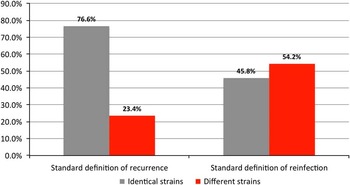
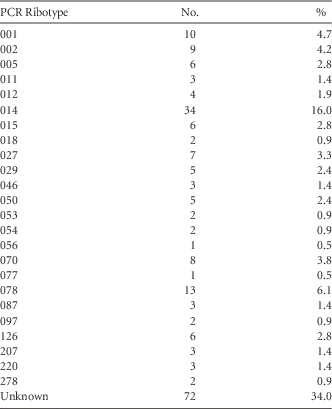
Among 750 patients diagnosed with CDI during the study period, 130 (17.3%) were diagnosed with either recurrence or reinfection. In total, 212 strains from both episodes of CDI were available from 106 patients, of which 47 were considered recurrence and 59 were considered reinfection, based on the standard definitions. Strains from either the first or the second episode of CDI were missing for 24 patients, who therefore had to be excluded from further analyses. The distribution of ribotypes is summarized in Table 1; they show a broad diversity of ribotypes with no predominance of a particular type, except for ribotype 014 (n=34; 16%). We were not able to identify any association between any specific ribotype and a second episode of CDI caused by the same genotype of C. difficile (P=.358). Identical strains (ie, “same genotype CDI”) were identified during both episodes of CDI in 36 patients with recurrence (36 of 47) and in 27 patients with reinfection (27 of 59) (Figure 1).
Proportion of patients with “same genotype C. difficile infection” (grey bars) and “different genotype C. difficile infection” (red bars), stratified by standard definitions of recurrence and reinfection.

Distribution of Polymerase Chain Reaction (PCR) Ribotypes

Sensitivity, specificity, negative and positive predictive value of the standard criteria for predicting “same genotype infection” were 56%, 74%, 53%, and 76%, respectively. The 8-week cutoff for distinguishing recurrent CDI from reinfection was associated with “same genotype CDI” (OR, 3.88; 95% CI, 1.66–9.05; P=.002) with an ROC AUC of 0.658.
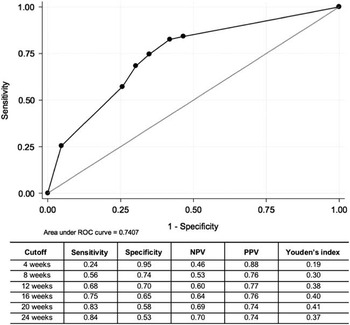
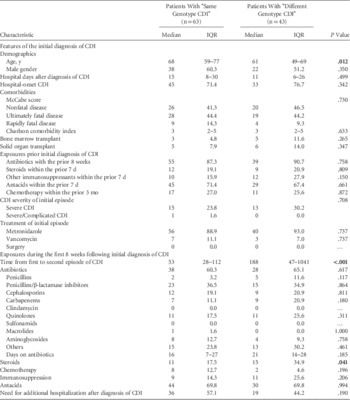
Patients with a second episode of CDI caused by the same strain as initially detected (“same genotype CDI”), were older and less likely to be treated with steroids during the following 8 weeks after initial diagnosis of CDI than patients with “different genotype CDI,” while other baseline characteristics and exposures did not differ (Table 2). Time from initial diagnosis of CDI to second episode was associated with “different genotype CDI” (OR, 1.31; 95% CI, 1.09–1.56; P=.003 per week). In multivariate analyses, including age and receipt of steroids during the following 8 weeks after initial diagnosis of CDI into the regression model, only time remained associated with “different genotype CDI” (OR, 1.27; 95% CI, 1.05–1.53; P=.013), while age (OR, 0.98; 95% CI, 0.95–1.01) and receipt of steroids (OR, 2.32; 95% CI, 0.89–6.06) lost statistical significance (P=.086). For prediction of reinfection rather than recurrence by time, the ROC AUC was 0.741, with an optimal cutoff for discrimination (ie, best match for both sensitivity and specificity) at 20 weeks (Figure 2). Hosmer-Lemeshow statistics revealed an insignificant P value for the univariaye regression model, indicating good calibration of time (Hosmer-Lemeshow χ2 goodness-of-fit test=2.35; P=.503).
Performance characteristics of different cutoffs for prediction of “different genotype C. difficile infection” rather than “same genotype C. difficile infection.”

Comparisons of Clinical Features and Exposures Between Patients With Clostridium difficile Infection (CDI) Caused by Recurrence and Reinfection

NOTE. Bold text indicates significant P values. IQR, interquartile range.
DISCUSSION
The 8-week cutoff for distinguishing recurrent CDI from reinfection requires reconsideration: the overall performance characteristics and time between the first and second CDI episodes show low measures of discrimination for episodes of CDI caused by identical or different genotypes. We could not identify any additional clinical characteristics with independent distinctive power and thus, potential to improve performance of the currently applied standard definition. We found a considerably extended period of 20 weeks to result in the best match for both sensitivity and specificity to distinguish recurrence from reinfection.
Our results are supported by previous studies revealing that 65% of all second episodes of CDI occurring between 8 weeks and 11 months after the initial diagnosis were caused by identical strains,Reference Kamboj, Khosa, Kaltsas, Babady, Son and Sepkowitz 10 and identical strains were identified in recurrent CDI up to 26 weeks after initial diagnosis.Reference Kumar, Miyajima and He 11 Similarly, an earlier study performed on a smaller cohort of HIV patients revealed that recurrent CDI was caused by the same strain of C. difficile after more than 8 weeks in a relevant proportion of patients.Reference Alonso, Gros, Pelaez, Garcia-de-Viedma, Rodriguez-Creixems and Bouza 12 However, these studies did not investigate other time frames.
Our results have important implications for clinical trials investigating the effectiveness of novel compounds for the treatment of CDI, for epidemiological studies aiming to identify risk factors for recurrent disease, and for CDI surveillance.
Because identification of identical strains of C. difficile during both episodes of CDI may indicate treatment failure, and while identification of different strains rather reflects ongoing exposure to risk factors and possibly longer time to reconstitution of gut flora, this distinction is critical when studying treatment effects. In our cohort, 23% of patients diagnosed with a second episode of CDI during the first 8 weeks after initial infection were, in fact, infected with a different strain, indicating failure to reverse the effects of predisposing risk factors rather than failure of initial treatment to eradicate the causative strain. Similarly, 17% of patients were diagnosed with CDI caused by a different strain of C. difficile within 30 days after treatment in a large prospective cohort comparing fidaxomicin to vancomycin for treatment of CDI,Reference Figueroa, Johnson, Sambol, Goldstein, Citron and Gerding 13 possibly resulting in an underestimation of treatment effects allocated to these drugs. On the other hand, assessing recurrence as an outcome measure within 28 days of cure of the initial episode (as commonly applied),Reference Louie, Miller and Mullane 14 , Reference Cornely, Crook and Esposito 15 may result in the overestimation of treatment success; 46% and 65% of patients were identified with a second episode of CDI caused by the identical strain after 8 weeks from initial diagnosis in our cohort and an independent cohort,Reference Kamboj, Khosa, Kaltsas, Babady, Son and Sepkowitz 10 respectively. Interestingly, trials investigating efficacy of treatments not only aiming at eradication of the inciting strain but also influencing the host response to C. difficile by administration of monoclonal antibodies or reconstitution of gut flora have used longer follow-up periods of 84 daysReference Lowy, Molrine and Leav 16 and 10 weeks,Reference van Nood, Vrieze and Nieuwdorp 17 respectively. Consistent definitions and standardized applications of follow-up periods are needed to compare different treatment strategies for CDI and to provide evidence-based guidelines. Broadly applied strain typing in patients with recurrent disease would provide valuable insights into the pathophysiology of CDI and the identification of risk factors.
Both the ECDC and the National Healthcare Safety Network (NHSN) recommend including CDI cases occurring 8 weeks after the onset of a previous episode as a new case, and our results have important implications regarding surveillance, especially because CDI rates may be used as a marker for quality assessment to compare hospitals and because the diagnosis of healthcare-associated CDI may result in decreased reimbursement. Based on our results, studies on large and independent cohorts are needed to externally validate the most accurate cutoff to avoid misclassification of a case as a new case.
Our study has important limitations. First, it was conducted at a single center, which may hamper generalizability of the results to other settings. Second, distinguishing C. difficile strains by PCR ribotyping may result in insufficient resolution to compare strains. Newer typing technologies, such as whole-genome sequencing, can determine relatedness of strains more accurately.Reference Eyre, Cule and Wilson 18 Therefore, we cannot rule out that in cases with identification of identical strains as determined by PCR ribotying, reinfection with a different strain of C. difficile belonging to the identical ribotype may have occurred. Third, we had to rely on medical chart review to identify clinically relevant risk factors and exposures. Finally, our sample size was too small to divide into a derivation and a validation data set, which would have enabled us to provide more robust statistics to identify ideal cutoffs.
In conclusion, our results question the utility of the 8-week cutoff for distinguishing recurrent CDI from reinfection. An extended period of 20 weeks may result in improved overall performance characteristics but this finding requires external validation.
ACKNOWLEDGMENTS
We thank Elisabeth Schultheiss, Division of Clinical Microbiology, University Hospital Basel, Basel, Switzerland, for excellent technical assistance with PCR ribotyping. We would also like to thank the European Study group for Clostridium difficile (ESGCD) for their professional support.
Financial support: No financial support was provided relevant to this article.
Potential conflicts of interest: S. Tschudin-Sutter and A.Widmer are members of the Fidaxomicin Advisory Board of Astellas and the Merck, Sharp, and Dohme C. difficile Advisory Board. S. Tschudin-Sutter is a recipient of 2 unrestricted grants from Astellas. All other authors report no relevant conflicts of interest.