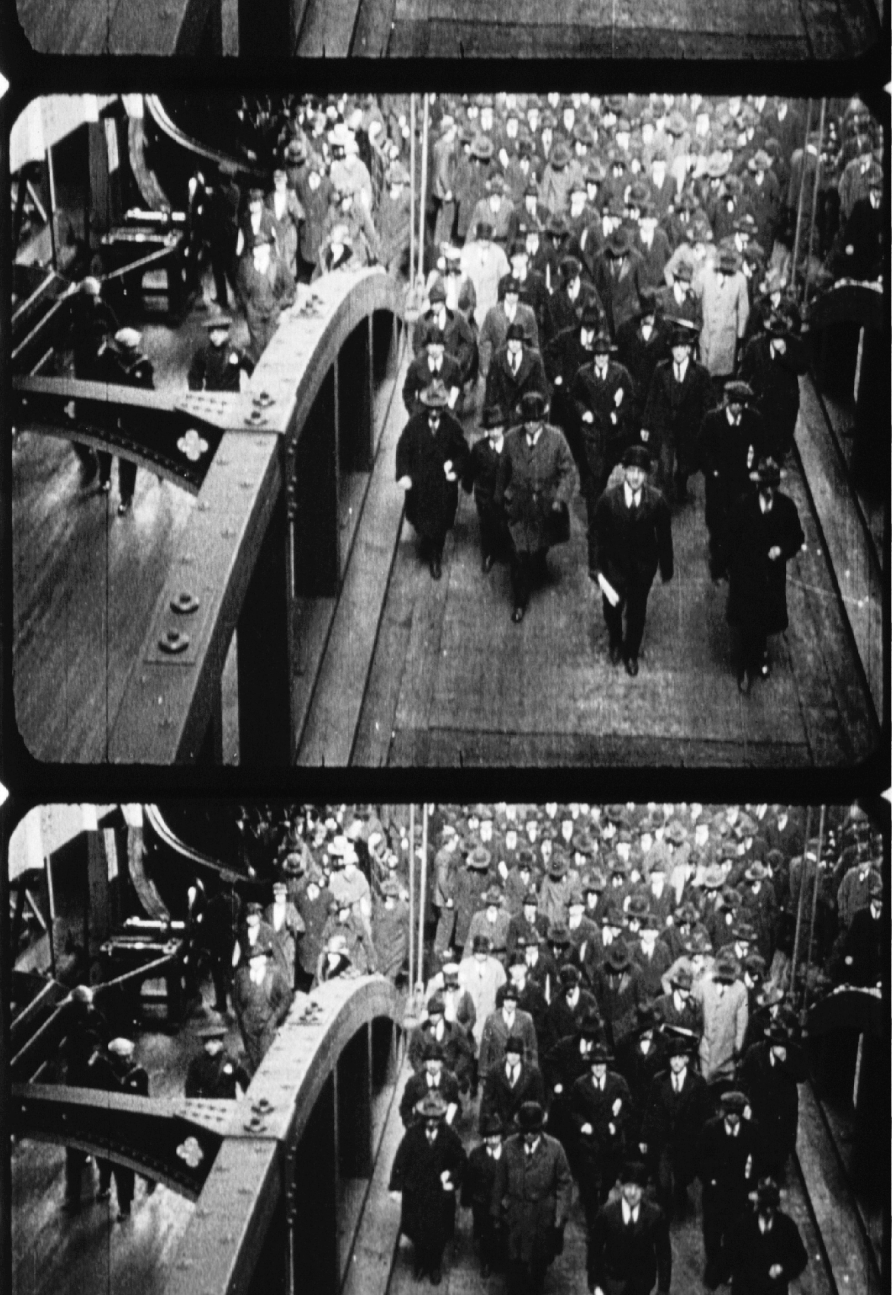
Towards the beginning of Manhatta, the short film Charles Sheeler made in 1921 with the photographer Paul Strand, the camera focusses on the Staten Island Ferry as it glides into its Manhattan dock (Figure 1). Throughout the film Strand and Sheeler insert intertitles culled from Walt Whitman's mid-nineteenth-century evocations of New York in the poems “Crossing Brooklyn Ferry,” “A Broadway Pageant” and “Mannahatta.” The intertitle – the second of the film – that introduces this initial sequence runs, “When million-footed Manhattan / unpent, descends / to its pavements,” and the crowd flows from the ferry at the release of the chain to hurry into the streets of the city. This is really the last we see of New York's citizens for the bulk of the film. But towards the end of Manhatta the penultimate intertitle picks up this image of the “million-footed” city: “Where the City's ceaseless crowd moves on, the live long day,” it runs. And we see again the crowd, this time in vertiginous perspectives down into the city's streets, as “insects crawling between skyscrapers.”Footnote 1
Still from Charles Sheeler and Paul Strand, Manhatta, 1921. From the Unseen Cinema: Early American Avant-Garde Film 1893–1941 project. New York: Anthology Film Archives. Photo: Anthology Film Archives.

Between these two sections of the film, the intertitles concern the physical fabric of the city rather than its inhabitants: “High growths of iron / slender, strong, splendidly uprising toward clear skies,” runs one; “Where our tall topt marble beauties / range on opposite sides”; “This world all spanned with iron rails.” Or they conjure up its watery commercial context: “With lines of steamships threading every sea.” The images that accompany these quotations eschew the crowd and even human presence. Instead, they depict abstract perspectives and broad cityscapes, with the skyscrapers and buildings of Manhattan taking centre stage. People almost never appear, and when they do – as briefly on Brooklyn Bridge, or when we see labourers delicately balanced along the beams of buildings under construction – they do so at a distance, minute figures servicing machinery or moving anonymously against the camera's remote perspectives. The very last intertitle of all evokes “Gorgeous clouds of sunset,” which are summoned to “drench with your splendor / me or the men and women / generations after me.” But Whitman's bustling nineteenth-century city has been transformed into the empty ballet mécanique of the early twentieth, and the final shots are of the sunset over the unpopulated Manhattan skyline. The implication is that it is Strand and Sheeler and their audience who are Whitman's posterity. But if so, “the men and women” of this new generation are absent from the scene which they survey.
In 1921 Strand and Sheeler had a set of traditions to look back on when they came to depict the city of New York.Footnote 2 Whitman, who, according to one modern commentator, they “revered as a spiritual forefather” for his evocation of a human city “of ordinary American people,” was matched by a related line of descent in the visual arts.Footnote 3 Only a decade before Manhatta the artists of the Ashcan School were painting and drawing New York City from street level as an intimately human place. The Ashcanners – among them John Sloan, George Bellows, Everett Shinn, George Luks and William Glackens – are usually seen as gritty urban realists, expanding on Robert Henri's influential insistence that artists should develop a new style that sought to catch the ebb and flow of life in urban America. Ashcan images often focus on the creation of empathy in the viewer, making use of anecdote and gesture to represent individuality, human interaction and shared bodily experience.
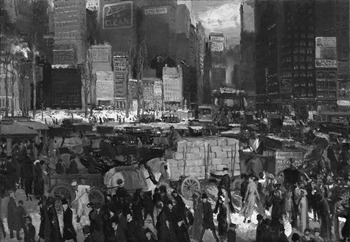
In the short span of time between such paintings and Strand and Sheeler's film the human subject vanishes in cutting-edge depictions of the city – so that Whitman's evocations “of ordinary American people” seems a melancholy aspiration out of kilter with the images they accompany. Like Strand and Sheeler, artists and photographers, including John Marin, Alvin Langdon Coburn, Joseph Stella and Alfred Stieglitz, produced images which shrank or abolished the human figure in favour of the soaring steel and concrete which characterized the unprecedented cityscape of lower Manhattan.Footnote 4 Folded first into the anonymity of the crowd and then omitted altogether, the city's inhabitants were replaced in these works by empty vistas across a massive skyline. This shift has been recognized as marking an important moment in American visual culture, indeed some commentators have discerned two contrasting “traditions” of American modernism in Ashcan's humane realism and the empty machine city of a greater Stieglitz circle.Footnote 5 But it is worth noting that an Ashcan image like George Bellows's 1911 painting New York (Figure 2), is already in the process of withdrawing from the humanity of the street in this way. Recent commentary on Bellows's painting has seen it as struggling to maintain what John Fagg has called an “anecdotal” reading of the city, dependent on the human perspective of the sidewalks and their bustling crowds.Footnote 6 But the tilt of Bellows's attention is already sliding away from such a focus. Tracking back from the intimate human view, Bellows reaches a point where the city of buildings and panoramas beyond the human scale starts to rise up, and where the language of gesture Ashcan deploys has already collapsed into the anonymous mass of the crowd. The people here are staffage at best, unspecified or interchangeable. At the centre of the painting, the affectless driver seated on the wagon turns an almost featureless face towards us. It is the systems of the modern metropolis rather than its inhabitants that fascinate Bellows in New York. The purposeful traffic cop – the sole gesturing figure – is nothing but a functionary of the machine, ushering the system efficiently onwards.
George Bellows, New York, 1911. Oil on canvas, 106.7×152.4 cm. Washington, DC: National Gallery of Art (Collection of Mr. and Mrs. Paul Mellon, 1986.72.1). Photo: National Gallery of Art.

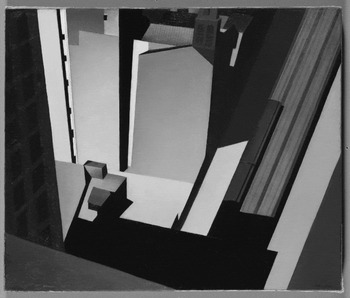
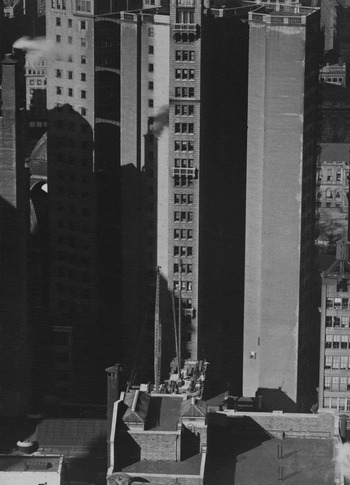
Like the film, Sheeler's paintings and photographs of New York made around the same time as Manhatta, such as Church Street El (1920, Figure 3) – in fact based on a still from the film – or the photograph New York: Park Row Building (1920, Figure 4), offer the unpeopled metropolis to which Bellows's painting tends. The derrick and the train and the stark facades of buildings dominate the eye to the exclusion of any human presence.Footnote 7 The contrast between Church Street El (or Strand's From the El (1915), which looks down, through elevated latticework, on a single ant-like pedestrian below), and Sloan's earlier Ashcan depictions of the same train in Six O'clock, Winter of 1912 or the 1907 Election Night is striking for this reason.Footnote 8 Even when Sloan in Six O'clock chooses to paint the undifferentiated crowd rather than the conglomeration of individuals pushing and thrusting out of the mass in Election Night, the contrast with the mechanical impersonality of Strand and Sheeler's city is manifest.
Charles Sheeler, Church Street El, 1920. Oil on canvas, 41×48.5 cm. Cleveland: The Cleveland Museum of Art (Mr. and Mrs. William H. Marlatt Fund, 1977.43). Photo: The Cleveland Museum of Art.

Charles Sheeler, New York: Park Row Building, 1920. From photographic negative. Boston: Museum of Fine Arts (The Lane Collection). Photo: Museum of Fine Arts, Boston.

This vanishing of the human figure will be central to what I have to say about the presence of the past in Sheeler's work in the 1910s and 1920s. Before I turn to that, however, I want to note that whatever their differences, Strand and Sheeler and the Ashcan painters are all concerned with the visual as a means of understanding the city. Rebecca Zurier, the leading Ashcan scholar, wonders if the Ashcan painters' “spectator's passion,” apparently fixated on the gritty, human, particularities of streets and lives, is “not so much for [their] fellow citizens as for the act of seeing.”Footnote 9 No matter how empathetic that process seems, “seeing” as a means of portraying the chaotic vitality and profusion of street life provides the opportunity for the artists to substitute the act of looking for the alien lives they observe. Such a procedure defines much Ashcan art, in which the observer–artist characteristically stands back from the events he depicts, as in Sloan's etching Night Windows of 1910 with its rapt voyeur looking down on lighted scenes below him. The impulse behind that act of surveillance is not fundamentally different in the severe visual perspectives of Manhatta down into evacuated streets. Both seek to understand, and provide a visual account of, the new urban centres and dynamism of early twentieth-century America.
I am interested in this article in what is at stake when this recourse to vision as a mode of understanding is no longer directed at the city's inhabitants but at its existence independent of humanity, at its systems and built environment. In works by Stieglitz, Marin and Edward Steichen, then, as well as by Strand and Sheeler, it is the physical fabric of the “new New York” that serves as protagonist and centre of attention, usurping the human principle. But I want to make this observation clarify a more central theme – that Sheeler's deployment of vision in his depiction of the city mediates an unresolved relationship to the past. I argue that Sheeler's art engages with two linked exclusions, of the self and of the past. The traditions of representation which I have described as characteristic of the Ashcan artists, the visual authority of the artist–observer gazing onto the new life of the streets, are abstracted from the urban scene, relegated to the crowd, or erased entirely. At the same time, because the American past seemed to be slipping away as a result of modernization, that past and its traditions came to seem to Sheeler's contemporaries of unprecedented importance, and what the American past consisted in developed into the subject of intense debate. In the emptied-out cityscapes and interiors of Sheeler's years in Pennsylvania during the 1910s and New York in the 1920s an imagined past is refracted in response to this situation, but it is a past which remains too uncertain to grasp clearly, however urgent the need. Sheeler reaches for a connection that proves elusive, so that the American past returns instead in hauntings, absences and uncertainties, versions of emptiness which substitute for that uncertain relationship. The interest of his work during these years is that it does not accept an imagined or invented past in any straightforward way, but allows the ambivalences of a quest to connect the past to the needs of the present to resonate without resolution.
In what follows I explore some of the ramifications of this situation. In particular, I argue that it is not only a question in Sheeler of the emptying of the city, purging its inhabitants in favour of the constructed environment and the modernist energies of industrial and machine time that sustain it, but also of the persistence of other, personal and emotional, times opposed to this mechanical flow. The past is a pervasive presence in Manhatta, continuously interwoven with the vivid modernity of the skyscraper cityscape. The “few blocks of lower Manhattan” that fascinated so many artists at this time may have been “the main showcase of skyscraper architecture in the world” as scholars have noted, but they also constituted the historic core of the city.Footnote 10 The most substantial symbol of this historic Manhattan in the film is Trinity Church, founded in 1696 and rebuilt in 1846 by the architect Richard Upjohn. The contrast with the rising skyscraper city around the church had already by 1921 become a topos, as, to borrow Wanda Corn's words, “Wall Street buildings dwarfing Trinity Church became a signature for New York.”Footnote 11 But Strand and Sheeler's film makes of this already familiar and rhetorical pairing of old and new something fundamental to their understanding of the relationship of past and present. Filmed from the top of the twenty-one-storey Empire Building at 71 Broadway, ant-like pedestrians flow through the graveyard of the church in a vertiginous image of passing time.Footnote 12 From the diurnal rhythm that gives Manhatta its structure to the flow of commuters at the start and end of the day, the film is constantly aware of the passing of modern time and of how it is ordered and assembled in the new city. Manhatta, like Sheeler's contemporary photographs and paintings, also engages with the presence of different times – the fleeting signs of human duration and the vanishing pulse of human lives – and the desire to perceive time from the past as intimately part of the world of the present. Both also put such continuities under question. I look first at the photographs of the interior of a colonial house in rural Pennsylvania that Sheeler made around 1917, and then at the photographs and paintings of New York he made in the 1920s, before returning to Manhatta to describe its problematic relationship with the past and with the role of the artist–observer.
Charles Sheeler began his career with an eye on the past. His early photographs and drawings of barns in Bucks County, Pennsylvania, made before his move to New York in 1919, describe a past in dialogue with the modernization of American life. Photographs such as Side of a White Barn (c. 1916–17) are often said to treat the historic surface as an abstraction and are interpreted as Sheeler's discovery of modernity in vernacular objects from the past. Karen Lucic, a leading scholar of the artist, has spoken, for instance, of “Sheeler's treatment of antiquated, indigenous artifacts” in these images as important moments in his definition of a stylistic modernism.Footnote 13 In readings of this sort recognition of common attitudes to form and function in American tradition and the present bridge the gap between the past and a convincingly indigenous American modernism. Here I want to shift the balance of such arguments, for the presence of the past in Sheeler's Doylestown images is rather different than they suggest.
In an important discussion of Sheeler, Wanda Corn has pointed out that attitudes to the rural past and its historical artefacts came under intense scrutiny and revision in these years.Footnote 14 There was a widespread sense by the first decades of the century that the rapidity and cumulative effects of modernization had uprooted American culture and cut it off from its own history and from what began in retrospect to look attractively like a coherent tradition.Footnote 15 Although one might object that a difficult relationship to the past is a characteristic of much modernism outside the United States, Sheeler encountered the problem in a particularly American form. At least as early as the Centennial celebrations in 1876, Americans manifested a newly intense interest in their national past. The decades around 1900 are those when Americans became fascinated with their cultural inheritance – from the interest in the conservation of historic buildings, to investigations of folkways, music, and the fine arts. That development can be mapped onto the attempt over the same period to capture the explosive cityscape of lower Manhattan in visual imagery. The intensity of America's modernization cast the predominantly rural past into the realm of imaginative recovery with a force and specificity of contrast that distinguishes it from modernisms elsewhere.
Other images Sheeler produced at the same time as Side of a White Barn reflect a more convoluted sense of the American tradition. The photograph known as Stairway with Chair (1917, Figure 5), for instance, recalls Charles Willson Peale's The Staircase Group (Portrait of Raphaelle Peale and Titian Ramsey Peale) of 1795 (Figure 6), in more than name.Footnote 16 It is not only the curving stairs and domestic scene that are conjured up, but also one of the first important moments in the creation of a self-consciously American art. Sheeler offers us a reverse version of the Peale, in which the context of the earlier painting, its dramatic setting of light, space and darkness, becomes the subject, and the figures who give meaning to the original have absented themselves, leaving a void where they have been, to be filled with shadows and suggestions.
Charles Sheeler, Doylestown House – Stairway with Chair, 1917. Gelatin silver print, 23.5×16.9 cm. Washington, DC: National Gallery of Art (Gift of the Brown Foundation, Inc., Houston). Photo: National Gallery of Art.

Charles Willson Peale, The Staircase Group (Portrait of Raphaelle Peale and Titian Ramsey Peale), 1795. Oil on canvas, 227.3×100 cm. Philadelphia: Philadelphia Museum of Art (The George W. Elkins Collection). Photo: Philadelphia Museum of Art.

Stairway with Chair is an image intensely conscious of a past that it also finds itself different to and separated from. With his friend and fellow painter Morton Schamberg, Sheeler spent over a decade renting the house in rural Pennsylvania where it was taken, building up his own layers of biography, history and association to add to those which had accumulated since its colonial origins in 1768.Footnote 17 At some point towards the end of this period, probably in 1917, Sheeler made a series of photographs of the interior of the house which emphasize the atmospherics and sensory ambiguities of its whitewashed and unpopulated spaces and which exploit its historic character to mysterious and uncanny effect.Footnote 18 Made at the end of a period when Sheeler had been travelling regularly to New York to commune with the Stieglitz group, it is sometimes said that Sheeler and Schamberg sought to make of the austere whitewashed interior of their colonial house a version of Stieglitz's stripped modernist New York Gallery 291. But Sheeler had been careful, too, to retain his independence from the Stieglitz circle, and the Doylestown photographs provide a compelling visual realization of a complex relationship with the American past. The magic realism of the interior Open Door with Dark Mirror of 1917 (Figure 7), for instance, conjures up a powerful image of that past, with every crack, repair and bulge in the walls and door thrown into high visibility by the lighting that defines the space. The photograph is reminiscent in this way of the late nineteenth-century trompe-l'oeil paintings of American artists such as William Michael Harnett and John Frederick Peto. It evokes the specific reality effect of such works, miming the individual scuffs and gashes on the wooden supports. It is materiality, age, a venerable American antiquity that is brought to mind in Open Door with Dark Mirror, and which is given a precise visual credence through the modernist rhythms of light and shade that Sheeler allows to divide up the picture plane. We might understand this as a quest for identity, serving to link up the past with its representation in the present. The joke of the dark mirror in the centre of the image acts to reflect back at the spectator Sheeler's preoccupation with the connections his own art strives to make with American history. It is a small pun on the impenetrability of the past that nevertheless insists, almost playfully, on its centrality and on the importance of attempts to scrutinize and identify with it. The past, no matter how opaque, is anchored at the central point of Sheeler's composition as he strives to understand it and connect himself back to it.
Charles Sheeler, Doylestown House – Open Door with Dark Mirror, 1917. Gelatin silver print, 25.4×20.3 cm. Boston: Museum of Fine Arts (The Lane Collection). Photo: Museum of Fine Arts, Boston.

But this mirror is not simply a joke, even a serious one. Sheeler's interiors have a haunted quality too. These domestic scenes are given an unnerving, imprecise, emotional charge that provokes us to posit events and situations that might saturate the physical spaces he depicts. Here, the two doors, ajar, suggestively opening out into other dark spaces, or hiding – while underlining – the uncertainty of what is behind them, evoke a haunted world beyond the domesticity of the interior. The principal absence in the picture – that of the human – serves to reinforce this sense of almost supernatural menace. The spectator's own absence, projected into the space of the picture, becomes the lurking presence that we nervously sense. The past survives as a haunting, a scary but deliberately evoked trace that presses on the spectator even as its presence is solicited and summoned up. This is Sheeler's power in these photographs; the meaning of the past is suspended between a desire for its meaningful continuity and the sense of its otherness and deathly pressure.Footnote 19 His mingled modern techniques and venerable settings produce subtle images which are both welcoming and disquieting.
The literary scholar Jeffrey Andrew Weinstock has observed that “phantoms have been part of American culture since its inception,” and that this “defining American obsession” has throughout been one which clarifies the fears and preoccupations of individual historical moments.Footnote 20 For commentators like Weinstock, the spectral or supernatural is a sensitive indicator of shifts and tensions within the social fabric and of the relationship between the individual and the wider social body. Ghosts can make visible things which are otherwise hard to visualize or express. The perception of presences that are suspected but never quite concretely there, which are understood as nearby, close at hand, or in attendance, but which are not directly apprehended, allows a metaphorical realization of the sense of these other pressures, equally slippery and hard to pin down. They are “one form by which something lost, or barely visible, or seemingly not there to our supposedly well-trained eyes, makes itself known or apparent to us.”Footnote 21 It is, I think, the past, or more precisely the relationship of contemporaries to the past, that figures in Sheeler's Doylestown photographs as something like this: “lost, or barely visible.” Absent from these images is any convincing realization of Sheeler's desire for history and continuity, for the palpable sense of the unfolding of a continuous skein of time that would link his present moment in the modernizing culture of early twentieth-century America with its deeper past.
In 1918, a year after Sheeler made his Doylestown photographs, the critic and historian of American literature and art Van Wyck Brooks wrote a well-known essay, which he called “On Creating a Useable Past,” and in which he famously declared that “the present is a void” and noted that “the past that survives in the common mind of the present is a past without living value.”Footnote 22 Writers and intellectuals like Brooks at the beginning of the twentieth century were inclined to denigrate or regret the character of American cultural history and to compare it disadvantageously to the cultures of Europe to which it seemed subordinate. Brooks's 1908 volume The Wine of the Puritans, subtitled “a study of present day Americans,” and later the 1915 America's Coming-of-Age, provided a critique of his native culture, in which, Brooks asserted, the Puritan legacy of materialism gave rise to a foundational suspicion of anything that could not be expressed as a marketable activity. For him, American culture had been vitiated by this point of origin, decoupled from the spiritual and consigned to either materialism or alienation. “We Americans do not feel the inspiration of American life because we shut ourselves off from understanding it,” he wrote. “Everything in America is in a state of distraction, of divorce.”Footnote 23
Similar views to these were common, as was a dismissal of American culture on the grounds of an inevitable and derivative inferiority to that of Europe. But at the same time, the very forcefulness and dismal precision of such arguments suggest that the counterarguments were already brewing. Brooks himself was not satisfied for long with such an unhelpful characterization of America. The Wine of the Puritans ends with a moment of possibility: “I think a day will come,” he wrote, “when the names of Denver and Sioux City will have a traditional and antique dignity like Damascus and Perugia – and when it will not seem to us grotesque that they have.”Footnote 24 As a response to his poignant sense of unjustified neglect and dismissal, Brooks contributed “in the mid-1910s” to what has been termed a “call for the full-scale renovation of American life.”Footnote 25 Working against the negative troping of America as a spiritual wasteland, cultural commentators like Brooks, Randolph Bourne, Waldo Frank and Lewis Mumford sought to join together once again the separated realms of thought and lived experience. They sought to bring to bear a newly revitalized American intellectual culture “on the new conditions of industrial society and thereby transform them.”Footnote 26 This revivification of the culture at what they perceived as a moment of deep transformation required that it receive a systematic scrutiny, taking the long view of its origins and its capacities, as well as asserting a strong belief in its potential. The historian Susan Hegeman has traced their “romantic assertions of mystical unity between nation and citizen, in which ‘America’ was seen, in effect, to possess a personality – while the personality of its citizens was distinctly ‘American’.”Footnote 27
In his 1918 essay on the “Useable Past” Brooks was prepared to recommend, as a response to this poignant situation, the invention or reinvention of the American past, writing provocatively that “if we need another past so badly, is it inconceivable that we might discover one, that we might even invent one?”Footnote 28 Sheeler's response, however, was not readily adaptable to such a thought. Like Brooks, Sheeler desired a reconnection with the past, but unlike Brooks he could not contemplate such appropriation as a solution to what the relationship might be. The recovery of the past as nourishment for the present, which is the usual way of describing Sheeler's interest as a modernist in American antiquity, in fact threatens to misrepresent the case. For Sheeler the bond with the past is more fraught and less clear-cut than it implies. However desirable it might be to imagine it into existence, and however determined his attempts to evoke its reality in Doylestown and after, that relationship refuses to come convincingly into focus.
This is why in the Doylestown scenes the people have already vanished. They already haunt their own views of the American past, as if it is no longer possible to imagine the self within the historical purview of that past. Although continuities with the past were being invented around him, for Sheeler in these works modern selves and tradition, continuity and inheritance, being in some sense awkwardly related to each other, are better represented as absence than in any way that would depict a clear connection. As his commentators have observed, Sheeler is attentive to the American past. But this attention produces difficulty rather than any resolution. In Doylestown, Sheeler is intensely fixated on the cluster of artefacts and building types that signal the American past, but he concentrates on the interior of the house, as if it is some inwardness as model of psychic interiority that really captures his attention, a crucible where he can explore the scene of emotion and obsession raised by the desire for a continuity between past and present.
The implications of these obsessions were further developed in the work in photography and painting that Sheeler produced after his move to New York from Doylestown in 1919, the period in which he and Strand made Manhatta. Perched atop the towering skyscrapers of the Manhattan skyline, camera at the ready, he surveys the scene before him. The crowds and human presence so pervasive in Ashcan paintings of the city have vanished; the past too is ceasing to exist; the cityscape is new, astonishing, the definition of modernity. Where the past persists, as it does in Trinity Church, or in Whitman's evocative nineteenth-century city, its relationship to the new is attractive but problematic. The artist's observing self now has a home neither in the past nor in the novel contexts of the present. No longer understood as actively part of what it surveys, as in Ashcan works, it becomes something indistinct, a ghostly presence, describing the gap between this self and the new world of modernity. The flow of human time as it occurs in and to the self is so awkwardly juxtaposed to the mechanical time of the city, with its elevated trains and bustling commuters, that it is barely visible. Sheeler's rooftop vigils uncover first of all the brevity and fragility of human time when viewed from the summit of the new modernity.
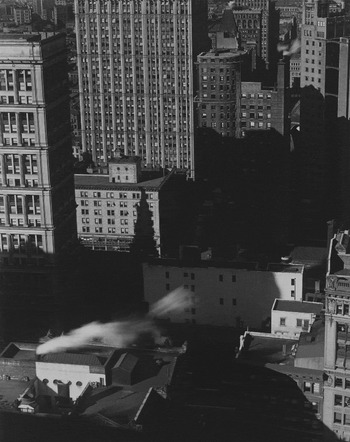
In a number of the photographs Sheeler made at this time such as New York: Buildings in Shadows and Smoke of 1920 (Figure 8), the artist's self is indicated as an absence, something we can intuit or deduce but which is not directly apprehended. In Shadows and Smoke a geometric shadow thrown forward onto the scene from the forty-one-storey Equitable Building, the height from which Sheeler surveys the empty city, both signals the artist's presence by proxy and also obliterates it, covering it over with the larger, aggressive, shadow of the city itself.Footnote 29 Blown smoke, too, signals the observer's presence, offering a brief sign of mobility and duration in the otherwise static scene. Such effects stand for the transit of human time, the present continually melting into the past, the future into the present. The passage of time – shadows cast by sun, smoke streaming in the wind – becomes the indicator of human presence and the human scale, fragile signs conjured from the alien materials of the built environment amongst which they have to find a place. For the Ashcan artist Sloan, presence can be figured directly in the observers he places in the city, but such confidence has not survived in Sheeler. Presence is now cast into these temporary imprints, the shadow of smoke on the wall, as in New York, Temple Court, Distant View of 1920, or Shadows and Smoke. This is very different to the meaning of the upright and assertive smoke in Stieglitz's precursor photograph City of Ambition (1910). There the docking ferry and the jaunty solid plumes wafting skywards imply a city of opportunity and confidence. In Sheeler's response to this trope, smoke becomes the sign of other qualities, the fragility, brevity and vulnerability of the human investment in the city.
Charles Sheeler, New York: Buildings in Shadows and Smoke, 1920. Gelatin silver print, 25.4×20.3 cm. Boston: Museum of Fine Arts (The Lane Collection). Photo: Museum of Fine Arts, Boston.

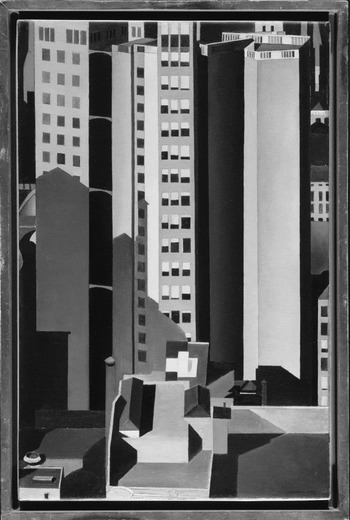
Writing on the nineteenth-century culture of mourning in the United States, Dana Luciano has posited “the luxury of mourning” as a response to the modernization of industrial clock-time: “in the face of a new order of time frequently described as mechanical and impersonal,” she writes, “the time of grief – the slow time of deep feeling – could be experienced … as personal, human, intimate.”Footnote 30 Sheeler's photographs of New York perhaps speak to a continuity in such experience. But by the 1920s time has also moved on; for in the paintings he made from these photographs Sheeler suppresses even these fleeting and barely tangible indications of the artist's presence. The brief indications of presence in the photographs, the pulse of human time, even, are expunged in the paintings. If selves are at issue here, then it is to register their absence from the new world and the rupture of their relationship with the past. Skyscrapers (1922, Figure 9), omits the smoking chimney and its shadow visible in the photograph New York: Park Row Building (1920, Figure 4), on which the painting is based. Even the derrick has vanished in the painting, and the windows with their hint of human life behind the blinds, pulled down to various heights, are given a rhythmic blankness instead. One might be tempted to think of these variations as evidence of a human presence, but the rhythms are mechanical, evocative more of the fall and snap of the camera's shutter than of any individuals who might be beyond the blinds, but who of course are invisible here and substituted by darkness. Individuality if it exists at all is usurped by the building which arrogates the variations of human personality to its own array of impersonal blinking eyes.
Charles Sheeler, Skyscrapers, 1922. Oil on canvas, 50.8×33.02 cm. Washington, DC: Phillips Collection (acquired 1926). Photo: Phillips Collection.

In these images, I suggest, the buildings in fact look back, scrutinizing their spectators. In contrast to the active artist–observer of the Ashcan School, scrutiny in Sheeler's New York paintings is directed from the city more forcefully than towards it; the glittering surfaces of the new skyscrapers' facades now turn their unnerving stare back on the human observer, who relinquishes the authority of his gaze. This shrunken or evacuated presence, however, returns in oblique indications within the cityscape. It is what is absent that signifies, or what is traced in delicate, transient forms that we overlook or think unimportant. The implication or suggestion of meaning appears in unstable and nomadic shapes, as hauntings, atmospherics, and presences that are apprehended but unseen or barely visible. The city is a refractive medium through which other and more troublesome concerns about past and present can be given form without direct representation: the business of modern life and its connections to the past are otherwise presented, through another lens and other subjects.
I have been arguing that Sheeler's pictures abstract the self from the image because its place in these contexts is radically uncertain. The vanished crowds and people of Sheeler's pictures are haunted by the American past because their relation to these traditions and continuities is problematic, or, better perhaps, obscure, to him. This is true of Manhatta and of Sheeler's photographs and paintings of the 1920s, but it is also true of the Doylestown photographs. The rift between the past and the modernity of the present forces this uncertainty on the hitherto potent figure of the artist–observer. Now the skyscrapers of the new city are more credibly represented as protagonists than he is. The broken relationship to the past, signalled by metaphors and analogies of transience in the New York photographs, reveals the pressure of these questions. It seems to me that the awkward wrestling in the scholarly literature with the question whether Sheeler was or was not in favour of modern life and the “machine age” is a symptom of this.Footnote 31 There is no straightforward answer because neither option is true: Sheeler did not know and could not say.
In a recent essay, Bernard Schultz has intriguingly examined Sheeler's relationship to the American past by reference to modernist aesthetics. Noting Sheeler's active interest in Shaker furniture and other folk and domestic American art- and craftworks, Schultz quotes Sheeler's assertion that he collected such objects not for their historical or national–historical associations, but, as he said, only “for the pleasure they could give and because they were useful.” For Schultz, “this is the link that Sheeler established between the past and his present. It exists in the timeless usefulness of an object and its function.”Footnote 32 But this, I have been arguing, is not entirely the case. Rather, it is the unsatisfactory nature of the modernist notion of the past as a “timeless” analogue of the present, its inability to register the character of the relationship of past and present, that Sheeler is concerned with at this moment of his work. It is the sense that the past is not straightforwardly continuous with the present, is not clearly in relation to it, that engages Sheeler's art, provoking the vanishing and absent presences in his work. In the works of this period Sheeler puzzles over what that means for Americans in the new century, and for their relationship to their vanished past.