INTRODUCTION
Three distinct attentional networks that carry out stimulus recognition and response initiation by maintaining a state of alertness (alerting), orienting to specific-sensory stimuli (orienting), and resolving conflict (executive attention; Fan, Fossella, Sommer, Wu, & Posner, Reference Fan, Fossella, Sommer, Wu and Posner2003; Fan, McCandliss, Sommer, Raz, & Posner, Reference Fan, McCandliss, Sommer, Raz and Posner2002; Fan, McCandliss, Fossella, Flombaum, & Posner, Reference Fan, McCandliss, Fossella, Flombaum and Posner2005; Posner & Petersen, Reference Posner and Petersen1990; Posner & Rothbart, Reference Posner and Rothbart2007; Posner, Sheese, Odludas, & Tang, Reference Posner, Sheese, Odludas and Tang2006) have been identified. These networks vary in terms of their neuroanatomical substrates (Fan et al., Reference Fan, McCandliss, Sommer, Raz and Posner2002, Reference Fan, McCandliss, Fossella, Flombaum and Posner2005, Reference Fan, Kolster, Ghajar, Suh, Knight and Sarkar2007; Konrad et al., Reference Konrad, Neufang, Thiel, Specht, Hanisch and Fan2005; Niogi, Mukherjee, Ghajar, & McCandliss, Reference Niogi, Mukherjee, Ghajar and McCandliss2010; Posner & Petersen, Reference Posner and Petersen1990) and associations with genetic polymorphisms (Fan et al., Reference Fan, Fossella, Sommer, Wu and Posner2003; Fossella et al., Reference Fossella, Sommer, Fan, Wu, Swanson and Pfaff2002). Alerting, or preparing for a stimulus by establishing and maintaining a state of alertness (Posner & Petersen, Reference Posner and Petersen1990), is associated with frontal, parietal and thalamic activity, and with norepinephrine (Coull, Frith, Frackowiak, & Grasby, Reference Coull, Frith, Frackowiak and Grasby1996; Marrocco, Witte, & Davidson, Reference Marrocco, Witte and Davidson1994; Posner & Petersen, Reference Posner and Petersen1990). Orienting, or the voluntary and involuntary selection of and shifting of attention toward the direction of an incoming stimulus (Posner & Petersen, Reference Posner and Petersen1990), is associated with activity in the superior and inferior parietal lobes, frontal eye fields, superior colliculus, pulvinar, and reticular thalamic nuclei (Corbetta & Shulman, Reference Corbetta and Shulman2002), and with acetylcholine (Davidson & Marrocco, Reference Davidson and Marrocco2000). Executive attention involves the detection and resolution of conflict in mental operations between brain regions, as well as the production of accurate behavioral responses (Posner & Petersen, Reference Posner and Petersen1990). Executive attention is associated with activity in the anterior cingulate cortex (ACC), medial frontal cortex (MFC), and lateral prefrontal cortex (LPFC), and with dopamine (Bush, Luu, & Posner, Reference Bush, Luu and Posner2000; Fan et al., Reference Fan, McCandliss, Fossella, Flombaum and Posner2005; MacDonald, Cohen, Stenger, & Carter, Reference MacDonald, Cohen, Stenger and Carter2000; Posner et al., Reference Posner, Sheese, Odludas and Tang2006).
Age effects on individual attention networks have been examined using several experimental manipulations. Tales, Muir, Bayer, Jones, and Snowden (Reference Tales, Muir, Bayer, Jones and Snowden2002) used a reaction time (RT) task with visual alerting cues and reported comparable benefits of alerting in both young and old groups. Similarly, Nebes and Brady (Reference Nebes and Brady1993) used a choice RT task with alerting cues and found intact phasic alerting in healthy aging and in Alzheimer’s disease (AD) patients. Experiments using peripheral spatial cueing paradigms revealed comparable exogenous orienting in young and old adults (Folk & Hoyer, Reference Folk and Hoyer1992; Hartley, Kieley, & Slabach, Reference Hartley, Kieley and Slabach1990; Lincourt, Folk, & Hoyer, Reference Lincourt, Folk and Hoyer1997). Using the covert orienting of visual attention task to measure inhibition of return or reorienting, Danckert, Maruff, Crowe, & Currie (Reference Danckert, Maruff, Crowe and Currie1998) and Hartley and Kieley (Reference Hartley and Kieley1995) reported preserved exogenous orienting in aging. Thus, there is evidence to suggest relatively intact alerting and orienting in older adults.
Executive attention is multi-faceted both theoretically and operationally (see Miyake, Friedman, Emerson, Witzki, Howerter, & Wager, Reference Miyake, Friedman, Emerson, Witzki, Howerter and Wager2000). Relevant to the current study is the flanker interference task (Hedge & Marsh, Reference Hedge and Marsh1975; Simon, Sly, & Vilapakkam, Reference Simon, Sly and Vilapakkam1981); an executive attention task used to measure conflict resolution or interference effects in older adults. Kramer, Humphrey, Larish, Logan, and Strayer (Reference Kramer, Humphrey, Larish, Logan and Strayer1994) reported comparable interference effects in young and old adults, while Zeef, Sonke, Kok, Buiten, and Kenemans (Reference Zeef, Sonke, Kok, Buiten and Kenemans1996) found that older adults had larger interference effects than younger adults for target-flanker conditions which were presented in close proximity. In contrast, Madden and Gottlob (Reference Madden and Gottlob1997) revealed smaller interference effects in old as compared to young adults. Kramer and Kray (Reference Kramer, Kray, Bialystok and Craik2006) report that discrepant age-related effects in interference tasks can be explained by stimulus characteristics, age-related differences in perceptual load, processing capacity, and inhibitory processes. It is noteworthy that beyond the flanker interference task, the effect of age on executive attention varies depending on the experimental paradigm used to operationalize it (Verhaeghen & Cerella, Reference Verhaeghen and Cerella2002).
The Attention Network Test (ANT) simultaneously assesses alerting, orienting, and executive attention, as well as their possible interactions (Fan et al., Reference Fan, McCandliss, Sommer, Raz and Posner2002, Reference Fan, McCandliss, Fossella, Flombaum and Posner2005; Posner & Rothbart, Reference Posner and Rothbart2007; Raz & Buhle, Reference Raz and Buhle2006). There are three warning cue conditions (no, alert, or orient) that can precede each target stimulus. Alerting cues indicate that the target stimulus is about to appear (i.e., temporal cue). Orienting cues provide both temporal and spatial (i.e., location on the screen) information about the target stimulus. The target stimulus (i.e., central arrow) points either leftward or rightward and is surrounded by two flanker arrows on each side that provide either no, congruent, or incongruent information about the target stimulus. In the incongruent condition, flankers provide conflicting information that causes an interference that typically results in an increase in the time required to respond to the target, as compared to the congruent flanker condition (see Method-ANT section for details). This executive attention task requires the involvement of several brain regions because it requires online monitoring, detection, resolution of conflict, as well as the production of accurate behavioral responses which may be sensitive to aging and blood pressure dysregulation.
The ANT has been used in children ages 10 and younger (Rueda et al., Reference Rueda, Fan, McCandliss, Halparin, Gruber and Lercari2004), in children with attention deficit hyperactivity disorder (ADHD) (Johnson et al., Reference Johnson, Robertson, Barry, Mulligan, Daibhis and Daly2008), in adults ages 55 and younger (see Fan et al., Reference Fan, McCandliss, Sommer, Raz and Posner2002, Reference Fan, McCandliss, Fossella, Flombaum and Posner2005; Posner & Rothbart, Reference Posner and Rothbart2007), and in adults with posttraumatic stress disorder (PTSD) (Leskin & White, Reference Leskin and White2007) and schizophrenia (Nestor, Kubicki, Spencer, Niznikiewicz, McCarley, & Shenton, Reference Nestor, Kubicki, Spencer, Niznikiewicz, McCarley and Shenton2007). However, investigations of the effects and interactions of these networks in non-demented older adults have been fairly limited and somewhat conflicting. Fernandez-Duque and Black (Reference Fernandez-Duque and Black2006) studied the effects of alerting and orienting on conflict resolution in a small sample of young adults, non-demented older adults, and AD patients. Results from this study revealed an overall slowing of RTs in older as compared to younger adults and comparable attention network effects across all groups. Irrespective of AD, older adults experienced increased difficulty sustaining attention in the absence of alerting cues. Additional results revealed reduced benefit of alerting cues and no beneficial effects of orienting during conflict resolution across groups. Jennings, Dagenbach, Engle, and Funke (Reference Jennings, Dagenbach, Engle and Funke2007) found significant attention network effects and cue × flanker interactions for both alerting and orienting. However, these analyses did not adjust for speed of processing or other confounders. Significant reductions in the alerting network in old compared with young adults, with no reliable age differences in orienting or executive attention networks were also reported in a subset of analyses that controlled for speed of processing (Jennings et al., Reference Jennings, Dagenbach, Engle and Funke2007).
The effect of health status on cognitive performance has long been identified (Libow, Reference Libow, Eisdorfer and Friedel1977; Schillerstrom, Horton, & Royall, Reference Schillerstrom, Horton and Royall2005; Willis, Yeo, Thomas, & Garry, Reference Willis, Yeo, Thomas and Garry1988). The need to differentiate between cognitive and biological changes related to aging versus chronic disease is paramount for the welfare and proper management of individuals (Albert, Reference Albert1981). The Federal Interagency Forum on Aging-Related Statistics (2008) has reported hypertension as the most prevalent chronic disease in the United States for individuals ages 65 and older. Hypertension is a major risk factor for cardiovascular and cerebrovascular diseases, as well as poor cognitive performance and cognitive decline (Elias et al., Reference Elias, Elias, D’Agostino, Cupples, Wilson and Silbershatz1997; Elias, Elias, Robbins, & Budge, Reference Elias, Elias, Robbins and Budge2004; Raz, Rodrigue, Kennedy, & Acker, Reference Raz, Rodrigue, Kennedy and Acker2007). However, low blood pressure (BP; i.e., hypotension) is also associated with poor health status (Hakala & Tilvis, Reference Hakala and Tilvis1998), cognitive impairment and decline (Glynn, Beckett, Hebert, Morris, Scherr, & Evans, Reference Glynn, Beckett, Hebert, Morris, Scherr and Evans1999; Guo, Fratiglioni, Winblad, & Viitanen, Reference Guo, Fratiglioni, Winblad and Viitanen1997; Hestad, Kveberg, & Engedal, Reference Hestad, Kveberg and Engedal2005; Launer, Masake, Petrovitch, Foley, & Havlik, Reference Launer, Masaki, Petrovitch, Foley and Havlik1995; Morris et al., Reference Morris, Scherr, Hebert, Bennett, Wilson, Glynn and Evans2002; Nilsson, Read, Berg, Johansson, Melander, & Lindblad, Reference Nilsson, Read, Berg, Johansson, Melander and Lindblad2007), deficits in attention and working memory (Duschek, Matthias, & Schandry, Reference Duschek, Matthias and Schandry2005; Duschek & Schandry, Reference Duschek and Schandry2007), and increased risk of dementia (Verghese, Lipton, Hall, Kuslansky, & Katz, Reference Verghese, Lipton, Hall, Kuslansky and Katz2003) in older adults.
While associations of systolic (SBP) and diastolic blood pressure (DBP) with cognitive function and dementia in the elderly have been inconsistent, the import of examining the role of BP on cognitive functioning has been recognized (Birns & Kalra, Reference Birns and Kalra2009; Hannesdottir, Nitkunan, Charlton, Barrick, MacGregor, & Markus, Reference Hannesdottir, Nitkunan, Charlton, Barrick, MacGregor and Markus2009; Nordahl, Ranganatha, Yonelinas, DeCarli, Reed, & Jagust, Reference Nordahl, Ranganatha, Yonelinas, DeCarli, Reed and Jagust2005; Oosterman, de Vries, & Scherder, Reference Oosterman, de Vries and Scherder2007; Waldstein, Brown, Maier, & Katzel, Reference Waldstein, Brown, Maier and Katzel2005; Waldstein, Giggey, Thayer, & Zonderman, Reference Waldstein, Giggey, Thayer and Zonderman2005; Waldstein & Katzel, Reference Waldstein and Katzel2005). Qiu, Windblad, and Fratiglioni (Reference Qiu, Winblad and Fratiglioni2005) summarized results from several late-life cross-sectional studies examining the relationship of BP levels with cognitive function into four categories: harmful effects of high BP; harmful effects of low BP; no effect of BP and; and U-shaped associations of BP with cognitive function. The relationship of abnormal BP levels, whether high or low, and cognition has been examined across various neuropsychological domains including response inhibition (Waldstein & Katzel, Reference Waldstein and Katzel2005), verbal memory (Nordahl et al., Reference Nordahl, Ranganatha, Yonelinas, DeCarli, Reed and Jagust2005; Waldstein, Brown, et al., Reference Waldstein, Brown, Maier and Katzel2005; Waldstein, Giggey, et al., Reference Waldstein, Giggey, Thayer and Zonderman2005; Waldstein & Katzel, Reference Waldstein and Katzel2005), non-verbal memory (Nordahl et al., Reference Nordahl, Ranganatha, Yonelinas, DeCarli, Reed and Jagust2005; Waldstein, Brown, et al., Reference Waldstein, Brown, Maier and Katzel2005), executive functioning and attention (Hannesdottir et al., Reference Hannesdottir, Nitkunan, Charlton, Barrick, MacGregor and Markus2009; Oosterman et al., Reference Oosterman, de Vries and Scherder2007), and psychomotor speed (Hannesdottir et al., Reference Hannesdottir, Nitkunan, Charlton, Barrick, MacGregor and Markus2009).
To date, however, the relationship between BP and attention networks has not been examined. Niogi et al. (Reference Niogi, Mukherjee, Ghajar and McCandliss2010) report that while distinct alerting, orienting, and executive attention networks exist, variations in white matter tract microstructure could modulate the efficiency of these attentional processes in very specific ways. The potentially differential relationship between BP and attention networks can be optimally determined using the ANT because visual input and motor output are the same across all trials. This is an advantage compared with studies that use separate neuropsychological measures that vary in terms of their input (e.g., visual vs. auditory) and output (oral vs. manual) modalities and demands to assess the relationship between BP and specific cognitive functions. An examination of the association, if any, between BP and the attention networks would provide a preliminary investigation of the possible biological underpinnings of ANT performance in aging.
Results from the Framingham Heart Study and others indicated that SBP was a better predictor of future cardiovascular events than DBP as people age (Franklin et al., Reference Franklin, Larson, Khan, Wong, Leip and Kannel2001; Sever, Reference Sever2009). Low SBP has been linked to alterations in cerebral white matter (e.g., leuko-araiosis) in older adults with dementia (Räihä, Tarvonen, Kurki, Rajala, & Sourander, Reference Räihä, Tarvonen, Kurki, Rajala and Sourander1993). Age, BP dysregulation, and hypertension are risk factors for leuko-araiosis and are associated with ischemic changes in small blood vessels (Pantoni & Garcia, Reference Pantoni and Garcia1997). Nordahl et al. (Reference Nordahl, Ranganatha, Yonelinas, DeCarli, Reed and Jagust2005) studied patients diagnosed with mild cognitive impairment (MCI) and found that patients with white matter hyperintensities were severely impaired on tests of verbal and spatial memory, as well as attentional control compared with patients with hippocampal atrophy. These results suggest that small vessel cerebrovascular disease can result in working memory and executive control deficits. Meyer, Rauch, Rauch, and Haque (Reference Meyer, Rauch, Rauch and Haque2000) reported an association between age-related changes in gray and white matter with cortical hypoperfusion, which in turn has been linked to poorly regulated BP. Severe leuko-araiosis and its relation to cognitive decline has been demonstrated in frontal brain regions of adults over age 60 and is associated with frontal cortical atrophy and cerebral hypoperfusion (Kawamura et al., Reference Kawamura, Terayama, Takashima, Obara, Pavol and Meyer1993).
Functions mediated by the frontal and prefrontal cortex including executive attention function are among the first cognitive processes to decline with age (Albert & Kaplan, Reference Albert, Kaplan, Poon, Fozard, Cermark, Arenberg and Thompson1980; Dempster, Reference Dempster1992; Fuster, Reference Fuster1989; Raz et al., Reference Raz, Gunning, Head, Dupuis, McQuain and Briggs1997; West, Reference West1996). Studies assessing functional changes in the aging brain have shown significant reductions in regional cerebral blood flow in anterior relative to posterior cortical regions (i.e., hypofrontality; see Gur, Gur, Obrist, Skolnick, & Reivich, Reference Gur, Gur, Obrist, Skolnick and Reivich1987; Melamed, Lavy, Bentin, Cooper, & Rinot, Reference Melamed, Lavy, Bentin, Cooper and Rinot1980). This age-related decrease in anterior blood flow has been demonstrated during executive tasks (Sorond, Schnyer, Serrador, Milberg, & Lipsitz, Reference Sorond, Schnyer, Serrador, Milberg and Lipsitz2008), suggesting decreased task-specific efficiency of the frontal lobes. The effects of cerebral microvascular pathology on cognitive impairment (Cabeza, Reference Cabeza2001; Farkas & Luiten, Reference Farkas and Luiten2001; Pugh & Lipsitz, Reference Pugh and Lipsitz2002; Sorond et al., Reference Sorond, Schnyer, Serrador, Milberg and Lipsitz2008), has been linked to frontal cerebral hypoperfusion (Kawamura et al., Reference Kawamura, Terayama, Takashima, Obara, Pavol and Meyer1993) and low SBP (Räihä et al., Reference Räihä, Tarvonen, Kurki, Rajala and Sourander1993). However, the association of BP with alerting, orienting, and executive attention networks has not been reported.
Current Study
The current study was designed to achieve three main objectives. First, we determined the reliability, effects, and interactions of attention networks, in a relatively large cohort of well-characterized non-demented older adults, while controlling for speed of processing (Salthouse, Reference Salthouse, Birren and Schaie1985). We predicted that interactions between cue and flanker types would reveal a diminished alerting and enhanced orienting effect during the incongruent flanker condition. Second, in the context of this aged cohort, we examined the effect of chronological age on attention network performance. Consistent with executive function decline in old age, we hypothesized that increased chronological age would be associated with worse executive attention. Third, in light of findings linking age-related decline in executive function (Sorond et al., Reference Sorond, Schnyer, Serrador, Milberg and Lipsitz2008) to cerebral hypoperfusion (Kawamura et al., Reference Kawamura, Terayama, Takashima, Obara, Pavol and Meyer1993) and low SBP (Räihä et al., Reference Räihä, Tarvonen, Kurki, Rajala and Sourander1993) in older adults, we examined the effects of BP on attention network performance. We hypothesized that low SBP would be associated with worse executive attention.
METHOD
Participants
Participants were enrolled in the Einstein Aging Study (EAS), a longitudinal study of aging and dementia located at the Albert Einstein College of Medicine in Bronx, New York. The study design, recruitment, and follow-up methods have been previously described elsewhere (Lipton et al., Reference Lipton, Katz, Kuslansky, Sliwinski, Stewart and Verghese2003; Verghese, Katz, Derby, Kuslansky, Hall, Lipton, Reference Verghese, Katz, Derby, Kuslansky, Hall and Lipton2004). Briefly, eligibility criteria require that participants be 70 years of age and older, reside in Bronx county, and speak English. Exclusion criteria include severe audiovisual disturbances that would interfere with completion of neuropsychological tests, significant loss of vision, inability to ambulate even with a walking aid or in a wheelchair, and institutionalization. Written informed consent was obtained at clinic visits according to study protocols and approved by the Committee on Clinical Investigation (CCI; the institutional review board of the Albert Einstein College of Medicine).
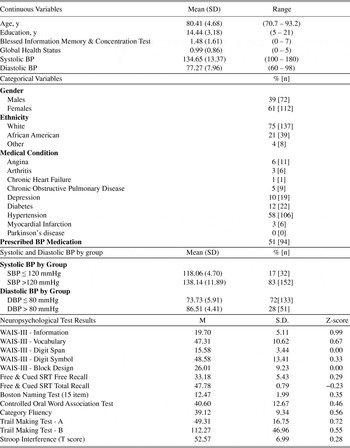
To address the decline in vision inherent in the aging population, we used a variant of the original ANT (Fan et al., Reference Fan, McCandliss, Sommer, Raz and Posner2002) that enhanced the size and luminosity of the stimuli (see the Procedures and Measures section). A total of 184 non-demented participants (see below) whose ANT performance was above 75% accurate, and who did not have a history of stroke were eligible to participate in the current experiment (see Table 1). The 75% accuracy cutoff, which only 4 potentially eligible participants did not meet (accuracy range = 30–69%), was designed to insure that abnormal performance did not influence ANT results.
Summary of Participant Characteristics (n=184)

Cognitive Status and Function
Participants were determined to be cognitively normal based on established diagnostic case conference procedures (Holtzer, Verghese, Wang, Hall, & Lipton, Reference Holtzer, Verghese, Wang, Hall and Lipton2008) that include neuropsychological tests for which robust longitudinal norms have been published (Holtzer, Goldin, Zimmerman, Katz, Buschke, & Lipton, Reference Holtzer, Goldin, Zimmerman, Katz, Buschke and Lipton2008; see Table 1). Tests included in our clinical neuropsychology battery have been validated in previous studies of this aged population (Holtzer, Friedman, Lipton, Katz, Xue, & Verghese, Reference Holtzer, Friedman, Lipton, Katz, Xue and Verghese2007; Holtzer, Verghese, Xue, & Lipton, Reference Holtzer, Verghese, Xue and Lipton2006; Masur, Sliwinski, Lipton, Blau, & Crystal, Reference Masur, Sliwinski, Lipton, Blau and Crystal1994; Sliwinski, Buschke, Stewart, Masur, & Lipton, Reference Sliwinski, Buschke, Stewart, Masur and Lipton1997). The Blessed Information Memory Concentration Test (BIMCT; best score: 0 errors and worst score: 32 errors; Blessed, Tomlinson, & Roth, Reference Blessed, Tomlinson and Roth1968), was also used to assess cognitive status. Participants who scored ≥ 8 on the BIMCT were not included in the current study. This test has high test–retest reliability (0.86) and correlates well with the pathology of Alzheimer disease (Fuld, Reference Fuld, Terry, Katzman, Bick and Sisodia1978; Grober et al., Reference Grober, Dickson, Sliwinski, Buschke, Katz and Crystal1999).
Blood Pressure (BP)
SBP and DBP measurements were recorded by trained registered nurses within the same session as the ANT. We implemented a standardized BP procedure in which trained research staff collected two BP readings in the morning, with a 2-min delay between each reading, from the right forearm after 5 min of rest in a sitting position. Systolic Korotkoff phase I and diastolic Korotkoff phase V were used as cutoff points. The mean of the two readings for both SBP and DBP was used for the current analyses. Based on recent BP level guidelines for the general population (JNC-7th Report; Chobanian et al., Reference Chobanian, Bakris, Black, Cushman, Green and Izzo2003) and for ease of interpretation, individuals were divided into two BP groups: low (SBP ≤ 120 mmHg and DBP < 80 mmHg) and high (SBP > 120 mmHg and DBP > 80 mmHg).
Global Disease Status
Trained research assistants used structured clinical interview and the study physician obtained medical history from multiple sources during the neurological examination. Consistent with our previous studies (Holtzer et al., Reference Holtzer, Verghese, Xue and Lipton2006; Holtzer, Verghese, et al., Reference Holtzer, Verghese, Wang, Hall and Lipton2008; Verghese, Wang, Lipton, Holtzer, & Xue, Reference Verghese, Wang, Lipton, Holtzer and Xue2007) dichotomous rating (presence or absence) of diabetes, chronic heart failure, arthritis, hypertension, depression, stroke, Parkinson’s disease, chronic obstructive lung disease, angina, and myocardial infarction was used to calculate a global disease status summary score (range, 0–10).
Procedures and Measures
ANT
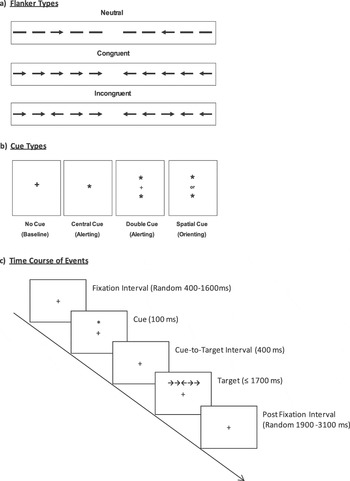
In the ANT, a target stimulus (i.e., central arrow) which points leftward or rightward is surrounded by two flankers on each side. There are three flanker types: neutral (dashes), congruent (arrows that point in the same direction as the central arrow), and incongruent (arrows that point in the opposite direction of the central arrow; see Figure 1a). There are also four types of warning cues that can precede each target: no, center, double, and spatial. The warning cue is an asterisk (*) that is presented in the center of the screen for the center cue, above and below central fixation for the double cue, and either above or below central fixation for the spatial (i.e., orient) cue (see Figure 1b). In the case of the no cue, the central fixation point (+) remains visible until the target is displayed. The no cue condition serves as the control, whereas the double and center cue conditions measure alerting, and the spatial cues measure orienting. Figure 1c depicts the time course of events. All target stimuli were centrally presented, bar the target stimuli that followed the orienting cues which were presented 1.06° above or below central fixation depending upon the location of the spatial cue. This visual angle of 1.06° above and below fixation also corresponded to the placement of the asterisks for the double and spatial cues.
Experimental design. A schematic of the three flanker types (a) and four cue types (b) that are used in the Attention Network Test. Notice that the double and center cue conditions measure alerting, while the spatial cue condition measures orienting. Executive attention is measured by comparing congruent and incongruent flanker types. Panel c delineates the time course of events. This figure appears with permission by the Massachusetts Institute of Technology. [Journal of Cognitive Neuroscience] Jin Fan, Bruce D. McCandliss, Tobias Sommer, Amir Raz and Michael I. Posner, “Testing the Efficiency and Independence of Attentional Networks”, 14:3 (April 1, 2002), pp. 340–347. © 2002.

In the current ANT paradigm, the diameter of the cues and the height of the arrows were increased from 0.32 cm to 0.64 cm. The width of the arrows was increased from 2.54 cm to 3.81 cm. In addition, the luminosity of the target and flanker stimuli was modified from 254.45 to 253.99 cd/m2 for the congruent and incongruent flanker conditions, and from 254.50 to 254.09 cd/m2 for the neutral flanker condition.
The participant’s task was to report the direction of the central arrow by pressing the left mouse button for leftward arrows and the right mouse button for rightward arrows. Participants were required to fixate a central fixation cross and respond to each stimulus as quickly as possible without making errors. Participants received one practice block of 24 trials and were required to attain 75% accuracy or higher to proceed to three experimental blocks consisting of 96 trials each. Consistent with other studies (e.g., Fan et al., Reference Fan, McCandliss, Sommer, Raz and Posner2002, Reference Fan, Fossella, Sommer, Wu and Posner2003), only correct responses were included in our statistical analyses.
Statistical Analyses
The Guttman split-half reliability test was used to assess the reliability of the ANT and specific flanker and cue types. Due to concerns of redundancy (see Fan et al., Reference Fan, McCandliss, Fossella, Flombaum and Posner2005), two-tailed Pearson correlations were used to determine whether the inclusion of neutral and congruent flankers, and double and center cue conditions was extraneous. The mean RTs for the neutral and congruent flankers, averaged across cues, were highly correlated (r = 0.96; p ≤ .01). The mean RTs for the double and center cues, averaged across flanker types, were also highly correlated (r = 0.97; p ≤ .01).
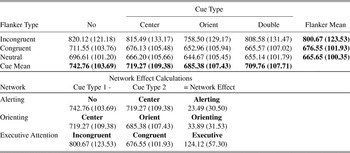
Each attention network is calculated using simple subtractions to determine the influence of alerting cues, orienting cues, and flankers (executive attention) on RTs (see Table 2). Individual median values were averaged across blocks for each condition to avoid the influence of outliers. While larger alerting and orienting network scores are indicative of faster cue-related performance, larger executive attention network scores are indicative of worse performance (i.e., longer RTs required for conflict resolution). Bi-variate correlations were used to examine the statistical independence of the alerting, orienting, and executive attentional networks.
Summary of ANT Mean RT (SD) results by Flanker, Cue, and Network Type (n=184)

† Neutral flanker and Double cue conditions were not used for Network Effect Calculations.
Linear Mixed Effects Models
The effects of attention networks and their interactions were assessed using two separate linear mixed effects models. Repeated-measures included in the models were a two-level flanker (congruent vs. incongruent) and a three-level cue (no, center, or orient). To address the issue of age-related decline in speed of processing (Salthouse, Reference Salthouse, Birren and Schaie1985) the first model controlled for overall RT averaged across all ANT trials. The second model was specifically designed to assess the effects and interactions of chronological age and BP group with attention networks, adjusting for overall RT, sex, education, global disease status, and BP medications.
RESULTS
Demographics
Participants were community dwelling non-demented individuals with a mean age of 80.41(4.68) years who were relatively healthy (see Table 1 for details). The demographic characteristics did not vary based on SBP and DBP grouping (see Table 1) and were comparable to those reported for the source EAS sample at baseline (Holtzer, Verghese, et al., Reference Holtzer, Verghese, Wang, Hall and Lipton2008). Of note, 58% of the participants reported a history of hypertension and 51% were currently prescribed antihypertensive medication.
ANT Results
On average, ANT performance accuracy was very high (97%), indicating that the participants understood the instructions and were able to reliably determine the direction of the target stimulus. Split-half reliability, as measured by the Guttman Split-Half Coefficient, revealed high correlations between the first and second half of all ANT trials (0.93), and more specifically, between the first and second half of trials separated by no cue (0.94), alerting cue (0.94), orienting cue (0.95), congruent flanker (0.97), and incongruent flanker (0.97). Table 2 depicts the mean RTs for each cue type, flanker type, and their corresponding overall mean. Calculation of the attention networks yielded effects for alerting 23.49 (SD = 30.50), orienting 33.89 (SD = 31.53), and executive attention 124.12 (SD = 57.30) ms. Two-tailed bi-variate correlations between alerting and executive attention (r = -0.07), and orienting and executive attention (r = -0.05) were not significant. However, the low, but significant correlation between the alerting and orienting networks (r = -0.27; p < .01) can be explained by the incremental effect of spatial as compared to alerting cues and has been recognized as an overlap in orienting and alerting attention networks (see Fan et al., Reference Fan, McCandliss, Sommer, Raz and Posner2002).
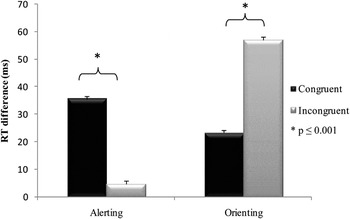
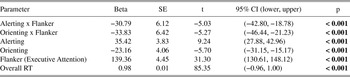
Results from the first linear mixed effects model (Table 3), which adjusted for speed of processing showed a main effect of flanker type (p < .0001), and revealed that RTs were significantly longer for incongruent (M = 800.67; SD = 123.53 ms) than for congruent (M = 676.55, SD = 101.93 ms) flankers. There was a main effect of alerting (p < .0001) and orienting (p < .0001) cues. The interaction between alerting × flanker type (p < .0001) was significant and revealed that relative to no cues, alerting cues enhanced performance in congruent (M = 35.42; SD = 40.30 ms) but not in incongruent (M = 4.63; SD = 62.21 ms; see Figure 2) trials. Conversely, the significant interaction of orienting × flanker revealed that relative to the center cues, orienting cues enhanced performance in incongruent (M = 56.99; SD = 56.10 ms) compared with congruent trials (M = 23.16; SD = 42.01 ms; see Figure 2).
Alerting and orienting effects by flanker type. Mean RT difference (i.e., network effect) of alerting and orienting attention networks for congruent (black bars) and incongruent flankers (gray bars). Clear benefits of alerting and orienting are noticeable for congruent flankers. However, a significantly diminished alerting effect and a significantly enhanced orienting effect during conflict resolution trials (gray bars) is depicted.

Model 1. Summary of ANT results using linear mixed effects models adjusted for overall reaction time, (n=184)

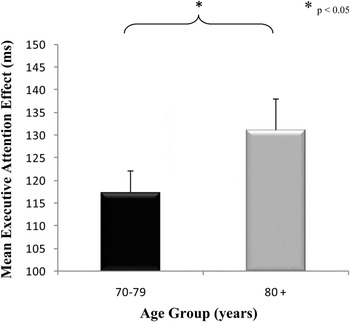
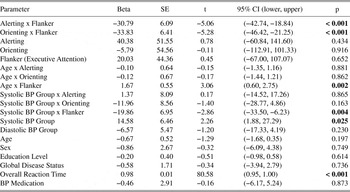
A second linear mixed effects model controlling for overall RT, sex, education level, global disease status, and blood pressure medications was conducted specifically to examine the effects and interactions of chronological age and blood pressure with attention networks (see Table 4). Chronological age interacted with flanker type (p = .002), but not with alerting or orienting cues. As depicted in Figure 3, individuals ages 80 and above had a larger executive attention effect (131.17 ms; SD = 65.92) than individuals ages 70–79 (117.37; SD = 46.98).
Executive attention by age group. For descriptive purposes, we separated individuals into two age groups: young-old (70–79 years old) and old-old (80+ years old). Mean executive attention network effects (±SE) for both age groups are displayed. Elders in the 70–79 age group performed significantly better on the flanker task, than elders in the 80+ age group. Thus, ability to resolve conflict significantly decreases with chronological age.

Model 2. Summary of ANT results using linear mixed effects models controlled for age, sex, education level, global health status, overall reaction time, and blood pressure (BP) medication (n=184)

Note
Diastolic BP Group interactions with flanker and cue were not significant (data not shown but can be provided upon request).
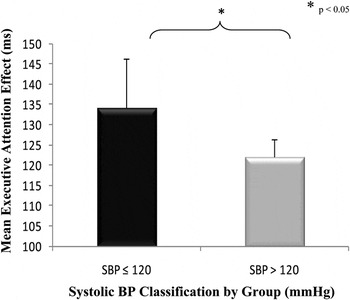
The main effect (p = .025) and interaction of SBP group with executive attention (p = .004; see Figure 4) were significant indicating that low SBP was associated with worse conflict resolution. The interactions of SBP with alerting and orienting were not significant. The main effect and interactions of DBP with the attention networks were not significant and are not reported in Table 4 because of space limitations (see the Discussion section). Additionally, the main effects of alerting, orienting, and executive attention networks were not significant; however, these main effects are explained by their interactions in the adjusted model.
The effect of systolic blood pressure (SBP). Mean executive attention network effects (±SE) for elders in the systolic blood pressure ≤ 120 and >120 groups. Elders in the SBP ≤ 120 group performed worse on the flanker task, than elders in the SBP > 120 group. Ability to resolve conflict was significantly different for elders in these two SBP groups.

DISCUSSION
This study demonstrated high reliability for the ANT and for specific cue and flanker types in older adults. As expected, participants were significantly faster at responding to congruent compared to incongruent flankers. When adjusting for overall speed of processing, significant alerting, orienting, and executive attention, network effects were found. The facilitating effects of cues on performance were influenced by flanker type. Specifically, alerting cues which offer no information regarding target location, facilitated performance only in congruent trials. In contrast, the facilitating effect of orienting cues on performance was enhanced during conflict resolution (Figure 2).
While this diminished alerting effect during conflict resolution trials of the ANT is noteworthy, it has been previously reported in older adults (Fernandez-Duque & Black, Reference Fernandez-Duque and Black2006; Jennings et al., Reference Jennings, Dagenbach, Engle and Funke2007). Diminished alerting effects for incongruent flankers has also been reported in young adults and described as an enhanced flanker interference effect for alerting cues (Fan et al., Reference Fan, McCandliss, Sommer, Raz and Posner2002, Reference Fan, Gu, Guise, Liu, Fossella and Wang2009) and an inhibition of the executive attention network due to a highly active alerting network (Callejas, Lupianez, & Tudela, Reference Callejas, Lupianez and Tudela2004; see also Posner, Reference Posner1994). Furthermore, recent neuroimaging studies suggest that alerting and executive attention networks share common activation sites in both the ACC and the fronto-parietal network (Fan et al., Reference Fan, Kolster, Ghajar, Suh, Knight and Sarkar2007, Reference Fan, Gu, Guise, Liu, Fossella and Wang2009), suggesting that diminished alerting may be attributed to competition for attentional resources which are known to be limited in aging (Craik & Byrd, Reference Craik, Byrd, Ceaik and Trehub1982).
In contrast, we found that orienting cues facilitated performance during incongruent trials. This enhanced orienting effect can be explained, in part, by the diminished alerting effect observed in incongruent trials. However, it is noteworthy that the orienting network is linked to the superior parietal regions and temporal parietal junction. These brain areas and networks are distinct from the fronto-parietal circuits implicated in executive attention. The recruitment of additional neural resources to enhance performance in conditions that maximize cognitive demands is consistent with compensatory reallocation (Cabeza, Reference Cabeza2002; Cabeza, Anderson, Locantore, & McIntosh, Reference Cabeza, Anderson, Locantore and McIntosh2002) or neural compensation (Stern et al., Reference Stern, Habeck, Moeller, Scarmeas, Anderson and Hilton2005) models of aging. The enhancement of orienting during conflict resolution can be attributed to the allocation of additional neural networks which aid in the facilitation of conflict resolution when provided with specific spatial cues.
In the context of this aged cohort, increased chronological age was associated with decreased ability to resolve conflict. This finding is contrasted to previous studies (Fernandez-Duque & Black, Reference Fernandez-Duque and Black2006; Jennings et al., Reference Jennings, Dagenbach, Engle and Funke2007) and can be attributed to differences in sample size and methodological rigor. However, chronological age did not influence alerting or orienting. The differential effect of age on attention network performance is noteworthy given that visual input and motor output are the same across all ANT trial types. The relationship between chronological age and executive attention is consistent with previous work suggesting executive functions decline disproportionally with increasing age due to deteriorating prefrontal cortex function (see Albert & Kaplan, Reference Albert, Kaplan, Poon, Fozard, Cermark, Arenberg and Thompson1980; Dempster, Reference Dempster1992; Fuster, Reference Fuster1989; Raz et al., Reference Raz, Gunning, Head, Dupuis, McQuain and Briggs1997; Sorond et al., Reference Sorond, Schnyer, Serrador, Milberg and Lipsitz2008; West, Reference West1996).
Individuals with low SBP demonstrated worse executive attention than individuals with normal to high SBP. This finding is consistent with previous work linking low SBP to leuko-araiosis and hypoperfusion (Meyer et al., Reference Meyer, Rauch, Rauch and Haque2000; Pantoni & Garcia, Reference Pantoni and Garcia1997; Räihä et al., Reference Räihä, Tarvonen, Kurki, Rajala and Sourander1993) which in turn have been linked to poor performance on executive function tasks (Kawamura et al., Reference Kawamura, Terayama, Takashima, Obara, Pavol and Meyer1993; Sorond et al., Reference Sorond, Schnyer, Serrador, Milberg and Lipsitz2008). Similar to previous studies (Franklin et al., Reference Franklin, Larson, Khan, Wong, Leip and Kannel2001; Sever, Reference Sever2009) DBP was not significant in the current study. Our findings suggest that the maintenance of optimal SBP levels in older adults may be crucial for optimal cognitive functions that depend on the frontal lobes. Low SBP has been associated with dementia (Guo, Viitanen, Fratiglioni, & Winblad, Reference Guo, Viitanen, Fratiglioni and Winblad1996) and mortality (Molander, Lovheim, Norman, Nordstrom, & Gustafson, Reference Molander, Lovheim, Norman, Nordstrom and Gustafson2008; Morris et al., Reference Morris, Scherr, Hebert, Bennett, Wilson and Glynn2000). Specifically, Molander et al. (Reference Molander, Lovheim, Norman, Nordstrom and Gustafson2008) report that even after controlling for global health status and antihypertensive medicine, the highest mortality was observed in older adults with SBP ≤ 120 mmHg.
The finding that older adults with “normal” SBP levels, as defined by the JNC-7th report (Chobanian et al., Reference Chobanian, Bakris, Black, Cushman, Green and Izzo2003), demonstrate worse ability to resolve conflict in the current study may suggest that “normal” SBP range for individuals in their early-to-middle stages of life (<120 mmHg) may not be “normal” for adults in later stages of life. In support, Guo et al. (Reference Guo, Fratiglioni, Winblad and Viitanen1997) revealed that SBP of at least 130 mmHg was crucial for the maintenance of cognitive function in the very old. More recently, Qiu et al. (Reference Qiu, Winblad and Fratiglioni2005) reported that the harmful cognitive effects of low BP in older adults may reveal that an appropriate level of BP is necessary to retain cognitive functioning in late-life by maintaining adequate cerebral perfusion, and furthers that such an optimal level still remains unidentified.
Limitations and Future Directions
A longitudinal design will be necessary to establish low SBP as a predictor of decline in executive attention. When used as a continuous measure SBP was not associated with executive attention. This may be attributed to low representation of more extreme BP values in this relatively healthy sample that did not allow us to assess threshold effects. However, continuous SBP may be associated with executive attention in larger and more heterogeneous samples. In addition, future neuroimaging studies will help validate the role of cerebral hypoperfusion and normal aging on executive attention effects. Visual-acuity was not formally tested in the current experiment. However, average ANT accuracy was at 97% indicating that participants were able to reliably determine the direction of the target stimulus. Results from the current study, as well as others (Fan et al., Reference Fan, McCandliss, Fossella, Flombaum and Posner2005) have reported a high-correlation between neutral and congruent flanker types, and central and double alerting cues in the ANT. Due to this redundancy, removal of extraneous flankers and alerting cues from the ANT paradigm seems appropriate.
CONCLUSION
In summary, the current study provided evidence in support of the effects, interactions, and reliability of attention networks in a relatively large cohort of non-demented older adults. We also found that increased chronological age and low blood pressure were both associated with significantly worse performance on the executive attention network.
ACKNOWLEDGMENTS
The Einstein Aging Study is supported by the National Institute on Aging program project grant AGO3949. Dr. Holtzer is supported by the National Institute on Aging Paul B. Beeson Award K23 AG030857. The study authors have no financial or personal conflicts of interest related to this manuscript.