What explains shifts in the balance of power between the executive and legislative branches in modern democracy? To the extent that political scientists have predicted change, they have usually put their money on the executive branch. In fact, this expectation of a ‘ratchet effect’ – that is, unidirectional empowerment of the executive – is now more than a century old. In ‘Parties and Parliament in a Reconstructed Germany’ (originating in 1917 as a series of newspaper articles), Max Weber predicted a shift in authority from the legislative to the executive branch that would grow more pronounced throughout the 20th century. He claimed that parliaments would gradually become agents of oversight and of budgetary control, rather than the initiators of legislation (Weber Reference Weber1978: 1407–1419). Decades later, students of the Third Wave of democratization would frequently echo Weber, displaying concern at perceived overreach by the executive branch – for example, ‘majoritarianism’, ‘super-presidentialism’, ‘delegative democracy’ and the like.
Much of the literature evincing this disquiet was based on case studies or at best limited to a single region of the world. Yet with the global expansion of competitive regimes since the 1970s, and with vast improvements in the availability of comparative data, we are now in a better position than ever before to observe variations in the relative shares of influence over statutory authority, both across space and across time (Chernykh et al. Reference Chernykh, Doyle and Power2017; Fish and Kroenig Reference Fish and Kroenig2009; Wilson and Woldense Reference Wilson and Woldense2019). In this observational study, we document instances of interbranch oscillations in legislative authority – both oversight and lawmaking – since the dawn of the Third Wave. Our dependent variable, as explained below, is not the quantity or stock of power (i.e. shares or levels of legislative influence), but rather any recorded change to the existing balance of power. These changes, in theory, could advantage either the executive or the assembly.
We begin by documenting these shifting empowerments in democratic or semi-democratic political systems over four decades of the Third Wave. We draw on two theoretical traditions strongly associated with the study of democratization – delegation theory and the politics of institutional foundings – to derive a set of simple, intuitive hypotheses about what might alter the relative balance of power between the executive and the assembly. As readers will observe, much of the thinking behind these hypotheses is driven by century-old expectations of executive aggrandizement. We then test these hypotheses on 2,020 observed country-years of competitive politics in the Third Wave, while controlling for socioeconomic modernization, the robustness of democracy, executive format, incentives to cultivate a personal vote, and the electoral cycle. While these are not definitive tests, they do allow for some ‘plausibility assessments’ of some prominent theoretical arguments.
Our principal findings are: (1) while perceptible power shifts are relatively rare in practice, gains by the legislature are no less frequent than gains by the executive; (2) robust democracy seems to maintain interbranch power relations in equilibrium, while lower levels of polyarchy are associated with greater ‘noise’ in the relationship; (3) economic crisis, contrary to conventional wisdom, does not appear to advantage political executives; and surprisingly, (4) some of the factors expected to benefit executives also seem to enhance assembly authority as well.
What causes power shifts in executive–legislative relations? Looking for theoretical clues
The extant literature on executive–legislative relations broadly accepts that the interbranch balance of power is not static. Some scholars believe that there is a secular trend towards greater concentration of power in the executive over time (e.g. Weber Reference Weber1978 [1918]); others claim that executive-legislative relations are periodically reshaped by institutional foundings and constitutional amendments (e.g. Lijphart Reference Lijphart2012; Sartori Reference Sartori1994); others argue that the balance of power can be altered by paraconstitutional practices that take shape over time, exogenously from the constitutional text (Riggs Reference Riggs1988); others accept the role of parchment constraints while asserting that the balance of power can still undergo short-term shifts based on electoral dynamics and outcomes (e.g. Shugart and Carey Reference Shugart and Carey1992). At the same time, while some scholars of presidentialism imply that executive power is already so high everywhere that it is unlikely to rise much further under conditions of democracy (Morgenstern et al. Reference Morgenstern, Polga-Hecimovich and Shair-Rosenfield2013), other analysts insist on the ability of legislative reformers to make relative institutional gains against even the most entrenched executives (Barkan Reference Barkan2009; Fish Reference Fish2006).
Dissensus in the literature may be a predictable consequence of differing regional experiences. However, a more serious problem is that changes in the interbranch balance of power can result from two very different sources: institutional design (that is, formal changes to the rules of the game) and political process (changes in relative de facto influence over legislation occurring in the absence of any alterations to the formal rules). Using presidential systems as an illustration, an example of the former phenomenon might be a constitutional amendment awarding the president the right to exclusive initiative of budgetary laws, or a reform empowering the power of standing committees to scrutinize the activities of government departments. An example of the latter phenomenon might be the emergence of a legislative supermajority that approves 90% of the president's proposals for eight years running, or conversely, an assembly that amends or rejects 90% of the proposals of a weak minority president. In both cases, observers would conclude that legislative influence was shifting from one branch of government to another, but the underlying cause would be fundamentally different.Footnote 1
Research on executive–legislative relations is of course cognizant of these two fundamental sources of power shifts but has not always been explicit in distinguishing between them. An admirable exception is the work on separation of power systems by John Carey and Matthew Shugart (Reference Carey, Shugart, Carey and Shugart1998). They make a clear distinction between two types of decree power: constitutional decree authority, in which this presidential prerogative is clearly and permanently specified in the constitutional text, and delegated decree authority, in which a legislature makes a temporary, reversible transfer of lawmaking power to the executive for limited policy objectives. The former is an institutional power, the latter a political gesture – although they may be observationally equivalent when we examine legislative outcomes post hoc.
This contrast helps us to identify the two subliteratures that can help us derive hypotheses about relative empowerments: the first on the politics of institutional foundings (e.g. Kitschelt Reference Kitschelt1992; Sartori Reference Sartori1994; Shugart Reference Shugart1998; Shugart and Carey Reference Shugart and Carey1992), the second on delegation theory (e.g. Bendor et al. Reference Bendor, Glazer and Hammond2001; Carey and Shugart Reference Carey, Shugart, Carey and Shugart1998; Elgie Reference Elgie2006; Huber and Lupia Reference Huber and Lupia2001; Strom Reference Strom2000). These correspond roughly to the key distinction between constitutional and political variables referenced above. Many of the key contributions in both literatures – especially in the first two decades of the Third Wave – focused on the variables expected to predict a concentration of power in the executive, not in the legislature. Reviewing this literature and noting its directional bias, the task of formulating hypotheses starts with a simple question: given a minimal level of democratic competition, what factors explain empowerment of, or delegation to, the executive branch? Below we focus on four dominant arguments in the comparative literature.
One hypothesis is that seat fragmentation in the legislature would induce collective action problems that would encourage a transfer of responsibilities to the executive. This argument is consistent both with accounts of institutional foundings and with observation of ongoing political dynamics. In their work on presidentialism, Shugart and Carey (Reference Shugart and Carey1992) focused on certain patterns in founding constitutional choices: wherever constitution-writers had good reasons to believe that governability would be difficult to achieve in the future (e.g. due to party fragmentation), they would opt for certain institutions designed to lubricate or streamline the policymaking process. These could include presidential agenda power, decree authority or exclusive initiative in specific policy areas. Such institutions were seen as having a pre-emptive quality: they were quite clearly intended to correct for the inherent collective action problems of fragmented legislatures. The same internal coordination problems could explain why legislatures, even long after founding institutional choices have been made, could still prefer – or at least tolerate – de facto legislative agenda-setting by the executive.
A second hypothesis identifies a political mechanism for delegation: the size of the executive party. In contrast to explanations focusing on fragmentation, which are actor-blind, this approach understands delegation in terms of the level of support commanded by the nominal party of the head of government. Famously described by Walter Bagehot (Reference Bagehot1867) as the ‘efficient secret’ of English parliamentary politics, legislators delegate their legislative and oversight powers to their partisan leaders (Cox Reference Cox1987; Mainwaring and Shugart Reference Mainwaring and Shugart1997; Rasch and Tsebelis Reference Rasch and Tsebelis2011). Thus, delegation to the executive is likely to accelerate as the number of legislators belonging to the executive party increases.
A third hypothesis is that assemblies that have close political alignment to the executive would be willing to cede authority. If the median legislator has similar preferences to the head of government, we would expect that the assembly – for reasons of expedience or velocity – would tolerate a higher level of executive control over the legislative process. This is inspired by principal–agent models of executive–legislative relations (e.g. Carey and Shugart Reference Carey, Shugart, Carey and Shugart1998; Shugart and Carey Reference Shugart and Carey1992; Strom Reference Strom2000).
A fourth hypothesis is that delegation of authority to the executive occurs mainly during major socioeconomic crises. When economic crisis is severe and problems need to be solved yesterday, chief executives should be more likely to arrogate authority into the executive branch, and legislators should be more likely to tolerate this (perhaps temporary) concentration of power. The crisis explanation is consistent with both the ‘usurpation’ interpretation (e.g. Ferreira Rubio and Goretti Reference Ferreira Rubio, Goretti, Carey and Shugart1998; Parrish Reference Parrish, Carey and Shugart1998) and the ‘delegation’ interpretation of executive agenda control; either one would predict agency loss by the assembly. This approach is also closely linked to theories of ‘delegative democracy’, which cite economic crisis as the main causal factor in explaining the shift from representative to delegative (executive-centric) forms of governance (O'Donnell Reference O'Donnell1994).
We acknowledge that these four hypotheses are not the only conceivable approaches to explaining interbranch power shifts. However, they are simple and intuitive. If they are well supported empirically, they should correctly predict a clear directional outcome: empowerment of the executive. In the next section, we operationalize these models.
Data and method
We analyse expert survey data for 2,020 years of legislative–executive relations since the dawn of the Third Wave of democratization in 1976. These data cover parliamentary, presidential and semipresidential political systems that meet a minimum standard of pluralism: we restrict our analysis to political systems with a positive score (1–10) on the Polity IV scale. This measure spans ‘open anocracies’ – countries that are neither fully democratic nor fully autocratic, but are closer to democracies on all components measured by Polity – to established democracies (Marshall and Cole Reference Marshall and Cole2014: 21). This variation allows us to explore how regime-level factors may affect the balance of power between executives and legislative assemblies.
As can be seen in Table 1, our annualized data cover country cases from most world regions. The largest share of cases (approximately 40%) can be found in Europe; almost 30% derive from Latin America; around 30% are shared between Asia and sub-Saharan Africa; and the remainder can be found in the Middle East and the former Soviet Union. These regional differences display immense variation in terms of executive format. Over 50% of the parliamentary year-cases and 60% of the semipresidential year-cases are from Europe, while most of the presidential observations (over 70%) are drawn from Latin America.
Sample Summary of Cases by Region, Country and Executive Type, 1976–2014

To examine dynamics in legislative–executive relations over a 40-year period and cross-regionally, we deploy expert assessments of assembly lawmaking and executive oversight powers generated by the Varieties of Democracy (V-Dem) project (Coppedge et al. Reference Coppedge2016). Although these data derive from the subjective interpretation of actual practice, we believe that they are superior to measures of legislative–executive relations that rely on formal rules alone. This is because shifts in legislative–executive power relations often occur independently from changes in de jure arrangements. Moreover, while such de facto measures always raise the possibility of cross-contamination by expert assessments of executive power in other areas, the variables that we use correlate significantly with formal measures of legislative power and executive oversight.Footnote 2 Thus, we are confident that the V-Dem variables are capturing substantive patterns of legislative–executive relations.
To examine relative empowerment of either the legislative or executive branches, we analyse categorical variables for oversight and lawmaking, which are formed from responses to V-Dem survey items. First, to assess oscillations in oversight power, we use the composite V-Dem index of ‘Legislative Constraints on the Executive’, which measures the capacity of the assembly to scrutinize and investigate the sitting executive.Footnote 3 Second, to assess any institutional shifts in lawmaking power, we analyse three V-Dem questions on the lawmaking power of the legislative and executive branches:
1. ‘In practice, is the approval of the lower (or unicameral) chamber of the legislature required to pass legislation?’
2. ‘Does the head of state have the capacity, in practice, to propose legislation?’
3. ‘Does the head of government have the capacity, in practice, to propose legislation?’
Following the thrust of most of the literature, we first arrange responses to each question in the direction of empowerment of the executive. We then code any within-country change in consecutive annual scores as advantaging the executive (positive values), empowering the assembly (negative values) or exhibiting no change at all (scored as zero).Footnote 4 With the data available to us at present, we are unable to say whether these shifts are due to constitutional/institutional reform or to the logic of political process; as explained above, both phenomena result in power shifts that are observationally equivalent in our data set.
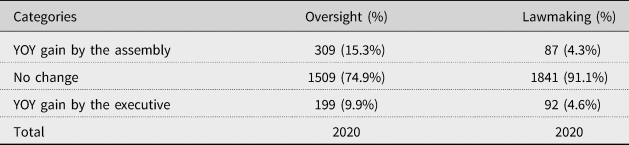
Recoding the V-Dem items produces two dependent variables, one representing oversight dynamics and one capturing lawmaking dynamics. Each dependent variable consists of three simple categories: year-on-year empowerment of the assembly, year-on-year empowerment of the executive or no change.
As can be seen in Table 2, visible oscillations in either direction are atypical; the modal outcome is for legislative–executive relations to remain in a steady state. In our data, ‘no change’ occurs almost 75% of the time for the oversight questions, and an astonishing 90% of the time for the lawmaking questions. These data exhibit less dynamism than much of the extant literature would seem to suggest, perhaps because political scientists tend to focus on change rather than stasis. Moreover, these data confound some time-honoured Weberian expectations: change advantaging the executive is no more likely than the reverse pattern. In our sample of more than 2,000 country-years beginning in 1976, executive empowerment occurs just 10% of the time on the question of oversight, and less than 5% of the time on the question of lawmaking. These findings, which are robust to the deployment of alternative dependent variables, call into question some widely held stereotypes about executive aggrandizement or usurpation in Third Wave democracies (for a critique of the presidential literature, see Carey and Shugart Reference Carey, Shugart, Carey and Shugart1998).Footnote 5
Frequencies of Change in Legislative–Executive Relations

Note: N refers to country-year observations as explained in Table 1.
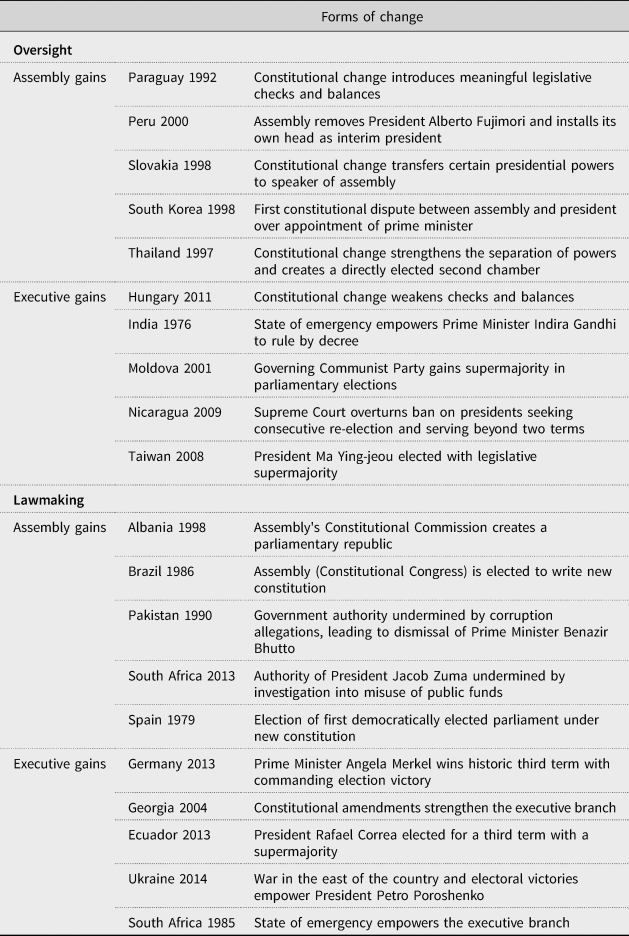
Concrete examples taken from the data set, which illustrate changes to the balance of power in the areas of oversight and lawmaking, are presented in Table 3. Oscillations in the real world can take surprisingly diverse forms. These range from constitutional engineering (e.g. Paraguay 1992 or Hungary 2011); to elections that transform legislative majorities (e.g. Taiwan 2008 or Germany 2013); and to systemic shocks such as the impeachment of a president (e.g. Peru 2000), the dismissal of a prime minister (Pakistan 1990) or a state of emergency and war, which has direct consequences for the power of the executive (e.g. India 1976 or Ukraine 2014).
Illustrative Examples of Change in the Executive–Legislative Balance of Power

Source: Compiled by authors.
Note: Examples encompass changes deriving from both institutional redesign and from political process (see text for distinction).
We now explore our four hypotheses for changes in the balance of executive–legislative relations, using a variety of lagged independent variables. These variables are listed in Table 4. First, to examine the hypothesis that legislators cede power to the executive in the face of the collective action problems generated by multipartism, we operationalize a party fractionalization variable. This measure, originated by Douglas Rae (Reference Rae1967), estimates the probability that two MPs drawn randomly from the assembly will belong to different parties.
Independent Variables in the Analysis

Sources: Party fragmentation, calculated from data coded by Cheibub et al. (Reference Cheibub, Przeworski and Saiegh2004) and extended to 2014; ideological proximity and distance to next election, calculated from data coded by the Database of Political Institutions (Cruz et al. Reference Cruz, Keefer and Scartascini2015); Electoral Democracy Index, electoral system, candidate selection and personal vote calculated from data coded by V-Dem (Coppedge et al. Reference Coppedge2016); economic crisis from Laeven and Valencia (Reference Laeven and Valencia2012) and V-Dem; GDP PPP per capita (real GDP at chained PPP using 2011 USD) drawn from Penn World Table 8.1, available at www.rug.nl/ggdc/productivity/pwt/; parliamentary, semipresidential and presidential calculated from data coded by Cheibub et al. (Reference Cheibub, Przeworski and Saiegh2004) and Elgie (Reference Elgie2018).
Second, to consider the hypothesis that delegation is more likely to occur when the chief executive's party dominates the assembly, we simply measure the fractional share of seats held by the party of the chief executive in the lower house or single chamber of the legislature.
Third, to test the hypothesis that delegation is more likely to occur when there is preference congruence between the executive and legislature, we estimate the overall ideological proximity of the assembly to the executive, relying on annualized data on party orientations towards economic policy. We recognize that coding a single policy area in a one-dimensional space is an imperfect way of measuring this preference congruence, yet we note that left–right differences on macroeconomic management are a major feature of political life in virtually all competitive polities. First, we calculate the ideological distance between the party of the head of the executive and the weighted ideological average of all the parties for which ideological coding was available in the Database of Political Institutions: these data cover up to three government parties and one opposition party.Footnote 6 To capture ideological proximity, the variable was recoded so that higher values represent greater alignment.
Finally, we inspect the argument that severe economic crises tend to loosen constraints on executives and expand their statutory influence. Our economic crisis variable is constructed from International Monetary Fund data on incidents of financial, banking and debt crises (Laeven and Valencia Reference Laeven and Valencia2012), and from data that record annualized, negative gross domestic product (GDP) (Coppedge et al. Reference Coppedge2016).
Moving beyond our leading explanatory variables, we also control for other factors that are likely to affect the likelihood that executive and legislative actors will seek to maximize power. First, we control for the level of electoral democracy, on the assumption that more polyarchic regimes will exhibit greater stability of interbranch relations than semi-competitive systems.Footnote 7 In this article, we do not examine the effects of judicial independence on delegation, but we note that it is highly correlated with the level of electoral democracy and produces similar results.Footnote 8 Second, we estimate the level of socioeconomic modernization using GDP per capita at purchasing power parity. This controls for the possibility that economic crisis will generate comparatively greater institutional instability in poorer societies. Third, we control for executive format, whether presidential, semipresidential or parliamentary. We expect oscillation in legislative authority to be more frequent in separation of powers and dual executive systems, given that both the executive and assembly have a constitutional right to shape legislation. Fourth, we control for systemic incentives that lead legislators to ‘cultivate a personal vote’ (Carey and Shugart Reference Carey and Shugart1995) – that is, to rely on candidate-centred rather than party-centred appeals to the electorate. Where these incentives are strong, legislators are more likely to engage in particularistic exchanges and leave national policymaking to the executive branch (Shugart Reference Shugart1998; Shugart and Carey Reference Shugart and Carey1992). The personal vote variable we use here is an interaction term incorporating the degree of majoritarianism and the centralization of candidate selection procedures.Footnote 9 Fifth, given the known effects of ‘honeymoon’ and ‘lame duck’ periods on assembly–executive relations (Howell and Mayer Reference Howell and Mayer2005; Shull Reference Shull1997), we include a variable measuring the length of time (in years) to the next parliamentary election. Distance from the next election should boost de facto alignment between the executive and assembly, even if the size or ideology of the parties remain unchanged over the course of a chief executive's term in office. All of our control variables are lagged by one year in the analyses.
Analysis and findings
In presenting our empirical results, we remind the reader once again that our goal is not to explore the power of executives or assemblies in absolute terms, but rather in relative terms, using the year-on-year (YOY) change variables described in the preceding section. Using multinomial regression, we assess the plausibility of the different explanations in separate models that test the lawmaking and oversight dependent variables. These models explore the extent to which each predictor is likely to explain empowerment of the legislature or of the executive relative to the baseline. The reference category is ‘no observed change’ in the balance of power, which is the modal YOY observation in our data set.
Table 5 summarizes the estimated effects of each explanatory variable on the likely increase or decrease in the capacity of legislatures to oversee the executive branch. (As the variables for party fragmentation and the size of the chief executive's party are highly correlated, we analyse them in separate models.) The general pattern here is that our explanatory variables, which are largely derived from theories of executive dominance, actually perform better at predicting empowerments of the legislative assembly. Interestingly, our analysis finds no evidence to support the view that the probability of delegation to the executive is determined by the size of the chief executive's party. In fact, we find that assemblies dominated by the party of the chief executive are significantly less likely to change the status quo. This equilibrium may reflect the interest of large legislative majorities that do not face significant veto players.
Predictors of Power Shifts in Executive Oversight Patterns (Multinomial Regression Coefficients and Standard Errors)

Notes: The excluded category on the dependent variable is no annual change. The reference category for executive format is parliamentary. Significance levels: * p < 0.05; ** p < 0.01; *** p < 0.001.
The only explanatory variable that is significantly correlated with the empowerment of the executive – party fragmentation – also seems to contribute to the empowerment of the assembly. Holding all the other variables at their means, fragmentation values increase the probability of executive empowerment by 12 percentage points (as fragmentation increases from its minimum to maximum value), but also increase the probability of assembly empowerment by 15 percentage points. In other words, partisan fractionalization – which we interpret here as a measure of collective action problems in the interbranch bargaining environment – sharply raises the probability of departures from the status quo. Low levels of political fragmentation seem to hold the executive–legislative relationship in place, while high levels of fragmentation are associated with a breakdown of this equilibrium.
The other explanatory variables that have a significant impact on change in oversight powers – ideological affinity and economic crisis – advantage only the legislative branch. Holding all the other variables at their means, the probability of assembly empowerment increases from 6 to 18 percentage points (Model 1) as the ideological gap between the executive's party and the assembly's weighted average narrows to zero (with a one-year lag). In other words, relative ideological congruence between the executive and legislature seems to open up space for potential (rather than observed) legislative oversight of the executive, which is what our V-Dem variable captures. One possible explanation for this could be that when interbranch preference congruence is known to be high, executives may have less to fear from legislative scrutiny. However, deployment (as opposed to availability) of oversight mechanisms is not directly observable in our data set, and more research would be necessary to confirm this interpretation.
Crisis is also more likely to strengthen the legislature's oversight power, despite strong theoretical and empirical reasons to expect that economic crisis would advantage the executive. Holding all the other variables at their means (Model 1), economic crisis (lagged by one year) increased the probability of legislative oversight empowerment from 13 (no crisis) to 18 (crisis) percentage points. Conversely, economic crisis had a negative impact on executive empowerment. Although the crisis variable is almost significant at the 0.05 level (p = 0.06), its effect is to produce change that strengthens legislative oversight of the executive branch. This negative effect, which is statistically significant in Model 2, holds when the crisis variable is lagged by more than two years.Footnote 10 One interpretation of these results could be that crises actually do confer various first-mover advantages upon incumbent executives – as predicted by the delegation and crisis literatures – but assemblies then counter this effect by upgrading horizontal accountability after the fact. This causal mechanism would require confirmation in case studies, focusing on instances of institutional reform in post-crisis scenarios.
The lagged control variables were significant for all or most models, but their effects both suppress and magnify the empowerment of both branches on the oversight dimension. Consistent with our expectations, the level of electoral democracy significantly depresses the likelihood that change in oversight politics will occur. Recall that we first selected country-years with Polity scores of above 1, and then within this set of cases, we used the V-Dem Electoral Democracy Index (EDI) to discriminate among them. The EDI variable has the largest impact of any of our predictors. As electoral democracy becomes more robust, change becomes less likely in either direction: existing oversight patterns remain in a steady state. As electoral democracy increases from its minimum to maximum values in Model 1, the likelihood of change empowering the legislature and executive falls by 15 and 19 percentage points, while the likelihood of no change increases by 34 percentage points.
The effect of democracy does not appear to be conditional on the institutional format of the executive. Figures 1a and 1b summarize the results of logistic regressions estimating the predicted probabilities of lagged electoral democracy on empowerment of both the legislature and executive branches, while holding all the lagged regime-type categories at their means. As electoral democracy increases, the probability of any shift in oversight patterns declines. This bracing effect holds across presidential, semipresidential and parliamentary systems.
Probability that Democratization Will Empower the Assembly in Oversight, by Executive Format (predicted probabilities with 95% confidence intervals)
Note: Predicted probabilities in Figures 1a, 1b, 2a, 2b are estimated from binary logistic regression of the effects of levels of electoral democracy on change (either to the assembly or the executive) for each executive format.

Probability that Democratization Will Empower the Executive in Oversight, by Executive Format (predicted probabilities with 95% confidence intervals)

However, these results also show that the probability of oversight change remains consistently higher in separation of powers systems. This is evident in the full regression model. As can been seen in Table 5, both presidential and semipresidential systems are significantly more likely than the reference category (parliamentarism) to experience change that strengthens either the oversight power of legislatures or the capacity of executives to reduce these constraints. This is consistent with our theoretical expectations.
The observed effects of the other control variables are the opposite of what we expected. Interestingly, the likelihood of change falls significantly at the start of an executive's term in office. There is no evidence to suggest that temporal distance to the next election (the honeymoon effect) empowers either the executive or the assembly. Yet change in oversight patterns – in either direction – is far more likely towards the end of a government's term in office. When the legislature gains in oversight capacity, it could be because of the anticipated political weakness of tired or term-limited governments (the lame duck effect), but it could also simply reflect the political life cycle of incumbents: incoming governments have less of a record to be investigated than do outgoing governments. When the oversight capacity of the assembly to hold the executive to account atrophies towards the end of a parliament, it could be because members are more concerned with electoral prospects in the final year of the legislature.
Also contrary to our expectations, the strengthening of the personal vote can advantage the assembly as well as the executive. Holding all the other variables at their means, the probability of change in political systems with the highest personal vote value was 28 percentage points greater than in political systems with the lowest personal vote value (at a one-year lag in Model 1). This finding is not an artefact of the way we code individual-level incentives to cultivate a personal vote. When we repeat the analysis with a V-Dem variable that codes party systems along a dimension from programmatic to clientelistic, the result is the same: more particularistic political systems increase the probability of both legislative and executive empowerments.Footnote 11
This finding may sound counterintuitive, but we remind the reader that we are not observing ‘legislative strengthening’ in the sense of professionalization, but simply a perceptible shift in the balance of oversight authority in interbranch politics. Why would institutional incentives to cultivate a personal vote advantage the assembly? The shift we observe may be a consequence of extreme forms of clientelism, which require chief executives to negotiate each piece of legislation ad hoc with individual legislators, thus inflating drastically the number of veto players. This scenario resembles Gary Cox and Scott Morgenstern's (Reference Cox and Morgenstern2001) model of the ‘venal-parochial’ assembly. Under these conditions, as work on Italy (e.g. Di Palma Reference Di Palma1977) or Brazil has shown (e.g. Ames Reference Ames2001), rampant clientelism can make the executive a ‘hostage’ to the legislature, with legislators exerting great influence over the government's statutory proposals.
In a second analysis, we now consider the impact of our four explanatory variables on the balance of lawmaking powers between assemblies and executives. These results are summarized in Table 6. As can be seen, they are less significant statistically, although the findings for the effects of party fragmentation, the size of the chief executive's party and electoral democracy power remain similar in terms of empowerment of the assembly. When the fragmentation of parties is at its maximum level, for example, the probability of any increase in the lawmaking power of assemblies is 8 percentage points greater than when fragmentation is at its minimum level.
Predictors of Power Shifts in Lawmaking Patterns (Multinomial Regression Coefficients and Standard Errors)

Notes: The excluded category on the dependent variable is no annual change. The reference category for executive format is parliamentary. Significance levels: * p < 0.05; ** p < 0.01; *** p < 0.001.
As in the previous models, the likelihood of change empowering both the legislature and executive declines as the level of democracy rises. Holding all the other variables at their means (Model 1), the probability that democracy will empower the lawmaking capability of legislators falls by 22 percentage points as political systems move from the lowest to the highest levels of electoral democracy, and by 17 for executives. Thus, as in our oversight analysis, the main effect of democratization seems to be the cementing of stable equilibria in interbranch relations.
This evidence seems to bolster the conventional wisdom about the Third Wave: change empowering the executive is more likely to occur in semi-competitive systems and in unconsolidated democracies of all stripes. This is a recurring theme in the vast literatures on ‘delegative democracy’ (e.g. González Reference González, Brinks, Leiras and Mainwaring2014; O'Donnell Reference O'Donnell1994; Peruzzotti Reference Peruzzotti, Brinks, Leiras and Mainwaring2014) and on ‘hybrid regimes’ (e.g. Levitsky and Way Reference Levitsky and Way2011; Schedler Reference Schedler2013). However, it also shows that change empowering the executive is not the only outcome in these regimes: legislative gains in oversight and statutory authority are also commonplace. The clearest implication of the analyses is that if and when hybrid regimes democratize further, fluctuations in the interbranch balance of power are likely to slow or cease. Although our data do not measure formal institutions, here we can offer an interpretation inspired by historical institutionalism, identifying a window of opportunity for change in the interbranch balance of power. This window is open mainly at modest levels of polyarchy.
Moreover, we find that the effect of democratization on the balance of lawmaking power between executives and assemblies is once again unmediated by executive format. As Figures 2a and 2b show, the probability of change in the balance of lawmaking power between the executive and assembly falls consistently across all regime types as the level of electoral democracy rises.
Probability that Democratization Will Empower the Assembly in Lawmaking Authority, by Executive Format (predicted probabilities with 95% confidence intervals)

Probability that Democratization Will Empower the Executive in Lawmaking Authority, by Executive Format (predicted probabilities with 95% confidence intervals)

The same visual analysis also shows that the likelihood of any change is greatest in semipresidential systems. This gives further support to Maurice Duverger's classic (Reference Duverger1980) contention that the balance of power swings more dramatically under semipresidentialism due to the existence of a dual executive. This institutional arrangement incentivizes the legislature and the executive to make competing claims on lawmaking and oversight power, thereby increasing the probability of power shifts whenever changes in legislative support for the president lead to a more united or divided executive. While Duverger described semipresidentialism as a form of ‘alternation’ between presidential and parliamentary patterns, Giovanni Sartori (Reference Sartori1994: 24) preferred the term ‘oscillation’, which we have adopted here. Both authors correctly predicted the patterns we illustrate in Figures 2a and 2b.
The most striking regional effect that we also observe in these results – the probability of change in either direction was highest in those countries that were formerly part of the Soviet UnionFootnote 12 – highlights the effects of the combination of political system hybridity with semipresidentialism, an admixture that predominates in the region. Although our concern in this article has been with latent cross-national trends, this finding will be of interest to scholars of post-Soviet politics.
Conclusions
Shifting empowerments between the executive and legislature are relatively rare in modern political systems. When we examine the interbranch balance of power on oversight and lawmaking, the vast majority of country-years exhibit no change at all. But this aggregate finding obscures substantial variation across cases when we control for the level of political democracy. Country-years with high Polity IV scores display lower variation in the relative balance of power between the executive and assembly – the probability of change empowering either the executive or assembly in a given year is around 4% in terms of lawmaking and between 11 and 14% for oversight – while semi-competitive political systems exhibit far more dynamism in the relationship. At our lowest observed levels of political pluralism (countries with a Polity score of 1), the probability of a fluctuation in the lawmaking authority of the assembly or executive in a given year is between approximately 13 and 16 percentage points, and between 14 and 27 percentage points for oversight.Footnote 13
Democracy matters. While robust polyarchy does not freeze interbranch relationships in place forever, it is far more likely to exhibit a stable equilibrium between the executive and assembly. A reasonable interpretation of the robust-democracy equilibrium is that actors’ expectations concerning executive oversight and the origins, amendment and enactment of legislation have largely converged. This finding holds across different regime types – presidential, semipresidential and parliamentary – and can be viewed as both cause and consequence of the ‘only game in town’ (Linz and Stepan Reference Linz and Stepan1996).
Yet even when we control for the (stabilizing) effects of democracy on the interbranch balance of power, and the greater likelihood of change in lawmaking patterns in semipresidential systems, we still find that fractionalization of the party system is associated with change in either direction. Both the executive and the assembly are in a position to exploit fragmentation for procedural gains. An intuitive reading of this finding would be that extremely fragmented party systems are associated with minority executives, the lack of a hegemonic force in the legislature, and continual political conflicts. This argument resonates in the presidentialism literature, wherein these features were famously identified as ‘perils’ by Juan Linz (Reference Linz1990); it is possible that ‘Linzian conflicts’ could be responsible for the see-saw pattern that we observed in the results for fragmentation. Such an interpretation would be consistent with the early revisions to Linz (Reference Linz1990) proposed by Scott Mainwaring (Reference Mainwaring1993) and Mark Jones (Reference Jones1995); fragmentation may not always cause regime breakdown, but is associated with protracted struggles for policymaking authority.
We also find that ideological affinity of both branches is more likely to empower assemblies over executives. When there is reasonable ideological congruence among the main parties in the legislature, we observe a much greater likelihood that executive oversight power will gravitate towards the assembly. One reading of this scenario is that the executive, not feeling threatened by an ideologically distant parliament, is content to let the assembly drive a greater share of the policy agenda. However, we observe that this effect is independent of the electoral timetable. We find no evidence to suggest that the more cooperative relations that we associate with electoral honeymoons has any impact on the balance of power. On the contrary, as elections approach, the oversight powers of the assembly and the executive's power to withstand oversight appear to be strengthened.
We also find some mixed evidence that electoral systems encouraging legislators to cultivate a personal vote may actually advantage legislative assemblies vis-à-vis the executive. We concede that our personal vote variable captures only institutional incentives towards particularism in legislative careers, and is in no way a behavioural measure of observed clientelistic interactions between the executive and the assembly. Yet our findings are congruent with bargaining models suggesting that pervasive clientelism inflates the number of effective veto players (even net of party fragmentation) and dilutes the executive's agenda.
Most surprisingly, we find little evidence to support the contention that economic crisis empowers executives. We observe that (lagged) economic crisis is significant only in predicting greater legislative oversight of the executive branch. The utter failure of crisis models to predict shifts in interbranch authority in the direction of the executive calls into question some long-standing arguments about executive dominance, such as theories of presidential decree deployment (e.g. Ferreira Rubio and Goretti Reference Ferreira Rubio, Goretti, Carey and Shugart1998), and also claims about an economic origin of so-called ‘delegative democracy’ (e.g. Kubicek Reference Kubicek1994; O'Donnell Reference O'Donnell1994).Footnote 14
Overall, we have found that some mainstream explanations of delegation – devised almost exclusively to explain delegation from the assembly to the executive – also work passably well in explaining delegation to the opposite direction, i.e. to the legislature. This finding is at odds with many of the principal–agent models that have shaped the study of executive–legislative relations in the Third Wave, particularly in the study of comparative presidentialism. Some readers may interpret the surprising infrequency of gains by the executive to be indicative of the already high levels of executive authority in modern political systems – in this view, some sort of ‘Weberian ceiling’ may have already been reached. This would echo the recent analysis by Morgenstern et al. (Reference Morgenstern, Polga-Hecimovich and Shair-Rosenfield2013), who claim that presidential power in the US and Latin America is either high or very high. However, a proper test of the ceiling hypothesis will only be possible when we have comparable measures of legislative power that are valid across space, time, and executive format.Footnote 15
In conclusion, while many case studies on post-Third Wave politics have documented executive usurpation or encroachment upon legislative authority, a cross-national analysis suggests the need to rethink some of these arguments. Change in executive–legislative relationships is relatively infrequent; concrete gains by the executive are rare; and moreover, even when such gains do occur, the proposed explanatory factors perform inconsistently at best.
Acknowledgements
We thank Christopher Gerry and the ECPR Presidential Politics Standing Group for advice and helpful comments.