In the past decade, there has been growing interest in children's emotionality and self-regulation of emotion and behavior, as well as the role of these characteristics in children's adjustment (e.g., Eisenberg, Fabes, Guthrie, & Reiser, 2000; Rothbart & Bates, 2006). Although numerous investigators have found links between adjustment and children's dispositional regulation and emotion, they seldom have differentiated among various aspects of regulation (such as components of effortful control), differentiated regulation from related constructs that appear similar but may differ in important ways, or examined specific types of negative emotions (rather than general negative emotionality). In addition, most or all of the few studies that have made these sorts of distinctions have been conducted in Western cultures. The purpose of the present study was to examine the individual and unique relations of children's dispositional anger, self-regulation (i.e., attentional and inhibitory control), and reactive (less voluntary) undercontrol (i.e., impulsivity) to adjustment in a sample of children from the Peoples Republic of China.
Emotion and Adjustment
Negative emotionality is a symptom of some types of psychopathology (American Psychiatric Association, 2000), and both internalizing and externalizing problems have been linked with global measures of negative emotionality (Clark, Watson, & Mineka, 1994; Lengua, West, & Sandler, 1998). Recently, investigators have argued that it is important to examine the specific types of negative emotions associated with various problems of adjustment (Keltner, Moffitt, & Stouthamer-Loeber, 1995; Rothbart & Bates, 2006). For example, there is some evidence that externalizing problems are more strongly associated with anger and irritability, whereas internalizing problems are especially linked with sadness, anxiety, and fear (Eisenberg, Cumberland, et al., 2001; Lemery, Essex, & Smider, 2002; Rothbart & Bates, 2006).
The association between externalizing behavior and emotions such as anger, frustration, and irritation is commonsense. Although not all externalizing behaviors are driven by emotion, anger or frustration often would be expected to motivate behaviors such as defiance, aggression, and destructive behavior. In addition, children may tend to experience heightened anger/frustration because of others' negative reactions to their externalizing behavior. Regardless of the direction of causality, there is evidence that anger, hostility, frustration, and irritability are associated with high levels of children's externalizing behavior problems (e.g., Casey & Schlosser, 1994; Colder & Stice, 1998; Gilliom, Shaw, Beck, Schonberg, & Lukon, 2002; Keltner et al., 1995; Lemery et al., 2002; Zahn-Waxler et al., 1994).
There also is reason to predict a positive association between anger/frustration and internalizing problems; indeed, irritability is one possible symptom of internalizing problems (American Psychiatric Association, 2000). Although it is possible that anger contributes to children's social withdrawal (an aspect of internalizing problems), more often investigators have suggested that children who are withdrawn, anxious, and depressed tend to be rejected by peers, and this rejection is likely to elicit anger. In fact, socially withdrawn behavior has been linked to peer rejection in elementary school (Rubin, Bukowski, & Parker, 1998). Moreover, low peer status and victimization have been associated with anger (Dodge, Coie, Pettit, & Price, 1990; Hanish et al., 2004; Maszk, Eisenberg, & Guthrie, 1999), although some of this relation may be because of an association between rejection and aggression due to anger. In addition, children with internalizing problems may have difficulty speaking up in class or with other demands that require social assertion (e.g., sports), and these experiences are likely to elicit frustration and anger.
The empirical literature on the relation of anger/frustration to internalizing problems is not highly consistent. Some researchers have found little relation between anger or irritability and internalizing problems (including shyness; Eisenberg, Shepard, Fabes, Murphy, & Guthrie, 1998; Zahn-Waxler et al., 1994), especially at a younger age (Eisenberg, Cumberland, et al., 2001). However, a number of others who have examined either more serious levels of adjustment problems or older individuals have found positive relations between anger/frustration and internalizing problems (e.g., Blumberg & Izard, 1985; Keltner et al., 1995; Lemery et al., 2002; Silk, Steinberg, & Morris, 2003; Zeman, Shipman, & Suveg, 2002). Moreover, there is some evidence that the association between anger and internalizing problems increases in the elementary school years and is relatively clear by age 6 to 9 (Eisenberg et al., 2005). One might expect the relation between internalizing problems and anger to become stronger with age because of increased negative social experiences (e.g., peer rejection) for socially fearful, withdrawn children (Rubin et al., 1998), at least in cultures that value confident, assertive behavior.
Regulation, Reactive Control, and Adjustment
Although dispositional anger or negative emotionality and self-regulation are negatively related (e.g., Derryberry & Rothbart, 1988; Eisenberg et al., 2003), the constructs of emotionality and regulatory processes are conceptually and empirically different (Rothbart, Ahadi, Hershey, & Fisher, 2001; Rothbart & Bates, 2006). For example, some children may exhibit unregulated behaviors (e.g., proactive aggression or impulsive behaviors) that are problematic, even if they are not particularly prone negative emotions. Nonetheless, children predisposed to anger would be expected to be prone to adjustment problems, although the degree to which this is true may depend on their self-regulation (Eisenberg et al., 2000; Eisenberg & Spinrad, 2004; Valiente et al., 2003). Children who frequently experience anger (and perhaps experience it intensely) but modulate its expression in a socially acceptable manner would likely to be viewed as adjusted.
In addition, distinctions within the domain of regulation/control have proven useful in predicting children's adjustment. An important construct in research on self-regulation is that of effortful control, defined as “the efficiency of executive attention—including the ability to inhibit a dominant response and/or to activate a subdominant response, to plan, and to detect errors” (Rothbart & Bates, 2006, p. 129). Effortful control is believed to regulate dispositional reactivity, including emotions, and to involve the effortful or willful control of attention and behavior. It involves the executive attention system and the functioning of the midfrontal lobe, including the anterior cingulate gyrus (Rothbart & Bates, 2006). A typical measure of effortful control is attention focusing: the ability to maintain attentional focus upon task-related channels; this ability is expected to contribute to the processing of information and learning and hence, the quality of performance during social interactions and on nonsocial tasks. Effortful control also involves inhibitory control: the capacity to plan and effortfully suppress inappropriate approach responses under instructions or in novel or uncertain situations (Rothbart et al., 2001). Inhibitory control obviously contributes to the child's ability to inhibit behavioral expressions of negative emotion and to behave in ways consistent with social norms and others' expectations.
Eisenberg and Morris (2002) built on Rothbart's distinction between reactive processes and effortful control (e.g., Derryberry & Rothbart, 1997), arguing that it is important to differentiate between degree of control (inhibition vs. approach/expressivity) and self-regulation (also see Nigg, 2000). Self-regulation involves voluntary or effortful control; however, children often may exhibit inhibition or approach behaviors that are less voluntarily controlled and do not reflect effortful inhibitory or activational control. Thus, effortful control, believed to be a process involved in self-regulation, may be confused with reactive aspects of control.
Reactive overcontrol includes behaviors that are overly inhibited and inflexible, such as behavioral inhibition (e.g., constrained and rigid behavior in novel or perhaps stressful situations; behavioral inhibition is not the same as inhibitory control; Kagan, 1998). Reactive undercontrol is exemplified by impulsive approach tendencies. Both reactive over- and undercontrol are linked to motivational states and emotion (e.g., fear for the former, and surgent positive emotion for the latter; Derryberry & Rothbart, 1997), and are less willful or voluntary than effortful control. Thus, children who are pulled in an unthinking, impulsive manner by desires and potential rewards or who are very inhibited, rigid, and socially withdrawn because of behavioral inhibition can be viewed as having problems with reactive undercontrol or overcontrol, respectively (Eisenberg & Morris, 2002). Reactive over- and undercontrol likely are tapped by measures of ego overcontrol (Block & Block, 1980; Derryberry & Rothbart, 1997), as well as impulsivity (Eisenberg et al., 2004), and the construct probably includes what Kindlon, Mezzacappa, and Earls (1995) labeled as motivational impulsivity: the insensitivity to reward or punishment. Unlike effortful control, reactive approach or inhibition is believed to be situated primarily in subcortical structures (e.g., Pickering & Gray, 1999). Empirical data suggest that these constructs, albeit correlated, can be empirically differentiated (Eisenberg et al., 2004; Kindlon et al., 1995; Olson, Schilling, & Bates, 1999; Rothbart et al., 2001).
The Relations of Anger, Effortful Control, and Reactive Undercontrol to Adjustment
Eisenberg and colleagues (Eisenberg, Cumberland, et al., 2001; Eisenberg & Morris, 2002) have argued that both effortful control and reactive control uniquely predict children's adjustment. Moreover, they have suggested that some aspects of effortful control may be more strongly related to internalizing problems than others. Specifically, Eisenberg and Morris (2002) hypothesized that children prone to externalizing problems are low in all types of effortful control (e.g., attentional and with regard to the voluntary inhibition or activation of behavior), as well as high in reactive undercontrol (i.e., impulsive). These deficits would account for the lack of behavioral control and the diminished attentional and sociocognitive capacities (e.g., information processing; Coie & Dodge, 1998) that are associated with some externalizing problem behavior.
In contrast, it has been argued that children prone to internalizing problems are low in effortful attentional control, average in effortful inhibitory control, and high in reactive overcontrol (Eisenberg & Morris, 2002). Internalizing symptoms such as depression probably involve deficits in the abilities to downregulate negative feelings and to maintain or produce positive feelings (Cole, Michel, & Teti, 1994). The abilities to shift attention when experiencing negative emotions and to focus on affectively neutral or positive thoughts and activities seem to be important in cutting off negative emotion (Rothbart, Ziaie, & O'Boyle, 1992), and have been linked to anxiety and depression (Derryberry & Reed, 1994, 2002; Silk et al., 2003; Vasey, El-Hag, & Daleiden, 1996). It is likely that deficits in attentional regulation also predispose children with internalizing symptoms to difficulties in dissipating feelings of anger. Finally, well-adjusted children were hypothesized to be high in effortful attentional, activational, and inhibitory control and moderate in reactive control (i.e., not overcontrolled or overly impulsive). Because effortful control is willfully modulated and can be used as needed, high levels of effortful control generally are believed to be associated with better adjustment and adaptive behavior.
The empirical research provides support for the expectation that both effortful and reactive control processes predict adjustment. Children's effortful control has been linked to high levels of social competence and conscience (Eisenberg et al., 2000; Kochanska, Murray, & Coy, 1997; Kochanska, Murray, & Harlan, 2000). Conversely, externalizing problems have been associated with low levels of effortful control (Lemery et al., 2002; Lengua et al., 1998; Murray & Kochanska, 2002; Valiente et al., 2003) and to high impulsivity (Krueger, Caspi, Moffitt, White, & Stouthamer-Loeber, 1996; Lemery et al., 2002; Lengua et al., 1998; Lynam, 1997) or surgency (low shyness and high intensity pleasure; Oldehinkel, Hartman, Winter, Veenstra, & Ormel, 2004).
Empirical relations between internalizing problem and children's effortful control have been less consistent. Oosterlaan and Sergeant (1996) found that nondisordered and anxious children did not differ on inhibitory control. In contrast, Oldehinkel et al. (2004) found that children with internalizing problems were lower in attentional and activational effortful control than nondisordered children, albeit higher than externalizing children. Hart, Hofmann, Edelstein, and Keller (1997) found that children with an overcontrolled personality (who were shy and inhibited) scored high on attentional problems. Shyness (which involves social withdrawal or anxiety) also has been related to low levels of attentional control in adults (Eisenberg, Fabes, & Murphy, 1995), although results are less consistent for children (Eisenberg et al., 1998). Murray and Kochanska (2002) found that young children high in effortful control had more internalizing problems than children at moderate levels of effortful control; however, their measures of effortful control may have tapped reactive control to some degree (some involved approach to rewards and a relative stranger). Aksan and Kochanska (2004) found an association between what they labeled as reactive inhibition to novelty and later emerging effortful inhibition; however, it was fearfulness, not inhibition with novel toys/activities, that was positively related to effortful control. These findings suggest that the fearfulness but not the control-related aspects of inhibition associated with internalizing problems may be positively related to effortful control. Variation in findings may be partly because of the aspect of effortful control assessed and the age of the children.
Findings in regard to the relation of internalizing problems to reactive control are mixed. Some investigators have obtained some positive relations between an overcontrolled personality and internalizing problems (e.g., Huey & Weisz, 1997; Robins, John, Caspi, Moffitt, & Stouthamer-Loeber, 1996) or have found that children who are behaviorally inhibited (and thus high in reactive overcontrol) tend to develop internalizing problems with age (e.g., Biederman et al., 1990). In contrast, O'Brien and Frick (1996) found that anxious children did not differ from nondisordered children on a task that likely assessed reward dominance or impulsivity (also see Krueger et al., 1996). Furthermore, Lengua et al. (1998) found a positive relation between impulsivity and depression when contaminated (i.e., overlapping) items were removed from the scales (but not prior to removing those items).
Eisenberg, Cumberland, et al. (2001) specifically examined the relations of attention focusing, attention shifting, inhibitory control, and impulsivity to children's internalizing and externalizing problems. When the children were age 4.5 to just turning 8 years of age, children with borderline or clinical level externalizing problems (comorbid or not), in comparison to nondisordered children, were low in attention focusing, attention shifting, and inhibitory control, and high in impulsivity. This same pattern of findings was obtained 2 years later (Eisenberg et al., 2005). At the first assessment, children with pure (not comorbid) internalizing problems, in comparison to nondisordered children, were low in attentional effortful control and impulsivity, but did not differ in inhibitory control. Internalizers were higher than externalizers in effortful control and lower in impulsivity. Children classified as internalizers 2 years later were low in impulsivity, but did not differ from nondisordered children in inhibitory control (and were higher than children with externalizing problems in this regard). Moreover, effortful control or impulsivity and negative emotionality (anger or sadness) often provided some unique, additive prediction of problem group designation (Eisenberg, Cumberland, et al., 2001; Eisenberg et al., 2005). Valiente et al. (2003) found that ego over- versus undercontrol and effortful control provided some unique prediction of problem behaviors in younger children, but that by early adolescence, impulsivity did not provide unique prediction of level of externalizing symptoms. With development, children's growing effortful control may increasingly modulate the overt expression of reactive tendencies. In brief, Eisenberg and colleagues have found that externalizing children are deficient in effortful control and high in impulsivity, that young children with internalizing symptoms are low in attentional but not inhibitory control (although the negative relation with attentional control may decrease with age), and that effortful control and impulsivity provide some unique prediction of adjustment.
The Role of Culture
As yet, there is only limited research on the relations of adjustment with anger, effortful control, and impulsivity in non-Western cultures. The present study was conducted in China, a country that has been found to have a relatively collectivistic culture (Oyserman, Coon, & Kemmelmeier, 2002). Although there is disagreement about the degree to which cultures can be classified as collectivistic (Kitayama, 2002; Miller, 2002), a number of people have argued that in cultures such as China, conformity with societal and in-group norms and group harmony are valued (Cheah & Rubin, 2004; Triandis, 1995) and predict social behavior (Bond & Chi, 1997). Moreover, the display of emotions such as anger that are disruptive to the functioning of the group is likely to be discouraged (Markus & Kitayama, 1991), as are externalizing behaviors such as aggression (Cheah & Rubin, 2004). Thus, in China one would expect regulation and minimal expression of anger to be valued and to be predictors of low levels of externalizing problems.
There is conflicting evidence regarding the degree to which some internalizing behaviors, such as socially withdrawn behavior, are valued in China and related to positive socioemotional development. Chen, Cen, Li, and He (2005) suggested that in Chinese culture, shy, sensitive, and restrained behavior traditionally has been considered indicative of social accomplishment and maturity. Consistent with this view, some researchers have found that shy, sensitive behavior, which is described by Chen et al. (2005) as wariness and anxious social reactivity and likely reflects internalizing problems to some degree (Rubin, Burgess, & Coplan, 2002), is associated with high social competence (Chen, Dong, & Zhou, 1997; Chen, Rubin, & Li, 1995; Chen, Rubin, & Sun, 1992). However, Chen et al. (2005) found that this positive relation evaporated in the last decade; indeed, in their 2002 cohort, shyness was associated with peer rejection, problems in school, and depression. Chen et al. argued that Chinese culture has become Westernized to the degree that assertive behavior is now valued, whereas sensitive, restrained behavior is not (Yu, 2002). Moreover, other investigators who have assessed social withdrawal in Chinese children, which could be due in part to anxious shyness, have found that it is related to peer rejection (Chang, 2003; Hart et al., 2000; Schwartz, Chang, & Farver, 2001) and negative emotional reactions from adults (Cheah & Rubin, 2004).
If Chinese culture has changed and currently discourages and sanctions socially withdrawn and/or anxious, sensitive shy behavior, those displaying such behavior are likely to be children who do not have very good voluntary control over its occurrence. In the United States, conflicted (anxious) shyness has been associated with high negative emotionality and low attention span (Coplan, Prakash, O'Neil, & Armer, 2004). Thus, as in Western societies, we expected Chinese children's internalizing behaviors involving anxiety to be associated with high levels of reactive overcontrol and anger, and perhaps low levels of attentional control.
There is very little work on the Chinese children's regulation/control. Ahadi, Rothbart, and Ye (1993; Rothbart et al., 2001) found considerable similarity in the factor structures of temperament for 6- to 7-year-old Chinese and American children. As has often been found in the United States, in the Chinese sample, anger/frustration loaded on a negative affect factor; attention focusing and inhibitory control loaded on the effortful control factor; and impulsivity loaded on the surgency factor. However, in the Chinese sample, effortful control was uncorrelated with negative affect, but negatively correlated with surgency, whereas in the US sample effortful control was negatively related with negative affect and uncorrelated with surgency. Thus, in China, compared to the United States, one might expect less of a relation between internalizing negative emotions and effortful control.
Studies suggest that rates of depression and internalizing problems in China and Hong Kong are at least as high as in the United States (e.g., Chen & Li, 2000; Greenberger, Chen, Tally, & Dong, 2000; Liu, Kurita, Guo, Miyake, Ze, & Cao, 1999; Liu, Kurita, Guo, Tachimori, & Ze, 2000; Stewart et al., 2004), and that US children are higher in aggressive behavior (Weine, Phillips, & Achenbach, 1995). Chinese girls are higher than Chinese boys in internalizing problems in childhood and adolescence, whereas Chinese boys are higher in externalizing problems (Liu et al., 2000; Weine et al., 1995). Consistent with the idea that depressed children and adolescents are unregulated, Chan (1994) found that youth with anxiety and depression tended to use ineffective rather than rational problem-solving modes of coping. Other studies show that depressive symptoms in Chinese children, like in the United States, are associated with low social and academic competence (Chen et al., 1995; Chen & Li, 2000), as well as self-perceptions thereof (Chan, 1997).
In a recent study, Zhou, Eisenberg, Wang, and Reiser (2004) examined the relations of first and second graders' effortful control and anger/frustration with a composite of teachers' and parents' ratings of children's externalizing problems and low social competence, as well as peers' reports of aggression. Teacher-, but not parent-, reported effortful control and anger were negatively related to peer-rated aggression. In addition, adults' reports of high social competence/low externalizing problems (combined) generally were related to high levels of children's effortful control, and teacher-reported low anger and high effortful control uniquely predicted high-quality social functioning (only parent-reported effortful control and not anger was a unique predictor). In addition, sometimes effortful control and anger interacted such that anger/frustration was negatively related to social functioning for children with low effortful control but was weakly related or unrelated to social functioning for children with mean to high levels of effortful control. Zhou et al. (2004) did not examine relations of anger and effortful control (or type of effortful control) to adults' reports of externalizing problems only (not combined with social competence). Moreover, they did not assess internalizing problems or impulsivity.
The Present Study
In the present study, we examined the relations between Chinese children's problem behaviors and specific types of effortful control (inhibitory control and attention focusing) or reactive control (i.e., impulsivity) and one specific mode of negative emotion (anger). First and second graders were used in this work for two reasons. First, because of the multiple challenges faced by children entering school, effortful control and anger were expected to be especially important for coping with this stress and for anxiety/depression and acting out behaviors during this transition. Second, we chose this age because it is similar to that used in both China and the United States in previous work on effortful control and its relation to adjustment (Ahadi et al., 1993; Eisenberg, Cumberland, et al., 2001; Zhou et al., 2004). We hypothesized that many of the same relations found in the United States would be found in this sample (and that the findings would be consistent with those of Zhou et al., 2004, using a composite measure of social functioning). Specifically, low effortful attentional and inhibitory control and high impulsivity and anger/frustration were expected to predict higher levels of externalizing problems (either by themselves or comorbid with internalizing problems). Children with relatively high levels of pure internalizing problems were expected to be relatively low in impulsivity and average in inhibitory control. In United States, the relation of internalizing problems with anger was weak in early elementary school and increased with age into middle elementary school; thus, we were unsure if anger would relate to internalizing problems. We also were unsure about the relations of adjustment with attentional control because they were evident at a mean age of 6 but not 8 years in the United States (Eisenberg et al., 2005). As in the United States, relatively high attentional and inhibitory effortful control, low anger, and moderate impulsivity were expected to predict nondisordered status. We also predicted that there would be unique contributions of both emotionality and regulation/impulsivity to the prediction of adjustment. Because some research with Western samples suggests that effortful control is a stronger predictor of adjustment or social competence for children who are prone to anger (e.g., Belsky, Friedman, & Hsieh, 2001; Eisenberg et al., 2000), we examined if effortful control and emotionality interacted when predicting children's adjustment. Specifically, we expected effortful control to be a stronger predictor of adjustment (especially externalizing problems) for children prone to anger. Moreover, effortful control and impulsivity were expected to uniquely predict adjustment.
Third and finally, because girls, in comparison to boys, tend to be higher in internalizing problems and effortful control, and lower in externalizing problems and impulsivity (Eisenberg, Cumberland, et al., 2001), we examined if gender moderated any of the relations between the various predictors and children's adjustment problems. In research in the United States, patterns of findings were similar for girls and boys; thus, we did not expect strong or consistent evidence of moderation by gender.
Method
Participants
Participants were recruited from two elementary schools in Beijing, the capital of People's Republic of China, and from another two elementary schools in a rural area of He Bei Province of China adjacent to Beijing. In the urban schools, participants were recruited from six first-grade and seven second-grade classes (average class size = 27). In the two rural schools, all three first-grade and four second-grade classes were included (average class size = 49).
Parental consent forms were distributed to all the students in first and second grade. Close to 98% of parents in the two rural schools and 95% in the two urban schools gave permission for their children's participation. The final sample consisted of 697 children in total, with 356 urban (44% female) and 341 (45% female) rural children. The average ages of the rural and urban samples were 8.36 and 8.33 years (SDs = 0.57 and 0.60), respectively (mean age for the total sample = 8.34, SD = 0.58).
For most of the main analyses, only the 603 children with scores on both internalizing problems (collected from parents; see below) and externalizing problems (collected from peers and/or teachers) were included (M age = 8.32, SD = 0.59), including 322 boys (53.4%; M age = 8.29, SD = 0.60) and 281 girls (46.6%; M age = 8.35, SD = 0.58). In this subsample, 302 children (M age = 8.34, SD = 0.57) were from rural area and 301 children (M age = 8.30, SD = 0.61) were from urban area. Of these, 293 children (48.6%) were in first grade and 310 children (51.4%) were in second grade. Parental questionnaire data were obtained from mothers for 347 children (57.5%; M age = 34.0 years, SD = 34.57), from fathers for 171 children (28.4%; M age = 35.78, SD = 3.94); for the remaining 85 children (14.10%), gender of the parent was not reported. Five hundred sixteen children (85.6%) were from two-parent households, parents of 17 children (2.8%) had divorced, and information on family status was missing for 70 children (11.6%). Fathers' and mothers' educational levels (available for 89 and 90%) were as follows: 2.6 and 3.9% had middle school or lower education, respectively; 61.3 and 62.7% had a high school education; and 36.1 and 33.5% had at least some college or higher education.
Procedure
Two graduate students went to each classroom when no other adults were present. They first explained the procedures for completing a set of peer nomination and self-response forms. They specifically told the students that nobody in their school would see their responses and that the researchers would not know whom the students were and would not be interested in any individual responses. The students were then given time to practice with the procedures and to learn the names of their classmates for the peer nominations. As most students could not read their classmates' names in print at this age, this practice session took almost a class period. After the practice session and a short recess, students were administered the self-report and peer nomination instruments. One assistant stood in the front of the class and read each question slowly while students filled out the answers. The other research assistant walked around the classroom to assist individual students when they needed help or additional explanation. At the end of the session, which lasted slightly more than one class period, the students were again briefed about the purpose of the research and the anonymity of their identity. They were also asked to take home a set of questionnaires for their parents to fill out and to bring them back, sealed, the next day.
In primary as well as secondary schools in China, each class has one designated head teacher. Head teachers usually teach major subjects such as Chinese and mathematics. They teach fewer classes but are assigned the extra responsibility of attending to student affairs for the designated class. Most school activities, including academic instruction, are conducted within a class as the organizing unit. Students in a class go to the head teacher for any problems they encounter, including those that occur outside school or in lessons taught by other subject teachers. Head teachers see their students every day, either individually or in groups, and maintain close contact with the parents, many of whom know the school only through the head teachers. Twenty-seven head teachers (93% female) filled out a set of behavior evaluations of the students in their designated classes. They were provided with the same explanation given to the students about confidentiality and were compensated for their work.
Measures
Procedures for removing overlapping items in the temperament and problem behavior scales
To reduce the potential for confounding of measures of temperament and behavioral problems, we excluded items on the temperament scale that likely reflected psychopathology and vice versa. To determine which items are confounded, temperament items from the Child Behavior Questionnaire (CBQ; Rothbart, Ahadi, & Hershey, 1994; Rothbart et al., 2001) reflecting attention shifting, attention focusing, inhibitory control, sadness, and anger, as well as child psychopathology items reflecting externalizing and internalizing problems from Child Behavior Checklist (CBCL; Achenbach, 1991) were rated by experts for another study (see Eisenberg et al., 2004). In the current study, the measures of children's emotionality and regulation were nearly identical to the corresponding scales in CBQ (e.g., a few minor changes were made in translation), and the measures of children's internalizing and externalizing problems were adapted from, and identical or similar to, the CBCL. Thus, the items rated by experts as problematic in the prior study were also excluded in this study.
Specifically, 32 experts in this field of temperament and/or emotion and psychopathology (24 faculty and 8 graduate students) completed a questionnaire measure assessing to what extent each item reflected either temperament or behavior problems (1 = much better measure of temperament; 3 = not a better measure of temperament or symptoms, substantial content for both; 5 = much better measure of symptoms than temperament). The average rating score for each item was calculated. If the measured construct of an item rated by experts was inconsistent with the construct that the item was intended to measure, this item was regarded as a confounded item and dropped altogether. That is, temperament items that had a mean score of 3.00 or more and symptom items that had a mean score of 3.00 or less were removed from the corresponding scale (see below).
Children's dispositional emotionality
Children's anger/frustration was assessed with the anger/frustration subscale from the Chinese version of Rothbart's CBQ (Halverson, personal communication, March 2000; Rothbart et al., 2001).1
Because of the need to limit the number of questionnaires completed by parents and teachers, the only other subscale administered from the CBQ was sadness, which was not reliably rated by adult reporters.
Children's dispositional regulation and reactive undercontrol (impulsivity)
Parents and teachers rated children's effortful control (i.e., regulation) with subscales from the Chinese version of the CBQ using the same response format as for the anger/frustration subscale. Attentional regulation was assessed using the attention focusing subscale (11 items, e.g., “when drawing or reading in a book, shows strong concentration,” αs = .79 for parents and .89 for teachers). Two additional items from this subscale were dropped from both parent- and teacher-report measures because of their negative item-scale correlations. Behavioral effortful control was measured with the inhibitory control subscale, which assesses children's ability to effortfully inhibit behavior (11 items for parent and 13 items for teachers, αs = .71 and .87, respectively, e.g., “can lower his/her voice when asked to do so”). One additional item was dropped for parents' report because of its negative item-total correlation.
The impulsivity subscale of the CBQ, used to assess reactive undercontrol, contained 11 items (αs = .57 for parents and .73 for teachers) and measured children's tendency to act without thinking (e.g., “tends to say the first thing that comes to mind, without stopping to think about it”). Two additional items were dropped from both parent and teacher measures because of negative item-total correlations. Although the alpha for parent-reported impulsivity was rather low, findings with this measure generally were consistent with expectations so the low reliability did not appear to undermine its usefulness.
Children's problem behaviors
Parents rated children's internalizing problem behaviors, whereas teachers and peers reported on children's externalizing problem behaviors. The measure of internalizing behaviors included 19 items (α = .85): 13 items were originally from the Teacher's Rating Index of Depression (Cole, Martin, Powers, & Truglio, 1996, e.g., “looks lonely”) and 6 were from Kendall, MacDonald, and Treadwell's (1998) adaptation of the anxiety scale of Achenbach's CBCL (“too tearful or anxious”). Parents rated items using the same format as the emotionality scale. Although the items assessed primarily depression and anxiety, some items could be viewed as measuring social withdrawal (e.g., “plays or works alone,” “shy or timid”). This measure was translated and rechecked by several bilingual psychologists who worked together on the task, including two bilingual Chinese psychologists trained in the United States.
Teachers rated children's externalizing problem behaviors with Lochman and the Conduct Problems Prevention Research Group's (1995) externalizing scale using the same format as the emotionality scale. It assesses children's aggression and delinquency (22 items, α = .95, e.g., “physically harms other children”). This measure was translated and backtranslated and was used previously by Zhou et al. (2004) in China. Two additional items were dropped because of the experts' ratings of overlap with anger/frustration measure (i.e., “easily upset, annoyed or irritated,” “temper tantrum”). Peers also reported on children's externalizing behaviors with the subscale of aggressive–disruptive behavior from the Class Play (Masten, Morison, & Pelligrini, 1985; 7 items, α = .94, e.g., “someone who teases other children too much”; the Chinese version of this measure was used; Chen et al., 1992; Zhou et al., 2004). Students were given a list of all their classmates' names and a list of descriptions of roles. After the description of each role was read by a graduate student, the students were asked to write down the names of their classmates who could best play each role (up to 3). Nominations for each child on each role were summed. Because the number of students differed by class, scores were standardized (Z scores) within class.
Problem behavior grouping
For some analyses, an aggregate externalizing score was computed by averaging the teacher- and peer-rated externalizing scores. Before computing the average, scores on teacher-rated externalizing problems were standardized (scores for peer-rated aggressive-disruptive behaviors were already standardized).
Based on their scores on both internalizing and combined externalizing symptoms, children were categorized into four groups. Children who had a Z score ≥ 0.8 SD above the mean in either type of problem behavior (internalizing or externalizing), but not on the other, were assigned to the internalizing (INT) or externalizing (EXT) behavior groups, respectively. If children had scores higher than 0.8 SD above the mean on both internalizing and combined externalizing measures, they were considered to be in the comorbid group (CO). Children with scores lower than 0.8 SD above the mean in both internalizing and combined externalizing measures were considered to be in the no problem behavior group (CONT). This procedure resulted in 400 children (66.3%) in the CONT (195 boys, 205 girls), 113 children (18.7%) in the INT group (55 boys, 58 girls), 73 children (12.1%) in the EXT group (59 boys, 14 girls), and 17 children (2.8%) in the CO group (13 boys, 4 girls). If the cutoff point were set at 1 instead of 0.8, the number of children in our adjustment groups (especially the number of externalizers) would have been quite small. Achenbach's (1991) cutoff for borderline clinical status (a T score of 60) is approximately 1 SD above the mean, which should result in approximately 16% of a sample being designated as having a borderline or clinical status for internalizing problems and 16% having this status for externalizing problems (with some of those children being the same)—numbers not very different from those in our sample. Of interest, unlike in the United States, few children (<3%) in this study were classified as having relatively high levels of both internalizing and externalizing problems.
Results
Descriptive statistics
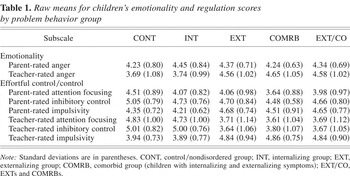
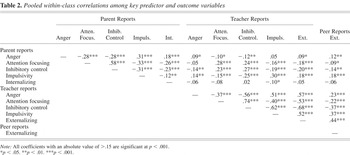
Means for the main variables are presented in Table 1. Given that the data are clustered within school classrooms, we computed the pooled within class correlation matrix for those children with complete data (see Table 2). These correlations remove any effects of classroom-based clustering.
Raw means for children's emotionality and regulation scores by problem behavior group

Pooled within-class correlations among key predictor and outcome variables

Gender differences
Teachers rated boys higher on anger and impulsivity, but lower on attention focusing and inhibitory control (raw Ms = 3.96, 4.20, 4.45, and 4.57, respectively) than girls (raw Ms = 3.71, 3.91, 4.75, and 4.95, respectively), pooled within class rs (508) = −.18, −.19, .14, and .22, respectively; ps < .001, < .001, = .002, and < .001, respectively. Parents' ratings of temperamental characteristics did not differ for boys and girls. The gender difference was not significant for parent-rated internalizing behavior (the continuous variable), but was significant for both teacher-rated externalizing behavior and peer-rated aggression/disruption, rs (508)= −.24 and −.25, ps < .001. Boys scored high on teacher- and peer-rated externalizing problems (raw Ms = 2.30 and 0.19, respectively) than did girls (raw Ms = 1.84 and −0.23, respectively).
Relations with age
The pooled within class correlations showed no significant relations with age for the major parent- and teacher-reported variables in the study.
Rural–urban differences
Analyses were conducted to determine if differences in the children from urban and rural settings might account for the prediction of adjustment from children's emotion and regulation/control. Because urban–rural was a classroom level rather than student level variable, it could not be easily tested in an overall test with adjustment for clustering. We conducted simple multivariate analysis of variances to assess urban–rural differences in the parent and teacher reports of emotionality (anger) and regulation/control (i.e., attention focusing, inhibitory control, and impulsivity). These tests provide correct estimates of the effects, but the standard errors of these tests may be too small, so significance levels should be treated cautiously. The omnibus multivariate F for the four parent-report measures was marginally significant, F (4, 618) = 2.18, p < .07. Urban children (M = 4.42) scored higher than rural children (M = 4.27) on parent-rated attention focusing, F (1, 621) = 3.88, p < .049. The omnibus multivariate F for the four teacher-report measures was significant, F (4, 615) = 19.30, p < .001. Means on teacher-rated anger (Mrural = 4.90, Murban = 3.63) and impulsivity (Mrural = 4.21, Murban = 3.94) were higher for rural than urban children, Fs (1, 618) = 29.02 and 15.63, ps < .001. In analysis of variancs, rural and urban children did not differ significantly on parents' reports of internalizing problems or teachers' reports of externalizing problems. Peers' reports of externalizing problems were standardized within classroom and could not be appropriately compared. Based on these analyses, it seemed unlikely that coming from an urban versus rural environment affected the relations of the dispositional predictors to the measures of adjustment.
Consistency of measures across reporters
Pooled within class correlations were used to examine if parents and teachers agreed on ratings of children's emotionality and regulation/control. There were significant correlations across reporters for children's anger, attention focusing, inhibitory control, and impulsivity, rs (508) = .09, .28, .27, and .30, respectively; ps < .043, .001, .001, and .001, respectively, although the correlation for anger was quite low. The correlation between teachers' reports of externalizing problems and peers' reports of aggressive/disruptive behavior was also significant, r (508) = .44, p < .001.
Differences between problem behavior groups in anger, effortful control, and impulsivity
We conducted a series of separate hierarchical logistic regression analyses to examine whether measures of emotion and regulation predicted membership in the adjustment groups. These analyses provide appropriate adjustment of standard errors for the effects of clustering within classrooms. Following Eisenberg, Cumberland, et al. (2001), we selected the same three pairs of adjustment groups: (a) the nondisordered behavior group (CONT) was compared with the high externalizing and comorbid groups combined (EXT/CO), (b) the nondisorder group (CONT) was compared with the internalizing group (INT), and (c) the internalizing group (INT) was compared with the externalizing group (EXT). The predictors were anger or regulation/impulsivity, gender, and the interaction between anger or regulation/impulsivity and gender. Anger, regulation, or impulsivity was examined in separate hierarchical logistic regression analyses; moreover, parents' reports and teachers' reports were examined separately. The externalizing and comorbid groups were combined for comparison with the control group because of the small number of comorbid children and because Eisenberg, Cumberland, et al. (2001) found that the findings did not change much when this was done. Moreover, doing so allowed for closer comparison with the findings of Eisenberg, Cumberland, et al. (2001).
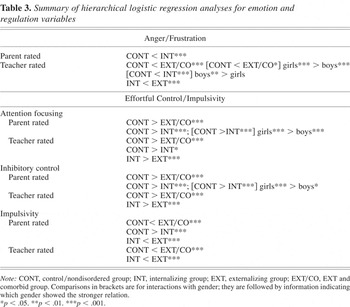
Many more first-order effects were obtained than would be expected by chance and nearly all (i.e., all but one) were significant at p < .001. Interactions with gender were less frequent and sometimes were somewhat weaker; thus, they may be less reliable (although a number were significant). The findings for girls and boys were typically in the same direction, but the magnitude of the relation was sometimes stronger for one gender than the other. A summary of the conclusions of these analyses with associated p values is presented in Table 3. We present unstandardized logistic regression coefficients, exact p and t values, odds ratios (ORs), and the 95% confidence interval on the ORs in the text.2
In logistic regression models the simple effect with a weaker OR may occasionally have a more significant t value because of differences in the standard errors that comprise the denominator of the t tests of the simple effects. The OR and its confidence interval should be used to interpret the strength of the simple slopes.
Summary of hierarchical logistic regression analyses for emotion and regulation variables

In all analyses predicting INT versus EXT status (ORs = .15–.24) and CONT versus EXT/CO status (ORs = .13–.25), but not CONT versus INT status, the first-order effects of gender were significant (ps < .001). Girls were prone to categorization in the INT rather than EXT, or the CONT rather than EXT/CO, groups. This finding is not repeated again in the presentation of the results below. When interactions with gender were significant, simple effects were computed with the procedures outlined by Cohen et al. (2003).
Anger
We tested three a priori hypotheses. First, we hypothesized that anger would have a positive relation with the EXT/CO versus CONT comparison. The first-order effect showed that anger had an overall positive relation with EXT/CO, regression coefficient = 1.08, t (472) = 5.94, p < .001, OR = 2.95 (2.07, 4.23). This first-order effect was qualified by a two-way interaction with gender, regression coefficient = .69, t (472) = 2.03, p = .043, OR = 2.00 (1.02, 3.92). The relation of anger with group status was significant for both genders, but somewhat stronger for girls than boys, regression coefficients = 1.43 and .74, ts = 4.56 and 4.52, ps < .001, ORs = 4.18 (2.26, 7.73) and 2.09 (1.52, 2.88), respectively. Second, we expected anger would have a small positive relation (favoring INT) with the CONT versus INT comparison. The first-order effect showed that parent-rated anger had a positive relation with INT, regression coefficient = .36, t = 6.26, p < .001, OR = 1.43 (1.28, 1.60). There was a two-way interaction between teacher-rated anger and child gender, but no first-order effect, in the prediction of CONT versus INT status, regression coefficient = −.30, t (490) = −3.48, p = .001, OR = .74 (.62, .88). Teacher-rated anger had a positive relation to INT for boys; regression coefficient for boys = 0.20, t (490) = 3.19, p = .002, OR = 1.22 (1.08, 1.39), whereas teacher-rated anger had a nonsignificant negative relation to INT for girls. Third, we predicted that anger would have a positive relation with the INT versus EXT comparison. Teacher-rated (but not parent-rated) anger had a positive relation with EXT, regression coefficient = 1.02, t (175) = 4.22, p < .001, OR = 2.76 (1.72, 4.44). Thus, as hypothesized, anger had a positive relation with EXT status relative to either INT or CONT status.
Effortful control (attention focusing and inhibitory control)
As predicted, CONT status rather than EXT/CO status was related to both parent-rated attention focusing and inhibitory control, as well as teacher-rated attention focusing and inhibitory control, regression coefficients = −.66, −.68, −1.35, and −1.78; ts = −4.15, −3.79, −6.65, and −7.91; ps < .001 (dfs = 484, 484, 483, and 480); ORs = .52 (.38, .71), .51 (.36, .72), .26 (.18, .39), and .17 (.11, .26). The interaction of teacher-rated attention focusing with gender was also significant for the CONT versus EXT/CO contrast, regression coefficient = −.96, t (483) = −2.42, p < .016, OR = .38, (.18, .84). Although significant for both genders, teacher-rated attention focusing was a stronger predictor of CONT (vs. EXT/CO) status for girls than boys, regression coefficients = −1.83 and −.87, ts (483) = −4.95 and −5.49, ps < .001, ORs = .16 (.08, .33) and .42 (.31, .57).
As hypothesized, parent-rated attention focusing and inhibitory control, as well as teacher-rated attention focusing, predicted CONT rather than INT status, regression coefficients = −.56, −.50, and −.10; ts = −10.58, −5.69, and −2.15 (dfs = 507, 506, and 506); ps < .001, < .001, and = .032; ORs = .57 (.51, .63), .60 (.54, .68), and .91 (.83, .99). There also were significant interactions of gender with parent-rated attention focusing and inhibitory control, regression coefficients = −.39 and −.63, ts = −3.68 and −5.46 (dfs = 507 and 506), ps < .001, ORs = .68 (.55, .83) and .53 (.42, .67). The aforementioned pattern of prediction was significant for both genders, albeit more so for girls: regression coefficients for girls' and boys' attention focusing = −.76 and −.37, ts (507) = −10.26 and −4.79, ps < .001, ORs = .47 (.41, .54) and .69 (.60, .81), and regression coefficients for inhibitory control = −.82 and −.19, ts (506) = −10.01 and −2.28, ps < .001 and = .023, ORs = .44 (.38, .52) and .83 (.71, .97). Last, teacher-reported attention focusing and inhibitory control related to INT rather than EXT status, regression coefficients = −1.02 and −1.63, ts = 4.78 and −15.94 (dfs = 180 and 181), ps < .001, ORs = .36 (.24, .55) and .20 (.16, .24). In summary, both parent- and teacher-reported effortful control were related to CONT rather than EXT/CO status; parent-reported attentional and behavioral control predicted CONT rather than INT status, and teacher-reported attentional and behavioral regulation were related to INT rather than EXT status.
Impulsivity (reactive undercontrol)
It was predicted that impulsivity would be associated with EXT/CO rather than CONT or INT status, and would also be associated with CONT versus INT status. Parents' reports and especially teachers' reports of impulsivity predicted EXT/CO versus CONT status, regression coefficients = .78 and 1.54, ts = 3.65 and 6.86 (dfs = 478 and 475), ps < .001, ORs = 2.18 (1.43, 3.31) and 4.67 (3.01, 7.27), respectively. In addition, parent-rated high impulsivity predicted CONT rather than INT status, regression coefficients = −.31, t = −4.78 (df = 500), p < .001, OR = .73 (.64, .83). Moreover, both parent- and teacher-rated impulsivity predicted EXT rather than INT status, regression coefficients = 1.19 and 1.44, ts = 3.99 and 5.00 (dfs = 180 and 180), ps < .001, OR = 3.30 (1.83, 5.96) and 4.21 (2.39, 7.43). Thus, externalizing status was most highly related to adults' reports of impulsivity, whereas parents' ratings of impulsivity were linked to INT versus CONT status.
Additive and multiplicative prediction of problem behavior groups from emotion and regulation
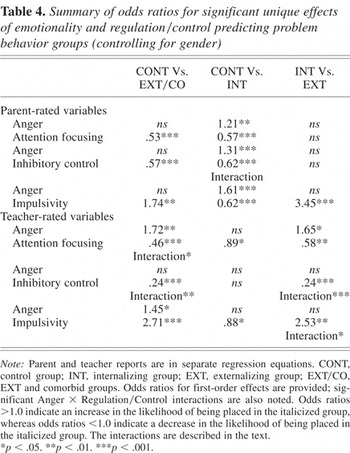
To examine whether anger and the regulation/control variables uniquely predicted children's problem behavior grouping and if anger interacted with measures of effortful control or impulsivity when predicting adjustment, hierarchical logistic regressions were conducted with HLM (clustered by classroom), separately for parent- and teacher-report data. The outcome variables were problem behavior group (examined separately for each of the three contrasts, CONT vs. EXT/CO, CONT vs. INT, and INT vs. EXT). Gender was entered as a covariate for partialling out, because in the first set of analyses, many significant gender effects were found. Thus, in each analysis, the first-order effects of gender, anger/frustration, and inhibitory control, attentional control, or impulsivity were entered into the analysis; in addition, the interaction of anger with the index of regulation/control was included. Thus, there were six pair of predictors and 18 hierarchical logistic regressions in total (six for each of three problem group contrasts). Out of the 18 hierarchical logistic regressions, there were significant interactions in five analyses, in addition to some unique first-order effects. A summary of the ORs and their significance are presented in Table 4.
Summary of odds ratios for significant unique effects of emotionality and regulation/control predicting problem behavior groups (controlling for gender)

Comparison of CONT and EXT/CO groups
In the analyses in which the predictors were parent-reported child temperament, both parent-reported attention focusing and inhibitory control predicted CONT status (in separate regressions) whereas impulsivity predicted EXT/CO rather than CONT status, regression coefficients = −.64, −.56, and .55, ts = −4.36, −3.40, and 3.02 (dfs = 482, 482, and 477), ps < .001, = .001, and < .003, ORs = .53 (.40, .71), .57 (.41, .79), and 1.74 (1.21, 2.49). In contrast, parent-reported anger/frustration did not have unique additive prediction when entered with any of the three regulation/control predictors. Moreover, the interactions between anger/frustration and the three regulation/control variables were not significant.
In contrast, in the analyses of teacher-reported temperament, there sometimes were additive effects of anger/frustration and regulation/impulsivity when predicting CONT versus EXT/CO status. In the regression including teacher-reported anger and attention focusing, high anger and low attention focusing each uniquely predicted EXT/CO status, regression coefficients = .54 and −.78, ts (470) = 3.17 and −4.85, ps = .002, ORs = 1.72 (1.23, 2.41) and .46 (.33, .63). Teacher-rated inhibitory control, but not anger, predicted CONT (vs. EXT/CO) status, regression coefficient = −1.41, t (465) = −6.85, p < .001, OR = .24 (.16, .37). Both teacher-reported anger and impulsivity uniquely predicted EXT/CO (vs. CONT) status, regression coefficients = .37 and 1.00 (df = 461), ps = .033 and < .001, ORs = 1.45 (1.03, 2.05) and 2.71 (.80, 4. 09). Thus, additive effects were found for teacher-reported anger with teacher-reported attention focusing or impulsivity.
Moreover, the interactions of teacher-reported anger/frustration with attention focusing and inhibitory control were significant, regression coefficients = −.30 and −.48, ts = −2.25 and −2.94 (dfs = 470 and 465), ps = .025 and .004, ORs = .74 (.57, .96) and .62 (.45, .85). The prediction of CONT (vs. EXT/CO) status by attention focusing was stronger at higher levels of anger, regression coefficients for high (1 SD above the mean), mean, and low (1 SD below the mean) anger = −1.11, −.78, and −.46; ts (470) = −5.69, −4.85, and −1.93; ps < .001, .001, and .054; ORs = .33 (.22, .48), .46 (.33, .63), and .63 (.40, 1.01). Similarly, the relation of inhibitory control to CONT (vs. EXT/CO) status was stronger at higher than at lower levels of anger, regression coefficients for high, mean, and low levels of anger = −1.93, −1.41, and −.88; ts = −7.07, −6.85, and −3.26 (dfs = 465); ps < .001, .001, and = .002; ORs = .14 (.08, .25), .24 (.16, .37), and .41 (.24, .70).
In summary, high effortful control or low impulsivity, in comparison to anger, were more consistently unique predictors of status as a CONT versus EXT/CO child, although teacher-reported anger sometimes was also a unique additive predictor. In addition, the differentiation of these two groups by teacher-rated attention focusing and inhibitory control was stronger for children high in anger.
CONT versus INT groups
In the analyses of parents' reports of anger/frustration and regulation/control, both anger/frustration and regulation/control uniquely differentiated CONT from INT children. High anger and low attention focusing jointly and uniquely predicted INT (vs. CONT) status, regression coefficients = .19 and −.56, ts = 3.14 and −10.10 (dfs = 504), ps = .002 and < .001, ORs = 1.21 (1.07, 1.36) and .57 (.51, .64). Similarly, high anger and low inhibitory control predicted INT versus CONT status, regression coefficients = .27 and −.48, ts (504) 4.56 and −8.02, ps < .001, ORs = 1.31 (1.17, 1.47) and .62 (.55, .70). Moreover, high anger and low impulsivity uniquely predicted INT versus CONT status, regression coefficients = .48 and −.47, ts (499) = 7.78 and −6.84, ps < .001, ORs = 1.61 (1.43, 1.82) and .62 (.54, .71). In addition, the interaction between parent-reported anger/frustration and inhibitory control was significant, regression coefficient = .24, t = (504) 3.20, p = .002, OR = 1.27 (1.10, 1.47). Although prediction was significant at all levels of anger, as anger decreased, inhibitory control was a better differentiator of CONT versus INT status: regression coefficients for high, mean, and low anger = −.29, −.48, and −.67; ts (504) = −.3.72, −8.02, and −7.50, ps < .001; ORs = .75 (.64, .87), .62 (.55, .70), and .51 (.43, .61). Thus, inhibitory control was related to CONT rather than INT status regardless of the level of children's anger, although this relation was stronger when children were lower in anger.
When teacher reports of anger/frustration and regulation/control were the predictors of CONT versus INT status, attention focusing or impulsivity was higher for CONT than INT children, regression coefficients = −.12 and −.13, ts = −2.37 and −1.96 (dfs = 487 and 477), p < .018 and = .05, ORs = .89 (.80, .98) and .88 (.77, 1.00), whereas anger was not a unique predictor of CONT versus INT status. The interactions of anger with inhibitory control, attention focusing, or impulsivity were not significant.
Thus, parent-reported anger/frustration and effortful control or impulsivity uniquely predicted CONT versus INT status, whereas only teacher-reported effortful control and impulsivity (rather than anger) were unique predictors of INT versus CONT status. Differentiation between the two groups based on inhibitory control was somewhat stronger when children were low in anger.
INT versus EXT groups
Neither parents' reports of anger nor measures of regulation (i.e., attention focusing or inhibitory control) uniquely differentiated between INT and EXT groups. Parent-reported impulsivity (but not anger) was a predictor of EXT rather than INT status, regression coefficient = 1.24, t (179) = 4.26, p < .001, OR = 3.45 (1.95, 6.13). In contrast, teacher-reported high anger and low attention focusing were unique, additive predictors of EXT (vs. INT) status, regression coefficients = .50 and −.54, ts = (173) 2.01 and −2.61, ps = .045 and .01, ORs = 1.65 (1.01, 2.70) and .58 (.39, .88). However, in analyses of teachers' reports of anger/frustration and inhibitory control together, or anger frustration and impulsivity together, anger was not a unique predictor whereas both low inhibitory control and high impulsivity were significant predictors of EXT rather than INT status, regression coefficients = −1.44 and .92, ts = −13.28 and 3.20 (dfs = 173 and 172), ps < . 001 and = .002, ORs = .24 (.19, .29) and 2.53 (1.43, 4.48).
Moreover, the interactions of teacher-reported anger with both inhibitory control and with impulsivity were significant, regression coefficients = −.61 and .56, ts = −6.29 and 2.32 (dfs = 173 and 172), ps < .001 and .021, ORs = .54 (.45, .66) and 1.76 (1.09, 2.84). Although differentiation between groups was significant at all levels of anger, inhibitory control was a stronger predictor of INT versus EXT status at high levels of anger: regression coefficients for high, mean, and low anger = −2.11, −1.44, and −.78; ts (173) = −13.79, −13.18, and −5.17; ps < .001; ORs = .12 (.09, .16), .24 (.19, .29), and .46 (.34, .62). Similarly, impulsivity was a stronger differentiator of EXT than INT status for children higher in anger. Impulsivity was a significant predictor of group status at high and mean, but not low, levels of anger: regression coefficients = 1.54, .93, and .31; ts (172) = 4.10, 3.20, and 0.77; ps < .001, = .002, and ns; ORs = 4.68 (2.23, 9.83), 2.53 (1.43, 4.48), and 1.37 (.61, 3.05).
In summary, parent-reported impulsivity, but not anger or effortful control, provided unique prediction of EXT (vs. INT) status. Teacher-reported regulation/control was more often a unique predictor of EXT versus INT status, although anger sometimes provided additional prediction. Moreover, high impulsivity and low inhibitory control were stronger predictors of EXT (versus INT) status for children prone to anger.
Unique prediction of adjustment by impulsivity (reaction undercontrol) and effortful control
In a final set of analyses, we examined if impulsivity (an index of reactive control) and effortful control provided unique contributions to the prediction of adjustment, despite the substantial negative correlations between the two constructs. In these analyses, we combined the two indices of effortful control (inhibitory control and attention focusing) within reporter to reduce the number of analyses (and because the two indices usually related in similar ways to adjustment). Thus, we computed six regressions, three (comparing CONT vs. EXT/CO, CONT vs. INT, and INT vs. EXT groupings) in which parents' reports of reactive and effortful control were the predictors and three in which teachers' reports of these variables were predictors of adjustment. In each analysis, gender was entered as a covariate because in the first set of analyses the first-order effect of gender frequently was significant.
Teachers' reports of both effortful control and low impulsivity were unique predictors of CONT versus EXT/CO status, regression coefficients = −1.26 and .82, respectively, ts (469) = −6.51 and 3.86, ps < .001, ORs = .28 (.19, .41) and 2.28 (1.50, 3.47). In contrast, for parents' reports, only effortful control was a unique predictor of being a CONT (rather than EXT/CO) child, regression coefficient = −.61 (df = 477), p < .001, OR = .54 (.38, .77) (p < .10 for impulsivity).
For both parents' and teachers' reports, both high effortful control and high impulsivity were significant predictors of CONT versus INT status, regression coefficients for effortful control = −.99 and −.14, ts = −14.00 and −2.44 (dfs = 499 and 489), ps < .001 and = .015, ORs = .37 (.32, .43) and .87 (.77, .97), and regression coefficients for impulsivity = −.68 and −.17, ts = −9.62 and −2.52, ps < .001 and .012, ORs = .50 (.44, .58) and .85 (.75, .96). Finally, when predicting INT versus EXT status, teachers' reports of both high effortful control and low impulsivity uniquely predicted INT status, regression coefficients = −1.13 and .83, respectively, ts (177) = −11.44 and 7.97, ps < .001, ORs = .32 (.26, .39) and 2.30 (1.87, 2.82). In contrast, only parents' reports of low impulsivity uniquely predicted INT rather than EXT status, regression coefficient = 1.16, t (180) = 4.01, p < .001, OR = 3.20 (1.81, 5.66).
Thus, in four of six equations, effortful control and impulsivity were unique predictors of adjustment when entered simultaneously. Specifically, additive unique prediction was found for both reporters when differentiating CONT from INT children, but only for teachers when differentiating CONTs from EXT/COs or INTs from EXTs.
Discussion
To our knowledge, there is virtually no existing research on the relation of effortful control and anger to different types of adjustment problems, especially internalizing symptoms, in China. Moreover, this is one of the few studies to examine the unique relations of effortful control and anger outside of North America in the prediction of adjustment outside the United States (see, however, Zhou et al., 2004). Our results indicate that Chinese children's adjustment is related to anger, effortful control, and impulsivity in ways that are, for the most part, similar to in the United States. However, some findings differ somewhat from prior data obtained in the United States, suggesting that there may be some interesting cross-national differences, especially in regard to internalizing problems.
When comparing children with externalizing problems (including mostly pure externalizers, but also a few comorbid children) with control children, externalizing status was predicted by low attentional and inhibitory control and high anger. This finding is similar to data in the United States (Eisenberg, Cumberland, et al., 2001), and is consistent with findings for broader measures of social functioning in China (Zhou et al., 2004) and Indonesia (Eisenberg, Pidada, & Liew, 2001). In addition, externalizing status was predicted by impulsivity. This pattern held for parents' and teachers' reports on all three indices of effortful/reactive control, and for teacher-reported anger/frustration. Thus, there is growing evidence across cultures that externalizing problems are associated with a lack of effortful control, high impulsivity, and anger that is expressed overtly. Difficulty controlling attentional processes that are important for managing negative emotions and overt behavior seems to predict externalizing problems.
Generally effortful control or impulsivity was a stronger single and unique predictor of externalizing status than was anger/frustration, although anger sometimes provided additional unique prediction of externalizing problems. Thus, dispositional anger may be a less important predictor of adjustment than if children have the regulatory capacities needed to control the expression of anger. Moreover, although teacher-reported high effortful control generally decreased the probability of being in the externalizing versus the nondisordered group, this was especially true for children prone to anger. Thus, a disposition toward anger/frustration at school increased the importance of effortful control (but not impulsivity) as a buffer against externalizing problems. This finding is consistent with data in the United States indicating that regulation is a stronger predictor of children's adjustment for those children prone to dysregulating negative emotions (e.g., Colder & Stice, 1998; Diener & Kim, 2004; Eisenberg et al., 2004; Valiente et al., 2003; also see Stifter, Spinrad, & Braungart-Rieker, 1999). Thus, there is mounting evidence that children who are at risk because of their emotionality tend to benefit more than less emotional peers from well-developed regulatory capacities. This finding has implications for the effectiveness of interventions designed to enhance children's adjustment by fostering emotion-related regulation: such interventions are most likely to be effective for children prone to experience negative emotions, and may be less effective for children whose externalizing problems are more proactive and goal-oriented.
INT status, compared to nondisordered status, was predicted by reports of high anger proneness by parents and teachers (the latter only for boys), as well as low attentional and/or behavioral regulation. INT versus CONT status was also related to low parent-reported impulsivity. In addition, in INT versus EXT comparisons, internalizing status was related to low levels of teacher-rated anger and parent- and teacher-rated impulsivity, and high levels of teacher-rated attention focusing and inhibitory control. Anger and effortful control or impulsivity both provided some unique prediction of parent-reported INT versus CONT status, whereas effortful control or impulsivity was a stronger unique predictor than anger of teacher-reported INT versus CONT status. In terms of moderation, inhibitory control was a stronger predictor of CONT versus INT status for children lower in anger, although the relation held in both groups. Because this was the only interaction of anger with regulation/control when predicting control versus internalizing status, it may not be a reliable finding. However, it is possible that nondisordered children who are high in anger are lower on inhibitory control (and, thus, more like INT children) because their anger sometimes evokes impulsive action.
The positive relation between anger and internalizing problems is similar to that found in a sample of children of approximately the same mean age in the United States (Eisenberg et al., 2005). Because internalizing children are likely to encounter problems in early elementary school, by the second grade they may often experience anger as a consequence of the quality or quantity of their social interactions (Rubin et al., 1998). It is also possible that children with anxiety or depressive symptoms experience some self-directed anger because of feelings of inadequacy.
In the United States, there was no association between internalizing problems and low inhibitory control or attentional control when the children were a mean age of 8 years (Eisenberg et al., 2005), although low attentional (but not inhibitory) control has been associated with shyness among younger school children (Eisenberg, Cumberland, et al., 2001) and adults in the United States (Eisenberg et al., 1995). Perhaps Chinese parents are more aware than American parents that their children's internalizing problems often reflect a lack of control over those attentional processes used to modulate anxiety and depression (e.g., Derryberry & Reed, 2002). Youth with anxiety and/or depressive symptoms are prone to rumination, use ineffective coping strategies, and likely have difficulty redirecting their attention from disturbing thoughts (Schniering & Rapee, 2004; Silk et al., 2003; Vasey et al., 1996). Moreover, it is possible that depression and anxiety are more strongly linked to deficits in effortful control, especially attentional control, than is social withdrawal (which can occur for a variety of reasons). Although the measure used in this study included a few items related to social withdrawal and loneliness, Eisenberg and her colleagues (Eisenberg, Cumberland, et al., 2001; Eisenberg et al., 2005) included more items on social withdrawal in the internalizing scale than was true in this study. It would be useful in the future to determine if social withdrawal (especially based on social anxiety or behavioral inhibition) relates differently to effortful control than do symptoms of anxiety and depression.
The fact that both impulsivity and effortful control often provided some unique prediction of problem behavior groups (in four out of six analyses) is consistent with the argument that effortful control and reactive undercontrol (i.e., impulsivity) are not the same construct, although they are substantially negatively correlated within reporter. This is, to our knowledge, the first time that the unique prediction of these two aspects of control has been examined outside the United States. Additive unique effects when predicting adjustment from these two constructs were most consistent for differentiating nondisordered from internalizing children, and it appeared that controlling for the low level of impulsivity associated with pure internalizing status increased the evidence of internalizers' low effortful control. Because internalizers tend to be so inhibited, they may appear voluntarily controlled when they are not. It appears that teachers, in particular, were adept at differentiating between the two constructs and in using both to differentiate children in regard to their adjustment.
Parents' reports of effortful control, impulsivity, and anger were more likely to differentiate internalizing children from nondisordered children, whereas teachers' reports on the same constructs were more likely to differentiate internalizing children from externalizing children. In this study, because of the need to reduce the load on parents and teachers, only parents reported on children's internalizing problems whereas only teachers and peers reported on externalizing problems. Both parents' reports of internalizing and teachers' (and peers') reports of externalizing were used to classify children as nondisordered. Parents' and teachers' reports of internalizing problems usually are, at best weakly related (Eisenberg, Cumberland, et al., 2001; Stanger & Lewis, 1993; Verhulst & Akkerhuis, 1989). Thus, perhaps it is not surprising that parents' reports of effortful control, impulsivity, and anger were most likely to differentiate between the two groups for which their input contributed to the classification of problem groupings (internalizing and nondisordered), although teachers also differentiated between these two groups when reporting on anger (only for boys) and attention focusing. Moreover, because only teachers and peers at school provided the measure of externalizing problems, teachers may have been in a better position to report on the correlates of externalizing in this sample. Note, however, that despite the fact that parents did not rate children on externalizing problems, both parents and teachers clearly viewed externalizers, in comparison to nondisordered children, as more likely to be low in effortful control and high in impulsivity. This strong concurrence probably was obtained because teachers and parents tend to agree on the level of children's externalizing problems (e.g., Eisenberg, Cumberland, et al., 2001) and because externalizers' impulsivity and lack of regulation are more observable than internalizers' depression and anxiety.
An interesting finding in the present study was the low incidence of children who were high in both internalizing and externalizing problems, a finding that differs considerably from the high rate of comorbidity found in the United States. Chen et al. (1995) found that boys', but not girls', depressive symptoms were linked with high levels of externalizing problems, but they had only 12 boys in their depressive group. In a study of preschoolers, Chen and Jiang (2002) found that only 10% of their sample was high in both externalizing and internalizing symptoms, whereas rates of purer externalizing or internalizing symptoms were 29 and 11%, respectively. Perhaps because of the strong sanctions for the expression of externalizing emotions and acting out behavior, children with internalizing symptoms tend not to act on their anger. The fact that anger usually was not a unique predictor of children's adjustment in our sample is consistent with this possibility. In future work, it would be useful to conduct cross-cultural comparisons of comorbidity rates for children's depressive/anxious symptoms and externalizing problems and factors that affect such comorbidity.
In summary, the findings in this study extend our understanding of the relations of effortful control, impulsivity, and anger/frustration to adjustment in a non-Western culture. Strengths of the study include the broad and inclusive sample (including a large number of rural and urban children), the fact that the sample was non-Western, and the use of three types of reporters to obtain data. Weaknesses include the fact that internalizing was assessed solely with parents' reports, whereas externalizing problems were rated solely at school (by teachers and peers). In future work, it would be useful to study older children, to assess more types of negative emotion, and to collect longitudinal and behavioral data on effortful control, reactive control, and negative emotionality and their relations to children's adjustment in diverse cultures.