

INTRODUCTION
NGOs and governments recognize that durable domestic support is a necessary linchpin of a sustainable national foreign aid program (International Development Committee, 2009; Stern, Reference Stern1998). Polls consistently show that citizen support for increasing their nation’s foreign aid outlays is low, but more systematic research finds that the answers people provide is susceptible to question framing and wording (Hudson and vanHeerde-Hudson, 2013). The ways in which aid recipients are portrayed also affects the public’s generosity and can stimulate paternalism (Baker, Reference Baker2015). A further reason citizens may be reluctant to increase aid spending is that they over-estimate the percentage of the budget allocated to foreign aid (Gilens, Reference Gilens2001). For example, both Americans and British believe foreign aid constitutes a large portion of the budget, 28% (Klein, Reference Klein2013) and 18% (vanHeerde-Hudson, Reference van Heerde and Hudson2014), respectively.
The impact of citizens’ misperceptions of aid spending may be compounded by innumeracy—the inability to process and deal with quantitative information (Peters, Reference Peters2006). This problem is not unique to foreign aid. A recent survey by Ipsos MORI (2015) shows the British public overestimate the percentage of wealth owned by the top 1% at 59% (actual 23%), underestimate the percentage of obese adults at 44% (actual 62%), and overestimate the percentage of the population that are immigrants at 25% (actual 13%). Innumeracy, or what Gigerenzer (2008) terms “collective statistical illiteracy,” includes the inability to understand risk, probabilities, or estimate the size of sub-groups in society (e.g., African Americans, Jews, and immigrants) (Alba et al., Reference Alba, Rumbaut and Marotz2005; Citrin and Sides, Reference Citrin and Sides2008). In addition, Kahan et al. (Reference Kahan, Peters, Dawson and Slovic2013) show that innumeracy can itself be a function of directionally motivated reasoning.
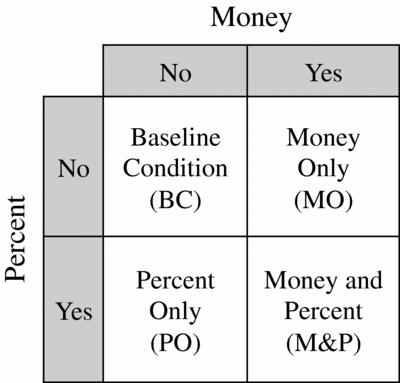
Previous research has demonstrated the consequences of misperceptions (Gilens, Reference Gilens2001; Kuklinski et al., Reference Kuklinski, Quirk, Jerit, Schwieder and Rich2000) and difficulties in correcting them (Nyhan and Reifler, Reference Nyhan and Reifler2010). We extend recent work on the consequences of political innumeracy (Lawrence and Sides, Reference Lawrence and Sides2014; Mérola and Hitt, Reference Mérola and Hitt2015) using a framing experiment where we directly test the notion that large numbers that lie outside people’s everyday experience (millions and billions), adversely affect support for foreign aid. More specifically, we examine the effect of presenting the foreign aid budget in absolute amounts versus as a percentage of the budget or both (see Figure 1). Our results show that presenting aid spending as a percentage of the national budget reduces the demand to cut aid spending.
Experimental Design: Factorial Presentation of Budget Numbers

We examine the United States and the United Kingdom because they are the largest donors in the world, committing US$33.1 billion and US$19.3 billion respectively in official development assistance (OECD, 2016). The United Kingdom has doubled the proportion of national income it spends on foreign aid to become only the seventh country to meet the long-standing United Nations target of spending 0.7% of Gross National Income (GNI) on aid (Pearson, Reference Pearson1969). The United States is one of the least generous donors, sitting between Estonia and Spain, spending just 0.19% of GNI.
DATA, SURVEY, AND EXPERIMENTAL DESIGN
In February 2013, a matched quota sample of 1,010 British and 1,990 U.S. respondents received a YouGov online survey designed to measure individual attitudes on a host of foreign and domestic policy issues. Respondents were randomly assigned to one of four treatment conditions:
-
• Baseline Condition (BC): Thinking about the amount of money the British (U.S.) government spends on overseas aid, do you think the amount is too little, too much, or about right?
-
• Money Only (MO): Thinking about the 10.4 billion pounds (38 billion dollars) the British (U.S.) government spends on overseas aid, do you think this amount is too little, too much, or about right?
-
• Percent Only (PO): Thinking about the 0.7% (1%) of the budget the British (U.S.) government spends on overseas aid, do you think this amount is too little, too much, or about right?
-
• Money and Percent (M&P): Thinking about the 10.4 billion pounds (38 billion dollars)—or 0.7% (1%) of the budget—the British (U.S.) government spends on overseas aid, do you think this amount is too little, too much, or about right?
Subjects receive the experiment in the closing portion of the survey.Footnote 1 Prior to exposure to treatment, respondents were asked about: their partisan identification; their position on an 11-point left-right ideology scale; retrospective and prospective economic evaluations; the instrumental value of foreign aid; and whether government should do more to promote income equality. In addition to these pre-treatment attitudinal variables, our models include basic demographics—the respondents’ age, gender, and religious status—as controls in the multivariate analyses below.Footnote 2
EXPERIMENTAL RESULTS
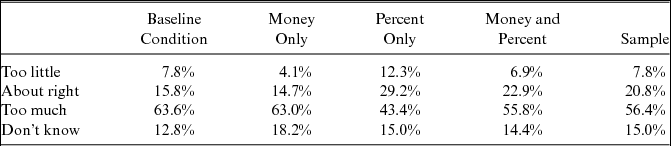
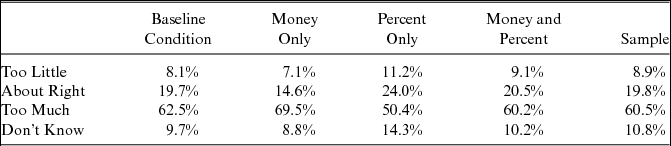
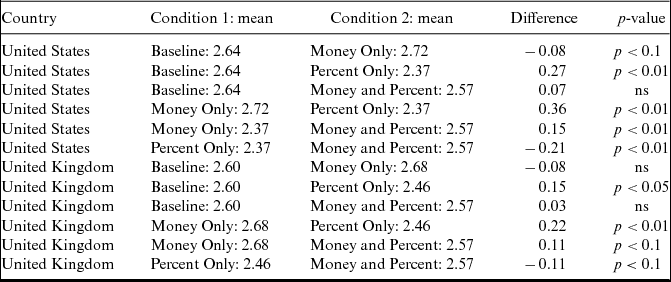
As can be seen in Tables 1 and 2, there is majority belief that government spends too much on foreign aid (except the “Percent Only” (PO) condition in the United States, where merely a plurality believes this). However, response distributions differ significantly across treatment conditions. The most dramatic difference occurs for the PO treatment compared to the “Baseline Condition” (BC)—those saying “too much” is spent on aid falls from 63.6% to 43.4% in the United States and from 62.5% to 50.4% in Britain. The full set of pairwise comparisons across treatment groups using t-tests is presented in Table 3.
Preferences for Foreign Aid Spending by Treatment—United States
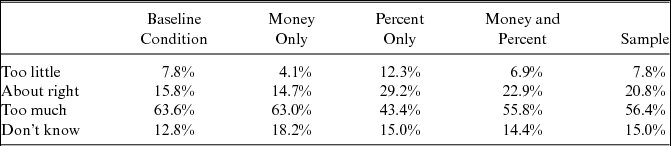
Notes: N = 1, 990; χ2 = 81.60, df = 9; p < 0.001.
Preferences for Foreign Aid Spending by Treatment—Britain
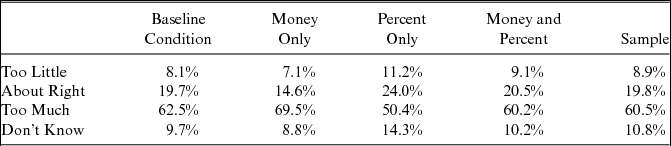
Notes: N = 1, 010; χ2 = 20.23, df = 9; p < 0.05.
Pairwise Comparison t-tests of All Experimental Conditions
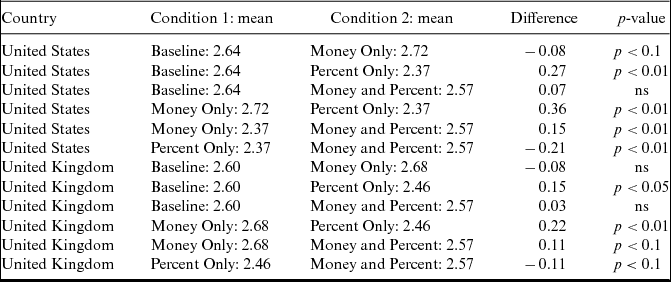
Two sided p-values using unweighted data. Dependent variable coded so that 1=“Too little”, 2=“About right”, and 3=“Too much”. Respondents who answered “Don’t know” were recoded to missing.
Interestingly, the “Money and Percent (M&P)” treatment creates a distribution right in the middle between the “Money Only” (MO) and PO treatments. In Britain, the percentage of those believing the nation spends “too much” on overseas aid in the M&O treatment (60.2%) sits perfectly between the percentage of respondents in the MO (69.5%) and PO (50.4%) treatments. In the United States, a far greater proportion of Americans in the M&P treatment come to see aid spending as “about right” and slightly more who receive this frame believe the United States spends “too little” on aid than in the MO treatment (although in United States the M&P treatment percentages are not quite as perfectly between the MO and PO treatments).
MULTIVARIATE ANALYSES
To test the robustness of these findings, we look at two further questions: (A) Are the treatment effects robust to adding a select set of predictors of support for aid? In other words, does adding other things that we know predict support for aid “crowd out” the effect of our treatments? And (B) Do the treatment effects work uniformly across different segments of the public? To be more precise, we expect that the treatment effects would be greater for the sub-group of people who are predisposed toward the benefits of aid, the importance of redistribution, and are optimistic about their economic situation.
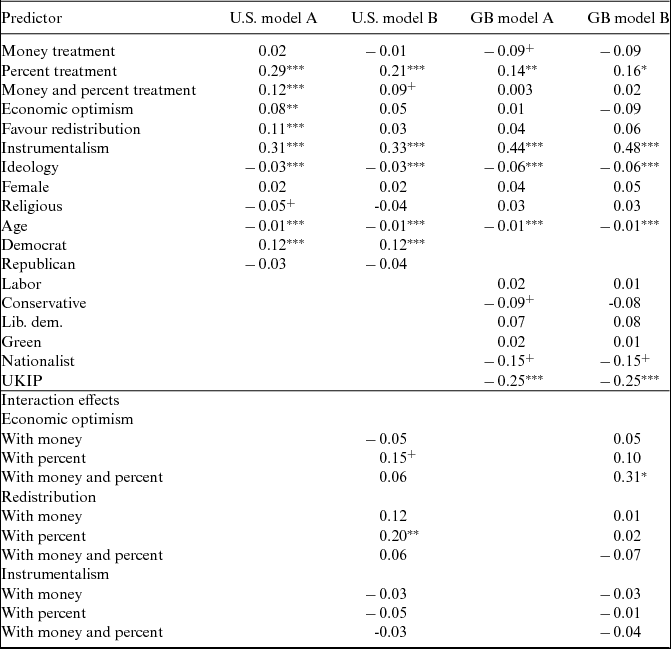
We run a probit model using a dichotomous dependent variable that splits the sample into those who believe their nation spends “too much” on foreign aid (0) and those who feel otherwise (1). As for the right hand side of the model, we created a control variable called instrumentalism that measures respondents’ beliefs about the instrumental value of foreign aid: whether aid strengthens U.S./Great Britain (GB) political influence and helps to prevent international terrorism.Footnote 3 Table 4 contains marginal effects from two separate probit estimations for each country.
Marginal Effects—Sources of Support for Overseas Aid—United States and Great Britain (GB)
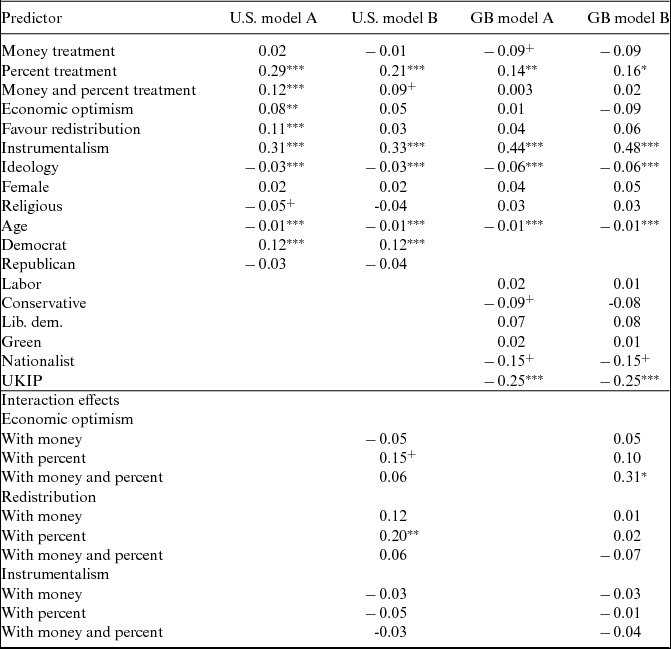
Notes: *** = p < 0.001; ** = p < 0.01; * = p < 0.05; + = p < 0.10.
Model A reports the increase in probability of not believing the nation spends “too much” on foreign aid that comes about with the single unit change in dichotomous co-variates. Both GB and U.S. respondents who receive the PO only treatment have a significantly higher probability of moving away from the belief that their nation spends “too much” on aid. In the United States, receiving the PO treatment results in 29 percentage point change; only the shift from scoring low (0) to high (1) on the instrumentalism control has a stronger effect at making typical respondents warm toward aid spending. In Britain, the PO treatment results in a 14 percentage point change. This effect is outweighed only by foreign policy instrumentalism or by identifying with UKIP or regional parties (Plaid Cymru/SNP).
Other comparisons demonstrate the power of the PO treatment. In the United States, it takes extreme changes in a respondent’s ideology (moving the full distance of the 11 point scale from 10 [conservative] to liberal [0]) to exceed the effect of the PO treatment. In a similar vein, a respondent has to move from an advanced age (over 80) to a young voter just over 18 to show the decrease in propensity to believe that United States was overspending on aid that occurs with a shift from the BC to PO treatment.
In Model B, we examine the second question of whether the treatments have differential effects on those respondents who have a more instrumentalist view of aid, have positive economic evaluations, and support redistribution. To do so, we add interactions between these variables and the treatments to Model A. The stand-alone marginal effect of the PO treatment remains quite strong in the United States (21%) and is slightly larger in the GB model with interactions (16%) than in the model without (14%). What most stands out is the fact that Americans with particular characteristics respond very strongly to the PO treatment. On top of the 21% increase in probability in moving away from favoring aid reductions that come simply from receiving the treatment, Americans who feel good about their personal finances and receive the PO treatment see another 15% decline in their demand for aid cuts. Americans who receive the PO treatments and believe governments should promote income equality see an even larger 20% decline in opposition to overseas aid.
Model B for Great Britain suggests that support among all respondents will improve if British citizens are made aware of how small of portion of budget foreign aid is. However, by-and-large, there are not interactions between the treatments and the co-variates. Unlike the U.S. case, those favoring economic redistribution or who are economic optimists are no more likely to be leery of aid cuts when they receive the PO treatments.Footnote 4
To summarize, we find that the treatment effects for the PO treatment hold in both countries (Question A above). Plus, we find that an instrumentalist belief in the benefits of aid also makes people warm toward aid spending. U.S. respondents that are optimistic about their economic situation or support redistribution are more receptive to the PO treatment. However, no such heterogeneous effects exist in the United Kingdom (Question B above).
CONCLUSION
Relative to everyday purchases, the raw amounts of foreign aid expenditures appear enormous. Any way you slice it, “billions” is a lot of money. Our findings suggest that these large numbers render the public cool toward their nation’s levels of overseas aid expenditure. And, those in the media with an agenda opposed to aid further throw ice on the public mood by noting the inefficiencies in these large expenditures.Footnote 5
Results from the above experiment suggest that it is possible to shift people’s scepticism toward aid spending by presenting the percentage of the UK and U.S. budgets allocated to foreign aid.Footnote 6 The observed reduction in citizen demands to cut foreign aid when only percentages of budgets are mentioned remains after adding controls for some common correlates of foreign aid to multivariate models.
However, it is only in the United States that mentioning the low percentage spend in the presence of dollar amounts where we see reduced support for aid cuts relative to the baseline or MO conditions. The cross-national difference in the effect of the M&P treatment is not the only finding that differs across countries. Agree–disagree responses to the two questions that comprise the “instrumentalist” index show that Americans are more instrumentalist in their attitudes towards aid, but the effect of instrumentalism is stronger in the analyses that utilize respondents from the United Kingdom.
We have shown that in the United States the effect of showing the percentage figure is stronger for those people who are in favor of redistribution and being optimistic about their economic situation. However, there is no such heterogeneous treatment effect in Britain. This is a possible indication that attitudes are more inflexible in Britain. Our inference is that this may well be a function of the smaller misperceptions about the aid budget that exist in Britain. Extrapolating this finding suggests that the treatment effect of communicating the percentage of the budget spent on aid will probably be most effective in countries where misperceptions are largest (see Eurobarometer, 2003 for comparative EU data), but it may also be the case that this works at the individual level too. Or it may be the case that high estimates of the budget themselves reflect underlying negative attitudes toward aid. Future work will need to tease out the causal direction of attitudes, information, and support.
Finally, future research should consider the means by which innumeracy can be addressed. In the case of foreign aid, bringing public perceptions in line with actual government outlays is valuable in and of itself, particularly in light of concerns over low levels of citizens’ knowledge and the consequences innumeracy has for democratic representation. However, the big numbers problem—the billions spent on aid—still serves to skew judgments on the appropriate level of aid spending. There are a few remedies on hand to address innumeracy. Wegwarth (Reference Wegwarth2013) advocates national statistical literacy campaigns, but a more likely and potentially successful approach may involve moving away from “large numbers” and toward representations that are more intuitive for citizens with limited numeric skills. Here, we have shown that presenting foreign aid as a percentage of the national budget is effective. Future work should explore visual as well as numerical presentations of budget information or more frequentist statements, i.e., one penny of every dollar is spent on foreign aid (Gigerenzer and Edwards, Reference Gigerenzer and Edwards2003).
SUPPLEMENTARY MATERIALS
The appendix is available online as supplementary material at https://doi.org/10.1017/XPS.2017.6