Introduction
Tourette syndrome (TS) is a childhood-onset neuropsychiatric disorder characterized by motor and phonic tics, 1 with tic severity and frequency often waxing and waning over time.Reference Singer 2 TS affects approximately 1% of school-age children and is associated with significant emotional, social, behavioral, and academic problems.Reference Knight, Steeves, Day, Lowerison, Jette and Pringsheim 3 -Reference Pringsheim, Okun and Muller-Vahl 5
The guiding principle of TS management in children is to normalize and prevent the effects of tics on various psychological domains, including self-esteem, physical and mental health, relationships, and learning.Reference Waldon, Hill, Termine, Balottin and Cavanna 6 This is generally accomplished with pharmacotherapies, behavioral therapies, or a combination of these approaches. Although tic reduction can contribute to desired outcomes, tic elimination is not a goal of treatment.
Pharmacotherapy has historically been considered the first-line treatment for TS; however, it is not effective for all patients, and its use can be limited because of unwanted side effects.Reference Thomas and Cavanna 7 Antipsychotic medications in particular, which have been used to control tics for decades, are associated with significant adverse effects, including movement disorders and metabolic alterations. Furthermore, few randomized controlled trials have evaluated the efficacy of drugs for TS. Recommendations are often based on case reports and open-label trials and many agents are used off-label.Reference Quezada and Coffman 8 , Reference Capriotti, Himle and Woods 9 As a result, there has been increased interest in nonpharmacological approaches for tic management and new therapies from other drug classes.Reference McGuire, Piacentini and Brennan 10
Behavioral therapy has demonstrated moderate treatment effects compared with controls in patients with TS.Reference Andren, Aspvall and de la Cruz 11 However, as with pharmacotherapy, there are challenges associated with this management approach. For example, the use of habit-reversal training—the mainstay of behavioral therapy for TS—is limited by a lack of routine insurance coverage and shortage of well-trained therapists, although internet-delivered therapy is a promising way to address challenges related to patient location.Reference Robertson 12
Comorbid psychiatric conditions, including attention-deficit/hyperactivity disorder (ADHD) and obsessive-compulsive disorder (OCD), are common among children with TS. This can pose a diagnostic challenge as well as exacerbate the problems resulting from TS,Reference Debes, Hjalgrim and Skov 13 which can further complicate TS management. Compared with children who do not have comorbid mental health disease, those with ADHD or OCD receive more pharmacotherapy and a greater number of agents for tic control.Reference Cuenca, Glazebrook and Kendall 14
The dynamics of TS and issues related to its treatment present a range of management challenges for physicians. It is largely unknown how physicians make treatment decisions in TS and how their attitudes, knowledge, and beliefs impact their approach. Furthermore, previous studies indicate a general opinion among individuals with TS and their parents that physicians lack an accurate understanding of TS and its treatment,Reference Ludlow, Brown and Schulz 15 , Reference Hollis, Pennant and Cuenca 16 although the reasons for this perception are not fully understood.
The purpose of this study was to gain an understanding of the current practice paradigm of U.S.–-based physicians in TS management and to compile associated gaps that may be addressed by future education directed at both clinicians and families of patients with TS.
Methods
Survey development
A survey instrument was developed to collect data on physician TS management, perceptions, and attitudes. The survey applied clinical vignettes to assess and quantify practice patterns. These cases and associated questions were developed through consultation with a board-certified psychiatrist TS expert. The survey underwent pilot testing with 2 neurologists and 1 psychiatrist. Question formats included multiple choice, 5-point rating scale, ranking, and text response.
The clinical patient case vignettes included a case of an 8-year-old girl with ADHD who presented with findings meeting Diagnostic and Statistical Manual of Mental Disorders, 5th Edition (DSM-5) criteria for TS and a case of a 16-year-old boy with poorly controlled TS and mood symptoms. The cases were progressed several times to provide details of clinical findings and functioning, with each progression accompanied by questions about management and clinical decision-making (Cases 1 and 2 in the Supplementary Materials).
To further evaluate physician management of TS from the patient and caregiver perspective, the clinician survey (along with a published study on TS patients/caregiversReference Rivera-Navarro, Cubo and Almazan 17) was adapted to target parents of children with TS. This survey focused on the details of their child’s diagnosis, treatment received, and perceptions regarding management. After undergoing internal testing, the caregiver survey was launched slowly to allow for modification, if needed.
This study received institutional review board exemption from Western Institutional Review Board (Puyallup, WA) on April 12, 2019.
Data collection
Data were collected in April and May 2019. Email invitations to participate in the survey were sent to neurologists and psychiatrists who have participated in continuing medical education research with CE Outcomes, with inclusion criteria ensuring that each respondent managed pediatric patients on a weekly basis and saw at least 5 patients with TS per month. Family caregivers were recruited with newsletter and message board advertisements directed to state TS chapters, and online support groups and caregiver forums. Caregivers were required to be at least 21 years of age and the parent of patient with TS who was younger than 18 years of age. The surveys were completed online and estimated to take ~20 to 30 minutes to complete. Those who completed the survey received a financial honorarium ($50 for physicians and $15 for caregivers).
Data extraction and analysis
Data were compiled and analyzed with IBM SPSS Statistics 25. Duplicate and incomplete entries were removed from the final sample. Descriptive statistics, such as frequencies and means, were calculated to examine overall responses and related trends among the survey items. Responses to open-ended questions were coded. Subanalyses were conducted to understand differences in responses using key demographic variables.
Results
Respondent demographics and characteristics
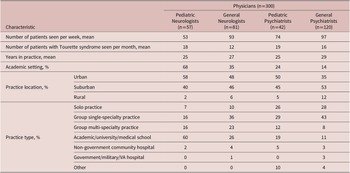
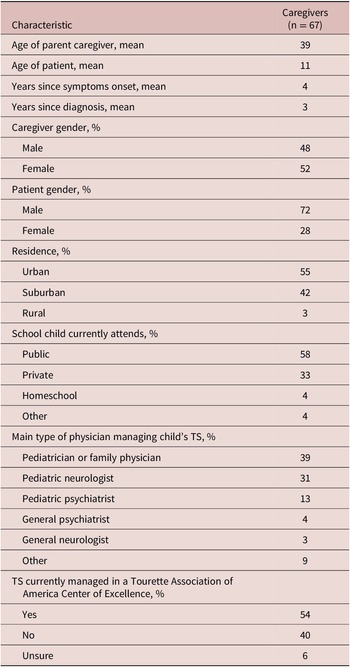
Email invitations were distributed to 19,693 neurologists and psychiatrists, 7% of those distributed to engaged in the survey (1445) including those who screened out or did not complete, and 21% (300) of those who engaged completed the survey. Of the 300 physicians who completed the survey, 138 were neurologists (including 57 pediatric neurologists) and 162 were psychiatrists (including 42 pediatric psychiatrists). Respondents averaged over 25 years in practice. On average, pediatric neurologists, general neurologists, pediatric psychiatrists, and general psychiatrists reported managing 18, 12, 19, and 16 patients with TS per month, respectively (Table 1). Caregivers (n = 67), representing 19 states, reported an average of 3 years since their child was diagnosed with TS. More caregivers reported that a pediatric or general neurologist is the main doctor managing their child’s TS than a pediatric or general psychiatrist (34% vs 17%). Over half (54%) of patients received TS care from a Tourette Association of America Center of Excellence (Table 2).
Characteristics of Physicians

Note: Totals may not equal 100% because of rounding.
Abbreviation: VA, Veterans Affairs.
Characteristics of Caregivers

Note: Totals may not equal 100% because of rounding.
Abbreviation: TS, Tourette syndrome.
Diagnosis of TS
When provided with a case of a school-age girl with ADHD and a history and presentation suggesting TS, 65% of pediatric neurologists indicated they would rely on clinical findings only to make a diagnosis, whereas the minority of other physicians would do so. Of those who would not diagnose the patient based on clinical findings alone, 73% would order an electroencephalogram, 54% brain imaging, 21% lab testing, 12% genetic testing, and 3% an electromyogram. Psychiatrists were more likely than neurologists to refer the patient to another specialist for diagnosis (39% vs 5%), most commonly to a neurologist or movement disorder specialist. The majority of caregivers (57%) reported that a neurologist made the diagnosis of TS for their child. Only 16% of diagnoses were made by psychiatrists.
The majority (76%) of psychiatrists would use DSM-5 criteria to establish a diagnosis of TS, whereas 43% of neurologists would do so. Fewer physicians would use Tourette Syndrome Study Group criteria (28%) or the International Classification of Diseases, 10th Revision, Clinical Modification (ICD-10-CM) (26%) in establishing a diagnosis. Twenty-two percent of neurologists would not use standardized criteria in making a diagnosis, compared with only 4% of psychiatrists.
Over one-third of physicians (36%) indicated that parents commonly request additional diagnostic workup at the time they are told their child has TS, and 25% indicated that parents commonly request a second opinion.
Most physicians (72%) reported that parents have many questions when their child is diagnosed with TS. Other responses to diagnosis that physicians perceived parents to have included denial or disbelief (41%), acceptance (32%), relief (22%), and anger (15%). Of note, about half of pediatric specialists perceived parents to respond with acceptance, compared with less than one-third of general neurologists and psychiatrists. General neurologists and psychiatrists, on the other hand, were more likely to indicate a parental response of denial or disbelief than pediatric specialists.
Tic management
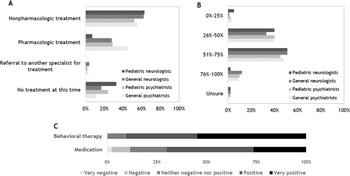
A notable proportion of physicians (44% of psychiatrists and 20% of neurologists) would use pharmacotherapy to treat a patient with “slightly bothersome” tics and no functional impairment (Figure 1A). Of those who would not begin pharmacotherapy, most would reconsider pharmacotherapy if the patient developed impairments in activities of daily living (96%), social or emotional problems (90%), impairments in academic performance (90%), or physical discomfort (86%) associated with the tics. Fewer would start medication if the patient requested it (28%) or was nonadherent to behavioral therapy recommendations (25%). The majority of physicians (62% of neurologists and 54% of psychiatrists) would begin nonpharmacologic treatment, either alone or in addition to pharmacotherapy. Over half (58%) of physicians expect more than a 50% reduction in tic severity with pharmacotherapy (Figure 1B).
Tic management in patients with Tourette syndrome. (A) Physician selection of initial tic management in a patient with tics described as “slightly bothersome” and not impacting academic performance. (B) Physician expected reduction in tic severity with treatment. (C) Caregiver perceptions of management options for tics (behavioral therapy, n = 61; medication, n = 55). Note that the sample size reflects the number of caregivers making a selection other than “Not applicable.”

When asked to characterize their reaction to treatment options presented to them for tic management for their child, caregivers appeared to favor behavioral therapy over medication; 86% reported a positive or very positive reaction to behavioral therapy, compared with 61% to pharmacotherapy (Figure 1C). More neurologists than psychiatrists would not initially begin any treatment for the patient’s tics (24% vs 14%).
Safety profile and clinical efficacy were ranked as the most important factors by physicians in the selection of an agent when beginning pharmacotherapy for tics, followed by personal experience with an agent and mechanism of action. Drug-drug interactions and a Food and Drug Administration indication for use in TS were ranked as the least important factors.
When determining treatment effectiveness, physicians felt that subjective reporting of symptom control by patients or caregivers is the most important factor. Slightly less important factors were observation of the patient and academic performance. Standardized scales or questionnaires were felt to be the least important. Of those placing some importance on the use of standardized tools to evaluate treatment, 57% reported actually using them in practice. Notably, 41% of pediatric neurologists reported using standardized tools, which was slightly less than other specialists.
Social stigma and mood symptoms in TS
The majority (60%) of physicians were very or extremely concerned that social stigma related to having a TS diagnosis may affect a patient’s treatment compliance or outcome, whereas 32% were very or extremely concerned that social stigma related to taking an antipsychotic medication may do so. Caregivers had a similar rate of being concerned about social stigma related to the diagnosis of TS (59% very or extremely concerned); however, they had a greater level of concern related to antipsychotic medication use (61% very or extremely concerned).
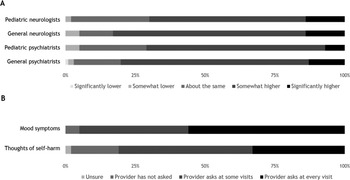
When presented with a patient with TS who met diagnostic criteria for major depressive disorder, physicians perceived the patient to be at somewhat higher risk of suicide than a similar patient without TS (Figure 2A).
Risk of suicide and assessment of its risk in patients with Tourette syndrome (TS). (A) Comparative risk of suicide among patients with TS to patients without TS, as perceived by physicians. (B) Frequency of physician inquiry of mood symptoms and thoughts of self-harm in patients with TS, as reported by caregivers (n = 67).

Caregivers reported that their child’s healthcare provider often asks about mood symptoms (54% asking at every visit and 42% asking at some visits). Fewer indicated that the provider asks about thoughts of harming oneself (31% at every visit and 51% at some visits) (Figure 2B).
Communication with patients and caregivers
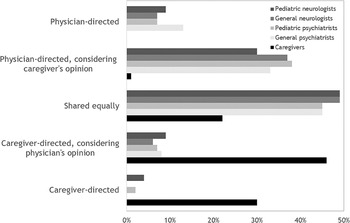
When managing a patient with TS, 45% of physicians indicated that they prefer to share responsibility with the patient or caregiver in deciding which treatment is best. Another 35% indicated that they prefer to consider the patient’s or caregiver’s opinion before making the final decision. Most (76%) caregivers indicated that they prefer to make the final decision about which treatments are given to their child. No caregivers reported wanting to leave all aspects of decision-making to the physician (Figure 3).
Physician and caregiver preferences regarding shared decision-making in Tourette syndrome management.

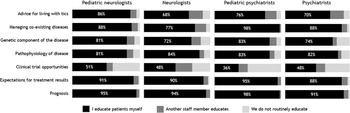
Physicians appeared to take responsibility for educating patients and families about various aspects of TS and its management, rather than deferring to another staff member for education or forgoing education (Figure 4). However, less than half (47%) of physicians would educate patients about clinical trial opportunities.
Percentage of physicians by specialty reporting that they personally educate, that another staff member educates, or that they do not routinely educate patients and caregivers on topics related to Tourette syndrome.

Physician confidence and knowledge of TS management
Most physicians reported that they were very or extremely confident in several aspects of TS management, including when to begin treatment for tics (65%), managing medication side effects (65%), and selecting treatment for tics (63%). The majority of psychiatrists were very or extremely confident in managing coexisting psychiatric disease in patients with TS (84%).
Over half (54%) of the caregivers surveyed agreed or strongly agreed with the statement, “I feel the main healthcare provider who treats my child’s TS is knowledgeable about the disease and its treatment,” whereas 30% disagreed or strongly disagreed with this statement. In response to the statement, “I know more about TS than the healthcare provider,” 38% agreed or strongly agreed.
Discussion
The results of this survey reveal important issues related to physician practice patterns, knowledge, attitudes, and perceptions with regard to TS. Several findings of particular significance are associated with TS diagnosis, tic management and monitoring, suicide risk in patients with TS, caregiver and patient involvement in TS decision-making, and staying updated in advances in TS treatment. As subsequently discussed, each of these findings has implications for future physician education on the topic of TS.
In our survey, most physicians would conduct diagnostic testing in a patient who met DSM-5 clinical criteria for TS. A significant proportion of neurologists would not use standardized criteria in making a diagnosis. Although diagnostic testing is sometimes needed to rule out other causes of presenting symptoms, the majority of physicians would order an electroencephalogram (75%) or brain imaging (54%) prior to making a diagnosis. This high rate of utilization of what in many cases may be medically unnecessary tests may indicate a need for education in appropriate diagnostic testing or be in response to caregiver wishes. Many physicians indicated that parents commonly request diagnostic testing—a belief that may lead physicians to preemptively order testing despite feeling confident about TS as the diagnosis. It has previously been noted that difficulties surrounding the diagnosis of TS are associated with a lack of knowledge about the disease by physicians and can result in nonoptimal treatment.Reference Swain, Scahill, Lombroso, King and Leckman 18 Taken together, these findings suggest that increased awareness of TS diagnostic criteria and strategies for communicating the diagnosis of TS to patients and caregivers may be beneficial.
Although watchful waiting is recommended in the American Academy of Neurology treatment guidelines for patients with TS who do not experience functional impairment or injury associated with their tics,Reference Waldon, Hill, Termine, Balottin and Cavanna 6 a sizable proportion of physicians surveyed (44% of psychiatrists and 20% of neurologists) would prescribe pharmacotherapy for these patients. Caregivers indicated a slight preference for behavioral therapy over pharmacotherapy for tic management, but we found that physicians—particularly psychiatrists—would begin medication for initial management of tics. This observation may be confounded by the requirement that caregivers be the parent of a patient with TS who is younger than 18 years of age, and would therefore be more likely to be treated by a pediatric provider, who in turn are less likely to manage TS with pharmacotherapy than general neurologists or psychiatrists. This is noteworthy in light of previous research identifying parental frustration and disappointment at the fact that medication is often offered, with few alternative treatment options presented.Reference Murphy, Lewin, Storch and Stock 19
In our survey, 58% of physicians expected >50% reduction of tic severity with medication, despite published, placebo-controlled clinical trials that demonstrated smaller reductions.Reference Martino, Pringsheim and Cavanna 20 This belief may negatively impact subsequent treatment decisions, as well as lead to unrealistic parent and patient expectations.
A substantial proportion of physicians reported that they do not use standardized tools to monitor response to TS management despite demonstrated validity, reliability, and consistency of rating scales, such as the Yale Global Tic Severity Scale.Reference Hirschtritt, Lee and Pauls 21 Because physicians managing TS must frequently distinguish its functional effects from those of comorbid conditions such as ADHD and OCD, education that includes information about TS-specific rating scales may be beneficial.
Both clinical and population-based studies have shown that people with TS are at an increased risk of mood disorders,Reference Kurlan, Como and Miller 22 , Reference de la Cruz, Rydell and Runeson 23 and suicide death or attempts.Reference Robertson 24 This is felt to be the result of several mechanisms, including a psychological reaction to living with a potentially disabling condition, neurotransmitter abnormalities, and effects of drugs used to treat tics.Reference Huisman-van Dijk, Matthijssen, Stockmann, Fritz and Cath 25 Nonetheless, prior research has not found an association between depression symptom severity and tic severity,Reference Cox, Nahar and Termine 26 suggesting that tic assessment at patient follow-up is not sufficient to evaluate potential mood symptoms.
Social stigma is associated with TS,Reference Peabody, Luck and Glassman 27 although prior research has not established how this impacts TS management. We found evidence that physicians have a high level of concern that social stigma related to both having a diagnosis of TS and taking antipsychotic treatment for tics may impact patient outcomes. Physicians are also generally aware of the increased risk of suicide among individuals with TS. However, based on caregiver responses, it is unclear whether this awareness and concern translate to sufficient assessment of mood symptoms and suicidal ideation in practice.
A result from this study with potentially broad impact on the approach to TS management concerns the use of shared decision-making. Physicians had an overall preference toward directive management decisions in TS, while caregivers indicated a desire to make final treatment decisions themselves. It is possible that education on multiple aspects of TS management may mitigate some differences between shared decision-making preferences by leading to improved communication about TS and its management options to caregivers.
Finally, educational programming that includes updates on clinical research in TS may encourage physicians to more consistently discuss clinical trial opportunities with patients and caregivers.
Limitations
This study used a patient case survey as a surrogate measure of the physician’s management approach to TS. It did not attempt to verify any information with chart reviews or direct assessment of physician practice. However, the use of case vignettes (as compared with chart review and standardized patients) has been shown to provide valid and reliable data on clinicians’ actual practice patterns.Reference Peabody, Luck and Glassman 28 Not all patient types, comorbidities, and clinical situations related to TS were addressed in the cases used in this survey. The honorarium offered to complete the surveys, their online nature, and the invitation methods (ie, support groups, TS chapters, and caregiver forums) could have established a selection bias in responses and limits the generalizability of the results. In addition, caregivers were asked for details about how TS was diagnosed and managed in their child; these responses may have been subject to recall bias.
Conclusions
This study provides insight into the practice patterns and perceptions of U.S.-based neurologists and psychiatrists in managing TS. Results highlight current gaps in standardized diagnostic criteria utilization, tic monitoring and management strategies, comorbid mood symptoms and suicidality assessment, physician-caregiver joint decision-making, and clinical updates on TS management. These gaps may be potential areas for physician education to optimize TS management and improve patient care.
Acknowledgements
Medical writing support for the development of this manuscript, under the direction of the authors, was provided by Jennifer DiNieri, PhD, and editing support by Jason Tuffree, both of Ashfield MedComms, an Ashfield Health company, and funded by Teva Pharmaceutical Industries. The authors take full responsibility for the content of this article.
Financial Support
This study was supported by Teva Pharmaceutical Industries.
Author Contributions
Conceptualization: S.S., G.D.S., E.B., A.W., J.K.A., G.W.M.; Data curation: S.S., G.D.S., E.B., A.W., J.K.A., G.W.M.; Funding acquisition: S.S., G.D.S., E.B., A.W., J.K.A., G.W.M.; Investigation: S.S., G.D.S., A.W., J.K.A., G.W.M.; Methodology: S.S., G.D.S., A.W., J.K.A., G.W.M.; Project administration: S.S., G.D.S., A.W., J.K.A., G.W.M.; Resources: S.S., G.D.S., E.B., A.W., J.K.A., G.W.M.; Software: S.S., G.D.S., E.B., A.W., J.K.A., G.W.M.; Supervision: S.S., G.D.S., E.B., A.W., J.K.A., G.W.M.; Validation: S.S., G.D.S., E.B., A.W., J.K.A., G.W.M.; Visualization: S.S., G.D.S., E.B., A.W., J.K.A., G.W.M.; Writing—original draft: S.S., G.D.S., E.B., A.W., J.K.A., G.W.M.; Writing—review and editing: S.S., G.D.S., E.B., A.W., J.K.A., G.W.M.
Disclosures
Sylvie Stacy, Gregory D. Salinas, and Emily Belcher have no potential conflicts of interest to disclose. Amanda Wilhelm and Jessica K. Alexander are employees of Teva Pharmaceutical Industries. Gregory W. Mattinglyhas served as a speaker for AbbVie, Alkermes, Eisai, Janssen, Lundbeck, Neurocrine Biosciences, Otsuka, Sunovion, Supernus Pharmaceuticals, Takeda, and Tris Pharma. Gregory W. Mattingly has been a consultant for AbbVie, Acadia Pharmaceuticals, Alkermes, Axsome Therapeutics, Eisai, Ironshore Pharmaceuticals, Intra-Cellular Therapies, Janssen, Lundbeck, Neos Therapeutics, Neurocrine Biosciences, Otsuka, Redax, Roche, Rhodes Pharmaceuticals, Sage Therapeutics, Shire, Sunovion, Supernus Pharmaceuticals, Takeda, Teva Pharmaceutical Industries, and Tris Pharma. Gregory W. Mattingly has received research support from AbbVie, Acadia Pharmaceuticals, Alkermes, Avanir Pharmaceuticals, Axsome Therapeutics, Boehringer Ingelheim, Emalex Biosciences, Janssen, Medgenics, NLS-1 Pharma AG, Redax, Roche, Sage Therapeutics, Shire, Sunovion, Supernus Pharmaceuticals, Takeda, and Teva Pharmaceutical Industries.
Supplementary Material
To view supplementary material for this article, please visit https://doi.org/10.1017/S1092852921000766.