Saint-Saëns and Hellenism
At the beginning of June 1893, a week after the premiere of Phryné at the Opéra Comique, Saint-Saëns left for England to play several concerts as well as to collect an honorary doctorate from Cambridge. While there, he received an urgent request from the playwright Paul Meurice to work on a new project, incidental music for a revival of a translation that Meurice had prepared with Auguste Vacquerie of Sophocles’ Antigone many years before.Footnote 1 It was to take place at the Comédie-Française on 21 November later that year with Mounet-Sully (stage name for Jean Sully-Mounet) as Créon. Mounet-Sully, the most charismatic French male actor of the period, had already been acclaimed in the title role of Œdipe roi at the Comédie-Française in 1881. That production had travelled to the outdoor Roman theatre at Orange in the south of France in 1888, where it was also enthusiastically received and regularly programmed in the theatre's summer season. So too would Antigone journey to the Théâtre d'Orange on 12 August 1894 and remain ensconced in its repertoire.Footnote 2 Saint-Saëns was probably aware of plans to replicate the open-air setting characteristic of ancient practice when he took up the Antigone commission.
The Meurice and Vacquerie translation was first given with some success almost 50 years before at the Odéon in 1844, also with incidental music then in the form of a score written by Felix Mendelssohn that had served for a German translation of the play performed at the court theatre in Potsdam in 1841. The French revival of 1893 provided an occasion to rethink the approach. Meurice and Vacquerie had worked directly from the Greek for the spoken portions of the play in 1844 but were constrained in their translations of the choruses by the accentuation patterns of Mendelssohn's music, patterns that sometimes proved difficult to adapt to the French language. Moreover, the Mendelssohn setting seemed to them not only to overshadow the spoken dialogue but also too modern in flavour. In a discussion of Mendelssohn's music, Jason Geary has characterized it as a vehicle to make the whole production accessible to a nineteenth-century public, ‘a vital means of bridging the historical divide between classical antiquity and the modern age’.Footnote 3 Following Richard Taruskin's well-known distinction between ‘authentistic’ and ‘authentic’ performance, we might characterize the Mendelssohn project as authentistic, that is, more animated by a desire to adhere to the spirit of an original rather than its original sonic qualities, grammar or instrumental forces.Footnote 4 The ‘spirit’, in this view, could be rendered by modern musical language. In 1893, fired by a more authentic orientation to achieve a result closer to the imagined sound world of the ancients, Meurice and Vacquerie reasoned that it would be better to start their translations of the Greek choruses from scratch and commission a new musical setting. But, as we shall see, accessibility remained a concern just as it had with Mendelssohn, and authentistic and authentic expression form a continuum instead of hard and fast categories.
Meurice and Vacquerie's initiative fit into the current of increased attention given over to classical, and especially ancient, Greek, studies after 1850, where a culture previously known mainly through literary texts became better understood through artefacts and architecture.Footnote 5 With encouragement from the Greek monarch and the establishment of foreign institutes on Greek soil, the second half of the nineteenth century saw an increase in the pace of excavation. A milestone was the founding of the École française d'Athènes in 1846, which continues to play an important role in major archaeological digs to this day. In music, during the summer of 1893 French and German scholars uncovered and restored important inscriptions from Delphi, including vocal notation that became known as the Hymne à Apollon, which the archaeologist, musicologist, numismatist and (eventually) librettist, Théodore Reinach transcribed and edited before seeking out Gabriel Fauré to supply an accompaniment.Footnote 6 Performances of the Hymne à Apollon drew considerable press attention the following year and studies were published in academic journals, but to my knowledge we do not know exactly when Saint-Saëns got wind of this discovery and whether it was a catalyst for his own project.
The administration of the Comédie-Française became motivated in its production of Antigone by the spirit of authenticity sparked by all of this archaeological activity, certainly to a greater degree than those responsible for the Odéon Antigone a half-century before, and even for the Œdipe roi of 1881. And there was the promise of the open-air Théâtre d'Orange performances of Antigone that would soon be put on by the Comédie. The stage was set up on two levels following ancient practice – the lower for the chorus, the upper for the actors. The Odéon had followed the same scheme, but now the set cleaved more to authentic detail. Scholarly works were consulted for the costumes. A choreographer specializing in ‘la eurythmie grecque’ brought her expertise to the project. Focusing on similar initiatives, Samuel Dorf has written persuasively about how scholarship concerned with Greek antiquity at the fin de siècle broadened from reflections upon documents to re-enactment and performance that engaged ephemeral parameters such as gestures, spaces and tone – to which we might add the ephemeral nature of the Greek musical record itself. That is, rather than centre on the realization and analysis of fixed texts, this kind of research involved the imaginative combination of resources in embodied representation under the banner of an authentic orientation. To experience in real time, even with speculative materials, was better to understand.
The commission fell on fertile ground not only because of Saint-Saëns's openness to experimentation with historical matter but also because of his longstanding interest in the culture of antiquity.Footnote 7 He had already drawn inspiration from classical material on several occasions during the 1870s, including, most conspicuously, the symphonic poems Le Rouet d'Omphale (1871), Phaeton (1873) and La Jeunesse d'Hercule (1877). This interest extended impressively to activities as a scholar, which Saint-Saëns pursued in 1886 by writing a short study on stage décor in Roman theatre.Footnote 8 There he developed the argument, largely based on published iconography, that Pompeii murals depicting unusually proportioned architecture offered clues to the mise-en-scène of ancient theatre. In this, he took into account older scholarship on the Théâtre d'Orange because of its similarity with the theatre at Pompeii. As Elinor Olin has already noted, Saint-Saëns also studied depictions of singing or declaiming to the accompaniment of a kithara in Greek drama.Footnote 9 He developed a particular interest in classical organology and addressed his colleagues at the Institut de France in October 1892 on the subject of ancient lyres and kitharas. The lecture was soon printed in Le Monde artiste, and he kept returning to these instruments in several additional publications over the course of his career, each time refining his findings based on new iconographical evidence.Footnote 10 His research claimed enough authority that one version even made it into the Encyclopédie de la musique et dictionnaire du Conservatoire in 1913. In his creative work, Saint-Saëns explored open air theatre with Greek subject matter in Déjanire, written for the arènes de Béziers in 1898, a bull-ring turned into a pseudo-Greek performing space that provided the venue for the première of Gabriel Fauré's Prométhée two years later.Footnote 11 Although planning for an open-air venue in itself might well be described as embodied experimentation within an authentic frame, the particular musical scores for Déjanire and Prométhée, with their modern textures and common practice tonality coloured by modal touches, are better described as more authentistic in orientation.
Indeed, in commenting on Déjanire Saint-Saëns noted that his music for the work did not ‘go as far as the archéologie pure of Antigone’.Footnote 12 The expression archéologie pure is noteworthy, especially in the context of all the activity of the École française d'Athènes. The sense of it is of ‘real’ or ‘true’ archaeology. Dorf has pointed out the performative aspect of archaeology as a discipline, not only in its imaginative (but informed) creation of complete structures out of mere fragments but also in its fashioning of models that could be inspected by a mobile observer from different angles.Footnote 13 This fits with the general programme of the 1893 Comédie-Française Antigone of taking research on ancient Greek theatre and culture into account. And it fits even more with performances at the Théâtre d'Orange the following year, for these involved not only the restoration of an ancient building but also what one might call its re-animation by being assigned its original purpose with a Saint-Saëns score that actually sought to emulate ancient practice.
But archéologie pure, paradoxically, is a relative concept – just like the authentic and the authentistic. On the one hand, in an article for Le Figaro written just after the premiere performance in November 1893, Saint-Saëns reported that the commission involved ‘restoring the music of the Greeks as much as possible’ and that this entailed avoiding modern textures and tonal language. On the other hand, he revealed that he had undertaken the project with the proviso that he would not complete it if he found that ‘the result seemed to challenge the amount of austerity that the public is able to tolerate’.Footnote 14 As it turns out, some late nineteenth-century habits of thought still affected the final result. The impulse to authentic reconstruction did have its limitations. Nonetheless, in its positing of an imagined ancient sound, the score remained utterly idiosyncratic, even strange, and not comparable to any other work within a classicistic or neo-Hellenistic orientation written in this period by Saint-Saëns, or anyone else. Performed within the putatively original space of the Théâtre d'Orange (with its own compromises, including modern electric lighting) it invited listeners to become time travellers, and not without important ideological resonance. First we examine the score, then the venue.
The Limits of Authenticity
In his Figaro article, Saint-Saëns wrote that his guide for composition was the research of François-Auguste Gevaert, principally, one must assume, his Histoire et théorie de la musique de l'antiquité published in two volumes in 1875 and 1881.Footnote 15 Building on the work of the German scholars Heinrich Bellermann and Rudolf Westphal, Gevaert provided in these volumes a thorough account of ancient Greek music culture, including a description of its syntactical system related to pitch, rhythm and phrase structure, as well as notation, the place of music in society, the genres of ancient Greek music and their development, and ancient instruments. But, by his own admission, Saint-Saëns did not know Gevaert's study well. In Le Figaro he noted that he had to work quickly on the incidental music to Antigone when he returned from England in 1893: ‘I had just a few hours to complete preliminary research that should have taken a week’. Given the scope of Gevaert's work – it is over 1,000 pages – even a single week seems like a compressed time for study. From the outset, the goal of archéologie pure came up against the pragmatics of career imperatives and deadlines.
Within Greek theatrical practice, the layout of Antigone is classical. A spoken prologue plunges the spectator in medias res: Antigone reacts vehemently against Créon's decree forbidding the interment of the corpse of her brother Polynices. She tells her sister Ismene that she will bury him herself. In the subsequent parados two male choruses enter from opposite sides of the stage to celebrate the victory of Thebes over Argos. The plot moves forward in the first episode as Créon learns about Antigone's violation of his decree. In the ensuing stasimon, a sung chorus celebrates humankind's domination over nature. Alternation between kinetic episodes and sung choral stasima continues in the play. Each stasimon contains one or two strophes, which are normally paired with antistrophes from a second chorus that moves in an opposite direction on the stage and elaborates upon the theme articulated by the first chorus. The episode–stasimon pattern is abandoned at the fifth stasimon, which also marks the beginning of the exodus of the play and the unwinding of the tragedy: a messenger announces the suicides of Antigone and her betrothed Haemon (son of Creon and Eurydice). While Creon laments the death of his son, the suicide of his wife Eurydice is also revealed. A final chorus warns that the gods must never be dishonoured.
Timbre and texture played an important part in the business of archéologie pure. In his choral writing, Saint-Saëns largely adheres to unison, with a significant number of antiphonal exchanges between the two choruses. The orchestra comprises four flutes, two clarinets, two oboes, an unspecified number of harps and three string parts (violins, violas and cellos). As the composer explained in his preface to the score, this palette was meant to replicate the judicious mix of flutes and single and double reed instruments in the Greek orchestra. The modern harp is a stand-in for the ancient lyre and functions ‘almost always’, said Saint-Saëns, as a melodic instrument. Saint-Saëns's qualifier ‘almost’ was meant to take into account the third stasimon, an exceptional moment in other ways, where the harp accompanies a solo voice with arpeggios. The addition of strings to many of the numbers was an obvious compromise with contemporary practice, ostensibly to provide a more familiar colour as well as variety of timbre. Nonetheless, the orchestral texture does remain remarkably sparse throughout. It consists of doubling of the unison vocal parts, single instrumental lines to offset the choral unison, and connectors between phrases – all much different than Mendelssohn's nineteenth-century orchestra with full strings, winds and brass accompanying his two tenor–bass choruses that explore a much wider range of textures: lyrical unison, choral recitative, four part writing and lyrical interventions by soloists.
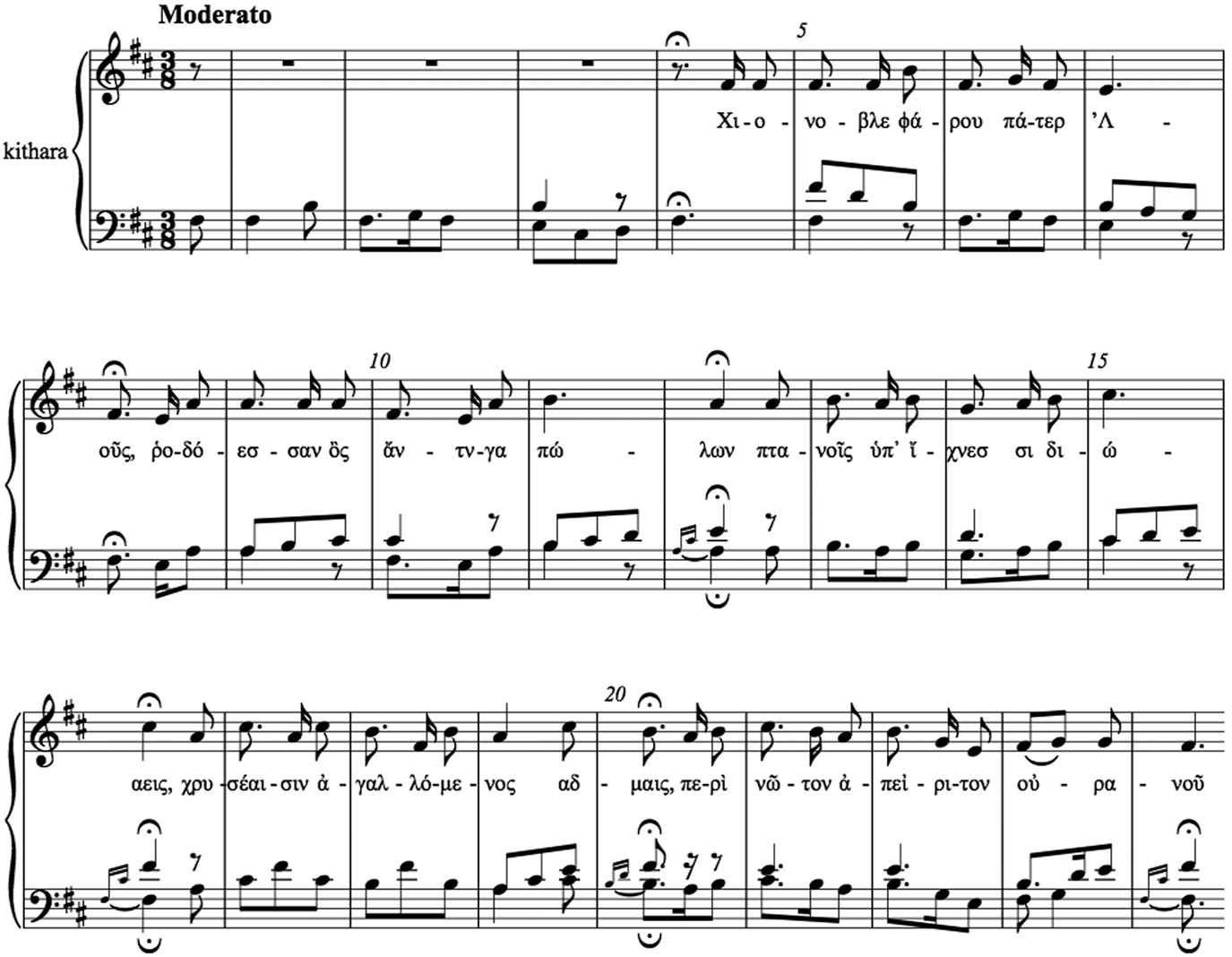
Yet how close was Saint-Saëns to Gevaert's description of textures in Greek music? Whereas Gevaert ruled out chordal harmonic thinking in Greek music, he thought that polyphonic writing was indeed practiced by the ancients. He explains his theories in the Histoire et théorie de la musique de l'antiquité, in one passage imagining the deployment of descants made of descending and ascending tetrachords and pentachords against sample modal tunes.Footnote 16 Elsewhere he describes two-voice note against note style with a preference for octaves and fifths, and for passing thirds and seconds as dissonances, and suggests a contrapuntal line for kithara to a melody from the second century CE by Mesomedes of Crete commonly called the Hymn to Helios, as shown in Example 1.
Mesomedes, Hymn to Helios, second century CE

Whereas there is stability in transmission of the pitch content of this melody, the rhythms have been subject to many interpretations. Gevaert's version presumably looks back to that of Bellermann, and with little claim to absolute authenticity. In Gevaert's fanciful realization of the instrumental part, the kithara anticipates the first phrase of the vocal melody (much as one might expect in, say, a Bellini opera aria) and then produces note against note octave doubling with a modest degree of independence at cadences and during tiny connecting links between vocal phrases. Gevaert explicitly says that polyphony with more than two voices was unknown to the Greeks. Although Saint-Saëns did use a lot of simple doubling, he went far beyond the (questionable) parameters laid out by Gevaert. In the first antistrophe of the parados (‘Elle fuit la terrible armée’), harps and strings double the antistrophe chorus while flutes, oboes and clarinets add an independent descant in running eighth notes. During the first strophe of the subsequent stasimon (‘L'homme est le grand prodige’), strings accompany with rather academic three-part writing, and flutes and clarinets spin extended connecting passages between vocal phrases (after ‘Il en fait ce qu'il veut’). Strings then obsessively reiterate an agitato turning figure to accompany the chorus (at ‘Sa nef victorieuse’), a figure already used in the prologue for the first appearance of Antigone as harps punctuate strong beats with complete chords. In the second strophe of this stasimon (‘Sa parole pressée’), the texture returns to three-part writing in the strings. And so it continues for the rest of the score: the textures do not resemble anything that Gevaert, or anyone else to my knowledge, describes as characteristic of Greek music, despite their threadbare quality by the standards of nineteenth-century orchestral writing. One might perhaps best describe this as a kind of contrived austerity.
Turning to pitch collections, the diatonic genus of the dorian and hypodorian modes governs most of the score. This modal choice conforms to Gevaert's passing remark on the authority of Plato that dorian (analogous to the medieval phrygian mode, it will be recalled) was the most authentically Greek of the modes.Footnote 17 Saint-Saëns generally does not appear to ‘modulate’ within individual choral numbers, though some passages are open to debate about which combination of tetrachords is actually operative and what might be felt as a temporary final or co-final. For tonal variety, Saint-Saëns uses dorian mode at different transposition levels from number to number (with key signature changes) rather than explore different modes and their affects. More than a quest for authentic reconstruction, one senses here the habit of a tonal composer setting individual numbers of a dramatic work in different keys.
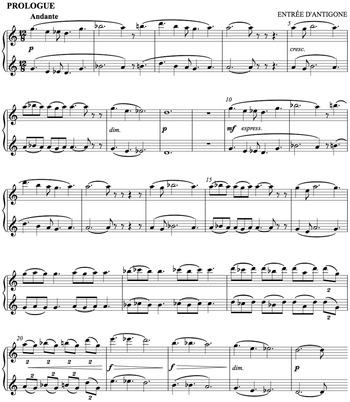
For obvious practical reasons, Saint-Saëns did not attempt to recreate the Greek microtonal enharmonic genus, but three extended appearances of the chromatic genus stand out against the prevalent diatonic fabric: at Antigone's first appearance in the prologue; later in episode 4, when Antigone emerges on stage to be led to her death; and finally to prepare the telling of the deaths of Haemon and Eurydice in the exodus. Example 2 shows the first of these: the diatonic Greek dorian collection here is D–E@–F–G–A–B@–C–D, its chromatic variant D–E@–E–F–G–A–B@–B–D. Saint-Saëns returns to the very same music transposed down a whole tone in episode 4, where it functions to punctuate and sometimes even underpin Antigone's spoken text. In his preface to the score, Saint-Saëns remarked that he reserved ‘more complicated’ scales (he obviously meant the chromatic genus) for those moments where actors in the ancient Greek tragedy actually would have broken into song. But he did not put this theory into practice himself, preferring instead to use the texture of melodrama at these moments. For all the recognizably Greek flavour of the chromatic genus, the strategy of thematic recall for two appearances of the main tragic figure is straight from the toolkit of the nineteenth-century opera composer – think, for example, Verdi's Aida or Bizet's Carmen. During the reprise at episode 4 Saint-Saëns spins out the turning figure from the prologue music (shown in bars 6 and 15–19 in Example 2), thus further extending the web of thematic recall because this is the very same agitato motif that had already been extended (as I have already observed) in the first antistrophe of the parados.
Saint-Saëns, Antigone, Antigone's first appearance (Durand, 1893)

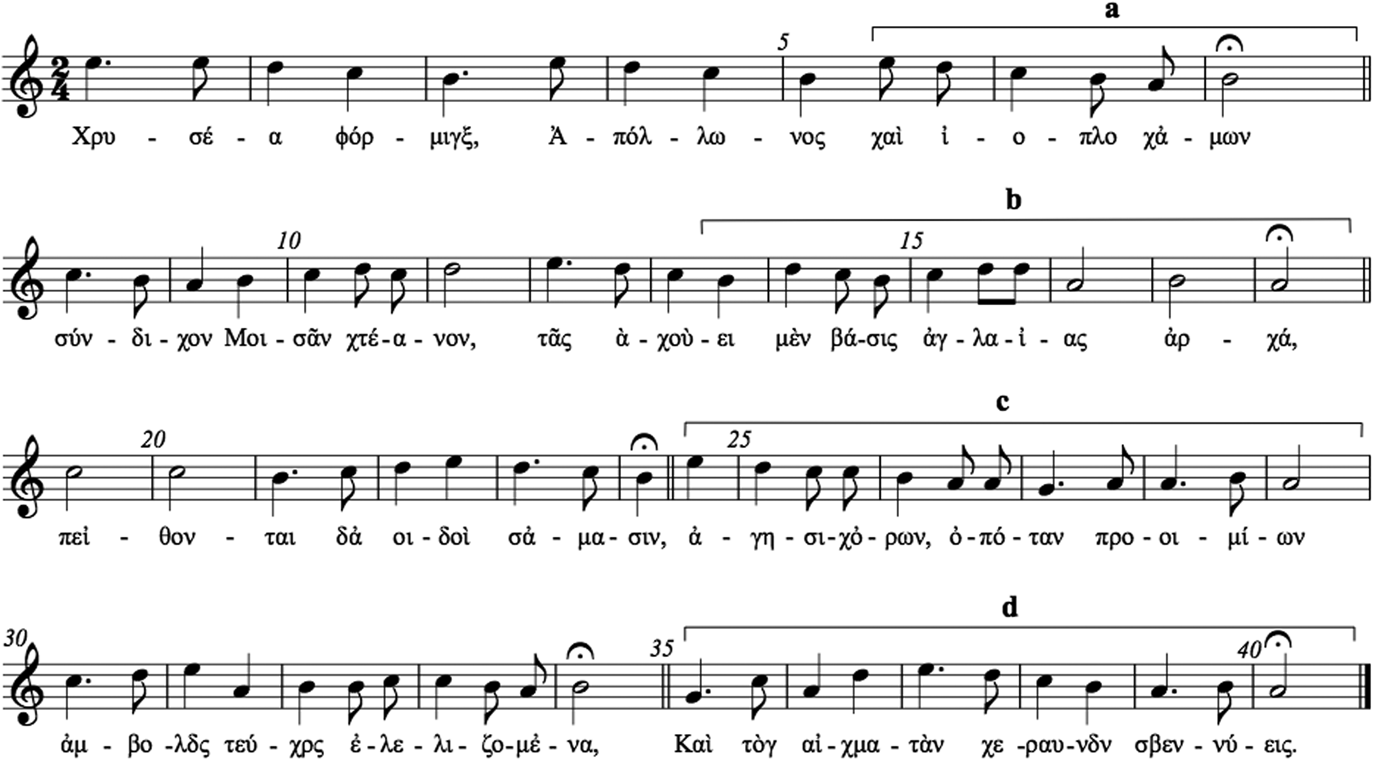
The appearance of the chromatic genus in the prologue and later is doubly significant because Saint-Saëns believed it to be an authentic fragment, as he explained in the preface to his score. He actually lifted the chromatic genus passage verbatim from Gevaert's study, where it is identified as a duet between Andromeda and Hecuba from Euripides’ The Trojan Women. But Gevaert does not claim it as authentic; the tune is but one of the many hypothetical reconstructions of Greek music that populate his study. Whether Saint-Saëns was aware of the tune's hypothetical nature is unclear, but he appears to have thought that use of a Greek ‘original’ would lend authority to his reconstruction, rather like how archaeologists erect new walls around fragmentary remains. In his preface Saint-Saëns remarks that the final chorus of the incidental music is also modelled on – he uses the expression ‘imité de’ – an authentic fragment, a ‘hymne de Pindare’ now known more commonly as Pindar's First Pythian Ode and long ago shown to be completely spurious as an example of ancient Greek music. Examples 3a and b show the original as Gevaert gives it and Saint-Saëns's variation. Here the remnants of the ‘Pindar’ are seamlessly incorporated into a piece that adheres to the general style of the period original, again, much as one might see at a real archaeological site – except that in this case, as with the putative excerpt from Euripides’ The Trojan Women, the remnant is not ‘real’. Perhaps Saint-Saëns varied the ‘Pindar’ in order to accommodate the Meurice-Vacquerie text. Notwithstanding its authentic aura, the music does reflect late nineteenth-century French text-setting practice by frequently avoiding the downbeat to create the effect of a large upbeat to a strong syllable at the beginning of the subsequent bar (bars 2, 6, 10, 16, and 19).
Pindar, First Pythian Ode

Saint-Saëns, Antigone, final chorus (Durand, 1893)

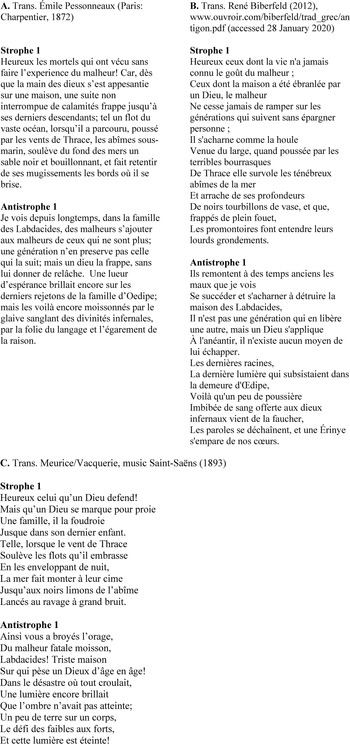
Meurice-Vacquerie's style of lyrical translation had an important bearing on Saint-Saëns's musical choices. Comparison of three different renditions of the beginning of the second stasimon in Example 4 will illustrate this: the first, a respected reading published 20 years before the Comédie Française production; the second, a modern translation; and the third, the Meurice-Vacquerie version. The first is prose and the second free verse with variable line lengths. The structural freedom of the first two versions allows them to adhere closely to the syntax and imagery of the original Greek. They are much closer to each other than they are to the Meurice-Vacquerie version, which is constrained by having been conceived as equal line rhyming poetry, following the pattern of eight-syllable lines for all the choruses and Alexandrines for the spoken passages. Compare the first prose line ‘Heureux les mortels qui ont vécu sans faire l'experience du malheur!’ and the free verse ‘Heureux ceux dont la vie n'a jamais connu le goût du malheur’ to the Meurice and Vacquerie ‘Heureux celui qu'un Dieu défend’. The idea of a protective God in the Meurice-Vacquerie (‘qu'un Dieu défend’) does not emerge in the two first renditions, but does produce a terminal rhyme with ‘enfant’ three lines later. Next, Meurice and Vacquerie write of a god identifying a family as prey (‘qu'un Dieu se marque pour proie/Une famille’) in order to produce the rhyme ‘proie-foudroie’, whereas the other two translations agree with each other and are closer to the Greek, by specifying a family house that is destroyed by a god. Much more like a libretto by Jules Barbier and Michel Carré than writing by Sophocles, this verse naturally encourages equal-length phrases, pressure that would have to be actively resisted in order to match the musical effect that would inevitably emerge from the irregular line lengths of the original Greek.
Sophocles, Antigone, comparison of translations of second stasimon

In the context of increasing interest in prose libretti in the 1890s, Saint-Saëns publicly articulated on more than one occasion why he thought verse continued to be artistically relevant and superior to prose for musical setting.Footnote 18 There is therefore a strong possibility that he himself requested translation with a regular grid of verse. His general orientation towards text setting certainly trumped archaeology. For all its nineteenth-century orchestral and vocal textures, in the matter of fidelity to the metrical character of the Greek text even Mendelssohn is closer to the original than Saint-Saëns. As Jason Geary has explained, Mendelssohn used a German translation of Antigone by Johann Jakob Christian Donner that followed the metrical scheme of the Greek original and he took account of it in his musical setting through an alternation of metrical and agogic accents that allowed a fairly consistent alignment with the long syllables of the Sophocles text.
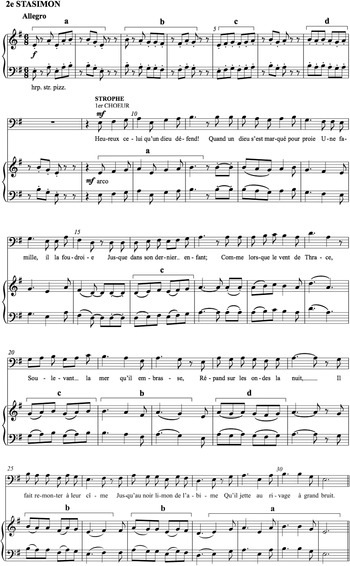
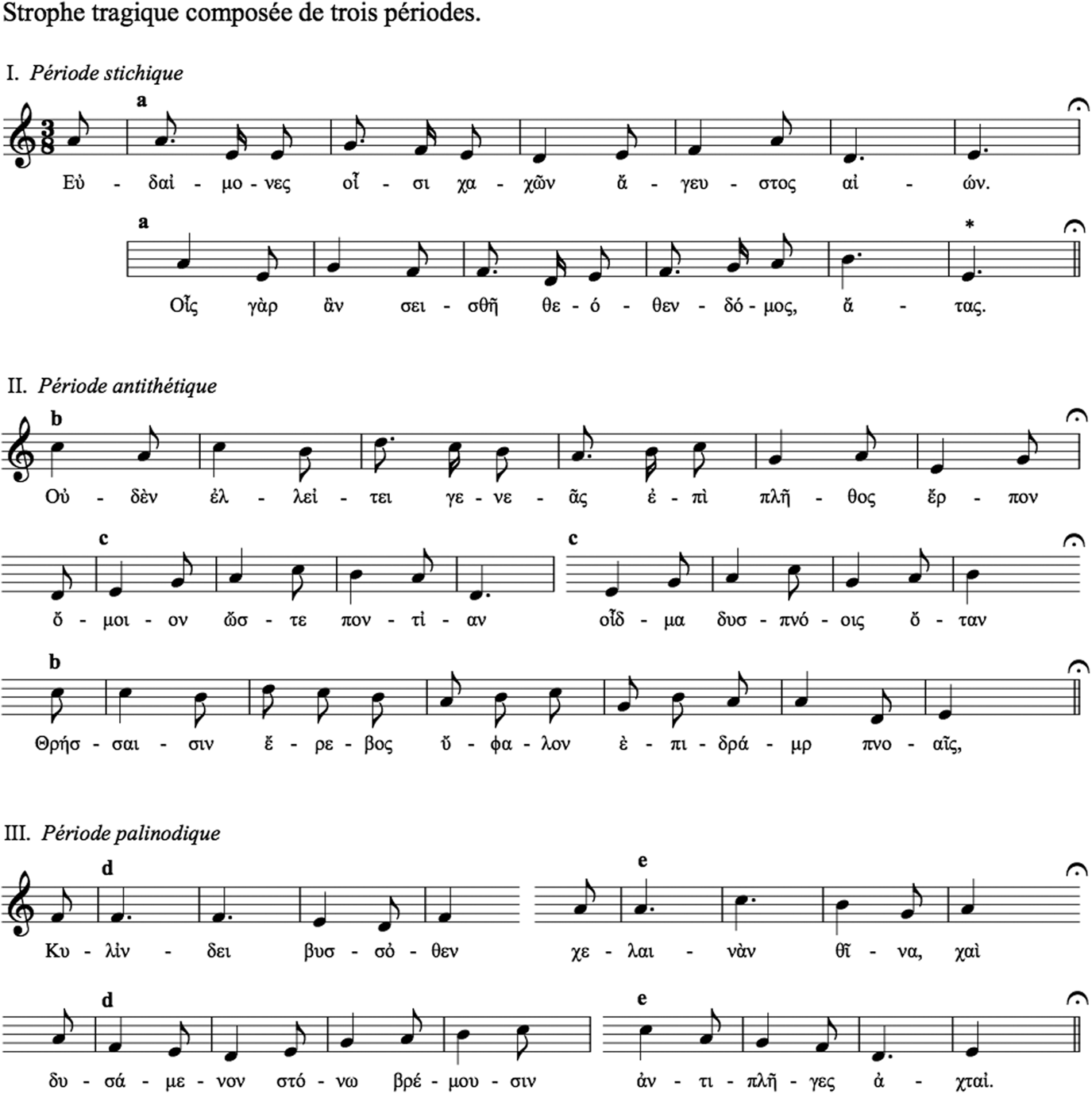
How did the text shape melodic choices? Two different approaches give an idea of the wide scope of the nineteenth-century Hellenistic imagination. Example 5a is Saint-Saëns's setting of the second stasimon in vocal score reduction. Example 5b gives a hypothetical monophonic realization of the same stasimon provided by Gevaert based on factors such as Greek poetic metre, suppositions about intonation, consideration of syntactical principles, and supposed links to the style of both chant and modern Greek folksong.
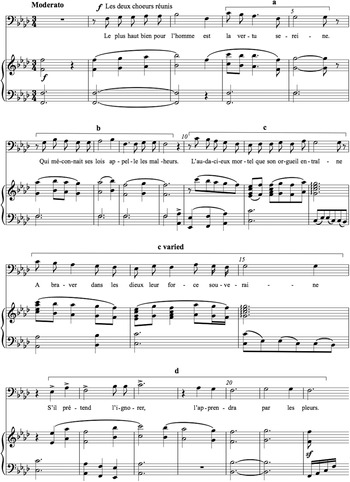
Saint-Saëns, Antigone, setting of second stasimon (Durand, 1893)

Gevaert, realization of second stasimon, Sophocles, Antigone

We turn first to the Saint-Saëns version. Citing Aristotle's dictum that music was but ‘seasoning’ for poetry, Gevaert noted near the beginning of his first volume that for the ancients ‘the poetic content of a piece was more important than melody and harmony’.Footnote 19 To judge by the textures that Saint-Saëns chose, one might very well imagine that Gevaert's remark caught his eye. In Example 5a, Saint-Saëns adheres to austere syllabic choral unison in transposed Greek hypodorian (E–F#–G–A–B–C–D–E) where B divides the modal octave into the interval of a fifth (below) and a fourth (above), and functions as a melodic ‘dominant’ while E functions as ‘tonic’. (This is unlike the medieval modal system where the ‘tonic’ function would remain B in the plagal form). Saint-Saëns follows Gevaert's description of the mode, in particular the attribution of ‘dominant’ function to the final of the mode (B).Footnote 20 The melodic line here remains confined to a limited ambitus within the lower part of the modal octave. Unison strings accompany (without putatively more authentic single and double-reed timbres.) Here, as elsewhere in the score, Saint-Saëns put up only light resistance to the regularity of the verse: most of his music moves in two-bar groups, initiated by anacruses of various length as required by the verse accentuation and terminated by a strong downbeat followed by a rest. Beyond this regularity, however, there is little sense of a hierarchical organization of phrases or of shaping phrase groups at a higher temporal and structural level. At first blush, the passage might well seem unstructured, an ad hoc succession of two (and, occasionally, three) bar units. But what it does exhibit is a wilful strategy of creating motivic coherence, as indicated by the repeated melodic cells located with letters in the example. Four motifs (labelled a–d) can be identified in the eight-bar instrumental gambit and throughout the example in full, varied or truncated form. The stasimon begins and ends with the same melodic cell that is partially disguised through variation in rhythm.
Gevaert sets his speculative realization of the same stasimon, shown in Example 5b, in untransposed Greek dorian, with an E to E octave divided by the ‘dominant’ A. It moves predominantly in the lower part of the modal octave and remains syllabic throughout, a feature of Saint-Saëns's setting as well. But although both Saint-Saëns and Gevaert manifestly strove for authenticity, this ideal cut across the music in different ways. Not having to set a regular succession of poetic lines, Gevaert largely avoids two-bar groupings. And by providing a letter analysis in his score, he notes the applicability here of hierarchical periodic structures that he identified more generally in his study of Greek music: a succession of a période stichique (two symmetrical phrases, labelled a a), période antithétique (a palindrome with two longer phrases framing two shorter ones, b c c b) and période palinodique (two shorter phrases that are repeated, d e d e). Groupings identified by the same letters are certainly not identical, but similar enough in range and motif to warrant the labels, or at least so implies Gevaert. The periods are strongly articulated because each finishes on the co-final E and internal phrases are often articulated by fermate. For Gevaert, these periodic structures represented the lasting genius of ancient Greek music and established patterns that endured in European folk music.Footnote 21 The periodic and phrase subdivisions in the choral stasima of staged tragedy in particular were what Gevaert (and others) called orchestiques, that is, meant to shape the gestures and movement of the chorus.
In short, although Saint-Saëns and Gevaert both strive for coherence, they conceive it in different ways – phrase structural (with irregular phrase lengths) in Gevaert, motivic (with more regular phrase lengths) in Saint-Saëns. Although Saint-Saëns took Gevaert as a credible archaeologist who proposed plausible reconstructions, the source of Saint-Saëns's archéologie pure seems somewhat mysterious on the basis of a comparison of these two passages, both typical of the style of their respective larger works. The local-level repeat patterns in the Gevaert find no echo in the Saint-Saëns, where the motivic impulse seems more in tune with privileging organicism in the late nineteenth-century musical environment than with emulating phrase rhythms.
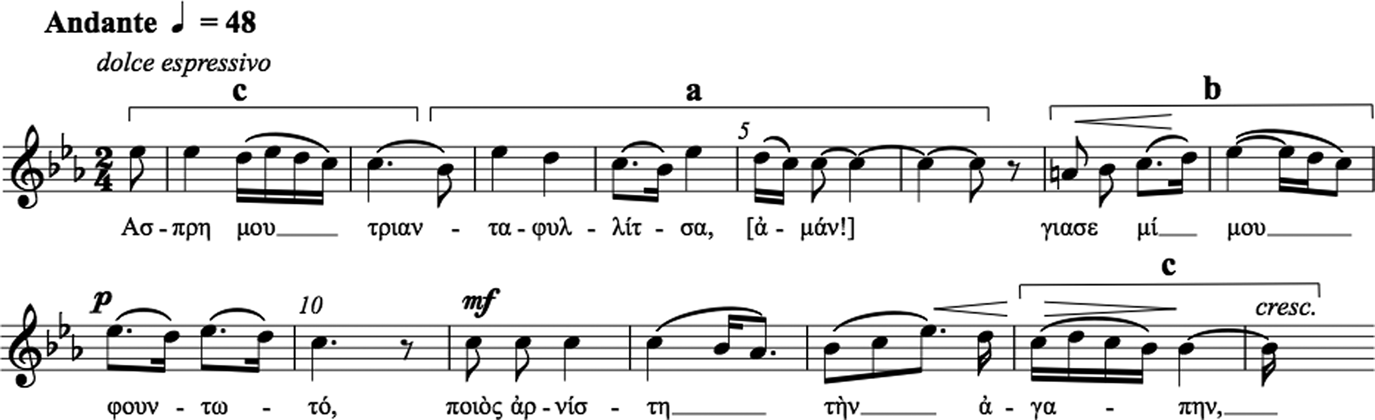
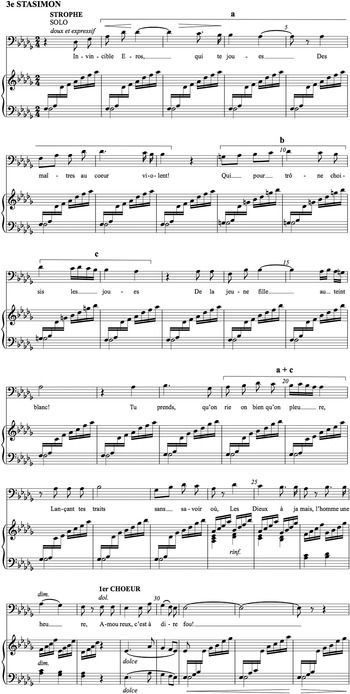
As I suggested above, another area where Saint-Saëns sacrificed authenticity was his decision to set the third stasimon for solo voice with arpeggiated chordal accompaniment. One of the motivations for this may well have been commercial: a piece for solo voice was sold as a separate extract from the incidental music as ‘Hymne à Éros’. But the decision also betrays a deeper aesthetic and ideological motivation. In his preface, Saint-Saëns says the number ‘imitated a Greek popular song recorded in Athens by M. Bourgault-Ducoudray’. The piece to which Saint-Saëns refers is the sixth song in Louis Bourgault-Ducoudray's Trente mélodies populaires de Grèce et d'orient, a project that Bourgault-Ducoudray had conceived with the goal of showing links between ancient and modern Greek folk music. Gevaert fundamentally agreed with this thesis.Footnote 22 All of this occurred within the larger envelope of turning to modern Greek for understanding the pronunciation of the ancient language.Footnote 23 Bourgault-Ducoudroy even begins his anthology with an extended explanation of Aristoxenian theory in order to provide a basis for understanding the modality of the folk tunes that he had collected in Greece. Besides the questionable nature of this thesis, the character of the collection as ethnography is further blemished by the addition of a piano accompaniment and Italian translations to the pieces, as if wishing to create a direct link between the misty ancient Greek past and the modern salon mondain. Saint-Saëns's ‘imitation’ is along the lines of his recasting of Pindar's Pythian ode that I discussed earlier, except it is now even looser in its variations. Examples 6a and 6b show how motifs from the original (labelled a, b and c, with c as a variant of the tail of a) are freely distributed in Saint-Saëns's reworking. There can be little doubt that Saint-Saëns's decision to write a calque of the song represents fundamental agreement with Bourgault-Ducoudroy's claims, indeed a kinetic exercise in them. We need to remember that Saint-Saëns was tasked to write music for an ancient play. To have merely copied Bourgault-Ducoudroy's sixth song for his incidental music would have been baldly anachronistic. Instead, the incorporation of motifs from a ‘modern’ piece into a classical Greek tragedy makes the point of a common basin of inspiration without inviting that charge. This brings to mind Samuel Dorf's discussion of Théodore Reinach's adaptation of Delphic inscriptions to Fauré's accompaniment, where continuity between ancient and modern culture is also posited as a motivating factor.Footnote 24 And, as we shall see shortly, such a model acted as the ideological substrate of the Théâtre d'Orange project as well.
Bourgault-Ducoudray, Trente mélodies populaires de Grèce et d'orient, No. 6

Saint-Saëns, Hymne à Éros, Antigone (Durand, 1893)

Saint-Saëns's ‘Hymne à Éros’ is anachronistic in another sense. It is ostensibly meant to be in Greek dorian mode (that is, with the modal octave in five flats from dominant F to dominant F, with a B@ final), but considering the harmonies that Saint-Saëns chooses it is very difficult to avoid the impression of a piece in D-flat major, a good lesson on how hard it is to break tonal habits of listening. An initial long F in the bass sounds like I6 harmony that moves to V/V (in D-flat) in bar 11. That harmony remains unresolved as the bass moves back down to F, but then strong articulation of a G-flat chord in bar 21 followed by an A-flat chord in bar 24 suggests a half-close cadence in D-flat.
Saint-Saëns's claims for archéologie pure in the incidental music for Antigone, then, are surely overstated. Instead of an effort to ‘restore’ as much Greek music as possible, his score gives the impression of a free play of compositional imagination based on a selective appreciation of Gevaert's study tinged with contemporary compositional habits. We might, however, also fairly describe it as a kind of research-creation, to use a modern expression that highlights its experimental orientation. For his part, Hugh Macdonald has suggested that on the face of it Saint-Saëns's music sounds no less modern in its own idiosyncratic way than contemporaneous works by Debussy and Satie.Footnote 25 Yet, scratch the surface and traditional orientations become more apparent (which one might also say about certain completely different kinds of pieces by the young Debussy). Modernist ambitions to increase expressive range, challenge the listener, claim compositional autonomy, or push syntactical envelopes do not seem operative in Saint-Saëns's work. Rather, the very strangeness of the score fed a mirage that Saint-Saëns brought back the sounds of centuries past.
Creating a Time Machine
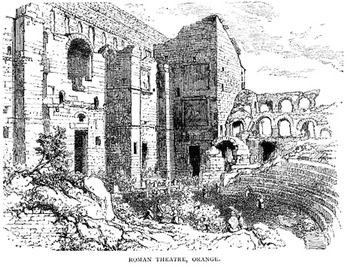
To underline this separation from modernist impulse, I want to consider how the (fictitious) immediacy of ancient culture that the Saint-Saëns score implicitly promised fit into a larger cultural practice around the Théâtre d'Orange. The large wall of the ancient Roman theatre that stood opposite a steep hillside of stone rafters – pockmarked by the ravages of time and overgrown with all manner of vegetation – caught the eye of two Provençal ‘nationalists’ Antony-Real (pseudonym for François-Fortuné Fernand-Michel) and Félix Ripert in the late 1860s as a site for opera performance. Figure 1 shows a drawing of the remains. Their plans culminated in an initial production on 21 August 1869 featuring Méhul's Joseph sung by Parisian opera stars of the day, including Palmyre Wertheimber for whom the great Provençal poet Fédéric Mistral penned a madrigal to celebrate the kind of song that caused ‘Provence, charmed, to believe that the sky had opened’ (‘En ausènt ta voues courouso,/Vivo, ardènto, pouderouso/La Prouvènço benurouso/ Creseguè lou cèu dubert’; ‘En entendant ta voix brillante/Vive, ardente, puissante./La Provence charmée/Crut le ciel entr'ouvert’).Footnote 26 Mistral and others of the Provençal literary movement called the Félibrige identified the Roman theatre as a potential hub for regional culture, indeed a celebration of it. Nevertheless, performances remained sporadic until the 1890s when under the stewardship Paul Mariéton, a protégé of Mistral, the summer seasons became more regular. An early highlight was the staging of two Greek tragedies on successive evenings, Oedipe roi and Antigone on 11–12 August 1894, plays that were to remain stalwarts of the summer repertory. Both productions brought the Comédie-Française cast to Provence and were accompanied by shorter pieces: a hymn to Pallas-Athéné composed by Saint-Saëns to a text by J.L. Croze on the first night and the recently discovered Hymne à Apollon in the Reinach/Fauré adaptation on the second night, the latter inviting comparison of a ‘real’ example of ancient Greek music with Saint-Saëns's imaginative recreation.
Roman Theatre, Orange (before restoration)

Other venues would follow before the turn of the century: the bullring in Béziers in 1898, already mentioned, and the Roman amphitheatre at Nîmes the following year. Greek tragedies were eventually performed at both. As Sabine Teulon Lardic has noted, there was a distinctly populist side to the productions, not only in the availability of inexpensive seating but also in the participation of amateur community groups in the performance, such as when Saint-Saëns's music for Antigone was used in Nîmes in 1912.Footnote 27 One has to wonder how amateur choral groups reacted to such an esoteric score. The enthusiasm for Greek tragedy performed in ancient theatres in southern France fit into a larger programme of figures such as Charles Maurras and the erstwhile symbolist Jean Moréas breaking free from Nordic, English, Germanic and Slavic literary influences. The short-lived École romane movement that congealed around these figures in the early 1890s attracted much interest from Félibrige writers, Mistral included, because it looked to Provençal literature and culture more generally as a nexus of Mediterranean civilization, situated between Spain on one side and Italy and Greece on the other. In a polemical piece for the literary journal La Plume entitled ‘Barbares et Romans’, Maurras wrote of a ‘mysterious rhythm extending from the Midi in undulations of light and consecrated by a thousand figures of speech. Latin, félibréen, Italian, Hellenistic: it is all the same [rhythm]’. In this spirit Maurras identified Provençal literature of the ninth century as an important conduit for the entry of ‘ancient rhythms’ into the stream of French letters. With a grandiose final flourish in the essay he recalled Ernest Renan's words on the Acropolis, when the great historian finally understood the ‘purified rhythm’ of Minerva after having come to it too late in life: ‘O noblesse, ô beauté simple et Vraie!’Footnote 28 On the same wavelength, Paul Mariéton sought to create a renaissance of theatre in the Greco-Latin tradition at the Théâtre d'Orange.Footnote 29 The goal of such initiatives was to communicate continuity (sometimes quite subterranean) with ancient aesthetic values, where perceptions of the classical were inseparable from a vaguely defined Mediterranean spirit. It was a project of transhistorical classicism where traditional views of links between ancient culture and le grand siècle of Racine, much challenged by the romantics, gave way to other (post-romantic … and post-Wagnerian) strategies of drawing connections.Footnote 30
Parisian audiences and reporters flocked to the Théâtre d'Orange performances of Sophocles in 1894. Edouard Conte, the reporter for L'Écho de Paris, reflected general sentiment by noting that predictions the actors would risk being dwarfed in the huge amphitheatre against its massive wall turned out to be unfounded. Instead, the setting contributed to magnifying their actions and words, and underlined the extent to which performances in Paris were out of place at the Comédie-Française. Slow, stately movement and declamation – now all the slower given the acoustic properties of the ancient space – fit the character of Sophocles’ tragedy. This was true ancient theatre. Seven thousand spectators – time travellers – sat spellbound in hushed silence that was rendered more dramatic on one of the evenings because the wind caused disruption of power supply to the electric lights in the stands. Only the stage remained illuminated, another unavoidable product of modern adaptation, and the billowing of the actors’ robes in the light produced a striking effect.
A parallel to another, by now famous, summer festival suggested itself to many. Jacques Normand of La Gaulois wrote:
Two years ago I went on le pèlerinage artistique de Bayreuth. Now it is the turn of Orange, for the word pilgrimage suits such an enormous movement of humanity to this small Provençal town, towards this admirable theatre, the ruins of which, baked in the sun for so many years, rise victoriously towards the sky.Footnote 31
The adverb ‘victoriously’ deserves special attention here. Normand closed his article by calling on the festival to be run regularly with the goal of creating a Bayreuth national and citing founder of the festival Antony Réal: ‘Bayreuth français! That is to say the very soul of France will dominate these sublime manifestations of national art’. This was a Bayreuth français projected through regionalism: it is worth recalling that many papers reported that on the first evening the presence of Fédéric Mistral drew an extended ovation from the audience, much larger than that accorded the three government ministers sent from Paris.Footnote 32 Emile Berr of Le Figaro was more taken up with practical – and decidedly modern – issues: ‘Dare I remind the municipality of Orange that if it wants to create a Bayreuth français, as has been said, then it has to learn a lot.’Footnote 33 Many reviewers complained about the lack tourist infrastructure in the small town of 7,000 that welcomed an equal number of spectators for the show: hotels were unavailable, restaurants few. Bayreuth, equally small, was much further along in accommodating such tourist traffic.
Saint-Saëns's score for Antigone barely got a mention in the critical reception of the Théâtre d'Orange performance of 1894, let alone received a sustained reflection on its place within the cultural project of nationalist regionalism. We are left to make the case for links to a new kind of post-Wagnerian classicism – with Bayreuth as a competitive foil rather than a model to emulate – from the score itself. But modal music more remarkable for its strangeness than for its range of affect does not lend itself well to critical discourses of classicism. To draw the link we might focus on Saint-Saëns's own stated goal of textural clarity as well as the austere textures and relative lack of expression of the score. In his Le Figaro article on the piece, Saint-Saëns noted that he had written music ‘bereft of all the resources of modern art to which audiences have become accustomed’. One might certainly understand that statement within a classical frame of reference. Or we might seek out the classical ‘spirit’ that links Saint-Saëns's experiment with the Hellenistic past or simply describe its participation as a component of a French Gesamtkunstwerk-as-time machine.
In this light, Saint-Saëns's setting for Croze's Hymne à Pallas-Athèné is eloquent, although it is much different from the incidental music to Antigone because it is composed in late-nineteenth century style. The text begins by drawing attention to the fate of the ancient Gods: ‘Les Dieux sont morts, leur culte aboli: c'est à peine/Si leur grand nom par une levre humaine/Est encore murmuré’(The Gods are dead, their worship abolished: hardly a human lip murmurs their great name). Saint-Saens sets this with an updated sarabande in D minor. The archaic musical topic draws attention to the idea of the Past writ large. Shimmering arpeggios bring in a change of affect: ‘Et quelle blanche forme apparait aujourd'hui?/ Grandie à l'aube qui se lève,/Elle semble, dans sa beauté,/La vivante splendour d'un rêve’ (And what white image appears today? Growing out of emerging dawn, in her beauty she seems like the living splendour of a dream). Such is Pallas Athena, treated musically here like a dea ex machina. Heroic sounding octaves accompany the description of her journey from the Parthenon to establish a temple where the souls of the ancient Gods might be reborn. ‘La Provence est soeur de la Grèce’, writes Croze and ‘Les Provençaux nouveaux Hellènes’ (Provence is sister to Greece … The Provençals new Greeks). And the Théâtre d'Orange will become the new Parthenon: ‘Le temple est là debout: que ta gloire y pénètre’ (The temple stands tall: let your glory fill it). Saint-Saens's music becomes ever more emphatic in the piece, almost as if seeking to will the ancient goddess into (re)existence. And we might say the same of his will in the unusual incidental music for Antigone, now a concrete effort actually to simulate the past – if a no less futile one.