Global production and consumption of pomegranate fruit have greatly increased in recent years up to 15 million metric tons (Fruit Market Reports, 2013), partly due to recognition of the health-promoting potential of various components of this fruit in human (Aviram et al. Reference Aviram, Volkova, Coleman, Dreher, Reddy, Ferreira and Rosenblat2008). This led to development of advanced industrial technologies, which provide consumers with ‘ready to eat’ pomegranate grains and fresh juices (Shabtay et al. Reference Shabtay, Nikbachat, Zenou, Yosef, Arkin, Sneer, Shwimmer, Yaari, Budman, Agmon and Miron2012). This development increased global production of fresh pomegranate pulp (PP), which is usually very wet (~20% DM) and may contain readily fermentable soluble sugars, resulting in spoilage under aerobic conditions (Eliyahu et al. Reference Eliyahu, Yosef, Weinberg, Hen, Nikbachat, Solomon, Mabjeesh and Miron2015b). Spoilage might lead to unpleasant odours and attract flies, creating an environmental nuisance (Shabtay et al. Reference Shabtay, Eitam, Tadmor, Orlov, Meir, Weinberg, Weinberg, Chen, Brosh, Izhaki and Kerem2008). Disposal of PP by drying or burying is not cost-efficient; a better alternative is to use PP for feeding ruminants. However, processing of pomegranate fruit to produce PP is limited to its short harvest season (September through December). Thus, seasonal limitations on the one hand, and high contents of moisture and fermentable sugars which interfere with preservation on the other, are the main obstacles for standardization of PP as continuous and steady ingredient in ruminant rations. A previous study examined direct ensiling in glass silos of fresh PP solely or in a mixture with various drier feeds. Results showed that without addition of drier feeds, high fermentation losses occurred (about 20% of DM) accompanied with reduction of in vivo DM digestibility of the ensiled PP in sheep (Eliyahu et al. Reference Eliyahu, Yosef, Weinberg, Hen, Nikbachat, Solomon, Mabjeesh and Miron2015b). The best combination used for successful ensiling of PP in the glass silos was a mixture of fresh PP with soy hulls and corn silage at DM proportions of: 40:35:25, respectively. Therefore this PP mixture (PPM) was used in the present study for ensiling in large bales wrapped with polyethylene layers and used to measure its nutritive value as feed supplement for lactating cows.
It was previously shown that supplementation of wet fresh PP (up to 20% of dietary DM), promotes an increase in feed intake and a tendency to increase weight gain in bull calves (Shabtay et al. Reference Shabtay, Eitam, Tadmor, Orlov, Meir, Weinberg, Weinberg, Chen, Brosh, Izhaki and Kerem2008). In addition, inclusion of up to 4% concentrated extract of PP in the total mixed ration (TMR) of lactating cows, increased their milk production and improved their health status (Shabtay et al. Reference Shabtay, Nikbachat, Zenou, Yosef, Arkin, Sneer, Shwimmer, Yaari, Budman, Agmon and Miron2012). However, fresh pomegranate pulp contains high levels of soluble phenolics and NDF which impaired its voluntary consumption by sheep to a maximal level of 20% in concentrated or wheat hay based rations (Eliyahu et al. Reference Eliyahu, Shaani, Yosef, Ben-Meir, Nikbachat, Solomon, Mabjeesh, Weinberg and Miron2015a, Reference Eliyahu, Yosef, Weinberg, Hen, Nikbachat, Solomon, Mabjeesh and Mironb). In view of these results, it was clear that restricted amount of ensiled PPM should be fed to the lactating cows, and therefore a level of 8% PP in the PPM-TMR was chosen for the present study.
The objective was to study the effect of including 20% ensiled PPM (containing 8% PP) in dairy cow TMR, on: voluntary DM intake, milk yield, milk composition and in vivo digestibility, compared with a control group fed corn grains as PP substitute.
Materials and methods
Ensiling of pomegranate pulp with solid additives
The PP used in this study was freshly obtained from the fruit juice factory, Primor, (Kibutz-Gat, Israel). A previous study (Eliyahu et al. Reference Eliyahu, Shaani, Yosef, Ben-Meir, Nikbachat, Solomon, Mabjeesh, Weinberg and Miron2015a) demonstrated that a mixture (on DM basis) of 40% fresh PP, 35% soy hulls, and 25% corn silage was successfully ensiled in glass silos and resulted in low pH (3·86), relatively high DM content (34·7%), high content of NDF (53·9%), low DM loss during ensiling (5·58%) and 66·2% in vitro DM digestibility. Therefore, on March 10, 2013, 22 tons of ensiled PPM were prepared at Massuot Yizkhak feeding centre, with a baling machine (New Mix, Massuot Yizkhak, Israel). The fresh PPM was premixed for 10 min in a mixing wagon (Lachish IndustriesLTD, Sderot, Israel) and loaded into a compression chamber by a conveyor belt; the compressed bales were then lowered on to a rotating tray and wrapped with 8–9 layers of stretch polyethylene UV resistant film, 32 μm thickness (Poleg Industries, Kibbutz Gevim, Israel) as previously described (Weinberg et al. Reference Weinberg, Chen, Miron, Raviv, Nahim, Bloch, Yosef, Nikbahat and Miron2011). 32 bales of about 700 kg each were prepared and stored (ensiled) outdoor for 60 days at ARO feeding centre until May 2013. Ambient temperatures were 25–28°C during the outdoor storage period. The dimensions of the bales were 1·1 × 0·9 × 0·9 m3. The 32 bales were weighed at packing and before opening for the feeding trial, and only 1·5 + 0·1% weight loss was found in these ensiled bales. DM content of the PPM in the bales was not changes during their ensiling (34·7 ± 0·3%).
Analytical procedures and in vitro digestibility
Dry matter content of PPM before and after ensiling, TMR samples, orts, and faeces samples from the cows, was determined by drying in an air-forced oven for 48 h at 60 °C. Ash was determined as the residue after 3 h burning at 600 °C (AOAC, 1980). Water extract was prepared manually (5 g DM/100 g water, in triplicates) from each replicate of the TMRs and from the ensiled PPM (four replicates) to determine content of total soluble phenolics by the method of Kanner et al. (Reference Kanner, Frankel, Granit, German and Kinsella1994) and water soluble carbohydrate (WSC) according to Dubois et al. (Reference Dubois, Gilles, Hamilton, Rebes and Smith1956). Neutral detergent fiber (NDF) with heat-stable amylase and without Na-sulfite, acid detergent fiber (ADF) and acid detergent lignin, were determined in dried (for 48 h at 60 °C), ground (1-mm sieve) samples according to the sequential method of Van Soest et al. (Reference Van Soest, Robertson and Lewis1991) by an ANKOM fiber analyzer (ANKOM220 Technology, Macedon, NY, USA). Cellulose was calculated as ADF – ADL and hemicelluloses was calculated as NDF – ADF. Crude protein (CP) was determined according to the Kjeldahl method (procedure 14·068 in AOAC, 1980). Ether extract (EE) was determined according to AOAC procedure 14·131, (1980). Analyses were performed in triplicates and means are presented with standard error of the means (SEM). pH was determined in rumen fluid samples with a pH-metre (PL 600, MRC, Netanya, Israel). Particle-size distribution of TMRs was determined by a Penn State Particle Separator, with a 19-mm screen (long), an 8-mm screen (medium), and a pan (fine) (Lammers et al. Reference Lammers, Buckmaster and Heinrichs1996). The content of physically effective NDF remaining above the 8-mm sieve of the separator was designated peNDF > 8 mm.
In vitro DM digestibility (IVDMD) and in vitro NDF digestibility (IVNDFD) were analyzed in the dried ground samples according to the two-stage technique of Tilley & Terry (Reference Tilley and Terry1963) using rumen fluid obtained from two ruminally fistulated dry Holstein cows, with each sample in four replicates. The rumen fluid donor-cows were fed 7 kg (DM) of wheat hay and 3 kg (DM) of total mixed ration (TMR) comprised of 300 g/kg grains, 350 g/kg wheat silage, 150 g/kg soybean meal, and 200 g/kg by-products (cottonseed, wheat bran, and gluten feed).
Intake and performance in lactating cows
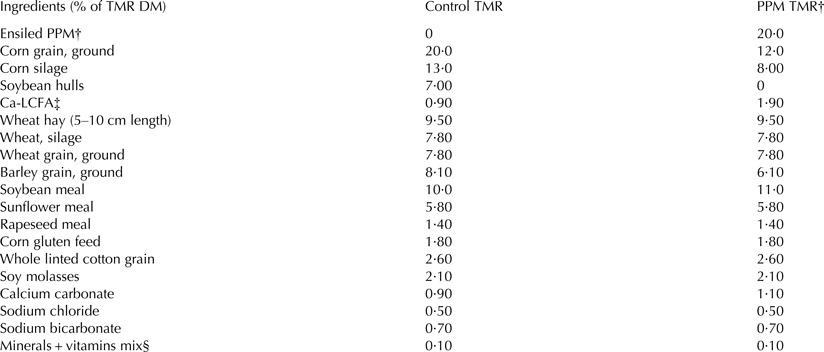
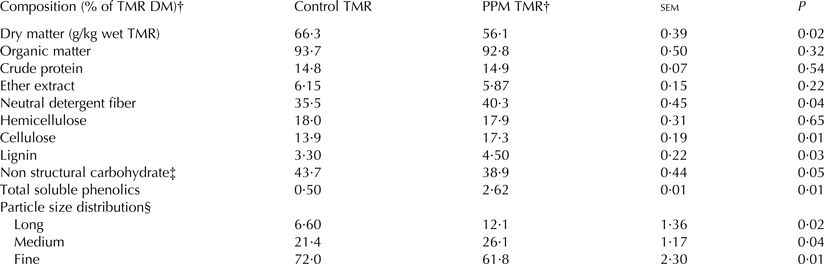
The 32 ensiled PPM bales were transferred to Yavne Feeding Centre, (Kibutz Yavne, Israel) on May 2013. The PPM TMR and control TMR were freshly prepared every day in Yavne Feeding Centre, delivered to the Agricultural Research Organization dairy barn in Bet-Dagan (Israel), and fed to one of the two groups of 21 lactating cows each. Composition of the two TMR ingredients is presented in Table 1 and their chemical and structural composition in Table 2. The ensiled PPM was included in the PPM-TMR at a level of 20% of TMR DM, that actually supply 8% PP as corn grain replacer, bringing the contribution of PPM soluble phenolics in the TMR to 2·62% assuming that this level of soluble phenolics will not affect negatively cow's performance. The two groups of cows were similar at the onset of the experiment (Mean + se) in lactation number (3·3 + 0·3), days in milking (192 + 7·0) and milk yield (45·3 + 0·96). Cows were blocked by DIM (60–120 vs. 120–180) and daily milk production (35–40 vs. 40–50 kg/cow) and randomly assigned within block to pairs fed the two dietary treatments. The two groups were adapted to the individual dairy barn for 1 week followed by 1 weeks of gradual adaptation to the two TMRs (control vs. PPM) and 6 weeks of experiment. The two TMRs were fed individually once per day at 1000 h ad libitum, allowing for 5–10% orts, and cows were milked 3 times per day at 0600, 1400, and 2200 h. Cows were fed individually via a computerized monitoring system designed to electronically identify individual cows and to automatically control and record each cow's daily feed intake (Miron et al. Reference Miron, Yosef, Maltz and Halachmi2003). Daily DMI of individual cows was determined based on DM content in TMR and feed refusals sampled daily. Recumbence time for each cow, an indicator of animal welfare (Drissler et al. Reference Drissler, Gaworski, Tucker and Weary2005), was recorded daily by an automatic metre located within each cow's pedometer (Afimilk Ltd., Kibbutz Afikim, Israel). Body weight (BW) data were recorded by an automatic walk-over scale 3 times per day while cows were entering the milking parlour. Changes in BW were calculated as the gap between the week before the onset of the experiment and at week 6 of the experiment. Milk yield (kg) and content of milk fat, protein, and lactose, were recorded daily for each cow by an automatic metre equipped with on-line near-infra-red-spectroscopy measurement (Afilab, Afimilk Ltd., Kibbutz Afikim, Israel). In parallel for validation of the on-line milk composition measurement, milk samples were collected in 3 sequential milking's on a weekly basis throughout the study, stored at 4 °C in the presence of 2-bromo-2-nitropropane-1,3-diol, until infrared analysis for fat, protein, urea and lactose content, using a MilkoScan 4000 analyzer (Foss Electric A/S, Hillerød, Denmark). Energy corrected milk (ECM) yield was calculated using the following equation (NRC, 2001): ECM (kg/d) = milk yield (kg/d) × {[0·3887 × milk fat (%)] + [0·2356 × milk protein-urea (%)] + [0·1653 × milk lactose (%)]}/3·1338 MJ/kg. Animal performance study was conducted according to the guidelines and under the supervision of ARO Animal Care Committee.
Ingredients of the total mixed rations (TMR) fed to lactating cows

The ensiled PPM was characterized by acidic pH (3·86), 34·7% DM content and its chemical composition on DM basis was: 0·42% water soluble carbohydrate, 11·2% crude protein, 53·8% neutral detergent fiber, 17·1% hemicelluloses, 29·4% cellulose, 7·31% lignin, 11·1% total soluble phenolics, 67·5% in vitro DM digestibility, and 52·3% in vitro NDF digestibility
† PPM = ensiled mixture of pomegranate pulp with drier feeds composed of: 40% pomegranate pulp, 25% corn silage and 35% soybean hulls on DM basis. The ensiling occurred in pressed bales wrapped with polyethylene stretched films
‡ Calcium salts of long-chain fatty acids
§ Containing (g/kg of mix DM): Zn, 24; Fe, 24; Cu, 12·8; Mn, 24; I, 1·44; Co, 0·32; Se, 0·32; 16 000 000 IU of vitamin A; 3 200 000 IU of vitamin D3; and 48 000 IU of vitamin E
Chemical and structural composition of the total mixed rations (TMR) fed to lactating cows
† Ensiled PPM = ensiled pomegranate pulp mixture composed of: 40% pomegranate pulp, 25% corn silage and 35% soybean hulls on DM basis. The ensiling occurred in pressed bales wrapped with polyethylene stretched films
‡ NSC = Non-structural carbohydrates including soluble phenolics calculated as: organic matter – NDF – crude protein – ether extract
§ Particle size distribution was determined by a Penn State Particle Separator, which has a 19-mm screen (long), 8-mm screen (medium), and a pan (fine)
In vivo digestibility measurements in lactating cows
At week 5 of the experiment, 4 days were assigned for daily sampling of TMR, feed refusals, and faeces from 7 cows from each of the two dietary treatments. The 14 cows used for the digestion study were selected in pairs to obtain two groups from the two dietary treatments similar in milk yield (47·0 kg/d). Estimation of daily faecal excretion was based on indigestible NDF concentrations in faeces and the TMRs. Samples of the TMR and refusals were composited on a daily basis, dried (60 °C for 48 h), and ground through a 1-mm sieve (S-M-100; Retsch GmbH, Haan, Germany). Faecal grab samples were collected 3 times daily for 4 days, at 8-h intervals, each day 2·5 h later than the preceding day. Faecal samples were composited (on a DM basis) from each cow during the collection period, dried at 60 °C for 48 h in a forced-air oven, ground to pass through 1-mm sieve, and then used for chemical analyses as described above, and for indigestible NDF content in the TMR and faecal pooled samples. The two-stage in vitro digestibility technique of Tilley & Terry (Reference Tilley and Terry1963) was used to analyze the content of residual indigestible NDF in the TMR and in the pooled faecal samples of each cow, after incubation with rumen fluid for 72 h followed by incubation for 48 h with HCl-pepsin (Adin et al. Reference Adin, Solomon, Nikbachat, Zenou, Yosef, Brosh, Shabtay, Mabjeesh, Halachmi and Miron2009). The quantitative ratio indigestible NDF in TMR/indigestible NDF in faeces is identical to the ratio Faecal DM/DMI of each cow, which is actually the reciprocal of in vivo DM digestibility according to the following equation (Adin et al. Reference Adin, Solomon, Nikbachat, Zenou, Yosef, Brosh, Shabtay, Mabjeesh, Halachmi and Miron2009):
 $$\eqalign{&\hbox{DM digestibility}\, = \, \cr & \quad 1 - \left( \hbox{TMR indigestible NDF}/\hbox{fecal indigestible NDF} \right)}$$
The digestibility values of each chemical component (i.e., DM, CP, NDF, cellulose, and hemicellulose) were calculated for every cow using its proportion between intake and faecal output according to the equation presented in Adin et al. (Reference Adin, Solomon, Nikbachat, Zenou, Yosef, Brosh, Shabtay, Mabjeesh, Halachmi and Miron2009).
Rumen pH and in vitro methane production measurement
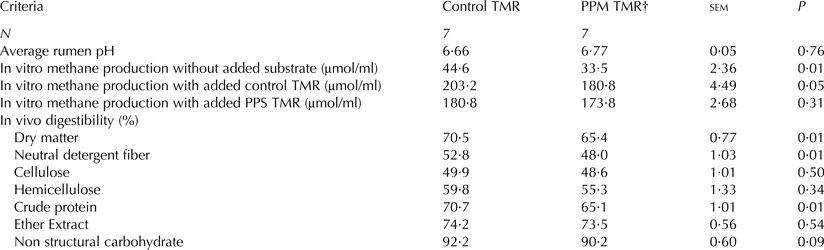
The 7 cows from each group used for digestibility measurements, were also sampled during every day of week 6 for rumen fluid. During this week cows were fed once a day at 0600 for 1 h, following by feed prevention for 6 h and then aloud to eat for ad-lib intake. This feeding routine was chosen since preliminary observations have demonstrated maximal and minimal rumen pH at 1 h pre-feeding and 6 h post feeding, respectively. 500 ml of rumen fluid samples free of saliva were collected from each cow with a rumen vacuum sampler at 1 h pre-feeding and 6 h after feeding. The vacuum pump was turned on only after the metal coated sampler pipe was inserted through the oesophagus and located in the rumen math, to avoid saliva contamination. The rumen pH values were immediately determined by a portable pH-metre (PL 600, MRC Israel), and daily average rumen pH data is presented in Table 3.
Rumen parameters and digestibility of the two total mixed rations (TMR) fed to lactating cows
† PPM = ensiled pomegranate pulp mixture composed of: 40% pomegranate pulp, 25% corn silage and 35% soybean hulls on DM basis. The ensiling occurred in pressed bales wrapped with polyethylene stretched films
Methane production in vitro was measured twice during the last week of the experiment in those seven cows from each treatment. Rumen fluid was sampled 6 h after feeding from each cow, and 1 ml of it was mixed with 2 ml of buffer (Tilley & Terry, Reference Tilley and Terry1963) in rubber sealed anaerobic 5 ml GC vials (SUPLECO, USA). Each source of rumen fluid from each cow was incubated (in triplicate vials) without substrate, with 50 mg control TMR, and with 50 mg PPM TMR. Vials were incubated for 48 h at 38 °C, and then 500 µl of the upper gas phase produced in each vial were sampled by automatic sampler and injected into gas chromatograph (GC 5890 Hewlett Packard, USA) equipped with semi-capillary column (SUPLECO, USA molsieve 5A), and FID detector, for quantitative methane measurement according to the method of Harinder et al. (Reference Harinder, Makkar and Vercoe2007).
Statistical analyses
Differences between the two types of TMR fed to 21 pairs of lactating cows with respect to chemical composition (Table 2), in vivo digestibility, rumen pH and in vitro methane production (Table 3), were tested for significance by F-test using JMP-5 software (SAS, 1996). Tukey test (SAS, 1996) was used for comparison between means.
Daily DM intake, BW, milk yield, milk fat, protein and lactose content, ECM yield, and recumbence time (Table 4) were averaged by cow for the 42 d in the experiment (42 repeated measures for each cow). Data were analyzed as a randomized complete block design using the mixed model of SAS software (SAS, 1996). The statistical model included the effects of dietary treatment, block, and cow by block interaction. Cow within block was delineated as the random effect in the model and used to test treatment and block effects, whereas repeated measurement of daily data were tested for the residual error.
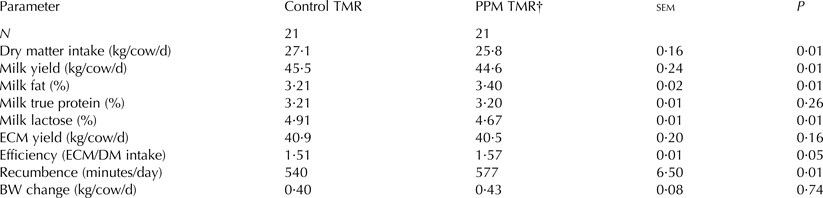
Intake and performance in lactating cows fed the two total mixed rations (TMR)
† PPM = ensiled pomegranate pulp mixture composed of: 40% pomegranate pulp, 25% corn silage and 35% soybean hulls on DM basis. The ensiling occurred in pressed bales wrapped with polyethylene stretched films
Results
Composition and in vitro digestibility of the ensiled PPM are shown in the footnotes of Table 1. Chemical composition of the two TMR fed to lactating cows is shown in Table 2. Data show similar content of CP in the two diets, but higher content of NDF, cellulose, lignin and soluble phenolics in the PPM-TMR compared with the control TMR.
In vivo digestibility data of the two TMRs fed individually to lactating cows are in Table 3 and intake and performance data are in Table 4. Cows fed the control TMR showed higher intake and digestibility values and therefore ingested 5·04% more DM (P = 0·01) than the PPM cows. The control group ingested 7·5% less NDF and 4·4% more CP than the PPM cows. The control group had 10% advantage in NDF digestibility and 8·6% advantage in CP digestibility, compared with the PPM cows (Table 3). Average daily rumen pH values were similar and relatively high in cows fed the two TMR. In vitro methane accumulative production without added substrate was reduced by 25% (P < 0·01) in rumen fluid sampled from the cows fed ensiled PPM compared with the control cows. In addition, significant methane inhibition (11%) was observed in the PPM rumen fluid when incubated with added control substrate (Table 3).
The higher intake of digestible DM in the control cows resulted in 2·01% higher milk yield (P < 0·01) of this group compared with the PPM cows. However, milk fat content was higher (P < 0·01) in cows fed the PPM TMR, while milk protein content was similar in both groups, and this was reflected in similar ECM yield of both groups. The lower intake and similar ECM yield of the PPM cows were reflected in a 3·97% increase (P < 0·05) in production efficiency (ECM/DMI) compared with the control cows. The welfare of the cows as assessed by length of daily recumbence time was slightly improved by 37 min in the PPM cows compared with the control group, however, both groups were in the normal recumbence range of non- stressed milking cows (500–600 min/d). Both groups gained similar BW gain during the 6 weeks of experimental period.
Discussion
In the present study low level of soluble phenolics from PP was included in the PPM -TMR (2·62%, Table 2) resulting in improved fat yield, similar ECM yield and improved ECM production efficiency compared to the control TMR (Table 4). Part of the improved efficiency in the PPM cows could be attributed to 25% inhibition of in vitro methane production by ruminal mathanogenic bacteria of the PPM cows compared with the control cows (Table 3). The ensiled PPM apparently inhibited methanogenesis by rumen bacteria with or without PPM-TMR addition to the in vitro vials (Table 3). Reduction of methanogenesis by PPM phenolics in the rumen might save energy which otherwise is wasted as CH4 gas, resulting in improve production efficiency in lactating ruminants as demonstrated previously by Aerts et al. (Reference Aerts, Barry and McNabb1999) and in the present study (Table 4). Pomegranate pulp is rich in tannins (Shabtay et al. Reference Shabtay, Eitam, Tadmor, Orlov, Meir, Weinberg, Weinberg, Chen, Brosh, Izhaki and Kerem2008), which have been shown to have both adverse and beneficial effects in ruminants (Makkar, Reference Makkar2003). Punicalagin was the most abundant tannic component in concentrate water extract of pomegranate pulp (at 2·65% of DM, Shabtay et al. Reference Shabtay, Nikbachat, Zenou, Yosef, Arkin, Sneer, Shwimmer, Yaari, Budman, Agmon and Miron2012). Previous studies showed that moderate concentrations of tannins (2–4% of DM) in the diet improved production efficiency of ruminants, without increasing DM intake, as manifested by increased wool growth, BW gain, milk yield and ovulation rate (Aerts et al. Reference Aerts, Barry and McNabb1999). Similar positive effects of 20% pomegranate pulp addition on palatability and DM intake was found in calves at 11 months of age, fed fresh pomegranate peels in addition to a mixed ration, which showed linear increase in PP intake during feeding without adverse effects on BW gain (Shabtay et al. Reference Shabtay, Eitam, Tadmor, Orlov, Meir, Weinberg, Weinberg, Chen, Brosh, Izhaki and Kerem2008). A similar trend was also observed in a previous study with lactating cows, fed additive of 4% concentrated extract of PP containing 0·9% soluble phenolics, which resulted in 6·4% increase in milk production in early lactation cows (Shabtay et al. Reference Shabtay, Nikbachat, Zenou, Yosef, Arkin, Sneer, Shwimmer, Yaari, Budman, Agmon and Miron2012).
The improved milk fat content in the PPM cows might also be associated with the higher NDF and cellulose content and the higher content of peNDF > 8 mm of the PPM TMR (Table 2) compared with the control TMR, as well as the similar cellulose and EE digestibility of the two rations that probably encouraged milk fat production (Adin et al. Reference Adin, Solomon, Nikbachat, Zenou, Yosef, Brosh, Shabtay, Mabjeesh, Halachmi and Miron2009).
On the other hand, in the present study cows fed the control TMR showed higher DM intake and DM digestibility values and therefore ingested 5·04% more DM (P = 0·01) than the PPM cows (Tables 3 and 4). One explanation for this advantage in intake is probably related to the lower NDF and peNDF > 8 mm content of the control TMR (Table 2), and to the higher in vivo DM and NDF digestibility of the control cows fed 8% highly digestible corn grain as substitute for 8% less digestible PP in the PPM group (Eliyahu et al. Reference Eliyahu, Shaani, Yosef, Ben-Meir, Nikbachat, Solomon, Mabjeesh, Weinberg and Miron2015a). An additional explanation might be related to the negative effects of soluble phenolics on DMI as well as NDF and CP digestibility in cows fed ensiled PPM (Tables 3 and 4), resulting in decreased production of milk and milk lactose compared with the control TMR (Table 4). Support to these findings is given from previous studies showing that high concentrations of hydrolysable tannins may reduce DM intake, digestibility of proteins and carbohydrates as well as animal performance, through negative effects on palatability and digestion (Broderick et al. Reference Broderick, Wallace, Ørskov, Tsuda, Sasaki and Kawashima1991; Reed, Reference Reed1995). Similar findings were observed in lactating goats fed an additive of 6 or 12% pomegranate seed pulp, resulting in little reduction in DM intake, milk yield, and milk solids yield (Modarasi et al. Reference Modarasi, Fathi, Nasri, Rashidi, Dayani and Kebreab2011). In accord, a previous study showed negative lignin digestibility and low CP digestibility in sheep fed a TMR containing 51% PPM and 5·85% soluble phenolics, which demonstrated the formation of indigestible complexes between dietary protein and tannins in the digestive tract (Eliyahu et al. Reference Eliyahu, Shaani, Yosef, Ben-Meir, Nikbachat, Solomon, Mabjeesh, Weinberg and Miron2015a).
The discrepancy between previous studies with respect to pomegranate tannins effects on intake, digestibility and performance of ruminants, might be associated with differences among studies, in the diets used as well as the quantity, type and features of the hydrolysable tannins of the various pomegranate additives used: ensiled PPM in the present study and in the study of Eliyahu et al. (Reference Eliyahu, Shaani, Yosef, Ben-Meir, Nikbachat, Solomon, Mabjeesh, Weinberg and Miron2015a); concentrated PP extract in the study of Shabtay et al. (Reference Shabtay, Nikbachat, Zenou, Yosef, Arkin, Sneer, Shwimmer, Yaari, Budman, Agmon and Miron2012); seed pulp in the goat study (Modarasi et al. Reference Modarasi, Fathi, Nasri, Rashidi, Dayani and Kebreab2011); and fresh wet peels in the calf study (Shabtay et al. Reference Shabtay, Eitam, Tadmor, Orlov, Meir, Weinberg, Weinberg, Chen, Brosh, Izhaki and Kerem2008) and in the sheep digestion study of Eliyahu et al. (Reference Eliyahu, Yosef, Weinberg, Hen, Nikbachat, Solomon, Mabjeesh and Miron2015b).
In addition, in the present study the ensiled PPM contained less water soluble carbohydrate (0·42% WSC in DM PPM, Table 1) than the fresh PP or the concentrated extract of PP used in some of the previous studies (Shabtay et al. Reference Shabtay, Eitam, Tadmor, Orlov, Meir, Weinberg, Weinberg, Chen, Brosh, Izhaki and Kerem2008, Reference Shabtay, Nikbachat, Zenou, Yosef, Arkin, Sneer, Shwimmer, Yaari, Budman, Agmon and Miron2012; Jami et al. Reference Jami, Shabtay, Miron and Mizrachi2012; Eliyahu et al. Reference Eliyahu, Yosef, Weinberg, Hen, Nikbachat, Solomon, Mabjeesh and Miron2015b). This difference in WSC content might attribute to the different effect on methanogenic activity observed in a previous study (Jami et al. Reference Jami, Shabtay, Miron and Mizrachi2012) that showed increased rumen methanogenic population in cow fed 4% concentrated extract of pomegranate pulp, whereas in the present study a decline in rumen methanogenic activity was found due to 8% PP feeding (Table 3). It is therefore suggested that inclusion in the TMR, levels of up to 4% PP or concentrated extract of PP, might not interact strongly with dietary proteins (Broderick et al. Reference Broderick, Wallace, Ørskov, Tsuda, Sasaki and Kawashima1991; Jami et al. Reference Jami, Shabtay, Miron and Mizrachi2012), or inhibit protease activity (Van Leeuwen et al. Reference Van Leeuwen, Jansman, Wiebenga, Koninkx and Mouwen1995) sufficient to negatively impair animal performance. However, the level of 8% PP in the PPM-TMR used in the present study to feed lactating cows was probably too high as reflected in impaired TMR digestibility and milk yield (Tables 3 and 4) compared with the control group.
Conclusions
High producing lactating Holstein cows fed up to 8% ensiled PP as corn grain replacer, are characterized by similar ECM yield and improved ECM production efficiency compared with the control cows. However, this dose of ensiled PP impaired DMI, milk production and digestibility of DM, CP, and NDF by the PPM cows compared with the control group.
The authors express their appreciation to Primore the manufacturers of pomegranate pulp for supplying the PP and PPS, and to Yavne Feeding Centre for the TMRs production. This study was supported by the Israeli Dairy Board Foundation project 362-0296.