INTRODUCTION
Host-parasite interactions are an important component of community and food web structure, and have been the focus of many recent ecological studies (e.g. Lafferty et al. Reference Lafferty, Dobson and Kuris2006; Kuris et al. Reference Kuris, Hechinger, Shaw, Whitney, Aguirre-Macedo, Boch, Dobson, Dunham, Fredensborg, Huspeni, Lorda, Mababa, Mancini, Mora, Pickering, Talhouk, Torchin and Lafferty2008; Sukhdeo, Reference Sukhdeo2010). Parasites can augment the energy flow of food webs, alter the strength of interactions, and cause trophic cascades. The inclusion of infectious agents in the fundamental ecological concepts might allow for a better understanding and mitigation of human impacts on ecosystems, such as global climate change (Lafferty et al. Reference Lafferty, Allesina, Arim, Briggs, DeLeo, Dobson, Dunne, Johnson, Kuris, Marcogliese, Martinez, Memmott, Marquet, McLaughlin, Mordecai, Pascual, Poulin and Thieltges2008).
Inter-specific interactions like those of hosts and parasites should be influenced by climate change. In fact, human-induced climate change has recently been reported to impact ecological interactions. Many studies have concurrently documented changes in intra- and inter-specific interactions, and community structure caused by climate change (e.g. Post and Stenseth, Reference Post and Stenseth1999; Gordo and Sanz, Reference Gordo and Sanz2005; Chiba et al. Reference Chiba, Tadokoro, Sugisaki and Saino2006). For parasitology, McCarthy (Reference McCarthy1999) reported that the survival and infectivity characteristics of cercariae changed under different air temperatures. Mouritsen and Poulin (Reference Mouritsen and Poulin2002) reported potential links between host-parasite interactions and global climate oscillations. They summarized host-parasite systems influenced by temperature in particular, but also by precipitation and ocean currents. Thus, they expected that Atlantic and other climatic oscillations indirectly influenced the dynamics of parasite and the host in a region throughout changes in temperature, precipitation and other environmental factors.
In the northern hemisphere, the North Atlantic Oscillation (NAO) is an important index of climatic oscillation (Hurrell, Reference Hurrell1995). An extended version of the index can be derived for the winter months of the year using a station in the southwestern part of the Iberian Peninsula (Hurrell, Reference Hurrell1995). The NAO is a major driving force in the climate system of the northern hemisphere and determines most of the inter-annual variation in winter temperatures in the northern hemisphere including the northern Atlantic Ocean (Hurrell, Reference Hurrell1995). A highly positive NAO index (measured as the deviance from the average sea level pressure difference between the Azores and Iceland) is associated with high temperatures, strong winds, and high levels of precipitation in northern Europe. Conversely, a low NAO index gives rise to the opposite conditions (Hurrell and van Loon, Reference Hurrell and Van Loon1997). The NAO impacts ecological processes such as population and community dynamics and specific interactions (e.g. Post and Stenseth, Reference Post and Stenseth1999; Ottersen et al. Reference Ottersen, Planque, Belgrano, Post, Reid and Stenseth2001; Blenckner and Hillebrand, Reference Blenckner and Hillebrand2002; Stenseth et al. Reference Stenseth, Ottersen, Hurrell, Mysterud, Lima, Chan, Yoccoz and Adlandsvik2003; Schindler et al. Reference Schindler, Rogers, Scheuerell and Abrey2005; Chiba et al. Reference Chiba, Tadokoro, Sugisaki and Saino2006). Hence, it was concluded that the NAO might strongly affect host-parasite interactions in aquatic and terrestrial habitats in northern regions (Mouritsen and Poulin, Reference Mouritsen and Poulin2002). In addition, the authors suggested that host-parasite interactions are influenced by climatic oscillations. However, they also reported that no study has directly considered the importance of climatic oscillations in host-parasite interactions.
In Lake Chany, western Siberia, researchers have collected a long-term dataset on density of host snail populations, prevalence and mean abundance of metacercariae infection. Using this long-term dataset, we can test the hypothesis that the NAO influences host and parasite interactions. In this study, we estimated the impact of the NAO as well as local environmental factors on the host and parasite interactions using the 17-year dataset of the population dynamics of host snail and trematode parasites (i.e. metacercariae infections) in Lake Chany. Hence, we can test whether NAO and local environmental factors influence host-parasite interactions. Moreover, many waterbird species breed and stop over at Lake Chany during spring migration from wintering in Africa, Western Europe and the Middle East (Yurlov, Reference Yurlov and Yurlov1981; Veen et al. Reference Veen, Yurlov, Delany, Mihantiev, Selivanova and Boere2005). NAO influences the bird population size and distribution during breeding and wintering (e.g. Zalakevicius et al. Reference Žalakevičius, Bartkevičiene, Raudonikis and Janulaitis2006; Gordo, Reference Gordo2007), and most waterbird species are the final hosts of trematoda in this area (e.g. Yurlova et al. Reference Yurlova, Vodyanitskaya, Serbina, Biserkov, Georgiev and Chipev2006). Thus, indirect effects of NAO through birds would influence interactions of snail hosts and trematode cercariae and metacercariae in the lake.
MATERIALS AND METHODS
Dataset for host and parasite densities
The datasets created by Yurlova et al. (Reference Yurlova, Vodyanitskaya, Serbina, Biserkov, Georgiev and Chipev2006) were used for this study. Detailed descriptions of the study area and collections are provided in Yurlova et al. (Reference Yurlova, Vodyanitskaya, Serbina, Biserkov, Georgiev and Chipev2006). Briefly, sample collection was conducted at the littoral zone of Lake Chany (54°30′–55°09′ N, 76°48′–78°12′ E) in Russia. Three sampling sites were chosen, each separated by 0·5–1·0 km (see Yurlova et al. Reference Yurlova, Vodyanitskaya, Serbina, Biserkov, Georgiev and Chipev2006). Lymnaea stagnalis comprises the dominant species within the pulmonate snail assemblage (Yurlova and Vodyanitskaya, Reference Yurlova, Vodyanizkaya and Glupov2005). Specimens of L. stagnalis and their parasites were sampled annually from 1982 to 1999, with the exception of 1983. Sampling was conducted approximately every 10 days between 20 May and 20 August of each year, and the annual mean data are provided in Yurlova et al. (Reference Yurlova, Vodyanitskaya, Serbina, Biserkov, Georgiev and Chipev2006). Snails were collected by hand at a depth of 0·1–0·5 m. The sample from each sampling site contained 4–6 subsamples (depending on the density of snails), each obtained from an area of 0·25 m2.
Snails were counted, and shell length was measured from the apex to aperture to study snail density and population structure. The snails were dissected and examined for both primary (asexual in digestive gland) and secondary infections (metacercariae). In parasitological analyses to estimate prevalence (%) and mean abundance of metacercariae and prevalence of parthenitae infection, mature individuals (shell length >15 mm) were used, because for juvenile snails, metacercariae infection is very rare and parasites are practically absent in snails with 2–10 mm shell length.
In total, 18 species of metacercariae belonging to 6 families were found in L. stagnalis with Moliniella anceps, Cotylurus cornutus, and E. aconiatum and E. recurvatum (Echinoparyphium spp.) being the dominant parasite species found in 70–90% of the samples, common in all years, seasons and sites (Yurlova et al. Reference Yurlova, Vodyanitskaya, Serbina, Biserkov, Georgiev and Chipev2006). The metacercariae of the Echinostomatidae family (E. aconiatum, E. recurvatum and Moliniella anceps) were encysted in mantles and lung cavities, and that of Cotylurus cornutus were in the hepatopancreas. We calculated the mean abundance as the number of parasites per host snail, and used abundance of these dominant species and total parasite abundance of all 18 spp. per host snail for our analysis. We also calculated the prevalence of infection (%) with metacercariae species in the snail population.
Life cycle of parasite and host
According to our previous data, the first intermediate hosts for E. aconitum in Lake Chany are L. stagnalis and L. palustris, those for E. recurvatum are primarily L. tumida, L. auricularia and rarely L. stagnalis, those for M. anceps are L. stagnalis and L. palustris, and for Cotylurus spp. are L. stagnalis, L. tumida, and L. auricularia (Yurlova, Reference Yurlova, Vodyanizkaya and Glupov2003). Second intermediate hosts for all 4 dominant trematode spp. in Lake Chany included several Pulmonata and Prosobranchiae snail species (Yurlova et al. Reference Yurlova, Vodyanitskaya, Serbina, Biserkov, Georgiev and Chipev2006). The final hosts for Echinoparyphium spp. are Anatidae, Rallidae, Scolopacidae, Laridae bird species, and those for C. cornutus are Anatidae, Rallidae, Scolopacidae, Laridae, Accipitridae and Charadriidae birds (Yurlova et al. Reference Yurlova, Vodyanitskaya, Serbina, Biserkov, Georgiev and Chipev2006). In contrast, the final host for M. anceps is only the coot Fulica atra (Filimonova and Shalyapina, 1975).
L. stagnalis is the dominant species in Lake Chany with a 2-year life span (Yurlova, 2003). Reproduction age is 1 year (shell length: >20 mm). The optimal water temperature for snail reproduction is 18–30°C. The reproduction period is from May to August.
Climate dataset
We used the mean water temperature, water level, and ice-melting date of the lake as local climate indicators. The relative water level of the lake and ice-melting date were obtained from the local hydrological station maintained by the West Siberian Hydrological and Meteorological Service, Novosibirsk, Russia. Water temperature was measured at a depth of 0·3–0·4 m at the shoal of the Kargat River close to the sampling site from May to August.
In this study, we used NAO as the climatic oscillation index. NAO was defined as the normalized air-pressure difference between a station on the Azores and one on Iceland. An extended version of the index can be derived for the winter half of the year by using a station in the southwestern part of the Iberian Peninsula (Hurrell, Reference Hurrell1995). Kitaev and Kislov (Reference Kitaev and Kislov2007) reported that in west Siberia, NAO circulation influenced regional and local meteorological regimes, especially snow cover and air temperature. Hence, from the evidence, we can assume that the local climate around Lake Chany was also influenced by NAO. NAO measured by The NAO index was provided by the Climatic Research Unit, School of Environmental Sciences, University of East Anglia, UK (data available online: http://www.cru.uea.ac.uk/∼timo/projpages/nao_update.htm). We used the annual mean NAO from 1982 to 1999.
Statistical analysis
To estimate the role of climatic and ecological factors in host and parasite dynamics, we used generalized linear models (GLMs) based on a Gaussian distribution with log10 (x+1)-transformation. Before analysis, we checked Variance Inflation Factors (VIF) among the explanation factors and also tested time-series autocorrelation using Durbin-Watson test. The VIFs for the factors were <3 (not shown), and time-series autocorrelation was not significant (P>0·05). The models were selected by a stepwise procedure based on the Akaike information criterion (AIC) to determine the best model for the relationships. Given that the climatic dataset was annual, we used the annual mean of the dataset collected at Lake Chany from May to August for the GLM. The models used for the GLM were as follows. For parasite species [Echinoparyphium spp. (E. aconiatum and E. recurvatum), M. anceps, and C. cornutus] and total parasite abundance:

For the host snail (L. stagnalis):


where ß indicates the coefficient of factors and α indicates the constant. WT, WL, and Ice melt indicate water temperature, water level in summer, and the day of the year when the lake ice melted, respectively. The factors for the GLMs are provided in Appendix 1. The mean water temperature did not change markedly from 1982 to 1999, whereas the water level of the lake significantly increased (see Appendix 1; simple regression, R2=0·32, P<0·01, slope: 0·38 m per decade). The annual mean of the NAO fluctuated between the years 1982 and 1999.
To estimate the importance of each factor for hosts and parasites, we also performed a simple linear regression. All statistical analyses were performed using R ver. 2.12.0 (R Development Core Term, 2011).
RESULTS
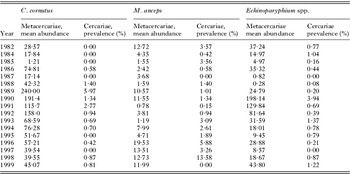
Changes in mean abundance of metacercariae and prevalence of parthenitae and cericariae for 4 dominant trematoda species in L. stagnalis from 1982 to 1999 are shown in Table 1, and the correlations between both variables were significant in the species; C. cornutus, M. anceps, and Echinoparyphium spp. (r>0·46, P<0·05 Pearson's correlation coefficients).
Mean abundance of metacercariae and prevalence (%) of cercariae for dominant trematode species in Lymnaea stagnalis from 1982 to 1999

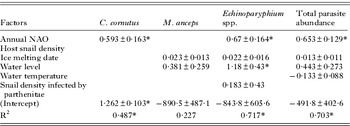
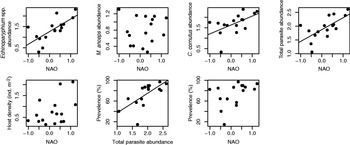
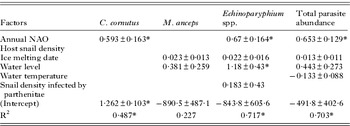
The best GLM for C. cornutus included only NAO (Table 2), whereas those for Echinoparyphium spp. contained other factors including density of snails infected by the parthenitae; however, NAO was the only significant indicator (P<0·05). Mean abundances of C. cornutus and Echinoparyphium spp. significantly increased with NAO (simple regression in Fig. 1, R2=0·30 and 0·49, P<0·01). Conversely, for M. anceps, among other variables, ice melting date and water level were included in the best GLM (Table 2). Also, single regression indicated no relationship between the mean abundance of M. anceps and NAO (R2=0·004, P=0·81). For total parasite abundance, the best GLM included NAO among other variables; however, NAO was the only significant factor. Mean abundances of the total parasite species significantly increased with NAO (Fig. 1, R2=0·44, P<0·01).
Coefficients and R2 values for the best GLMs for parasite abundance
Relationships between NAO and mean parasite abundance, host density, and prevalence of metacercariae infection, and the relationships between total parasite abundance and prevalence of metacercariae infection. Values on the y-axis were log10 (x+1)-transformed. The lines indicate the simple linear regression lines.

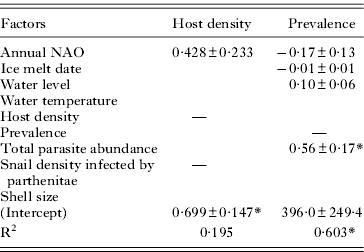
With respect to the density of the host snail L. stagnalis, the best GLM included only NAO, but was not significant (Table 3). Regarding prevalence of metacercariae infection, the factors in the best GLM included NAO, total parasite abundance, and other factors, but total parasite abundance was the only significant factor (P<0·05, Table 3). The relationship between prevalence and total parasite abundance was significantly positive (Fig. 1, R2=0·47, P<0·01). Conversely, the regression between prevalence and NAO was not significant, but followed a positive trend (Fig. 1, R2=0·18, P=0·10).
Coefficients and R2 values for the best GLMs of host density and prevalence

DISCUSSION
Our results showed that the abundance of most of the dominant metacercariae species might be influenced by the NAO. Stenseth et al. (Reference Stenseth, Ottersen, Hurrell, Mysterud, Lima, Chan, Yoccoz and Adlandsvik2003) suggested that biological effects might be more strongly related to global climate indices than to any single local climate variable. However, the mean abundance of M. anceps was not influenced by the NAO but was impacted by the ice period of the lake as well as the water level. Global climatic oscillations influence the population dynamics of terrestrial and aquatic organisms (e.g. Post and Stenseth, Reference Post and Stenseth1999; Schindler et al. Reference Schindler, Rogers, Scheuerell and Abrey2005; Chiba et al. Reference Chiba, Tadokoro, Sugisaki and Saino2006), but only in localized areas of lakes (e.g. Schindler et al. Reference Schindler, Rogers, Scheuerell and Abrey2005). Our results support these previous studies, despite the small sampling area of this study.
Straile (Reference Straile2002) suggested that inter-annual variability in the timing of clear water phases in lakes was strongly related to the NAO. Given that the NAO is responsible for inter-annual and decadal fluctuations in winter air temperatures (Hurrell and van Loon, Reference Hurrell and Van Loon1997), it may reflect the annual climatic and limnological conditions of West Siberia and Lake Chany. Indeed, a significant correlation between the NAO and the temperature in western Siberia was observed from 1900 to 2000 (Vaganov et al. Reference Vaganov, Briffa, Naurzbaev, Schweingruber, Shiyatov and Shishov2000; Ippolitov et al. Reference Ippolitov, Kabanov and Loginov2007). Thus, the NAO is an important factor in determining the densities of host and trematode parasite populations during the summer.
Mouritsen and Poulin (Reference Mouritsen and Poulin2002) suggested that host-parasite interactions are influenced by climatic oscillations. However, in this study, the abundances of parasites (metacercariae) were not significantly related to host density, and the density of L. stagnalis was not influenced by metacercariae infections. The asexual stages of the parasite (parthenitae) influence host reproduction (Sorensen and Minchella, Reference Sorensen and Minchella2001; Gutiérrez et al. Reference Gutiérrez, Yong, Perera, Sánchez and Théron2002; Yurlova, 2003; Negovetich and Esch, Reference Negovetich and Esch2008) and host density (Yurlova et al. 2000). However, there is little understanding of the influence of metacercariae infection on the reproduction of snails. Our data indicated that the population dynamics of hosts and parasites were not strongly influenced by host-parasite interactions in the ‘snail-metacercariae’ host-parasite system. The density of L. stagnalis was not influenced by the metacercariae infection, probably because the infection was not caused by host castration like parthenitae. Thus, global climatic oscillation, such as NAO, may indirectly affect host-parasite interactions through the independent population dynamics of the hosts and parasites, for example, the differences in the temperature responses in populations of host and parasite. In this case, climatic conditions of the lake may exert a greater effect on recruitment of L. stagnalis than changes in metacercariae infection rate of the species.
The trematode species found as metacercariae in L. stagnalis also infect snails as first intermediate hosts and various water birds as definitive hosts (Yurlova et al. Reference Yurlova, Vodyanitskaya, Serbina, Biserkov, Georgiev and Chipev2006). Thus, the population dynamics of the parasites would also be related to the first intermediate hosts and the migration of birds, as well as their density, distribution, and other population parameters such as the timing of spring migration and breeding success, all of which are influenced by the NAO (Nott et al. Reference Nott, DeSante, Siegel and Pyle2002; Hechinger and Lafferty, Reference Hechinger and Lafferty2005; Marra et al. Reference Marra, Francis, Mulvihill and Moore2005). However, in this case, our analyses found no relationship between the density of the infected snails and the abundance of metacercariae. Thus the linkages between primary (snail) and secondary (snail) hosts for metacercariae populations are not detected from our dataset. Although our dataset did not directly support this hypothesis, but climate effects on the linkages between secondary and primary hosts for parasite would be not related and probably climate effects on the particular host-parasite interaction is more important and stronger than the effect on linkages of hosting. The hypothesis of host-linkage effect on host-parasite dynamics would be very important to consider the whole cycle of parasitism, thus, further study is needed to test the hypothesis using direct evidence.
We estimated the effects of the NAO and local climate factors on host snail and parasite interactions. Our data indicated that the NAO influenced common parasitism in an aquatic ecosystem. Host-parasite interactions indirectly influence food webs and community structures (Mouritsen and Poulin, Reference Mouritsen and Poulin2002; Lafferty et al. Reference Lafferty, Allesina, Arim, Briggs, DeLeo, Dobson, Dunne, Johnson, Kuris, Marcogliese, Martinez, Memmott, Marquet, McLaughlin, Mordecai, Pascual, Poulin and Thieltges2008; Sukhdeo, Reference Sukhdeo2010). Thus, we conclude that the indirect effect of parasitism is important when evaluating the impact of climate change on ecosystems. However, in this study, we were not able to estimate the indirect effects of parasites on the other species, given the limitations of the dataset used. Thus, it would be worthwhile to address the indirect effects of climatic oscillations on ecosystems in future studies.
ACKNOWLEDGEMENTS
We thank Dr A. Yurlov, Institute of Animal Systematics and Ecology, Siberian Branch of Russian Academy Sciences (SB RAS), for useful comments during preparation of this paper and scientific associate S. Vodyanitskaya for her help in the field survey. This study was partly supported by a Grant-in-Aid for Scientific Research (B) from the Japan Society for the Promotion of Science (JSPS, No. 13575004, 16405005), Russian Found Basic Research (RFBR, No. 07-04-01416, 09-04-92104, and 10-04-01293), and JSPS to H. Doi.