Introduction
The incidence of schizophrenia increases with urbanicity. This association is unlikely to be explained by social drift, given: that dose–response relationships extend to urbanicity at birth (Takei et al. Reference Takei, Sham, O'Callaghan, Glover and Murray1995; Mortensen et al. Reference Mortensen, Pedersen, Westergaard, Wohlfahrt, Ewald, Mors, Andersen and Melbye1999) and during upbringing (Marcelis et al. Reference Marcelis, Takei and van Os1999); that this has been frequently replicated; and, is independent of a number of confounders, including age, sex, ethnicity, family history of psychosis and cannabis use. Despite these findings, few studies have specifically delineated which factors associated with urbanicity increase risk. Some authors have hypothesized that socio-environmental risk factors (SERFs) may be important, perhaps mediated by genetic susceptibility (Krabbendam & van Os, Reference Krabbendam and van Os2005).
Among these factors, social capital has been proposed as potentially relevant in the aetiology of schizophrenia (McKenzie et al. Reference McKenzie, Whitley and Weich2002; Sartorius, Reference Sartorius2003; Almedom, Reference Almedom2005; De Silva et al. Reference De Silva, McKenzie, Harpham and Huttly2005; Whitley & McKenzie, Reference Whitley and McKenzie2005; Allardyce & Boydell, Reference Allardyce and Boydell2006). Social capital attempts to describe features of populations such as levels of civic participation, social networks and trust. Such forces shape the quality and quantity of social interactions and the social institutions that underpin society McKenzie & Harpham, 2006. The most commonly used definition of social capital in the health sciences originates from the political scientist Robert Putnam (Reference Putnam1993, p. 36), who suggests that social capital consists of five principal characteristics:
(1) Community networks, voluntary, state, personal networks and density.
(2) Civic engagement, participation and use of civic networks.
(3) Local civic identity: sense of belonging, solidarity and equality with local community members.
(4) Reciprocity and norms of cooperation, a sense of obligation to help others and confidence in return of assistance.
(5) Trust in the community.
Not all forms of social capital have to act in a positive direction for all individuals. Bonding social capital, for example, which links people together who share a similar social identity, may be protective for those belonging to a cohesive social group, and also negative, increasing risk for those who are excluded. Durkheim (Reference Durkheim1952) suggested that it was possible for even relatively cohesive communities to experience high rates of disorder, and a study of deliberate self-harm has found some evidence to support this hypothesis (Neeleman et al. Reference Neeleman, Wilson-Jones and Wessely2001). Several authors have highlighted the potential negative consequences of social capital on health (Portes, Reference Portes1998; Baum, Reference Baum1999; Lochner et al. Reference Lochner, Kawachi, Brennan and Buka2003; Whitley & McKenzie, Reference Whitley and McKenzie2005), and it follows that the relationship between psychoses and social capital may not necessarily be linear. However, this hypothesis has yet to be tested.
Despite some theoretical speculation, to date there has been little empirical evidence testing the association between social capital and schizophrenia (see Henderson & Whiteford, Reference Henderson and Whiteford2003 for a full discussion). Boydell et al. (Reference Boydell, McKenzie, van Os and Murray2002) found a significant inverse relationship between increased social cohesion and decreased incidence rates of schizophrenia in a small pilot study in South-East London, but did not control for confounding by other SERFs, such as socio-economic deprivation. More recently, however, a larger study found no evidence to support an association between social capital and the incidence of schizophrenia in Maastricht, having controlled for socio-economic factors (Drukker et al. Reference Drukker, Krabbendam, Driessen and van Os2006).
We recently reported that approximately 25% of the variance in the incidence of schizophrenia could be attributed to neighbourhood-level risk factors, including voter turnout at local elections (a proxy for social capital), ethnic density and ethnic fragmentation (Kirkbride et al. Reference Kirkbride, Morgan, Fearon, Dazzan, Murray and Jones2007). Informed by recent theoretical work, we sought to extend these models by collecting detailed, validated measures of neighbourhood social capital, to test whether social capital was associated with the incidence of schizophrenia, after controlling for a number of individual- and neighbourhood-level confounders. We considered the possibility that any association between the incidence of schizophrenia and social capital may be nonlinear.
Method
Overview
We conducted a population-based, cross-sectional postal survey of 5% of the relevant adult population in the South London centre of the Aetiology and Ethnicity in Schizophrenia and Other Psychoses (AESOP) study. The study was designed to collect detailed social capital data at the neighbourhood level using items from two scales (Sampson et al. Reference Sampson, Raudenbush and Earls1997; McCulloch, Reference McCulloch2001). One scale tapped into aspects of social cohesion and trust (Sampson et al. Reference Sampson, Raudenbush and Earls1997), directly relevant to the formation of social capital. The second scale measured levels of social disorganization (McCulloch, Reference McCulloch2001), which may provide a marker for social capital. We modelled these constructs, together with other individual- and neighbourhood-level risk factors, against the incidence of schizophrenia estimated from the AESOP study.
Incidence data study design
Incidence data were obtained from the AESOP study, a population-based study of first-episode psychoses, in people aged 16–64 years, over 2 years (September 1997 to August 1999) in three UK centres: South London, Nottingham and Bristol. In the present study we used data from South London only. The study area covered the borough of Lambeth, and the lower two-thirds of Southwark, containing 33 Census Area Statistical wards (population per ward about 6000). These wards defined our neighbourhood-level units of analysis. For each ward, we calculated the incidence of ICD-10 F20 schizophrenia, which provided the outcome variable in our study. The population at risk in each ward, aged 16–64, was estimated from the 2001 census. Full details of the methodology of the AESOP study have been given previously (Kirkbride et al. Reference Kirkbride, Fearon, Morgan, Dazzan, Morgan, Tarrant, Lloyd, Holloway, Hutchinson, Leff, Mallett, Harrison, Murray and Jones2006).
Social cohesion survey study design
The postal survey was conducted over two phases between January and March 2004 in nine wards in Southwark, which made up the old Camberwell Psychiatric Case Register (Phase 1), and between January and March Reference March and Susser2006 in the remaining 24 wards (Lambeth and three Southwark wards) of the AESOP study area (Phase 2).
Instrument
The questionnaire was a modified version of two surveys designed to measures dimensions of social capital (Sampson et al. Reference Sampson, Raudenbush and Earls1997; McCulloch, Reference McCulloch2001, Reference McCulloch2003). The McCulloch instrument was designed to measure social cohesion and social disorganization (SocD) in the British Household Panel Survey (McCulloch, Reference McCulloch2001, Reference McCulloch2003). We included the eight items relating to SocD in our questionnaire. Respondents were given eight statements regarding the frequency with which certain scenarios occurred in their neighbourhood. These included the presence of graffiti, teenagers, vandalism, attacks due to race or skin colour, other attacks, burglary and the theft of, or from, vehicles. Each item was assessed using a four-point Likert-type scale ranging from ‘very common’ to ‘not at all common’.
The Sampson instrument attempts to assess informal social control (ISC) and social cohesion and trust (SC&T) at the neighbourhood level (Sampson et al. Reference Sampson, Raudenbush and Earls1997). We included five items relating to SC&T in our questionnaire. Respondents were asked the extent to which they agreed with five statements concerning the level of SC&T in their neighbourhood; for example, the extent to which someone was likely to help their neighbours. These items were assessed using a five-point Likert-type scale ranging from ‘strongly agree’ to ‘strongly disagree’.
Finally, three (optional) demographic items – age, sex and ethnicity – were included. Our questionnaire was therefore a 16-item instrument (see Appendix, available online). A pilot study suggested our instrument was culturally valid in South-East London (Boydell et al. Reference Boydell, McKenzie, van Os and Murray2002). The content of the questionnaire was identical in both phases of the study. In Phase 2 we standardized the style of the questionnaire to make it machine readable for data entry.
Sample size and power calculations
Formal sample size calculations were difficult because of the limited empirical work conducted in this field. However, research from the pilot study (Boydell et al. Reference Boydell, McKenzie, van Os and Murray2002) suggested that sampling one-twentieth of the adult population (aged 16+ years) would be sufficient to obtain precise estimates of neighbourhood-level social capital, given likely response rates and the size of the target population (n=321 981) estimated from the 2001 census. This proportion was larger than previous studies of neighbourhood-level social capital (Sampson et al. Reference Sampson, Raudenbush and Earls1997).
Sampling strategy
Our primary sampling unit was the household because we were unable to obtain an accurate sampling frame of all individuals within the study area given high rates of migration. The electoral register, for example, includes approximately 92% of the eligible electorate in the UK and this figure is known to be lower in inner London, with young people, men, and people who have recently moved less likely to be included (Electoral Commission, 2005). Thus, we adopted a systematic sampling procedure, sampling every kth household in each ward, which was less likely to exclude these groups. This strategy also ensured that we sampled potential respondents from the entire ward; this was important because wards are unlikely to be homogeneous with respect to social capital. We obtained the total number of households in our study area from the 2001 census (n=176 029). To sample 5% of the adult population (n=16 100) we estimated that every eleventh household in each ward would need to be surveyed (k=176 029/16 100=10.93).
Data collection
Questionnaires were delivered by hand in a white, C5 envelope, addressed ‘to the occupier’ (written in hand). Each envelope also contained a pen, a freepost return envelope and an entry form inviting respondents to enter a prize draw for one of five cash incentives (1×£500, 4×£250). These methods have been shown to increase response (Edwards et al. Reference Edwards, Roberts, Clarke, DiGuiseppi, Pratap, Wentz and Kwan2002).
Every street in the study area was surveyed. At the start of the day, each researcher chose, at random, one of 11 numbered coins. This determined the first household in the street to be included in the survey. Subsequently, every eleventh household was sampled. All identifiable separate households in a single dwelling were treated as separate households. Several dwellings in South London, in both private and local authority sectors, had controlled entry to prevent unsolicited access to properties. Where these dwellings could not be accessed immediately, the researcher made contact with a resident or receptionist, identifying themselves and the nature of the project in an attempt to access the property. Where access remained impossible, the researcher estimated the number of respondents in the dwelling who should have received a survey and delivered these to the nearest similar dwelling in the vicinity. Residential care homes, hospitals and prisons were excluded from the study.
Research assistants received training to ensure that they understood the reason for the study and the data collection methodology. Research assistants worked in pairs, for safety and to minimize errors, taking one side of a street each. Research assistants were given detailed maps that they marked off after each street had been surveyed to ensure that no household was included twice in the survey.
Data entry
Returned questionnaires were separated from prize-draw entry forms to maintain anonymity of the respondent. Questionnaires were included in calculation of response rates even if they were returned uncompleted (n=11, Phase 2). Closing dates for both phases of the study were in early May; at least 2 months after the questionnaire delivery. Evidence from Phase 1 suggested that the majority of responses had been returned by this point. Phase 1 data entry was conducted by hand. Phase 2 data entry was automated to minimize data entry errors. Data from each phase were combined into a single dataset.
Statistical analyses
Response rates were calculated in each ward. Confirmatory factor analysis (CFA) was conducted to test the a priori specification of the two constructs (SocD and SC&T) being measured (Diez Roux, Reference Diez Roux2004). For each ward, mean ward-level factor scores were derived by averaging individual-level factor scores to provide two ward-level constructs measuring social capital (SocD and SC&T). Correlation coefficients were obtained between the three social capital constructs and our other neighbourhood-level risk factors.
The incidence of schizophrenia in each ward was modelled in a multi-level Poisson regression. The modelling strategy was analogous to that in our previous study (Kirkbride et al. Reference Kirkbride, Morgan, Fearon, Dazzan, Murray and Jones2007), with SocD and SC&T replacing voter turnout as measures of social capital. Individual-level age, sex and ethnicity [Black and Minority Ethnic (BME) versus White British] were entered as a priori individual-level covariates, with neighbourhood-level variables entered in a forward-fitting model according to change in residual variance at the neighbourhood level identified by a univariate analysis. Socio-economic deprivation (Index of Multiple Deprivation), population density (people per hectare), ethnic density (BME population as a proportion of total population) and ethnic fragmentation (the extent to which White British and BME groups live in cohesive residential patterns; Index of Dissimilarity) were considered as potential confounders and included as fixed effects (for a full discussion of these variables, see Kirkbride et al. Reference Kirkbride, Morgan, Fearon, Dazzan, Murray and Jones2007). An a priori cross-level interaction between individual-level ethnicity and ethnic density was tested. Social capital variables were initially entered as continuous measures with a quadratic term fitted to assess possible non-linearity. We also assessed whether a categorical classification of our social capital variables (thirds of wards: ‘low’, ‘medium’ and ‘high’) provided a better fit to the data. Neighbourhood-level variables were standardized to have a mean of zero and a standard deviation (s.d.) of one. Here, incidence rate ratios (IRRs) represented the increased risk associated with 1 s.d. change in exposure. Significance testing of fixed effects and their interactions was assessed by likelihood ratio tests (LRTs).
CFA was conducted using M-Plus (version 4.1) with the WLSMV (weighted least squares, mean and variance adjusted) estimator (Muthén & Muthén, Reference Muthén and Muthén2006). χ2 tests and multi-level Poisson regression (xtpoisson) were conducted in Stata version 9 (StataCorp, 2005). Maps were produced in ArcView version 8.1 (ESRI, 2001).
Ethical approval
Ethical approval was granted for Phase 1 of the social capital survey from the Local Research Ethics Committee (LREC) in the South London and Maudsley National Health Service (NHS) Trust, with permission to extend the study into Phase 2 granted in October 2005.
Results
Social cohesion questionnaire sample characteristics
Sample representativeness
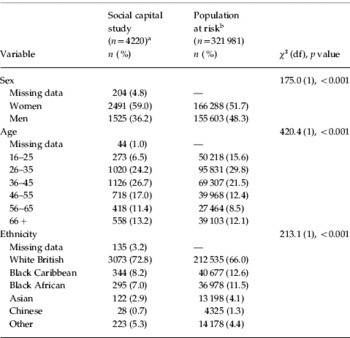
A total of 16 459 households received a social capital questionnaire (Phase 1: n=4250; Phase 2: n=12 209). Overall response was low (25.7%; n=4231). Neighbourhood-level response rates varied from 17.3% to 39.4%. Fifty-nine per cent of the survey sample were women; significantly greater than in the population at risk in South London (p<0.001) (Table 1). There was evidence that our sample was significantly older than the population at risk (p<0.001), and more likely to be from a white ethnic group compared with the population at risk (72.8% v. 66.0% respectively; p<0.001). Black Caribbean (8.2% v. 12.6%) and Black African (7.0% v. 11.5%) respondents were notably under-represented in our sample when compared with the population at risk.
Social cohesion sample characteristics versus estimated denominator population at risk in South-East London

df, Degrees of freedom.
a Not including 11 surveys that were returned blank but counted towards response rates.
b Estimated from the 2001 census, aged 16 years and over.
Dimensions of social capital
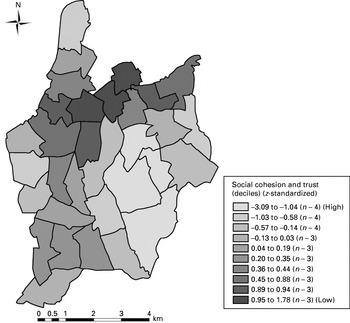
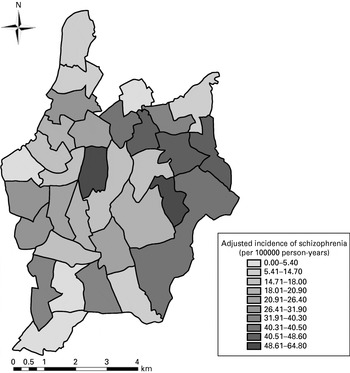
CFA suggested that the questionnaire was internally valid with the values of the Comparative Fit Index and the Tucker Lewis Index scores ranging above 0.95, suggesting that SocD and SC&T provided good measures of fit to the data. Correlation between SocD and SC&T for individuals was high (r=−0.54, p<0.05), but became very high (r=−0.93, p<0.001) when factor scores were averaged at the neighbourhood level. The geographical distribution of SC&T (Fig. 1) and SocD (available from authors) was similar (as suggested by their high correlative value). For comparison, we have included the distribution of incidence rates for schizophrenia, after indirect standardization for age, sex and ethnicity (Fig. 2).
Geographical distribution of social cohesion and trust (SC&T) at ward level in South London (deciles).

Incidence rates of schizophrenia by neighbourhood following indirect standardization for age, sex and ethnicity. Rates were indirectly standardized using the overall age-, sex-, ethnicity-specific rates for the entire study region. Ethnicity was a seven-category variable: White British, White Other, Mixed ethnicity, Black Caribbean, Black African, Asian (Indian subcontinent), and all other ethnic groups.

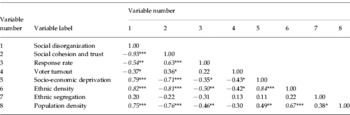
SocD was negatively correlated with response rates (r=−0.54, p<0.01), suggesting that people were less likely to respond to the questionnaire in more disorganized neighbourhoods (Table 2), and positively correlated with ethnic density (r=0.82, p<0.001), population density (r=0.75, p<0.001) and socio-economic deprivation (r=0.79, p<0.001). By contrast, these correlations were reversed for SC&T (Table 2).
Correlation matrix for three bespoke constructs of social capital and other neighbourhood-level variablesFootnote a

a Correlations greater than ±0.5 in italics.
Significant at: * p<0.05, ** p<0.01, *** p<0.001.
The correlation between response rates and voter turnout in local elections was positive, but non-significant (r=0.22, p=0.22).
Social capital and schizophrenia: multi-level Poisson regression
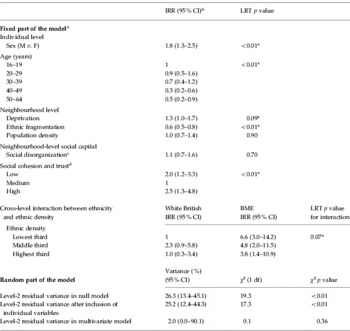
We identified 148 cases of schizophrenia during 565 576 person-years at risk during the AESOP study (Kirkbride et al. Reference Kirkbride, Fearon, Morgan, Dazzan, Morgan, Tarrant, Lloyd, Holloway, Hutchinson, Leff, Mallett, Harrison, Murray and Jones2006). Age, sex and ethnicity were significant individual-level predictors of the incidence of schizophrenia, as reported previously (Kirkbride et al. Reference Kirkbride, Morgan, Fearon, Dazzan, Murray and Jones2007), but could not explain variation attributable to neighbourhood-level factors [25%; 95% confidence interval (CI) 12.4–44.3, p<0.01] (Table 3).
Modelling neighbourhood-level social capital and the incidence of schizophrenia

IRR, incidence rates ratio; CI, confidence interval; LRT, likelihood ratio test; df, degrees of freedom.
a Unless stated otherwise, IRR represents increased risk associated with 1 standard deviation increase in exposure variable. LRT p values and IRRs for non-significant variables prior to their removal from the model.
b Baseline group for sex is women, age is 16–19 and social cohesion and trust is ‘medium’ wards. IRRs for other neighbourhood variables represent increased incidence of schizophrenia with a 1 standard deviation change in exposure.
c A quadratic (LRT p=0.90) association with the incidence of schizophrenia did not improve the model.
d A quadratic (LRT p=0.73) association with the incidence of schizophrenia did not improve the model.
* Included in the final multivariate model.
SC&T was associated with the incidence of schizophrenia at the neighbourhood level (LRT p<0.01), but non-linearly (Table 3). Thus, compared with wards with medial levels of SC&T, wards with both ‘low’ (IRR 2.0, 95% CI 1.2, 3.3) and ‘high’ (IRR 2.5, 95% CI 1.3, 4.8) levels of SC&T had an increased incidence of schizophrenia, having controlled for age, sex, ethnicity, socio-economic deprivation, ethnic density and ethnic fragmentation. Modelling SC&T as a categorical variable led to significant improvement in model fit over the model with SC&T as a continuous measure (LRT p<0.01). This non-linear relationship remained present if we used SocD in place of SC&T in the final model (data available from the authors). However, SocD (LRT p=0.70) did not significantly improve the final model once SC&T had been included. Quadratic terms for SocD (LRT p=0.90) or SC&T (LRT p=0.73) did not improve the model. After including all significant terms in the final model, there was no evidence of unexplained variance at the neighbourhood level (χ2p=0.36).
The associations between other neighbourhood-level variables and the incidence of schizophrenia did not change from our previously reported model (Kirkbride et al. Reference Kirkbride, Morgan, Fearon, Dazzan, Murray and Jones2007), when we replaced voter turnout with SC&T. Lower ethnic fragmentation was associated with a reduction in the incidence of schizophrenia (IRR 0.6, 95% CI 0.5–0.8). There was some evidence that socio-economic deprivation increased the incidence of schizophrenia (IRR 1.3, 95% CI 1.0–1.7, p=0.09), despite being just beyond conventional statistical significance.
There was weak evidence of a cross-level interaction between individual-level ethnic status and the proportion of ethnic minorities resident within the neighbourhood (LRT p=0.07). Thus, compared with the White British group in neighbourhoods with the lowest proportion of ethnic minorities, the risk of schizophrenia was greatest for BME individuals in these neighbourhoods (IRR 6.6, 95% CI 3.0–14.2). This risk remained elevated for BME groups in ‘medium’ (IRR 4.8, 95% CI 2.0–11.5) and ‘high’ (IRR 3.8, 95% CI 1.4–10.9) ethnic density neighbourhoods, but decreased linearly. For the White British group, there was weak evidence that incidence rates were elevated for people living in neighbourhoods with medium (IRR 2.3, 95% CI 0.9–5.8), though not high (IRR 1.0, 95% CI 0.3–3.4), levels of ethnic density, when compared with White British individuals in ‘low’ ethnic density neighbourhoods.
Discussion
Principal findings
This is the first UK study to have tested whether the incidence of schizophrenia is associated with dimensions of social capital, having controlled for other individual- and neighbourhood-level risk factors. We found a non-linear association between the level of SC&T at the neighbourhood level and the incidence of schizophrenia, such that neighbourhoods with ‘low’ or ‘high’ levels of SC&T had significantly increased rates of schizophrenia compared with medial neighbourhoods. SocD was not associated with the incidence of schizophrenia after considering SC&T, probably because of high correlation between these measures. Of interest, inclusion of detailed measures of social capital in place of voter turnout did not alter the associations between the incidence of schizophrenia and other neighbourhood-level SERFs (Kirkbride et al. Reference Kirkbride, Morgan, Fearon, Dazzan, Murray and Jones2007).
Methodological limitations
The overall response rate to the postal questionnaire was low. Recently, a similar survey in Maastricht also reported a low response rate (48%; Drukker et al. Reference Drukker, Krabbendam, Driessen and van Os2006), which, although higher than ours, may be comparable given the absolute differences in the socio-environmental milieu of these two centres. However, we were interested in social capital at the ecological level, and low response was not as serious as it might have been for individual-level studies because we wanted to measure differences between areas as opposed to absolute values. Non-response may have invited bias into the results, although it is difficult to interpret its direction. On the one hand, wards with higher response rates may have had a greater proportion of respondents motivated by local issues, thus indicating higher levels of social capital. On the other hand, however, higher response could have indicated a higher level of discontent regarding these issues within their neighbourhood. Response rates were unlikely to provide a meaningful measure of social capital because we went to considerable lengths to minimize non-response, including monetary incentives. Indeed, response rates were significantly correlated with socio-economic deprivation, but not the incidence of schizophrenia (data available from authors).
It is impossible to determine whether social capital is causally related to the incidence of schizophrenia from our study. First, exposure to social capital was measured 5–9 years after the collection of our outcome data. It is possible that exposure to social capital prior to the onset of schizophrenia may have differed to the levels measured here, particularly because the South London area has undergone several periods of regeneration (Lambeth Borough Council, 2005, 2006). We believe that reverse causality is an unlikely explanation for our findings given the absolute rate of schizophrenia (Kirkbride et al. Reference Kirkbride, Fearon, Morgan, Dazzan, Morgan, Tarrant, Lloyd, Holloway, Hutchinson, Leff, Mallett, Harrison, Murray and Jones2006). It is unlikely that social drift can wholly explain our findings in view of the association between urbanicity at birth and later schizophrenia (Mortensen et al. Reference Mortensen, Pedersen, Westergaard, Wohlfahrt, Ewald, Mors, Andersen and Melbye1999), but we could not exclude it as a possibility.
Second, given that we used an ecological design to measure our exposure and outcome data, we could not determine whether people who developed schizophrenia were exposed to, or excluded from, the critical level of social capital necessary to induce, mediate or buffer schizophrenia (how social capital may operate in schizophrenia causation is, in itself, unclear and discussed below). Future studies of social capital and schizophrenia will need to collect longitudinal, prospective measures of social capital at both the individual and neighbourhood levels to investigate this issue in more detail.
We may not have specified all relevant risk factors at the individual level, including family history of psychoses or socio-economic status (SES). It was not possible to obtain this denominator data from the census at the ward level. However, we made attempts to control for neighbourhood-level socio-economic deprivation because it is unclear whether SES is causally related to schizophrenia or at which level it may operate (Diez-Roux et al. Reference Diez-Roux, Nieto, Muntaner, Tyroler, Comstock, Shahar, Cooper, Watson and Szklo1997). One possible way to circumnavigate these issues would be to adopt a multi-level case–control approach, as recently applied in Maastricht (Drukker et al. Reference Drukker, Krabbendam, Driessen and van Os2006). After adjusting for individual-level SES, they did not observe a significant association between social capital and schizophrenia.
We attempted to keep both phases of the study as similar as possible. The wording, administration and incentives of the questionnaire were identical in both phases, which were conducted during the same calendar period to minimize seasonal bias in perceptions of social capital. The only changes made to the questionnaire were stylistic for data entry purposes. These changes improved the readability of the questionnaire in Phase 2 and should have improved response rates. However, the opposite effect was observed (data available from authors).
Meaning of findings
Neighbourhood-level risk factors appear to be associated with the incidence of schizophrenia beyond that which can be attributed to individual-level characteristics or socio-economic deprivation. The results of this study build upon our recent work (Kirkbride et al. Reference Kirkbride, Fearon, Morgan, Dazzan, Morgan, Tarrant, Lloyd, Holloway, Hutchinson, Leff, Mallett, Harrison, Murray and Jones2006), and, taken together, the two studies suggest that dimensions of social capital may be associated with the incidence of schizophrenia. However, as noted by Whitley & McKenzie (Reference Whitley and McKenzie2005), we are still a long way from defining social capital, or lack thereof, as a risk factor for schizophrenia.
We previously hypothesized that greater levels of social capital may ‘buffer’ susceptible individuals against the onset of schizophrenia, principally by mediating social stress (Kirkbride et al. Reference Kirkbride, Morgan, Fearon, Dazzan, Murray and Jones2007). However, our current findings do not support this hypothesis because social capital does not appear to be linearly associated with the rate of schizophrenia. Any association between social capital and schizophrenia is therefore likely to be complex, non-linear and possibly interacting with individual characteristics (Baum, Reference Baum1999). In light of this, we believe it is worthwhile exploring alternative explanations for our findings. It remains possible that neighbourhoods with low social capital provide less opportunity for people to dissipate social stresses associated with urban living, which in turn could lead to higher rates of schizophrenia if chronic exposure to social stresses was sufficient to trigger schizophrenia, potentially through dysregulation of the dopamine system (Selten & Cantor-Graae, Reference Selten and Cantor-Graae2005). However, this would not explain the elevated rates of schizophrenia in neighbourhoods with high social capital.
There are two competing, but not necessarily mutually exclusive, explanations for this observation. First, it is likely that some residents in neighbourhoods measured as having ‘high’ social capital were excluded from access to that social capital, conversely increasing their risk of schizophrenia. Such isolation may be particularly detrimental, given both the stress placed on someone as an ‘outsider’ and the more limited opportunity to dissipate social stress itself. Because our social capital survey was over-representative of older, white and female groups, it is possible that other groups may not experience the same level of social capital as reported by respondents to our study. Thus, neighbourhoods perceived as having ‘high’ social capital may have been hostile and exclusionary for certain others, such as the young, male or BME groups, who are also known to be at the highest risk of schizophrenia (Kirkbride et al. Reference Kirkbride, Fearon, Morgan, Dazzan, Morgan, Tarrant, Lloyd, Holloway, Hutchinson, Leff, Mallett, Harrison, Murray and Jones2006). Living in neighbourhoods where someone is perceived to be an outsider may compound this risk. It will be important for future studies to investigate differential perceptions of social capital along demographic subgroups within the same neighbourhood.
Second, higher rates in ‘high’ social capital neighbourhoods may theoretically be explained by an increased likelihood that psychotic individuals in these communities come to the attention of services, principally because of greater ISC. Drukker et al. (Reference Drukker, Krabbendam, Driessen and van Os2006) observed that neighbourhoods in Maastricht with greater levels of ISC had greater levels of in-patient service consumption, although this is different from case identification. This explanation would support our current findings. We did not measure ISC, but this presents an important pathway for future studies. Of interest, a study of deliberate self-harm (DSH) and ethnic density has also observed a similar, curvilinear relationship (Neeleman et al. Reference Neeleman, Wilson-Jones and Wessely2001).
Comparison with previous studies
Apart from the pilot study that informed the present work (Boydell et al. Reference Boydell, McKenzie, van Os and Murray2002), only one study to date has specifically tested hypotheses regarding social capital and psychoses. Drukker et al. (Reference Drukker, Krabbendam, Driessen and van Os2006) used both of Sampson's measures of social capital, SC&T and ISC, to consider the role of neighbourhood social capital in the risk of schizophrenia in a multi-level case–control design in Maastricht. After controlling for several individual-level confounders, they found no evidence to support an association between social capital, or any other neighbourhood variables, and the incidence of treated schizophrenia. These findings were surprising considering that a previous study from Maastricht reported that approximately 12% of the variation in incidence rates of schizophrenia could be attributed to neighbourhood-level characteristics (van Os et al. Reference van Os, Driessen, Gunther and Delespaul2000). These findings are also contrary to our own work, but this may reflect genuine differences between Maastricht and South London, given the absolute differences between these settings in terms of urbanicity. International comparisons of social capital, and how social capital may vary with ethnic group, are likely to be complex (Drukker et al. Reference Drukker, Buka, Kaplan, McKenzie and Van Os2005).
The results of the present study support an increasing number of findings that suggest that neighbourhood characteristics are associated with schizophrenia. Allardyce et al. (Reference Allardyce, Gilmour, Atkinson, Rapson, Bishop and McCreadie2005) have shown that the incidence of schizophrenia in Scotland was associated with the level of social fragmentation, which included information from the census on mobility in the previous year, the number of people living alone and the number of unmarried people. The prevalence of schizophrenia has also been associated with the level of residential mobility (or turnover of residents) beyond that which could be explained by individual-level SES (Silver et al. Reference Silver, Mulvey and Swanson2002). Taken together, these findings are intriguing because residential stability is thought to be a prerequisite for the formation of social capital (McCulloch, Reference McCulloch2003). Our findings lend support to previous research that suggests that the risk of schizophrenia for individuals may be conditional upon neighbourhood characteristics (van Os et al. Reference van Os, Driessen, Gunther and Delespaul2000; Boydell et al. Reference Boydell, van Os, McKenzie, Allardyce, Goel, McCreadie and Murray2001). We hope that the work presented here can inform future research, as we move from thinking about risk factor models at a single level to models that consider multiple, interacting levels that may be aetiologically relevant to schizophrenia over the life course (March & Susser, Reference March and Susser2006).
Acknowledgements
This study was funded by grants from the UK Medical Research Council, the Wellcome Trust and the Stanley Medical Research Institute.
Declaration of Interest
R. Murray is a Joint Editor of Psychological Medicine.
Note
Supplementary information accompanies this paper on the Journal's website (http://journals.cambridge.org).