Populations of many amphibians are declining, and nearly a third of amphibian species are threatened with extinction worldwide (Hof et al. Reference HOF, ARAÚJO, JETZ and RAHBEK2011, Wake & Vredenburg Reference WAKE and VREDENBURG2008). At La Selva Biological Station in north-eastern Costa Rica, overall populations of leaf-litter amphibians have decreased greatly since the 1970s (Whitfield et al. Reference WHITFIELD, BELL, PHILIPPI, SASA, BOLAÑOS, CHAVES, SAVAGE and DONNELLY2007). However, the population changes documented by Whitfield et al. (Reference WHITFIELD, BELL, PHILIPPI, SASA, BOLAÑOS, CHAVES, SAVAGE and DONNELLY2007) differed between habitats. Primary forests experienced consistent population losses, while secondary forests in abandoned plantations of Theobroma cacao L. sometimes had significant increases. Populations of our study species, the poison-dart frog Oophaga pumilio (Schmidt, 1857), have declined by an average of 1.18% y−1 since the 1970s in primary forest, but increased by 8.75% y−1 in abandoned plantations (Whitfield et al. Reference WHITFIELD, BELL, PHILIPPI, SASA, BOLAÑOS, CHAVES, SAVAGE and DONNELLY2007).
There are a number of potential reasons for the difference between O. pumilio populations in primary versus secondary forests at La Selva. Oophaga species raise their young in small pools of water that occur in the axils of leaves (Brown et al. Reference BROWN, MORALES and SUMMERS2010), and the availability of these pools may become a limiting resource for reproduction. Donnelly (Reference DONNELLY1989a, Reference DONNELLYb) found that O. pumilio populations increased in response to the experimental addition of tadpole-rearing sites at our study site in Costa Rica. Thus we hypothesized that tadpole-rearing sites are limiting to O. pumilio populations and could explain habitat-specific population changes.
We have been investigating the distribution of O. pumilio and its potential tadpole-rearing sites at La Selva Biological Station in north-eastern Costa Rica since 1998. Our goals were to (1) determine what plants O. pumilio uses for tadpole rearing at La Selva; (2) document the distribution of tadpole-rearing resources in primary versus secondary forest; and (3) describe the changes in population of Dieffenbachia spp. (Araceae), the plant taxon most heavily used by O. pumilio for tadpole rearing at La Selva.
In December 1998, we quantified the abundance of O. pumilio and potential tadpole-rearing sites in 50 plots of 100 m2. Most previous work on O. pumilio at La Selva took place in abandoned T. cacao plantations (as reviewed by Whitfield et al. Reference WHITFIELD, BELL, PHILIPPI, SASA, BOLAÑOS, CHAVES, SAVAGE and DONNELLY2007). However, we also sampled old-growth primary forest as well as other types of secondary forest, including successional forest of varying ages and selectively logged forest. Plots were located along the following named trails: CES, STR, SOR, SHO, SSO and LOC; see McDade et al. (Reference MCDADE, BAWA, HESPENHEIDE and HARTSHORN1994) for trail maps and classification of forest types. To choose plot locations, we used the permanent trail markers that are placed every 50 m along La Selva's trails. Forty square 10 × 10-m plots were located 50 paces perpendicular to the trail from the markers. An additional 10 rectangular 5 × 20-m plots were placed directly adjacent to trails.
Five observers walked systematically through each plot to search for O. pumilio adults. All frogs were temporarily captured and sexed by means of throat colouration (Donnelly Reference DONNELLY1989a). We also searched for pools of water accessible to us (< 2 m in height). Any standing pool of water above the forest floor of ≥1 ml (smallest volume in which tadpoles were found) was considered a potential tadpole-rearing site. The water in each pool was extracted by suction with a calibrated pipette in order to search for tadpoles and to measure pool volume.
We also counted the number of shoots of Dieffenbachia spp. and bromeliads (Bromeliaceae) in each plot, regardless of whether the plants had any leaf-axil pools. Most of the bromeliads we encountered were fallen epiphytes persisting on the forest floor. Dieffenbachia species are perennial clonal herbs that can form dense stands in the understorey of wet tropical forests (Croat Reference CROAT and JANZEN1983), including La Selva (Young Reference YOUNG1986). Dieffenbachia plants at La Selva often have been referred to as Dieffenbachia longispatha (McDade et al. Reference MCDADE, BAWA, HESPENHEIDE and HARTSHORN1994), but this species does not occur in Costa Rica (Croat Reference CROAT2004). Based on field characters, the plants we observed were almost all Dieffenbachia nitidipetiolata Croat & Grayum. Because we could not always be sure of species identification during field surveys, we refer to our plants as Dieffenbachia spp.
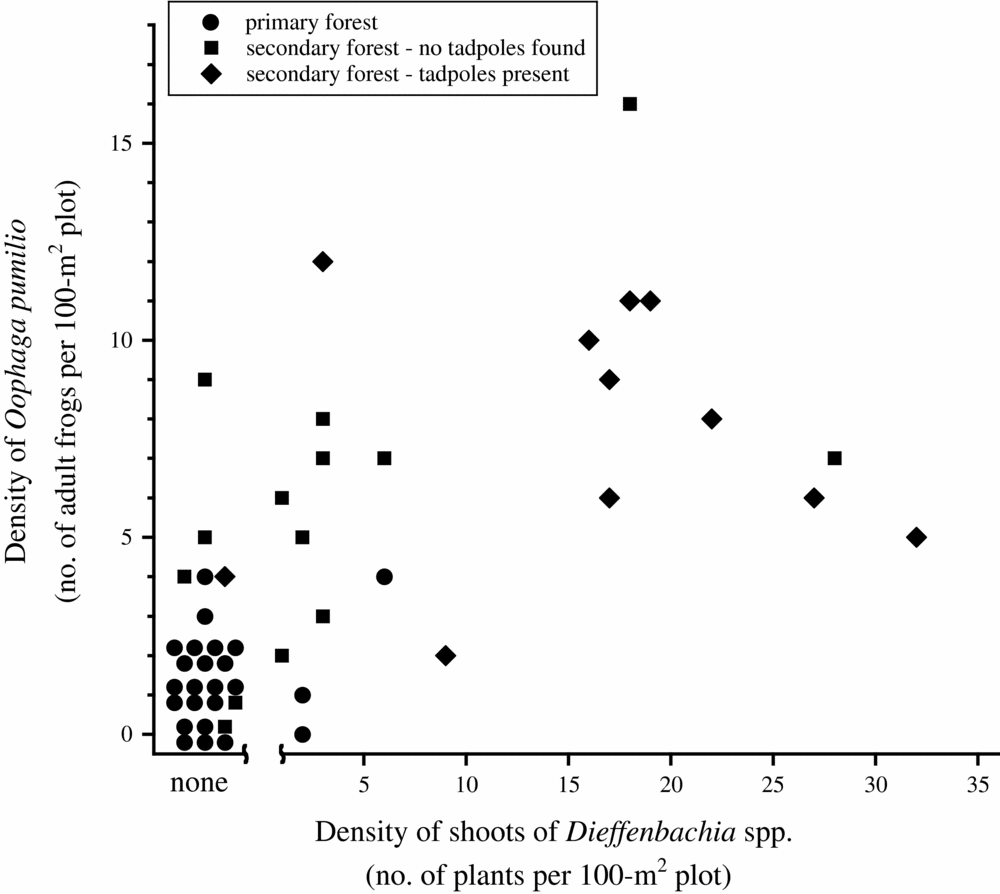
In 1998 there were adult frogs in 43 out of 50 plots (Figure 1), with an average abundance of 4.0 ± 0.53 (mean ± SE) frogs per plot of 100 m2. Of 166 sexed adults, 65.7% were female. Frogs were more common in secondary forest (6.26 ± 0.72 frogs per plot) versus primary forest (1.35 ± 0.25 per plot; Mann–Whitney test, U = 563, P < 0.001). The number of adult frogs per plot was highly correlated with the number of shoots of Dieffenbachia spp. in the plot (Spearman rank correlation, r s = 0.69, P < 0.001; Figure 1). The correlation between number of adult frogs and number of bromeliad plants was not significant (r s = 0.27, P = 0.065).
Density of adult frogs (Oophaga pumilio) among 49 plots in 1998 in relation to the density of Dieffenbachia spp. plants. Plots were spread across primary and secondary forest at La Selva, Costa Rica. Secondary forest included successional forest, selectively logged forest and abandoned plantations of Theobroma cacao. Overlapping points have been offset for visibility in the multiple plots without Dieffenbachia spp. Symbols indicate whether plots were in primary or secondary forest, and whether tadpoles were present in the plot. No plots with tadpoles were found in primary forest.

We found 19 tadpoles in 11 of the 50 plots. Seventeen of the 19 tadpoles were in leaf axils of shoots of Dieffenbachia spp., one was in a bromeliad and one was in a tree hole. The average volume of water in pools with tadpoles was 3.0 ± 0.4 ml (range = 1.0–7.0 ml). All plots with tadpoles were in secondary forest, so there was a highly significant difference in tadpole distribution between primary and secondary forest (Fisher's exact test, df = 1, P < 0.001). Plots with tadpoles had about eight times more shoots of Dieffenbachia spp. (16.4 ± 2.9 plants per plot) than plots without tadpoles (2.0 ± 0.9 plants per plot; Mann–Whitney test, U = 43, P < 0.001; Figure 1). Of 307 pools found with water volume ≥ 1 ml, 69.1% were in leaf axils of Dieffenbachia spp., 29.6% in leaf axils of bromeliads and 1.3% in tree holes.
In 1998, shoots of Dieffenbachia spp. were found much more frequently in secondary forest (73.1% of 26 plots) compared with primary forest (13.0% of 23 plots; Fisher's exact test, df = 1, P < 0.0001). Bromeliads also were more common in secondary (53.8% of plots) versus primary forest (26.1% of plots; Fisher's exact test, df = 1, P = 0.033).
In December 2010, we again measured abundance of Dieffenbachia spp. and bromeliads (but not frogs) in plots similar to those sampled in 1998. We surveyed 58 plots, each measuring 10 × 10 m and centred 10 m from points along the CES, STR, CEN, SSO, CCL, SOR, SUA and SHO trails; most plots were near the same trail markers sampled in 1998.
There were no Dieffenbachia spp. plants in any of the plots sampled in 2010, a striking reduction in abundance from 1998 when 45% of all plots had some Dieffenbachia spp. plants (Fisher's exact test, df = 1, P < 0.0001). Density of Dieffenbachia spp. in 1998 averaged 5.2 ± 1.3 plants per 100-m2 plot. Bromeliad frequency did not change significantly between 1998 (40.8% of plots with bromeliads) and 2010 (43.1% of plots with bromeliads; Fisher's exact test, df = 1, P = 0.85). Bromeliad density averaged 1.1 ± 0.3 plants per 100-m2 plot in 1998 and 1.5 ± 0.3 in 2010.
We sampled populations of Dieffenbachia spp. more broadly to determine overall distribution at La Selva. In December 2002 and June 2012, we surveyed most of the marked trails within 2 km of the station buildings, including the trails along which the 1998 plots were located. Specifically, we sampled trails CCL, CEN, CES, LOC, SAT, SHO, SOR, SSE, STR, SUA and SUR. We evaluated the abundance of shoots of Dieffenbachia spp. (> 0.3 m tall) visible from the trail on 219 50-m segments of trail, for a total of 10.95 km of trails sampled. The distance observable from the trail varied with topography and density of the understorey vegetation, but was generally between 5 and 8 m from the trail edge. The density of shoots of Dieffenbachia spp. per trail segment was classified as absent, low density (1–10 plants), medium density (approximately 10–25 plants) or high density (>25 plants).
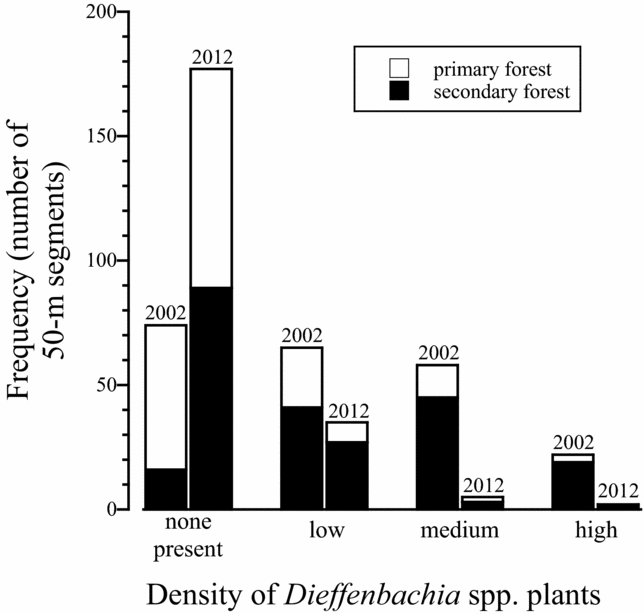
The abundance of Dieffenbachia spp. on trail segments declined greatly between 2002 and 2012 (Figure 2; χ2 = 116, df = 4, P < 0.0001). By 2012, Dieffenbachia spp. had been completely extirpated in 105 (72%) of the 145 segments that had Dieffenbachia spp. in 2002. Dieffenbachia spp. abundance in 2012 was ranked lower than in 2002 in 91% of the segments (132 out of 145). The few segments with shoots of Dieffenbachia spp. in 2012 had small populations; the medium- and high-abundance ranks observed in 2002 were virtually absent (Figure 2). Shoots of Dieffenbachia spp. were much more abundant in secondary forest than in primary forest (Figure 2), both in 2002 (χ2 = 58.6, df = 4, P < 0.0001) and 2012 (χ2 = 9.29, df = 2, P < 0.01).
The density of Dieffenbachia spp. shoots along 50-m segments of trails in 2002 and 2012. The same 219 segments (10.95 km of trail) were counted in each year, ranging across primary and secondary forest at La Selva, Costa Rica. Plant density of each segment was classified as absent, low density (1–10 plants), medium density (approximately 10–25 plants) or high density (>25 plants). Plants were counted only if they were >0.3 m tall.
The collapse of the population of a common understorey plant in such a short time is remarkable. Young (Reference YOUNG1986) reported that Dieffenbachia spp. were abundant at La Selva in the early 1980s, with populations in abandoned plantations (areas included in both our plot and trail samples) reaching densities of 100–200 plants per 100 m2. Our Dieffenbachia spp. surveys show that the collapse occurred at some point between 2002 and 2010.
We propose that the reason for the rapid decline of Dieffenbachia spp. is mammalian herbivory, in particular by the collared peccary (Pecari tajacu Linnaeus, 1758). This omnivorous species is abundant at La Selva, and the local population has increased greatly in recent decades (Romero et al. Reference ROMERO, O’NEILL, TIMM, GEROW and MCCLEARN2013). Peccary exclosures at La Selva show that these animals influence diverse ecological interactions (Michel et al. Reference MICHEL, SHERRY and CARSON2014), and can affect the populations of some amphibians and reptiles (Reider et al. Reference REIDER, CARSON and DONNELLY2013). Consumption of Dieffenbachia spp. by the collared peccary is well known (Timm et al. Reference TIMM, WILSON, CLAUSON, LAVAL and VAUGHAN1989, Wainwright Reference WAINWRIGHT2002). The remaining plants we found in 2012 had clear evidence of mammalian herbivory, including many stems that were partially eaten. Intact shoots of Dieffenbachia spp. were usually found in places that were relatively inaccessible to ground-dwelling mammals, such as steep slopes or small islands in streams. Though there are several other possible hypotheses for the loss of Dieffenbachia spp. at La Selva (e.g. climate change, a novel pathogen, successional changes in forest composition), these do not seem sufficient to explain such a rapid loss across wide areas of secondary forest at La Selva.
There is evidence that the population of O. pumilio in secondary forest responded to the decline in abundance of Dieffenbachia spp. We used frog calls to estimate the relative abundance of O. pumilio males (females do not call) in December 2006 and December 2010. At sample points spaced 50 m apart, we recorded the number of distinct calling frogs over a 2-min sampling period. Counts were done in the morning when calling was much greater than later in the day (pers. obs.). In 2006, we counted calls at 24 points on two trails: STR (secondary forest) and CES (primary forest). In 2010, we counted calls at 79 sites in both primary and secondary forest, on the CES, STR, SOC, SSO, CEN and SCH trails. Each sample point was counted on two different mornings in 2006, and on five or six different mornings in 2010; number of calls per point was averaged across days for analysis.
In 2006, there were more than three times as many frogs heard per sample point in secondary forest than in primary forest (Mann–Whitney test, U = 138, P < 0.001). But in 2010, there was no difference in number of calling frogs between habitats (Mann–Whitney test, U = 796, P > 0.20). The call surveys in the different years are not directly comparable because of potential biases introduced by different observers and different weather conditions. However, the number of calling frogs in 2010 (0.39 ± 0.04 calling males per sample point in primary forest, 0.48 ± 0.06 in secondary forest) was similar to the number in primary forest in 2006 (0.67 ± 0.19) but much lower than in secondary forest in 2006 (2.12 ± 0.11). This suggests that the lack of habitat difference in 2010 was caused by a reduction in frog calls in secondary forest rather than an increase in calls in primary forest.
Our plot survey in 1998 and our calling frog survey in 2006 showed 5–6 times as many frogs in secondary versus primary forest. This is consistent with multiple other previous studies at La Selva. Based on a review of surveys in the 1970s, Whitfield et al. (Reference WHITFIELD, BELL, PHILIPPI, SASA, BOLAÑOS, CHAVES, SAVAGE and DONNELLY2007) found an average of 4.5 times as many O. pumilio in abandoned plantations compared with primary forest. In a 1990 study, plantations abandoned 25 y previously had 3.4 times the number of O. pumilio as primary forest (Heinen Reference HEINEN1992). Our 2010 calling survey is the first dataset of which we are aware that found similar densities of O. pumilio in primary and secondary forest at La Selva. The fact that O. pumilio remained relatively abundant in secondary versus primary forest in 2006 suggests that the density of Dieffenbachia spp. used by the frogs to rear tadpoles might have remained relatively high until that time. If so, the decline of Dieffenbachia spp. occurred in 4 y or less.
In conclusion, we found that the population of Dieffenbachia spp. declined drastically across La Selva in less than a decade. The loss of a species favoured as a tadpole-rearing site by O. pumilio may have consequences for the population of these frogs, and it will be important to continue monitoring frog populations of La Selva and other forests where peccaries are common. While concern has focused on large-scale drivers of amphibian declines such as climate change (Hof et al. Reference HOF, ARAÚJO, JETZ and RAHBEK2011), our work suggests that local food web interactions may also rapidly change the distribution and abundance of amphibians.
ACKNOWLEDGEMENTS
We thank Andrea Romero for helpful discussions and Steven Whitfield for comments on the manuscript. Carleton College provided funding for work at La Selva. We appreciate the facilities and support from the people at La Selva over the years of our research. Our excellent colleagues and friends in Tropical Rainforest Ecology from 1998 to 2010 provided an intellectually stimulating environment. Kyle Halstvedt contributed valuable field assistance in 2012.